

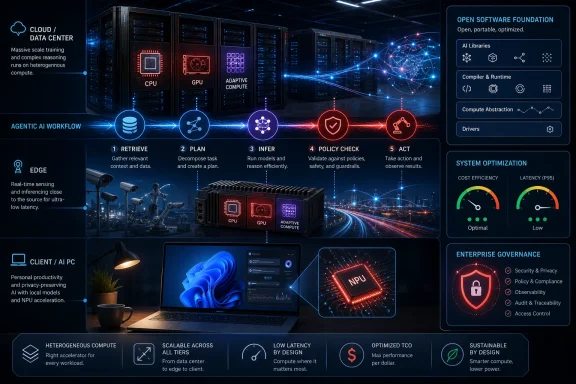
At RAISE Summit, AMD’s Mark Papermaster told SiliconANGLE’s theCUBE on July 8, 2026, that agentic AI is forcing enterprises beyond chip-by-chip thinking toward system-level infrastructure optimization across data-center clusters, edge deployments, and AI-enabled PCs, because end-to-end workloads now demand cooperating compute engines at scale. The message was not subtle: AMD wants to be judged less as a component supplier and more as an infrastructure architect. That is a convenient narrative for a company that has assembled CPUs, GPUs, adaptive compute, networking, systems design and software under one roof. It is also a useful warning for IT buyers: the next AI procurement mistake may not be buying the wrong accelerator, but placing the right accelerator in the wrong tier of the business.
Papermaster, chief technology officer and executive vice president of Advanced Micro Devices Inc., framed the shift in practical rather than theatrical terms. “The workloads are so complex because people are looking at what they do end to end. They’re looking at whole processes, not just one bespoke task,” he said in the interview with John Furrier, co-founder of SiliconANGLE. “That means you need different computing engines and they need to work together at scale. We’re talking across massive clusters of racks.”
That is the real story inside the RAISE Summit interview. The old AI-infrastructure conversation was dominated by benchmark slides, accelerator launches and the eternal question of who could feed the largest model the fastest. The new conversation is uglier, more operational and probably more important: where does each piece of an AI workflow run, what does it cost, how close must it be to the user or device, and can the same enterprise architecture stretch from a rack cluster to a Windows PC without collapsing into bespoke integration work?
Papermaster’s comments land at a moment when “agentic AI” has become the industry’s preferred shorthand for workloads that do not merely answer a prompt, but coordinate multiple steps, tools, models, data calls and policy checks. In that world, the unit of work is no longer a neat inference request sent to one accelerator. It can be a chain of retrieval, planning, model execution, validation, user interaction and sometimes local action.
That is why his language matters. He did not describe the future as one bigger GPU or one better CPU. He described “different computing engines” operating together “across massive clusters of racks,” then extended the same argument down to edge deployments and AI-enabled PCs. In AMD’s telling, the winning architecture is heterogeneous by design: CPU where control flow, compatibility and general-purpose execution matter; GPU where dense parallel math dominates; embedded neural processors where local AI needs power efficiency and responsiveness; adaptive or embedded compute where fixed-function or latency-sensitive workloads demand something more specialized.
This is also AMD’s answer to a market that has been conditioned to think of AI infrastructure through a single-vendor lens. Nvidia’s advantage has long been as much about the platform as the silicon: accelerators, networking, software libraries, developer gravity and deployment patterns that make the hardware feel like an operating environment. AMD cannot counter that merely by pointing to a competitive chip. It has to argue that enterprises are about to care more about portfolio breadth, openness, workload placement and economics than about any one benchmark.
SiliconANGLE’s framing of the interview is therefore useful but incomplete if read only as a vendor update. Yes, the piece reports AMD’s push toward “system-level AI infrastructure optimization.” But the deeper consequence is that AMD is trying to move the enterprise buyer’s evaluation criteria. If the question remains “which accelerator wins the model benchmark,” AMD fights on difficult terrain. If the question becomes “which architecture lets me run AI across data centers, edge sites and existing x86 estates without re-platforming everything,” AMD has a broader story to tell.
That distinction matters for WindowsForum readers because Windows fleets are increasingly part of the AI infrastructure map. A modern business PC is no longer just an endpoint that consumes cloud AI. On AMD’s preferred reading, it is one compute tier among several, potentially able to handle parts of a workflow locally using CPU, GPU and embedded neural processors while heavier work runs in a data center or cloud cluster.
The infrastructure problem is that each part of that chain has different compute characteristics. Retrieval and ranking may behave differently from text generation. Guardrails may need low-latency policy checks. User-facing interactions may require real-time response. Data-preparation steps may run better on CPUs. Large model inference may need GPUs. Some vision, audio, collaboration or automation tasks may be candidates for local acceleration on a PC or embedded device.
This is why the “run everything in one place” model begins to look expensive and brittle. A centralized cloud or large data center may still be the right place for heavy model serving, training, fleet-wide analytics and workloads that benefit from pooled accelerators. But it is not automatically the best place for every AI action. Latency, bandwidth, privacy, resilience and cost all pull parts of the workload outward.
Papermaster made that economic argument directly. “Most enterprises — that’s very expensive if you run everything in the cloud or a big data center,” he said. “They’re looking to run that more economically, and often at the edge it has to be done locally because you need real-time response. We’ve done that for not only our CPU and GPU, but the embedded neural processors that we have on the PCs, and also in the embedded edge.”
That sentence is the fulcrum of the interview. It connects the data-center AI boom to Windows AI PCs and embedded edge systems without pretending they are interchangeable. The question is no longer whether local AI will replace cloud AI. It will not. The question is whether enterprise IT can partition AI workflows intelligently enough that each layer does what it is economically and technically suited to do.
For IT pros, this means the AI architecture diagram starts to resemble a distributed-systems diagram. There are queues, policy boundaries, telemetry paths, model versions, latency budgets, failover requirements and device-capability checks. The glamorous part is the model. The durable work is deciding where each step runs and how to keep that decision from becoming hard-coded chaos.
Xilinx brought adaptive computing into the AMD story, including technologies aimed at specialized acceleration and intelligent edge use cases. Pensando added data-processing and networking capabilities that matter when AI infrastructure becomes a rack-scale and cluster-scale problem rather than a single-card problem. ZT Systems, as AMD has described in its own materials, adds AI systems expertise tied to hyperscale infrastructure design. Put together, those assets let AMD talk credibly about more than “our GPU goes fast.”
The important word is system. At rack scale, the accelerator is only one constraint. Power delivery, thermals, memory behavior, networking, storage, orchestration, serviceability and software maturity can be just as decisive. A cluster that performs well in a lab but is difficult to deploy, monitor, upgrade or subdivide for enterprise workloads is not a platform; it is a science project with a purchase order attached.
That is where AMD’s acquisition story intersects with ROCm, the company’s unified software stack. AMD’s official ROCm material describes it as an open software stack with drivers, development tools and APIs for GPU programming, and the company presents it as a foundation for AI and high-performance computing workloads. SiliconANGLE’s RAISE Summit report goes further in the enterprise framing: ROCm runs across large data center clusters, edge deployments and AI-enabled PCs, giving customers a path to route workloads to a cost-efficient compute tier without replacing existing x86 infrastructure.
That last clause is doing heavy lifting. “Without replacing existing x86 infrastructure” is the kind of phrase that appeals to enterprise buyers because infrastructure continuity is often more valuable than theoretical elegance. Most organizations do not get to build AI estates from scratch. They have Windows fleets, virtualization investments, identity systems, endpoint-management tools, existing data centers, existing procurement rules and existing operational scars.
AMD’s pitch is that heterogeneous AI should not require abandoning that world. It should extend it. That is a stronger argument than “buy our accelerator,” but it is also a harder promise to keep. Once a vendor claims to optimize across clusters, edge devices and PCs, it inherits a messier set of expectations: driver maturity, framework compatibility, telemetry, lifecycle management, developer experience, security boundaries and predictable support matrices.
The RAISE Summit report describes ROCm as a unified stack that runs identically across large data center clusters, edge deployments and AI-enabled PCs. Read charitably, that is the architecture enterprises want: one programming and deployment model that lets them move workloads or components across tiers as economics and latency dictate. Read skeptically, it is the hardest part of the promise, because “runs identically” in enterprise IT must survive real hardware variation, driver versions, operating-system differences, security policy and application dependencies.
The official AMD ROCm messaging emphasizes openness and support for widely used AI frameworks. That matters because software lock-in is one of the biggest strategic concerns in AI procurement. Enterprises do not merely buy accelerators; they buy into ecosystems of model runtimes, libraries, monitoring tools, orchestration layers and developer habits. If a workload is deeply tied to one vendor’s software assumptions, the hardware decision becomes sticky long after the initial business case expires.
ROCm is AMD’s attempt to make its hardware viable inside the AI software mainstream rather than adjacent to it. But for Windows users and admins, the nuance is important. ROCm’s strongest historical center of gravity has been in Linux-heavy data-center and developer environments, while Windows AI PCs are also shaped by Microsoft’s own Windows AI APIs, Copilot+ PC requirements, NPUs and app frameworks. The enterprise reality may therefore be less “one stack everywhere” than “one AMD strategy mapped onto multiple software surfaces.”
That does not invalidate AMD’s argument. It simply makes the operational question more precise. If a company wants to run a model-serving workload on an AMD GPU cluster, a smaller inference service at the edge and AI-assisted features on Windows PCs, IT must understand which layers are ROCm, which are Windows platform APIs, which are application-specific, and which are vendor tooling wrapped around the whole estate. A unified story is not the same thing as a uniform deployment.
This is where vendors tend to over-simplify and admins get burned. A slide can show data center, edge and PC as three dots connected by a clean arrow. A deployment team has to deal with image management, patch timing, firmware, drivers, endpoint security tools, device capability detection, model update cadence and audit requirements. The more AI becomes distributed, the more those mundane disciplines determine whether the architecture works.
The risk is that buyers treat the AI PC as a branding category rather than an infrastructure component. A PC with an NPU is not automatically a useful AI endpoint for every enterprise workflow. It is useful when the workload is designed to use local acceleration, when the model or feature fits within local resource limits, when the user experience benefits from lower latency or offline operation, and when privacy or bandwidth considerations justify doing the work on-device.
That is why Papermaster’s economic point matters. Local execution is not inherently cheaper if it creates support complexity, drains batteries, fragments application behavior or forces developers to maintain too many execution paths. But cloud execution is not inherently better if it turns every small AI feature into recurring inference spend and network dependency. The right answer is workload placement, not ideology.
For Windows admins, this changes procurement conversations. The old endpoint checklist emphasized CPU generation, memory, storage, security features, manageability and warranty terms. The AI-era checklist adds NPU capability, GPU capability, driver support, software-framework support, application roadmaps and whether business workflows will actually use local acceleration. Buying AI PCs before the software plan exists can be as wasteful as buying GPUs before the model-serving plan exists.
There is also a governance angle. If AI execution moves onto endpoints, organizations need policies for what data can be processed locally, how local models are updated, whether outputs are logged, how sensitive prompts are handled and what happens when a device is offline. The Windows PC becomes not only a client but a semi-autonomous compute location inside the enterprise trust boundary.
AMD’s advantage here is the continuity of x86. Its pitch implicitly says: you can add AI capability to the PC estate without moving away from the compatibility assumptions that made Windows enterprise computing durable. That is a powerful message. But it should not lull IT into thinking AI endpoint management is just another hardware refresh. The hardware may fit the existing estate; the workload behavior may not.
When Papermaster says that “often at the edge it has to be done locally because you need real-time response,” he is stating a constraint that cloud-first AI narratives sometimes flatten. Some decisions cannot wait for a round trip to a centralized cluster. Some data is too sensitive, too voluminous or too operationally local to ship continuously. Some environments cannot depend on perfect connectivity.
This is where heterogeneous computing becomes more than a vendor architecture diagram. An edge AI system may need CPU control, GPU acceleration, embedded inference, sensor processing, networking and security in a constrained power and thermal envelope. It may also have to operate for long periods under conservative patching policies because the cost of downtime is physical, not just digital.
AMD’s Xilinx and embedded-edge assets are relevant here, as is the broader push toward adaptive compute. But again, the practical burden lands on integration. Enterprises do not need edge AI that is impressive in isolation; they need edge AI that can be deployed, updated, monitored and governed across sites. A model running locally in one facility is a demo. A fleet of local models with version control, rollback, observability and security policy is infrastructure.
This is also where Windows may play a quieter but real role. Not every edge deployment is a rugged Linux appliance. Many branch, industrial and business environments include Windows PCs, Windows-based control stations, Windows IoT systems or Windows-managed endpoints participating in local workflows. If AMD’s CPU, GPU and embedded neural processor story can meet those environments where they already are, it becomes more than a data-center challenge to Nvidia. It becomes a distributed enterprise-compute play.
The edge also sharpens the cost argument. Cloud AI bills are visible and recurring, but edge complexity has its own hidden costs: site visits, hardware failures, inconsistent environments, local storage, physical security and lifecycle drift. The correct financial model must compare total operating cost, not just inference cost. Papermaster is right that running everything centrally can be expensive. It is also true that distributing AI badly can make the savings disappear.
If AI workloads are simple, the fastest chip wins more often. If AI workloads become multi-stage, distributed and policy-heavy, the platform that makes workload placement manageable gains power. That platform may be a vendor stack, a cloud provider layer, an open-source orchestration framework, a Windows developer surface, or more likely some uncomfortable blend of all of them.
AMD’s system-level argument is therefore both offensive and defensive. Offensively, it lets AMD claim relevance across the whole AI estate: data-center clusters, edge systems and PCs. Defensively, it reduces dependence on any single product comparison. A buyer may not believe AMD has the dominant AI accelerator ecosystem everywhere, but may still value a supplier that can speak to x86 continuity, heterogeneous compute and cost-aware placement.
For enterprise IT, the danger is vendor abstraction. Every vendor now says “open,” “full stack,” “optimized,” “scalable” and “edge to cloud.” Those words mean little until translated into deployment artifacts: supported operating systems, tested frameworks, reference architectures, management integrations, security documentation, driver cadence, rollback procedures and measurable cost models. A system-level pitch is useful only if the system can be operated.
The same skepticism should apply to the phrase “agentic.” If an application vendor claims an agent can automate a business process, IT should ask what compute resources it requires at each step, where data flows, what happens when a local accelerator is unavailable, how failures are detected, and whether the workflow can be constrained by policy. Agentic AI increases the importance of infrastructure design because it increases the number of places where infrastructure can fail quietly.
This is why Papermaster’s “whole processes” comment deserves attention. It points to a future in which AI is embedded in business operations rather than parked beside them. Once that happens, AI infrastructure becomes part of process reliability. If the model-serving tier is slow, the process is slow. If the local device lacks the right accelerator, the user experience changes. If the edge system cannot respond in real time, the business outcome changes.
Vendor-executive summit interviews are not adversarial investigations. They are structured opportunities for companies to articulate strategy to a targeted audience. SiliconANGLE and theCUBE have a large technology-media footprint, with the source material citing 15M+ viewers of theCUBE videos, 11.4k+ theCUBE alumni, more than 11,400 tech and business leaders in the alumni network, and reach across 15+ million elite tech professionals. The company also promotes theCUBE AI Video Cloud and theCUBEai.com neural network as part of its audience-interaction and decision-support ecosystem.
That media context matters because AMD’s message is designed for exactly that audience: enterprise technologists, cloud strategists, infrastructure buyers and executives deciding how to spend into the AI cycle. Papermaster was not speaking to hobbyists wondering whether to run a local model on a spare GPU. He was speaking to the people who must decide whether AI becomes a centralized services bill, a data-center buildout, a PC refresh strategy, an edge modernization program or all of the above.
The strongest reading of the interview is that AMD is trying to make those categories inseparable. If AI is a whole-process technology, then infrastructure must span the whole process. That is a persuasive argument, but it is also one that benefits a company with assets across the span. Readers should treat the thesis seriously without mistaking it for neutral industry law.
This is the difference between useful vendor strategy and pure marketing. Marketing says AMD can do everything. Strategy says AMD sees the AI market moving from component selection to system design and has shaped its portfolio accordingly. IT buyers can use that insight even while demanding proof at the level of their own workloads.
This table is simple, but the underlying decision is not. Most real enterprise workflows will use more than one tier. A support agent’s Windows PC may handle local summarization or transcription while a back-end service performs retrieval and a data-center model handles complex generation. A retail edge device may classify local video or sensor events, then send only selected metadata to a central system. A developer workstation may run smaller local models for iteration while training or large-scale inference stays in a cluster.
That hybrid reality makes procurement harder. It is no longer enough for separate teams to buy endpoints, servers and edge devices independently. AI forces coordination across endpoint management, data-center architecture, security, application development and finance. The budget holder who optimizes only one tier may push cost or complexity into another.
AMD’s “without replacing existing x86 infrastructure” message is attractive precisely because replacement is the most expensive way to modernize. But extension still requires discipline. Existing x86 infrastructure can become a strength if it gives organizations compatibility and management continuity. It can become a weakness if teams assume old deployment habits are enough for distributed AI.
The right comparison, then, is workload-by-workload. Which steps require real-time response? Which can tolerate latency? Which involve sensitive data? Which are GPU-bound? Which are better suited to an NPU? Which need central logging? Which must work offline? Which are worth accelerating locally, and which are not worth the support burden?
Its second strong claim is that x86 continuity matters. Enterprises do not casually abandon infrastructure foundations, and Windows estates remain central to business computing. If AI can be introduced as an extension of existing PC and server assumptions rather than a clean-sheet replacement, adoption becomes easier to justify.
The third strength is portfolio logic. Xilinx, Pensando and ZT Systems fit the story AMD is telling: adaptive compute, data-center networking and systems-level expertise around AI infrastructure. These are not random additions when the company’s thesis is that the rack, the edge and the endpoint all matter.
The proof burden sits in software and operations. ROCm has to keep improving not just as a developer toolkit, but as a platform enterprises trust for production AI. AMD’s PC-side AI story has to align with Windows realities, not merely with silicon capabilities. Edge deployments have to be manageable at fleet scale. And the company has to show that “system-level optimization” produces measurable gains in cost, latency, utilization or resilience for real workloads.
There is also a messaging challenge. A broad platform story can become vague quickly. If AMD says it optimizes across everything, buyers will ask for reference designs that map to their actual environments. If it says ROCm unifies the stack, buyers will ask where that unity starts and ends. If it says local AI reduces cost, finance teams will ask whether endpoint refreshes and management overhead have been counted.
That is healthy. The AI infrastructure market has had enough magic. The next phase should be boring in the best possible way: measured, instrumented, governed and tied to business-process outcomes rather than accelerator mythology.
That does not mean every Windows refresh must become an AI refresh. It means every Windows refresh now needs an AI-aware justification. If your organization expects to use local transcription, translation, summarization, image processing, automation, developer tools or line-of-business AI features, then NPU and GPU capability may affect user experience and support lifespan. If your organization’s AI strategy is entirely browser- and cloud-based, the endpoint requirements may be different.
Admins should resist both extremes. The first extreme is dismissing AI PCs as branding fluff because today’s must-have local workloads remain uneven. The second is buying the label without knowing what software will use the hardware. The better approach is to segment the fleet: developers, analysts, field workers, executives, contact-center staff, creative teams and regulated users may have different local-AI needs.
Windows management also becomes more important, not less. If local AI features process business data, endpoint security policy matters. If drivers unlock or break acceleration, update rings matter. If model components are delivered through applications or platform updates, change management matters. If users experience different AI behavior on different classes of PC, help-desk documentation matters.
AMD’s x86 story is comforting because it suggests continuity. But continuity is not passivity. The organizations that benefit most from AI PCs will be those that treat them as part of a governed distributed-compute strategy, not as a perk in a hardware catalog.
AI economics change as usage scales. A proof of concept can hide behind a small cloud bill or a shared GPU pool. A production workflow used by thousands of employees, customers or devices cannot. Every prompt, retrieval call, generated response, image operation, tool invocation and validation step becomes part of a recurring cost structure.
That does not automatically make local execution cheaper. Local hardware has capital cost, depreciation, power, support and management overhead. Edge sites have maintenance burdens. Data centers have utilization challenges. Cloud services have elasticity and operational simplicity but can become expensive at volume. The architecture is the economics because the placement of each workload determines which cost model applies.
This is where system-level optimization becomes a real discipline rather than a slogan. An enterprise may choose to run latency-sensitive inference at the edge, batch analytics centrally, user-facing small-model features on PCs and large-model reasoning in a data-center cluster. Another may decide that operational simplicity justifies more centralization. The answer depends on workload shape, compliance, geography, staff skill and user expectations.
AMD’s opportunity is to provide hardware and software that make those choices less binary. Its challenge is that enterprises will demand evidence, not just optionality. A platform that can run everywhere is valuable only if it helps decide where things should run.
Papermaster, chief technology officer and executive vice president of Advanced Micro Devices Inc., framed the shift in practical rather than theatrical terms. “The workloads are so complex because people are looking at what they do end to end. They’re looking at whole processes, not just one bespoke task,” he said in the interview with John Furrier, co-founder of SiliconANGLE. “That means you need different computing engines and they need to work together at scale. We’re talking across massive clusters of racks.”
That is the real story inside the RAISE Summit interview. The old AI-infrastructure conversation was dominated by benchmark slides, accelerator launches and the eternal question of who could feed the largest model the fastest. The new conversation is uglier, more operational and probably more important: where does each piece of an AI workflow run, what does it cost, how close must it be to the user or device, and can the same enterprise architecture stretch from a rack cluster to a Windows PC without collapsing into bespoke integration work?
 AMD Is Selling a System Argument, Not Just a Faster Chip
Papermaster’s comments land at a moment when “agentic AI” has become the industry’s preferred shorthand for workloads that do not merely answer a prompt, but coordinate multiple steps, tools, models, data calls and policy checks. In that world, the unit of work is no longer a neat inference request sent to one accelerator. It can be a chain of retrieval, planning, model execution, validation, user interaction and sometimes local action.That is why his language matters. He did not describe the future as one bigger GPU or one better CPU. He described “different computing engines” operating together “across massive clusters of racks,” then extended the same argument down to edge deployments and AI-enabled PCs. In AMD’s telling, the winning architecture is heterogeneous by design: CPU where control flow, compatibility and general-purpose execution matter; GPU where dense parallel math dominates; embedded neural processors where local AI needs power efficiency and responsiveness; adaptive or embedded compute where fixed-function or latency-sensitive workloads demand something more specialized.
This is also AMD’s answer to a market that has been conditioned to think of AI infrastructure through a single-vendor lens. Nvidia’s advantage has long been as much about the platform as the silicon: accelerators, networking, software libraries, developer gravity and deployment patterns that make the hardware feel like an operating environment. AMD cannot counter that merely by pointing to a competitive chip. It has to argue that enterprises are about to care more about portfolio breadth, openness, workload placement and economics than about any one benchmark.
SiliconANGLE’s framing of the interview is therefore useful but incomplete if read only as a vendor update. Yes, the piece reports AMD’s push toward “system-level AI infrastructure optimization.” But the deeper consequence is that AMD is trying to move the enterprise buyer’s evaluation criteria. If the question remains “which accelerator wins the model benchmark,” AMD fights on difficult terrain. If the question becomes “which architecture lets me run AI across data centers, edge sites and existing x86 estates without re-platforming everything,” AMD has a broader story to tell.
That distinction matters for WindowsForum readers because Windows fleets are increasingly part of the AI infrastructure map. A modern business PC is no longer just an endpoint that consumes cloud AI. On AMD’s preferred reading, it is one compute tier among several, potentially able to handle parts of a workflow locally using CPU, GPU and embedded neural processors while heavier work runs in a data center or cloud cluster.
Agentic Workloads Break the Old Inference Mental Model
The phrase “agentic AI” is easy to dismiss as another marketing layer over automation. Papermaster’s explanation is more grounded: people are no longer optimizing one “bespoke task,” they are looking at “whole processes.” That is a useful dividing line. A chatbot answering a question is an application. A workflow that reads a ticket, consults documentation, checks customer status, drafts a response, invokes a tool, logs the action and escalates edge cases is infrastructure.The infrastructure problem is that each part of that chain has different compute characteristics. Retrieval and ranking may behave differently from text generation. Guardrails may need low-latency policy checks. User-facing interactions may require real-time response. Data-preparation steps may run better on CPUs. Large model inference may need GPUs. Some vision, audio, collaboration or automation tasks may be candidates for local acceleration on a PC or embedded device.
This is why the “run everything in one place” model begins to look expensive and brittle. A centralized cloud or large data center may still be the right place for heavy model serving, training, fleet-wide analytics and workloads that benefit from pooled accelerators. But it is not automatically the best place for every AI action. Latency, bandwidth, privacy, resilience and cost all pull parts of the workload outward.
Papermaster made that economic argument directly. “Most enterprises — that’s very expensive if you run everything in the cloud or a big data center,” he said. “They’re looking to run that more economically, and often at the edge it has to be done locally because you need real-time response. We’ve done that for not only our CPU and GPU, but the embedded neural processors that we have on the PCs, and also in the embedded edge.”
That sentence is the fulcrum of the interview. It connects the data-center AI boom to Windows AI PCs and embedded edge systems without pretending they are interchangeable. The question is no longer whether local AI will replace cloud AI. It will not. The question is whether enterprise IT can partition AI workflows intelligently enough that each layer does what it is economically and technically suited to do.
For IT pros, this means the AI architecture diagram starts to resemble a distributed-systems diagram. There are queues, policy boundaries, telemetry paths, model versions, latency budgets, failover requirements and device-capability checks. The glamorous part is the model. The durable work is deciding where each step runs and how to keep that decision from becoming hard-coded chaos.
The Acquisitions Explain the Pitch
AMD’s RAISE Summit argument makes more sense when viewed through its portfolio expansion. SiliconANGLE notes that AMD expanded through acquisitions of Xilinx, Pensando and ZT Systems. That is not just corporate history; it is the architecture AMD is now trying to sell.Xilinx brought adaptive computing into the AMD story, including technologies aimed at specialized acceleration and intelligent edge use cases. Pensando added data-processing and networking capabilities that matter when AI infrastructure becomes a rack-scale and cluster-scale problem rather than a single-card problem. ZT Systems, as AMD has described in its own materials, adds AI systems expertise tied to hyperscale infrastructure design. Put together, those assets let AMD talk credibly about more than “our GPU goes fast.”
The important word is system. At rack scale, the accelerator is only one constraint. Power delivery, thermals, memory behavior, networking, storage, orchestration, serviceability and software maturity can be just as decisive. A cluster that performs well in a lab but is difficult to deploy, monitor, upgrade or subdivide for enterprise workloads is not a platform; it is a science project with a purchase order attached.
That is where AMD’s acquisition story intersects with ROCm, the company’s unified software stack. AMD’s official ROCm material describes it as an open software stack with drivers, development tools and APIs for GPU programming, and the company presents it as a foundation for AI and high-performance computing workloads. SiliconANGLE’s RAISE Summit report goes further in the enterprise framing: ROCm runs across large data center clusters, edge deployments and AI-enabled PCs, giving customers a path to route workloads to a cost-efficient compute tier without replacing existing x86 infrastructure.
That last clause is doing heavy lifting. “Without replacing existing x86 infrastructure” is the kind of phrase that appeals to enterprise buyers because infrastructure continuity is often more valuable than theoretical elegance. Most organizations do not get to build AI estates from scratch. They have Windows fleets, virtualization investments, identity systems, endpoint-management tools, existing data centers, existing procurement rules and existing operational scars.
AMD’s pitch is that heterogeneous AI should not require abandoning that world. It should extend it. That is a stronger argument than “buy our accelerator,” but it is also a harder promise to keep. Once a vendor claims to optimize across clusters, edge devices and PCs, it inherits a messier set of expectations: driver maturity, framework compatibility, telemetry, lifecycle management, developer experience, security boundaries and predictable support matrices.
ROCm Becomes the Load-Bearing Layer
In any AMD AI story, ROCm is no longer a side note. It is the layer that determines whether AMD’s hardware portfolio feels like a coherent platform or a set of individually interesting parts. Hardware breadth without software consistency becomes an integration tax; software ambition without hardware breadth becomes a developer experiment. AMD needs both.The RAISE Summit report describes ROCm as a unified stack that runs identically across large data center clusters, edge deployments and AI-enabled PCs. Read charitably, that is the architecture enterprises want: one programming and deployment model that lets them move workloads or components across tiers as economics and latency dictate. Read skeptically, it is the hardest part of the promise, because “runs identically” in enterprise IT must survive real hardware variation, driver versions, operating-system differences, security policy and application dependencies.
The official AMD ROCm messaging emphasizes openness and support for widely used AI frameworks. That matters because software lock-in is one of the biggest strategic concerns in AI procurement. Enterprises do not merely buy accelerators; they buy into ecosystems of model runtimes, libraries, monitoring tools, orchestration layers and developer habits. If a workload is deeply tied to one vendor’s software assumptions, the hardware decision becomes sticky long after the initial business case expires.
ROCm is AMD’s attempt to make its hardware viable inside the AI software mainstream rather than adjacent to it. But for Windows users and admins, the nuance is important. ROCm’s strongest historical center of gravity has been in Linux-heavy data-center and developer environments, while Windows AI PCs are also shaped by Microsoft’s own Windows AI APIs, Copilot+ PC requirements, NPUs and app frameworks. The enterprise reality may therefore be less “one stack everywhere” than “one AMD strategy mapped onto multiple software surfaces.”
That does not invalidate AMD’s argument. It simply makes the operational question more precise. If a company wants to run a model-serving workload on an AMD GPU cluster, a smaller inference service at the edge and AI-assisted features on Windows PCs, IT must understand which layers are ROCm, which are Windows platform APIs, which are application-specific, and which are vendor tooling wrapped around the whole estate. A unified story is not the same thing as a uniform deployment.
This is where vendors tend to over-simplify and admins get burned. A slide can show data center, edge and PC as three dots connected by a clean arrow. A deployment team has to deal with image management, patch timing, firmware, drivers, endpoint security tools, device capability detection, model update cadence and audit requirements. The more AI becomes distributed, the more those mundane disciplines determine whether the architecture works.
The AI PC Is a Compute Tier, Not a Magic Box
Papermaster’s reference to embedded neural processors on PCs is notable because it puts the Windows endpoint into the same strategic discussion as the data center. Microsoft’s Copilot+ PC positioning has already trained the market to associate modern Windows AI experiences with NPUs. AMD’s Ryzen AI messaging similarly emphasizes systems that include CPU, GPU and a neural processing unit for AI tasks.The risk is that buyers treat the AI PC as a branding category rather than an infrastructure component. A PC with an NPU is not automatically a useful AI endpoint for every enterprise workflow. It is useful when the workload is designed to use local acceleration, when the model or feature fits within local resource limits, when the user experience benefits from lower latency or offline operation, and when privacy or bandwidth considerations justify doing the work on-device.
That is why Papermaster’s economic point matters. Local execution is not inherently cheaper if it creates support complexity, drains batteries, fragments application behavior or forces developers to maintain too many execution paths. But cloud execution is not inherently better if it turns every small AI feature into recurring inference spend and network dependency. The right answer is workload placement, not ideology.
For Windows admins, this changes procurement conversations. The old endpoint checklist emphasized CPU generation, memory, storage, security features, manageability and warranty terms. The AI-era checklist adds NPU capability, GPU capability, driver support, software-framework support, application roadmaps and whether business workflows will actually use local acceleration. Buying AI PCs before the software plan exists can be as wasteful as buying GPUs before the model-serving plan exists.
There is also a governance angle. If AI execution moves onto endpoints, organizations need policies for what data can be processed locally, how local models are updated, whether outputs are logged, how sensitive prompts are handled and what happens when a device is offline. The Windows PC becomes not only a client but a semi-autonomous compute location inside the enterprise trust boundary.
AMD’s advantage here is the continuity of x86. Its pitch implicitly says: you can add AI capability to the PC estate without moving away from the compatibility assumptions that made Windows enterprise computing durable. That is a powerful message. But it should not lull IT into thinking AI endpoint management is just another hardware refresh. The hardware may fit the existing estate; the workload behavior may not.
The Edge Is Where Cost and Latency Stop Being Abstract
The edge is the least glamorous and often most consequential tier in Papermaster’s argument. Data centers get the biggest chips. PCs get the consumer branding. Edge deployments get the messy jobs: factories, retail sites, clinics, vehicles, cameras, industrial controllers, branch offices and field systems where latency, connectivity and local context matter.When Papermaster says that “often at the edge it has to be done locally because you need real-time response,” he is stating a constraint that cloud-first AI narratives sometimes flatten. Some decisions cannot wait for a round trip to a centralized cluster. Some data is too sensitive, too voluminous or too operationally local to ship continuously. Some environments cannot depend on perfect connectivity.
This is where heterogeneous computing becomes more than a vendor architecture diagram. An edge AI system may need CPU control, GPU acceleration, embedded inference, sensor processing, networking and security in a constrained power and thermal envelope. It may also have to operate for long periods under conservative patching policies because the cost of downtime is physical, not just digital.
AMD’s Xilinx and embedded-edge assets are relevant here, as is the broader push toward adaptive compute. But again, the practical burden lands on integration. Enterprises do not need edge AI that is impressive in isolation; they need edge AI that can be deployed, updated, monitored and governed across sites. A model running locally in one facility is a demo. A fleet of local models with version control, rollback, observability and security policy is infrastructure.
This is also where Windows may play a quieter but real role. Not every edge deployment is a rugged Linux appliance. Many branch, industrial and business environments include Windows PCs, Windows-based control stations, Windows IoT systems or Windows-managed endpoints participating in local workflows. If AMD’s CPU, GPU and embedded neural processor story can meet those environments where they already are, it becomes more than a data-center challenge to Nvidia. It becomes a distributed enterprise-compute play.
The edge also sharpens the cost argument. Cloud AI bills are visible and recurring, but edge complexity has its own hidden costs: site visits, hardware failures, inconsistent environments, local storage, physical security and lifecycle drift. The correct financial model must compare total operating cost, not just inference cost. Papermaster is right that running everything centrally can be expensive. It is also true that distributing AI badly can make the savings disappear.
The Real Competition Is for the Control Plane
It is tempting to frame AMD’s comments as another round in the AMD-versus-Nvidia accelerator contest. That framing is too narrow. The deeper fight is for the AI infrastructure control plane: the software, orchestration, management and deployment patterns that decide where workloads run and how hardware is consumed.If AI workloads are simple, the fastest chip wins more often. If AI workloads become multi-stage, distributed and policy-heavy, the platform that makes workload placement manageable gains power. That platform may be a vendor stack, a cloud provider layer, an open-source orchestration framework, a Windows developer surface, or more likely some uncomfortable blend of all of them.
AMD’s system-level argument is therefore both offensive and defensive. Offensively, it lets AMD claim relevance across the whole AI estate: data-center clusters, edge systems and PCs. Defensively, it reduces dependence on any single product comparison. A buyer may not believe AMD has the dominant AI accelerator ecosystem everywhere, but may still value a supplier that can speak to x86 continuity, heterogeneous compute and cost-aware placement.
For enterprise IT, the danger is vendor abstraction. Every vendor now says “open,” “full stack,” “optimized,” “scalable” and “edge to cloud.” Those words mean little until translated into deployment artifacts: supported operating systems, tested frameworks, reference architectures, management integrations, security documentation, driver cadence, rollback procedures and measurable cost models. A system-level pitch is useful only if the system can be operated.
The same skepticism should apply to the phrase “agentic.” If an application vendor claims an agent can automate a business process, IT should ask what compute resources it requires at each step, where data flows, what happens when a local accelerator is unavailable, how failures are detected, and whether the workflow can be constrained by policy. Agentic AI increases the importance of infrastructure design because it increases the number of places where infrastructure can fail quietly.
This is why Papermaster’s “whole processes” comment deserves attention. It points to a future in which AI is embedded in business operations rather than parked beside them. Once that happens, AI infrastructure becomes part of process reliability. If the model-serving tier is slow, the process is slow. If the local device lacks the right accelerator, the user experience changes. If the edge system cannot respond in real time, the business outcome changes.
The Disclosure Matters Because the Story Is Also Platform Theater
SiliconANGLE’s article includes an important disclosure: theCUBE is a paid media partner for the RAISE Summit event, while Solidigm, the headline sponsor of theCUBE’s event coverage, and other sponsors are described as having no editorial control over theCUBE or SiliconANGLE content. That does not invalidate the interview. It does require readers to understand the format.Vendor-executive summit interviews are not adversarial investigations. They are structured opportunities for companies to articulate strategy to a targeted audience. SiliconANGLE and theCUBE have a large technology-media footprint, with the source material citing 15M+ viewers of theCUBE videos, 11.4k+ theCUBE alumni, more than 11,400 tech and business leaders in the alumni network, and reach across 15+ million elite tech professionals. The company also promotes theCUBE AI Video Cloud and theCUBEai.com neural network as part of its audience-interaction and decision-support ecosystem.
That media context matters because AMD’s message is designed for exactly that audience: enterprise technologists, cloud strategists, infrastructure buyers and executives deciding how to spend into the AI cycle. Papermaster was not speaking to hobbyists wondering whether to run a local model on a spare GPU. He was speaking to the people who must decide whether AI becomes a centralized services bill, a data-center buildout, a PC refresh strategy, an edge modernization program or all of the above.
The strongest reading of the interview is that AMD is trying to make those categories inseparable. If AI is a whole-process technology, then infrastructure must span the whole process. That is a persuasive argument, but it is also one that benefits a company with assets across the span. Readers should treat the thesis seriously without mistaking it for neutral industry law.
This is the difference between useful vendor strategy and pure marketing. Marketing says AMD can do everything. Strategy says AMD sees the AI market moving from component selection to system design and has shaped its portfolio accordingly. IT buyers can use that insight even while demanding proof at the level of their own workloads.
What Enterprises Should Actually Compare
The comparison that matters is not cloud versus edge versus PC as rival camps. It is what each tier is good for, where it becomes expensive, and what operational questions follow. Papermaster’s comments are valuable because they push the conversation toward that mapping.| Compute tier | Best fit in AMD’s argument | Economic pressure | Operational risk | WindowsForum relevance |
|---|---|---|---|---|
| Large data-center clusters | Heavy AI workloads across massive racks | Expensive if everything is centralized | Power, networking, scheduling and software-stack maturity | Back-end services used by Windows apps and enterprise workflows |
| Edge deployments | Local AI where real-time response is required | Cloud round trips and bandwidth can be inefficient | Fleet management, physical sites and update control | Branch, industrial and Windows-adjacent operational systems |
| AI-enabled PCs | Local acceleration using CPU, GPU and embedded neural processors | Avoids sending every small task to cloud inference | Hardware fragmentation, drivers and app support | Windows AI PCs, Copilot+ class devices and endpoint policy |
That hybrid reality makes procurement harder. It is no longer enough for separate teams to buy endpoints, servers and edge devices independently. AI forces coordination across endpoint management, data-center architecture, security, application development and finance. The budget holder who optimizes only one tier may push cost or complexity into another.
AMD’s “without replacing existing x86 infrastructure” message is attractive precisely because replacement is the most expensive way to modernize. But extension still requires discipline. Existing x86 infrastructure can become a strength if it gives organizations compatibility and management continuity. It can become a weakness if teams assume old deployment habits are enough for distributed AI.
The right comparison, then, is workload-by-workload. Which steps require real-time response? Which can tolerate latency? Which involve sensitive data? Which are GPU-bound? Which are better suited to an NPU? Which need central logging? Which must work offline? Which are worth accelerating locally, and which are not worth the support burden?
Action checklist for admins
- Inventory where AI features are already running: cloud services, data-center workloads, edge systems, Windows apps and local PC features.
- Map each planned AI workflow into steps, then assign latency, privacy, cost and hardware requirements to each step before buying infrastructure.
- Treat AI PCs as managed compute endpoints: track NPU/GPU capability, driver versions, firmware, app support and policy settings.
- Validate ROCm or AMD software-stack assumptions against the actual operating systems, frameworks and hardware in your environment.
- Require vendors to document fallback behavior when a local accelerator, edge node or cluster resource is unavailable.
- Build a cost model that includes cloud inference, data transfer, endpoint refreshes, edge maintenance, admin labor and support complexity.
Where AMD’s Argument Is Strong — and Where It Still Has to Prove It
AMD’s strongest claim is that AI infrastructure is becoming heterogeneous by necessity. That is difficult to dispute. Agentic and process-oriented workloads naturally splinter across task types, latency needs and cost profiles. No serious enterprise architecture will run every AI operation in the same place forever.Its second strong claim is that x86 continuity matters. Enterprises do not casually abandon infrastructure foundations, and Windows estates remain central to business computing. If AI can be introduced as an extension of existing PC and server assumptions rather than a clean-sheet replacement, adoption becomes easier to justify.
The third strength is portfolio logic. Xilinx, Pensando and ZT Systems fit the story AMD is telling: adaptive compute, data-center networking and systems-level expertise around AI infrastructure. These are not random additions when the company’s thesis is that the rack, the edge and the endpoint all matter.
The proof burden sits in software and operations. ROCm has to keep improving not just as a developer toolkit, but as a platform enterprises trust for production AI. AMD’s PC-side AI story has to align with Windows realities, not merely with silicon capabilities. Edge deployments have to be manageable at fleet scale. And the company has to show that “system-level optimization” produces measurable gains in cost, latency, utilization or resilience for real workloads.
There is also a messaging challenge. A broad platform story can become vague quickly. If AMD says it optimizes across everything, buyers will ask for reference designs that map to their actual environments. If it says ROCm unifies the stack, buyers will ask where that unity starts and ends. If it says local AI reduces cost, finance teams will ask whether endpoint refreshes and management overhead have been counted.
That is healthy. The AI infrastructure market has had enough magic. The next phase should be boring in the best possible way: measured, instrumented, governed and tied to business-process outcomes rather than accelerator mythology.
The Practical Read for Windows Shops
For Windows-heavy organizations, the RAISE Summit interview should be read as part of a larger shift: the endpoint is being pulled into the AI architecture. Microsoft’s Copilot+ PC push already made the NPU a mainstream procurement term. AMD’s comments place that NPU alongside CPUs, GPUs, edge processors and data-center clusters as part of a workload-placement continuum.That does not mean every Windows refresh must become an AI refresh. It means every Windows refresh now needs an AI-aware justification. If your organization expects to use local transcription, translation, summarization, image processing, automation, developer tools or line-of-business AI features, then NPU and GPU capability may affect user experience and support lifespan. If your organization’s AI strategy is entirely browser- and cloud-based, the endpoint requirements may be different.
Admins should resist both extremes. The first extreme is dismissing AI PCs as branding fluff because today’s must-have local workloads remain uneven. The second is buying the label without knowing what software will use the hardware. The better approach is to segment the fleet: developers, analysts, field workers, executives, contact-center staff, creative teams and regulated users may have different local-AI needs.
Windows management also becomes more important, not less. If local AI features process business data, endpoint security policy matters. If drivers unlock or break acceleration, update rings matter. If model components are delivered through applications or platform updates, change management matters. If users experience different AI behavior on different classes of PC, help-desk documentation matters.
AMD’s x86 story is comforting because it suggests continuity. But continuity is not passivity. The organizations that benefit most from AI PCs will be those that treat them as part of a governed distributed-compute strategy, not as a perk in a hardware catalog.
The Economics Are the Architecture
Papermaster’s most important contribution in the SiliconANGLE interview may be the least flashy one: cost. “Most enterprises — that’s very expensive if you run everything in the cloud or a big data center,” he said. The line cuts through the hype because it points to the budgetary wall many AI pilots hit when they become production systems.AI economics change as usage scales. A proof of concept can hide behind a small cloud bill or a shared GPU pool. A production workflow used by thousands of employees, customers or devices cannot. Every prompt, retrieval call, generated response, image operation, tool invocation and validation step becomes part of a recurring cost structure.
That does not automatically make local execution cheaper. Local hardware has capital cost, depreciation, power, support and management overhead. Edge sites have maintenance burdens. Data centers have utilization challenges. Cloud services have elasticity and operational simplicity but can become expensive at volume. The architecture is the economics because the placement of each workload determines which cost model applies.
This is where system-level optimization becomes a real discipline rather than a slogan. An enterprise may choose to run latency-sensitive inference at the edge, batch analytics centrally, user-facing small-model features on PCs and large-model reasoning in a data-center cluster. Another may decide that operational simplicity justifies more centralization. The answer depends on workload shape, compliance, geography, staff skill and user expectations.
AMD’s opportunity is to provide hardware and software that make those choices less binary. Its challenge is that enterprises will demand evidence, not just optionality. A platform that can run everywhere is valuable only if it helps decide where things should run.
The Signal Beneath the Summit Noise
The useful lesson from AMD’s RAISE Summit appearance is not that every enterprise should standardize on AMD for AI. It is that AI infrastructure planning has moved beyond accelerator selection and into distributed systems design.- Agentic AI makes “whole process” performance more important than isolated task performance.
- AMD is positioning CPUs, GPUs, embedded neural processors, adaptive compute, networking and systems design as one infrastructure story.
- ROCm is central to whether that story behaves like a platform rather than a hardware catalog.
- Windows AI PCs should be evaluated as managed local compute tiers, not merely as premium laptops with a new label.
- Edge AI is justified when latency, data locality or economics require local response, but it adds fleet-management complexity.
- The winning architecture will be the one that places workloads by cost, latency, privacy and operational reliability — not by vendor slogan.
References
- Primary source: SiliconANGLE
Published: Thu, 09 Jul 2026 01:15:03 GMT
AI infrastructure optimization at the system level - SiliconANGLE
Learn how agentic AI is driving AI infrastructure optimization by shifting infrastructure design toward modular, heterogeneous systems. siliconangle.com
- Related coverage: rocmdocs.amd.com
System requirements (Linux) — ROCm installation (Linux)
System requirements for AMD ROCmrocmdocs.amd.com
- Related coverage: rocm.blogs.amd.com
ROCm 7.9 Technology Preview: ROCm Core SDK and TheRock Build System
Introduce ROCm Core SDK, and learn to install and build ROCm components easily using TheRock.rocm.blogs.amd.com