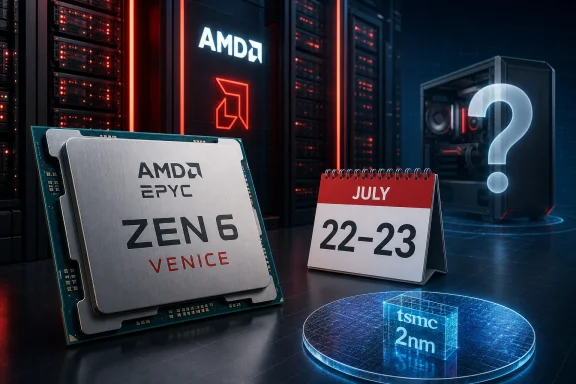
AMD has confirmed that its Zen 6 rollout will take place at the July 22–23 Advancing AI event, beginning with the server-focused EPYC processor codenamed Venice, which is built on TSMC’s 2 nm process. AMD has not announced desktop Ryzen Zen 6 timing, models, socket support, pricing, platform requirements, or retail availability, so the event should not be treated as a desktop launch.
Current PC buyers: Do not delay an urgently needed purchase solely because of AMD’s July announcement. Venice confirms progress on Zen 6, but it provides none of the desktop details needed to compare a future Ryzen system with hardware available now.
Planned late-2026 upgraders: If your current PC remains adequate, waiting for AMD’s desktop specifications and independent reviews is reasonable. The information that matters will include platform compatibility, motherboard BIOS support, memory requirements, thermals, model segmentation, price, and performance in independent Windows applications and games. All of those points remain unknown.
Windows Server and virtualization administrators: Treat the July event as the beginning of a new evaluation cycle, not as a deployment deadline. Once Venice systems are available for testing, validate actual workloads, software licensing, memory bandwidth, power consumption, firmware maturity, virtualization behavior, and operational fit before making purchasing or consolidation decisions.
Server-first confirmation improves confidence that the Zen 6 architecture has reached an important stage of maturity. It does not answer the purchasing questions that determine whether a Windows desktop upgrade is practical, cost-effective, or even compatible with an existing system.
That is the central news: AMD has attached a specific event window to the beginning of its Zen 6 rollout. Venice, the server-focused EPYC implementation, is the confirmed starting point.
The wording still requires care. A rollout at an event does not, by itself, confirm immediate retail availability, broad customer shipments, production-system availability in every market, or a complete product portfolio on the first day. AMD may clarify those matters at the event, but they should not be assumed in advance.
PC Gamer reports that the July announcement concerns server Zen 6 and that desktop Zen 6 is expected later in 2026. That report provides useful context, but it does not turn the desktop expectation into an AMD-confirmed launch date. AMD has not announced a specific desktop event, sales date, model list, or shipping schedule.
Venice is nevertheless important to desktop enthusiasts because it moves Zen 6 beyond a distant architectural name. A server-first introduction indicates that AMD is preparing to discuss a real Zen 6 implementation built on TSMC’s 2 nm process. It increases confidence in the broader architecture without establishing how AMD will adapt that architecture to Ryzen.
That distinction is the key WindowsForum takeaway. Architecture maturity and desktop purchasing readiness are not the same thing.
May 2026 — PC Gamer discusses reports and speculation concerning possible desktop Zen 6 chiplet configurations, including 12-core chiplets, dual-chiplet 24-core processors, and gaming-oriented 3D V-Cache models. AMD has not confirmed those configurations.
July 22–23, 2026 — AMD says the Zen 6 rollout will occur at its Advancing AI event, beginning with the server-focused EPYC processor codenamed Venice. AMD has not provided a confirmed day-by-day Venice schedule in the supplied information.
Later in 2026 — PC Gamer expects desktop Zen 6, but AMD has not announced the date, models, specifications, socket, prices, or retail availability.
AMD also claims that Venice will deliver 1.7 times the performance and efficiency of the prior generation. That wording should be preserved as AMD’s claim rather than converted into a universal prediction about every workload, system, or deployment.
The figure remains a vendor claim until independent testing can show how Venice performs across specific applications and configurations. A database server, virtualization host, rendering system, software-build machine, and general-purpose application server can respond differently to the same processor architecture. Buyers will need results that resemble their own environments.
The 2 nm process is another confirmed fact, but its practical effects cannot be determined from the process name alone. It establishes an important manufacturing milestone for AMD; it does not independently reveal retail pricing, sustained clock speeds, system power, memory performance, cooling requirements, or application-level gains.
It is also premature to describe Venice as broadly shipping or already available as a production generation. AMD has confirmed a rollout at the July event. More specific claims about system availability, customer deployment, sampling, or shipment volumes require further confirmation.
The event may provide additional information, but its content should not be predicted beyond the facts AMD has disclosed. There is no need to infer Venice sessions, processor-selection presentations, CPU inference demonstrations, enterprise infrastructure briefings, or production-system evidence from the event’s title.
The important limitation is scope. A broad vendor figure does not mean that every Windows Server workload will become 70 percent faster, that every server will consume proportionally less power, or that every organization will obtain the same improvement after replacing an older host.
Independent reviews will need to test identifiable workloads and report complete system behavior. Enterprise teams will then need to compare those results with their own performance constraints, service-level requirements, virtualization policies, and licensing arrangements.
Windows administrators should be particularly careful about translating a general processor claim directly into virtual-machine density. More processor capacity is useful only when the host also has suitable memory capacity, memory bandwidth, storage performance, network throughput, and software support. The limiting resource will vary by environment.
Licensing can also change the value calculation. Products licensed by physical cores, virtual cores, sockets, hosts, servers, or application instances can produce different outcomes on denser or faster hardware. A processor that looks compelling in a benchmark may require a separate financial analysis once the full software stack is included.
This does not diminish AMD’s claim. It places the claim in the correct role: evidence of AMD’s performance target, subject to verification once suitable systems and independent results are available.
The gap between those categories is why server-first confirmation should not be converted into desktop buying advice. A desktop customer needs answers that Venice cannot provide.
This comparison shows both why Venice matters and why it cannot settle a desktop upgrade decision. It increases confidence that Zen 6 is advancing, but nearly every consumer-facing variable remains open.
Platform compatibility is especially important. AMD has not confirmed whether desktop Zen 6 will use an existing socket, require a new socket, work across all boards associated with a particular platform, or depend on specific BIOS versions. Buyers should not purchase a motherboard today based on an assumption about future support.
The same caution applies to memory. No desktop Zen 6 memory requirement has been announced in the supplied facts. Claims about mandatory memory upgrades, supported speeds, optimal configurations, or platform costs would therefore be premature.
Thermal behavior is also unknown. A manufacturing process and a rumored frequency cannot reveal the cooling requirements of an unannounced desktop processor. Those requirements will depend on final models, power limits, firmware behavior, package design, and the way retail CPUs perform under sustained Windows workloads.
Model segmentation may ultimately matter as much as the architecture. Buyers will need to know which products use one or more chiplets, which receive additional cache, how many cores each model contains, what power targets apply, and how AMD prices the lineup. None of that can be derived from the Venice rollout alone.
The 12-core chiplet idea is noteworthy because it would change the arithmetic of a chiplet-based desktop lineup. Even so, a mathematically possible configuration is not evidence that AMD will sell it. Product decisions can be influenced by yields, pricing, package limits, power targets, market segmentation, and competition.
The same applies to 3D V-Cache. AMD has established that additional cache can be an important part of selected gaming products, but prior product strategy does not confirm a future Zen 6 model. Buyers should wait for an official model list.
The 6.5 GHz claim is even less useful. Without a named processor and defined operating conditions, the number cannot be compared with sustained application clocks, all-core behavior, efficiency, thermals, or real performance. The leaker’s stated certainty does not substitute for product documentation or independent testing.
It does not tell enthusiasts whether a current motherboard will support desktop Zen 6. It does not identify the BIOS versions that may be required, the memory configuration AMD will recommend, or the cooling hardware appropriate for each model.
It does not reveal whether AMD will emphasize higher clocks, additional cores, larger caches, lower power, or some combination across different desktop products. It does not identify a Ryzen model stack or establish that the rumored 12-core chiplet, 24-core dual-die configuration, 3D V-Cache model, or 6.5 GHz clock will reach retail.
It also does not provide a price comparison with existing Ryzen processors or competing desktop products. Without CPU prices, motherboard requirements, and independent benchmarks, there is no reliable way to calculate the value of a Zen 6 desktop upgrade.
Independent Windows testing will be essential. Reviewers will need to examine games, content-creation tools, software development workloads, productivity applications, power behavior, temperatures, and consistency across supported versions of Windows. If AMD offers several cache, core-count, or power configurations, each will need to be evaluated on its own merits.
That is where WindowsForum’s focus differs from a simple architecture announcement. Confirmation that Zen 6 exists as a server rollout is important, but a Windows desktop purchase is determined by the complete platform and its measured behavior—not by a codename, process node, rumor, or server performance claim.
The limits of the announcement are just as important. AMD has not confirmed when desktop Ryzen Zen 6 will launch, which models it will include, what socket it will use, which motherboards and BIOS versions will support it, what memory it will require, how it will behave thermally, what it will cost, or when consumers will be able to buy it.
Current buyers should therefore make decisions based on current hardware unless their needs allow them to wait without consequence. Late-2026 upgraders can watch the Venice rollout as an architectural milestone, but they should hold their desktop conclusions until AMD supplies specifications and independent reviewers test retail products under Windows.
Server and virtualization teams have a different task. Once systems become available, they should validate Venice against real workloads, licensing structures, memory demands, power limits, and virtualization behavior rather than treating a vendor performance claim as a universal capacity forecast.
For desktop enthusiasts, the practical guidance is straightforward: follow the July event for evidence of Zen 6’s progress, not for answers AMD has not promised. The upgrade decision begins only when desktop models, platform support, prices, availability, and independent Windows and gaming benchmarks are known.
 What This Means for Windows Users
Current PC buyers: Do not delay an urgently needed purchase solely because of AMD’s July announcement. Venice confirms progress on Zen 6, but it provides none of the desktop details needed to compare a future Ryzen system with hardware available now.Planned late-2026 upgraders: If your current PC remains adequate, waiting for AMD’s desktop specifications and independent reviews is reasonable. The information that matters will include platform compatibility, motherboard BIOS support, memory requirements, thermals, model segmentation, price, and performance in independent Windows applications and games. All of those points remain unknown.
Windows Server and virtualization administrators: Treat the July event as the beginning of a new evaluation cycle, not as a deployment deadline. Once Venice systems are available for testing, validate actual workloads, software licensing, memory bandwidth, power consumption, firmware maturity, virtualization behavior, and operational fit before making purchasing or consolidation decisions.
Server-first confirmation improves confidence that the Zen 6 architecture has reached an important stage of maturity. It does not answer the purchasing questions that determine whether a Windows desktop upgrade is practical, cost-effective, or even compatible with an existing system.
AMD Turns Zen 6 From a Roadmap Into a Rollout
AMD Chief Technology Officer and Executive Vice President Mark Papermaster disclosed the timing at Raise Summit 2026. Describing the Zen program as a journey that began in 2017, he said AMD is now on its sixth generation and would roll out the new generation during the company’s July 22–23 Advancing AI event.That is the central news: AMD has attached a specific event window to the beginning of its Zen 6 rollout. Venice, the server-focused EPYC implementation, is the confirmed starting point.
The wording still requires care. A rollout at an event does not, by itself, confirm immediate retail availability, broad customer shipments, production-system availability in every market, or a complete product portfolio on the first day. AMD may clarify those matters at the event, but they should not be assumed in advance.
PC Gamer reports that the July announcement concerns server Zen 6 and that desktop Zen 6 is expected later in 2026. That report provides useful context, but it does not turn the desktop expectation into an AMD-confirmed launch date. AMD has not announced a specific desktop event, sales date, model list, or shipping schedule.
Venice is nevertheless important to desktop enthusiasts because it moves Zen 6 beyond a distant architectural name. A server-first introduction indicates that AMD is preparing to discuss a real Zen 6 implementation built on TSMC’s 2 nm process. It increases confidence in the broader architecture without establishing how AMD will adapt that architecture to Ryzen.
That distinction is the key WindowsForum takeaway. Architecture maturity and desktop purchasing readiness are not the same thing.
Timeline
2017 — The beginning of the modern Zen architectural run referenced by Papermaster.May 2026 — PC Gamer discusses reports and speculation concerning possible desktop Zen 6 chiplet configurations, including 12-core chiplets, dual-chiplet 24-core processors, and gaming-oriented 3D V-Cache models. AMD has not confirmed those configurations.
July 22–23, 2026 — AMD says the Zen 6 rollout will occur at its Advancing AI event, beginning with the server-focused EPYC processor codenamed Venice. AMD has not provided a confirmed day-by-day Venice schedule in the supplied information.
Later in 2026 — PC Gamer expects desktop Zen 6, but AMD has not announced the date, models, specifications, socket, prices, or retail availability.
What AMD Has Confirmed About Venice
The confirmed picture is narrow but significant. Venice is an EPYC processor based on AMD’s Zen 6 architecture, it is built on TSMC’s 2 nm process, and its rollout is tied to AMD’s July 22–23 event.AMD also claims that Venice will deliver 1.7 times the performance and efficiency of the prior generation. That wording should be preserved as AMD’s claim rather than converted into a universal prediction about every workload, system, or deployment.
The figure remains a vendor claim until independent testing can show how Venice performs across specific applications and configurations. A database server, virtualization host, rendering system, software-build machine, and general-purpose application server can respond differently to the same processor architecture. Buyers will need results that resemble their own environments.
The 2 nm process is another confirmed fact, but its practical effects cannot be determined from the process name alone. It establishes an important manufacturing milestone for AMD; it does not independently reveal retail pricing, sustained clock speeds, system power, memory performance, cooling requirements, or application-level gains.
It is also premature to describe Venice as broadly shipping or already available as a production generation. AMD has confirmed a rollout at the July event. More specific claims about system availability, customer deployment, sampling, or shipment volumes require further confirmation.
The event may provide additional information, but its content should not be predicted beyond the facts AMD has disclosed. There is no need to infer Venice sessions, processor-selection presentations, CPU inference demonstrations, enterprise infrastructure briefings, or production-system evidence from the event’s title.
The 1.7x Figure Needs a Vendor-Claim Label
AMD’s 1.7x “performance and efficiency” statement is likely to receive significant attention because it compresses the appeal of a new server processor into one memorable figure. For buyers, however, it is a starting point for investigation rather than a purchasing formula.The important limitation is scope. A broad vendor figure does not mean that every Windows Server workload will become 70 percent faster, that every server will consume proportionally less power, or that every organization will obtain the same improvement after replacing an older host.
Independent reviews will need to test identifiable workloads and report complete system behavior. Enterprise teams will then need to compare those results with their own performance constraints, service-level requirements, virtualization policies, and licensing arrangements.
Windows administrators should be particularly careful about translating a general processor claim directly into virtual-machine density. More processor capacity is useful only when the host also has suitable memory capacity, memory bandwidth, storage performance, network throughput, and software support. The limiting resource will vary by environment.
Licensing can also change the value calculation. Products licensed by physical cores, virtual cores, sockets, hosts, servers, or application instances can produce different outcomes on denser or faster hardware. A processor that looks compelling in a benchmark may require a separate financial analysis once the full software stack is included.
This does not diminish AMD’s claim. It places the claim in the correct role: evidence of AMD’s performance target, subject to verification once suitable systems and independent results are available.
Server Zen 6 and Desktop Zen 6 Share an Architecture, Not a Launch Plan
Venice makes a future desktop Zen 6 family more credible, but it does not disclose the design or commercial plan for that family. EPYC and Ryzen can share architectural foundations while differing substantially in packaging, core configuration, cache, power targets, firmware, platform support, and product segmentation.The gap between those categories is why server-first confirmation should not be converted into desktop buying advice. A desktop customer needs answers that Venice cannot provide.
| Purchasing question | EPYC Venice | Desktop Ryzen Zen 6 |
|---|---|---|
| Product status | Rollout confirmed for the July 22–23 event | AMD has not announced a desktop rollout date |
| Market | Server-focused EPYC | Desktop models have not been announced |
| Architecture | Zen 6 | A future desktop Zen 6 family is expected, but details remain unconfirmed |
| Manufacturing process | TSMC 2 nm | Not confirmed by the supplied desktop information |
| Performance statement | AMD claims 1.7x performance and efficiency over the prior generation | No official desktop performance claim |
| Models and core counts | Full rollout details are not established here | No official model stack or core counts |
| Socket and platform | Server platform details are outside the confirmed facts summarized here | No confirmed socket or platform compatibility |
| BIOS support | Not a desktop purchasing question | No confirmed motherboard or BIOS support list |
| Memory requirements | Specific purchasing details remain to be established | Not announced |
| Thermals and cooling | Must be evaluated in actual systems when available | Not announced |
| Pricing | Not established here | Not announced |
| Availability | Rollout confirmed; broad shipment or system availability should not be assumed | No retail availability date |
| Windows performance | Requires workload-specific validation | No independent Windows or game benchmarks |
Platform compatibility is especially important. AMD has not confirmed whether desktop Zen 6 will use an existing socket, require a new socket, work across all boards associated with a particular platform, or depend on specific BIOS versions. Buyers should not purchase a motherboard today based on an assumption about future support.
The same caution applies to memory. No desktop Zen 6 memory requirement has been announced in the supplied facts. Claims about mandatory memory upgrades, supported speeds, optimal configurations, or platform costs would therefore be premature.
Thermal behavior is also unknown. A manufacturing process and a rumored frequency cannot reveal the cooling requirements of an unannounced desktop processor. Those requirements will depend on final models, power limits, firmware behavior, package design, and the way retail CPUs perform under sustained Windows workloads.
Model segmentation may ultimately matter as much as the architecture. Buyers will need to know which products use one or more chiplets, which receive additional cache, how many cores each model contains, what power targets apply, and how AMD prices the lineup. None of that can be derived from the Venice rollout alone.
Unconfirmed Reports and Speculation
Keeping these claims together and clearly labeled prevents them from being mistaken for details attached to Venice. They describe possible desktop configurations, not features AMD has confirmed for Ryzen or EPYC.None of the items in this box has been confirmed by AMD, and none should be used as the basis for a purchase.
These reports may help explain what enthusiasts are watching, but they do not establish AMD’s desktop plans.
- Reports have discussed the possibility of a Zen 6 CPU chiplet containing as many as 12 cores.
- A 12-core chiplet could theoretically permit a 12-core single-chiplet desktop processor or a 24-core dual-chiplet processor, but AMD has not announced either product.
- PC Gamer has discussed a possible gaming-oriented 12-core model with 3D V-Cache. This is not a confirmed specification or model.
- An unnamed leaker has claimed that desktop Zen 6 will exceed 6.5 GHz. The claim is non-actionable because AMD has not confirmed the clock speed, the affected model, the boost conditions, or any retail specification.
The 12-core chiplet idea is noteworthy because it would change the arithmetic of a chiplet-based desktop lineup. Even so, a mathematically possible configuration is not evidence that AMD will sell it. Product decisions can be influenced by yields, pricing, package limits, power targets, market segmentation, and competition.
The same applies to 3D V-Cache. AMD has established that additional cache can be an important part of selected gaming products, but prior product strategy does not confirm a future Zen 6 model. Buyers should wait for an official model list.
The 6.5 GHz claim is even less useful. Without a named processor and defined operating conditions, the number cannot be compared with sustained application clocks, all-core behavior, efficiency, thermals, or real performance. The leaker’s stated certainty does not substitute for product documentation or independent testing.
What Venice Does—and Does Not—Tell Desktop Enthusiasts
Venice tells desktop users that AMD is ready to begin rolling out a Zen 6 product and that the first confirmed implementation uses TSMC’s 2 nm process. It also provides a future opportunity to see how the architecture performs when independent testing becomes possible.It does not tell enthusiasts whether a current motherboard will support desktop Zen 6. It does not identify the BIOS versions that may be required, the memory configuration AMD will recommend, or the cooling hardware appropriate for each model.
It does not reveal whether AMD will emphasize higher clocks, additional cores, larger caches, lower power, or some combination across different desktop products. It does not identify a Ryzen model stack or establish that the rumored 12-core chiplet, 24-core dual-die configuration, 3D V-Cache model, or 6.5 GHz clock will reach retail.
It also does not provide a price comparison with existing Ryzen processors or competing desktop products. Without CPU prices, motherboard requirements, and independent benchmarks, there is no reliable way to calculate the value of a Zen 6 desktop upgrade.
Independent Windows testing will be essential. Reviewers will need to examine games, content-creation tools, software development workloads, productivity applications, power behavior, temperatures, and consistency across supported versions of Windows. If AMD offers several cache, core-count, or power configurations, each will need to be evaluated on its own merits.
That is where WindowsForum’s focus differs from a simple architecture announcement. Confirmation that Zen 6 exists as a server rollout is important, but a Windows desktop purchase is determined by the complete platform and its measured behavior—not by a codename, process node, rumor, or server performance claim.
Actionable WindowsForum Buyer Checklist
If You Need a PC or Server Now
- Do not postpone an urgent purchase solely because AMD has scheduled the Venice rollout for July 22–23.
- Buy against current requirements, available products, support commitments, and independently measured performance.
- Do not assume that a motherboard or other desktop component purchased now will support an unannounced Ryzen generation.
- If the purchase is a server, size it for the workload and support period you actually have rather than for unconfirmed Venice availability.
If You Plan to Upgrade Later in 2026
- Wait for AMD to announce the desktop launch date and retail models.
- Confirm socket and motherboard compatibility rather than relying on architectural expectations.
- Check the motherboard vendor’s CPU-support list and required BIOS version.
- Review official memory requirements and independent testing of practical configurations.
- Compare complete system cost, not just processor price.
- Evaluate thermals, power behavior, application performance, and game performance in independent reviews.
- Compare specific retail models rather than assuming every Zen 6 processor will share the same core count, cache, frequency, or power characteristics.
- Treat all 12-core chiplet, 24-core dual-die, 3D V-Cache, and 6.5 GHz reports as speculation until AMD announces products.
If You Manage Windows Server or Virtualization
- Wait until relevant Venice systems are available before drawing deployment conclusions from AMD’s 1.7x claim.
- Test the applications and services that determine your actual capacity needs.
- Measure memory bandwidth and capacity requirements alongside processor performance.
- Review licensing by core, virtual core, socket, host, server, and application instance as applicable.
- Validate hypervisor compatibility, virtual-machine behavior, firmware, management tooling, and security controls.
- Measure sustained system power rather than relying only on processor-level claims.
- Test storage, networking, backup, and recovery behavior under the intended consolidation level.
- Account for maintenance capacity and failure domains before placing more workloads on each host.
- Require support commitments from the server vendor and relevant software vendors before production deployment.
July Is a Milestone, Not a Desktop Buying Signal
AMD’s July 22–23 event now has a clear processor milestone attached to it: the rollout of Zen 6 begins with EPYC Venice. That is meaningful news for AMD’s server roadmap and an encouraging sign that the architecture expected to underpin a future desktop generation is progressing.The limits of the announcement are just as important. AMD has not confirmed when desktop Ryzen Zen 6 will launch, which models it will include, what socket it will use, which motherboards and BIOS versions will support it, what memory it will require, how it will behave thermally, what it will cost, or when consumers will be able to buy it.
Current buyers should therefore make decisions based on current hardware unless their needs allow them to wait without consequence. Late-2026 upgraders can watch the Venice rollout as an architectural milestone, but they should hold their desktop conclusions until AMD supplies specifications and independent reviewers test retail products under Windows.
Server and virtualization teams have a different task. Once systems become available, they should validate Venice against real workloads, licensing structures, memory demands, power limits, and virtualization behavior rather than treating a vendor performance claim as a universal capacity forecast.
For desktop enthusiasts, the practical guidance is straightforward: follow the July event for evidence of Zen 6’s progress, not for answers AMD has not promised. The upgrade decision begins only when desktop models, platform support, prices, availability, and independent Windows and gaming benchmarks are known.
References
- Primary source: PC Gamer
Published: Fri, 10 Jul 2026 10:27:34 GMT
AMD Zen 6 server CPUs are launching this month, which has me hopeful for a desktop release this year | PC Gamer
Here's hoping the swap to 2 nm is huge.www.pcgamer.com - Related coverage: amd.com
Choosing the Right CPUs – Understanding the Venice Portfolio
As enterprise compute diversifies across general-purpose, AI, and emerging agentic workloads, a single CPU design no longer suffices. This session examines the evolving requirement for differentiated CPU profiles and introduces AMD Venice as a purpose-built portfolio aligned to these demands...www.amd.com - Related coverage: techspot.com
AMD Zen 6 desktop CPUs may deliver 24 cores, 7 GHz targets, and AM5 support | TechSpot
According to well-known leaker HXL, Zen 6 will span four single-CCD processor variants alongside three higher-end dual-CCD designs. While the exact Ryzen branding for each chip hasn't...www.techspot.com - Related coverage: tomshardware.com
Intel confirms Arrow Lake refresh set for 2026, Nova Lake later that year — company admits there are 'holes to fill on the desktop front,' says it is 'confident in the roadmap' | Tom's Hardware
Though the next-generation chip launch looks set to extend into 2027, too.www.tomshardware.com