

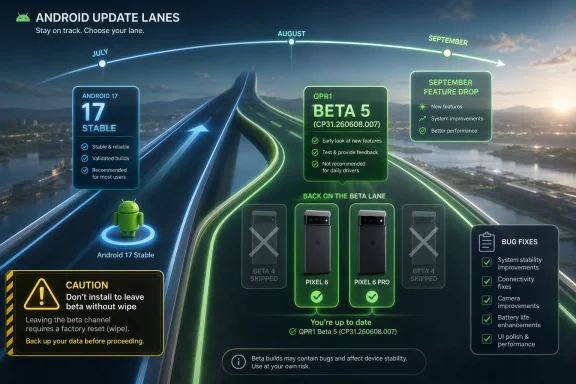
Google began rolling out Android 17 QPR1 Beta 5 on June 23, 2026, for Pixel 6 and newer devices enrolled in the Android Beta Program, restoring Pixel 6 and Pixel 6 Pro eligibility after Beta 4 skipped those phones and delivering build CP31.260608.007 with mostly bug fixes. The timing matters because Android 17 itself only reached stable Pixel users last week, turning Google’s beta channel into a fork in the road rather than a simple early-access lane. If you are already on the beta train, Beta 5 is the next stop; if you want the public Android 17 release without wiping your phone, Google’s advice is blunt: do not install it. This is not a flashy update, but it is a revealing one.
Android used to have a relatively legible rhythm. Google would preview the next platform release, stabilize it, ship it to Pixels, and then use quarterly platform releases to polish and extend the experience over time. That structure still exists, but Android 17 QPR1 Beta 5 shows how compressed the calendar has become.
The stable Android 17 rollout has barely had time to settle on Pixel phones, yet the beta program is already testing the September Feature Drop track. That means Pixel owners are being asked to choose not just between “stable” and “experimental,” but between two different futures: the public Android 17 build available now, or the QPR1 line that will eventually become the next quarterly release.
For enthusiasts, that is part of the appeal. The Pixel beta program has long been a way to get a preview of Google’s next UI ideas, behavioral changes, and under-the-hood platform work. For everyone else, it makes the update screen feel less like a software maintenance tool and more like a branching workflow.
Beta 5’s changelog reportedly leans heavily on bug fixes rather than marquee features, which is exactly what you would expect this late in a quarterly beta cycle. But the absence of drama is itself the story. Google is trying to make QPR betas feel routine, even as the logistics around them become more consequential for users who may not fully understand which release train they are boarding.
That matters because the Pixel 6 generation remains one of the most important dividing lines in Google’s phone history. It was the first Tensor Pixel generation, the moment Google moved from Qualcomm-based Pixels into its own silicon story, and the beginning of the modern promise that Pixel hardware and Android software would evolve together more tightly.
When Beta 4 skipped the Pixel 6 and 6 Pro, Google said support would return in a later build. Beta 5 appears to be that correction. For owners of those devices, the message is reassuring: the phones have not been quietly cut loose from the Android 17 QPR1 testing path.
Still, the temporary exclusion is a reminder that extended software support is not the same thing as frictionless software support. Older devices can remain eligible while still being more likely to encounter late-stage blockers, device-specific bugs, or rollout exceptions. The Pixel 6 line may be supported, but it is also old enough to expose the operational cost of supporting a long tail of Tensor hardware.
That cost is increasingly visible across the industry. Apple, Samsung, and Google all market longer support windows as a consumer benefit and environmental good. They are right to do so. But long support windows also turn every release into a bigger compatibility exercise, especially when platform, modem, camera, AI, and security changes all intersect.
But late betas carry strategic weight. They are where Google decides whether a quarterly release feels polished enough to ship broadly, whether regressions are contained, and whether device-specific problems remain isolated or systemic. For Pixel owners, the difference between a feature drop that feels seamless and one that feels cursed is often decided in builds like this.
Quarterly Platform Releases occupy a strange middle ground in Android. They are not full annual OS upgrades, but they are not ordinary monthly security patches either. They can include new Pixel features, platform refinements, UI adjustments, and changes that developers may need to account for.
That is why QPR testing is valuable. Google gets broader telemetry across real devices, real carriers, real apps, and real user habits. Testers get earlier access. The trade-off is that they also become part of the stabilization process, which is a polite way of saying they may be the first to discover what still breaks.
Beta 5’s practical role, then, is to narrow the gap between aspiration and release readiness. It is the software equivalent of tightening bolts before a vehicle leaves the factory. Nobody buys the car because of the bolts, but everyone notices if they were not tightened.
Google’s warning to beta users is straightforward: if you want to leave the beta program and move to the public stable Android 17 release without wiping your device, opt out and avoid installing QPR1 Beta 5. Once a device moves forward onto the QPR1 track, the no-wipe path back to stable becomes more constrained.
This is where the beta program stops being a playground and starts behaving like a production branch. Android’s update system is designed to prevent unsafe downgrades, and moving from a newer beta build to an older public build can require a wipe. That is technically defensible, but it is not always obvious to ordinary users who see a system update notification and assume “newer” means “better” and “safe to install.”
The Pixel beta program has improved over the years, but it still asks users to understand release channels in a way that many phone owners do not. The difference between Android 17 stable and Android 17 QPR1 Beta 5 sounds subtle. In practice, it can decide whether your next move is a painless opt-out or a factory reset.
That is the kind of detail WindowsForum readers will recognize from Windows Insider flights. The names differ, but the pattern is familiar: Dev, Beta, Release Preview, stable, rollback windows, build numbers, and the occasional “you can leave now, but only if you do not install the next thing.” Enthusiasts accept that bargain. Casual users often stumble into it.
That has advantages. A faster stable release gives device makers more time to adapt Android for their own hardware. Quarterly releases let Google deliver meaningful changes without waiting for the next annual upgrade. Pixel owners get a steadier cadence of improvements, and developers get earlier visibility into platform behavior.
But this also makes Android harder to describe. “Android 17” is now both a stable release and the foundation for multiple overlapping future releases. A Pixel can be on Android 17 stable, Android 17 QPR1 beta, or eventually Android 17 QPR1 stable, all while appearing to run the same major OS version to anyone who does not live inside build numbers.
That ambiguity is not just semantic. It affects support conversations, bug reports, app compatibility testing, and enterprise policy. If a user says they are “on Android 17,” the next question increasingly has to be: which Android 17?
Microsoft learned this lesson the hard way with Windows 10 and Windows 11 servicing. A brand name can stay constant while builds, enablement packages, feature updates, and cumulative updates diverge underneath. Google is not copying Windows servicing exactly, but Android’s direction is unmistakably more channelized, more continuous, and more dependent on users understanding where they are in the release stream.
For enthusiasts, that is a feature. Pixel devices are the reference point for modern Android testing, and joining the beta program is a way to see what Google is preparing before Samsung, OnePlus, Xiaomi, Motorola, and others translate those changes into their own ecosystems.
For average users, the benefit is less clear. The stable Android 17 release is already available for eligible Pixels, so the case for jumping to QPR1 Beta 5 depends on appetite for risk. If the changelog is mostly bug fixes and the September Feature Drop features are still in flux, the reward may not justify the friction.
The calculus changes for developers and IT testers. They may want to validate apps, device management behavior, accessibility workflows, authentication flows, or Bluetooth peripherals before QPR1 reaches stable. For those users, Beta 5 is not a toy; it is an early warning system.
That distinction is important. A beta can be both irresponsible for a daily-driver phone and valuable for a lab device. Google’s challenge is that both audiences reach the same enrollment page.
The Pixel 6 generation is not ancient, but it is now several hardware cycles behind the newest Pixels. It has first-generation Tensor silicon, older modem behavior, older camera tuning assumptions, and a support story that has already lived through several major Android changes. Keeping it aligned with newer Pixels is valuable, but it is not free.
This is where Google’s software promise meets engineering reality. The company wants Pixel buyers to trust that their phones will age well. It also wants Android to evolve quickly, especially as AI features, privacy controls, and device-local intelligence become more central to the platform.
Those goals can conflict. Newer platform features may depend on hardware capabilities that older devices lack. Battery, heat, connectivity, and camera regressions can show up differently across generations. A release that is stable on a Pixel 10-class device may still need special handling on a Pixel 6.
The temporary Beta 4 exclusion and Beta 5 restoration are a small example of that tension. Support is not a binary switch. It is a continuing negotiation between ambition, compatibility, and the patience of users who bought into the Pixel promise early.
A Pixel owner can be current and still not be on the same “current” as another Pixel owner. One device may be on the public Android 17 release. Another may be on QPR1 Beta 5. A third may be waiting for a carrier-staged rollout. All three users can plausibly believe they are up to date.
That makes support harder. It complicates online troubleshooting, because advice that works for stable may not apply to beta. It complicates app bug reports, because developers need build numbers rather than broad version labels. It complicates consumer coverage, because “Android 17 is out” is true but incomplete.
Google can solve some of this with clearer language. The beta program should continue to warn users about wipe risks, opt-out timing, and release-channel consequences in plain English. But the deeper issue is structural: continuous delivery creates more moments where users need to make informed choices.
Windows users know this world well. The Insider Program taught a generation of PC enthusiasts that build numbers matter, channels matter, and rollback paths matter. Android is not becoming Windows, but Pixel owners are increasingly being asked to think like Windows Insiders.
Feature Drops are one of Google’s best Pixel ideas. They give the company a way to improve phones after launch, reinforce the Pixel brand, and deliver visible changes outside the annual Android version cycle. They also help Google turn software velocity into a competitive advantage.
But the more important Feature Drops become, the more pressure QPR betas carry. A quarterly release that ships with regressions can sour the whole experience. Users rarely separate the platform from the phone. If a Pixel update breaks battery life, connectivity, notifications, or camera behavior, the blame lands on the device, not the release process.
That is why a bug-fix-heavy Beta 5 is not boring. It is the work required to make the September release feel uneventful in the best possible way. Stability is not the absence of innovation; it is the condition that lets innovation survive contact with millions of phones.
The irony is that Google’s most successful quarterly releases may be the ones that generate the least noise. A smooth Feature Drop arrives, installs, adds a few useful tricks, and disappears into daily use. A bad one becomes a forum megathread.
Changes in behavior around permissions, background activity, UI surfaces, media handling, Bluetooth, biometrics, or power management can affect apps long before users understand what changed. The earlier developers test against these builds, the less likely they are to discover a compatibility problem after a stable release lands.
This is especially true for apps that live close to the system. Launchers, accessibility tools, VPN clients, password managers, enterprise agents, device policy controllers, camera apps, health peripherals, and notification-heavy services all have more to lose from subtle platform shifts than a simple content app.
Android 17 QPR1 Beta 5 may not be a headline feature release, but it is a useful checkpoint. If a bug has survived to Beta 5, developers should not assume it will magically disappear before September. If an app behaves differently on Beta 5 than on stable Android 17, that difference is worth investigating now.
For IT teams, the same logic applies. A spare Pixel enrolled in the beta program can act as a canary for mobile device management policies, conditional access, work profile behavior, Wi-Fi authentication, and line-of-business apps. The beta may not be suitable for production users, but it can be very suitable for production planning.
If you are already committed to testing QPR1, Beta 5 is a logical update. It restores Pixel 6 and Pixel 6 Pro participation, advances the build to CP31.260608.007, and reportedly focuses on bug fixes. That is what a late beta should do.
If you want out of the beta program, the advice changes completely. Installing Beta 5 may move you further away from the no-wipe exit path to stable Android 17. That is the part users need to slow down and read.
This is where Google’s beta program has to fight normal user instinct. Most people are trained to install updates promptly because updates fix problems and improve security. In the beta channel, the right move can sometimes be to refuse an update precisely because you want to return to stable software.
That inversion is unintuitive, and it is why coverage of these releases should not treat enrollment as a casual recommendation. The Android Beta Program is useful, but it is still a beta program. The word beta is doing real work.
The concrete takeaways are less about shiny features than about release hygiene:
 Google’s Beta Channel Is Now Running Ahead of Its Own Stable Release
Android used to have a relatively legible rhythm. Google would preview the next platform release, stabilize it, ship it to Pixels, and then use quarterly platform releases to polish and extend the experience over time. That structure still exists, but Android 17 QPR1 Beta 5 shows how compressed the calendar has become.The stable Android 17 rollout has barely had time to settle on Pixel phones, yet the beta program is already testing the September Feature Drop track. That means Pixel owners are being asked to choose not just between “stable” and “experimental,” but between two different futures: the public Android 17 build available now, or the QPR1 line that will eventually become the next quarterly release.
For enthusiasts, that is part of the appeal. The Pixel beta program has long been a way to get a preview of Google’s next UI ideas, behavioral changes, and under-the-hood platform work. For everyone else, it makes the update screen feel less like a software maintenance tool and more like a branching workflow.
Beta 5’s changelog reportedly leans heavily on bug fixes rather than marquee features, which is exactly what you would expect this late in a quarterly beta cycle. But the absence of drama is itself the story. Google is trying to make QPR betas feel routine, even as the logistics around them become more consequential for users who may not fully understand which release train they are boarding.
The Pixel 6 Return Is More Than a Footnote
The most visible change in Android 17 QPR1 Beta 5 is not a new feature. It is the return of the Pixel 6 and Pixel 6 Pro after their omission from Beta 4.That matters because the Pixel 6 generation remains one of the most important dividing lines in Google’s phone history. It was the first Tensor Pixel generation, the moment Google moved from Qualcomm-based Pixels into its own silicon story, and the beginning of the modern promise that Pixel hardware and Android software would evolve together more tightly.
When Beta 4 skipped the Pixel 6 and 6 Pro, Google said support would return in a later build. Beta 5 appears to be that correction. For owners of those devices, the message is reassuring: the phones have not been quietly cut loose from the Android 17 QPR1 testing path.
Still, the temporary exclusion is a reminder that extended software support is not the same thing as frictionless software support. Older devices can remain eligible while still being more likely to encounter late-stage blockers, device-specific bugs, or rollout exceptions. The Pixel 6 line may be supported, but it is also old enough to expose the operational cost of supporting a long tail of Tensor hardware.
That cost is increasingly visible across the industry. Apple, Samsung, and Google all market longer support windows as a consumer benefit and environmental good. They are right to do so. But long support windows also turn every release into a bigger compatibility exercise, especially when platform, modem, camera, AI, and security changes all intersect.
Beta 5 Is a Bug-Fix Release With a Strategic Job
On paper, Android 17 QPR1 Beta 5 is modest. It is not being sold as a reinvention of Android 17, and the reported changelog is primarily a cleanup pass. That makes it tempting to dismiss the update as a maintenance build.But late betas carry strategic weight. They are where Google decides whether a quarterly release feels polished enough to ship broadly, whether regressions are contained, and whether device-specific problems remain isolated or systemic. For Pixel owners, the difference between a feature drop that feels seamless and one that feels cursed is often decided in builds like this.
Quarterly Platform Releases occupy a strange middle ground in Android. They are not full annual OS upgrades, but they are not ordinary monthly security patches either. They can include new Pixel features, platform refinements, UI adjustments, and changes that developers may need to account for.
That is why QPR testing is valuable. Google gets broader telemetry across real devices, real carriers, real apps, and real user habits. Testers get earlier access. The trade-off is that they also become part of the stabilization process, which is a polite way of saying they may be the first to discover what still breaks.
Beta 5’s practical role, then, is to narrow the gap between aspiration and release readiness. It is the software equivalent of tightening bolts before a vehicle leaves the factory. Nobody buys the car because of the bolts, but everyone notices if they were not tightened.
The No-Wipe Exit Window Is the Trap Door
The most important instruction around Android 17 QPR1 Beta 5 is not how to install it. It is when not to install it.Google’s warning to beta users is straightforward: if you want to leave the beta program and move to the public stable Android 17 release without wiping your device, opt out and avoid installing QPR1 Beta 5. Once a device moves forward onto the QPR1 track, the no-wipe path back to stable becomes more constrained.
This is where the beta program stops being a playground and starts behaving like a production branch. Android’s update system is designed to prevent unsafe downgrades, and moving from a newer beta build to an older public build can require a wipe. That is technically defensible, but it is not always obvious to ordinary users who see a system update notification and assume “newer” means “better” and “safe to install.”
The Pixel beta program has improved over the years, but it still asks users to understand release channels in a way that many phone owners do not. The difference between Android 17 stable and Android 17 QPR1 Beta 5 sounds subtle. In practice, it can decide whether your next move is a painless opt-out or a factory reset.
That is the kind of detail WindowsForum readers will recognize from Windows Insider flights. The names differ, but the pattern is familiar: Dev, Beta, Release Preview, stable, rollback windows, build numbers, and the occasional “you can leave now, but only if you do not install the next thing.” Enthusiasts accept that bargain. Casual users often stumble into it.
Google’s Release Calendar Is Becoming a Product Feature
Android 17’s June stable release and the already-active QPR1 beta cycle reflect a broader shift in how Google treats Android releases. The annual version number is no longer the whole story. The calendar itself is becoming part of the product.That has advantages. A faster stable release gives device makers more time to adapt Android for their own hardware. Quarterly releases let Google deliver meaningful changes without waiting for the next annual upgrade. Pixel owners get a steadier cadence of improvements, and developers get earlier visibility into platform behavior.
But this also makes Android harder to describe. “Android 17” is now both a stable release and the foundation for multiple overlapping future releases. A Pixel can be on Android 17 stable, Android 17 QPR1 beta, or eventually Android 17 QPR1 stable, all while appearing to run the same major OS version to anyone who does not live inside build numbers.
That ambiguity is not just semantic. It affects support conversations, bug reports, app compatibility testing, and enterprise policy. If a user says they are “on Android 17,” the next question increasingly has to be: which Android 17?
Microsoft learned this lesson the hard way with Windows 10 and Windows 11 servicing. A brand name can stay constant while builds, enablement packages, feature updates, and cumulative updates diverge underneath. Google is not copying Windows servicing exactly, but Android’s direction is unmistakably more channelized, more continuous, and more dependent on users understanding where they are in the release stream.
Pixel Owners Get First Access, and First Contact With the Bugs
The Pixel line exists partly to show Android in its most Google-shaped form. That makes Pixels the first recipients of stable releases, feature drops, and beta builds, but it also means Pixel owners are the first large public group to encounter the messy edges of the release process.For enthusiasts, that is a feature. Pixel devices are the reference point for modern Android testing, and joining the beta program is a way to see what Google is preparing before Samsung, OnePlus, Xiaomi, Motorola, and others translate those changes into their own ecosystems.
For average users, the benefit is less clear. The stable Android 17 release is already available for eligible Pixels, so the case for jumping to QPR1 Beta 5 depends on appetite for risk. If the changelog is mostly bug fixes and the September Feature Drop features are still in flux, the reward may not justify the friction.
The calculus changes for developers and IT testers. They may want to validate apps, device management behavior, accessibility workflows, authentication flows, or Bluetooth peripherals before QPR1 reaches stable. For those users, Beta 5 is not a toy; it is an early warning system.
That distinction is important. A beta can be both irresponsible for a daily-driver phone and valuable for a lab device. Google’s challenge is that both audiences reach the same enrollment page.
The Pixel 6 Question Foreshadows the Long-Support Era
The Pixel 6 and 6 Pro returning in Beta 5 should calm fears about immediate abandonment, but it also foreshadows a larger problem Google will face as Pixel support windows stretch. The longer phones remain in the update pool, the more varied that pool becomes.The Pixel 6 generation is not ancient, but it is now several hardware cycles behind the newest Pixels. It has first-generation Tensor silicon, older modem behavior, older camera tuning assumptions, and a support story that has already lived through several major Android changes. Keeping it aligned with newer Pixels is valuable, but it is not free.
This is where Google’s software promise meets engineering reality. The company wants Pixel buyers to trust that their phones will age well. It also wants Android to evolve quickly, especially as AI features, privacy controls, and device-local intelligence become more central to the platform.
Those goals can conflict. Newer platform features may depend on hardware capabilities that older devices lack. Battery, heat, connectivity, and camera regressions can show up differently across generations. A release that is stable on a Pixel 10-class device may still need special handling on a Pixel 6.
The temporary Beta 4 exclusion and Beta 5 restoration are a small example of that tension. Support is not a binary switch. It is a continuing negotiation between ambition, compatibility, and the patience of users who bought into the Pixel promise early.
Android’s New Stability Problem Is User Comprehension
The old critique of Android was fragmentation across manufacturers and OS versions. That critique still has merit, but Google’s own Pixel program now shows a newer and subtler fragmentation: release-channel fragmentation.A Pixel owner can be current and still not be on the same “current” as another Pixel owner. One device may be on the public Android 17 release. Another may be on QPR1 Beta 5. A third may be waiting for a carrier-staged rollout. All three users can plausibly believe they are up to date.
That makes support harder. It complicates online troubleshooting, because advice that works for stable may not apply to beta. It complicates app bug reports, because developers need build numbers rather than broad version labels. It complicates consumer coverage, because “Android 17 is out” is true but incomplete.
Google can solve some of this with clearer language. The beta program should continue to warn users about wipe risks, opt-out timing, and release-channel consequences in plain English. But the deeper issue is structural: continuous delivery creates more moments where users need to make informed choices.
Windows users know this world well. The Insider Program taught a generation of PC enthusiasts that build numbers matter, channels matter, and rollback paths matter. Android is not becoming Windows, but Pixel owners are increasingly being asked to think like Windows Insiders.
The September Feature Drop Is Already Casting a Shadow
QPR1 Beta 5 is widely understood as part of the road to the September Pixel Feature Drop. That means the update is not only about today’s testers; it is about what stable Pixel users may receive later this year.Feature Drops are one of Google’s best Pixel ideas. They give the company a way to improve phones after launch, reinforce the Pixel brand, and deliver visible changes outside the annual Android version cycle. They also help Google turn software velocity into a competitive advantage.
But the more important Feature Drops become, the more pressure QPR betas carry. A quarterly release that ships with regressions can sour the whole experience. Users rarely separate the platform from the phone. If a Pixel update breaks battery life, connectivity, notifications, or camera behavior, the blame lands on the device, not the release process.
That is why a bug-fix-heavy Beta 5 is not boring. It is the work required to make the September release feel uneventful in the best possible way. Stability is not the absence of innovation; it is the condition that lets innovation survive contact with millions of phones.
The irony is that Google’s most successful quarterly releases may be the ones that generate the least noise. A smooth Feature Drop arrives, installs, adds a few useful tricks, and disappears into daily use. A bad one becomes a forum megathread.
Developers Should Treat QPR Builds as More Than Pixel Curiosities
It is easy for developers outside the Pixel ecosystem to ignore QPR betas. After all, Samsung and other OEMs often ship their own schedules, skins, and feature layers. But QPR builds can still reveal platform direction before it becomes broadly unavoidable.Changes in behavior around permissions, background activity, UI surfaces, media handling, Bluetooth, biometrics, or power management can affect apps long before users understand what changed. The earlier developers test against these builds, the less likely they are to discover a compatibility problem after a stable release lands.
This is especially true for apps that live close to the system. Launchers, accessibility tools, VPN clients, password managers, enterprise agents, device policy controllers, camera apps, health peripherals, and notification-heavy services all have more to lose from subtle platform shifts than a simple content app.
Android 17 QPR1 Beta 5 may not be a headline feature release, but it is a useful checkpoint. If a bug has survived to Beta 5, developers should not assume it will magically disappear before September. If an app behaves differently on Beta 5 than on stable Android 17, that difference is worth investigating now.
For IT teams, the same logic applies. A spare Pixel enrolled in the beta program can act as a canary for mobile device management policies, conditional access, work profile behavior, Wi-Fi authentication, and line-of-business apps. The beta may not be suitable for production users, but it can be very suitable for production planning.
Enthusiasts Should Read the Build Number Before Pressing Install
The practical advice is simple: know which train you are on before you accept the update. Android 17 QPR1 Beta 5 is not the same thing as the Android 17 stable build that began rolling out last week.If you are already committed to testing QPR1, Beta 5 is a logical update. It restores Pixel 6 and Pixel 6 Pro participation, advances the build to CP31.260608.007, and reportedly focuses on bug fixes. That is what a late beta should do.
If you want out of the beta program, the advice changes completely. Installing Beta 5 may move you further away from the no-wipe exit path to stable Android 17. That is the part users need to slow down and read.
This is where Google’s beta program has to fight normal user instinct. Most people are trained to install updates promptly because updates fix problems and improve security. In the beta channel, the right move can sometimes be to refuse an update precisely because you want to return to stable software.
That inversion is unintuitive, and it is why coverage of these releases should not treat enrollment as a casual recommendation. The Android Beta Program is useful, but it is still a beta program. The word beta is doing real work.
The Quiet Beta That Tells Pixel Owners Where Android Is Going
Android 17 QPR1 Beta 5 does not need to be dramatic to be significant. Its importance lies in the shape of the release: a post-stable beta, tied to a quarterly feature track, restoring older Pixel support, and arriving with a warning about the consequences of crossing from one branch to another.The concrete takeaways are less about shiny features than about release hygiene:
- Android 17 QPR1 Beta 5 is intended for Pixel 6 and newer devices enrolled in the Android Beta Program.
- The build restores Pixel 6 and Pixel 6 Pro eligibility after those models were left out of the previous QPR1 beta release.
- The update is primarily a bug-fix release rather than a feature showcase.
- Users who want to leave the beta program for stable Android 17 without wiping should not install QPR1 Beta 5.
- Developers and IT testers should treat QPR1 Beta 5 as an early look at the September Feature Drop path, not as a casual daily-driver recommendation.
- Pixel owners should pay attention to build numbers and release channels because “Android 17” now describes more than one practical software state.
References
- Primary source: Android Authority
Published: Tue, 23 Jun 2026 21:25:45 GMT
Android 17 QPR1 Beta 5 is out now for your Pixel phone to test
We only just got Android 17 stable, but testers are already getting a preview of Android's latest additions with QPR1 Beta 5.www.androidauthority.com - Related coverage: techradar.com
7 of the best Android 17 features available now — from Bubbles to Screen Reactions | TechRadar
Expect new tools and upgraded abilitieswww.techradar.com - Related coverage: androidcentral.com
Android 17 review: Bubbling with excitement | Android Central
With a new multitasking mode, even better customizability, and security tweaks, there's a lot to like in Android 17 today — with much more to come soon.www.androidcentral.com - Related coverage: betawiki.net
- Related coverage: developer.android.com
- Related coverage: phonearena.com
Android 17 expected release date, supported devices and must-know features - PhoneArena
Everything you need to know about the upcoming Android 17 mobile operating system.www.phonearena.com

- Official source: 9to5google.com
Android 17 QPR1 Beta 5 rolling out for Pixel
Google is rolling out Android 17 QPR1 Beta 5 less than two weeks after the release with a number of bug fixes for Pixel devices.9to5google.com - Related coverage: androidsage.com
Android 17 QPR1 Beta 2 Available for Google Pixel Devices
Google has released Android 17 QPR1 Beta 2 with critical bug fixes including F2FS data corruption, Bluetooth tethering resets, lock screen overlaps, and more. Here's a full breakdown of what's new and how to get it.www.androidsage.com - Related coverage: gadgets360.com
- Related coverage: techcabal.com
Phones getting the Android 17 update in 2026
Find out which phones getting the Android 17 update across Samsung, Google Pixel, OnePlus, Xiaomi, Motorola etc. With expected rollout datestechcabal.com - Related coverage: techgenyz.com
Android 17 QPR1 Beta 4 Released With Pixel Camera and Stability Fixes
Android 17 QPR1 Beta 4 is rolling out with Pixel bug fixes, 5x zoom video recording improvements, external display fixes, and system stability updates.techgenyz.com - Related coverage: tomsguide.com
Android 17 officially rolls out to Pixel devices with new features — screen reactions, bubbles, gaming mode, and more | Tom's Guide
Google's massive June 2026 software drop delivers Android 17's productivity and security overhauls to Pixel devices, alongside new Wear OS 7 features.www.tomsguide.com - Related coverage: cincodias.elpais.com
Android 17 ya está aquí: esto es lo más importante que ofrece y los Pixel compatibles | Smartphones | Smartlife | Cinco Días
Ya ha comenzado el despliegue de esta iteración del sistema operativo de la firma de Mountain View para sus teléfonos Pixel.cincodias.elpais.com - Related coverage: t3.com
Your Google Pixel phone could get another big software upgrade soon – Android 17 is just "around the corner" | T3
There's something new coming to Android phones and Pixel will be front of the queuewww.t3.com
