

Google updated Android Bench on July 8, 2026, expanding its Android app-development LLM benchmark with eight new models, a new framework, and cost and efficiency metrics, while its own Gemini 3.1 Pro now sits in fifth place behind OpenAI and Anthropic rivals. The useful story is not merely that Google lost a leaderboard on a Google-run benchmark. It is that Android coding has become important enough, expensive enough, and model-specific enough that a general “best AI model” claim is no longer good enough. For developers and engineering leads, Android Bench is becoming less like a marketing scoreboard and more like a procurement instrument.
Android Bench began as a pointed admission: coding benchmarks that look impressive in the abstract do not necessarily tell an Android team which agent can understand a Gradle project, change Kotlin or Java safely, and produce a patch that survives real tests. As Ars Technica reported, Google created the benchmark earlier this year to evaluate how large language models perform in Android app development, then launched Android Bench in March as a formal leaderboard and testing framework.
That framing matters. Google is not benchmarking poetry, browser trivia, or isolated algorithm puzzles. Android Bench is aimed at Android app development, where “works” means navigating a mobile codebase, respecting platform conventions, generating a patch, and avoiding the kind of plausible nonsense that looks fine in a chat window but collapses in CI.
The benchmark currently centers on a suite of 100 Android development tasks. That is small enough that every task selection choice matters, but large enough to show why a single anecdotal “Claude fixed my bug” or “Gemini wrote my Activity” story is not evidence. Android development is full of platform-specific traps: lifecycle state, permissions, resource handling, dependency resolution, test harnesses, SDK version differences, and the long tail of project-specific architecture. A coding agent that does well on generic Python exercises may still stumble when dropped into an Android repository.
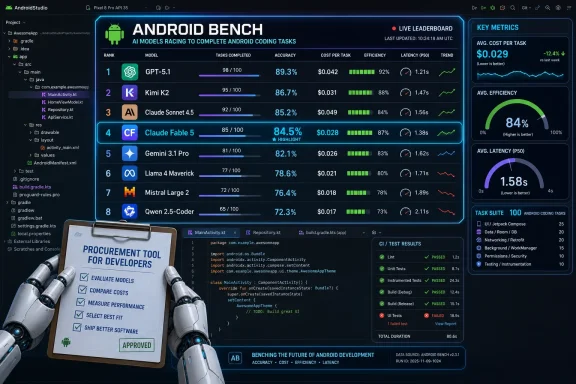
The awkward part for Google is that its benchmark has not functioned as a Gemini showcase. Ars noted that even the initial Android Bench release did not put Google’s AI models at the top; OpenAI’s latest LLMs were slightly ahead. In the new leaderboard, the story is worse for Google: Gemini 3.1 Pro is in fifth place, behind GPT 5.4, Claude Sonnet 5, and Claude Fable 5, with Claude Fable 5 posting an 84.5 percent accuracy result.
There are two ways to read that. The cynical interpretation is that Google has published a benchmark that embarrasses its own flagship model. The more important interpretation is that Google may be trying to make Android development itself the object of optimization, even if that means giving rival model makers a public way to beat Gemini on Google’s home turf.
Google’s decision to make Android Bench explicitly about Android app development is a recognition that the platform has its own physics. Mobile code is not just “software,” in the same way that a laptop driver, a cloud billing rule, and a React component are not the same category of engineering problem. Android projects involve UI resources, build variants, SDK contracts, Play ecosystem expectations, memory constraints, background execution limits, accessibility concerns, and years of framework evolution layered into code that may not have been touched in months.
This is where the phrase “AI coding assistant” becomes dangerously broad. A developer can ask an LLM to generate a sample screen and get something plausible in seconds. That is not the same as asking an agent to understand a mature app, edit the right files, avoid breaking tests, and preserve behavior that the user never explicitly described. Android Bench is aimed at the latter problem, which is why it matters more than another leaderboard showing that a model can solve a decontextualized programming puzzle.
Ars Technica’s report captured the practical tension: LLMs are popular coding tools, but they do not get everything right. Separating useful output from slop requires choosing the right tool. Android Bench is Google’s attempt to put numbers around that choice for one very large developer ecosystem.
That should sound familiar to Windows developers and IT professionals. The same shift has happened in system administration and endpoint management: a chatbot that can explain a PowerShell cmdlet is not the same as an agent that can safely remediate a failed deployment across a fleet. Context, tooling, permissions, rollback strategy, and error handling are the difference between convenience and operational risk. Android Bench is a mobile-development version of that same realization.
The headline result is Claude Fable 5’s 84.5 percent accuracy. That is not just a win over Gemini; it is a reminder that agentic coding performance is increasingly being judged at the workflow level. If a model can more reliably understand the repository, pick the right change, and produce a working patch, it becomes more than a text generator. It becomes a development dependency.
The comparison also complicates how organizations should think about “standardizing” on a single AI provider. Many companies would like to pick one model family for security, governance, billing, and support reasons. Android Bench argues against making that decision solely from broad brand strength. The best model for chat, summarization, or document search may not be the best model for Android patch generation.
That does not mean every engineering team should chase the highest leaderboard score every week. Leaderboards are snapshots. They reflect task design, scoring methods, run configuration, and the set of models included at the time. But a domain benchmark can still expose a crucial truth: if your team is paying for AI coding assistance, you should test it against your own work, not against a vendor’s favorite demo.
That is where AI coding gets uncomfortable for managers. Accuracy is easy to admire in isolation. But agentic coding can become expensive quickly when a system needs to inspect files, run multi-step reasoning, generate patches, retry failures, and consume long context windows. A model that wins by brute force may be useful for critical fixes and unacceptable for everyday refactoring. A cheaper model that performs slightly worse may be better for triage, code review suggestions, or repetitive maintenance tasks.
This is why cost and efficiency belong beside accuracy. An Android team does not buy abstract intelligence; it buys throughput under constraints. If a model can solve a task but requires many attempts, large token consumption, or long latency, its real value depends on whether it saves developer time after review, debugging, and integration costs are included.
There is also a governance angle. When AI coding tools move from experimentation to daily workflow, they become part of the software supply chain. The question is no longer “Can this model write code?” It is “Can this model write code reliably enough, cheaply enough, and transparently enough that we can justify using it across a team?” Android Bench’s expanded metrics push the discussion in that direction.
The efficiency question is especially important for mobile teams because many Android changes are not greenfield. They are maintenance tasks: adjust behavior, fix a regression, update an API call, repair a test, or change code in a way that avoids unintended side effects. A benchmark that measures completed tasks is useful; a benchmark that also pressures models on the cost of those completions is much closer to how development organizations actually make decisions.
But it is also the point. If Android Bench is perceived as a Gemini promotional page, developers will ignore it. If it is perceived as a serious Android benchmark that sometimes makes Google look bad, it gains credibility. The fifth-place Gemini 3.1 Pro result is embarrassing only if the goal is short-term positioning. If the goal is to build a durable evaluation layer for Android development, credibility is worth more than a flattering first-place badge.
Google’s public invitation for developers to run their own tests and submit feedback reinforces that interpretation. A benchmark becomes more useful when practitioners can reproduce it, contest it, and shape it. Android is too broad for any single suite of 100 tasks to settle the question forever. Feedback from developers can reveal whether the tasks overrepresent libraries, underrepresent app-specific UI work, miss certain Gradle pain points, or fail to capture the kinds of regressions that matter in production.
The adoption of a new framework that should be easier to use is also more than a tooling nicety. Benchmarks live or die by participation. If only the benchmark’s creators can run it cleanly, it becomes a static leaderboard. If outside developers and model providers can reproduce runs, inspect outputs, and adapt the framework, it becomes a common arena.
That is where Google may be thinking beyond Gemini. Android’s long-term health depends on the availability of tools that make developers more productive on Android specifically. If Claude, GPT, Gemini, Qwen, Kimi, GLM, and MiniMax all optimize for Android development tasks because Android Bench makes those tasks visible, the platform benefits even when Google’s own model does not win every round.
This distinction is easy to miss because AI leaderboards invite a consumer-electronics mindset: pick the top number, buy the winner, move on. Software teams cannot do that. A coding agent touches intellectual property, creates diff noise, may introduce subtle regressions, and can push developers toward accepting code they do not fully understand. The cost of a bad suggestion is not just the wasted prompt. It is review time, test failures, production defects, and the erosion of trust.
Android Bench should therefore be treated as a filter, not an oracle. If a model performs poorly on Android Bench, that is a warning sign for Android work. If a model performs well, that earns it a trial, not a blank check. Teams still need repository-specific evals, controlled pilots, permission boundaries, and review rules.
The rise of coding agents also creates a new kind of vendor lock-in. Once a team tunes prompts, workflows, CI hooks, and review habits around a specific model, switching costs appear even if the model itself is accessed through a standard API. Benchmarks can reduce that lock-in by making alternatives more visible, but they can also accelerate churn if teams chase every leaderboard change without thinking through operational stability.
For WindowsForum readers, the parallel to endpoint and update management is direct. A tool that looks good in a lab can behave differently across real fleets. The prudent response is not cynicism; it is staged rollout, measurement, and rollback planning. AI coding tools deserve the same discipline.
Open-weight models are not automatically safer, cheaper, or better. They can be difficult to operate, require specialized infrastructure, and underperform on complex tasks depending on configuration. But they offer a different governance story: the possibility of local or controlled deployment, deeper inspection, and reduced dependence on a single hosted provider.
For regulated industries and large enterprises, that matters. The codebase is often among the most sensitive assets a company owns. Sending repository context to an external model provider may be unacceptable for certain projects, or allowed only under strict contractual and technical controls. If Android Bench can show where open-weight models are good enough — and where they are not — it gives decision-makers a better way to evaluate trade-offs.
This is also where efficiency metrics become practical. A frontier model may deliver higher accuracy, but an open-weight model that is cheaper to run and adequate for narrow tasks could be attractive for internal lint-like workflows, test repair suggestions, or documentation-linked code changes. Conversely, if the gap is too large, the benchmark can justify reserving sensitive tasks for human developers or carefully approved external models.
The important word is “specific.” Android Bench does not prove that an open-weight model is generally enterprise-ready. It can help show whether a model is viable for certain Android development tasks under defined conditions. That is the right level of ambition.
Android Bench tries to quantify one part of that trust: whether a model completes tasks accurately. That is essential, but it is not the whole story. A model that solves a task with a sprawling, risky patch may be less useful than a slightly less accurate model that produces conservative changes. A model that burns through budget invisibly may be less acceptable than one with predictable efficiency. A model that performs well only under a particular agent framework may not transfer cleanly into a team’s preferred IDE or CI pipeline.
This is why the new framework matters. Agent benchmarks are never just about the underlying model. They are about the harness: how the model is prompted, what tools it can use, how it sees the repository, whether it can run tests, how failures are handled, and how many attempts it gets. Changing the framework can change the meaning of the result.
That does not make the benchmark invalid. It makes it more honest. Real AI coding is a system, not a model call. Android Bench’s evolution toward easier use, broader model coverage, and cost-efficiency measurement reflects the maturity of the category.
The risk is that vendors will optimize for the benchmark rather than for developer reality. That has happened in every benchmarked industry. The defense is transparency, task refreshes, community feedback, and skepticism about any single number. Google inviting developers to submit feedback is therefore not just community theater; it is a necessary guardrail against benchmark rot.
But the next step is not to rip out existing tooling. The next step is to run controlled comparisons against the work your team actually does. Use Android Bench as a starting point, then create an internal evaluation set from recent bugs, merged pull requests, flaky tests, migration tasks, and code review comments. Measure not just whether the model produces an answer, but whether a developer would accept the patch after review.
Teams should also distinguish task classes. One model may be best for patch generation. Another may be good enough for explaining unfamiliar code. A cheaper model may be ideal for generating test scaffolding or summarizing build failures. A premium model may be worth reserving for multi-file changes with high ambiguity.
That division of labor is how AI coding will probably settle into serious teams. The future is unlikely to be one omniscient model doing everything. It is more likely to be a routed system where tasks go to different models based on risk, cost, context length, and expected payoff. Android Bench’s new cost and efficiency metrics point directly toward that future.
That reading is true but incomplete. The larger story is that Google is creating a public pressure mechanism around Android coding. By measuring model performance on Android-specific tasks, adding cost and efficiency, and broadening the model field, Google is telling the AI industry that Android development is a distinct target worth optimizing for.
That could pay off even if Gemini remains behind for several leaderboard cycles. Android’s competitive problem has never been merely whether Google can ship a good model. It is whether developers can build, maintain, and modernize Android apps with less friction than before. If Android Bench pushes every major model provider to get better at Android repositories, Gradle projects, Kotlin patterns, and platform-specific patching, Google wins at the ecosystem level.
There is a caution here for Microsoft watchers as well. Platform owners increasingly need to benchmark AI systems against the work their developers actually do. Microsoft has Windows, .NET, Azure, Office, PowerShell, and enterprise management workflows that are just as domain-specific as Android. Generic coding intelligence is valuable, but platform-native competence is where developer trust will be won.
 Google Builds the Ruler, Then Fails to Top the Measurement
Android Bench began as a pointed admission: coding benchmarks that look impressive in the abstract do not necessarily tell an Android team which agent can understand a Gradle project, change Kotlin or Java safely, and produce a patch that survives real tests. As Ars Technica reported, Google created the benchmark earlier this year to evaluate how large language models perform in Android app development, then launched Android Bench in March as a formal leaderboard and testing framework.That framing matters. Google is not benchmarking poetry, browser trivia, or isolated algorithm puzzles. Android Bench is aimed at Android app development, where “works” means navigating a mobile codebase, respecting platform conventions, generating a patch, and avoiding the kind of plausible nonsense that looks fine in a chat window but collapses in CI.
The benchmark currently centers on a suite of 100 Android development tasks. That is small enough that every task selection choice matters, but large enough to show why a single anecdotal “Claude fixed my bug” or “Gemini wrote my Activity” story is not evidence. Android development is full of platform-specific traps: lifecycle state, permissions, resource handling, dependency resolution, test harnesses, SDK version differences, and the long tail of project-specific architecture. A coding agent that does well on generic Python exercises may still stumble when dropped into an Android repository.
The awkward part for Google is that its benchmark has not functioned as a Gemini showcase. Ars noted that even the initial Android Bench release did not put Google’s AI models at the top; OpenAI’s latest LLMs were slightly ahead. In the new leaderboard, the story is worse for Google: Gemini 3.1 Pro is in fifth place, behind GPT 5.4, Claude Sonnet 5, and Claude Fable 5, with Claude Fable 5 posting an 84.5 percent accuracy result.
There are two ways to read that. The cynical interpretation is that Google has published a benchmark that embarrasses its own flagship model. The more important interpretation is that Google may be trying to make Android development itself the object of optimization, even if that means giving rival model makers a public way to beat Gemini on Google’s home turf.
Android Coding Is Now Too Specific for Generic AI Bragging Rights
The benchmark arms race has trained users to expect giant model launches to arrive with giant scorecards. But the scorecards often hide the question that matters most to practitioners: scorecards for what? A model that is excellent at mathematical reasoning, contract summarization, or general software interview problems is not automatically excellent at fixing an Android app.Google’s decision to make Android Bench explicitly about Android app development is a recognition that the platform has its own physics. Mobile code is not just “software,” in the same way that a laptop driver, a cloud billing rule, and a React component are not the same category of engineering problem. Android projects involve UI resources, build variants, SDK contracts, Play ecosystem expectations, memory constraints, background execution limits, accessibility concerns, and years of framework evolution layered into code that may not have been touched in months.
This is where the phrase “AI coding assistant” becomes dangerously broad. A developer can ask an LLM to generate a sample screen and get something plausible in seconds. That is not the same as asking an agent to understand a mature app, edit the right files, avoid breaking tests, and preserve behavior that the user never explicitly described. Android Bench is aimed at the latter problem, which is why it matters more than another leaderboard showing that a model can solve a decontextualized programming puzzle.
Ars Technica’s report captured the practical tension: LLMs are popular coding tools, but they do not get everything right. Separating useful output from slop requires choosing the right tool. Android Bench is Google’s attempt to put numbers around that choice for one very large developer ecosystem.
That should sound familiar to Windows developers and IT professionals. The same shift has happened in system administration and endpoint management: a chatbot that can explain a PowerShell cmdlet is not the same as an agent that can safely remediate a failed deployment across a fleet. Context, tooling, permissions, rollback strategy, and error handling are the difference between convenience and operational risk. Android Bench is a mobile-development version of that same realization.
The New Leaderboard Is a Model Market in Miniature
Google’s update adds eight new models to Android Bench: Claude Fable 5, Claude Sonnet 5, Claude Opus 4.8, GLM 5.2, Kimi K2.7 Code, MiniMax M3, Qwen 3.7 Plus, and Qwen 3.7 Max. The list is important because it reflects the current shape of the LLM market: frontier closed models, coding-specialized challengers, and open-weight or more accessible contenders all competing on a narrower and more useful field.| Model | Status in this Android Bench update | Reported benchmark detail |
|---|---|---|
| Claude Fable 5 | Newly added | 84.5 percent accuracy; ahead of Gemini 3.1 Pro |
| Claude Sonnet 5 | Newly added | Ahead of Gemini 3.1 Pro |
| Claude Opus 4.8 | Newly added | Added among the eight new models |
| GLM 5.2 | Newly added | Added among the eight new models |
| Kimi K2.7 Code | Newly added | Added among the eight new models |
| MiniMax M3 | Newly added | Added among the eight new models |
| Qwen 3.7 Plus | Newly added | Added among the eight new models |
| Qwen 3.7 Max | Newly added | Added among the eight new models |
| Gemini 3.1 Pro | Existing Google model on the new leaderboard | Fifth place |
| GPT 5.4 | On the new leaderboard | Ahead of Gemini 3.1 Pro |
The comparison also complicates how organizations should think about “standardizing” on a single AI provider. Many companies would like to pick one model family for security, governance, billing, and support reasons. Android Bench argues against making that decision solely from broad brand strength. The best model for chat, summarization, or document search may not be the best model for Android patch generation.
That does not mean every engineering team should chase the highest leaderboard score every week. Leaderboards are snapshots. They reflect task design, scoring methods, run configuration, and the set of models included at the time. But a domain benchmark can still expose a crucial truth: if your team is paying for AI coding assistance, you should test it against your own work, not against a vendor’s favorite demo.
Cost and Efficiency Turn the Scoreboard Into a Budget Conversation
The most consequential addition may not be the new names on the leaderboard. Google has also added metrics such as cost and efficiency, which changes Android Bench from a simple “who scored highest” contest into a more realistic engineering trade-off.That is where AI coding gets uncomfortable for managers. Accuracy is easy to admire in isolation. But agentic coding can become expensive quickly when a system needs to inspect files, run multi-step reasoning, generate patches, retry failures, and consume long context windows. A model that wins by brute force may be useful for critical fixes and unacceptable for everyday refactoring. A cheaper model that performs slightly worse may be better for triage, code review suggestions, or repetitive maintenance tasks.
This is why cost and efficiency belong beside accuracy. An Android team does not buy abstract intelligence; it buys throughput under constraints. If a model can solve a task but requires many attempts, large token consumption, or long latency, its real value depends on whether it saves developer time after review, debugging, and integration costs are included.
There is also a governance angle. When AI coding tools move from experimentation to daily workflow, they become part of the software supply chain. The question is no longer “Can this model write code?” It is “Can this model write code reliably enough, cheaply enough, and transparently enough that we can justify using it across a team?” Android Bench’s expanded metrics push the discussion in that direction.
The efficiency question is especially important for mobile teams because many Android changes are not greenfield. They are maintenance tasks: adjust behavior, fix a regression, update an API call, repair a test, or change code in a way that avoids unintended side effects. A benchmark that measures completed tasks is useful; a benchmark that also pressures models on the cost of those completions is much closer to how development organizations actually make decisions.
Google’s Transparency Cuts Both Ways
There is a real strategic risk in Google’s approach. By publishing a benchmark where Gemini is not leading, Google gives competitors an easy talking point: even Google’s own Android test shows rival models ahead. For a company trying to persuade developers to build with its AI stack, that is not an obvious marketing win.But it is also the point. If Android Bench is perceived as a Gemini promotional page, developers will ignore it. If it is perceived as a serious Android benchmark that sometimes makes Google look bad, it gains credibility. The fifth-place Gemini 3.1 Pro result is embarrassing only if the goal is short-term positioning. If the goal is to build a durable evaluation layer for Android development, credibility is worth more than a flattering first-place badge.
Google’s public invitation for developers to run their own tests and submit feedback reinforces that interpretation. A benchmark becomes more useful when practitioners can reproduce it, contest it, and shape it. Android is too broad for any single suite of 100 tasks to settle the question forever. Feedback from developers can reveal whether the tasks overrepresent libraries, underrepresent app-specific UI work, miss certain Gradle pain points, or fail to capture the kinds of regressions that matter in production.
The adoption of a new framework that should be easier to use is also more than a tooling nicety. Benchmarks live or die by participation. If only the benchmark’s creators can run it cleanly, it becomes a static leaderboard. If outside developers and model providers can reproduce runs, inspect outputs, and adapt the framework, it becomes a common arena.
That is where Google may be thinking beyond Gemini. Android’s long-term health depends on the availability of tools that make developers more productive on Android specifically. If Claude, GPT, Gemini, Qwen, Kimi, GLM, and MiniMax all optimize for Android development tasks because Android Bench makes those tasks visible, the platform benefits even when Google’s own model does not win every round.
The Benchmark Is Useful, but It Is Not the Same as Production Readiness
Android Bench’s 100-task suite is a serious step toward practical evaluation, but it should not be mistaken for a substitute for local testing. A benchmark can tell you which models performed well on a curated task set. It cannot tell you which model understands your app’s architecture, your security requirements, your legacy abstractions, or your tolerance for risk.This distinction is easy to miss because AI leaderboards invite a consumer-electronics mindset: pick the top number, buy the winner, move on. Software teams cannot do that. A coding agent touches intellectual property, creates diff noise, may introduce subtle regressions, and can push developers toward accepting code they do not fully understand. The cost of a bad suggestion is not just the wasted prompt. It is review time, test failures, production defects, and the erosion of trust.
Android Bench should therefore be treated as a filter, not an oracle. If a model performs poorly on Android Bench, that is a warning sign for Android work. If a model performs well, that earns it a trial, not a blank check. Teams still need repository-specific evals, controlled pilots, permission boundaries, and review rules.
The rise of coding agents also creates a new kind of vendor lock-in. Once a team tunes prompts, workflows, CI hooks, and review habits around a specific model, switching costs appear even if the model itself is accessed through a standard API. Benchmarks can reduce that lock-in by making alternatives more visible, but they can also accelerate churn if teams chase every leaderboard change without thinking through operational stability.
For WindowsForum readers, the parallel to endpoint and update management is direct. A tool that looks good in a lab can behave differently across real fleets. The prudent response is not cynicism; it is staged rollout, measurement, and rollback planning. AI coding tools deserve the same discipline.
Android Bench Gives Open-Weight Models a More Concrete Test
The inclusion of open-weight models in Android Bench’s expanded scope is significant because it gives organizations another axis of comparison. Many AI coding discussions collapse into frontier-model horse races. But some teams care just as much about deployment model, data control, customization, and cost predictability.Open-weight models are not automatically safer, cheaper, or better. They can be difficult to operate, require specialized infrastructure, and underperform on complex tasks depending on configuration. But they offer a different governance story: the possibility of local or controlled deployment, deeper inspection, and reduced dependence on a single hosted provider.
For regulated industries and large enterprises, that matters. The codebase is often among the most sensitive assets a company owns. Sending repository context to an external model provider may be unacceptable for certain projects, or allowed only under strict contractual and technical controls. If Android Bench can show where open-weight models are good enough — and where they are not — it gives decision-makers a better way to evaluate trade-offs.
This is also where efficiency metrics become practical. A frontier model may deliver higher accuracy, but an open-weight model that is cheaper to run and adequate for narrow tasks could be attractive for internal lint-like workflows, test repair suggestions, or documentation-linked code changes. Conversely, if the gap is too large, the benchmark can justify reserving sensitive tasks for human developers or carefully approved external models.
The important word is “specific.” Android Bench does not prove that an open-weight model is generally enterprise-ready. It can help show whether a model is viable for certain Android development tasks under defined conditions. That is the right level of ambition.
The Real Contest Is Over Developer Trust
The most durable advantage in AI coding may not be raw model intelligence. It may be trust. Developers will forgive an assistant that occasionally fails if it fails legibly, suggests small diffs, explains its reasoning, and improves the review process. They will abandon one that produces confident sludge, hides uncertainty, or repeatedly wastes time.Android Bench tries to quantify one part of that trust: whether a model completes tasks accurately. That is essential, but it is not the whole story. A model that solves a task with a sprawling, risky patch may be less useful than a slightly less accurate model that produces conservative changes. A model that burns through budget invisibly may be less acceptable than one with predictable efficiency. A model that performs well only under a particular agent framework may not transfer cleanly into a team’s preferred IDE or CI pipeline.
This is why the new framework matters. Agent benchmarks are never just about the underlying model. They are about the harness: how the model is prompted, what tools it can use, how it sees the repository, whether it can run tests, how failures are handled, and how many attempts it gets. Changing the framework can change the meaning of the result.
That does not make the benchmark invalid. It makes it more honest. Real AI coding is a system, not a model call. Android Bench’s evolution toward easier use, broader model coverage, and cost-efficiency measurement reflects the maturity of the category.
The risk is that vendors will optimize for the benchmark rather than for developer reality. That has happened in every benchmarked industry. The defense is transparency, task refreshes, community feedback, and skepticism about any single number. Google inviting developers to submit feedback is therefore not just community theater; it is a necessary guardrail against benchmark rot.
What Android Teams Should Actually Do Next
For Android developers, the new leaderboard is useful because it narrows the shortlist. Claude Fable 5’s 84.5 percent accuracy result demands attention. GPT 5.4 and Claude Sonnet 5 being ahead of Gemini 3.1 Pro also matters, because it suggests that the top Android coding agent may not come from the platform owner.But the next step is not to rip out existing tooling. The next step is to run controlled comparisons against the work your team actually does. Use Android Bench as a starting point, then create an internal evaluation set from recent bugs, merged pull requests, flaky tests, migration tasks, and code review comments. Measure not just whether the model produces an answer, but whether a developer would accept the patch after review.
Teams should also distinguish task classes. One model may be best for patch generation. Another may be good enough for explaining unfamiliar code. A cheaper model may be ideal for generating test scaffolding or summarizing build failures. A premium model may be worth reserving for multi-file changes with high ambiguity.
That division of labor is how AI coding will probably settle into serious teams. The future is unlikely to be one omniscient model doing everything. It is more likely to be a routed system where tasks go to different models based on risk, cost, context length, and expected payoff. Android Bench’s new cost and efficiency metrics point directly toward that future.
Action checklist for admins
- Treat Android Bench as a shortlist, not a purchasing decision.
- Run the updated framework against a small internal set of Android bugs, tests, and maintenance tasks.
- Compare accuracy, latency, review time, and total model cost before standardizing on a tool.
- Separate low-risk uses, such as explanation and test scaffolding, from high-risk patch generation.
- Require human review for generated code and track defect rates from AI-assisted changes.
- Send benchmark feedback upstream if the public task set does not reflect your Android workload.
Google’s Fifth-Place Problem Is Also Android’s Opportunity
It would be easy to make this a simple winner-and-loser story. Claude Fable 5 leads with 84.5 percent accuracy. Gemini 3.1 Pro is fifth. Google’s benchmark has become evidence against Google’s model supremacy in Android development.That reading is true but incomplete. The larger story is that Google is creating a public pressure mechanism around Android coding. By measuring model performance on Android-specific tasks, adding cost and efficiency, and broadening the model field, Google is telling the AI industry that Android development is a distinct target worth optimizing for.
That could pay off even if Gemini remains behind for several leaderboard cycles. Android’s competitive problem has never been merely whether Google can ship a good model. It is whether developers can build, maintain, and modernize Android apps with less friction than before. If Android Bench pushes every major model provider to get better at Android repositories, Gradle projects, Kotlin patterns, and platform-specific patching, Google wins at the ecosystem level.
There is a caution here for Microsoft watchers as well. Platform owners increasingly need to benchmark AI systems against the work their developers actually do. Microsoft has Windows, .NET, Azure, Office, PowerShell, and enterprise management workflows that are just as domain-specific as Android. Generic coding intelligence is valuable, but platform-native competence is where developer trust will be won.
The Practical Read for Developers, Managers, and Model Buyers
Android Bench’s update is not a declaration that one model has solved Android development. It is a sign that AI coding evaluation is becoming more serious, narrower, and more operationally relevant.- Claude Fable 5 is the standout reported performer, with 84.5 percent accuracy on the updated Android Bench test.
- Gemini 3.1 Pro’s fifth-place result matters because this is Google’s own Android-focused benchmark, not a rival’s marketing test.
- The addition of cost and efficiency metrics makes the leaderboard more useful for real teams than accuracy alone.
- The eight-model expansion shows that Android coding is now a competitive target for multiple model families, not just Google and OpenAI.
- Developers should run their own tests and submit feedback rather than treating the public leaderboard as final truth.
- Engineering leaders should evaluate AI coding agents by accepted patches, review burden, regression risk, and total cost — not demo quality.
References
- Primary source: Ars Technica
Published: Wed, 08 Jul 2026 16:39:48 GMT
Google updates Android Bench with new LLMs, but Gemini still lags behind - Ars Technica
Android Bench is evolving, and developers can help guide that process.arstechnica.com - Official source: github.com
GitHub - android-bench/android-bench: Android Bench is a framework for benchmarking Large Language Models (LLMs) on Android development tasks. It evaluates an AI model's ability to understand mobile codebases, generate accurate patches, and solve
Android Bench is a framework for benchmarking Large Language Models (LLMs) on Android development tasks. It evaluates an AI model's ability to understand mobile codebases, generate accurate patches, and solve Android-specific engineering problems. - android-bench/android-bench github.com
- Related coverage: techenet.com
- Related coverage: developer.android.com
- Related coverage: therift.ai
- Related coverage: androidcentral.com
Google will now show which AI models are best at building Android apps | Android Central
Of course, Gemini is on top.www.androidcentral.com
- Related coverage: lumichats.com
- Related coverage: eweek.com
Gemini Beats Claude, GPT in Google’s First Android AI Coding Benchmark | eWeek
Google’s new Android Bench ranks the top AI models for Android coding, with Gemini 3.1 Pro Preview leading Claude Opus 4.6 and GPT-5.2-Codex. www.eweek.com
- Related coverage: androidauthority.com
Google's Android coding tests reveal an unexpected Gemini 3.5 Flash weakness
Google's Gemini 3.5 Flash flunks the Android coding test by being slower, dumber, and three times more expensive than older AI models.www.androidauthority.com - Related coverage: letsdatascience.com
Google Releases Android Bench to Evaluate LLMs | Let's Data Science
According to MarkTechPost and the Android Developers methodology page, Google has released **Android Bench**, an open-source evaluation framework and leaderboard for Large Language Models on Android development tasks. Android Bench uses a curated dataset of **100** real-world tasks drawn from... letsdatascience.com
- Related coverage: appforge-bench.github.io
- Related coverage: iaexpertos.net
Android Bench: Google's New AI Benchmark for Mobile Development | IAExpertos.net
Google unveils Android Bench, an open-source framework to evaluate Large Language Models (LLMs) in real-world Android development scenarios. iaexpertos.net
- Related coverage: labs.scale.com
