

Google DeepMind CEO Demis Hassabis said in June 2026 that Google is still winning the AI talent race, even as high-profile researchers have left for OpenAI, Anthropic, Meta, and other rivals. His claim is not just defensive executive spin; it is a statement about what kind of institution wins when artificial intelligence stops being a chatbot feature and becomes infrastructure, science platform, cloud business, and geopolitical asset at once. The departures matter, but so does the bench behind them. The real contest is not whether Google can keep every star researcher, but whether it can turn its research machine into products fast enough to make those defections look like churn rather than decline.
The simplest version of the story is irresistible: Google invented or incubated many of the techniques behind the modern AI boom, then watched rivals commercialize them faster and recruit away the people who built them. That version has enough truth to sting. The transformer architecture, large-scale AI research culture, AlphaFold, and much of the current frontier-lab vocabulary all run through Google’s history.
But the harder version is more interesting. Google is not a hollowed-out research lab clinging to old glory; it is a company trying to reconcile three incompatible clocks. Academic research moves by papers and breakthroughs, product organizations move by launch cycles, and platform companies move by ecosystem lock-in. Hassabis’s argument is that Google’s scale lets it run all three clocks at once.
The recent defections are still meaningful because elite AI research is not like ordinary enterprise software hiring. A handful of researchers can influence model architecture, training strategy, synthetic data pipelines, safety culture, and entire product lines. When names associated with reasoning, coding, protein folding, or model evaluation move, competitors are not merely buying headcount. They are buying judgment.
That is why Hassabis’s “biggest and broadest research bench” defense lands as both plausible and incomplete. Breadth matters when AI becomes a general-purpose technology. But the frontier is often moved by small teams making uncomfortably specific bets before the bureaucracy catches up.
That is a different kind of recruitment pitch from “come build the next coding agent” or “come optimize ads with a larger context window.” Isomorphic Labs’ $2.1 billion Series B gives Hassabis a concrete story to tell researchers who want their work measured in more than benchmark scores. The company is targeting its first Investigational New Drug application by the end of 2026, and Hassabis has said its programs are already in pre-clinical development.
For researchers drawn to scientific impact, that matters. The 2024 Nobel Prize in Chemistry awarded to Hassabis and John Jumper for AlphaFold gave Google DeepMind something rare in Silicon Valley: proof that its AI work can meet the highest standards of science, not just the launch-day theater of product demos. In a labor market distorted by equity packages and signing bonuses, scientific legitimacy is a form of compensation too.
This is the strongest version of Google’s talent argument. OpenAI can offer proximity to the most famous consumer AI product. Anthropic can offer a safety-centered culture and enterprise momentum. Meta can offer vast compute and aggressive packages. Google can offer a giant research institution with direct lines into search, Android, cloud, productivity software, robotics, biology, and basic science.
That hesitation used to look responsible. Google had search quality to protect, regulators to appease, brand trust to preserve, and a global advertising business that punished reckless experimentation. In the pre-ChatGPT era, restraint could be framed as prudence. After ChatGPT, the same restraint looked like fear.
The reorganization that merged Google Brain and DeepMind into a more unified Google DeepMind was designed to fix that. Hassabis now sits closer to the center of Google’s product strategy than DeepMind did in its earlier, more autonomous years. Gemini is not a side project. It is the connective tissue across Search, Workspace, Android, Cloud, and developer tooling.
Yet the departures suggest that not every researcher wants to live inside that product machine. Some may prefer the speed of OpenAI, the tighter mission frame of Anthropic, the blank-check urgency of Meta, or the startup-like possibility of turning frontier work into outsized personal equity. Google’s advantage is scale; its liability is also scale.
The cultural question is whether Google can make elite researchers feel that shipping through a trillion-dollar platform is more liberating than constraining. If it cannot, the bench will remain broad while the sharpest edges keep walking out the door.
For Microsoft, that layer is Windows, Azure, Microsoft 365, GitHub, and the Copilot brand. For Google, it is Search, Android, Chrome, Workspace, Gemini, and Google Cloud. For Meta, it is social distribution, open-weight strategy, consumer devices, and an enormous advertising engine. For OpenAI and Anthropic, it is the model interface itself, extended outward into enterprise APIs, agents, coding tools, and partnerships.
That is why individual researchers have become strategic assets. The person who improves coding performance may shift developer mindshare. The person who advances long-context reasoning may change enterprise document workflows. The person who makes multimodal agents more reliable may influence how operating systems expose files, apps, notifications, and permissions to AI assistants.
Windows users should not treat this as distant Silicon Valley gossip. The AI talent war will shape the tools that appear inside the operating system, the browser, the IDE, and the office suite. It will determine whether AI feels like a helpful layer in Windows or an unstable subscription service bolted onto familiar workflows.
The same is true for sysadmins. Better models may automate helpdesk triage, endpoint remediation, identity-risk analysis, and log summarization. Worse models may hallucinate PowerShell commands, misread security alerts, or bury administrators in plausible nonsense. Talent choices at frontier labs eventually become operational risk in enterprise environments.
That framing gives Google a recruiting asset that is hard to copy. A pure software lab can talk about artificial general intelligence in sweeping terms, but drug discovery imposes a different discipline. Molecules either work or they do not. Pre-clinical programs either advance or fail. Regulators require evidence. Biology punishes hype.
This is why AlphaFold remains so important to Google’s AI identity. It is not simply a celebrated model; it is a proof point that AI can break open a scientific bottleneck. For researchers deciding where to spend the next five years of their lives, that proof point may matter more than a larger grant of private-company equity.
Still, science cuts both ways. Drug discovery is slow, expensive, and failure-prone. An Investigational New Drug filing target by the end of 2026 is ambitious, but it is only the start of a long clinical process. If Isomorphic succeeds, Hassabis gains one of the most powerful recruitment stories in AI. If it stalls, rivals will argue that Google’s grand mission is less immediately compelling than shipping agents to hundreds of millions of users.
That can work, up to a point. Compute, compensation, and distribution are real advantages. Meta has the money to hire, the infrastructure to train, and the consumer surface area to deploy. It also has a history of making open releases that reshape developer behavior, even when its consumer AI branding lags behind competitors.
But frontier AI is not assembled like a fantasy sports roster. Research teams need shared taste, common tooling, trust, and a coherent sense of what problem they are solving. A lab built through rapid poaching can become formidable, but it can also become a room full of famous people optimizing for different futures.
Hassabis’s implicit critique is that Google does not need to panic-buy talent because it already has the institutional depth. That is a credible argument, but it risks sounding complacent if rivals start shipping visibly better products. In AI, morale follows capability. Researchers want to be where the next breakthrough feels likely.
That clarity matters to researchers. A smaller lab can make a technical bet feel existential. A larger company can make the same bet feel like one input into a quarterly product roadmap.
Google’s answer is integration. Gemini can appear in Search, Android, Workspace, Cloud, and developer tools without needing to build distribution from scratch. If the model is good enough, that distribution is overwhelming. If the model is not good enough, distribution becomes a reminder that users are being pushed toward something they did not ask for.
This is where the talent story meets product reality. Researchers may join for mission, but they stay when they believe their work changes the world quickly and visibly. Google has world-changing surfaces everywhere. Its challenge is making those surfaces feel like accelerants rather than committees.
Microsoft benefits when labs compete fiercely because that competition improves the models and tools Microsoft can package into familiar workflows. It also faces a strategic vulnerability: if OpenAI, Anthropic, Google, or Meta capture developer loyalty outside Microsoft’s stack, Windows becomes one surface among many rather than the default command center for work.
The talent war therefore influences Microsoft indirectly. If Google’s Gemini ecosystem becomes meaningfully better at multimodal, long-context, or agentic workflows, Chrome, Android, and Workspace gain leverage against Windows and Microsoft 365. If OpenAI keeps attracting top researchers and shipping the most compelling assistant experience, Microsoft must balance partnership dependence with platform control. If Anthropic becomes the enterprise trust leader, Azure customers may demand model choice rather than Microsoft-preferred defaults.
This matters because AI is moving from apps into orchestration. The next competitive layer is not simply “which chatbot is smarter.” It is which assistant can safely act across email, files, identity systems, browsers, calendars, terminals, codebases, and cloud consoles. That is operating-system territory, even when the interface appears in a browser tab.
This is the brutal compression of the AI era. Scientific prestige, consumer product polish, cloud economics, and developer experience are now part of the same story. A lab can no longer win by publishing brilliant papers alone. It must also ship, monetize, govern, and support.
The same compression applies to talent. A researcher leaving Google may be a personal career decision, a compensation event, a cultural signal, or an indictment of the company’s direction. Outsiders often cannot know which. But enough departures in a short period create a narrative, and narratives affect recruiting.
Hassabis is trying to counter that narrative before it hardens. His message is that movement among researchers is normal in a ferociously competitive field, and that Google still has the deepest bench. That may be true. The harder question is whether the deepest bench still wins when the game rewards speed, focus, and product aggression.
If the assistant layer becomes more important than the OS shell, then Microsoft, Google, OpenAI, Anthropic, and Meta are all competing to define the new command surface. That surface may live in Windows, Edge, Chrome, Android, Office, Gmail, VS Code, or a standalone app. The location matters less than the permissions it receives and the trust it earns.
For administrators, this raises uncomfortable governance questions. Which AI tools are allowed to read corporate documents? Which can execute actions? Which can write code or scripts? Which logs are retained? Which models are approved for regulated data? Which vendor is responsible when an agent makes a plausible but damaging recommendation?
Google’s ability to keep and attract top researchers will shape the quality of its answers to those questions. So will Microsoft’s. So will every other lab’s. Talent churn at the frontier eventually becomes policy churn in IT departments.
The risk is that all of those strengths can become excuses. Distribution can hide weak user enthusiasm. Research history can become nostalgia. Infrastructure can encourage brute-force thinking. A science mission can distract from consumer and enterprise product urgency. Reorganization can look like strategy while slowing the people it is supposed to empower.
The next year will be clarifying. If Google converts its bench into models and products that feel unmistakably ahead, the defections will look like noise around an institution still operating at scale. If rivals continue to ship faster and recruit marquee names, Hassabis’s confidence will look less like leadership and more like whistling past the graveyard.
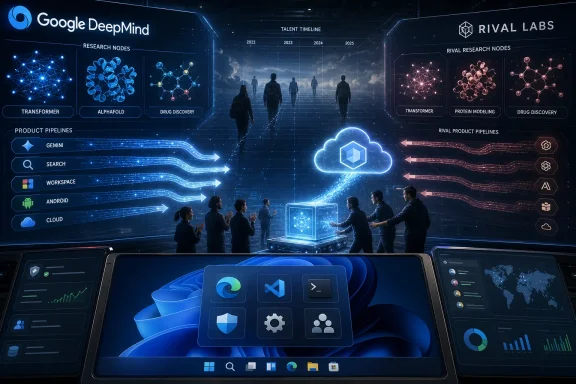 Google’s Talent Problem Is Real, but It Is Not the Whole Story
The simplest version of the story is irresistible: Google invented or incubated many of the techniques behind the modern AI boom, then watched rivals commercialize them faster and recruit away the people who built them. That version has enough truth to sting. The transformer architecture, large-scale AI research culture, AlphaFold, and much of the current frontier-lab vocabulary all run through Google’s history.But the harder version is more interesting. Google is not a hollowed-out research lab clinging to old glory; it is a company trying to reconcile three incompatible clocks. Academic research moves by papers and breakthroughs, product organizations move by launch cycles, and platform companies move by ecosystem lock-in. Hassabis’s argument is that Google’s scale lets it run all three clocks at once.
The recent defections are still meaningful because elite AI research is not like ordinary enterprise software hiring. A handful of researchers can influence model architecture, training strategy, synthetic data pipelines, safety culture, and entire product lines. When names associated with reasoning, coding, protein folding, or model evaluation move, competitors are not merely buying headcount. They are buying judgment.
That is why Hassabis’s “biggest and broadest research bench” defense lands as both plausible and incomplete. Breadth matters when AI becomes a general-purpose technology. But the frontier is often moved by small teams making uncomfortably specific bets before the bureaucracy catches up.
Hassabis Is Selling Mission Against Money
The most revealing part of Hassabis’s response is not the confidence about Google’s bench. It is the way he connects talent to mission. In the same period that AI companies were fighting over researchers with startling compensation packages, Hassabis was pointing to Isomorphic Labs, AlphaFold, and the ambition to use AI to redesign drug discovery.That is a different kind of recruitment pitch from “come build the next coding agent” or “come optimize ads with a larger context window.” Isomorphic Labs’ $2.1 billion Series B gives Hassabis a concrete story to tell researchers who want their work measured in more than benchmark scores. The company is targeting its first Investigational New Drug application by the end of 2026, and Hassabis has said its programs are already in pre-clinical development.
For researchers drawn to scientific impact, that matters. The 2024 Nobel Prize in Chemistry awarded to Hassabis and John Jumper for AlphaFold gave Google DeepMind something rare in Silicon Valley: proof that its AI work can meet the highest standards of science, not just the launch-day theater of product demos. In a labor market distorted by equity packages and signing bonuses, scientific legitimacy is a form of compensation too.
This is the strongest version of Google’s talent argument. OpenAI can offer proximity to the most famous consumer AI product. Anthropic can offer a safety-centered culture and enterprise momentum. Meta can offer vast compute and aggressive packages. Google can offer a giant research institution with direct lines into search, Android, cloud, productivity software, robotics, biology, and basic science.
The Defections Expose Google’s Oldest AI Weakness
Google’s problem has rarely been invention. It has been conversion. The company has often been brilliant at discovering the future and strangely hesitant about shipping it in a form that changes the market before someone else does.That hesitation used to look responsible. Google had search quality to protect, regulators to appease, brand trust to preserve, and a global advertising business that punished reckless experimentation. In the pre-ChatGPT era, restraint could be framed as prudence. After ChatGPT, the same restraint looked like fear.
The reorganization that merged Google Brain and DeepMind into a more unified Google DeepMind was designed to fix that. Hassabis now sits closer to the center of Google’s product strategy than DeepMind did in its earlier, more autonomous years. Gemini is not a side project. It is the connective tissue across Search, Workspace, Android, Cloud, and developer tooling.
Yet the departures suggest that not every researcher wants to live inside that product machine. Some may prefer the speed of OpenAI, the tighter mission frame of Anthropic, the blank-check urgency of Meta, or the startup-like possibility of turning frontier work into outsized personal equity. Google’s advantage is scale; its liability is also scale.
The cultural question is whether Google can make elite researchers feel that shipping through a trillion-dollar platform is more liberating than constraining. If it cannot, the bench will remain broad while the sharpest edges keep walking out the door.
The AI Labor Market Has Become a Proxy War for Platforms
The talent race is not really about résumés. It is about platform power. Every major AI lab is trying to control the layer through which users, developers, and enterprises experience machine intelligence.For Microsoft, that layer is Windows, Azure, Microsoft 365, GitHub, and the Copilot brand. For Google, it is Search, Android, Chrome, Workspace, Gemini, and Google Cloud. For Meta, it is social distribution, open-weight strategy, consumer devices, and an enormous advertising engine. For OpenAI and Anthropic, it is the model interface itself, extended outward into enterprise APIs, agents, coding tools, and partnerships.
That is why individual researchers have become strategic assets. The person who improves coding performance may shift developer mindshare. The person who advances long-context reasoning may change enterprise document workflows. The person who makes multimodal agents more reliable may influence how operating systems expose files, apps, notifications, and permissions to AI assistants.
Windows users should not treat this as distant Silicon Valley gossip. The AI talent war will shape the tools that appear inside the operating system, the browser, the IDE, and the office suite. It will determine whether AI feels like a helpful layer in Windows or an unstable subscription service bolted onto familiar workflows.
The same is true for sysadmins. Better models may automate helpdesk triage, endpoint remediation, identity-risk analysis, and log summarization. Worse models may hallucinate PowerShell commands, misread security alerts, or bury administrators in plausible nonsense. Talent choices at frontier labs eventually become operational risk in enterprise environments.
Google’s Science Bet Gives It a Different Center of Gravity
Isomorphic Labs is not a sideshow in this story. It is a statement about what Hassabis thinks AI is for. While much of the industry is focused on assistants, agents, coding, video generation, and search disruption, Hassabis continues to frame AI as a tool for scientific discovery.That framing gives Google a recruiting asset that is hard to copy. A pure software lab can talk about artificial general intelligence in sweeping terms, but drug discovery imposes a different discipline. Molecules either work or they do not. Pre-clinical programs either advance or fail. Regulators require evidence. Biology punishes hype.
This is why AlphaFold remains so important to Google’s AI identity. It is not simply a celebrated model; it is a proof point that AI can break open a scientific bottleneck. For researchers deciding where to spend the next five years of their lives, that proof point may matter more than a larger grant of private-company equity.
Still, science cuts both ways. Drug discovery is slow, expensive, and failure-prone. An Investigational New Drug filing target by the end of 2026 is ambitious, but it is only the start of a long clinical process. If Isomorphic succeeds, Hassabis gains one of the most powerful recruitment stories in AI. If it stalls, rivals will argue that Google’s grand mission is less immediately compelling than shipping agents to hundreds of millions of users.
Meta’s Checkbook Changes the Market but Not Necessarily the Frontier
Meta’s aggressive recruitment push has become the loudest symbol of the AI talent war. Reports of enormous offers, reorganized AI teams, and a superintelligence push have made Meta look less like a laggard and more like a company attempting to buy its way back to the frontier.That can work, up to a point. Compute, compensation, and distribution are real advantages. Meta has the money to hire, the infrastructure to train, and the consumer surface area to deploy. It also has a history of making open releases that reshape developer behavior, even when its consumer AI branding lags behind competitors.
But frontier AI is not assembled like a fantasy sports roster. Research teams need shared taste, common tooling, trust, and a coherent sense of what problem they are solving. A lab built through rapid poaching can become formidable, but it can also become a room full of famous people optimizing for different futures.
Hassabis’s implicit critique is that Google does not need to panic-buy talent because it already has the institutional depth. That is a credible argument, but it risks sounding complacent if rivals start shipping visibly better products. In AI, morale follows capability. Researchers want to be where the next breakthrough feels likely.
OpenAI and Anthropic Offer What Google Has to Manufacture
OpenAI and Anthropic have a simpler pitch than Google. OpenAI can say it created the consumer category and remains the default mental model for AI assistants. Anthropic can say it is building safer, more controllable systems for serious enterprise use. Both can move with a clarity that Google has to manufacture across a sprawling conglomerate.That clarity matters to researchers. A smaller lab can make a technical bet feel existential. A larger company can make the same bet feel like one input into a quarterly product roadmap.
Google’s answer is integration. Gemini can appear in Search, Android, Workspace, Cloud, and developer tools without needing to build distribution from scratch. If the model is good enough, that distribution is overwhelming. If the model is not good enough, distribution becomes a reminder that users are being pushed toward something they did not ask for.
This is where the talent story meets product reality. Researchers may join for mission, but they stay when they believe their work changes the world quickly and visibly. Google has world-changing surfaces everywhere. Its challenge is making those surfaces feel like accelerants rather than committees.
Microsoft Is the Quiet Beneficiary of Everyone Else’s Talent War
For WindowsForum readers, the most important company in this story may be Microsoft, even though the headline belongs to Hassabis. Microsoft’s strategy has been to turn the AI race into a platform upgrade cycle. Copilot, GitHub Copilot, Azure AI services, and AI features across Microsoft 365 all make frontier-model competition part of the Windows and enterprise stack.Microsoft benefits when labs compete fiercely because that competition improves the models and tools Microsoft can package into familiar workflows. It also faces a strategic vulnerability: if OpenAI, Anthropic, Google, or Meta capture developer loyalty outside Microsoft’s stack, Windows becomes one surface among many rather than the default command center for work.
The talent war therefore influences Microsoft indirectly. If Google’s Gemini ecosystem becomes meaningfully better at multimodal, long-context, or agentic workflows, Chrome, Android, and Workspace gain leverage against Windows and Microsoft 365. If OpenAI keeps attracting top researchers and shipping the most compelling assistant experience, Microsoft must balance partnership dependence with platform control. If Anthropic becomes the enterprise trust leader, Azure customers may demand model choice rather than Microsoft-preferred defaults.
This matters because AI is moving from apps into orchestration. The next competitive layer is not simply “which chatbot is smarter.” It is which assistant can safely act across email, files, identity systems, browsers, calendars, terminals, codebases, and cloud consoles. That is operating-system territory, even when the interface appears in a browser tab.
The Research Bench Will Be Judged by Products, Not Prestige
Hassabis can point to Nobel-winning work, foundational research, and a massive bench. Those are real assets. But the market will judge Google’s AI leadership by visible capability: whether Gemini improves faster than rivals, whether AI Overviews and Search features earn trust, whether Workspace AI becomes indispensable, whether Android gains a genuinely useful assistant layer, and whether Google Cloud can convert model quality into enterprise adoption.This is the brutal compression of the AI era. Scientific prestige, consumer product polish, cloud economics, and developer experience are now part of the same story. A lab can no longer win by publishing brilliant papers alone. It must also ship, monetize, govern, and support.
The same compression applies to talent. A researcher leaving Google may be a personal career decision, a compensation event, a cultural signal, or an indictment of the company’s direction. Outsiders often cannot know which. But enough departures in a short period create a narrative, and narratives affect recruiting.
Hassabis is trying to counter that narrative before it hardens. His message is that movement among researchers is normal in a ferociously competitive field, and that Google still has the deepest bench. That may be true. The harder question is whether the deepest bench still wins when the game rewards speed, focus, and product aggression.
The Windows Angle Is Less About Chatbots Than Control
Windows users should read the Google talent fight as part of a broader shift in who controls the computing experience. For decades, the operating system mediated access to files, applications, peripherals, security settings, and enterprise policy. AI assistants are now trying to become that mediator.If the assistant layer becomes more important than the OS shell, then Microsoft, Google, OpenAI, Anthropic, and Meta are all competing to define the new command surface. That surface may live in Windows, Edge, Chrome, Android, Office, Gmail, VS Code, or a standalone app. The location matters less than the permissions it receives and the trust it earns.
For administrators, this raises uncomfortable governance questions. Which AI tools are allowed to read corporate documents? Which can execute actions? Which can write code or scripts? Which logs are retained? Which models are approved for regulated data? Which vendor is responsible when an agent makes a plausible but damaging recommendation?
Google’s ability to keep and attract top researchers will shape the quality of its answers to those questions. So will Microsoft’s. So will every other lab’s. Talent churn at the frontier eventually becomes policy churn in IT departments.
The Signal Inside Hassabis’s Spin
Hassabis is doing what any executive must do after high-profile departures: prevent a staffing story from becoming a decline story. But his argument has substance because Google’s AI position is genuinely different from that of its rivals. It has unmatched distribution, deep research history, enormous infrastructure, a serious science mission, and a reorganized AI structure meant to close the gap between lab and product.The risk is that all of those strengths can become excuses. Distribution can hide weak user enthusiasm. Research history can become nostalgia. Infrastructure can encourage brute-force thinking. A science mission can distract from consumer and enterprise product urgency. Reorganization can look like strategy while slowing the people it is supposed to empower.
The next year will be clarifying. If Google converts its bench into models and products that feel unmistakably ahead, the defections will look like noise around an institution still operating at scale. If rivals continue to ship faster and recruit marquee names, Hassabis’s confidence will look less like leadership and more like whistling past the graveyard.
The Race Is Being Decided in Labs, Clouds, and Admin Consoles
The immediate lesson is not that Google is losing or that Hassabis is right by default. It is that AI leadership has become a compound contest, and talent is only one input. The winners will be the companies that can align research quality, product velocity, compute, safety, developer adoption, and enterprise trust without tearing themselves apart internally.- Google still has one of the deepest AI research organizations in the world, but recent defections have made its execution burden heavier.
- Hassabis’s strongest recruitment pitch is not compensation but mission, especially the AlphaFold-to-Isomorphic Labs path from scientific discovery to drug development.
- Meta’s aggressive hiring can change the competitive map, but frontier AI teams still need coherence, not just famous names and large packages.
- Microsoft’s Windows and enterprise customers will feel the effects indirectly as AI assistants become operating layers across files, apps, code, and cloud services.
- The practical question for IT is not which lab has the best narrative, but which vendor can deliver reliable, governable AI inside real workflows.
References
- Primary source: startuphub.ai
Published: 2026-06-29T08:30:22.735959
Demis Hassabis Says Google Leads AI Talent Race as Researchers Defect | StartupHub.ai
Hassabis told Semafor on June 23 that Google DeepMind still wins the AI talent war, days after four researchers joined Anthropic. Here is what his dual mandatewww.startuphub.ai - Related coverage: axios.com
Google DeepMind loses star power
Top talent wants to land at the lab that wins the race for AGI.www.axios.com
- Related coverage: semafor.com
DeepMind Chief Demis Hassabis says Google’s still winning AI talent | Semafor
Despite the departure of two top AI leaders that sent the company’s stock price down, Hassabis says Google is still on top.www.semafor.com - Related coverage: techtimes.com
Google DeepMind's Coding Pivot Lost Six Researchers to Meta, OpenAI, and Anthropic
Google DeepMind AI talent exodus accelerates as six researchers join Meta, OpenAI, and Anthropic in five months. Denny Zhou’s four-month-old move to Meta went unannounced, but the reasoning gap hewww.techtimes.com - Related coverage: fortune.com
Loss of top AI talent leaves some questioning if Google DeepMind can stay at AI's forefront | Fortune
Google DeepMind's AI models no longer hold top leaderboard places and its pace of model releases lags rivals Anthropic and OpenAIfortune.com
- Related coverage: techcrunch.com
AI researchers continue to leave Google for its rivals | TechCrunch
Top AI researchers Jonas Adler and Alexander Pritzel are leaving Google for Anthropic, following departures from top scientists Noam Shazeer and John Jumper.techcrunch.com
- Related coverage: techtarget.com
How big tech AI talent poaching affects the AI talent wars | TechTarget
AI has transformed workforces, and big tech's AI talent poaching spree is poised to do the same. Find out how CIOs can retain talent amid this poaching.www.techtarget.com - Related coverage: metaintro.com
xAI Talent Exodus 2026 — 50+ Researchers... | Metaintro
xAI has lost 50+ researchers since SpaceX took over in 2026. Meta and Mira Murati's TML grabbed the talent. What it means for AI job seekers right now.www.metaintro.com - Related coverage: itpro.com
DeepMind CEO Demis Hassabis thinks Meta's multi-billion dollar hiring spree shows it's scrambling to catch up in the AI race | IT Pro
DeepMind CEO Demis Hassabis thinks Meta's multi-billion dollar recruitment drive shows the company is scrambling to keep pace in the AI race.www.itpro.com - Related coverage: pcgamer.com
Elon Musk, Sam Altman and the world's billionaires are terrified of the Google AI genius behind a 25-year-old computer game, because they think he might actually end up controlling god | PC Gamer
There is a very low probability of a good future if someone doesn't slow Demis down.www.pcgamer.com - Related coverage: time.com
Meta Poaches Key Google DeepMind AI Researcher
Last month, Meta poached Tim Brooks—who co-led the Sora team at OpenAI before moving to Google DeepMind in 2024.time.com - Related coverage: sundeepteki.org
