Google Buys a Seat in the Editing Room, Not Just a Studio Cap Table
The easiest way to misunderstand the A24-Google DeepMind partnership is to treat it as a sci-fi twist: the studio behind Ex Machina now working with the company building the most advanced AI systems. That irony is real, and Hollywood will have fun with it. But the more practical story is that Google appears to be trying to solve an adoption problem, not just a technology problem.
Generative video systems have improved dramatically, but the film industry has not embraced them with the enthusiasm that Silicon Valley expected. Filmmakers are not short on imagination; they are short on reasons to trust tools that can flatten labor, ownership, authorship, and taste into a demo reel. Google’s partnership with A24 is a bid to move the conversation away from “type a prompt, get a movie” and toward AI as a production layer embedded in the messy logistics of filmmaking.
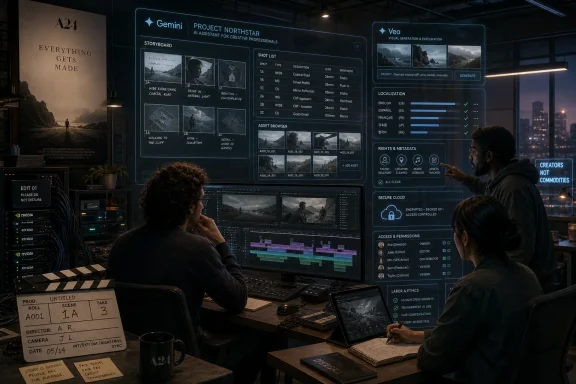
That distinction is not cosmetic. If AI tools are framed as replacement engines, they collide directly with writers, actors, editors, designers, VFX workers, and directors. If they are framed as assistants for storyboarding, location visualization, asset management, budgeting, versioning, localization, marketing, and distribution, they can look less like a hostile takeover and more like the next stage of production software.
A24 gives Google something no benchmark can provide: credibility with artists who are allergic to being told that creativity is a compute problem. Google gives A24 something independent studios increasingly need: technical leverage in a market where the giants own platforms, pipelines, data, and distribution muscle. The alliance is therefore less about one future AI movie than about who gets to define the tools that future filmmakers are expected to use.
The Pitch Is Creative Control, Because the Fear Is Creative Extraction
A24 and Google are reportedly positioning the effort around tools “shaped by the creators who use them,” a phrase that sounds gentle until you notice how defensive it is. It is designed to answer the central objection to generative AI in entertainment: that artists are being asked to train, test, and legitimize systems that may later undercut them. Hollywood’s AI backlash has never been only about bad images or awkward dialogue. It is about bargaining power.
That is why the companies are emphasizing production and distribution rather than AI-generated movies. A tool that helps a director identify continuity problems in a storyboard feels different from a system that generates an actor-like performance without an actor. A model that helps a production team visualize a location may be welcomed as previsualization; a model that replaces scouts, illustrators, and concept artists will not be received so warmly.
The problem is that these boundaries are porous. Today’s storyboard assistant can become tomorrow’s shot generator. A marketing localization system can become a synthetic trailer factory. A distribution optimizer can become a greenlight machine, nudging studios toward films that test well before anyone has taken a creative risk.
That is the paradox A24 is now stepping into. Its brand is built on risk, taste, and filmmaker identity. Google’s AI business is built on scale, generalization, and productization. The partnership will be judged not by its press language but by whether the tools preserve the friction that makes films distinctive, or quietly sand it down in the name of efficiency.
Hollywood Has Already Seen This Movie With Streaming
The film industry does not need to imagine what happens when technology platforms enter with promises of empowerment. It lived through the streaming transition. Netflix, Amazon, Apple, and others brought new money, new audiences, and new creative opportunities, but they also rewired compensation models, shortened theatrical windows, and made opaque data central to power.
AI could repeat that pattern at the level of production itself. Streaming changed how films were distributed and monetized. AI tools could change how they are conceived, budgeted, assembled, altered, translated, marketed, and measured. That is why a research partnership can be more important than it first appears.
The most consequential software in Hollywood is often not the flashiest. Scheduling systems, asset databases, editing suites, previsualization pipelines, render farms, rights-management tools, and analytics dashboards shape what can be made and how quickly. If Google can place AI inside those layers, it does not need to generate an entire feature film to become central to filmmaking.
That should interest WindowsForum readers for a simple reason: professional creative work has always been a proving ground for computing platforms. Video editing, 3D rendering, color grading, storage workflows, GPU acceleration, cloud collaboration, and now AI inference all pass through the hardware and software decisions that IT teams support. Hollywood’s AI debate may look glamorous, but underneath it are the same questions enterprise admins ask every day: Where does the data go? Who owns the output? What gets automated? What becomes dependent on a vendor cloud?
A24 Is the Ideal Partner Because It Is the Least Obvious One
If Google had announced a similar partnership with a traditional studio giant, the story would be simpler. Big studio meets big AI lab; efficiencies are pursued; labor worries intensify. A24 complicates the narrative because it is not merely a content library. It is a cultural signal.
A24’s reputation rests on the idea that audiences can trust its taste even when the films are strange, abrasive, or commercially risky. The studio has turned distribution and branding into a kind of auteur halo, helping make films such as Everything Everywhere All at Once, Moonlight, Hereditary, and Ex Machina feel like part of a larger sensibility. That makes it valuable to Google in a way a generic production company would not be.
For Google, A24 offers a route around the perception that AI video is a toy for synthetic slop. If A24 filmmakers use AI tools, the tools can be presented as artist-grade rather than prompt-happy. If the studio’s technology division helps shape workflows, Google can claim it is building with filmmakers rather than at them.
For A24, the attraction is also clear. Independent studios face pressure from rising production costs, fragmented distribution, and an attention economy dominated by platforms with far more data. AI-assisted workflows could help A24 stretch budgets, accelerate development, experiment with marketing, and support smaller teams. The danger is that the same efficiency that helps one filmmaker get a difficult project made can also be used elsewhere to justify fewer crew members, thinner development processes, and more algorithmic risk management.
The Real Product May Be the Workflow, Not the Film
The public tends to talk about AI in movies as if the endpoint is obvious: a feature-length film generated from a text prompt. That is a compelling fear and a mediocre business plan. The nearer-term opportunity is less theatrical and more pervasive: AI embedded into every step before and after the camera rolls.
Preproduction is the obvious target. Storyboards, animatics, shot lists, mood boards, production design references, location previews, and scheduling conflicts are all areas where machine assistance could reduce time and surface options. For a director, that could mean testing visual ideas earlier. For a producer, it could mean spotting budget problems before they become disasters.
Production and postproduction offer even more practical entry points. AI can help organize footage, search dailies, transcribe dialogue, suggest selects, manage visual references, clean audio, generate temporary effects, and prepare versions for different markets. Distribution brings another layer: localization, trailer testing, metadata, audience segmentation, accessibility, and platform-specific promotional assets.
None of this requires replacing the director. That is precisely why it is likely to advance faster than the more inflammatory “AI movie” pitch. The tools that win may be the ones that disappear into the pipeline, making themselves indispensable before the industry fully debates their consequences.
The Labor Fight Moves From Contracts to Interfaces
The 2023 Hollywood strikes put AI into the center of entertainment labor politics. Writers and actors fought for protections around synthetic performances, training, authorship, and compensation. Those fights were necessary, but contracts can lag behind product design. By the time a tool is common enough to regulate, it may already have changed expectations.
Interfaces are policy in disguise. If a storyboarding tool assumes that a production can generate endless visual options without paying illustrators, that is a labor position. If an editing assistant is trained to recommend cuts based on engagement metrics, that is an aesthetic position. If a distribution tool rewards assets that resemble past successes, that is a creative-risk position.
The A24-Google partnership will therefore be scrutinized for what its tools make easy. A filmmaker-friendly AI product would preserve consent, attribution, reversibility, and human decision-making. A studio-friendly but worker-hostile product would quietly convert craft into disposable intermediate output.
This is where A24’s involvement could matter. If the studio genuinely lets directors, editors, production designers, cinematographers, and other practitioners shape the systems, the result could be more respectful than tools built only by engineers and executives. But “creator-shaped” is not the same as worker-governed. Hollywood’s below-the-line professionals will want to know whether they are participants in the design process or merely the first people asked to adapt.
Google Is Building a Creative Stack Around Gemini, Veo, and Flow
The A24 deal does not stand alone. Google has been steadily assembling an AI creative stack, including video generation, filmmaking interfaces, music tools, location-based imagery concepts, and partnerships with filmmakers and creative organizations. The direction is unmistakable: Google wants its models to become infrastructure for creative production, not just chatbots answering prompts.
This is strategically important because creative tools are one of the places where AI can escape the commodity trap. A raw model may be impressive, but professionals pay for workflows, reliability, integration, rights controls, collaboration features, security, and predictable output. Adobe understands this. Avid understands this. So does every company that has ever sold into a production pipeline.
Google’s challenge is that it is not historically beloved as a pro creative software company. It has world-class AI research and vast cloud infrastructure, but filmmakers do not build careers around Google-branded editing suites. Partnering with A24 is a way to borrow domain authority while learning what professional users actually need.
There is also a competitive angle. OpenAI’s Sora, Runway’s video models, Adobe’s Firefly ecosystem, Meta’s media models, and a growing field of specialized startups are all fighting for the same territory. The winner may not be the company with the most astonishing demo. It may be the company that gets embedded into the boring parts of production where deadlines, budgets, compliance, and collaboration determine adoption.
The Windows Angle Is Workstations, Governance, and the New Creative IT
For Windows users, the A24-Google story is not merely entertainment news. Creative AI is already pushing workstation requirements, storage plans, GPU procurement, cloud access policies, and software governance. If AI-assisted production becomes normal, IT teams will be asked to support hybrid workflows that span local editing rigs, cloud models, asset repositories, and rights-controlled media libraries.
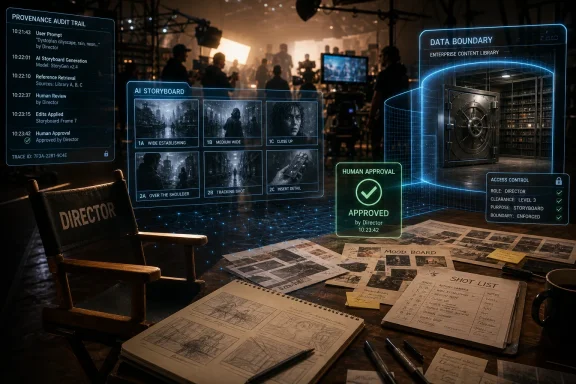
That means familiar Windows-world questions will arrive in new costumes. Can a production company allow sensitive scripts, unreleased footage, actor likenesses, or confidential marketing materials into cloud AI tools? How are prompts, generated assets, and model outputs logged? Can admins enforce retention policies? Can users run portions of the workflow locally on GPU-equipped workstations, or will the system require cloud inference?
Security-minded admins will also worry about leakage. Film and television productions are high-value targets, and unreleased media is commercially sensitive. AI tools that ingest scripts, production art, legal documents, or rough cuts expand the attack surface. The more useful the tool, the more privileged its access becomes.
There is a software licensing issue, too. Creative teams often adopt tools first and ask IT later. AI makes that risky. A seemingly harmless storyboarding assistant may involve training permissions, indemnity gaps, unclear output ownership, or storage in jurisdictions that violate a company’s agreements. Enterprise buyers have learned these lessons with SaaS; creative AI will force them to relearn them with higher emotional stakes.
“Not AI-Generated Movies” Is a Promise With an Expiration Date
The companies’ reported insistence that this is not about prompt-generated movies should be taken seriously but not literally forever. It is a statement about the current partnership’s political acceptability and near-term usefulness. It is not a permanent technical boundary.
Every generation of digital filmmaking has started with support tasks and moved closer to the final image. Nonlinear editing did not replace directors, but it transformed editing. Digital color grading did not replace cinematographers, but it changed cinematography. CGI did not replace physical production, but it remade the economics of spectacle. AI will follow the same pattern, except faster and with more ambiguity around authorship.
The more realistic future is not “AI makes movies” versus “humans make movies.” It is a spectrum of AI mediation. Some films will use AI only for planning and logistics. Others will use it for temporary assets, previsualization, cleanup, localization, or marketing. Some will use generated imagery or synthetic performance elements with consent and disclosure. A smaller number will chase fully synthetic production as a gimmick, a cost strategy, or an aesthetic experiment.
The question is who sets norms before the technology becomes mundane. If the norms are set by artists and workers, AI may become another tool in the kit. If they are set by investors and platform companies, the industry may wake up to find that “efficiency” has become the default argument against craft.
A24’s Brand Risk Is Bigger Than the Check
A24 has more to lose than many studios because its audience pays attention to ethos. The studio’s fans are not simply buying content; they are buying the belief that A24 backs human weirdness against franchise sameness. Taking Google money for AI research complicates that identity.
That does not mean the partnership is hypocrisy. Studios that care about filmmakers still need to understand emerging tools, especially if those tools will affect production whether artists like it or not. Refusing to engage with AI would not stop Google, OpenAI, Adobe, Runway, or anyone else from building creative systems. It would simply leave filmmakers with less influence over what gets built.
But A24 will need to be unusually transparent if it wants to maintain trust. The studio should be clear about whether any proprietary creative work is used for model training, whether filmmakers can opt out, whether workers are consulted, and how AI-assisted outputs are disclosed internally. Silence will be read as evasion.
The irony of Ex Machina should not distract from the more mundane risk: brand dilution. If A24 becomes associated with AI-enabled cost cutting rather than artist empowerment, the partnership could damage the very credibility Google is trying to access. Taste is difficult to build and easy to cheapen.
The Studio That Sold Weirdness Now Has to Sell Restraint
The concrete lesson from the A24-Google deal is that AI’s future in film will likely be decided less by spectacle than by restraint. The most important tools may be the ones that know when not to generate, when to preserve uncertainty, and when to leave a human decision unresolved. That is not the Silicon Valley default, but it may be the only way AI earns a durable place in serious filmmaking.
- Google is reportedly investing about $75 million in A24 as part of a DeepMind research partnership focused on AI tools for production and distribution.
- The companies are framing the work around filmmaker-shaped workflows rather than fully prompt-generated movies.
- A24 gives Google cultural credibility with artists, while Google gives A24 technical leverage in an increasingly platform-driven entertainment market.
- The most immediate impact is likely to appear in preproduction, asset management, postproduction, localization, marketing, and distribution rather than finished AI-made features.
- The biggest unresolved questions involve labor, consent, training data, ownership, security, disclosure, and whether creative workers have real influence over the tools.
- For IT pros, creative AI will bring familiar enterprise problems into media workflows, including cloud governance, data leakage, workstation strategy, software licensing, and access control.
The A24-Google partnership is important because it marks a shift from debating whether AI belongs in filmmaking to deciding where it belongs, who controls it, and what kinds of creative behavior it rewards. If the tools help filmmakers take risks, compress drudgery, and protect human authorship, this deal may become a model for responsible AI in production. If they turn taste into telemetry and craft into a cost center, it will be remembered as the moment prestige cinema helped normalize its own automation. The next phase of AI in movies will not be judged by a demo clip; it will be judged by the credits, contracts, workflows, and films that survive contact with it.
References
- Google Invests In A24 To Develop AI-Powered Filmmaking Tools “Shaped By The Creators Who Use Them” - Deadline Deadline · Mon, 22 Jun 2026 17:00:00 GMT