

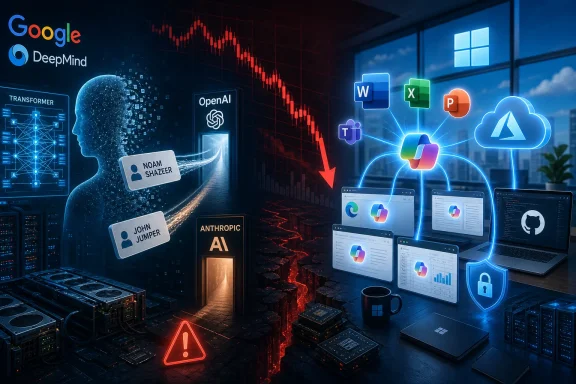
Alphabet shares fell sharply on Monday, June 22, 2026, as investors reacted to the back-to-back departures of Gemini co-lead Noam Shazeer to OpenAI and AlphaFold leader John Jumper to Anthropic. The market move was not just a personnel story dressed up as a stock chart. It was a referendum on whether Google can still turn world-class AI research into durable platform power.
For Windows users, developers, and IT departments, this is not a distant Silicon Valley HR drama. The fight for AI talent is increasingly the fight over which assistants get embedded into browsers, office suites, cloud consoles, identity systems, coding tools, and endpoint workflows. If Google’s AI bench looks less inevitable, Microsoft’s already aggressive AI bundling strategy suddenly looks less like overreach and more like a land grab happening on schedule.
Alphabet’s selloff landed because it gave investors a simple story to attach to a complicated fear: Google may still have the infrastructure, the cash, the chips, the data, and the distribution, but it may no longer have the uncontested aura of being the place where frontier AI happens. That aura matters in a market where a few dozen researchers can change the trajectory of a product line, a cloud business, or an IPO narrative.
Noam Shazeer’s exit carried special symbolism. He is not merely another senior engineer leaving for a richer package. He helped author the transformer paper that underpins much of the modern generative AI boom, co-founded Character.AI after an earlier Google departure, and was brought back into Google in 2024 through a deal reportedly worth billions. Less than two years later, he is headed to OpenAI.
John Jumper’s move to Anthropic was different but equally damaging to the story Alphabet wants to tell. Jumper helped lead AlphaFold, one of DeepMind’s most celebrated scientific achievements, and shared the 2024 Nobel Prize in Chemistry for work tied to protein structure prediction. His departure does not mean Google has lost its scientific culture overnight, but it does sharpen the perception that DeepMind’s crown jewels are now recruitable.
The stock market often overreacts to executive movement, especially in technology. But this reaction was not built on a single resignation. It came after months of investor anxiety over AI spending, compute scarcity, Gemini’s uneven public reception, and the uncomfortable reality that Google invented many of the ideas now being commercialized most aggressively by others.
The transformer architecture did not emerge from OpenAI. DeepMind did not lack ambition before ChatGPT. Google had LaMDA, PaLM, Bard, Gemini, AlphaFold, TPUs, world-class research labs, and a distribution surface that reaches billions of users. Yet the public imagination of generative AI still crystallized around ChatGPT, and Microsoft moved faster to turn that public shock into an enterprise sales motion.
That is the core of the investor panic. Alphabet is not being punished because it lacks AI assets. It is being punished because the market has watched the company struggle to translate those assets into unquestioned commercial leadership. A talent departure becomes frightening when it confirms an existing suspicion.
Shazeer’s history makes that suspicion harder to dismiss. He left Google once after the company reportedly declined to push harder on chatbot technology, built Character.AI, returned through an expensive licensing-and-hiring arrangement, then left again for OpenAI. Even if the internal reasons are more nuanced, the public narrative practically writes itself: Google saw the future, hesitated, bought back part of it, and still could not keep it.
That is why the departures hurt Alphabet despite its immense resources. Google can pay. It can offer scale. It can offer access to proprietary infrastructure. But the modern AI researcher may care just as much about whether their work ships quickly, whether compute is rationed, whether the company’s incentives favor science or ad-adjacent productization, and whether a startup’s eventual IPO creates a more explosive financial upside.
OpenAI and Anthropic are not normal competitors in this respect. They are mission-wrapped, investor-backed, talent-hungry organizations whose entire corporate identity revolves around frontier AI. Google, by contrast, is a sprawling conglomerate whose AI agenda must coexist with Search ads, YouTube, Android, Cloud, regulatory battles, workplace politics, and the reputational caution that comes from serving billions of users.
That breadth is a strength when distribution matters. It is a weakness when the competition is organized around a single question: how fast can we push the frontier model forward and turn it into leverage? The more AI becomes a winner-take-most platform race, the more Alphabet’s complexity looks like drag.
Google’s position should be enviable. It designs its own Tensor Processing Units, operates one of the world’s great cloud infrastructures, and sells AI capacity to outside customers. Yet that also creates internal tension. The same accelerators that researchers want for speculative experiments can be allocated to revenue-generating customers, Gemini production workloads, or strategic partnerships.
That changes the psychology of research. If the path to internal resources favors projects tied to near-term product goals, researchers who want to chase less predictable breakthroughs may conclude that the fastest route is out. A lab can still be brilliant under those conditions, but brilliance becomes more managed, more scheduled, and more politically mediated.
For enterprise buyers, this has practical consequences. The quality of an AI assistant or cloud coding tool is not just a function of a model benchmark. It reflects how fast the vendor can experiment, recover from failures, absorb research advances, and deploy improvements without breaking trust. If internal friction slows that loop, customers eventually feel it.
That is why Alphabet’s talent story matters to WindowsForum readers. Windows is becoming a delivery mechanism for AI services, not just a desktop operating system. Copilot’s long-term success will depend on whether Microsoft can make AI feel native to enterprise workflows, developer pipelines, and security operations. Google’s ability to counter that depends on both model quality and enterprise confidence.
Google Workspace and Google Cloud are formidable, but Microsoft owns much of the enterprise endpoint and productivity layer. If Google loses confidence among AI developers and investors at the same time Microsoft keeps deepening Copilot integration, the competitive gap becomes less about chatbot rankings and more about default behavior. In enterprise software, defaults are destiny.
This does not mean Microsoft has won. Copilot has its own adoption, pricing, privacy, and quality questions. Many administrators remain cautious about data exposure, hallucinations, compliance, and whether AI features justify premium licensing. But Microsoft has succeeded in making AI an unavoidable procurement conversation, while Google is still fighting to prove that Gemini is not merely technically impressive but strategically central.
First, AI answers can reduce the need to click through traditional search results. That pressures the web economy around Google’s advertising model and creates tension with publishers who already feel squeezed by summaries and zero-click results. Second, conversational agents can become the new starting point for intent, which is the most valuable real estate in computing.
Google knows this, which is why AI Overviews, Gemini integrations, and agentic search experiments are not optional. But the company faces a harsher trade-off than newer AI firms. If it moves too slowly, users migrate to ChatGPT, Claude, Perplexity-style systems, or AI features embedded in operating systems and browsers. If it moves too aggressively, it risks degrading the product that still pays the bills.
That dilemma makes talent retention more than a morale issue. The researchers and product leaders who can navigate AI-native search without detonating the economics of Search are among the most valuable employees in technology. Losing senior AI figures while that transition is underway gives investors a reason to wonder whether Alphabet’s caution is prudent stewardship or organizational paralysis.
But the AI market is not waiting for Google to assemble the perfect answer. OpenAI has brand gravity. Anthropic has enterprise credibility and a safety-forward pitch that appeals to risk-conscious buyers. Meta has open-weight leverage and a willingness to burn capital in pursuit of ecosystem influence. Microsoft has the Windows and Office channel. Amazon has AWS relationships and a strong incentive to keep cloud customers from standardizing elsewhere.
Gemini’s challenge is therefore not merely to be good. It must be good enough, visible enough, trusted enough, and integrated enough to shift behavior. That is a higher bar than topping a benchmark or producing an impressive demo at a developer conference.
The departures make that bar harder to clear because they affect perception before they affect code. Enterprise buyers do not rip up roadmaps because one researcher leaves. But they do notice when the market narrative around a vendor turns from “sleeping giant” to “leaky lab.” In AI procurement, confidence compounds just as quickly as doubt.
Microsoft’s strength is that it can make AI features appear inside the tools organizations already manage. A Windows shop may encounter Copilot through Microsoft 365 licensing, Windows settings, Edge policies, GitHub workflows, Defender, Intune, or Azure. That creates a procurement path that is familiar even when the technology feels new.
Google’s strength lies in web-scale services, collaboration, search, Android, and cloud AI tooling. But in Windows-heavy environments, Google must often win as an additional platform rather than the default administrative surface. That means any perceived weakening in Google’s AI leadership can have an outsized effect on conservative enterprise buyers who already prefer fewer vendors.
The practical question for IT is not whether Gemini, ChatGPT, or Claude wins a public leaderboard this month. It is which vendor can provide durable governance, predictable pricing, strong auditability, and model quality that improves without forcing administrators to redesign their entire risk posture every quarter. Talent churn matters because it can affect all of those things indirectly.
There is also a timing problem. Alphabet is spending heavily to build AI infrastructure just as the market is becoming more demanding about returns. When a company pours tens of billions into compute, shareholders want proof that the spending produces defensible growth rather than merely keeping pace with rivals. Losing high-profile AI leaders during that spending cycle makes the investment case harder to narrate.
This is why the day’s trading reaction may be rational even if the long-term conclusion is not. Markets compress complex uncertainty into price. They do not know whether Shazeer or Jumper’s departures will materially slow Google’s roadmap. They do know that OpenAI and Anthropic can now claim symbolic wins at Alphabet’s expense.
That symbolism becomes especially potent in AI because the field still runs on scarcity: scarce researchers, scarce chips, scarce training runs, scarce enterprise trust, and scarce time before user habits harden. In that environment, perception is not superficial. It is part of the competitive system.
Google DeepMind also remains packed with extraordinary talent. A research organization of that size does not become hollow because a few celebrated figures leave. In science and engineering, breakthroughs are usually collective, and the public often over-attributes institutional success to a small number of famous names.
Yet scale is not an unqualified defense. Large organizations can absorb departures, but they can also make departures more likely when top researchers feel their work is constrained by process, product politics, or internal resource competition. The very machinery that lets Google deploy AI to billions of users can make it harder for a researcher to feel the urgency and ownership available at a focused AI company.
That is the paradox now facing Alphabet. Its moat is scale. Its risk is scale. The company must convince employees, investors, developers, and customers that it can preserve the exploratory power of a frontier lab while operating with the discipline of one of the most scrutinized corporations on Earth.
Microsoft is trying to make Copilot that interface inside enterprise work. OpenAI is trying to make ChatGPT that interface across consumer and professional tasks. Anthropic is trying to win trust with Claude in knowledge work and software development. Google is trying to keep Search central while making Gemini feel like a natural extension of its services rather than a defensive appendage.
This is where Alphabet’s talent exits sting most. Shazeer represents the model frontier and the chatbot product instinct Google once seemed reluctant to embrace. Jumper represents DeepMind’s claim that AI can produce scientific breakthroughs beyond consumer chat. Losing both in the same week gives rivals two different ways to say that the future is happening outside Google’s walls.
For developers, this could shape toolchains. If Anthropic continues gaining credibility in coding and research workflows, and OpenAI keeps deepening its developer platform, Google must work harder to make Gemini and Vertex AI feel like first-choice tools rather than alternatives. For sysadmins, the vendor battle will show up as overlapping AI agents asking for access to sensitive documents, repositories, tickets, logs, and identity data.
For Windows users, developers, and IT departments, this is not a distant Silicon Valley HR drama. The fight for AI talent is increasingly the fight over which assistants get embedded into browsers, office suites, cloud consoles, identity systems, coding tools, and endpoint workflows. If Google’s AI bench looks less inevitable, Microsoft’s already aggressive AI bundling strategy suddenly looks less like overreach and more like a land grab happening on schedule.
 Wall Street Finally Prices the Brain Drain
Alphabet’s selloff landed because it gave investors a simple story to attach to a complicated fear: Google may still have the infrastructure, the cash, the chips, the data, and the distribution, but it may no longer have the uncontested aura of being the place where frontier AI happens. That aura matters in a market where a few dozen researchers can change the trajectory of a product line, a cloud business, or an IPO narrative.Noam Shazeer’s exit carried special symbolism. He is not merely another senior engineer leaving for a richer package. He helped author the transformer paper that underpins much of the modern generative AI boom, co-founded Character.AI after an earlier Google departure, and was brought back into Google in 2024 through a deal reportedly worth billions. Less than two years later, he is headed to OpenAI.
John Jumper’s move to Anthropic was different but equally damaging to the story Alphabet wants to tell. Jumper helped lead AlphaFold, one of DeepMind’s most celebrated scientific achievements, and shared the 2024 Nobel Prize in Chemistry for work tied to protein structure prediction. His departure does not mean Google has lost its scientific culture overnight, but it does sharpen the perception that DeepMind’s crown jewels are now recruitable.
The stock market often overreacts to executive movement, especially in technology. But this reaction was not built on a single resignation. It came after months of investor anxiety over AI spending, compute scarcity, Gemini’s uneven public reception, and the uncomfortable reality that Google invented many of the ideas now being commercialized most aggressively by others.
Google’s Problem Is Not Invention, It Is Conversion
The lazy version of the story says Google is falling behind in AI. The truer version is more damning: Google has repeatedly been early to the science and slower to the product moment. That distinction matters because Alphabet’s valuation depends less on whether its researchers can publish breakthroughs and more on whether its products can defend Search, grow Cloud, and make Gemini indispensable.The transformer architecture did not emerge from OpenAI. DeepMind did not lack ambition before ChatGPT. Google had LaMDA, PaLM, Bard, Gemini, AlphaFold, TPUs, world-class research labs, and a distribution surface that reaches billions of users. Yet the public imagination of generative AI still crystallized around ChatGPT, and Microsoft moved faster to turn that public shock into an enterprise sales motion.
That is the core of the investor panic. Alphabet is not being punished because it lacks AI assets. It is being punished because the market has watched the company struggle to translate those assets into unquestioned commercial leadership. A talent departure becomes frightening when it confirms an existing suspicion.
Shazeer’s history makes that suspicion harder to dismiss. He left Google once after the company reportedly declined to push harder on chatbot technology, built Character.AI, returned through an expensive licensing-and-hiring arrangement, then left again for OpenAI. Even if the internal reasons are more nuanced, the public narrative practically writes itself: Google saw the future, hesitated, bought back part of it, and still could not keep it.
The AI Talent War Has Become a Capital Allocation Problem
In earlier technology cycles, losing a distinguished researcher could be framed as a cultural issue. In 2026, it is also a capital allocation issue. Frontier AI talent now sits at the intersection of compensation, compute access, prestige, mission, and liquidity. If an AI lab can offer richer equity, faster deployment, looser bureaucracy, and more available GPUs or TPUs, the old prestige hierarchy becomes less binding.That is why the departures hurt Alphabet despite its immense resources. Google can pay. It can offer scale. It can offer access to proprietary infrastructure. But the modern AI researcher may care just as much about whether their work ships quickly, whether compute is rationed, whether the company’s incentives favor science or ad-adjacent productization, and whether a startup’s eventual IPO creates a more explosive financial upside.
OpenAI and Anthropic are not normal competitors in this respect. They are mission-wrapped, investor-backed, talent-hungry organizations whose entire corporate identity revolves around frontier AI. Google, by contrast, is a sprawling conglomerate whose AI agenda must coexist with Search ads, YouTube, Android, Cloud, regulatory battles, workplace politics, and the reputational caution that comes from serving billions of users.
That breadth is a strength when distribution matters. It is a weakness when the competition is organized around a single question: how fast can we push the frontier model forward and turn it into leverage? The more AI becomes a winner-take-most platform race, the more Alphabet’s complexity looks like drag.
Compute Scarcity Turns Culture Into a Product Constraint
The most revealing thread in recent reporting is not simply that Google researchers are leaving, but that some appear frustrated by compute access and internal prioritization. In frontier AI, compute is no longer a background utility. It is the lab bench, the factory floor, the test track, and the budget committee rolled into one.Google’s position should be enviable. It designs its own Tensor Processing Units, operates one of the world’s great cloud infrastructures, and sells AI capacity to outside customers. Yet that also creates internal tension. The same accelerators that researchers want for speculative experiments can be allocated to revenue-generating customers, Gemini production workloads, or strategic partnerships.
That changes the psychology of research. If the path to internal resources favors projects tied to near-term product goals, researchers who want to chase less predictable breakthroughs may conclude that the fastest route is out. A lab can still be brilliant under those conditions, but brilliance becomes more managed, more scheduled, and more politically mediated.
For enterprise buyers, this has practical consequences. The quality of an AI assistant or cloud coding tool is not just a function of a model benchmark. It reflects how fast the vendor can experiment, recover from failures, absorb research advances, and deploy improvements without breaking trust. If internal friction slows that loop, customers eventually feel it.
Microsoft’s Advantage Is Not That It Invented More
Microsoft’s AI position has always been misunderstood by people who score the race like a science fair. Microsoft did not need to invent the transformer. It needed to identify the platform shift early enough, attach itself to OpenAI, and push AI into the places enterprise customers already live: Windows, Microsoft 365, GitHub, Azure, Security Copilot, Teams, Edge, and the admin console.That is why Alphabet’s talent story matters to WindowsForum readers. Windows is becoming a delivery mechanism for AI services, not just a desktop operating system. Copilot’s long-term success will depend on whether Microsoft can make AI feel native to enterprise workflows, developer pipelines, and security operations. Google’s ability to counter that depends on both model quality and enterprise confidence.
Google Workspace and Google Cloud are formidable, but Microsoft owns much of the enterprise endpoint and productivity layer. If Google loses confidence among AI developers and investors at the same time Microsoft keeps deepening Copilot integration, the competitive gap becomes less about chatbot rankings and more about default behavior. In enterprise software, defaults are destiny.
This does not mean Microsoft has won. Copilot has its own adoption, pricing, privacy, and quality questions. Many administrators remain cautious about data exposure, hallucinations, compliance, and whether AI features justify premium licensing. But Microsoft has succeeded in making AI an unavoidable procurement conversation, while Google is still fighting to prove that Gemini is not merely technically impressive but strategically central.
Search Is the Profit Pool Everyone Is Circling
Alphabet’s deepest vulnerability remains Search. Google Search has long been the cash machine that subsidized moonshots, infrastructure buildouts, Android strategy, YouTube expansion, and the research culture that made DeepMind and Google Brain famous. AI threatens that machine from two directions at once.First, AI answers can reduce the need to click through traditional search results. That pressures the web economy around Google’s advertising model and creates tension with publishers who already feel squeezed by summaries and zero-click results. Second, conversational agents can become the new starting point for intent, which is the most valuable real estate in computing.
Google knows this, which is why AI Overviews, Gemini integrations, and agentic search experiments are not optional. But the company faces a harsher trade-off than newer AI firms. If it moves too slowly, users migrate to ChatGPT, Claude, Perplexity-style systems, or AI features embedded in operating systems and browsers. If it moves too aggressively, it risks degrading the product that still pays the bills.
That dilemma makes talent retention more than a morale issue. The researchers and product leaders who can navigate AI-native search without detonating the economics of Search are among the most valuable employees in technology. Losing senior AI figures while that transition is underway gives investors a reason to wonder whether Alphabet’s caution is prudent stewardship or organizational paralysis.
Gemini Still Has Time, but the Window Is Narrowing
It would be foolish to write off Gemini. Google has unmatched distribution through Android, Chrome, Search, YouTube, Gmail, Docs, and Cloud. It has years of experience running large-scale machine learning systems. It has internal chips, enormous data center capacity, and research depth that few rivals can match.But the AI market is not waiting for Google to assemble the perfect answer. OpenAI has brand gravity. Anthropic has enterprise credibility and a safety-forward pitch that appeals to risk-conscious buyers. Meta has open-weight leverage and a willingness to burn capital in pursuit of ecosystem influence. Microsoft has the Windows and Office channel. Amazon has AWS relationships and a strong incentive to keep cloud customers from standardizing elsewhere.
Gemini’s challenge is therefore not merely to be good. It must be good enough, visible enough, trusted enough, and integrated enough to shift behavior. That is a higher bar than topping a benchmark or producing an impressive demo at a developer conference.
The departures make that bar harder to clear because they affect perception before they affect code. Enterprise buyers do not rip up roadmaps because one researcher leaves. But they do notice when the market narrative around a vendor turns from “sleeping giant” to “leaky lab.” In AI procurement, confidence compounds just as quickly as doubt.
The Windows Angle Is Enterprise Gravity
For Windows administrators, the immediate lesson is not to switch vendors based on stock movement. It is to understand that AI platforms are becoming part of the enterprise control plane. The AI race is now entangled with identity, device management, document permissions, browser policy, endpoint telemetry, data loss prevention, and software development workflows.Microsoft’s strength is that it can make AI features appear inside the tools organizations already manage. A Windows shop may encounter Copilot through Microsoft 365 licensing, Windows settings, Edge policies, GitHub workflows, Defender, Intune, or Azure. That creates a procurement path that is familiar even when the technology feels new.
Google’s strength lies in web-scale services, collaboration, search, Android, and cloud AI tooling. But in Windows-heavy environments, Google must often win as an additional platform rather than the default administrative surface. That means any perceived weakening in Google’s AI leadership can have an outsized effect on conservative enterprise buyers who already prefer fewer vendors.
The practical question for IT is not whether Gemini, ChatGPT, or Claude wins a public leaderboard this month. It is which vendor can provide durable governance, predictable pricing, strong auditability, and model quality that improves without forcing administrators to redesign their entire risk posture every quarter. Talent churn matters because it can affect all of those things indirectly.
The Market Is Punishing Uncertainty, Not Just Departures
The sharpness of Alphabet’s stock move reflects an accumulation of doubts. Investors have already been digesting enormous AI capital expenditures, questions about monetization, competitive pressure in cloud, and the possibility that AI search cannibalizes traditional ads. The talent exits landed on top of that pile.There is also a timing problem. Alphabet is spending heavily to build AI infrastructure just as the market is becoming more demanding about returns. When a company pours tens of billions into compute, shareholders want proof that the spending produces defensible growth rather than merely keeping pace with rivals. Losing high-profile AI leaders during that spending cycle makes the investment case harder to narrate.
This is why the day’s trading reaction may be rational even if the long-term conclusion is not. Markets compress complex uncertainty into price. They do not know whether Shazeer or Jumper’s departures will materially slow Google’s roadmap. They do know that OpenAI and Anthropic can now claim symbolic wins at Alphabet’s expense.
That symbolism becomes especially potent in AI because the field still runs on scarcity: scarce researchers, scarce chips, scarce training runs, scarce enterprise trust, and scarce time before user habits harden. In that environment, perception is not superficial. It is part of the competitive system.
Google’s Defense Is Scale, but Scale Cuts Both Ways
Alphabet’s defenders can make a strong case. Google has survived waves of “it missed the next platform” criticism before. Android, Chrome, YouTube, Maps, Gmail, and Cloud all demonstrate a company capable of building or acquiring dominant services and operating them at planetary scale. The idea that two departures erase Google’s AI future is plainly absurd.Google DeepMind also remains packed with extraordinary talent. A research organization of that size does not become hollow because a few celebrated figures leave. In science and engineering, breakthroughs are usually collective, and the public often over-attributes institutional success to a small number of famous names.
Yet scale is not an unqualified defense. Large organizations can absorb departures, but they can also make departures more likely when top researchers feel their work is constrained by process, product politics, or internal resource competition. The very machinery that lets Google deploy AI to billions of users can make it harder for a researcher to feel the urgency and ownership available at a focused AI company.
That is the paradox now facing Alphabet. Its moat is scale. Its risk is scale. The company must convince employees, investors, developers, and customers that it can preserve the exploratory power of a frontier lab while operating with the discipline of one of the most scrutinized corporations on Earth.
The Real Contest Is for the Next Default Interface
The AI race is often described as a contest to build the best model. That is only partly true. The larger contest is to own the next default interface between people and computation. Whoever controls that interface can influence search, software development, office work, customer support, cloud operations, cybersecurity triage, and even how users navigate the web.Microsoft is trying to make Copilot that interface inside enterprise work. OpenAI is trying to make ChatGPT that interface across consumer and professional tasks. Anthropic is trying to win trust with Claude in knowledge work and software development. Google is trying to keep Search central while making Gemini feel like a natural extension of its services rather than a defensive appendage.
This is where Alphabet’s talent exits sting most. Shazeer represents the model frontier and the chatbot product instinct Google once seemed reluctant to embrace. Jumper represents DeepMind’s claim that AI can produce scientific breakthroughs beyond consumer chat. Losing both in the same week gives rivals two different ways to say that the future is happening outside Google’s walls.
For developers, this could shape toolchains. If Anthropic continues gaining credibility in coding and research workflows, and OpenAI keeps deepening its developer platform, Google must work harder to make Gemini and Vertex AI feel like first-choice tools rather than alternatives. For sysadmins, the vendor battle will show up as overlapping AI agents asking for access to sensitive documents, repositories, tickets, logs, and identity data.
The Week Google’s AI Aura Became Negotiable
The concrete facts are narrower than the market panic, but they are still consequential. Alphabet remains one of the most powerful companies in AI, yet the week’s exits changed the tone of the conversation around its leadership.- Noam Shazeer’s move to OpenAI is damaging because he was both a transformer co-author and a Gemini co-lead, making his departure symbolically larger than a normal executive exit.
- John Jumper’s move to Anthropic matters because AlphaFold is one of DeepMind’s clearest examples of AI producing world-class scientific impact.
- Alphabet’s stock reaction reflects broader investor anxiety about AI spending, Search disruption, and whether Google can commercialize its research advantages fast enough.
- Microsoft benefits from the uncertainty because its AI strategy is already embedded in Windows, Microsoft 365, GitHub, Azure, and enterprise administration workflows.
- IT buyers should treat the episode as a reminder that AI vendor selection is now a platform-risk decision involving governance, data access, model quality, and long-term supplier stability.
- Google’s AI future is not broken, but the assumption that its research depth automatically converts into market leadership is now much harder to defend.
References
- Primary source: The Tech Buzz
Published: 2026-06-22T17:42:09.325960
Alphabet Tumbles on AI Talent Exodus, Worst Day in a Year | The Tech Buzz
Google parent sheds top AI researchers as stock posts steepest decline since 2025www.techbuzz.ai - Related coverage: m.es.investing.com
Alphabet cae más de un 6% por la fuga de talento en IA y el desplome de SpaceX Por Investing.com
Alphabet cae más de un 6% por la fuga de talento en IA y el desplome de SpaceXm.es.investing.com - Related coverage: semafor.com
Alphabet to sell $80 billion in stock to fund AI buildout | Semafor
The Google parent has not offered stock for 20 years, but even Alphabet’s vast revenues are not enough to keep pace with AI construction.www.semafor.com - Related coverage: smartkarma.com
Alphabet (GOOGL) Earnings Plunge - Worst Day Since 2025 Amid $80 Billion AI Investment Plans | Smartkarma
“`html The Media & Entertainment sector fell significantly by 2.9%, largely due to Alphabet’s 3.9% drop and The Trade Desk’s decline of 9.1%. The Telecommunication Services sector saw a minor...www.smartkarma.com
- Related coverage: fxleaders.com
Google Stock GOOGL Heads Under $350 as Investors Question AI Economics After $80B Equity Offering from Alphabet - Forex News by FX Leaders
Alphabet shares continued to decline after a $80 billion equity fundraising plan was announced, boosting investor concerns that the cost of the unnecessary AI race is becoming more difficult to justify.www.fxleaders.com
- Related coverage: moneyweek.com
Should you buy Alphabet shares following $80 billion capital raise? | MoneyWeek
The Google parent company’s stock fell following the raise, but experts think it’s necessary for Alphabet to capitalise on the AI opportunity.moneyweek.com
- Related coverage: bloomberg.com
- Related coverage: jacksunwei.me
CMA forces Google opt-out, Alphabet drops 4% on $85B raise, Muse Spark 4th — AI News
Regulators, investors, and benchmarks each charge Big Tech a different bill today on Google's AI search, Alphabet's record raise, and Meta's Muse Spark. jacksunwei.me
- Related coverage: marketbeat.com
Alphabet (NASDAQ:GOOGL) Stock Price Down 1% - Here's Why
Alphabet (NASDAQ:GOOGL) Stock Price Down 1% - What's Next?www.marketbeat.com
- Related coverage: theguardian.com
Alphabet’s shares drop after announcing $80bn share sale, as AI threatens to drive up youth unemployment – as it happened | Business | The Guardian
Rolling coverage of the latest economic and financial newswww.theguardian.com - Related coverage: metaintro.com
xAI Talent Exodus 2026 — 50+ Researchers... | Metaintro
xAI has lost 50+ researchers since SpaceX took over in 2026. Meta and Mira Murati's TML grabbed the talent. What it means for AI job seekers right now.www.metaintro.com - Related coverage: savest-financial.com
- Related coverage: iccr.org
- Related coverage: startupfortune.com
Nobel laureate John Jumper leaves Google DeepMind for Anthropic as talent drains from Google's AI crown jewel - Startup Fortune
John Jumper, Nobel laureate and co-creator of AlphaFold, announced on June 19, 2026 that he is leaving Google DeepMind after nearly nine years to joinstartupfortune.com
