

Alphabet, Google’s parent company, will replace Verizon Communications in the Dow Jones Industrial Average before U.S. markets open on Monday, June 29, 2026, in the first reshuffling of the 30-stock blue-chip index since Nvidia and Sherwin-Williams joined in 2024. The move is not merely a Wall Street trophy ceremony. It is another admission that the companies defining the American economy now look less like regulated utilities and more like global software, advertising, cloud, and artificial intelligence platforms. For Windows users and IT departments, the swap is a reminder that the market’s definition of infrastructure has changed faster than the institutions built to measure it.
The Dow Jones Industrial Average has always carried more cultural weight than mathematical elegance. It is the number that appears on evening news graphics, retirement-account explainers, and anxious market tickers, even though it contains only 30 companies and uses a weighting method that can make a high-priced stock matter more than a larger business.
Alphabet’s arrival is therefore symbolic in the old-fashioned sense: it tells ordinary investors which firms are now considered indispensable. Google Search, YouTube, Android, Google Cloud, Gemini, Waymo, and Alphabet’s sprawling advertising machinery are no longer treated as speculative technology assets orbiting the “real” economy. They are the economy’s operating layer.
Verizon’s exit says just as much. The company remains important, profitable, and deeply embedded in American communications infrastructure. But in the Dow’s price-weighted arithmetic, a lower-priced telecom stock had become almost invisible, representing only a sliver of the index’s movement. The committee did not need to declare Verizon irrelevant; the index’s own mechanics had already done that.
That is the oddity of this moment. Alphabet is being added because it better represents market dynamism, but it is entering an index whose design belongs to another century. The Dow is modernizing its cast while keeping the stage machinery mostly untouched.
That remains true in a narrow engineering sense, but markets increasingly reward the companies that turn connectivity into services, data, compute, and attention. Verizon sells access to the network. Alphabet monetizes what happens after users connect.
That distinction matters. The most profitable layers of modern technology are less about transport and more about orchestration: search results, ad auctions, app ecosystems, identity systems, cloud platforms, AI models, and enterprise APIs. The carrier is still necessary, but the platform company captures more of the imagination and, more importantly for index committees, more of the market capitalization.
Verizon’s problem is not that it stopped being useful. It is that usefulness has become a poor proxy for market leadership. Telecom networks are capital-intensive, regulated, competitive, and expensive to maintain. Alphabet’s businesses are also costly, especially in AI and cloud infrastructure, but they scale with a different kind of leverage.
That is why this reshuffle feels bigger than a one-for-one substitution. It reflects a migration of investor attention from physical connectivity to computational control. The Dow is not saying that towers no longer matter. It is saying the market now believes the greater strategic power sits above them.
Google’s core advertising business still pays the bills. Search and YouTube remain extraordinary cash machines, and they fund the company’s more speculative bets. But Alphabet’s market narrative in 2026 is increasingly about whether it can defend search from AI-native interfaces while turning its enormous infrastructure investment into durable enterprise revenue.
That makes its Dow entry timely. The index is not just adding a company that already dominates digital advertising; it is adding one of the few firms with the capital, data center footprint, research bench, and developer ecosystem to compete seriously in frontier AI. Microsoft is already in the Dow. Nvidia joined in 2024. Apple has long been there. Alphabet’s absence had become harder to justify.
For WindowsForum readers, the enterprise angle is obvious. IT departments are no longer choosing merely between operating systems or office suites. They are choosing identity providers, cloud platforms, endpoint management models, browser policies, data governance layers, and AI assistants that increasingly cross vendor boundaries.
Alphabet’s inclusion in the Dow therefore mirrors the procurement reality many admins already live with. A Windows estate can still depend heavily on Google Workspace, Chrome Enterprise, Google Cloud, YouTube distribution, Android device management, and Google identity integrations. The old consumer-versus-enterprise divide no longer explains how technology is bought or used.
This is why the Dow has always been an imperfect map of American capitalism. A market-cap-weighted index like the S&P 500 gives more weight to companies investors collectively value more highly. The Dow gives more weight to companies with higher share prices, after adjusting through a divisor that preserves continuity across splits, substitutions, and corporate actions.
The result can be strange. Goldman Sachs can move the Dow disproportionately because its per-share price is high. Verizon, with a much lower share price, could remain a household-name blue chip while barely nudging the average. Alphabet, even after prior stock splits, enters with a share price large enough to matter more than Verizon did.
This does not make the Dow useless. It remains a widely watched indicator, and its changes can trigger real portfolio flows in funds tied to it. But it does mean that its symbolic power often exceeds its analytical precision.
Alphabet’s addition exposes that contradiction neatly. The committee is trying to make the Dow more representative of the modern economy, yet the index still measures that representativeness through a method that can punish or reward companies for share-price optics. The Dow can update its membership faster than it can update its mythology.
For decades, Intel was synonymous with the PC era. “Intel Inside” was not just a marketing slogan; it was the architecture of mainstream computing. Its departure from the Dow after Nvidia’s rise captured one of the central technology transitions of the last decade: from CPUs and client PCs as the symbolic center of computing to GPUs, accelerators, and data-center-scale AI infrastructure.
Alphabet replacing Verizon belongs to the same story. The Dow is slowly swapping out companies associated with older technology cycles and bringing in firms that dominate newer ones. Intel gave way to Nvidia. Verizon now gives way to Alphabet. The index is not leading the market; it is ratifying what the market has already decided.
Sherwin-Williams’ 2024 addition made the process look less glamorous, but it also showed the committee’s balancing act. The Dow cannot simply become a mega-cap technology index. It still wants industrial, consumer, financial, health-care, and materials exposure. The addition of a paint company alongside Nvidia was a reminder that blue-chip America includes both GPUs and coatings.
Alphabet’s entry tips the balance further toward platform technology, but not absurdly so. The Dow already contains Microsoft, Apple, Amazon, Nvidia, Salesforce, Cisco, and IBM, depending on how one draws the technology boundary. Add Alphabet, and the index increasingly resembles a curated museum of the digital economy’s winners, with enough banks, retailers, manufacturers, and health-care firms to preserve the old Dow silhouette.
The effect is smaller than it would be in the S&P 500, where enormous pools of passive capital track market-cap-weighted benchmarks. The Dow is famous, but fewer dollars directly track it than track broader indexes. Still, the mechanics matter, particularly around the effective date, when index funds, derivatives, and leveraged products rebalance.
This is one reason companies often see short-term share movement after index announcements. Inclusion can create forced buying, while deletion can create forced selling. Alphabet’s after-hours bump following the announcement fits the pattern, though it should not be confused with a fundamental rerating of the business.
For long-term investors, the bigger point is exposure concentration. Many people already own Alphabet indirectly through S&P 500 funds, Nasdaq-linked products, total-market funds, target-date funds, and retirement accounts. A Dow-linked product now adds another route.
That concentration is not automatically bad. Alphabet is one of the world’s most profitable companies, and its businesses are deeply entrenched. But it does mean that “diversified” portfolios can quietly become more dependent on the same handful of mega-cap technology companies across multiple index wrappers.
Alphabet fits that definition, but in a newer and more unsettling way. It is not a utility in the legal sense, yet billions of people treat its products as public infrastructure. Search is a gateway to knowledge. YouTube is a global broadcast system. Android is a mobile operating layer. Google Cloud is part of the enterprise compute fabric. Chrome is, for many users, the front door to work.
That gives Alphabet a blue-chip profile, but not a sleepy one. Its risks are not the familiar risks of a phone carrier. They include antitrust enforcement, AI disruption, advertising regulation, privacy scrutiny, cloud competition, data center power constraints, and the possibility that generative AI changes the economics of search.
The Dow has always tried to blend stability and relevance. Alphabet tests that blend. It is stable in the sense that it has immense revenue, cash flow, engineering capacity, and global reach. It is unstable in the sense that the technological foundations of its most profitable business are under active challenge.
That tension is exactly why the addition makes sense. A blue-chip index that excludes the companies exposed to the most important technology transitions risks becoming a nostalgia product. A blue-chip index that includes them inherits their volatility.
Microsoft controls Windows, Azure, Microsoft 365, Entra, GitHub, and a growing set of Copilot-branded services. Nvidia supplies the accelerator hardware and software ecosystem that has become the default substrate for high-end AI training and inference. Alphabet brings Google Cloud, Gemini, Tensor Processing Units, Android, Chrome, YouTube, and one of the world’s largest advertising and data businesses.
This matters because enterprise technology decisions increasingly compound. Choosing a cloud provider affects identity architecture. Choosing an AI platform affects data governance. Choosing an endpoint strategy affects browser policy, telemetry, security tooling, and compliance workflows. The old procurement model of evaluating discrete products is giving way to ecosystem risk management.
Alphabet’s Dow inclusion does not change a single admin console. It does not alter Chrome policy templates, Google Cloud SLAs, Android Enterprise enrollment, or Workspace retention settings. But it reinforces what many IT leaders already know: Google is not an optional consumer-web vendor sitting outside the enterprise stack.
In mixed environments, the practical question is no longer whether Microsoft or Google “wins.” Most organizations already run some combination of Windows endpoints, Microsoft identity or productivity tools, Chrome, Android, Google services, SaaS platforms, and public cloud workloads. The real work is controlling data movement, access boundaries, browser behavior, audit trails, and AI usage across ecosystems that were not designed to make each other easy to govern.
Verizon provides access. Alphabet abstracts access into services. It turns network connectivity into search intent, advertising inventory, app distribution, machine-learning workloads, video engagement, and cloud consumption. The business value comes from shaping what users and enterprises do once the connection exists.
This pattern is familiar across technology. Operating systems abstract hardware. Cloud platforms abstract servers. Containers abstract runtime environments. AI services abstract expertise, search, code generation, and workflow automation. The companies that dominate abstraction layers often capture more profit than the companies that provide the underlying commodity inputs.
Telecom executives understand this dynamic painfully well. Carriers invested heavily in 5G networks, spectrum, fiber, and backhaul, only to see much of the investor excitement flow to application platforms, hyperscalers, semiconductor companies, and AI labs. The pipes are essential, but essential is not the same as highly valued.
That does not mean telecom is doomed. Connectivity demand will keep growing, and enterprise networking, private wireless, edge computing, and fixed wireless access all remain meaningful businesses. But the Dow committee’s choice suggests that the index wants exposure to the layer where growth narratives are more explosive.
Alphabet is not being rewarded because it is merely large. It is being rewarded because it sits at multiple abstraction points at once: information discovery, digital advertising, mobile software, browser access, cloud infrastructure, and AI interfaces. That is the kind of reach a 30-stock index can no longer ignore.
This is where “blue chip” can mislead investors. The label suggests safety, but it does not eliminate structural risk. In Alphabet’s case, regulators are looking at the very mechanisms that helped produce its scale: default search placement, advertising market power, app ecosystem control, and data advantages.
The AI transition complicates that picture. On one hand, generative AI gives Google a way to reinvent search, cloud services, developer tools, and productivity experiences. On the other hand, it gives competitors and regulators a fresh argument that old platform advantages should not be allowed to harden into the next computing era.
For enterprise customers, regulatory pressure can cut both ways. It may open markets, encourage interoperability, and constrain bundling practices. It may also create uncertainty around product roadmaps, data handling, advertising systems, and contractual commitments.
Alphabet’s Dow seat therefore comes with an asterisk that investors should not ignore. The company is not entering the index as an unchallenged monopoly drifting peacefully into maturity. It is entering as a systemically important technology platform under pressure from regulators, rivals, and the AI transition it helped create.
And yet the Dow persists. It persists because humans like short lists, because media institutions like simple numbers, and because financial culture is built as much on ritual as on methodology. A company added to the Dow receives a kind of public certification that no index white paper can fully explain.
This certification matters for brand perception. Alphabet did not need Dow membership to prove it was important, but the addition places Google’s parent inside one of American capitalism’s oldest symbolic containers. It tells casual investors, not just analysts, that Alphabet belongs in the same mental category as the country’s canonical industrial and financial giants.
That may sound quaint until one remembers how many investment decisions are made through narratives. Retirement savers, financial advisors, TV commentators, corporate boards, and employees all absorb status signals. The Dow remains one of those signals.
For Verizon, the reputational impact cuts the other way. Leaving the Dow does not impair its network, cash flow, customer base, or spectrum portfolio. But it does reinforce the perception that telecom has slipped from the center of the growth story to the defensive-income shelf.
Windows is still foundational in business computing. But the Windows desktop is now surrounded by browser-delivered apps, cloud identity systems, SaaS workflows, cross-platform collaboration tools, mobile device fleets, and AI assistants. Alphabet is deeply present in that environment, even where Windows remains the primary client OS.
Chrome is often the most important application on a managed Windows machine. Google identity may coexist with Entra ID. YouTube may be a training platform, a marketing channel, or a productivity sink. Google Cloud may host workloads that authenticate from Windows endpoints. Android devices may be part of the same enterprise mobility estate.
That is why Alphabet’s market recognition has practical meaning. The company is not just a consumer internet giant that happens to sell ads. It is part of the administrative surface area that IT teams must secure, configure, monitor, and explain to auditors.
The Dow’s reshuffle does not change Windows, but it does reflect the environment Windows now inhabits. The desktop is no longer the center of gravity by itself. It is one managed node in a platform economy increasingly shaped by cloud services, browsers, identity, and AI.
A 30-company index selected by committee will always be partly subjective. A price-weighted index will always produce distortions. A blue-chip label will always lag the market because it tends to recognize dominance after the fact. Alphabet’s addition solves one representativeness problem while leaving the underlying methodology untouched.
But that may be the point. The Dow is not trying to be the most rigorous index. It is trying to be a durable shorthand for American corporate power. Shorthands survive by updating just enough to remain plausible.
In 2026, plausibility requires Alphabet. An index that includes Nvidia and Microsoft but excludes Google’s parent looks incomplete, especially as AI, cloud infrastructure, and digital advertising dominate corporate strategy. Verizon’s removal is the cost of making room.
The irony is that Alphabet’s entry makes the Dow both more representative and more concentrated in the same mega-cap technology story driving nearly every other major benchmark. Investors looking for diversification will not find it simply because the wrapper says “industrial.”
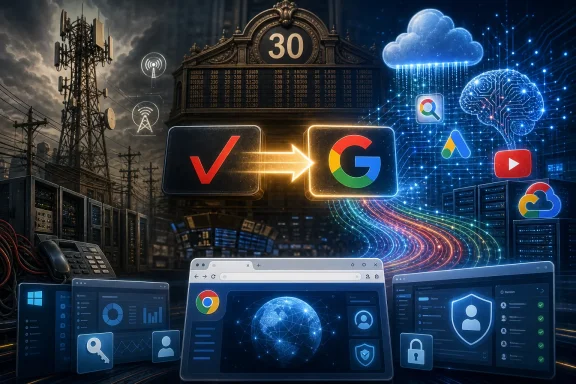 The Dow Finally Catches Up to the Economy It Claims to Represent
The Dow Jones Industrial Average has always carried more cultural weight than mathematical elegance. It is the number that appears on evening news graphics, retirement-account explainers, and anxious market tickers, even though it contains only 30 companies and uses a weighting method that can make a high-priced stock matter more than a larger business.Alphabet’s arrival is therefore symbolic in the old-fashioned sense: it tells ordinary investors which firms are now considered indispensable. Google Search, YouTube, Android, Google Cloud, Gemini, Waymo, and Alphabet’s sprawling advertising machinery are no longer treated as speculative technology assets orbiting the “real” economy. They are the economy’s operating layer.
Verizon’s exit says just as much. The company remains important, profitable, and deeply embedded in American communications infrastructure. But in the Dow’s price-weighted arithmetic, a lower-priced telecom stock had become almost invisible, representing only a sliver of the index’s movement. The committee did not need to declare Verizon irrelevant; the index’s own mechanics had already done that.
That is the oddity of this moment. Alphabet is being added because it better represents market dynamism, but it is entering an index whose design belongs to another century. The Dow is modernizing its cast while keeping the stage machinery mostly untouched.
Verizon Leaves as the Definition of Infrastructure Moves Up the Stack
For decades, telecommunications companies could credibly claim to be the backbone of the digital economy. They owned the wires, towers, spectrum licenses, billing relationships, and regulated access networks that made connectivity possible. If you wanted to understand the internet’s physical reach, you looked at carriers.That remains true in a narrow engineering sense, but markets increasingly reward the companies that turn connectivity into services, data, compute, and attention. Verizon sells access to the network. Alphabet monetizes what happens after users connect.
That distinction matters. The most profitable layers of modern technology are less about transport and more about orchestration: search results, ad auctions, app ecosystems, identity systems, cloud platforms, AI models, and enterprise APIs. The carrier is still necessary, but the platform company captures more of the imagination and, more importantly for index committees, more of the market capitalization.
Verizon’s problem is not that it stopped being useful. It is that usefulness has become a poor proxy for market leadership. Telecom networks are capital-intensive, regulated, competitive, and expensive to maintain. Alphabet’s businesses are also costly, especially in AI and cloud infrastructure, but they scale with a different kind of leverage.
That is why this reshuffle feels bigger than a one-for-one substitution. It reflects a migration of investor attention from physical connectivity to computational control. The Dow is not saying that towers no longer matter. It is saying the market now believes the greater strategic power sits above them.
Alphabet’s Dow Seat Is Really an AI and Cloud Seat
S&P Dow Jones Indices framed the addition around Alphabet’s breadth: advertising, cloud infrastructure, artificial intelligence, hardware, autonomous mobility, health technology, and media distribution. That list is almost comically broad, but the important words are cloud and AI. Those are the categories every major index, enterprise budget, and boardroom memo is trying to price correctly.Google’s core advertising business still pays the bills. Search and YouTube remain extraordinary cash machines, and they fund the company’s more speculative bets. But Alphabet’s market narrative in 2026 is increasingly about whether it can defend search from AI-native interfaces while turning its enormous infrastructure investment into durable enterprise revenue.
That makes its Dow entry timely. The index is not just adding a company that already dominates digital advertising; it is adding one of the few firms with the capital, data center footprint, research bench, and developer ecosystem to compete seriously in frontier AI. Microsoft is already in the Dow. Nvidia joined in 2024. Apple has long been there. Alphabet’s absence had become harder to justify.
For WindowsForum readers, the enterprise angle is obvious. IT departments are no longer choosing merely between operating systems or office suites. They are choosing identity providers, cloud platforms, endpoint management models, browser policies, data governance layers, and AI assistants that increasingly cross vendor boundaries.
Alphabet’s inclusion in the Dow therefore mirrors the procurement reality many admins already live with. A Windows estate can still depend heavily on Google Workspace, Chrome Enterprise, Google Cloud, YouTube distribution, Android device management, and Google identity integrations. The old consumer-versus-enterprise divide no longer explains how technology is bought or used.
The Dow’s Price-Weighted Design Makes the Moment Stranger
The Dow’s defining quirk is that it is price-weighted. A company’s influence on the index depends on the nominal price of one share, not the total value of the company. That means a stock split can reduce a company’s index influence without changing its business value at all.This is why the Dow has always been an imperfect map of American capitalism. A market-cap-weighted index like the S&P 500 gives more weight to companies investors collectively value more highly. The Dow gives more weight to companies with higher share prices, after adjusting through a divisor that preserves continuity across splits, substitutions, and corporate actions.
The result can be strange. Goldman Sachs can move the Dow disproportionately because its per-share price is high. Verizon, with a much lower share price, could remain a household-name blue chip while barely nudging the average. Alphabet, even after prior stock splits, enters with a share price large enough to matter more than Verizon did.
This does not make the Dow useless. It remains a widely watched indicator, and its changes can trigger real portfolio flows in funds tied to it. But it does mean that its symbolic power often exceeds its analytical precision.
Alphabet’s addition exposes that contradiction neatly. The committee is trying to make the Dow more representative of the modern economy, yet the index still measures that representativeness through a method that can punish or reward companies for share-price optics. The Dow can update its membership faster than it can update its mythology.
The 2024 Nvidia Lesson Still Hangs Over This Change
The last major Dow reshuffle, in 2024, brought Nvidia and Sherwin-Williams into the index while removing Intel and Dow Inc. Nvidia’s inclusion was the obvious headline. Intel’s removal was the more painful historical marker.For decades, Intel was synonymous with the PC era. “Intel Inside” was not just a marketing slogan; it was the architecture of mainstream computing. Its departure from the Dow after Nvidia’s rise captured one of the central technology transitions of the last decade: from CPUs and client PCs as the symbolic center of computing to GPUs, accelerators, and data-center-scale AI infrastructure.
Alphabet replacing Verizon belongs to the same story. The Dow is slowly swapping out companies associated with older technology cycles and bringing in firms that dominate newer ones. Intel gave way to Nvidia. Verizon now gives way to Alphabet. The index is not leading the market; it is ratifying what the market has already decided.
Sherwin-Williams’ 2024 addition made the process look less glamorous, but it also showed the committee’s balancing act. The Dow cannot simply become a mega-cap technology index. It still wants industrial, consumer, financial, health-care, and materials exposure. The addition of a paint company alongside Nvidia was a reminder that blue-chip America includes both GPUs and coatings.
Alphabet’s entry tips the balance further toward platform technology, but not absurdly so. The Dow already contains Microsoft, Apple, Amazon, Nvidia, Salesforce, Cisco, and IBM, depending on how one draws the technology boundary. Add Alphabet, and the index increasingly resembles a curated museum of the digital economy’s winners, with enough banks, retailers, manufacturers, and health-care firms to preserve the old Dow silhouette.
Passive Investors Will Own More Google Whether They Asked for It or Not
Index changes are symbolic, but they are not purely symbolic. Funds and products tied to the Dow must adjust their holdings to match the new composition. That means investors in common Dow-tracking products will soon have exposure to Alphabet in place of Verizon, whether or not they made a deliberate stock-picking decision.The effect is smaller than it would be in the S&P 500, where enormous pools of passive capital track market-cap-weighted benchmarks. The Dow is famous, but fewer dollars directly track it than track broader indexes. Still, the mechanics matter, particularly around the effective date, when index funds, derivatives, and leveraged products rebalance.
This is one reason companies often see short-term share movement after index announcements. Inclusion can create forced buying, while deletion can create forced selling. Alphabet’s after-hours bump following the announcement fits the pattern, though it should not be confused with a fundamental rerating of the business.
For long-term investors, the bigger point is exposure concentration. Many people already own Alphabet indirectly through S&P 500 funds, Nasdaq-linked products, total-market funds, target-date funds, and retirement accounts. A Dow-linked product now adds another route.
That concentration is not automatically bad. Alphabet is one of the world’s most profitable companies, and its businesses are deeply entrenched. But it does mean that “diversified” portfolios can quietly become more dependent on the same handful of mega-cap technology companies across multiple index wrappers.
The Blue-Chip Club Is Now a Platform Club
The phrase “blue chip” once implied industrial durability: railroads, oil majors, manufacturers, consumer staples, banks, and telecoms. It suggested companies that could survive recessions, wars, inflation shocks, and regulatory cycles because they were built into the basic functioning of society.Alphabet fits that definition, but in a newer and more unsettling way. It is not a utility in the legal sense, yet billions of people treat its products as public infrastructure. Search is a gateway to knowledge. YouTube is a global broadcast system. Android is a mobile operating layer. Google Cloud is part of the enterprise compute fabric. Chrome is, for many users, the front door to work.
That gives Alphabet a blue-chip profile, but not a sleepy one. Its risks are not the familiar risks of a phone carrier. They include antitrust enforcement, AI disruption, advertising regulation, privacy scrutiny, cloud competition, data center power constraints, and the possibility that generative AI changes the economics of search.
The Dow has always tried to blend stability and relevance. Alphabet tests that blend. It is stable in the sense that it has immense revenue, cash flow, engineering capacity, and global reach. It is unstable in the sense that the technological foundations of its most profitable business are under active challenge.
That tension is exactly why the addition makes sense. A blue-chip index that excludes the companies exposed to the most important technology transitions risks becoming a nostalgia product. A blue-chip index that includes them inherits their volatility.
Microsoft, Google, and Nvidia Now Define the Enterprise Weather System
For IT professionals, the Dow reshuffle is less important as a market event than as a signal of vendor gravity. The companies now most capable of moving the index are also the companies most capable of moving enterprise roadmaps. Microsoft, Nvidia, and Alphabet sit near the center of the AI infrastructure stack from different angles.Microsoft controls Windows, Azure, Microsoft 365, Entra, GitHub, and a growing set of Copilot-branded services. Nvidia supplies the accelerator hardware and software ecosystem that has become the default substrate for high-end AI training and inference. Alphabet brings Google Cloud, Gemini, Tensor Processing Units, Android, Chrome, YouTube, and one of the world’s largest advertising and data businesses.
This matters because enterprise technology decisions increasingly compound. Choosing a cloud provider affects identity architecture. Choosing an AI platform affects data governance. Choosing an endpoint strategy affects browser policy, telemetry, security tooling, and compliance workflows. The old procurement model of evaluating discrete products is giving way to ecosystem risk management.
Alphabet’s Dow inclusion does not change a single admin console. It does not alter Chrome policy templates, Google Cloud SLAs, Android Enterprise enrollment, or Workspace retention settings. But it reinforces what many IT leaders already know: Google is not an optional consumer-web vendor sitting outside the enterprise stack.
In mixed environments, the practical question is no longer whether Microsoft or Google “wins.” Most organizations already run some combination of Windows endpoints, Microsoft identity or productivity tools, Chrome, Android, Google services, SaaS platforms, and public cloud workloads. The real work is controlling data movement, access boundaries, browser behavior, audit trails, and AI usage across ecosystems that were not designed to make each other easy to govern.
The Market Is Voting for Abstraction, Not Just Innovation
One way to read the Verizon-to-Alphabet swap is as a vote for innovation. That is true, but incomplete. More precisely, the market is voting for abstraction.Verizon provides access. Alphabet abstracts access into services. It turns network connectivity into search intent, advertising inventory, app distribution, machine-learning workloads, video engagement, and cloud consumption. The business value comes from shaping what users and enterprises do once the connection exists.
This pattern is familiar across technology. Operating systems abstract hardware. Cloud platforms abstract servers. Containers abstract runtime environments. AI services abstract expertise, search, code generation, and workflow automation. The companies that dominate abstraction layers often capture more profit than the companies that provide the underlying commodity inputs.
Telecom executives understand this dynamic painfully well. Carriers invested heavily in 5G networks, spectrum, fiber, and backhaul, only to see much of the investor excitement flow to application platforms, hyperscalers, semiconductor companies, and AI labs. The pipes are essential, but essential is not the same as highly valued.
That does not mean telecom is doomed. Connectivity demand will keep growing, and enterprise networking, private wireless, edge computing, and fixed wireless access all remain meaningful businesses. But the Dow committee’s choice suggests that the index wants exposure to the layer where growth narratives are more explosive.
Alphabet is not being rewarded because it is merely large. It is being rewarded because it sits at multiple abstraction points at once: information discovery, digital advertising, mobile software, browser access, cloud infrastructure, and AI interfaces. That is the kind of reach a 30-stock index can no longer ignore.
Antitrust Risk Follows Alphabet Into the Blue-Chip Tent
The Dow’s embrace of Alphabet also brings a large regulatory overhang into the index’s blue-chip narrative. Google has faced intense antitrust scrutiny in the United States and Europe over search distribution, advertising technology, app-store practices, and platform self-preferencing. Those cases and investigations are not side stories; they are central to any sober assessment of Alphabet’s future.This is where “blue chip” can mislead investors. The label suggests safety, but it does not eliminate structural risk. In Alphabet’s case, regulators are looking at the very mechanisms that helped produce its scale: default search placement, advertising market power, app ecosystem control, and data advantages.
The AI transition complicates that picture. On one hand, generative AI gives Google a way to reinvent search, cloud services, developer tools, and productivity experiences. On the other hand, it gives competitors and regulators a fresh argument that old platform advantages should not be allowed to harden into the next computing era.
For enterprise customers, regulatory pressure can cut both ways. It may open markets, encourage interoperability, and constrain bundling practices. It may also create uncertainty around product roadmaps, data handling, advertising systems, and contractual commitments.
Alphabet’s Dow seat therefore comes with an asterisk that investors should not ignore. The company is not entering the index as an unchallenged monopoly drifting peacefully into maturity. It is entering as a systemically important technology platform under pressure from regulators, rivals, and the AI transition it helped create.
The Dow’s Prestige Still Matters Because Humans Still Like Short Lists
It is fashionable, and often correct, to mock the Dow. The S&P 500 is broader. The Nasdaq Composite is more directly associated with growth technology. Total-market indexes are more diversified. Institutional investors rarely need a 30-stock price-weighted average to understand the market.And yet the Dow persists. It persists because humans like short lists, because media institutions like simple numbers, and because financial culture is built as much on ritual as on methodology. A company added to the Dow receives a kind of public certification that no index white paper can fully explain.
This certification matters for brand perception. Alphabet did not need Dow membership to prove it was important, but the addition places Google’s parent inside one of American capitalism’s oldest symbolic containers. It tells casual investors, not just analysts, that Alphabet belongs in the same mental category as the country’s canonical industrial and financial giants.
That may sound quaint until one remembers how many investment decisions are made through narratives. Retirement savers, financial advisors, TV commentators, corporate boards, and employees all absorb status signals. The Dow remains one of those signals.
For Verizon, the reputational impact cuts the other way. Leaving the Dow does not impair its network, cash flow, customer base, or spectrum portfolio. But it does reinforce the perception that telecom has slipped from the center of the growth story to the defensive-income shelf.
The Windows Angle Is About Control, Not Stock Tickers
A Windows-focused audience might reasonably ask why a Dow component change involving Google and Verizon belongs on the front page of a Windows community. The answer is that the reshuffle captures the same forces reshaping endpoint computing, enterprise administration, and user behavior.Windows is still foundational in business computing. But the Windows desktop is now surrounded by browser-delivered apps, cloud identity systems, SaaS workflows, cross-platform collaboration tools, mobile device fleets, and AI assistants. Alphabet is deeply present in that environment, even where Windows remains the primary client OS.
Chrome is often the most important application on a managed Windows machine. Google identity may coexist with Entra ID. YouTube may be a training platform, a marketing channel, or a productivity sink. Google Cloud may host workloads that authenticate from Windows endpoints. Android devices may be part of the same enterprise mobility estate.
That is why Alphabet’s market recognition has practical meaning. The company is not just a consumer internet giant that happens to sell ads. It is part of the administrative surface area that IT teams must secure, configure, monitor, and explain to auditors.
The Dow’s reshuffle does not change Windows, but it does reflect the environment Windows now inhabits. The desktop is no longer the center of gravity by itself. It is one managed node in a platform economy increasingly shaped by cloud services, browsers, identity, and AI.
The Swap Makes the Dow More Modern, Not Necessarily More Rational
Alphabet replacing Verizon makes the Dow look more current. It gives the index better exposure to the sectors driving market performance and enterprise spending. It also makes the Dow’s shortcomings more visible.A 30-company index selected by committee will always be partly subjective. A price-weighted index will always produce distortions. A blue-chip label will always lag the market because it tends to recognize dominance after the fact. Alphabet’s addition solves one representativeness problem while leaving the underlying methodology untouched.
But that may be the point. The Dow is not trying to be the most rigorous index. It is trying to be a durable shorthand for American corporate power. Shorthands survive by updating just enough to remain plausible.
In 2026, plausibility requires Alphabet. An index that includes Nvidia and Microsoft but excludes Google’s parent looks incomplete, especially as AI, cloud infrastructure, and digital advertising dominate corporate strategy. Verizon’s removal is the cost of making room.
The irony is that Alphabet’s entry makes the Dow both more representative and more concentrated in the same mega-cap technology story driving nearly every other major benchmark. Investors looking for diversification will not find it simply because the wrapper says “industrial.”
The New Dow Tells Investors to Watch the Stack, Not the Slogan
The Alphabet-for-Verizon trade is easy to summarize, but its implications are broader than the headline. It tells investors and technologists where the index committee believes economic power is concentrating, and it shows how slowly legacy measures adapt to platform-era capitalism.- Alphabet will join the Dow Jones Industrial Average before trading opens on June 29, 2026, replacing Verizon Communications.
- The change gives the Dow more direct exposure to artificial intelligence, cloud infrastructure, digital advertising, media distribution, and platform technology.
- Verizon’s removal reflects both the Dow’s price-weighted mechanics and the market’s reduced enthusiasm for traditional telecom growth stories.
- Dow-tracking funds and leveraged products will rebalance, giving their holders Alphabet exposure in place of Verizon exposure.
- The reshuffle reinforces the concentration of major indexes around a relatively small group of mega-cap technology platforms.
- For IT professionals, the move mirrors a practical reality: enterprise infrastructure now includes browsers, cloud identity, AI services, and data platforms as much as networks and endpoints.
References
- Primary source: Gizmodo
Published: 2026-06-24T02:50:33.673630
Google Takes Verizon's Place in Dow Jones Industrial Average
It's the first change to the famous list of 30 companies since 2024. gizmodo.com
- Related coverage: press.spglobal.com
Alphabet Set to Join and Honeywell International to Remain in Dow Jones Industrial Average - Jun 23, 2026
Alphabet Inc. (NASD:GOOGL) will replace Verizon Communications Inc. (NYSE:VZ) in the Dow Jones Industrial Average (DJIA) effective prior to the opening of trading on Monday, June 29, 2026. Dow...press.spglobal.com
- Related coverage: es.investing.com
Alphabet reemplazará a Verizon en el Dow Jones Industrial Average Por Investing.com
Alphabet reemplazará a Verizon en el Dow Jones Industrial Averagees.investing.com - Related coverage: ground.news
Alphabet added to Dow Jones Industrial Average, replacing Verizon
Alphabet will replace Verizon in the Dow Jones Industrial Average, S&P Global said Tuesday, further expanding megacap technology’s presence in the blue-chip average.ground.news - Official source: 9to5google.com
Google parent Alphabet is being added to the Dow Jones index
Effective next week, Google’s parent company, Alphabet, is being added to the Dow Jones stock index. Starting on June 29,...9to5google.com - Related coverage: stocktwits.com
GOOGL Stock Gains After-Hours As Alphabet Is Set To Replace Verizon In Dow Jones — Retail Eyes ‘$400’ Level
Alphabet would replace Verizon Communications in the Dow Jones Industrial Average effective before the opening of trading on June 29.stocktwits.com
- Related coverage: au.investing.com
Alphabet to replace Verizon in blue-chip Dow Jones Industrial Average By Investing.com
Alphabet to replace Verizon in blue-chip Dow Jones Industrial Averageau.investing.com - Related coverage: whatjobs.com
- Related coverage: finanznachrichten.de
Alphabet To Replace Verizon In Dow Jones Industrial Average, Honeywell To Remain After Spin Off
NEW YORK CITY (dpa-AFX) - Alphabet Inc. (GOOG, GOOGL) will replace Verizon Communications Inc. (VZ) in the Dow Jones Industrial Average or DJIA, effective prior to the opening of trading on Mondaywww.finanznachrichten.de - Related coverage: goldesel.de
Alphabet ersetzt Verizon im Dow Jones: KI-Cloud, EU-Adregeln und Risik
KurzüberblickAlphabet nimmt zum 29. Juni den Platz von Verizon im Dow Jones Industrial Average ein. Damit rückt der Konzern erneut stärker in den Fokus... goldesel.de
- Related coverage: newsbytesapp.com
Alphabet to join Dow Jones Industrial Average replacing Verizon
Alphabet ($GOOGL) will replace Verizon ($VZ) in the Dow Jones Industrial Average on June 29, broadening the index's exposure to AI, cloud, and advertising sectors.www.newsbytesapp.com
- Related coverage: guggenheiminvestments.com
