

Android Authority’s latest reader poll found that the Samsung Galaxy S25 is the older Android phone most respondents would choose over a new 2026 model, taking 28.8 percent of more than 2,000 votes, narrowly ahead of the Google Pixel 9a at 25.6 percent. The result is less a coronation for Samsung than a referendum on the smartphone industry’s awkward new bargain: pay more for novelty, or pay less for something that already solved most people’s problems. In 2026, “last year’s phone” has stopped sounding like a compromise and started sounding like a strategy.
As reported by Android Authority, the poll followed a feature recommending previous-generation Android phones instead of newer 2026 releases, with the Galaxy S25, Pixel 9a, Galaxy A56 5G, Moto G Stylus 2025, and Motorola Razr 2025 on the ballot. The voting pattern tells a familiar story with sharper edges: buyers still like flagship polish, but they increasingly distrust the idea that every annual refresh deserves flagship money.
The Galaxy S25’s win is not surprising, but it is revealing. Samsung’s base Galaxy S model has spent years becoming the default Android answer to the iPhone: compact enough, powerful enough, camera-capable enough, and backed by the kind of retail presence that makes it feel safe. That safety matters more when the difference between a 2025 and 2026 flagship looks incremental from across a store counter.
Android Authority’s poll put the Galaxy S25 at 28.8 percent, a strong but not overwhelming lead. That number suggests enthusiasm, not consensus. The S25 is the phone readers chose most often, but the closeness of the Pixel 9a result shows that the old flagship is no longer the only obvious alternative to the new flagship.
There was a time when choosing last year’s premium phone meant accepting real trade-offs: shorter software support, worse cameras, dimmer screens, weaker processors, or batteries already behind the curve. That equation has changed. Long update commitments, mature camera pipelines, and overpowered chips have extended the useful life of high-end Android hardware.
The Galaxy S25 benefits from that maturity. It is new enough to feel modern, old enough to be discounted, and familiar enough that buyers do not need to decode a risky experiment. In a market where manufacturers are leaning heavily on AI branding and small cosmetic changes, the S25’s greatest selling point may be that it already exists, already works, and already costs less than its successor.
Google’s A-series Pixels have long occupied a sweet spot: not quite flagship, not quite budget, and often close enough to the mainstream Pixel experience that the cheaper model feels like the more rational purchase. In 2026, that proposition becomes stronger because the high end has become more expensive and less obviously transformative.
Android Authority noted that the Pixel 9a was still roughly $200 cheaper than the Galaxy S26 on Amazon at the time of writing. That kind of gap matters. It is the difference between buying into a flagship brand and buying a phone that can take good photos, get timely software, and disappear into daily life without turning the purchase into a financial event.
The Pixel 9a’s appeal also reflects a broader shift in Android buying psychology. Many users no longer think of midrange phones as second-class devices; they think of them as sane devices. If the camera is good, the screen is bright, the battery lasts, and the software is clean, the absence of a telephoto lens or titanium frame is not a tragedy.
This is where Google’s phone strategy cuts both ways. The company has done such a good job making cheaper Pixels feel complete that it has trained some buyers to question the need for more expensive Pixels. The Pixel 9a’s strong poll showing suggests that, at least among Android enthusiasts, value has become a feature class of its own.
The A56 is not the romantic choice. It is the phone for buyers who want a big screen, decent battery life, a recognizable brand, and a price that does not require carrier-financing gymnastics. If the Galaxy S25 is the enthusiast’s discounted flagship and the Pixel 9a is the software-forward value play, the A56 is the retail-shelf workhorse.
Its poll share also hints at the limits of enthusiast surveys. Android Authority’s readership is more likely than the average buyer to understand chipsets, camera processing, update policies, and launch cycles. In the wider market, a device like the Galaxy A56 may punch above its online mindshare because it is available everywhere and easy to recommend to relatives who do not want to think about phones.
Still, third place tells us something. Even among readers primed to consider older phones, the middle-tier Samsung did not generate the same excitement as the older flagship or the Pixel value model. That may be because discounted flagships compress the market from above. When a Galaxy S25 becomes affordable enough, the A-series has to work harder to justify itself.
But the poll also shows the ceiling for that kind of appeal. A built-in stylus is genuinely useful for note-taking, sketching, quick edits, and users who prefer more precise input. It is also not something most buyers wake up wanting. Motorola can own the niche, but owning the niche does not make the niche large.
The Moto G Stylus line tends to appeal to buyers who want utility over prestige. That is a good place to be when consumers are price-sensitive, but it is a harder place to be when discounted former flagships enter the same psychological territory. If shoppers can get stronger cameras, faster chips, longer support, or more premium materials for not much more money, the stylus has to do a lot of persuasive work.
The result also reinforces how difficult the Android midrange has become. There are many good-enough phones, but good-enough is crowded. A phone needs either brand gravity, exceptional software, a genuinely low price, or one distinctive feature that a meaningful number of people cannot live without. The Moto G Stylus has the feature; the question is how many people consider it essential.
Android Authority said it was somewhat surprised by the Razr’s weak showing, given its praise for the device. The surprise is understandable from a reviewer’s perspective. Foldables are more exciting to write about than another slab phone with a slightly faster processor and a slightly brighter display.
But excitement is not the same as purchase confidence. Foldables still carry mental baggage: durability concerns, repair anxiety, battery compromises, case awkwardness, and the lingering suspicion that the hinge is a liability waiting for a calendar reminder. Some of those fears may be outdated or exaggerated, but buying decisions are shaped by perception as much as specification.
The Razr’s low poll share suggests that price alone will not mainstream foldables. Consumers do not merely need foldables to be cheaper; they need them to feel ordinary. Until then, a discounted flip phone may remain a tempting second device rather than the default primary phone for people trying to make a careful purchase.
That sentiment has been building for years, and the industry knows it. Smartphones are now mature consumer appliances with luxury-product pricing. They are essential, personal, and frequently used, but the leap from one year to the next often feels smaller than the leap in marketing language suggests.
Manufacturers have tried to re-energize the cycle with AI features, camera tricks, satellite messaging, brighter displays, faster charging, and ecosystem tie-ins. Some of these improvements are real. Few of them have restored the old feeling that a two-year-old phone is obsolete.
The result is a buyer who has become harder to impress. A new model must not only be better; it must be better enough to overcome the discount on the old model. That is a much tougher standard, especially when last year’s phone still has years of software support ahead of it.
That means total cost of ownership matters. Software support matters. Repairability, trade-in value, battery degradation, storage configuration, and accessory compatibility matter. The device is not judged only by what it can do on launch day, but by how confidently it can serve for the next three or four years.
That is why older flagships have become so compelling. They often offer the best balance of premium hardware and reduced price, while still sitting within a long support window. The risk is lower than buying an obscure bargain phone, and the experience is often closer to the latest flagship than manufacturers would like to admit.
In enterprise terms, this is lifecycle management. In consumer terms, it is common sense finally catching up with marketing fatigue. The best phone is not always the newest one; it is the one whose depreciation has done more work than its successor’s spec sheet.
A Galaxy S23 Ultra at the right price is a direct challenge to the idea that the latest base flagship is automatically the better buy. It may be older, but it brings a larger display, more ambitious camera hardware, and the aura of a former ultra-premium device. For many users, that is a more meaningful upgrade than buying a newer but less capable model.
The import examples are even more revealing. They show that some Android buyers are willing to trade warranty simplicity and local-market certainty for hardware value. That is not a recommendation for everyone, but it reflects a market in which official pricing can feel detached from what informed buyers believe a phone is worth.
This is where Android remains very different from the iPhone world. Apple controls a relatively narrow ladder of choices. Android is a bazaar. That bazaar can be confusing, but it also gives price-sensitive enthusiasts more ways to escape the annual flagship treadmill.
That is a profound change. It means a 2026 phone cannot merely be newer than a 2025 phone. It has to be meaningfully better in a way the buyer can feel every day. A slightly improved chipset matters to gamers and power users, but it is invisible to someone whose current phone already opens apps instantly.
AI features are supposed to solve this problem, but they are not yet a universal upgrade trigger. Many are software-dependent, region-limited, cloud-connected, or eventually backported to older devices. If a marquee feature can arrive later through an update, it weakens the case for replacing the hardware immediately.
Camera improvements face the same issue. Computational photography has made even midrange phones highly competent in good lighting, while social media compression flattens many differences that reviewers obsess over. The best cameras are still meaningfully better, but “good enough” has become very good.
The Galaxy S25’s poll win is essentially an endorsement of waiting. Buy the mature product after the early-adopter tax has burned off. Let other people absorb launch pricing, preorder uncertainty, first-wave bugs, and accessory scarcity. Then step in when the device is still modern but no longer priced like a status symbol.
That advice runs against the rhythm of the smartphone business. The industry depends on anticipation: leaks, teasers, launch events, hands-on videos, preorder bonuses, embargoed reviews, and carrier promotions. The older-phone strategy asks buyers to step outside that machine.
It is also harder to market because it is situational. The best older phone depends on price, region, storage tier, carrier compatibility, warranty status, and timing. But that complexity is precisely why enthusiast communities matter. They help buyers find the point where last year’s premium hardware becomes this year’s rational purchase.
That has changed. Longer support commitments from major vendors have made one- and two-generation-old phones safer buys. A discounted device with several years of security updates remaining is no longer a risky stopgap; it can be a perfectly rational long-term purchase.
This shift helps Samsung and Google most. They have the brand trust and update infrastructure to make older models feel viable. Motorola and other vendors can compete on hardware value, but support perception still shapes buyer confidence, especially among readers who know enough to care.
It also changes how reviewers should talk about phones. Launch-day performance is only part of the story. A device’s value curve over time may matter more. The phone that looks slightly overpriced in month one can become a superb buy in month twelve if the software clock still has years left on it.
Enthusiasts often preview broader behavior before it becomes mainstream. They notice price-performance shifts earlier. They understand when annual upgrades flatten out. They are more willing to buy refurbished, import, or wait for discounts. If even that audience is increasingly comfortable skipping the newest model, manufacturers should pay attention.
The poll also aligns with a broader consumer mood. People are keeping devices longer, comparing prices harder, and showing less patience for upgrades that feel cosmetic. Inflation, higher flagship pricing, and subscription fatigue all feed into a more skeptical buying culture.
That skepticism does not mean people hate phones. It means they respect their money more than the launch calendar. For an industry trained to treat annual replacement as a near-natural law, that is a serious cultural shift.
The Galaxy A56 and Moto G Stylus both performed respectably, but neither broke through. The Razr’s weaker result suggests foldables remain aspirational or curiosity-driven rather than default value picks. The “other” vote, at 6 percent, reveals a long tail of savvy shoppers who see the entire Android back catalog as fair game.
The cleanest interpretation is that the 2026 Android buyer is not anti-upgrade. They are anti-waste. They will upgrade when the battery is failing, the screen is cracked, the software support is ending, or the deal is too good to ignore. What they are rejecting is the idea that the calendar alone should decide.
That distinction matters. It means phone makers can still win buyers, but they have to win them honestly. The upgrade has to solve a problem the old phone does not.
As reported by Android Authority, the poll followed a feature recommending previous-generation Android phones instead of newer 2026 releases, with the Galaxy S25, Pixel 9a, Galaxy A56 5G, Moto G Stylus 2025, and Motorola Razr 2025 on the ballot. The voting pattern tells a familiar story with sharper edges: buyers still like flagship polish, but they increasingly distrust the idea that every annual refresh deserves flagship money.
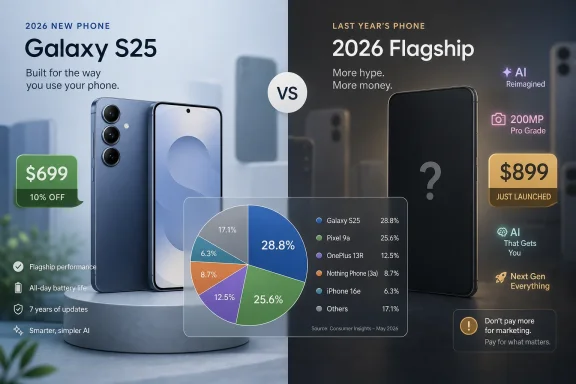 The Galaxy S25 Wins Because Boring Has Become Valuable
The Galaxy S25’s win is not surprising, but it is revealing. Samsung’s base Galaxy S model has spent years becoming the default Android answer to the iPhone: compact enough, powerful enough, camera-capable enough, and backed by the kind of retail presence that makes it feel safe. That safety matters more when the difference between a 2025 and 2026 flagship looks incremental from across a store counter.Android Authority’s poll put the Galaxy S25 at 28.8 percent, a strong but not overwhelming lead. That number suggests enthusiasm, not consensus. The S25 is the phone readers chose most often, but the closeness of the Pixel 9a result shows that the old flagship is no longer the only obvious alternative to the new flagship.
There was a time when choosing last year’s premium phone meant accepting real trade-offs: shorter software support, worse cameras, dimmer screens, weaker processors, or batteries already behind the curve. That equation has changed. Long update commitments, mature camera pipelines, and overpowered chips have extended the useful life of high-end Android hardware.
The Galaxy S25 benefits from that maturity. It is new enough to feel modern, old enough to be discounted, and familiar enough that buyers do not need to decode a risky experiment. In a market where manufacturers are leaning heavily on AI branding and small cosmetic changes, the S25’s greatest selling point may be that it already exists, already works, and already costs less than its successor.
The Pixel 9a Shows That Value Is No Longer a Budget Niche
The Pixel 9a’s second-place finish, at 25.6 percent, is arguably the more interesting result. It came close enough to the Galaxy S25 to show that Android Authority readers were not simply voting for the most premium older device. They were voting for the phone that made the cleanest economic argument.Google’s A-series Pixels have long occupied a sweet spot: not quite flagship, not quite budget, and often close enough to the mainstream Pixel experience that the cheaper model feels like the more rational purchase. In 2026, that proposition becomes stronger because the high end has become more expensive and less obviously transformative.
Android Authority noted that the Pixel 9a was still roughly $200 cheaper than the Galaxy S26 on Amazon at the time of writing. That kind of gap matters. It is the difference between buying into a flagship brand and buying a phone that can take good photos, get timely software, and disappear into daily life without turning the purchase into a financial event.
The Pixel 9a’s appeal also reflects a broader shift in Android buying psychology. Many users no longer think of midrange phones as second-class devices; they think of them as sane devices. If the camera is good, the screen is bright, the battery lasts, and the software is clean, the absence of a telephoto lens or titanium frame is not a tragedy.
This is where Google’s phone strategy cuts both ways. The company has done such a good job making cheaper Pixels feel complete that it has trained some buyers to question the need for more expensive Pixels. The Pixel 9a’s strong poll showing suggests that, at least among Android enthusiasts, value has become a feature class of its own.
Samsung’s Middle Child Still Has a Mass-Market Case
The Galaxy A56 5G landed third with 15.7 percent of the vote, a notable drop from the Galaxy S25 and Pixel 9a but still a respectable showing. That result fits the A-series perfectly. Samsung’s midrange phones rarely inspire the same online devotion as the Galaxy S line, but they sell because they solve practical problems at scale.The A56 is not the romantic choice. It is the phone for buyers who want a big screen, decent battery life, a recognizable brand, and a price that does not require carrier-financing gymnastics. If the Galaxy S25 is the enthusiast’s discounted flagship and the Pixel 9a is the software-forward value play, the A56 is the retail-shelf workhorse.
Its poll share also hints at the limits of enthusiast surveys. Android Authority’s readership is more likely than the average buyer to understand chipsets, camera processing, update policies, and launch cycles. In the wider market, a device like the Galaxy A56 may punch above its online mindshare because it is available everywhere and easy to recommend to relatives who do not want to think about phones.
Still, third place tells us something. Even among readers primed to consider older phones, the middle-tier Samsung did not generate the same excitement as the older flagship or the Pixel value model. That may be because discounted flagships compress the market from above. When a Galaxy S25 becomes affordable enough, the A-series has to work harder to justify itself.
Motorola’s Stylus Phone Is Practical, but Practical Has a Ceiling
The Moto G Stylus 2025 took 14.6 percent, almost level with the Galaxy A56. That is a solid result for a device category that has always lived slightly outside the mainstream Android conversation. The stylus gives Motorola a clear hook, and in a sea of glass rectangles, a clear hook is worth something.But the poll also shows the ceiling for that kind of appeal. A built-in stylus is genuinely useful for note-taking, sketching, quick edits, and users who prefer more precise input. It is also not something most buyers wake up wanting. Motorola can own the niche, but owning the niche does not make the niche large.
The Moto G Stylus line tends to appeal to buyers who want utility over prestige. That is a good place to be when consumers are price-sensitive, but it is a harder place to be when discounted former flagships enter the same psychological territory. If shoppers can get stronger cameras, faster chips, longer support, or more premium materials for not much more money, the stylus has to do a lot of persuasive work.
The result also reinforces how difficult the Android midrange has become. There are many good-enough phones, but good-enough is crowded. A phone needs either brand gravity, exceptional software, a genuinely low price, or one distinctive feature that a meaningful number of people cannot live without. The Moto G Stylus has the feature; the question is how many people consider it essential.
The Razr Result Is a Warning for Foldables
The Motorola Razr 2025 finished last among the named options, with 9.2 percent of the vote. That is the poll’s sharpest reality check. Even when a foldable becomes cheaper, interesting, and well-reviewed, many buyers still do not see it as the sensible alternative to a conventional phone.Android Authority said it was somewhat surprised by the Razr’s weak showing, given its praise for the device. The surprise is understandable from a reviewer’s perspective. Foldables are more exciting to write about than another slab phone with a slightly faster processor and a slightly brighter display.
But excitement is not the same as purchase confidence. Foldables still carry mental baggage: durability concerns, repair anxiety, battery compromises, case awkwardness, and the lingering suspicion that the hinge is a liability waiting for a calendar reminder. Some of those fears may be outdated or exaggerated, but buying decisions are shaped by perception as much as specification.
The Razr’s low poll share suggests that price alone will not mainstream foldables. Consumers do not merely need foldables to be cheaper; they need them to feel ordinary. Until then, a discounted flip phone may remain a tempting second device rather than the default primary phone for people trying to make a careful purchase.
The Real Winner Is the Upgrade Cycle Nobody Can Shorten
The most telling comments in Android Authority’s report were not about the Galaxy S25 or Pixel 9a at all. They were the readers questioning the premise of frequent upgrades. One commenter bluntly argued that unless a phone is damaged, people do not need to upgrade every year.That sentiment has been building for years, and the industry knows it. Smartphones are now mature consumer appliances with luxury-product pricing. They are essential, personal, and frequently used, but the leap from one year to the next often feels smaller than the leap in marketing language suggests.
Manufacturers have tried to re-energize the cycle with AI features, camera tricks, satellite messaging, brighter displays, faster charging, and ecosystem tie-ins. Some of these improvements are real. Few of them have restored the old feeling that a two-year-old phone is obsolete.
The result is a buyer who has become harder to impress. A new model must not only be better; it must be better enough to overcome the discount on the old model. That is a much tougher standard, especially when last year’s phone still has years of software support ahead of it.
Enthusiasts Are Becoming More Like Fleet Managers
The Android enthusiast used to be caricatured as the person who upgraded constantly, chased benchmarks, flashed ROMs, and debated camera sensors in comment sections. That person still exists. But the poll shows a more pragmatic enthusiast emerging, one who thinks less like a gadget collector and more like a small-business IT manager.That means total cost of ownership matters. Software support matters. Repairability, trade-in value, battery degradation, storage configuration, and accessory compatibility matter. The device is not judged only by what it can do on launch day, but by how confidently it can serve for the next three or four years.
That is why older flagships have become so compelling. They often offer the best balance of premium hardware and reduced price, while still sitting within a long support window. The risk is lower than buying an obscure bargain phone, and the experience is often closer to the latest flagship than manufacturers would like to admit.
In enterprise terms, this is lifecycle management. In consumer terms, it is common sense finally catching up with marketing fatigue. The best phone is not always the newest one; it is the one whose depreciation has done more work than its successor’s spec sheet.
The Used and Import Market Is the Subtext
Android Authority’s reader comments also surfaced alternatives beyond the poll choices, including the Galaxy S23 Ultra, HONOR Magic 6 Pro, Sony Xperia 5 IV, and OnePlus models. That matters because the official poll options represent only the neat, mainstream version of the older-phone argument. The messier, more interesting version lives in refurb listings, carrier deals, gray-market imports, and regional bargains.A Galaxy S23 Ultra at the right price is a direct challenge to the idea that the latest base flagship is automatically the better buy. It may be older, but it brings a larger display, more ambitious camera hardware, and the aura of a former ultra-premium device. For many users, that is a more meaningful upgrade than buying a newer but less capable model.
The import examples are even more revealing. They show that some Android buyers are willing to trade warranty simplicity and local-market certainty for hardware value. That is not a recommendation for everyone, but it reflects a market in which official pricing can feel detached from what informed buyers believe a phone is worth.
This is where Android remains very different from the iPhone world. Apple controls a relatively narrow ladder of choices. Android is a bazaar. That bazaar can be confusing, but it also gives price-sensitive enthusiasts more ways to escape the annual flagship treadmill.
The 2026 Phone Has to Justify Itself Now
The uncomfortable implication for phone makers is that the burden of proof has shifted. In earlier smartphone eras, the buyer had to justify keeping an old phone. Now the manufacturer has to justify replacing it.That is a profound change. It means a 2026 phone cannot merely be newer than a 2025 phone. It has to be meaningfully better in a way the buyer can feel every day. A slightly improved chipset matters to gamers and power users, but it is invisible to someone whose current phone already opens apps instantly.
AI features are supposed to solve this problem, but they are not yet a universal upgrade trigger. Many are software-dependent, region-limited, cloud-connected, or eventually backported to older devices. If a marquee feature can arrive later through an update, it weakens the case for replacing the hardware immediately.
Camera improvements face the same issue. Computational photography has made even midrange phones highly competent in good lighting, while social media compression flattens many differences that reviewers obsess over. The best cameras are still meaningfully better, but “good enough” has become very good.
The Discount Is the Feature Apple and Samsung Cannot Advertise
There is a reason manufacturers focus launch events on new features rather than depreciation. The price drop on last year’s phone may be the most consumer-friendly feature in the market, but it is not one the industry can comfortably celebrate.The Galaxy S25’s poll win is essentially an endorsement of waiting. Buy the mature product after the early-adopter tax has burned off. Let other people absorb launch pricing, preorder uncertainty, first-wave bugs, and accessory scarcity. Then step in when the device is still modern but no longer priced like a status symbol.
That advice runs against the rhythm of the smartphone business. The industry depends on anticipation: leaks, teasers, launch events, hands-on videos, preorder bonuses, embargoed reviews, and carrier promotions. The older-phone strategy asks buyers to step outside that machine.
It is also harder to market because it is situational. The best older phone depends on price, region, storage tier, carrier compatibility, warranty status, and timing. But that complexity is precisely why enthusiast communities matter. They help buyers find the point where last year’s premium hardware becomes this year’s rational purchase.
Software Support Has Quietly Rewritten the Rules
The older-phone argument would be weaker if Android devices still aged out of support quickly. For years, that was the platform’s Achilles’ heel. Buying an older Android phone often meant sacrificing updates sooner than expected, especially outside Google and Samsung’s premium tiers.That has changed. Longer support commitments from major vendors have made one- and two-generation-old phones safer buys. A discounted device with several years of security updates remaining is no longer a risky stopgap; it can be a perfectly rational long-term purchase.
This shift helps Samsung and Google most. They have the brand trust and update infrastructure to make older models feel viable. Motorola and other vendors can compete on hardware value, but support perception still shapes buyer confidence, especially among readers who know enough to care.
It also changes how reviewers should talk about phones. Launch-day performance is only part of the story. A device’s value curve over time may matter more. The phone that looks slightly overpriced in month one can become a superb buy in month twelve if the software clock still has years left on it.
The Poll Is Small, but the Signal Is Loud
A poll of more than 2,000 Android Authority readers is not a scientific portrait of the global smartphone market. It is enthusiast-skewed, self-selecting, and shaped by the options provided. But dismissing it for those reasons would miss the point.Enthusiasts often preview broader behavior before it becomes mainstream. They notice price-performance shifts earlier. They understand when annual upgrades flatten out. They are more willing to buy refurbished, import, or wait for discounts. If even that audience is increasingly comfortable skipping the newest model, manufacturers should pay attention.
The poll also aligns with a broader consumer mood. People are keeping devices longer, comparing prices harder, and showing less patience for upgrades that feel cosmetic. Inflation, higher flagship pricing, and subscription fatigue all feed into a more skeptical buying culture.
That skepticism does not mean people hate phones. It means they respect their money more than the launch calendar. For an industry trained to treat annual replacement as a near-natural law, that is a serious cultural shift.
The Message Hidden in Android Authority’s Vote Count
The exact rankings matter, but the distribution matters more. The Galaxy S25 and Pixel 9a together captured more than half the vote. That pairing tells us buyers want either a discounted premium experience or a highly competent value phone with strong software. The mushy middle is harder.The Galaxy A56 and Moto G Stylus both performed respectably, but neither broke through. The Razr’s weaker result suggests foldables remain aspirational or curiosity-driven rather than default value picks. The “other” vote, at 6 percent, reveals a long tail of savvy shoppers who see the entire Android back catalog as fair game.
The cleanest interpretation is that the 2026 Android buyer is not anti-upgrade. They are anti-waste. They will upgrade when the battery is failing, the screen is cracked, the software support is ending, or the deal is too good to ignore. What they are rejecting is the idea that the calendar alone should decide.
That distinction matters. It means phone makers can still win buyers, but they have to win them honestly. The upgrade has to solve a problem the old phone does not.
The Smartphone Calendar Finally Meets Buyer Patience
The lesson from Android Authority’s poll is not simply that the Galaxy S25 beat the Pixel 9a. It is that the most compelling Android phone in 2026 may be the one released before the marketing department says you should care. For buyers, that opens a more disciplined way to shop.- The Galaxy S25 won Android Authority’s poll with 28.8 percent of more than 2,000 votes, making it the leading older-phone alternative to a new 2026 model.
- The Pixel 9a’s 25.6 percent share shows that readers are nearly as interested in software-led value as they are in discounted flagship hardware.
- The Galaxy A56 5G and Moto G Stylus 2025 remained viable midrange options, but their lower vote shares show how aggressively older flagships and strong budget Pixels squeeze the middle.
- The Motorola Razr 2025’s 9.2 percent result suggests foldables still face a trust problem, even when pricing becomes more attractive.
- Reader comments highlighted a broader resistance to unnecessary upgrades, with some arguing that damaged hardware, not a new launch cycle, should be the real trigger for replacement.
- The strongest buying strategy in 2026 is not automatically choosing old or new, but comparing the remaining support window, current discount, and real-world feature gap before paying launch pricing.
References
- Primary source: Android Authority
Published: 2026-07-03T20:30:41.415329
Survey reveals which older phone you'd choose over a 2026 model
We polled our readers on which older phone you’d buy if you weren't buying the latest model, and the results were tight at the top.www.androidauthority.com - Related coverage: androidcentral.com
RAM is the only phone spec that matters in 2026 | Android Central
The availability of many on-device AI features is directly correlated to the amount of RAM your phone has, making memory the most important spec.www.androidcentral.com - Related coverage: phonearena.com
The Best Android Phones for 2026 (Tested & Reviewed) - PhoneArena
Here are the top Android phones we've tested along with expert tips on finding the right device for your budget and needs.www.phonearena.com - Related coverage: techradar.com
The best Android phones 2026: top Google-powered phones | TechRadar
Not after an iPhone? These are the best Android phones available right now.www.techradar.com - Related coverage: androidheadlines.com
The Galaxy A56 Beat the Galaxy S25 Ultra as the Top-Selling Android Phone
If you had to pick what Android phone would be the best-selling for the holiday quarter last year, what phone would you pick? Galaxy S25 Ultra? Pixel 10 www.androidheadlines.com
- Related coverage: tomsguide.com
Best Android phones 2026 tested and rated: Our top picks | Tom's Guide
Our list of the best Android phones at every size and for every budget will help you make the right choice.www.tomsguide.com
- Related coverage: ashgabattimes.com
