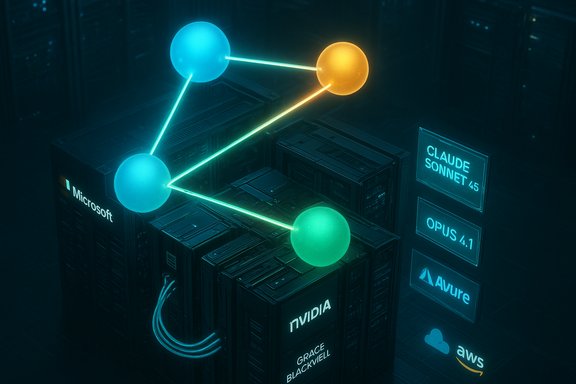
Microsoft, NVIDIA and Anthropic’s announcement is a structural moment for the enterprise AI market: Anthropic will scale its Claude family on Microsoft Azure with a formal compute purchase commitment and new one‑gigawatt capacity plans; NVIDIA and Anthropic will enter a deep technology partnership to co‑engineer model‑to‑silicon optimizations; and NVIDIA and Microsoft will invest in Anthropic as part of a broader ecosystem realignment that shifts model distribution, infrastructure control, and enterprise model choice.
The headlines are crisp: Anthropic has committed to purchase substantial Azure compute capacity—reported at $30 billion—and to secure additional dedicated capacity scaling up to one gigawatt, while NVIDIA and Microsoft have pledged large investments in Anthropic ($10 billion and $5 billion, respectively). These steps are paired with product-level changes: Anthropic’s Claude models (notably Claude Sonnet 4.5, Claude Opus 4.1, and Claude Haiku 4.5) will be available through Microsoft Foundry and integrated across Microsoft’s Copilot family, giving enterprises a broader roster of frontier models inside Microsoft surfaces. This is not a single‑product update; it’s a multi‑layered agreement that touches three axes of modern AI adoption: compute and facilities, model engineering and stack co‑design, and commercial distribution with integrated enterprise services. The announcement explicitly positions Claude as available on an expanded set of clouds and within Microsoft’s orchestration surfaces, making it, by Microsoft’s account, a frontier model available across the largest public cloud platforms.
(Note: Several technical and financial figures in the announcements are company‑reported projections and multi‑year commitments. Readers should treat headline numbers—purchase commitments, “up to” investment caps, and initial gigawatt targets—as contractual announcements that may include phased delivery, options, and conditional triggers, and validate specifics with vendor contracts during procurement.
Source: The Official Microsoft Blog Microsoft, NVIDIA and Anthropic announce strategic partnerships - The Official Microsoft Blog
 Background / Overview
The headlines are crisp: Anthropic has committed to purchase substantial Azure compute capacity—reported at $30 billion—and to secure additional dedicated capacity scaling up to one gigawatt, while NVIDIA and Microsoft have pledged large investments in Anthropic ($10 billion and $5 billion, respectively). These steps are paired with product-level changes: Anthropic’s Claude models (notably Claude Sonnet 4.5, Claude Opus 4.1, and Claude Haiku 4.5) will be available through Microsoft Foundry and integrated across Microsoft’s Copilot family, giving enterprises a broader roster of frontier models inside Microsoft surfaces. This is not a single‑product update; it’s a multi‑layered agreement that touches three axes of modern AI adoption: compute and facilities, model engineering and stack co‑design, and commercial distribution with integrated enterprise services. The announcement explicitly positions Claude as available on an expanded set of clouds and within Microsoft’s orchestration surfaces, making it, by Microsoft’s account, a frontier model available across the largest public cloud platforms. Deal specifics: numbers, commitments, and what they mean
The compute and capital headlines
- Anthropic’s compute purchase commitment is reported as $30 billion of Azure capacity, with the firm also contracting additional dedicated compute up to one gigawatt initially. Those figures were confirmed in multiple outlets covering the joint announcement.
- NVIDIA and Microsoft will make strategic investments in Anthropic—up to $10 billion from NVIDIA and up to $5 billion from Microsoft—framing Anthropic as a material partner in the model‑and‑infrastructure ecosystem.
What “one gigawatt” actually implies
A one‑gigawatt range for AI capacity is not a CPU/GPU count but an electrical and facilities scale: it maps directly to the power the data center(s) must deliver, protect, and cool. For reference, gigawatt‑scale commitments translate to multiple hyperscale campuses or a cluster of AI‑dense facilities capable of hosting tens to hundreds of thousands of advanced accelerators. That engineering reality is why vendors repeatedly pair compute deals with architectural roadmaps (e.g., rack‑level NVLink domains, liquid cooling and custom power arrangements). Putting an SLA‑backed, gigawatt‑grade footprint on paper signals long‑term operational planning: procurement, utility contracts, power‑density engineering and environmental considerations all become central.Technical partnership: Anthropic + NVIDIA co‑engineering
From commodity GPUs to co‑designed stacks
The announcement describes a “deep technology partnership” between Anthropic and NVIDIA: the two companies will collaborate on design and engineering to optimize Anthropic models for NVIDIA architectures and, reciprocally, tune future NVIDIA architectures for Anthropic workloads. This is explicitly framed as a co‑engineering effort to improve performance, efficiency, and total cost of ownership (TCO) for production deployments. NVIDIA’s public product roadmap—Blackwell Ultra, GB300 GB‑class rack designs, and the Vera Rubin family—shows the company is already focused on “rack as accelerator” and tightly coupled compute domains that demand software and model architectures to match. Co‑designing at the model and microarchitecture level can yield significant runtime gains: higher tokens per second, more efficient memory utilization across NVLink/NVSwitch, and better energy per inference metrics. These are precisely the levers cloud operators and model builders chase to make frontier models economically sustainable.The practical engineering workstreams
Anthropic/NVIDIA collaboration will likely include:- Kernel and operator optimization (tensor cores, sparse/dense operation mixes).
- Memory‑pooling and large‑context retrieval optimization for long‑context models.
- Custom compilation and runtime orchestration to utilize high‑bandwidth NVLink fabrics effectively.
- Joint validation of model precision, quantization strategies, and new accelerator features.
Product distribution: Claude on Azure, Foundry, and Copilot
Model availability and enterprise integration
Microsoft says Anthropic’s frontier Claude models—Claude Sonnet 4.5, Claude Opus 4.1, and Claude Haiku 4.5—will be accessible through Microsoft Foundry and embedded across the Copilot family (GitHub Copilot, Microsoft 365 Copilot, Copilot Studio). That expands Claude’s enterprise footprint inside Microsoft’s orchestration surfaces and adds to the ongoing shift toward multi‑model selection inside Copilot. Anthropic itself publishes a model availability matrix for Claude 4.5 variants and documents Sonnet’s and Haiku’s target workloads: Sonnet for high‑capability coding and agentic workflows, Haiku for cost‑efficient high‑volume deployments, and Opus for multi‑step reasoning and developer tasks. Those product definitions match Microsoft’s positioning of the models inside Copilot and Foundry.What enterprises actually get
- Model choice inside Copilot: IT admins can select models per task and orchestrate agents that route work to the appropriate backend (Sonnet for deep coding tasks; Haiku for scale; Opus for reasoning). That gives organizations a powerful lever to balance cost, latency and capability.
- MCP / connector semantics: Anthropic’s connector uses open tool protocols (like MCP) to let Claude access Microsoft 365 sources under admin control. That approach enables retrieval‑augmented generation with enterprise data, but it also introduces cross‑cloud data flow and contractual considerations.
- Copilot continuity: Microsoft committed to continuing Claude availability across its Copilot ecosystem—this is not a limited pilot but a platform integration that extends to GitHub and 365 productivity surfaces.
Market and competitive context
This deal sits in a larger, rapidly shifting mosaic of model builders, cloud providers, and hardware vendors. Over the past year leading into this announcement, Anthropic has expanded partnerships with AWS (Bedrock), Google (Vertex AI), and others for model distribution, while Amazon and Google maintain deep commercial ties with Anthropic for training and deployment in different channels. The multi‑cloud availability of Claude models was already visible on Vertex AI and AWS Bedrock before the Azure buildout news; the Microsoft announcement formalizes a much larger commercial and infrastructure commitment to Azure. From Microsoft’s standpoint, embracing more model diversity reduces concentration risk and positions Copilot as an orchestration and governance fabric rather than a single‑model product. For Anthropic, the Azure commitment and the NVIDIA co‑engineering pact boost its enterprise credibility and give the firm predictable infrastructure economics and distribution reach. For NVIDIA, the investment and technical tie deepen the company’s role as the dominant silicon and systems partner for foundational AI workloads.Infrastructure, energy, and operational implications
Data center engineering at scale
A 1 GW compute footprint and an Azure purchase commitment of the magnitude reported imply major data center engineering work: high‑density racks (NVL72/NVL144 style), liquid cooling, substation upgrades, and long‑term utility contracting. Microsoft’s own Fairwater campus examples and NVIDIA’s rack designs are the template for such deployments: tightly coupled GB300/Blackwell racks with NVLink fabrics and multi‑MW power delivery per building are now standard operating expectations for gigawatt‑scale AI.Environmental and community trade‑offs
Large AI campuses drive significant local energy demand and water/thermal management concerns. Companies increasingly commit to renewable contracts or grid‑scale energy management, but those arrangements require years of planning and can trigger local political scrutiny and permitting concerns. Enterprises should expect long lead times to get full capacity online. File‑level analyses of similar buildouts show that utility negotiation, grid upgrades, and environmental impact assessments are often the pacing items.Risks, caveats, and governance issues
Contractual & cross‑cloud data flows
A central governance risk is cross‑cloud processing and the contractual protections afforded to enterprise data. When a tenant routes requests to Anthropic‑hosted endpoints (even when accessible inside Microsoft Copilot), the processing may occur outside of Microsoft‑managed infrastructure and under Anthropic’s own DPAs and hosting terms—this matters for regulated industries and data‑residency needs. IT teams must confirm where inference occurs and what legal protections apply.Vendor claims vs. verifiable benchmarks
Vendor statements about model capability (benchmarks, large context sizes, throughput) are directional. Anthropic has published performance claims for Sonnet and Opus, and Microsoft has integrated these models into Copilot surfaces, but these claims should be validated in enterprise pilots. Where vendors cite 1M‑token contexts or specific latency/throughput numbers, organizations must run representative A/B tests to measure real‑world behavior, cost per inference, and edit rates for production tasks. Treat vendor benchmarks as starting points—not procurement guarantees.Concentration and competitive dynamics
Although multi‑model orchestration reduces single‑vendor dependence at the product level, infrastructure commitments that lock a model to a particular cloud for the bulk of its production footprint can reintroduce concentration risk at the compute and supply chain level. Anthropic’s $30B Azure commitment, if it materializes as long‑term spend on Azure and Microsoft‑managed campuses, could create asymmetries in negotiated pricing and capacity access across the industry. That has both competitive and regulatory implications.Practical guidance for Windows admins and enterprise IT
Enterprises and Windows‑centric IT leaders should approach the new landscape with measured pilots and governance-first automation:- Start with a controlled pilot tenant and scope Claude access to a small set of power users. Capture baseline KPIs for latency, accuracy, and human edit rate.
- Map data flows precisely: document where tenant data is routed (which cloud, which Anthropic endpoints), and confirm DPA and breach notification terms with both Microsoft and Anthropic.
- Require per‑request telemetry: log model IDs, provider details, MCP tool calls, costs, and provenance links to source documents. Ensure logs are auditable for compliance needs.
- Create model‑selection policies: define which model families are permissible for what data classes (e.g., Sonnet for internal dev tasks, Haiku for customer‑facing templated outputs, Opus for controlled research in sandboxes).
- Negotiate contractual clarity: secure explicit SLAs for latency, retention, deletion, and incident response for any cross‑cloud processing handled by Anthropic. Push for regional hosting options for regulated workloads.
Strategic takeaways and market outlook
- This tripartite arrangement accelerates the trend toward model and infrastructure co‑dependence: model builders are no longer purely software vendors; they are infrastructure consumers and, increasingly, infrastructure planners.
- NVIDIA’s role as both silicon provider and investor tightens the feedback loop between hardware roadmaps and model architectures, increasing the incentive for model authors to optimize for specific families (Blackwell, GB300 racks, Vera Rubin era systems). That co‑dependency can improve performance but also raises questions about portability and standards.
- Multi‑cloud distribution for models continues—Claude is already available on AWS Bedrock and Google Vertex AI—so enterprises will gain genuine vendor choice at the orchestration layer while still needing to manage cross‑cloud legal and operational complexity. The Microsoft deal formalizes a very large commercial and infrastructure commitment on top of an already multi‑cloud product footprint.
Strengths and opportunities
- Productivity & task fit: allowing different Claude variants and other LLM families inside Copilot gives IT teams a way to choose the right model for the right task, improving output quality and cost efficiency.
- Scale economics: Anthropic’s compute commitment and NVIDIA co‑engineering could lower marginal inference costs for high‑value, long‑context workloads through hardware/software synergy and predictable capacity planning.
- Enterprise distribution: embedding frontier models across Microsoft’s Copilot and Foundry surfaces simplifies adoption for Windows‑centric organizations that rely heavily on Microsoft 365, Visual Studio, and GitHub.
Key risks and what to watch closely
- Contractual gaps: ensure the DPA and hosting terms for cross‑cloud processing meet your regulatory needs; do not assume Copilot’s UI surface implies Microsoft legal protections extend to third‑party processing.
- Vendor lock and concentration at infrastructure level: a large compute commitment to a single cloud can rebalance competitive leverage in unexpected ways; watch for capacity allocation details and multi‑region guarantees.
- Unverified performance claims: run representative A/B tests and blind quality comparisons before making procurement decisions based on vendor benchmarks.
- Operational complexity: multi‑model orchestration increases telemetry, billing, and QA overhead; invest in automation to manage model routing, chargeback, and auditability.
Conclusion
The Microsoft–NVIDIA–Anthropic partnership is a defining moment in the industrialization of AI. It combines enormous commercial commitments (a reported $30 billion Azure purchase and 1 GW capacity), explicit hardware/software co‑design with NVIDIA, and deep product integration inside Microsoft’s Copilot and Foundry services. For Windows‑centric enterprises, the outcome is more choice inside tools you already use—but that choice carries contracts, data‑flow, and governance obligations that must be actively managed. The practical path forward for IT teams is clear: treat Claude availability as an opportunity to pilot, measure, and codify model selection policies; demand per‑request provenance and clear contractual protections; and plan for the infrastructure realities of gigawatt‑scale AI. If this deal unfolds as announced, it will accelerate enterprise AI adoption—while also reshaping how organizations think about who owns the compute, who owns the models, and who is accountable when those models run across corporate data.(Note: Several technical and financial figures in the announcements are company‑reported projections and multi‑year commitments. Readers should treat headline numbers—purchase commitments, “up to” investment caps, and initial gigawatt targets—as contractual announcements that may include phased delivery, options, and conditional triggers, and validate specifics with vendor contracts during procurement.
Source: The Official Microsoft Blog Microsoft, NVIDIA and Anthropic announce strategic partnerships - The Official Microsoft Blog