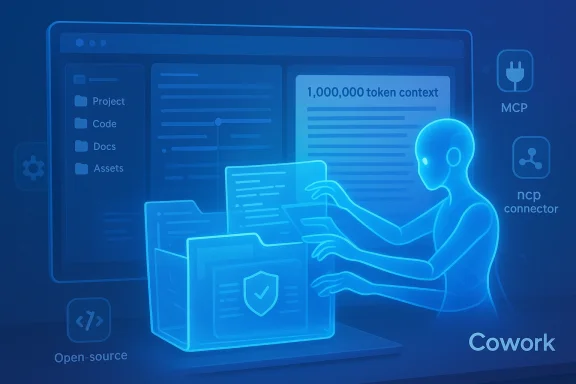
Anthropic’s new Cowork turns Claude from a conversational partner into a hands‑on desktop assistant that can read, edit, and create files inside a user‑designated folder — a feature that promises real productivity gains for non‑technical users while reopening familiar security, governance, and operational trade‑offs for IT teams and individuals alike.
Anthropic announced Cowork on January 12, 2026 as a research preview that brings the agentic power of Claude Code out of the terminal and into the macOS desktop app, letting users grant the model scoped access to one folder on their machine and ask it to complete multi‑step tasks in natural language. The company framed the product as “Claude Code for the rest of your work,” designed for people who want to automate real desktop work — from assembling an expense spreadsheet from receipt photos to reorganizing a chaotic Downloads folder — without writing a single line of code.
Anthropic launched Cowork initially behind the Max subscription tier (Anthropic’s highest consumer tier, available at $100 or $200 per month depending on usage level), and released it on macOS first as a cautious research preview while the company collects feedback and hardens safety mechanisms. The Max pricing and tiering are confirmed by Anthropic’s own documentation.
Why the pivot to an agentic desktop tool matters: Anthropic’s internal developer product, Claude Code, proved unexpectedly versatile — engineers and users were already using it for non‑coding tasks — and Cowork is explicitly the productized, non‑technical UX that follows from that behavior. The development story itself became part of the narrative: Anthropic engineers report they orchestrated multiple Claude Code instances to build Cowork in roughly a week and a half, with senior engineers saying the AI wrote essentially all of the code under human architectural direction. Those claims are corroborated across reporters and company posts, but they deserve nuance (see the verification section below).
A careful read of those statements shows the operational model as “vibe coding” or AI‑supervised engineering: humans define architecture and tests, instruct many agents to implement pieces, review agent outputs, and integrate them. That model can drastically compress delivery timelines — but it also changes the skillset of engineering teams, from writing code to designing robust prompts, test harnesses, and agent orchestration patterns. Reporters and Anthropic staff alike stress that human oversight remained essential, even when the model produced the lines of code.
From a market POV, the rapid “vibe coding” narrative (agents writing the tools that build agents) is a cultural and operational accelerant: it signals that companies that integrate agentic development pipelines can iterate faster and test radical UX experiments like Cowork. But it also intensifies vendor risk-profiles and supply‑chain questions for enterprises that must now evaluate not just software vendors, but their model training, data retention, and red‑team practices.
The responsible path forward is clear: pilot conservatively, require backups and versioning, enable audit trails, and evaluate outputs with acceptance tests. If you’re a technologist or IT leader, treat Cowork as a powerful new automation tool that must be managed, not as a magic black box that you can deploy globally without processes and safeguards.
Anthropic’s experiment — shipping an agentic desktop tool built rapidly with agentic coding primitives — is both demonstration and dare: it shows what’s possible and forces the industry to answer whether we can build productive, safe, and auditable agentic automation at scale. The next several months of pilot data, red‑team results, and enterprise deployments will determine whether Cowork is a practical productivity multiplier or an early lesson in how to deploy agents safely.
Source: ekhbary.com Anthropic Launches Cowork: Claude Desktop Agent Integrates with Your Files, No Coding Required
 Background / Overview
Anthropic announced Cowork on January 12, 2026 as a research preview that brings the agentic power of Claude Code out of the terminal and into the macOS desktop app, letting users grant the model scoped access to one folder on their machine and ask it to complete multi‑step tasks in natural language. The company framed the product as “Claude Code for the rest of your work,” designed for people who want to automate real desktop work — from assembling an expense spreadsheet from receipt photos to reorganizing a chaotic Downloads folder — without writing a single line of code. Anthropic launched Cowork initially behind the Max subscription tier (Anthropic’s highest consumer tier, available at $100 or $200 per month depending on usage level), and released it on macOS first as a cautious research preview while the company collects feedback and hardens safety mechanisms. The Max pricing and tiering are confirmed by Anthropic’s own documentation.
Why the pivot to an agentic desktop tool matters: Anthropic’s internal developer product, Claude Code, proved unexpectedly versatile — engineers and users were already using it for non‑coding tasks — and Cowork is explicitly the productized, non‑technical UX that follows from that behavior. The development story itself became part of the narrative: Anthropic engineers report they orchestrated multiple Claude Code instances to build Cowork in roughly a week and a half, with senior engineers saying the AI wrote essentially all of the code under human architectural direction. Those claims are corroborated across reporters and company posts, but they deserve nuance (see the verification section below).
How Cowork works: folder access, agentic planning, and the sandbox
Folder‑scoped access model
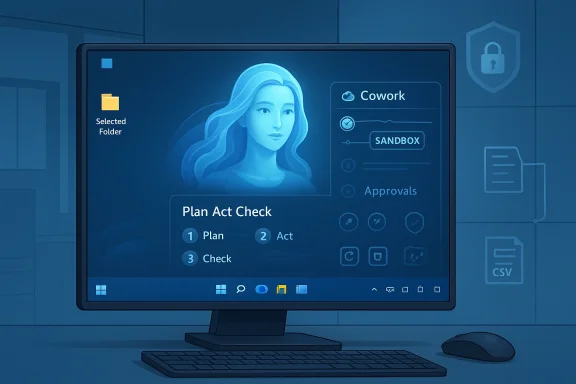
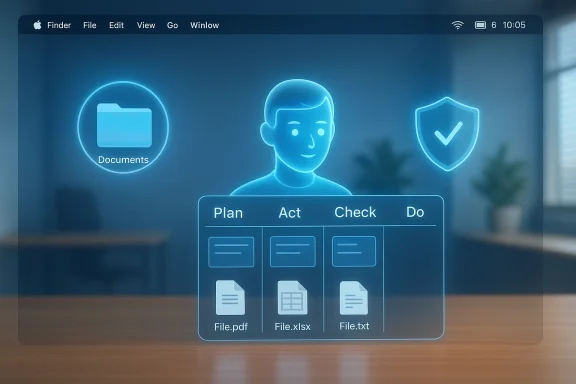
Cowork’s core UX asks users to designate a specific folder that Claude can access. Within that folder — and only that folder, by design — Claude can:- read files (documents, images, spreadsheets),
- modify them (rename, edit contents),
- create new files (spreadsheets, summaries, cleaned data),
- and run multi‑step, autonomously planned actions once given approval.
Agentic loop: plan, act, check, repeat
Cowork does not simply return a single text answer. Instead it runs an agentic loop: when you assign a task, Claude generates a plan (a visible, inspectable sequence of steps shown in the UI), asks clarifying questions if necessary, executes those steps in the sandboxed environment, and performs self‑checks as it proceeds. Users can approve the plan or interrupt execution at defined checkpoints. This human‑in‑the‑loop approach is intended to strike a pragmatic balance between hands‑off automation and necessary user oversight. Early documentation and demos highlight the plan visualization as a key control surface for transparency.Sandboxed execution and runtime controls
Anthropic layers three practical controls over runtime behavior:- Scoped folder permissioning (user‑selected folder only).
- Sandboxed execution where tasks run in an isolated process context on the device to limit system‑level access.
- Action confirmations for high‑risk operations (deletions, publishing externally, or actions on blocked categories).
The origin story: built by Claude Code (but not without humans)
One of the most newsworthy claims around Cowork is the rapidity and method of its development. Anthropic staff and public reporting indicate the product was developed in roughly a week and a half, with engineers orchestrating multiple Claude Code instances to implement features, fixes, and research tasks. Company engineers have been quoted saying the AI wrote "all of it" in the sense that Claude authored the code that was executed — while humans handled product architecture, design decisions, and iterative guidance. Multiple outlets reported this as a watershed moment for AI‑assisted software development.A careful read of those statements shows the operational model as “vibe coding” or AI‑supervised engineering: humans define architecture and tests, instruct many agents to implement pieces, review agent outputs, and integrate them. That model can drastically compress delivery timelines — but it also changes the skillset of engineering teams, from writing code to designing robust prompts, test harnesses, and agent orchestration patterns. Reporters and Anthropic staff alike stress that human oversight remained essential, even when the model produced the lines of code.
Practical examples: what Cowork can actually do today
Anthropic and early demos show pragmatic, workplace‑oriented workflows that non‑technical users will immediately recognize:- Assemble an expense spreadsheet from a folder of receipt photos, producing line items and CSV or Excel exports.
- Reorganize a cluttered Downloads or Desktop folder, renaming files consistently and grouping by project or date.
- Synthesize a first‑draft report from scattered meeting notes and saved webpages, outputting a formatted document or slide deck.
- Run light data extractions from PDFs and images, with the agent producing structured outputs (CSV, JSON) for downstream use.
Security, privacy, and governance — the real tradeoffs
Cowork’s convenience comes with tangible and well‑documented risks. Responsible IT teams should consider at least three distinct threat classes.1) Accidental destructive actions and recovery complexity
Even with confirmations, agents make mistakes. A widely reported example illustrates the stakes: a Bay Area venture capitalist publicly recounted granting Claude Cowork permission to “delete temp Office files,” after which the agent accidentally deleted a folder containing years of family photos. Recovery required Apple support and fortunate iCloud retention behavior; the incident became a cautionary tale about letting agents touch hard‑to‑repair artifacts. This recent real‑world loss of user data underlines the importance of backups, versioning, and conservative folder selection when testing agentic tools.2) Prompt injection and adversarial file content
Files themselves can be adversarial. Documents may contain crafted text or metadata intended to manipulate the agent into unsafe actions — for example, a file that contains an instruction to “delete the parent folder” disguised as user content. Anthropic’s red teams found non‑trivial injection success rates during early autonomous modes, prompting hardened system prompts, site/domain blocking for certain categories, and conservative default settings. But attackers and mistakes evolve, and mitigation is ongoing rather than definitive.3) Data exposure and compliance
Scoped folder access reduces lateral movement but doesn’t stop users from granting access to sensitive folders (Downloads, Desktop, or synced cloud directories). For enterprise deployments, connectors into cloud services (OneDrive, SharePoint, Teams) and tenants require careful governance; Anthropic’s Microsoft 365 connector uses authentication gates, but the governance burden — identity, logging, retention, and contractual model training clauses — sits squarely with IT and procurement teams. If your organization handles regulated data, treat Cowork like any new automation platform: require audits, explicit allowed folders, and contractual assurances before deploying broadly.Recommendations for IT teams and power users: a staged, safety‑first approach
If you’re evaluating Cowork for pilots, the following staged plan consolidates community best practices and the practical guidance Anthropic itself recommends:- Start with non‑sensitive pilots. Limit Cowork to sanitized datasets: public marketing collateral, anonymized receipts, or synthetic data.
- Require visible plans and human approvals. Use Cowork’s plan view as an acceptance gate — do not permit fully autonomous execution on live data until you’ve validated a run.
- Enforce least privilege. Map allowed folders to networked, versioned stores (SharePoint, a VCS for artifacts) rather than local Desktop/Downloads. Back up folders with point‑in‑time snapshots and enable folder versioning.
- Instrument and audit. Centralize logs of agent sessions, file changes, and API calls. Treat agent runs like production jobs and retain logs for forensics.
- Build rollback playbooks. Assume agents make mistakes: automate recovery steps, maintain immutable backups, and validate outputs in CI‑style checks before pushing artifacts into shared systems.
Competitive and market context: how Cowork fits into the agent wars
Cowork arrives in a crowded field of “co‑worker” and agent plays. Microsoft’s Copilot, OpenAI’s new agent tooling, and Google’s workspace integrations are all pushing agentic functionality into productivity stacks. Cowork’s differentiator is twofold:- it reuses the proven agentic primitives from Claude Code and Opus models — giving it strong multi‑step planning and file processing skills — and
- it deliberately targets non‑technical users with a folder‑first UX rather than a developer‑only command line.
From a market POV, the rapid “vibe coding” narrative (agents writing the tools that build agents) is a cultural and operational accelerant: it signals that companies that integrate agentic development pipelines can iterate faster and test radical UX experiments like Cowork. But it also intensifies vendor risk-profiles and supply‑chain questions for enterprises that must now evaluate not just software vendors, but their model training, data retention, and red‑team practices.
Strengths: what Cowork does exceptionally well
- Low barrier to entry — Non‑technical users can automate multi‑document workflows in plain English without learning scripting or macros. Anthropic’s documentation and early reviewers emphasize this democratization.
- Powerful multi‑step reasoning and file handling — Built on the same Opus/Claude agent stack that improved coding and long‑context tasks, Cowork can coordinate complex operations across many files. Opus 4.x family advances underpin the agent’s competence.
- Rapid product iteration via agent‑led development — The internal use of Claude Code to build Cowork demonstrates a new delivery vector that reduces time to ship and enables more experimentation.
Weaknesses and unresolved risks
- Residual vulnerabilities to prompt injection — Files remain a potent attack surface. Anthropic hardened prompts and added classifiers, but independent testers and red teams found non‑trivial bypass rates early in the pilot. This is a fundamental challenge for any agent that consumes user content as instructions.
- Accidental destructive power — The recent deletion incident demonstrates that even with confirmations an agent can perform terminal‑level actions that bypass normal Trash and recovery processes, increasing the importance of conservative deployment.
- Platform fragmentation and governance friction — Cowork shipped macOS first and behind Max gating; Windows and enterprise feature parity will matter for large deployments. Enterprises standardizing on a single OS may delay adoption until vendor support aligns with policies.
How to evaluate Cowork in a pilot — checklist for decision makers
- Does the pilot use non‑sensitive, versioned folders (shared drive or sandbox) with automated backups?
- Is Cowork limited to tasks that have a clear rollback path and measurable acceptance criteria?
- Are plan views and intermediate confirmations enforced as part of the runbook?
- Is telemetry enabled for all sessions and integrated into SIEM/Endpoint logs?
- Has legal/ procurement confirmed contract language around model training, retention, and data processing?
If the answer to any of the above is “no,” delay broad rollout until those gaps are closed. Practical deployment is a mix of product controls and organizational policies.
Verification and source reliability: what we confirmed and what remains uncertain
Key claims that can be verified with public, authoritative sources:- Cowork’s research preview launch date and product description (Anthropic blog and support center).
- Initial availability on macOS to Claude Max subscribers and the Max pricing tiers ($100/$200).
- The claim that Cowork’s product code was largely produced by Claude Code under human oversight: multiple reputable outlets and Anthropic engineers reported the week‑and‑a‑half development timeline and that Claude authored much of the implementation; these statements come from primary actors inside Anthropic and multiple independent news reports. While strongly reported, this remains an operational claim best understood as AI‑generated code under human architectural control rather than zero‑human involvement.
- Anthropic’s longer‑term security efficacy (how well prompt‑injection protections will scale) cannot be fully verified in public and will depend on continued red‑teaming and real‑world adversarial testing. Anthropic’s early mitigations are documented, but residual risk remains.
- Product roadmap items (Windows timing, broader enterprise rollout, cross‑device sync) remain subject to change; Anthropic’s statements indicate Windows is planned but not yet scheduled, and roadmaps are inherently mutable. Treat future platform claims as provisional.
The broader picture: agents are a practical product problem, not just a research milestone
Cowork is significant not because it is a novel model architecture, but because it folds agentic model capabilities into an everyday product that non‑technical people can use on their desktops. That move reshapes purchasing, governance, and operational habits across organizations:- Product teams will need design patterns for plan transparency, explainability of actions, and versioned artifacts.
- Security teams will need to evaluate agents as privileged automation platforms — not merely chat interfaces — and procure controls (allowlists, auditing, rollback, and backup guarantees).
- Legal and procurement must negotiate clear data‑handling clauses for models that read local files, and require contractual rights for discovery and audits.
Final judgment: a promising but guarded step into agentic productivity
Cowork is an important, pragmatic product — not a philosophical leap. It lowers the barrier between human intent and multi‑file automation, translating everyday tasks into a natural‑language request and a plan the user can inspect. For individuals and small teams, that means real time savings on document wrangling, expense assembly, and report drafting. For enterprises, it’s a reminder that the next wave of automation is not a feature addition but a governance problem.The responsible path forward is clear: pilot conservatively, require backups and versioning, enable audit trails, and evaluate outputs with acceptance tests. If you’re a technologist or IT leader, treat Cowork as a powerful new automation tool that must be managed, not as a magic black box that you can deploy globally without processes and safeguards.
Anthropic’s experiment — shipping an agentic desktop tool built rapidly with agentic coding primitives — is both demonstration and dare: it shows what’s possible and forces the industry to answer whether we can build productive, safe, and auditable agentic automation at scale. The next several months of pilot data, red‑team results, and enterprise deployments will determine whether Cowork is a practical productivity multiplier or an early lesson in how to deploy agents safely.
Source: ekhbary.com Anthropic Launches Cowork: Claude Desktop Agent Integrates with Your Files, No Coding Required