

Anthropic is pushing developers toward multi-model Claude deployments, using its newly released Fable 5 as a planning layer while cheaper models handle routine execution. The approach, described by Cryptonomist on July 18, positions model selection and routing as a core platform-engineering task rather than a per-prompt choice.
Fable 5 is Anthropic’s highest-capability generally available model for long-running, agentic work, according to the company. It launched in June and returned to global availability on July 1 after a temporary suspension. Anthropic lists Fable 5 alongside Opus 4.8, Sonnet 5 and Haiku models, with each aimed at a different balance of reasoning depth, speed and cost.
The proposed pattern is straightforward: send complex decomposition, planning and review work to Fable 5, then dispatch well-bounded subtasks to Sonnet 5 or Haiku. A higher-end model can also act as an orchestrator, deciding whether a task needs frontier reasoning or can be completed by a lower-cost model.
That differs from simply assigning every API call to the strongest available model. It also gives developers a way to contain the cost of agents that loop through many tool calls, documents or code changes. The model doing the planning does not necessarily need to generate every intermediate response.
For Windows developers building internal support agents, automation tools or coding workflows, the idea maps cleanly to existing job-routing patterns. A lightweight model can classify tickets, extract data from a form, summarize log output or produce routine responses. Fable 5 can be reserved for ambiguous incidents, multi-system troubleshooting plans, policy-sensitive decisions and final review of a complex change.
Cryptonomist said Anthropic is encouraging customers to build task-specific evaluation suites that compare output quality, tool-call correctness, latency and cost across the model lineup. That is the practical way to define routing rules, and those tests should be kept when models are upgraded.
Admins should also account for Fable 5’s current safety behavior. Anthropic says some cybersecurity and biology-related requests are automatically routed to Opus 4.8, while API customers must configure the relevant fallback settings. That means model identity and cost can differ from the originally requested route for affected workloads.
Teams should validate routing against their own workloads before making Fable 5 the planner in a production agent pipeline.
Fable 5 is Anthropic’s highest-capability generally available model for long-running, agentic work, according to the company. It launched in June and returned to global availability on July 1 after a temporary suspension. Anthropic lists Fable 5 alongside Opus 4.8, Sonnet 5 and Haiku models, with each aimed at a different balance of reasoning depth, speed and cost.
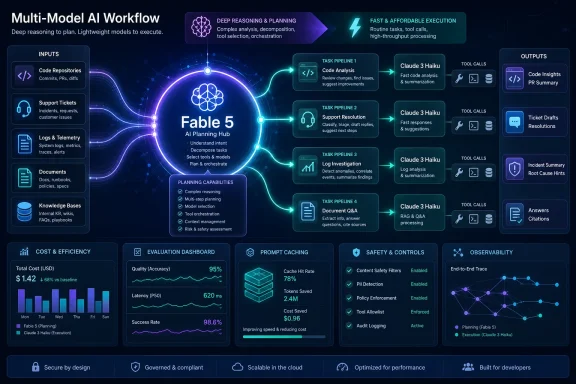 Plan with Fable, execute with smaller models
The proposed pattern is straightforward: send complex decomposition, planning and review work to Fable 5, then dispatch well-bounded subtasks to Sonnet 5 or Haiku. A higher-end model can also act as an orchestrator, deciding whether a task needs frontier reasoning or can be completed by a lower-cost model.That differs from simply assigning every API call to the strongest available model. It also gives developers a way to contain the cost of agents that loop through many tool calls, documents or code changes. The model doing the planning does not necessarily need to generate every intermediate response.
For Windows developers building internal support agents, automation tools or coding workflows, the idea maps cleanly to existing job-routing patterns. A lightweight model can classify tickets, extract data from a form, summarize log output or produce routine responses. Fable 5 can be reserved for ambiguous incidents, multi-system troubleshooting plans, policy-sensitive decisions and final review of a complex change.
Evals matter more than the product chart
The important caveat is that Anthropic’s suggested roles are not a substitute for evaluation. A task that appears simple can fail badly with a smaller model because of domain knowledge, tool-use reliability or an edge case in the input. Conversely, a team may find that Sonnet meets its accuracy threshold without requiring Fable’s extra reasoning budget.Cryptonomist said Anthropic is encouraging customers to build task-specific evaluation suites that compare output quality, tool-call correctness, latency and cost across the model lineup. That is the practical way to define routing rules, and those tests should be kept when models are upgraded.
Cost controls and safeguards
The operational pieces are familiar: prompt caching reduces repeat processing of stable context, batch processing suits high-volume work that is not latency-sensitive, and workflow budgets can limit the number of calls or tokens spent on a request. Anthropic says Fable 5 pricing includes a 90 percent input-token discount for prompt caching.Admins should also account for Fable 5’s current safety behavior. Anthropic says some cybersecurity and biology-related requests are automatically routed to Opus 4.8, while API customers must configure the relevant fallback settings. That means model identity and cost can differ from the originally requested route for affected workloads.
Teams should validate routing against their own workloads before making Fable 5 the planner in a production agent pipeline.
References
- Primary source: The Cryptonomist
Published: 2026-07-18T14:10:00+00:00
Claude Platform Orchestration: New AI Model Coordination
Explore Claude Platform orchestration to efficiently coordinate AI models, balancing power and cost in complex system deployments. en.cryptonomist.ch
- Official source: support.anthropic.com
Claude Code model configuration | Claude Help Center
support.anthropic.com
- Official source: assets.anthropic.com
