

Yellow.com reports that OpenAI’s GPT-5.6 Sol and Anthropic’s Claude Fable 5 are splitting benchmark wins, with Fable reportedly producing the stronger result in a one-shot browser-game test while Sol leads on selected coding-agent and long-horizon agent evaluations. For Windows developers, the practical message is less dramatic: the two flagship API models are close enough that workload testing matters more than a single leaderboard position.
OpenAI released GPT-5.6 Sol, Terra and Luna to general availability on July 9, replacing the prior single-model positioning with three capability and cost tiers. Sol is the flagship; Terra targets general workloads; Luna is the lower-cost option.
According to Artificial Analysis, Claude Fable 5 currently leads its broader Intelligence Index by one point, 60 to Sol’s 59 when both are run at their highest reasoning settings. But the same analyst says Sol leads its Coding Agent Index with a score of 80. OpenAI’s own launch material also puts Sol ahead of Fable on Agents’ Last Exam, though vendor benchmarks should be treated as product claims rather than a final verdict.
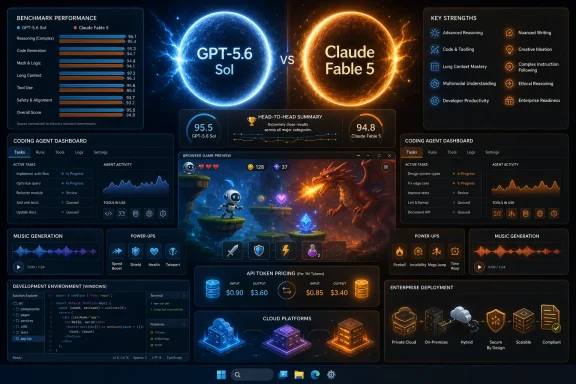
Yellow’s hands-on comparison argues that the difference becomes clearer in creative coding. In its cited browser-game exercise, Fable reportedly delivered a more complete package, including music, animation and power-ups, while Sol omitted those elements. The article does not provide a reproducible prompt, source code, run settings or scoring method, so it is not enough to establish a general coding winner.
That caveat applies especially to “creative” model tests. Output quality varies sharply with system prompts, tool access, reasoning level, iteration allowance, model version and whether the evaluator asks the model to test and repair its work. A polished first-pass game is useful evidence, but it is not a substitute for a project-specific evaluation.
For organizations building Windows-centric developer tooling, Copilot extensions, internal support bots or automation through cloud AI services, Sol’s lower list price is a legitimate reason to trial it first. Fable’s reported strength on ambitious one-shot code generation may justify the premium for teams that value a more complete initial implementation and can verify the output.
Anthropic says Fable 5 is available through its platform, supported marketplaces, AWS, Google Cloud and Microsoft Foundry. OpenAI has made the GPT-5.6 family available through ChatGPT, Codex and its API. That leaves enterprise buyers with more deployment and governance choices than a straightforward ChatGPT-versus-Claude comparison suggests.
Yellow says Anthropic’s paid-subscriber promotional access window ends July 19 after several extensions, but Anthropic’s public availability page does not establish that deadline.
Teams choosing between the models should run the same real prompts, repositories and acceptance tests against both before standardizing on either one.
 The benchmark picture is mixed
OpenAI released GPT-5.6 Sol, Terra and Luna to general availability on July 9, replacing the prior single-model positioning with three capability and cost tiers. Sol is the flagship; Terra targets general workloads; Luna is the lower-cost option.According to Artificial Analysis, Claude Fable 5 currently leads its broader Intelligence Index by one point, 60 to Sol’s 59 when both are run at their highest reasoning settings. But the same analyst says Sol leads its Coding Agent Index with a score of 80. OpenAI’s own launch material also puts Sol ahead of Fable on Agents’ Last Exam, though vendor benchmarks should be treated as product claims rather than a final verdict.
Yellow’s hands-on comparison argues that the difference becomes clearer in creative coding. In its cited browser-game exercise, Fable reportedly delivered a more complete package, including music, animation and power-ups, while Sol omitted those elements. The article does not provide a reproducible prompt, source code, run settings or scoring method, so it is not enough to establish a general coding winner.
That caveat applies especially to “creative” model tests. Output quality varies sharply with system prompts, tool access, reasoning level, iteration allowance, model version and whether the evaluator asks the model to test and repair its work. A polished first-pass game is useful evidence, but it is not a substitute for a project-specific evaluation.
Cost and platform implications
OpenAI lists Sol at $5 per million input tokens and $30 per million output tokens. Anthropic lists Fable 5 at $10 and $50 respectively. Those published token rates do not translate directly to final application cost: reasoning tokens, caching, output length, retries, tool use and latency can move the result substantially.For organizations building Windows-centric developer tooling, Copilot extensions, internal support bots or automation through cloud AI services, Sol’s lower list price is a legitimate reason to trial it first. Fable’s reported strength on ambitious one-shot code generation may justify the premium for teams that value a more complete initial implementation and can verify the output.
Anthropic says Fable 5 is available through its platform, supported marketplaces, AWS, Google Cloud and Microsoft Foundry. OpenAI has made the GPT-5.6 family available through ChatGPT, Codex and its API. That leaves enterprise buyers with more deployment and governance choices than a straightforward ChatGPT-versus-Claude comparison suggests.
Yellow says Anthropic’s paid-subscriber promotional access window ends July 19 after several extensions, but Anthropic’s public availability page does not establish that deadline.
Teams choosing between the models should run the same real prompts, repositories and acceptance tests against both before standardizing on either one.
References
- Primary source: yellow.com
Published: 2026-07-18T15:54:44.307000+00:00
Sol Or Fable 5: Which AI Model Wins The Creative Test | Yellow
Independent testing pits OpenAI's newest flagship against Anthropic's priciest model just as a discounted access deadline nears.yellow.com
