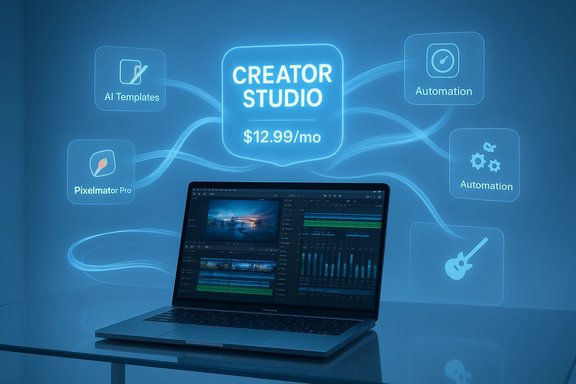
Apple has quietly changed how creators can test its pro apps: the generous, standalone 90‑day trials that let you evaluate Final Cut Pro and Logic Pro without committing are gone in favor of a bundled subscription path — Apple Creator Studio — that offers a shorter free window and folds the apps into a $12.99/month (or $129/year) subscription. This shift is small in a headline sense but large in practice: it reduces the low‑friction ways hobbyists and indie creators trial Apple’s pro tools, tilts discovery toward subscription revenue and on‑device AI features, and raises new questions about fairness, regional variability, and the long‑term calculus for professionals who prefer one‑time purchases. The practical upshot is simple: you can still use Final Cut Pro and Logic Pro before paying, but the route has changed — and the old loopholes that let users repeatedly reset long trial windows look to be closed.
Apple has long treated its pro apps differently from many pro software vendors. Final Cut Pro historically has been sold as a one‑time purchase (around $299.99 on the Mac App Store) while Logic Pro has been available as a one‑time purchase as well (around $199.99), each accompanied by a generous 90‑day free trial that allowed users to test the full program with no feature limits for three months. That arrangement made Apple’s tools unusually accessible for freelancers, students, and studios evaluating workflows. On January 13, 2026 Apple launched Apple Creator Studio, a paid subscription that bundles Final Cut Pro, Logic Pro, Pixelmator Pro (coming to iPad), Motion, Compressor, and MainStage, along with premium templates and Apple Intelligence features. Apple advertises a 30‑day free trial for Creator Studio and subscription pricing at $12.99 per month or $129 per year, with family sharing options. The company’s product pages now emphasize the bundled model as the trial path for trying Final Cut and Logic. Independent outlets and reader reports indicate that the standalone 90‑day downloads and links have been removed from Apple’s public trial pages.
The change is emblematic of a larger trend in creative software: vendors want to monetize ecosystems, not merely sell perpetual licenses. Creators who value the maximal trial runway should act quickly to secure longer evaluations through education deals, ask vendors for trial extensions in enterprise situations, or rely on capable free alternatives to vet workflows before they write the check. For everyone else, the Creator Studio subscription will be an attractive, lower‑cost path to a full suite of Apple‑native creative tools — provided you’re comfortable with subscription billing and Apple’s app ecosystem.
Apple’s official pages and the press coverage make one thing clear: the way to “try Final Cut Pro or Logic Pro for free” has changed. The old headline — “90‑day standalone trial” — is no longer Apple’s public story. For the most reliable, up‑to‑date details, consult Apple’s product pages for Creator Studio and the Mac App Store entries for Final Cut Pro and Logic Pro before you decide which route to take.
(If you want a short, practical checklist or a comparison table that shows the exact price and trial differences between the one‑time purchase and subscription options, that can be provided next.
Source: PCMag Middle East https://me.pcmag.com/en/video-editi...-or-logic-pro-for-free-apple-makes-it-harder]
 Background / Overview
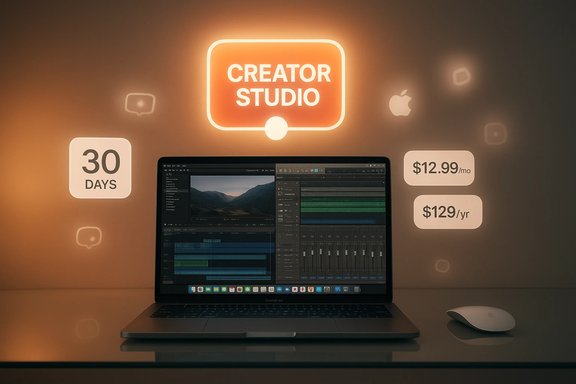
Apple has long treated its pro apps differently from many pro software vendors. Final Cut Pro historically has been sold as a one‑time purchase (around $299.99 on the Mac App Store) while Logic Pro has been available as a one‑time purchase as well (around $199.99), each accompanied by a generous 90‑day free trial that allowed users to test the full program with no feature limits for three months. That arrangement made Apple’s tools unusually accessible for freelancers, students, and studios evaluating workflows. On January 13, 2026 Apple launched Apple Creator Studio, a paid subscription that bundles Final Cut Pro, Logic Pro, Pixelmator Pro (coming to iPad), Motion, Compressor, and MainStage, along with premium templates and Apple Intelligence features. Apple advertises a 30‑day free trial for Creator Studio and subscription pricing at $12.99 per month or $129 per year, with family sharing options. The company’s product pages now emphasize the bundled model as the trial path for trying Final Cut and Logic. Independent outlets and reader reports indicate that the standalone 90‑day downloads and links have been removed from Apple’s public trial pages. What changed, exactly
The old flow (what many creators still remember)
- Download a standalone 90‑day trial directly from Apple for Final Cut Pro or Logic Pro on Mac.
- Launch, work on real projects, and evaluate the full feature set for 90 days.
- Decide to buy the one‑time license (Final Cut Pro ~$299.99, Logic Pro ~$199.99) or stop using the app.
- A common workaround exploited by some advanced users: installing a newer version or re‑downloading during major updates could effectively extend the free‑trial window under certain conditions. That loophole was real and was widely known.
The new flow (Apple Creator Studio)
- Apple now markets the Creator Studio subscription as the primary way to try Final Cut Pro and Logic Pro.
- New subscribers get a 30‑day free trial of the Creator Studio collection; Apple’s product copy indicates this explicitly. The subscription price after the trial is $12.99/month or $129/year.
- Standalone purchases remain available for users who prefer one‑time licensing — Final Cut Pro and Logic Pro are still sold separately on the Mac App Store — but the one‑time purchase route no longer carries the same public trial experience Apple previously advertised.
Why Apple likely made this move
Apple’s decision folds three commercial levers into one product architecture: subscription revenue, ecosystem lock‑in, and AI/feature monetization.- Subscription-first economics: Bundling pro apps into a $12.99/month subscription converts occasional testers into recurring revenue. For creators who use multiple apps, the annual subscription is a strong value proposition compared with independent one‑time purchases. Apple now captures long‑term lifetime value from users who previously might have paid once and never again.
- Cross‑sell and feature gating: Creator Studio advertises Apple Intelligence features and premium content that augment Final Cut and Logic. By packaging AI‑driven templates, automated workflows, and premium assets into a bundle, Apple can present differentiated capabilities to subscribers that m or are less clearly presented — to one‑time buyers. This nudges creators toward the subscription model beyond simple cost calculus.
- Reducing trial abuse and variability: The old 90‑day, standalone downloads were easy to game in some cases. Consolidating trial access into a subscription model allows Apple to centralize trial control, limit repeated long‑term free access, and standardize regional promotion windows. Community reports indicate users who attempted region‑based workarounds or trial resets have seen inconsistent results since the change.
What this means for creators — the practical impacts
Who benefits
- Multi‑app creators and teams: If you use Final Cut, Logic and Pixelmator (or plan to), the Creator Studio annual subscription is cheaper than buying each Mac app outright. Macworld’s value analysis shows the bundle becomes compelling when you compare sticker prices.
- Casual upgraders who prefer subscriptions: If you prefer subscription billing (predictable monthly cost, always‑current features, and family sharing), Creator Studio is an obvious fit.
- Apple‑led AI adopters: Creators who want access to Apple Intelligence features integrated across apps may prefer the subscription’s access to premium AI content and workflows.
Who loses out
- Budget‑conscious hobbyists and students: The old 90‑day trial was uniquely generous and let students and hobbyists evaluate pro workflows thoroughly before spending hundreds of dollars. The new model reduces that runway unless you qualify for a hardware‑tied promotional period or educational discount.
- One‑time‑purchase purists: Many professionals value a single perpetual license (low total cost over many years). While Apple continues to sell standalone licenses, the lowered visibility of standalone trials makes it harder for buyers to test apps before paying the full price.
- Evaluators with long, complex projects: A 30‑day window is ofly vet long‑form workflows, plugin compatibility, or lengthy collaboration cycles. The previous 90 days were more forgiving for big, complex evaluations.
Technical and legal caveats
- Apple still sells Final Cut Pro and Logic Pro as one‑time purchases on the Mac App Store; the change affects how Apple promotes and distributes trial access, not the fundamental licensing options. That nuance matters. If you prefer a perpetual license, you can still buy it.
- Trial availability and promotional durations may vary by region, Apple ID history, or hardware‑bundled promotions. Reported experiments by users (region switches, VM workarounds) produced inconsistent trial results and can be fragile. Apple’s centralized trial approach reduces those inconsistencies but also makes trial access more tied to Apple’s subscription rules.
- Readers should verify the trial text shown in their local App Store or Apple account before relying on device‑tied promotions; Apple’s store pages and support articles are the canonical source. Where publications like Cult of Mac or MacRumors report differences, those are typically based on examining store copy, press materials, or Apple’s Newsroom, but the local store text is definitive for any given user.
Alternatives and workarounds (a pragmatic checklist)
If you want to evaluate Final Cut Pro or Logic Pro without paying immediately, here are the realistic options in early 2026:- Try the Apple Creator Studio 30‑day free trial (or the promotional device‑linked trial if you have a qualifying new Apple device). This is the official, supported route now.
- If you need a long evaluation and can’t use Creator Studio, consider:
- Borrowing a colleague’s or school’s machine that already has the app licensed.
- Using competitor tools with longer free tiers (DaVinci Resolve’s free edition is notably capable for video; many DAWs offer generous demo periods). These let you validate workflows before committing to Apple’s ecosystem.
- Check educational discounts: Apple still offers the Pro Apps Bundle for Education at reduced rates, which can be a far cheaper route for students and staff.
- If you already purchased older versions or licenses, confirm upgrade paths and compatibility with the latest macOS — Apple’s support pages and the Mac App Store detail upgrade pricing and backward compatibility.
Business and market analysis — what Apple is optimizing for
Apple’s pro apps have always played double duty: they are both revenue drivers and ecosystem magnets. By moving trial access into Creator Studio, Apple is:- Encouraging cross‑app adoption (you pay one monthly fee and get a suite).
- Increasing predictable services revenue, which is attractive for Wall Street and for funding AI and content libraries.
- Making its premium AI features a differentiator you can’t get from singlrom a market perspective, this is a rational move: subscription economics scale better, and bundling with AI hooks helps Apple monetize future features. But that same logic reduces consumer testing freedom and transfers much of the evaluation burden onto third‑party reviews and social proof. For independent software vendors and plugin makers, the change raises a new challenge: fewer long trials mean fewer users will have extended windows to discover plugin compatibility issues, which could increase friction at the point of sale.
Risks and downsides — a clear‑eyed assessment
- Reduced trial runway increases buyer risk. One month is often insufficient to stress test a complex timeline or a multi‑plugin audio session across teams.
- Potential vendor lock‑in. Bundling increases the incentive to standardize on Apple’s toolchain; that’s positive if you embrace Apple’s roadmap, but it reduces cross‑platform flexibility.
- Inequity for lower‑budget creators. The previous 90‑day trial was a rare, genuinely consumer‑friendly step for those who could not immediately afford pro apps.
- Transparency and regional inconsistency. Where Apple’s marketing says one thing and local App Store copy another, users can be confused; third‑party reports show some region or account edge cases remain unpredictable.
Recommended next steps for readers
- If you’re considering Final Cut Pro or Logic Pro for a one‑off project, try Creator Studio’s 30‑day trial now — it’s the supported path and the fastest way to access both apps on Mac and iPad.
- If you need a longer test for a complex, multi‑week project, evaluate DaVinci Resolve (free) for video or consider a staged pilot with team members buying short subscriptions or borrowing licenses to spread the evaluation period.
- For educators, students, and institutions: check Apple’s Pro Apps Bundle for Education and compare lifetime costs versus Creator Studio subscriptions; education pricing can still be the best value.
- For plugin developers and integrators: update trial communications, test installers against subscription instances, and ensure support materials clearly state how to validate licensing and project portability between trial and purchased installs.
Closing analysis — a fair balance
Apple’s move is strategically coherent: it increases recurring revenue, centers Apple Intelligence across creative tools, and simplifies trial management. That said, it reduces the exceptional generosity of a standalone 90‑day trial that helped many creators start without financial friction. For professionals, the underlying economics aren’t catastrophic — the apps remain available as one‑time purchases — but the discovery and evaluation experience is notably different, and in some cases more restrictive.The change is emblematic of a larger trend in creative software: vendors want to monetize ecosystems, not merely sell perpetual licenses. Creators who value the maximal trial runway should act quickly to secure longer evaluations through education deals, ask vendors for trial extensions in enterprise situations, or rely on capable free alternatives to vet workflows before they write the check. For everyone else, the Creator Studio subscription will be an attractive, lower‑cost path to a full suite of Apple‑native creative tools — provided you’re comfortable with subscription billing and Apple’s app ecosystem.
Apple’s official pages and the press coverage make one thing clear: the way to “try Final Cut Pro or Logic Pro for free” has changed. The old headline — “90‑day standalone trial” — is no longer Apple’s public story. For the most reliable, up‑to‑date details, consult Apple’s product pages for Creator Studio and the Mac App Store entries for Final Cut Pro and Logic Pro before you decide which route to take.
(If you want a short, practical checklist or a comparison table that shows the exact price and trial differences between the one‑time purchase and subscription options, that can be provided next.
Source: PCMag Middle East https://me.pcmag.com/en/video-editi...-or-logic-pro-for-free-apple-makes-it-harder]