

Apple discontinued the Mac Pro on March 26, 2026, removing the tower workstation from its official store and product lineup after nearly 20 years as the company’s most expandable Mac for creative studios, engineers, developers, and other high-end professional users. As first reported by 9to5Mac, Apple also said it has no plans to offer future Mac Pro hardware. That makes this less a routine product refresh than a quiet admission that Apple’s idea of “pro” computing has moved decisively away from user-serviceable towers. The Mac Pro did not die because professionals stopped needing power; it died because Apple decided power no longer needs to look like a workstation.
The discontinuation feels sudden only if one looks at the Apple Store page rather than the product’s update history. The Mac Pro’s last meaningful refresh came in June 2023, when Apple moved the machine to the M2 Ultra and completed the long-delayed Apple silicon transition. After that, the tower simply sat there: expensive, imposing, and increasingly awkward beside smaller Macs that were receiving newer silicon first.
9to5Mac reported that the Mac Pro buy page began redirecting to Apple’s broader Mac homepage, with references removed from the company’s lineup. Tom’s Hardware and MacRumors subsequently framed the move as the end of a 20-year product line, though the strategic end had arguably arrived earlier, when the Mac Studio began receiving Apple’s fastest desktop chips ahead of the tower.
That is the uncomfortable truth for Mac Pro loyalists. Apple did not kill the Mac Pro at its peak; it killed a machine whose purpose had been eroded by the company’s own silicon strategy. The 2023 Apple silicon Mac Pro preserved PCIe slots, but it did not restore the old workstation bargain: buy the big box, then extend its life with GPUs, memory, storage, capture cards, and other internal hardware over time.
The Apple silicon version could accept expansion cards, but it could not accept the kind of expansion that once defined the category. Unified memory was fixed at purchase. External GPUs were not supported. The CPU and GPU were part of Apple’s system-on-chip design rather than replaceable or independently upgradeable components. The case still looked like a workstation, but the architecture increasingly behaved like an appliance.
The Mac Studio succeeded because it fits Apple’s current design vocabulary. It treats the computer as a dense performance block: chip, memory, GPU, media engines, storage, I/O, and thermal system designed as one unit. That approach is not friendly to traditional workstation upgradability, but it is exactly how Apple extracts performance per watt, reduces configuration complexity, and controls the full user experience.
For many editors, musicians, photographers, software developers, and design shops, the trade worked. A Mac Studio on a desk is quieter, smaller, easier to deploy, and often faster in the workflows Apple optimizes heavily: ProRes video, high-resolution photo processing, audio production, code compilation, and increasingly machine-learning-adjacent creative tasks. It is not a spiritual successor to the tower, but it is the machine Apple can sell to a broader pro audience.
That is why the Mac Pro’s $6,999 starting price became harder to defend with each passing quarter. A buyer was paying a tower premium for PCIe slots and a large chassis, while Apple’s fastest desktop momentum had shifted elsewhere. For a company as ruthless about lineup clarity as Apple, the overlap was unsustainable.
Apple silicon collapses those boundaries. CPU cores, GPU cores, Neural Engine, media engines, memory fabric, and other accelerators live inside a tightly integrated platform. The advantage is that Apple can move data quickly across the chip and memory system without the power and latency costs associated with more traditional component layouts. The disadvantage is obvious: the customer cannot upgrade much of anything that matters.
For laptops and small desktops, this compromise has mostly been accepted because the performance and battery-life wins are tangible. For a tower workstation, it is harder to swallow. The whole point of a tower is not merely that it is fast on day one; it is that it can adapt on day 900.
That mismatch haunted the Apple silicon Mac Pro from the start. It had the silhouette of the 2019 redemption machine, but not the same logic of ownership. Apple had built a beautiful case for a world in which the company no longer wanted users to treat the motherboard as a platform.
The so-called “trash can” Mac Pro bet on dual GPUs, shared thermal architecture, and external expansion through Thunderbolt. It looked futuristic. It also aged poorly as GPU needs changed, internal upgrades proved limited, and pro users discovered that external boxes were not always a substitute for internal slots. Apple eventually acknowledged that it had designed itself into a thermal corner.
The 2019 Mac Pro was the apology tour. It restored the tower, brought back PCIe expansion, revived the cheese-grater aesthetic in modern form, and told high-end users that Apple had listened. For a moment, it seemed as if the company had rediscovered the value of the workstation as a platform rather than a sealed product.
But the timing was cruel. Within a year, Apple announced the Mac transition to its own silicon. The 2019 Mac Pro was a triumphant return to modular Intel workstation design just as Apple was preparing to leave that world behind. It was not wrong; it was late.
Apple kept PCIe expansion, which mattered for some audio, video, networking, and storage workflows. That should not be dismissed. There are studios with expensive cards, ingest systems, interfaces, and specialized infrastructure where a slot is not a nostalgic luxury but an operational requirement.
But the machine could not support discrete graphics cards, and its unified memory ceiling was a purchase-time decision rather than a future upgrade path. For the sort of buyer who historically expected a Mac Pro to be a long-lived chassis, that was a profound shift. The expansion that remained was useful, but narrower.
The result was a Mac Pro that appealed to a smaller subset of an already small audience. If a user needed Apple silicon performance and could live without internal PCIe, the Mac Studio was the obvious answer. If a user needed a truly modular workstation with replaceable GPUs and massive internal expansion, Windows and Linux workstations increasingly looked more honest about what they were.
That can be a perfectly rational proposition. Many professional workflows are not improved by tinkering with components. A video editor who needs reliable ProRes performance, color-accurate displays, fast external storage, and quiet operation may reasonably prefer a Mac Studio over a hulking workstation full of replaceable parts. A software team standardizing on Apple silicon laptops and desktops may care more about fleet consistency than internal expansion.
But control matters in professional environments because needs change. A small studio may land a larger client. A developer may move into local AI experimentation. A lab may adopt new capture hardware. A post-production house may need to extend the useful life of systems after a rough budget year. Traditional workstations provide options precisely because the future is not fully knowable at purchase time.
The Mac Pro represented that optionality inside Apple’s ecosystem. Its disappearance leaves Apple’s high-end users with a cleaner lineup but fewer escape hatches. For some customers, that will be fine. For others, it will be the final nudge toward mixed fleets: Macs where Apple silicon shines, PCs or Linux workstations where hardware flexibility remains non-negotiable.
That mess has value. A Threadripper Pro or Xeon workstation with discrete NVIDIA or AMD graphics, ECC memory options, multiple internal drives, PCIe expansion, and vendor-certified ISV configurations is not elegant in the Apple sense. It is not supposed to be. It is a tool chest.
In enterprise and studio environments, the case for Windows workstations often begins where Apple’s model ends. If an application needs CUDA acceleration, specialized GPUs, unusual capture hardware, large pools of memory, or internal storage layouts tuned to a particular workflow, Apple’s integrated design can become a constraint rather than an advantage. The Mac Pro used to be Apple’s answer to that argument. Now Apple’s answer is mostly that many users do not need that category anymore.
That may be true for the majority of Apple’s pro customers. It is not true for all of them. The significance of the Mac Pro’s discontinuation is that Apple appears comfortable losing the edge cases that once gave the product its symbolic power.
For years, the Mac Pro told professionals that Apple was willing to build something for users whose needs were extreme, weird, and expensive. It did not matter that most Mac users bought MacBooks. The tower existed as a statement: Apple still had a place for those who needed the big box.
That symbolism was especially important after the 2013 model disappointed many of the very users it was meant to impress. The 2019 tower restored confidence not only because it was powerful, but because it looked like Apple admitting that professionals had been right to demand expansion and thermal headroom. It was a rare moment when Apple appeared to bend its design instincts toward the workstation community.
Ending the Mac Pro reverses that emotional signal. Apple is not abandoning professionals, but it is abandoning a particular promise to them. The promise was that the Mac could still be a platform you physically grew into over time. The replacement promise is that Apple will sell you a sealed machine powerful enough that you should not need to.
This distinction matters because Apple’s product transitions often generate wishful ambiguity. When a product disappears, enthusiasts search for a replacement rumor. When a page redirects, they look for supply-chain hints. When a niche machine goes quiet, they imagine a dramatic reveal waiting for the next keynote.
But the Mac Pro’s problem was not merely a missing M4 Ultra or M5 Ultra update. It was a category problem. If Apple believed the tower form factor still had a central role in its pro strategy, the company could have updated it, simplified it, lowered the price, or reworked it around a new chip architecture. Instead, according to 9to5Mac, Apple confirmed the end.
That does not mean Apple will stop courting developers and creative professionals at WWDC. Quite the opposite. Apple’s entire platform story depends on high-end creators, app developers, media professionals, and AI-adjacent workflows. The company simply appears to believe those customers can be served by MacBook Pro, Mac Studio, Mac mini, cloud resources, external Thunderbolt devices, and software optimization — not by a modular desktop tower.
But support is not the same as confidence. IT planners think in refresh cycles, spare parts, procurement standards, and deployment images. A discontinued flagship changes the conversation even if nothing breaks tomorrow. It tells purchasing departments not to build future plans around that form factor.
For studios, the bigger issue is not whether an existing Mac Pro can finish today’s jobs. It is whether the next round of hardware should remain all-in on Apple desktops or become more heterogeneous. That decision will vary by workflow. A Final Cut Pro or Logic-heavy shop may stay comfortably inside Apple’s ecosystem. A visual effects house leaning on GPU rendering, simulation, or machine learning may already be weighing alternatives.
The end of the Mac Pro also complicates the secondhand and reseller market. Remaining inventory may appeal to organizations with specific PCIe needs, but buying a discontinued tower at premium pricing is a very different proposition from buying into an actively maintained product line. The hardware may still be capable. The roadmap is the problem.
But the cost of that future is less hardware agency for the owner. Users choose at checkout, not over years. Memory is a configuration, not an upgrade. GPU capability is part of the chip family, not a card slot. Internal expansion becomes a specialty need rather than a defining feature.
This is a sharper version of a trend across the industry, not an Apple-only phenomenon. Laptops are less repairable than they used to be. Desktops are less central to many workflows. Cloud compute has absorbed some peak-demand tasks. External high-speed I/O has made internal bays less essential for many users. Apple is not inventing the move away from modular hardware; it is accelerating it with unusual confidence.
The danger for Apple is that professional credibility is hard to regain once users feel boxed in. The 2013 Mac Pro proved that. The company spent years rebuilding trust with pros who believed Apple had prioritized design purity over practical expansion. Ending the tower now risks reopening that wound, even if the performance case for Mac Studio is much stronger than the case for the cylinder ever was.
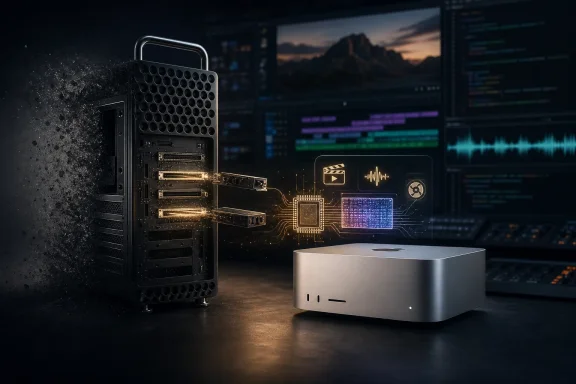 Apple Finally Ends the Tower It Had Already Left Behind
The discontinuation feels sudden only if one looks at the Apple Store page rather than the product’s update history. The Mac Pro’s last meaningful refresh came in June 2023, when Apple moved the machine to the M2 Ultra and completed the long-delayed Apple silicon transition. After that, the tower simply sat there: expensive, imposing, and increasingly awkward beside smaller Macs that were receiving newer silicon first.9to5Mac reported that the Mac Pro buy page began redirecting to Apple’s broader Mac homepage, with references removed from the company’s lineup. Tom’s Hardware and MacRumors subsequently framed the move as the end of a 20-year product line, though the strategic end had arguably arrived earlier, when the Mac Studio began receiving Apple’s fastest desktop chips ahead of the tower.
That is the uncomfortable truth for Mac Pro loyalists. Apple did not kill the Mac Pro at its peak; it killed a machine whose purpose had been eroded by the company’s own silicon strategy. The 2023 Apple silicon Mac Pro preserved PCIe slots, but it did not restore the old workstation bargain: buy the big box, then extend its life with GPUs, memory, storage, capture cards, and other internal hardware over time.
The Apple silicon version could accept expansion cards, but it could not accept the kind of expansion that once defined the category. Unified memory was fixed at purchase. External GPUs were not supported. The CPU and GPU were part of Apple’s system-on-chip design rather than replaceable or independently upgradeable components. The case still looked like a workstation, but the architecture increasingly behaved like an appliance.
The Mac Studio Won the Argument Before Apple Said It Out Loud
Apple’s chosen successor in practice is not another tower. It is the Mac Studio: compact, sealed, aggressively integrated, and positioned as the desktop Mac for users who need more than a Mac mini but do not need — or are no longer offered — the expandability of a Mac Pro. 9to5Mac argued that the Mac Studio is now clearly Apple’s pro desktop future, and Apple’s product cadence supports that reading.The Mac Studio succeeded because it fits Apple’s current design vocabulary. It treats the computer as a dense performance block: chip, memory, GPU, media engines, storage, I/O, and thermal system designed as one unit. That approach is not friendly to traditional workstation upgradability, but it is exactly how Apple extracts performance per watt, reduces configuration complexity, and controls the full user experience.
For many editors, musicians, photographers, software developers, and design shops, the trade worked. A Mac Studio on a desk is quieter, smaller, easier to deploy, and often faster in the workflows Apple optimizes heavily: ProRes video, high-resolution photo processing, audio production, code compilation, and increasingly machine-learning-adjacent creative tasks. It is not a spiritual successor to the tower, but it is the machine Apple can sell to a broader pro audience.
That is why the Mac Pro’s $6,999 starting price became harder to defend with each passing quarter. A buyer was paying a tower premium for PCIe slots and a large chassis, while Apple’s fastest desktop momentum had shifted elsewhere. For a company as ruthless about lineup clarity as Apple, the overlap was unsustainable.
Modular Computing Lost to Integrated Silicon
The Mac Pro’s death is really a referendum on modularity in the Apple silicon era. The Intel-era workstation model assumed that different components improved at different speeds and could be upgraded independently. Need more GPU? Add or swap cards. Need more RAM? Install it. Need specialty I/O? Use internal expansion. The workstation chassis existed because the system’s most important parts were separable.Apple silicon collapses those boundaries. CPU cores, GPU cores, Neural Engine, media engines, memory fabric, and other accelerators live inside a tightly integrated platform. The advantage is that Apple can move data quickly across the chip and memory system without the power and latency costs associated with more traditional component layouts. The disadvantage is obvious: the customer cannot upgrade much of anything that matters.
For laptops and small desktops, this compromise has mostly been accepted because the performance and battery-life wins are tangible. For a tower workstation, it is harder to swallow. The whole point of a tower is not merely that it is fast on day one; it is that it can adapt on day 900.
That mismatch haunted the Apple silicon Mac Pro from the start. It had the silhouette of the 2019 redemption machine, but not the same logic of ownership. Apple had built a beautiful case for a world in which the company no longer wanted users to treat the motherboard as a platform.
The 2013 Cylinder Cast a Long Shadow
To understand why this matters, it is worth remembering that Apple had already tried to redefine the Mac Pro once before. The 2013 cylindrical Mac Pro was compact, striking, and intensely Apple-like. It was also a lesson in what happens when industrial design outruns the messy realities of professional hardware.The so-called “trash can” Mac Pro bet on dual GPUs, shared thermal architecture, and external expansion through Thunderbolt. It looked futuristic. It also aged poorly as GPU needs changed, internal upgrades proved limited, and pro users discovered that external boxes were not always a substitute for internal slots. Apple eventually acknowledged that it had designed itself into a thermal corner.
The 2019 Mac Pro was the apology tour. It restored the tower, brought back PCIe expansion, revived the cheese-grater aesthetic in modern form, and told high-end users that Apple had listened. For a moment, it seemed as if the company had rediscovered the value of the workstation as a platform rather than a sealed product.
But the timing was cruel. Within a year, Apple announced the Mac transition to its own silicon. The 2019 Mac Pro was a triumphant return to modular Intel workstation design just as Apple was preparing to leave that world behind. It was not wrong; it was late.
The 2023 Mac Pro Was a Compromise Nobody Could Fully Love
The Apple silicon Mac Pro released in 2023 was important because it completed Apple’s move away from Intel. It was also strange because it tried to preserve the old tower’s external form while adopting an internal architecture that made many old workstation assumptions obsolete. It was both a milestone and a contradiction.Apple kept PCIe expansion, which mattered for some audio, video, networking, and storage workflows. That should not be dismissed. There are studios with expensive cards, ingest systems, interfaces, and specialized infrastructure where a slot is not a nostalgic luxury but an operational requirement.
But the machine could not support discrete graphics cards, and its unified memory ceiling was a purchase-time decision rather than a future upgrade path. For the sort of buyer who historically expected a Mac Pro to be a long-lived chassis, that was a profound shift. The expansion that remained was useful, but narrower.
The result was a Mac Pro that appealed to a smaller subset of an already small audience. If a user needed Apple silicon performance and could live without internal PCIe, the Mac Studio was the obvious answer. If a user needed a truly modular workstation with replaceable GPUs and massive internal expansion, Windows and Linux workstations increasingly looked more honest about what they were.
Professional Users Are Being Asked to Change Their Definition of Control
Apple’s message to professionals has been consistent for years, even when the company avoids saying it bluntly: trust the integrated system. Buy the configuration you need up front. Use external expansion where necessary. Let Apple own the core performance architecture.That can be a perfectly rational proposition. Many professional workflows are not improved by tinkering with components. A video editor who needs reliable ProRes performance, color-accurate displays, fast external storage, and quiet operation may reasonably prefer a Mac Studio over a hulking workstation full of replaceable parts. A software team standardizing on Apple silicon laptops and desktops may care more about fleet consistency than internal expansion.
But control matters in professional environments because needs change. A small studio may land a larger client. A developer may move into local AI experimentation. A lab may adopt new capture hardware. A post-production house may need to extend the useful life of systems after a rough budget year. Traditional workstations provide options precisely because the future is not fully knowable at purchase time.
The Mac Pro represented that optionality inside Apple’s ecosystem. Its disappearance leaves Apple’s high-end users with a cleaner lineup but fewer escape hatches. For some customers, that will be fine. For others, it will be the final nudge toward mixed fleets: Macs where Apple silicon shines, PCs or Linux workstations where hardware flexibility remains non-negotiable.
Windows Workstations Just Became Easier to Justify
For WindowsForum readers, this story is not merely Apple news. It is a reminder that the workstation market still has two very different philosophies fighting for professional budgets. Apple is betting on vertically integrated performance blocks. The Windows ecosystem still offers the old bargain: more vendors, more configurations, more component choice, and more mess.That mess has value. A Threadripper Pro or Xeon workstation with discrete NVIDIA or AMD graphics, ECC memory options, multiple internal drives, PCIe expansion, and vendor-certified ISV configurations is not elegant in the Apple sense. It is not supposed to be. It is a tool chest.
In enterprise and studio environments, the case for Windows workstations often begins where Apple’s model ends. If an application needs CUDA acceleration, specialized GPUs, unusual capture hardware, large pools of memory, or internal storage layouts tuned to a particular workflow, Apple’s integrated design can become a constraint rather than an advantage. The Mac Pro used to be Apple’s answer to that argument. Now Apple’s answer is mostly that many users do not need that category anymore.
That may be true for the majority of Apple’s pro customers. It is not true for all of them. The significance of the Mac Pro’s discontinuation is that Apple appears comfortable losing the edge cases that once gave the product its symbolic power.
The Symbol Was Always Bigger Than the Sales
The Mac Pro was never a volume product. It was expensive, niche, and often misunderstood by mainstream buyers who saw the starting price and wondered who could possibly need such a machine. But halo products matter because they tell customers where a company’s ceiling is.For years, the Mac Pro told professionals that Apple was willing to build something for users whose needs were extreme, weird, and expensive. It did not matter that most Mac users bought MacBooks. The tower existed as a statement: Apple still had a place for those who needed the big box.
That symbolism was especially important after the 2013 model disappointed many of the very users it was meant to impress. The 2019 tower restored confidence not only because it was powerful, but because it looked like Apple admitting that professionals had been right to demand expansion and thermal headroom. It was a rare moment when Apple appeared to bend its design instincts toward the workstation community.
Ending the Mac Pro reverses that emotional signal. Apple is not abandoning professionals, but it is abandoning a particular promise to them. The promise was that the Mac could still be a platform you physically grew into over time. The replacement promise is that Apple will sell you a sealed machine powerful enough that you should not need to.
The WWDC Timing Rumor Misses the Bigger Story
The source article notes speculation that Apple could introduce new models around WWDC 2026, scheduled for June 8 through June 12. That is a reasonable calendar hook for Apple watchers, but it now looks less persuasive in light of 9to5Mac’s report that Apple said it has no plans for future Mac Pro hardware. A new Mac Studio, new chip tier, or developer-focused workstation story may still appear. A direct Mac Pro successor is a different claim.This distinction matters because Apple’s product transitions often generate wishful ambiguity. When a product disappears, enthusiasts search for a replacement rumor. When a page redirects, they look for supply-chain hints. When a niche machine goes quiet, they imagine a dramatic reveal waiting for the next keynote.
But the Mac Pro’s problem was not merely a missing M4 Ultra or M5 Ultra update. It was a category problem. If Apple believed the tower form factor still had a central role in its pro strategy, the company could have updated it, simplified it, lowered the price, or reworked it around a new chip architecture. Instead, according to 9to5Mac, Apple confirmed the end.
That does not mean Apple will stop courting developers and creative professionals at WWDC. Quite the opposite. Apple’s entire platform story depends on high-end creators, app developers, media professionals, and AI-adjacent workflows. The company simply appears to believe those customers can be served by MacBook Pro, Mac Studio, Mac mini, cloud resources, external Thunderbolt devices, and software optimization — not by a modular desktop tower.
Service Support Softens the Landing but Does Not Change the Direction
Existing Mac Pro owners should not panic. Apple typically supports Macs with macOS updates for years, and service channels do not vanish the moment a product is discontinued. Businesses that recently invested in Mac Pro systems will still have operational life ahead of them, particularly if the machines were bought for stable workflows rather than speculative future upgrades.But support is not the same as confidence. IT planners think in refresh cycles, spare parts, procurement standards, and deployment images. A discontinued flagship changes the conversation even if nothing breaks tomorrow. It tells purchasing departments not to build future plans around that form factor.
For studios, the bigger issue is not whether an existing Mac Pro can finish today’s jobs. It is whether the next round of hardware should remain all-in on Apple desktops or become more heterogeneous. That decision will vary by workflow. A Final Cut Pro or Logic-heavy shop may stay comfortably inside Apple’s ecosystem. A visual effects house leaning on GPU rendering, simulation, or machine learning may already be weighing alternatives.
The end of the Mac Pro also complicates the secondhand and reseller market. Remaining inventory may appeal to organizations with specific PCIe needs, but buying a discontinued tower at premium pricing is a very different proposition from buying into an actively maintained product line. The hardware may still be capable. The roadmap is the problem.
Apple’s Pro Future Is Smaller, Denser, and Less Forgiving
The future Apple seems to want is not low-end. It is high-performance computing with fewer user decisions. The company will continue to push MacBook Pro and Mac Studio as serious machines, and it will continue to build silicon that embarrasses much larger systems in carefully optimized workloads. That is not marketing fluff; Apple silicon has genuinely changed expectations around desktop-class performance in compact devices.But the cost of that future is less hardware agency for the owner. Users choose at checkout, not over years. Memory is a configuration, not an upgrade. GPU capability is part of the chip family, not a card slot. Internal expansion becomes a specialty need rather than a defining feature.
This is a sharper version of a trend across the industry, not an Apple-only phenomenon. Laptops are less repairable than they used to be. Desktops are less central to many workflows. Cloud compute has absorbed some peak-demand tasks. External high-speed I/O has made internal bays less essential for many users. Apple is not inventing the move away from modular hardware; it is accelerating it with unusual confidence.
The danger for Apple is that professional credibility is hard to regain once users feel boxed in. The 2013 Mac Pro proved that. The company spent years rebuilding trust with pros who believed Apple had prioritized design purity over practical expansion. Ending the tower now risks reopening that wound, even if the performance case for Mac Studio is much stronger than the case for the cylinder ever was.
The Cheese-Grater Era Leaves a Practical Checklist Behind
The Mac Pro’s retirement is easy to romanticize, but the practical consequences are more useful than the nostalgia. The question for buyers is not whether the tower was iconic. It is whether their next workstation decision depends on capabilities Apple no longer wants to build into a Mac.- Apple has discontinued the Mac Pro as of March 26, 2026, and 9to5Mac reported that the company has no plans for future Mac Pro hardware.
- The Mac Studio is now Apple’s de facto high-end desktop, even though it does not offer the internal modularity that historically defined the Mac Pro.
- Existing Mac Pro systems remain useful for stable workflows, but they no longer represent a safe long-term platform bet for new procurement plans.
- Users who need replaceable GPUs, large internal expansion, or highly specialized workstation hardware now have stronger reasons to evaluate Windows and Linux systems.
- Apple’s professional strategy is not disappearing; it is consolidating around integrated silicon, sealed desktops, portable workstations, Thunderbolt expansion, and software optimization.
References
- Primary source: The Eastleigh Voice
Published: 2026-07-03T23:10:19.528349
Apple to discontinue Mac Pro, ending era of modular desktop | The Eastleigh Voice
While existing inventory may remain available through select resellers or third-party retailers until stocks are depleted, Apple itself will no longer.eastleighvoice.co.ke - Official source: apple.com
Apple introduces MacBook Pro with all-new M5 Pro and M5 Max - Apple
Apple announced the latest 14- and 16-inch MacBook Pro with the all-new M5 Pro and M5 Max.www.apple.com - Related coverage: macrumors.com
Apple Confirms Mac Pro Is Dead, No Future Models Planned
Apple has discontinued the Mac Pro and has removed the machine from its website, reports 9to5Mac. Apple said it does not plan to design a new version of the Mac Pro, and no new model will be coming in the future. The Mac Pro was last updated in 2023, which was when Apple added an M2 Ultra Apple...www.macrumors.com - Related coverage: tomshardware.com
Apple discontinues Mac Pro after 20 years — system had been stuck in stasis with M2 Ultra since 2023 | Tom's Hardware
Apple's iconic tower is gone, succeeded by the Mac Studio.www.tomshardware.com - Related coverage: theapplepost.com
Apple discontinues Mac Pro with no future models planned | The Apple Post
Apple has discontinued the Mac Pro, with no plans to develop future versions of its high-end desktop, according to a new report. 9to5Mac reports that Apple has confirmed the move, with the Mac Pro no longer available to purchase. The “Buy” page for the Mac Pro on Apple’s website now redirects to...www.theapplepost.com - Official source: support.apple.com
MacBook Pro (16-inch, M5 Pro or M5 Max) - Tech Specs - Apple Support
MacBook Pro (16-inch, M5 Pro or M5 Max) - Tech Specssupport.apple.com
- Related coverage: business-standard.com
- Related coverage: 9to5mac.com
Apple discontinues the Mac Pro with no plans for future hardware - 9to5Mac
It’s the end of an era: Apple has confirmed to 9to5Mac that the Mac Pro is being discontinued. It has...9to5mac.com - Related coverage: tomsguide.com
RIP cheese grater: Apple has officially discontinued the Mac Pro but I wouldn't buy a Mac Studio yet | Tom's Guide
Apple has discontinued the Mac Pro with no plans for a sequel, but I wouldn't rush out and buy a Mac Studio yet.www.tomsguide.com - Related coverage: techradar.com
Apple fans declare the ‘end of an era’ as the Mac Pro is discontinued — with its $700 accessory dubbed the ‘worst’ Apple product ever | TechRadar
Apple was asleep at the wheelwww.techradar.com - Related coverage: cincodias.elpais.com
Apple apaga a los Mac Pro: se han descatalogado y no hay relevo a la vista | Gadgets | Smartlife | Cinco Días
Todo apunta a un reordenamiento de los equipos profesionales de la firma de Cupertino, algo que es muy sensato en los tiempos que corren.cincodias.elpais.com
