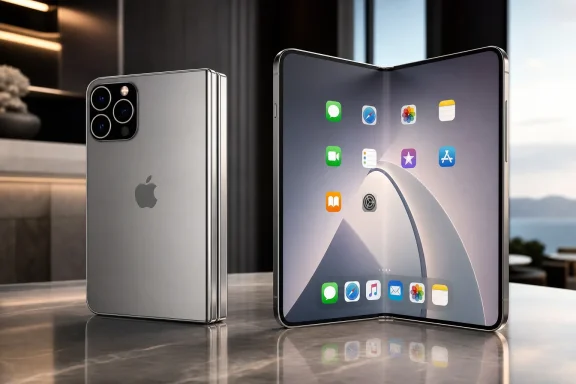
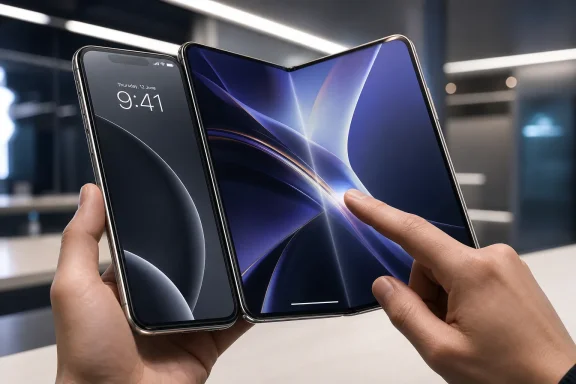
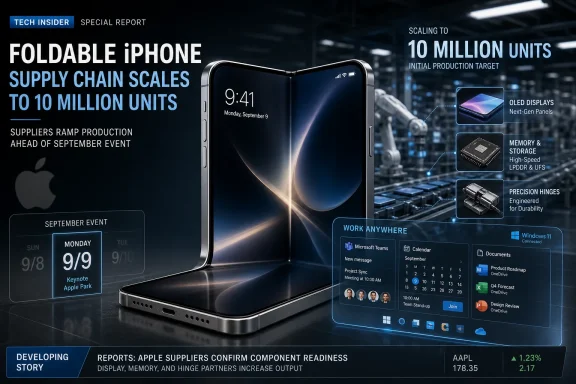
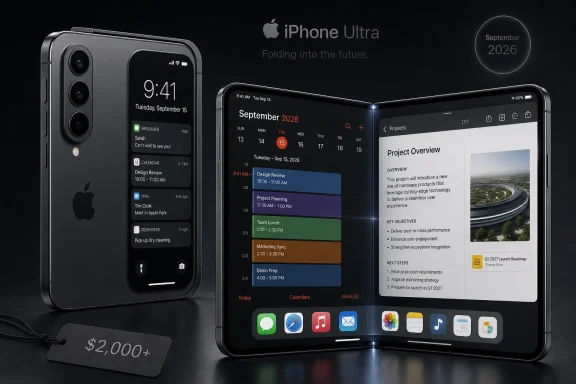
Apple is widely rumored to be preparing its first foldable iPhone for a September 2026 debut alongside the iPhone 18 Pro line, with recent reporting pointing to a book-style device, possible “iPhone Ultra” branding, iPad-like app layouts, and a price above $2,000. That is the factual core beneath the hype. The more interesting story is not that Apple may finally copy Samsung, Google, Motorola, and a long line of Chinese vendors. It is that Apple appears ready to redefine the foldable phone as an ultra-premium productivity device rather than a novelty for early adopters.
Apple has never been embarrassed by lateness when lateness can be reframed as discipline. The company did not invent the MP3 player, smartphone, tablet, smartwatch, wireless earbud, or mixed-reality headset. Its preferred move is to let the market expose the weak points, then enter when components, software conventions, and consumer expectations have hardened enough to be packaged as an Apple product.
Foldables have spent years doing exactly that market research in public. Samsung proved that a folding phone could survive multiple generations, but it also trained buyers to accept compromises: visible creases, awkward aspect ratios, fragile-feeling inner displays, thickness, high repair anxiety, and prices that make even flagship phones look sensible. Google showed that a wider foldable could feel more tablet-like, but also demonstrated how hard it is to align software polish, chip efficiency, and industrial design in a first-generation foldable.
That is why the rumored iPhone Ultra matters. If Apple launches a foldable in 2026, it will not be entering an empty category. It will be entering a category that already has defined failure modes, which is exactly the kind of battlefield Apple likes.
The PC comparison is hard to miss. Windows users watched Microsoft try dual-screen and folding-adjacent experiments with Surface Duo and Surface Neo, only for the software story to collapse before the hardware idea matured. Apple’s rumored device is not a Windows product, but it lands in the same broader argument about whether the next personal computer is a laptop, a tablet, a phone, or something that deliberately blurs all three.
That distinction matters. “Fold” describes what the product does. “Ultra” describes who it is for and how much Apple thinks it can charge. The name would also neatly avoid locking the device into the same vocabulary as Samsung’s Galaxy Z Fold, which has spent years owning the book-style foldable category.
Apple already uses “Ultra” where it wants to imply endurance, capability, and expense. Apple Watch Ultra is not merely a larger Apple Watch; it is the rugged, outdoor, battery-forward version for users willing to pay for a halo product. Extending that label to a foldable iPhone would signal that Apple sees the device less as an experimental side branch and more as the ultimate iPhone.
That framing would also protect the rest of the lineup. The iPhone Pro models can remain the mainstream luxury flagships, while the foldable sits above them as a device for the people who want the biggest screen, newest form factor, and highest status symbol. Apple does not need the first foldable iPhone to outsell the regular iPhone. It needs it to make the whole iPhone family look newly ambitious.
A book-style foldable gives Apple something more strategic: a phone that opens into a small tablet. The rumored inner display, often described as roughly iPad mini-sized, points directly at Apple’s strengths. Apple has spent more than a decade building tablet software conventions, large-screen app layouts, multitasking metaphors, and a developer culture that already understands adaptive interfaces.
The design would also explain why reports keep emphasizing iPad-like apps. Apple does not need to persuade developers to imagine an entirely new device class from scratch. It can tell them to make iPhone apps behave more intelligently across size classes, aspect ratios, and multitasking states, then let the hardware arrive as the most expensive reason to care.
The risk is that a book-style foldable can easily become neither fish nor fowl. Too narrow when closed, too square when open, too heavy in the pocket, too fragile for daily use, and too compromised for serious work. Apple’s rumored preference for a wider, passport-like shape would be an attempt to dodge one of the category’s most persistent annoyances: the feeling that the inner display is technically large but visually awkward.
That is why reports about Apple targeting better durability, screen quality, and a less visible crease feel plausible. Those are precisely the problems Apple would need to solve before exposing the iPhone brand to the foldable market. A cracked MacBook hinge is a repair issue. A compromised iPhone display is a reputational issue at global scale.
The first foldable iPhone does not need to be literally crease-free. It needs to be crease-minimized enough that Apple can photograph it, demo it, and sell it without the hinge becoming the first thing buyers notice. For a product rumored to cost well above $2,000, “better than Samsung” will not be enough; it will need to feel like Apple waited because the earlier versions were not good enough.
That is the company’s strongest argument and its biggest vulnerability. If the crease is still obvious, if the device feels thick, or if the inner display dents under normal use, Apple will not get to hide behind first-generation innocence. The market will judge it as a late entrant that had years to prepare.
A folding iPhone makes that line harder to defend. When closed, it is a phone. When open, it is tablet-sized. When running side-by-side apps, it begins to behave like an iPad. Yet if reports are correct, it will not offer the full multiwindow freedom of iPadOS.
That compromise is very Apple. The company tends to add capability slowly, especially on mobile devices, because every new interaction model increases complexity and support burden. Side-by-side apps would give the foldable enough productivity credibility without turning it into a tiny Mac or a fully windowed iPad.
For WindowsForum readers, this is where the story becomes more than an Apple rumor. Microsoft has spent decades building operating systems that assume windows, resizing, and arbitrary multitasking are normal. Apple’s mobile strategy has historically treated those same freedoms as something to ration. The foldable iPhone may become the most visible test yet of whether Apple can give users more screen without giving them too much control.
The key phrase in the current rumors is not “foldable.” It is adaptive. Apple needs apps that can move gracefully from a narrow outer display to a larger inner display without looking like stretched phone software. That requires developers to think less in terms of fixed rectangles and more in terms of responsive interfaces.
The iPad has already pushed developers in that direction, but unevenly. Some iPad apps are first-class citizens; others still feel like enlarged iPhone apps. A foldable iPhone would raise the stakes because users would transition between layouts constantly, not only when switching devices.
This could create a quiet sorting effect in the App Store. The best apps will feel native on the foldable immediately, with toolbars, panes, media views, and multitasking states that justify the display. Lesser apps will simply scale up and expose how little thought went into large-screen behavior. Apple can polish the operating system, but it cannot personally redesign every third-party app.
Large screens consume power. Multitasking consumes memory. More ambitious camera processing, gaming, video playback, and AI features all pile onto the same thermal envelope. A foldable phone also has less internal design freedom because hinge mechanics and dual displays compete with battery volume.
That is why Apple’s chip advantage matters. The company can use performance-per-watt as a design weapon, buying flexibility where rivals may have to choose between thinness, endurance, and heat. If the foldable iPhone is meant to be Apple’s most expensive mobile device, it cannot feel like a device that becomes powerful only when plugged in.
The bigger question is memory. Apple has historically been conservative with RAM compared with some Android rivals, leaning on iOS efficiency and tight hardware-software integration. But a foldable device designed around side-by-side apps will expose memory limits faster than a conventional phone. If Apple wants this to feel like an Ultra device, it needs to spec it like one.
The first foldable iPhone is likely to be a halo device, a proof of engineering power, and a way to lift the ceiling on what an iPhone can cost. Apple already sells Pro Max models at prices that would once have seemed absurd for a phone. A foldable Ultra lets the company create a new tier without making the ordinary Pro line look bloated.
That does not mean buyers will be rational. Many will compare the foldable to a phone plus an iPad mini and conclude that the math is not ridiculous. Others will compare it to a laptop and wonder why a fragile pocket tablet costs more than a serious computer. Both views can be true.
The repair story will matter almost as much as the purchase price. Foldables are expensive to fix, and buyers know it. AppleCare, display replacement pricing, hinge service policies, and battery repair terms will shape whether the iPhone Ultra feels like a premium tool or a luxury liability.
That work benefits Apple. Every Samsung Fold buyer has helped normalize the idea that a phone can open into a larger display. Every review that complained about creases, app scaling, battery life, thickness, and price gave Apple a checklist. Every generation proved that the market was not imaginary.
But Samsung also has a problem. If Apple enters with a credible foldable, Samsung’s years of category leadership may suddenly look like prelude rather than dominance. That is unfair, but consumer technology history is full of unfairness. The company that popularizes a category is not always the company that defines its mainstream meaning.
Samsung’s likely response will be speed. More shapes, thinner hardware, wider displays, better hinges, more aggressive AI features, and faster iteration. Apple’s response will be coherence. The fight will not simply be Fold versus iPhone Ultra; it will be Samsung’s hardware variety against Apple’s ecosystem gravity.
Apple is reportedly leaning toward that wider logic. That would be smart. If the outer display is unpleasant, users will resent the device every time they do a quick task. If the inner display is too square, video and games can look compromised despite the larger panel.
A foldable lives or dies in the transitions. It must be good enough closed that users do not feel forced to open it, and good enough open that users do not wonder why they bought it. The moment either state feels secondary, the device becomes a gimmick.
Apple’s advantage is that it can design the hardware, software, chips, and developer guidance as one story. Google has pieces of that equation, but Android foldables still depend heavily on OEM execution and app developer cooperation. Apple’s closed garden is often criticized for good reason, but a foldable may be one of the places where the walls make the experience easier to finish.
The Duo’s problem was not merely that it had two screens instead of one folding display. It was that the device asked users to believe in a new mode of mobile work before the software, performance, cameras, and platform support were fully convincing. Microsoft had an idea; Apple may have the distribution and developer leverage to make a similar class of idea feel inevitable.
That should sting in Redmond. Microsoft spent years talking about device categories that bridge phone and PC, only to retreat from phone hardware and pour its mobile strategy into Android apps, cloud services, and Windows integration. Apple, meanwhile, may be preparing to turn the iPhone into the pocket tablet that Microsoft could never quite deliver.
The irony is that Windows may still benefit. A successful foldable iPhone would push more developers to design adaptive interfaces, responsive layouts, and multi-pane mobile workflows. Those same habits matter for web apps, cross-platform apps, and Windows devices with unusual screens. Apple’s ecosystem may be closed, but its design gravity often leaks outward.
The enterprise appeal is obvious in specific niches. A foldable iPhone could make mobile dashboards, secure messaging, document review, remote desktop sessions, and line-of-business apps more usable without issuing a separate tablet. In industries where iPhones are already managed at scale, that matters.
But the device is unlikely to become a fleet standard quickly. Cost alone will limit deployment. Durability concerns will matter in the field. App readiness will vary, especially for internal tools that were designed around conventional phone screens and never properly adapted to iPad.
The likely pattern is familiar: executives first, specialists second, broad deployment maybe never. That does not make the device irrelevant. Halo devices often influence procurement indirectly by changing what users expect from the mainstream models that follow.
The harder sell is convincing buyers that this bigger screen is worth the weight, price, and fragility. Apple will need to show use cases that feel everyday rather than staged. Reading recipes while shopping, watching a match on a plane, editing photos, comparing messages and calendars, reviewing documents, playing console-style games, and using the camera with a flexible preview are all more persuasive than abstract productivity demos.
The device also has to avoid the “tiny iPad” trap. If buyers conclude that it is merely a worse iPad mini attached to a thicker iPhone, the value proposition weakens. The foldable must feel like a new default device, not a compromise bundle.
That is where continuity features could matter. Handoff, iCloud, AirDrop, Messages, FaceTime, Apple Pay, spatial media, and Apple Intelligence features could make the device feel like the central node in Apple’s ecosystem. The foldable is not just competing against other foldables. It is competing against the combination of an iPhone, iPad, MacBook Air, and user inertia.
If the iPhone Ultra costs more than the iPhone 18 Pro Max but ships with a less capable camera system, Apple will have to explain what “Ultra” means. The answer may be that Ultra refers to screen and form factor, not every spec. That is defensible, but it will still annoy buyers who assume the most expensive iPhone should be the best iPhone at everything.
Samsung has faced versions of this problem for years. Foldables often trail slab flagships in camera hardware because the design trade-offs are brutal. Reviewers notice. Enthusiasts notice. Ordinary buyers may notice only when they compare zoom shots, low-light photos, or video quality against a cheaper flagship.
Apple can soften the blow with computational photography, but physics remains physics. If the Ultra branding happens, the camera system will need to be good enough that the word does not feel like a dare.
Battery life will therefore be central to whether Apple’s foldable feels finished. A larger inner display invites more use, and more use drains more power. If users constantly ration the big screen to make it through the day, the product has failed its own premise.
Apple has some advantages here. Its chips are efficient, its operating system is tightly controlled, and it has a long history of making battery life feel better than raw capacity numbers suggest. But the physical constraints remain severe. Thin foldables leave less room for battery, and heavy foldables punish the pocket.
The rumored iPhone Ultra will need to be boringly reliable. That is not glamorous, but it is the difference between a showcase device and a daily driver. Foldables are already impressive; the next challenge is making them unremarkable in the best possible way.
The credible cluster is fairly coherent. A September 2026 launch alongside the iPhone 18 Pro family fits Apple’s seasonal rhythm, even if availability could be constrained. A book-style design fits the need for a larger computing canvas. iPad-like app layouts fit Apple’s developer direction. An A20 Pro-class chip fits the price and workload. A price above $2,000 fits the economics of a first-generation ultra-premium device.
The less certain claims are the ones that sound too clean. A completely invisible crease, flawless durability, uncompromised cameras, all-day battery under heavy unfolded use, and a thinness profile that magically escapes foldable physics should be treated skeptically until Apple shows the product. Apple is good at engineering trade-offs, not abolishing them.
That distinction is important because foldable rumors encourage fantasy. People do not merely imagine a folding iPhone; they imagine a folding iPhone that fixes every complaint they have about Android foldables while preserving every advantage of a normal iPhone. The real device, if it arrives, will be a set of choices.
If the iPhone Ultra launches well, Apple will claim the category was waiting for the right execution. If it launches awkwardly, rivals will get to say Apple waited years and still ran into the same problems. The margin for smugness is thin.
This is also why Apple’s first generation may be deliberately conservative. The company does not need wild triple-fold designs or experimental screen shapes. It needs a foldable that feels inevitable, reliable, and recognizably iPhone-like. That may disappoint gadget fans who want Apple to leapfrog everyone in one move, but it is more consistent with how Apple enters mature categories.
The real disruption may come later. A first foldable iPhone would normalize the form factor inside Apple’s ecosystem. A second or third generation could bring lower prices, better cameras, thinner designs, and broader software ambition. The first device opens the door; the later ones decide whether people walk through it.
 Apple Arrives Late Enough to Pretend It Was Waiting for the Market
Apple has never been embarrassed by lateness when lateness can be reframed as discipline. The company did not invent the MP3 player, smartphone, tablet, smartwatch, wireless earbud, or mixed-reality headset. Its preferred move is to let the market expose the weak points, then enter when components, software conventions, and consumer expectations have hardened enough to be packaged as an Apple product.Foldables have spent years doing exactly that market research in public. Samsung proved that a folding phone could survive multiple generations, but it also trained buyers to accept compromises: visible creases, awkward aspect ratios, fragile-feeling inner displays, thickness, high repair anxiety, and prices that make even flagship phones look sensible. Google showed that a wider foldable could feel more tablet-like, but also demonstrated how hard it is to align software polish, chip efficiency, and industrial design in a first-generation foldable.
That is why the rumored iPhone Ultra matters. If Apple launches a foldable in 2026, it will not be entering an empty category. It will be entering a category that already has defined failure modes, which is exactly the kind of battlefield Apple likes.
The PC comparison is hard to miss. Windows users watched Microsoft try dual-screen and folding-adjacent experiments with Surface Duo and Surface Neo, only for the software story to collapse before the hardware idea matured. Apple’s rumored device is not a Windows product, but it lands in the same broader argument about whether the next personal computer is a laptop, a tablet, a phone, or something that deliberately blurs all three.
The “Ultra” Name Would Be More Than Marketing
The most telling rumor is not the hinge, the chip, or even the launch date. It is the name. If Apple chooses “iPhone Ultra” instead of “iPhone Fold,” the company will be making a very Apple-like claim: this is not a variant defined by a mechanical trick, but a new top shelf in the iPhone hierarchy.That distinction matters. “Fold” describes what the product does. “Ultra” describes who it is for and how much Apple thinks it can charge. The name would also neatly avoid locking the device into the same vocabulary as Samsung’s Galaxy Z Fold, which has spent years owning the book-style foldable category.
Apple already uses “Ultra” where it wants to imply endurance, capability, and expense. Apple Watch Ultra is not merely a larger Apple Watch; it is the rugged, outdoor, battery-forward version for users willing to pay for a halo product. Extending that label to a foldable iPhone would signal that Apple sees the device less as an experimental side branch and more as the ultimate iPhone.
That framing would also protect the rest of the lineup. The iPhone Pro models can remain the mainstream luxury flagships, while the foldable sits above them as a device for the people who want the biggest screen, newest form factor, and highest status symbol. Apple does not need the first foldable iPhone to outsell the regular iPhone. It needs it to make the whole iPhone family look newly ambitious.
The Book-Style Fold Is the Only Apple-Like Choice
The rumor mill has generally settled on a book-style foldable rather than a clamshell. That makes sense. A flip-style iPhone would be fashionable, pocketable, and probably popular, but it would not give Apple a new computing canvas. It would mostly make an iPhone smaller when closed.A book-style foldable gives Apple something more strategic: a phone that opens into a small tablet. The rumored inner display, often described as roughly iPad mini-sized, points directly at Apple’s strengths. Apple has spent more than a decade building tablet software conventions, large-screen app layouts, multitasking metaphors, and a developer culture that already understands adaptive interfaces.
The design would also explain why reports keep emphasizing iPad-like apps. Apple does not need to persuade developers to imagine an entirely new device class from scratch. It can tell them to make iPhone apps behave more intelligently across size classes, aspect ratios, and multitasking states, then let the hardware arrive as the most expensive reason to care.
The risk is that a book-style foldable can easily become neither fish nor fowl. Too narrow when closed, too square when open, too heavy in the pocket, too fragile for daily use, and too compromised for serious work. Apple’s rumored preference for a wider, passport-like shape would be an attempt to dodge one of the category’s most persistent annoyances: the feeling that the inner display is technically large but visually awkward.
The Crease Is the Symbol Apple Has to Defeat
Every foldable has a crease. Some hide it better than others, but the crease remains the category’s most visible confession that the future is still a prototype. You can explain hinge geometry, ultra-thin glass, protective layers, and display physics all day; the buyer still sees the line in the middle of the expensive screen.That is why reports about Apple targeting better durability, screen quality, and a less visible crease feel plausible. Those are precisely the problems Apple would need to solve before exposing the iPhone brand to the foldable market. A cracked MacBook hinge is a repair issue. A compromised iPhone display is a reputational issue at global scale.
The first foldable iPhone does not need to be literally crease-free. It needs to be crease-minimized enough that Apple can photograph it, demo it, and sell it without the hinge becoming the first thing buyers notice. For a product rumored to cost well above $2,000, “better than Samsung” will not be enough; it will need to feel like Apple waited because the earlier versions were not good enough.
That is the company’s strongest argument and its biggest vulnerability. If the crease is still obvious, if the device feels thick, or if the inner display dents under normal use, Apple will not get to hide behind first-generation innocence. The market will judge it as a late entrant that had years to prepare.
iOS Is About to Become Less Certain of Its Own Shape
The software rumor is arguably more important than the hardware rumor. A foldable iPhone running iOS rather than iPadOS sounds simple, but it forces Apple to confront a long-standing boundary inside its ecosystem. For years, Apple has drawn a bright line between iPhone, iPad, and Mac, even as the chips, apps, and user habits have converged.A folding iPhone makes that line harder to defend. When closed, it is a phone. When open, it is tablet-sized. When running side-by-side apps, it begins to behave like an iPad. Yet if reports are correct, it will not offer the full multiwindow freedom of iPadOS.
That compromise is very Apple. The company tends to add capability slowly, especially on mobile devices, because every new interaction model increases complexity and support burden. Side-by-side apps would give the foldable enough productivity credibility without turning it into a tiny Mac or a fully windowed iPad.
For WindowsForum readers, this is where the story becomes more than an Apple rumor. Microsoft has spent decades building operating systems that assume windows, resizing, and arbitrary multitasking are normal. Apple’s mobile strategy has historically treated those same freedoms as something to ration. The foldable iPhone may become the most visible test yet of whether Apple can give users more screen without giving them too much control.
Developers Are Being Asked to Prepare Before the Hardware Exists
Apple’s recent developer messaging around flexible layouts, dynamic sizes, and changing aspect ratios is not proof of a foldable iPhone by itself. It is, however, exactly the kind of groundwork Apple would lay before introducing one. The company rarely wants a new device to arrive with a barren app ecosystem.The key phrase in the current rumors is not “foldable.” It is adaptive. Apple needs apps that can move gracefully from a narrow outer display to a larger inner display without looking like stretched phone software. That requires developers to think less in terms of fixed rectangles and more in terms of responsive interfaces.
The iPad has already pushed developers in that direction, but unevenly. Some iPad apps are first-class citizens; others still feel like enlarged iPhone apps. A foldable iPhone would raise the stakes because users would transition between layouts constantly, not only when switching devices.
This could create a quiet sorting effect in the App Store. The best apps will feel native on the foldable immediately, with toolbars, panes, media views, and multitasking states that justify the display. Lesser apps will simply scale up and expose how little thought went into large-screen behavior. Apple can polish the operating system, but it cannot personally redesign every third-party app.
The A20 Pro Rumor Fits the Product’s Real Job
The expected A20 Pro chip is the least surprising part of the rumor package. A foldable iPhone would need the best silicon Apple can justify, not because folding requires magical processing power, but because the device has to behave like a phone and a small tablet without draining itself into irrelevance.Large screens consume power. Multitasking consumes memory. More ambitious camera processing, gaming, video playback, and AI features all pile onto the same thermal envelope. A foldable phone also has less internal design freedom because hinge mechanics and dual displays compete with battery volume.
That is why Apple’s chip advantage matters. The company can use performance-per-watt as a design weapon, buying flexibility where rivals may have to choose between thinness, endurance, and heat. If the foldable iPhone is meant to be Apple’s most expensive mobile device, it cannot feel like a device that becomes powerful only when plugged in.
The bigger question is memory. Apple has historically been conservative with RAM compared with some Android rivals, leaning on iOS efficiency and tight hardware-software integration. But a foldable device designed around side-by-side apps will expose memory limits faster than a conventional phone. If Apple wants this to feel like an Ultra device, it needs to spec it like one.
The Price Is Not a Bug in Apple’s Strategy
A price above $2,000 sounds outrageous until you remember that this is the point. Apple does not need a foldable iPhone to be affordable in its first generation. In fact, affordability might work against the product’s purpose.The first foldable iPhone is likely to be a halo device, a proof of engineering power, and a way to lift the ceiling on what an iPhone can cost. Apple already sells Pro Max models at prices that would once have seemed absurd for a phone. A foldable Ultra lets the company create a new tier without making the ordinary Pro line look bloated.
That does not mean buyers will be rational. Many will compare the foldable to a phone plus an iPad mini and conclude that the math is not ridiculous. Others will compare it to a laptop and wonder why a fragile pocket tablet costs more than a serious computer. Both views can be true.
The repair story will matter almost as much as the purchase price. Foldables are expensive to fix, and buyers know it. AppleCare, display replacement pricing, hinge service policies, and battery repair terms will shape whether the iPhone Ultra feels like a premium tool or a luxury liability.
Samsung Built the Category Apple Wants to Reframe
Samsung deserves more credit than Apple fans often give it. The Galaxy Fold line took years of public iteration, including a famously troubled first launch, to reach the current stage of maturity. The Galaxy Z Flip line made foldables more socially visible, while the Fold line kept pushing the book-style format toward productivity.That work benefits Apple. Every Samsung Fold buyer has helped normalize the idea that a phone can open into a larger display. Every review that complained about creases, app scaling, battery life, thickness, and price gave Apple a checklist. Every generation proved that the market was not imaginary.
But Samsung also has a problem. If Apple enters with a credible foldable, Samsung’s years of category leadership may suddenly look like prelude rather than dominance. That is unfair, but consumer technology history is full of unfairness. The company that popularizes a category is not always the company that defines its mainstream meaning.
Samsung’s likely response will be speed. More shapes, thinner hardware, wider displays, better hinges, more aggressive AI features, and faster iteration. Apple’s response will be coherence. The fight will not simply be Fold versus iPhone Ultra; it will be Samsung’s hardware variety against Apple’s ecosystem gravity.
Google’s Pixel Fold Lesson Is the One Apple Should Study Closest
The Pixel Fold may be the more relevant comparison than Samsung’s Fold line because it showed the appeal of a wider foldable. A squat, passport-style shape can feel better for reading, browsing, and video than a tall, narrow device that opens into a nearly square canvas. It can also make the outer screen feel more like a normal phone instead of a remote control for the main display.Apple is reportedly leaning toward that wider logic. That would be smart. If the outer display is unpleasant, users will resent the device every time they do a quick task. If the inner display is too square, video and games can look compromised despite the larger panel.
A foldable lives or dies in the transitions. It must be good enough closed that users do not feel forced to open it, and good enough open that users do not wonder why they bought it. The moment either state feels secondary, the device becomes a gimmick.
Apple’s advantage is that it can design the hardware, software, chips, and developer guidance as one story. Google has pieces of that equation, but Android foldables still depend heavily on OEM execution and app developer cooperation. Apple’s closed garden is often criticized for good reason, but a foldable may be one of the places where the walls make the experience easier to finish.
Microsoft’s Ghost Still Haunts the Folding Phone
Windows enthusiasts have a special reason to watch Apple’s foldable closely: Microsoft already tried to make a pocketable dual-screen productivity device matter. Surface Duo was ambitious, clever, and deeply flawed. It was also a warning about what happens when a new form factor lacks the software ecosystem to justify its compromises.The Duo’s problem was not merely that it had two screens instead of one folding display. It was that the device asked users to believe in a new mode of mobile work before the software, performance, cameras, and platform support were fully convincing. Microsoft had an idea; Apple may have the distribution and developer leverage to make a similar class of idea feel inevitable.
That should sting in Redmond. Microsoft spent years talking about device categories that bridge phone and PC, only to retreat from phone hardware and pour its mobile strategy into Android apps, cloud services, and Windows integration. Apple, meanwhile, may be preparing to turn the iPhone into the pocket tablet that Microsoft could never quite deliver.
The irony is that Windows may still benefit. A successful foldable iPhone would push more developers to design adaptive interfaces, responsive layouts, and multi-pane mobile workflows. Those same habits matter for web apps, cross-platform apps, and Windows devices with unusual screens. Apple’s ecosystem may be closed, but its design gravity often leaks outward.
The Enterprise Case Is Narrower Than the Hype Suggests
For IT departments, the foldable iPhone will be tempting and irritating in equal measure. Executives will want it. Field workers may see real value in a larger display. Security teams will ask the usual questions about device management, repair exposure, app compatibility, and whether the new form factor creates new ways to mishandle sensitive data.The enterprise appeal is obvious in specific niches. A foldable iPhone could make mobile dashboards, secure messaging, document review, remote desktop sessions, and line-of-business apps more usable without issuing a separate tablet. In industries where iPhones are already managed at scale, that matters.
But the device is unlikely to become a fleet standard quickly. Cost alone will limit deployment. Durability concerns will matter in the field. App readiness will vary, especially for internal tools that were designed around conventional phone screens and never properly adapted to iPad.
The likely pattern is familiar: executives first, specialists second, broad deployment maybe never. That does not make the device irrelevant. Halo devices often influence procurement indirectly by changing what users expect from the mainstream models that follow.
The Consumer Pitch Will Be Entertainment First, Productivity Second
Apple may talk about productivity, but the first emotional sell will be entertainment. A larger display for video, games, photos, FaceTime, maps, and reading is easier to understand than mobile multitasking. Nobody needs a training session to grasp “your iPhone opens into a bigger screen.”The harder sell is convincing buyers that this bigger screen is worth the weight, price, and fragility. Apple will need to show use cases that feel everyday rather than staged. Reading recipes while shopping, watching a match on a plane, editing photos, comparing messages and calendars, reviewing documents, playing console-style games, and using the camera with a flexible preview are all more persuasive than abstract productivity demos.
The device also has to avoid the “tiny iPad” trap. If buyers conclude that it is merely a worse iPad mini attached to a thicker iPhone, the value proposition weakens. The foldable must feel like a new default device, not a compromise bundle.
That is where continuity features could matter. Handoff, iCloud, AirDrop, Messages, FaceTime, Apple Pay, spatial media, and Apple Intelligence features could make the device feel like the central node in Apple’s ecosystem. The foldable is not just competing against other foldables. It is competing against the combination of an iPhone, iPad, MacBook Air, and user inertia.
The Camera Compromise Could Become the Quiet Flashpoint
One under-discussed issue is camera hierarchy. Apple’s most expensive iPhone is expected to have the best cameras, but foldable designs make that harder. Internal space is constrained, thickness is politically dangerous, and hinge architecture competes with the camera bump for structural priority.If the iPhone Ultra costs more than the iPhone 18 Pro Max but ships with a less capable camera system, Apple will have to explain what “Ultra” means. The answer may be that Ultra refers to screen and form factor, not every spec. That is defensible, but it will still annoy buyers who assume the most expensive iPhone should be the best iPhone at everything.
Samsung has faced versions of this problem for years. Foldables often trail slab flagships in camera hardware because the design trade-offs are brutal. Reviewers notice. Enthusiasts notice. Ordinary buyers may notice only when they compare zoom shots, low-light photos, or video quality against a cheaper flagship.
Apple can soften the blow with computational photography, but physics remains physics. If the Ultra branding happens, the camera system will need to be good enough that the word does not feel like a dare.
Battery Life Will Decide Whether the Magic Survives Tuesday
Launch demos happen under perfect conditions. Real life happens at 4:37 p.m. with 18 percent battery, poor signal, a hot device, and a user trying to answer messages while streaming audio and navigating across town. Foldables often feel futuristic in the morning and compromised by evening.Battery life will therefore be central to whether Apple’s foldable feels finished. A larger inner display invites more use, and more use drains more power. If users constantly ration the big screen to make it through the day, the product has failed its own premise.
Apple has some advantages here. Its chips are efficient, its operating system is tightly controlled, and it has a long history of making battery life feel better than raw capacity numbers suggest. But the physical constraints remain severe. Thin foldables leave less room for battery, and heavy foldables punish the pocket.
The rumored iPhone Ultra will need to be boringly reliable. That is not glamorous, but it is the difference between a showcase device and a daily driver. Foldables are already impressive; the next challenge is making them unremarkable in the best possible way.
The Rumors Worth Believing Are the Ones That Fit Apple’s Incentives
Not every rumor deserves equal weight. Some foldable iPhone claims are plausible because they align with Apple’s business, design language, and software direction. Others sound like supply-chain telephone or wish-casting from people who want Apple to deliver a perfect version of a category that still involves hard compromises.The credible cluster is fairly coherent. A September 2026 launch alongside the iPhone 18 Pro family fits Apple’s seasonal rhythm, even if availability could be constrained. A book-style design fits the need for a larger computing canvas. iPad-like app layouts fit Apple’s developer direction. An A20 Pro-class chip fits the price and workload. A price above $2,000 fits the economics of a first-generation ultra-premium device.
The less certain claims are the ones that sound too clean. A completely invisible crease, flawless durability, uncompromised cameras, all-day battery under heavy unfolded use, and a thinness profile that magically escapes foldable physics should be treated skeptically until Apple shows the product. Apple is good at engineering trade-offs, not abolishing them.
That distinction is important because foldable rumors encourage fantasy. People do not merely imagine a folding iPhone; they imagine a folding iPhone that fixes every complaint they have about Android foldables while preserving every advantage of a normal iPhone. The real device, if it arrives, will be a set of choices.
The First Foldable iPhone Will Test Apple’s Patience Premium
Apple’s late-entry strategy depends on a bargain with customers: wait longer, pay more, and receive a more polished version of what others tried first. That bargain has worked often enough to become part of the company’s mythology. But foldables are a more dangerous test because the compromises are physical, visible, and expensive.If the iPhone Ultra launches well, Apple will claim the category was waiting for the right execution. If it launches awkwardly, rivals will get to say Apple waited years and still ran into the same problems. The margin for smugness is thin.
This is also why Apple’s first generation may be deliberately conservative. The company does not need wild triple-fold designs or experimental screen shapes. It needs a foldable that feels inevitable, reliable, and recognizably iPhone-like. That may disappoint gadget fans who want Apple to leapfrog everyone in one move, but it is more consistent with how Apple enters mature categories.
The real disruption may come later. A first foldable iPhone would normalize the form factor inside Apple’s ecosystem. A second or third generation could bring lower prices, better cameras, thinner designs, and broader software ambition. The first device opens the door; the later ones decide whether people walk through it.
The Rumor Stack Now Points to a Product, Not a Thought Experiment
At this stage, the foldable iPhone story has moved beyond the old cycle of patents, analyst notes, and speculative renders. The details now cluster around a launch window, product tier, software model, and industrial design direction. That does not make the device guaranteed, but it makes the rumor feel structurally believable.- Apple’s first foldable iPhone is currently expected in September 2026, likely near the iPhone 18 Pro launch, though supply constraints or shipping delays remain possible.
- The most credible reports point to a book-style foldable that opens into a display roughly comparable to an iPad mini, not a flip-phone design.
- The rumored “iPhone Ultra” name would position the device above the Pro line instead of defining it merely by the folding mechanism.
- The software story appears centered on iOS with iPad-like layouts and side-by-side apps, rather than a full iPadOS-style windowing environment.
- The most important engineering claims involve durability, display quality, and reducing the crease, because those are the visible weaknesses Apple must overcome.
- A price above $2,000 would make the device a halo product first and a mass-market iPhone second.
References
- Primary source: PCMag Australia
Published: 2026-07-01T13:52:07.354020
iPhone Ultra? All the Rumors About Apple's First Foldable I Actually Believe
Apple has yet to explore the folding phone market, even though most of its rivals have been at it for years. Can Cupertino catch up? These reports suggest it will, later this year.au.pcmag.com - Related coverage: tomsguide.com
iPhone 18 Pro launch date just tipped in new Gurman report — and we have a fresh look at the design | Tom's Guide
The iPhone 18 Pro and iPhone 18 Pro Max are tipped to launch Sept. 8 at the Apple event. Here's what to expect.www.tomsguide.com - Related coverage: bloomberg.com
- Related coverage: macrumors.com
iPhone 18 Pro and Ultra Launch Date: Here's When They'll Likely Debut
The most likely date for the debut of Apple's new iPhone 18 Pro models and highly anticipated foldable iPhone is September 8, 2026, according to Bloomberg's Mark Gurman. Gurman hedged his bets, however, by saying that the premium iPhone models could be unveiled on September 9, since...www.macrumors.com - Related coverage: macworld.com
iPhone Fold 'on track' for fall launch, despite delay rumors | Macworld
Should launch and ship in September as planned, although production issues remain.www.macworld.com - Related coverage: gadgetscout.co.uk
iPhone 18, iPhone 18 Pro & iPhone Fold: 2026 Specs, Price & Release Dates - Gadget Scout
The latest June 2026 iPhone 18 leaks: A20 Pro 2nm chip, variable-aperture camera, 24MP selfie, Dark Cherry colour, the first foldable iPhone, plus prices and rewww.gadgetscout.co.uk
- Related coverage: techradar.com
- Related coverage: creativebloq.com
Apple's folding iPhone suddenly doesn't sound so 'Ultra' | Creative Bloq
It's set to lose one of the iPhone's most familiar features.www.creativebloq.com - Related coverage: livemint.com
Apple's iPhone 18 Pro models may arrive in 2026 with standard models in 2027: Mark Gurman | Mint
Apple may shift to a staggered release cycle for the iPhone 18 series, with Pro models and a foldable iPhone expected in 2026 and the standard versions likely arriving in early 2027, as Mark Gurman reports. The move could aim to ease internal pressure and support smoother product rollouts. www.livemint.com
- Related coverage: techadvisor.com
Foldable iPhone Ultra Release Date, Design, Price Rumours - Tech Advisor
Almost every aspect of the iPhone Ultra - Apple's upcoming foldable - has leaked, but we still don't know when it'll arrivewww.techadvisor.com - Related coverage: ashgabattimes.com