

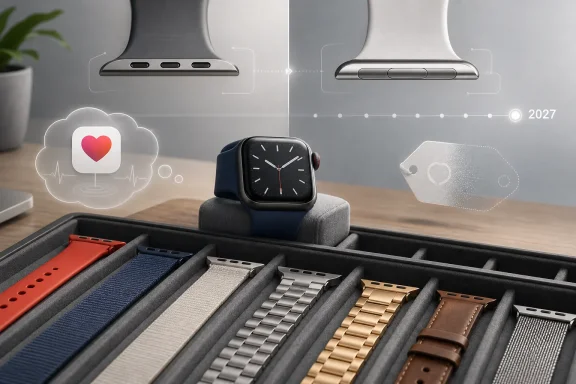
Apple’s next major Apple Watch redesign is reportedly planned for 2027 and could replace the band connector that has let straps move between generations since the original model, according to reports from Stuff, TechRepublic, MacRumors, and other outlets tracking a Weibo leaker’s claim. That sounds like a small mechanical change until you remember that the Apple Watch is not merely a watch; it is a wrist-mounted platform with a decade of sunk accessory costs attached. The real story is not whether Apple can justify a new connector. It is whether the company is preparing to spend one of the Watch’s most valuable reserves of goodwill.
Apple has redesigned the Apple Watch several times without breaking the promise that mattered most to many owners: your old bands probably still worked. Screens grew, bezels shrank, cases rounded out, sensors multiplied, and the Ultra line arrived with a larger, more rugged body. Yet the little slot-and-lug mechanism remained the quiet continuity beneath the marketing.
That continuity has been unusually valuable because watch bands are not chargers or cables. They are personal, visible, and habit-forming. A user might tolerate replacing a power adapter, but a band collection is part wardrobe, part identity, and part evidence that the Apple Watch has become less a gadget than an everyday object.
Apple’s own support guidance has long treated band compatibility as a feature, not an accident. Smaller case families have generally shared straps across 38mm, 40mm, and 41mm models, while larger bands have carried across 42mm, 44mm, 45mm, 46mm, and 49mm families with some activity-specific caveats for Ultra bands. That structure has not made sizing simple, but it has preserved the core idea that a good band could survive more than one watch.
The latest rumor, as summarized by Stuff and TechRepublic, says that assumption may be nearing its end. The claim traces back to the Weibo leaker Instant Digital, who reportedly advised would-be 2027 upgraders to stop buying extra bands if they expect to move to the redesigned model. MacRumors also reported the same basic thread: a major redesign, a new band system, and the possibility that the old accessory drawer becomes a museum.
But weakly sourced rumors can still illuminate strong product tensions. Apple has been nudging the Watch toward more health sensing, more autonomy, and more specialized use cases. The Ultra line already showed that Cupertino was willing to make the Watch feel less like a shrunken iPhone accessory and more like a category with its own design priorities.
A connector change would make sense only if Apple believes the old slot is now constraining the product. A thinner case, larger battery, new sensor layout, different antenna structure, magnetic attachment, or electrically active band could all push against the limits of a decade-old mechanical design. Bloomberg’s Mark Gurman previously reported years ago that Apple had explored a thinner Apple Watch with a magnetic band system, which gives the current rumor at least some historical resonance.
The problem is that “could make engineering sense” and “will be welcomed by customers” are very different claims. Apple has taught Watch buyers that bands are semi-durable assets. If it reverses that promise, the company will need to show that the trade was not merely aesthetic housekeeping.
This matters because Apple bands are not cheap impulse items. Even the basic Sport Band and Sport Loop sit above the price of many third-party alternatives, while metal, leather-era, Hermès, and specialty bands can turn a drawer into a serious investment. Many users bought those accessories precisely because Apple’s compatibility record made them feel safer than typical gadget add-ons.
There is also an environmental angle Apple cannot dodge. The company has spent years presenting itself as a steward of lower-carbon hardware, recycled materials, and longer device life. A connector break would not automatically contradict that story, but it would complicate it: the greenest accessory is the one a user can keep using.
Apple’s answer, if the redesign is real, will probably be that old watches and old bands remain supported, and that the new system enables features the old one could not. That may be true. But the optics of making millions of straps less useful at the upgrade point are exactly the kind of thing that makes ordinary consumers roll their eyes at sustainability keynotes.
Bands are part of that lock-in, but they are also part of the bargain. Apple says, in effect: buy into our ecosystem, and your accessories will have unusually long lives. Break that bargain, and the Watch starts to look a little more like the rest of consumer electronics, where every design refresh quietly taxes the loyal.
That is why this rumor has traveled so quickly through consumer tech outlets. Stuff framed it as a potential blow to your band collection. TechRepublic presented it as a practical warning for buyers. Tom’s Guide and Wareable picked up the anxiety because it is instantly understandable: people know what it means to own something that suddenly does not fit the next thing.
For IT pros and fleet buyers, the issue is less sentimental but still real. Organizations that deploy Apple Watches for health, safety, field work, or executive programs may standardize on bands for hygiene, durability, or accessibility. A connector break would add procurement complexity and create a split inventory problem between old and new fleets.
A more convincing justification would be functional bands. A strap with embedded sensors, haptics, antenna elements, medical components, or secure attachment for sports use would at least explain why the old lug had to go. MacRumors recently noted a separate sketchy rumor about a health sensor built into a silicone Apple Watch band, and while that claim should be treated carefully, it points toward the kind of future Apple may be studying.
The company could also soften the landing with adapters, transitional models, or a split lineup. It might keep the current connector on an Apple Watch SE-style model while moving the flagship or Ultra family to the new system. It might sell an official adapter for legacy bands, although adapters for something worn during exercise, sleep, and swimming would need to be exceptionally secure.
The worst version of this move would be a clean break with no bridge and no compelling feature story. That would feel like the Apple of old parody: elegant, controlled, expensive, and allergic to backward compatibility. The best version would be a rare case where users grumble at first, then admit the new hardware could not have existed otherwise.
That timing also lines up with a broader Apple pattern. The company often lets a mature accessory ecosystem run until it sees a hardware shift big enough to justify upsetting it. Lightning lasted a long time before USB-C became unavoidable. The iPhone’s shape has changed dramatically while MagSafe became a new accessory layer. Apple rarely preserves compatibility out of nostalgia alone; it preserves it when the business and engineering incentives align.
For the Watch, those incentives may be changing. Health sensing is harder than step counts and heart-rate trends. Battery life is now a competitive liability against Garmin and other fitness-focused rivals. The Ultra has expanded the Watch’s role into environments where secure attachment and rugged design matter more.
Still, Apple should not confuse plausibility with permission. A connector change may be technically rational and commercially dangerous at the same time. The customer does not evaluate a band system from the CAD file; the customer evaluates it from the drawer full of straps that used to fit.
That distinction matters because rumor-driven paralysis is its own kind of foolishness. A band worn daily for a year can easily justify its price, especially if it improves comfort, accessibility, or exercise use. The questionable purchase is the speculative collection: multiple premium bands bought today on the belief that Apple’s decade-long compatibility run must continue indefinitely.
Third-party band makers should also be watching closely. The Apple Watch strap market exists because Apple created a predictable mechanical target. If that target changes, accessory vendors will face a messy transition period of old inventory, new molds, uncertain demand, and customer confusion.
The same is true for repair shops, resellers, and refurbished-device sellers. Legacy bands may gain a longer tail among users keeping older Watches, while new-band demand could concentrate around launch. Compatibility charts, already more confusing than they should be, would become a frontline support issue.
 Apple’s Most Durable Watch Feature Was Never the Screen
Apple has redesigned the Apple Watch several times without breaking the promise that mattered most to many owners: your old bands probably still worked. Screens grew, bezels shrank, cases rounded out, sensors multiplied, and the Ultra line arrived with a larger, more rugged body. Yet the little slot-and-lug mechanism remained the quiet continuity beneath the marketing.That continuity has been unusually valuable because watch bands are not chargers or cables. They are personal, visible, and habit-forming. A user might tolerate replacing a power adapter, but a band collection is part wardrobe, part identity, and part evidence that the Apple Watch has become less a gadget than an everyday object.
Apple’s own support guidance has long treated band compatibility as a feature, not an accident. Smaller case families have generally shared straps across 38mm, 40mm, and 41mm models, while larger bands have carried across 42mm, 44mm, 45mm, 46mm, and 49mm families with some activity-specific caveats for Ultra bands. That structure has not made sizing simple, but it has preserved the core idea that a good band could survive more than one watch.
The latest rumor, as summarized by Stuff and TechRepublic, says that assumption may be nearing its end. The claim traces back to the Weibo leaker Instant Digital, who reportedly advised would-be 2027 upgraders to stop buying extra bands if they expect to move to the redesigned model. MacRumors also reported the same basic thread: a major redesign, a new band system, and the possibility that the old accessory drawer becomes a museum.
The Rumor Is Thin, but the Stakes Are Not
This is still a leak, not an announcement. Apple has said nothing public about a 2027 Apple Watch redesign or a new band connector, and accessory rumors have a long history of arriving early, changing shape, or vanishing before launch. The sane posture is skepticism with a raised eyebrow, not panic-buying or fire-selling.But weakly sourced rumors can still illuminate strong product tensions. Apple has been nudging the Watch toward more health sensing, more autonomy, and more specialized use cases. The Ultra line already showed that Cupertino was willing to make the Watch feel less like a shrunken iPhone accessory and more like a category with its own design priorities.
A connector change would make sense only if Apple believes the old slot is now constraining the product. A thinner case, larger battery, new sensor layout, different antenna structure, magnetic attachment, or electrically active band could all push against the limits of a decade-old mechanical design. Bloomberg’s Mark Gurman previously reported years ago that Apple had explored a thinner Apple Watch with a magnetic band system, which gives the current rumor at least some historical resonance.
The problem is that “could make engineering sense” and “will be welcomed by customers” are very different claims. Apple has taught Watch buyers that bands are semi-durable assets. If it reverses that promise, the company will need to show that the trade was not merely aesthetic housekeeping.
A New Connector Would Turn Accessories Into E-Waste Theater
The harshest reading of the rumor is simple: Apple would be making a decade of paid accessories obsolete. That is not technically identical to bricking them, since existing bands would still work with existing watches. But for buyers who upgrade regularly, incompatibility changes the economic life of every strap they already own.This matters because Apple bands are not cheap impulse items. Even the basic Sport Band and Sport Loop sit above the price of many third-party alternatives, while metal, leather-era, Hermès, and specialty bands can turn a drawer into a serious investment. Many users bought those accessories precisely because Apple’s compatibility record made them feel safer than typical gadget add-ons.
There is also an environmental angle Apple cannot dodge. The company has spent years presenting itself as a steward of lower-carbon hardware, recycled materials, and longer device life. A connector break would not automatically contradict that story, but it would complicate it: the greenest accessory is the one a user can keep using.
Apple’s answer, if the redesign is real, will probably be that old watches and old bands remain supported, and that the new system enables features the old one could not. That may be true. But the optics of making millions of straps less useful at the upgrade point are exactly the kind of thing that makes ordinary consumers roll their eyes at sustainability keynotes.
The Apple Watch Has Become a Platform, and Platforms Have Exit Costs
The Apple Watch is easy to underestimate because it still looks like a companion device. In practice, it is one of Apple’s stickiest ecosystem products. It pulls users toward the iPhone, stores health history, participates in authentication and payments, and lives on the body in a way a tablet or laptop never will.Bands are part of that lock-in, but they are also part of the bargain. Apple says, in effect: buy into our ecosystem, and your accessories will have unusually long lives. Break that bargain, and the Watch starts to look a little more like the rest of consumer electronics, where every design refresh quietly taxes the loyal.
That is why this rumor has traveled so quickly through consumer tech outlets. Stuff framed it as a potential blow to your band collection. TechRepublic presented it as a practical warning for buyers. Tom’s Guide and Wareable picked up the anxiety because it is instantly understandable: people know what it means to own something that suddenly does not fit the next thing.
For IT pros and fleet buyers, the issue is less sentimental but still real. Organizations that deploy Apple Watches for health, safety, field work, or executive programs may standardize on bands for hygiene, durability, or accessibility. A connector break would add procurement complexity and create a split inventory problem between old and new fleets.
Apple Has a Narrow Path to Make the Break Feel Worth It
If Apple does change the connector, it needs a reason stronger than “the new watch is thinner.” Thinness can be a virtue, but it is rarely worth destroying accessory continuity on its own. The Watch already sits in a category where battery life, sensor accuracy, comfort, and durability matter more than shaving fractions of a millimeter from the case.A more convincing justification would be functional bands. A strap with embedded sensors, haptics, antenna elements, medical components, or secure attachment for sports use would at least explain why the old lug had to go. MacRumors recently noted a separate sketchy rumor about a health sensor built into a silicone Apple Watch band, and while that claim should be treated carefully, it points toward the kind of future Apple may be studying.
The company could also soften the landing with adapters, transitional models, or a split lineup. It might keep the current connector on an Apple Watch SE-style model while moving the flagship or Ultra family to the new system. It might sell an official adapter for legacy bands, although adapters for something worn during exercise, sleep, and swimming would need to be exceptionally secure.
The worst version of this move would be a clean break with no bridge and no compelling feature story. That would feel like the Apple of old parody: elegant, controlled, expensive, and allergic to backward compatibility. The best version would be a rare case where users grumble at first, then admit the new hardware could not have existed otherwise.
The 2027 Timing Makes the Rumor More Plausible
The Apple Watch has been waiting for a reset. The Series 10 generation made the regular Watch thinner and larger, while the Ultra line changed expectations around ruggedness and battery life, but the family resemblance remains unmistakable. A 2027 redesign would arrive after years of incremental visual evolution.That timing also lines up with a broader Apple pattern. The company often lets a mature accessory ecosystem run until it sees a hardware shift big enough to justify upsetting it. Lightning lasted a long time before USB-C became unavoidable. The iPhone’s shape has changed dramatically while MagSafe became a new accessory layer. Apple rarely preserves compatibility out of nostalgia alone; it preserves it when the business and engineering incentives align.
For the Watch, those incentives may be changing. Health sensing is harder than step counts and heart-rate trends. Battery life is now a competitive liability against Garmin and other fitness-focused rivals. The Ultra has expanded the Watch’s role into environments where secure attachment and rugged design matter more.
Still, Apple should not confuse plausibility with permission. A connector change may be technically rational and commercially dangerous at the same time. The customer does not evaluate a band system from the CAD file; the customer evaluates it from the drawer full of straps that used to fit.
Buyers Should Treat 2026 Bands Like Short-Lived Accessories
The practical advice is not dramatic, but it is different from what it was a week ago. If you are buying a band because you love it for the watch you own now, buy it. If you are buying expensive straps on the assumption that they will carry you through the 2027 flagship generation, pause.That distinction matters because rumor-driven paralysis is its own kind of foolishness. A band worn daily for a year can easily justify its price, especially if it improves comfort, accessibility, or exercise use. The questionable purchase is the speculative collection: multiple premium bands bought today on the belief that Apple’s decade-long compatibility run must continue indefinitely.
Third-party band makers should also be watching closely. The Apple Watch strap market exists because Apple created a predictable mechanical target. If that target changes, accessory vendors will face a messy transition period of old inventory, new molds, uncertain demand, and customer confusion.
The same is true for repair shops, resellers, and refurbished-device sellers. Legacy bands may gain a longer tail among users keeping older Watches, while new-band demand could concentrate around launch. Compatibility charts, already more confusing than they should be, would become a frontline support issue.
The Drawer Full of Straps Is Now a Risk Signal
The useful lesson is not to assume the rumor is true. The useful lesson is to price in uncertainty where Apple used to provide confidence.- Apple has not announced a 2027 Apple Watch redesign, so the current band-connector claim remains an unconfirmed leak.
- Multiple outlets, including Stuff, TechRepublic, and MacRumors, have reported the same general claim from the Weibo leaker Instant Digital.
- Existing Apple Watch bands have enjoyed unusually long compatibility across case generations, which is why a connector change would land harder than a normal accessory refresh.
- Buyers planning to upgrade in 2027 should be cautious about buying expensive bands solely for long-term use.
- Apple would need a strong functional reason, such as new sensors, better durability, or a major case redesign, to make the compatibility break feel justified.
- Businesses and fleet buyers should avoid assuming that today’s band inventory will automatically fit a future redesigned Watch.
References
- Primary source: stuff.tv
Published: Fri, 03 Jul 2026 17:56:41 GMT
Next Apple Watch redesign might make your band collection useless | Stuff
The Apple Watch Series 13 might see a new band connection mechanism, according to a new leakwww.stuff.tv - Independent coverage: TechRepublic
Published: Thu, 02 Jul 2026 18:55:56 GMT
Apple Watch Redesign Could Make Current Bands Obsolete, Leaker Claims
Apple Watch redesign rumors point to a new band attachment system in 2027, raising questions about backward compatibility for bands.www.techrepublic.com
- Related coverage: t3.com
Apple Watch could undergo a seismic design change for the first time in a decade – but it'll come with a caveat | T3
The changes could change the watch for the better, but...www.t3.com - Related coverage: tomsguide.com
Leaked Apple Watch 12 design change is the opposite of an upgrade — and that has me worried | Tom's Guide
Cupertino has stuck with the same band attachment system since the first Apple Watch debuted. Now is not the time to switch it.www.tomsguide.com - Related coverage: macrumors.com
Report: Apple Watch Redesign Coming Next Year With New Band System
A "major overhaul" of the Apple Watch's design is due to arrive next year with a new system for connecting bands, according to a known Weibo leaker. In a set of recent posts, the leaker known as "Instant Digital" linked the new claim to older rumors about an "Apple...www.macrumors.com - Related coverage: gotechtor.com
Apple Watch's Band System May Be Obsolete by 2027 — Here's What Owners Should Know Before Buying More - Gotechtor
A redesigned Apple Watch arriving in 2027 could break compatibility with all existing bands. What current owners need to know before spending more money.www.gotechtor.com
- Related coverage: wareable.com
Leaker claims major Apple Watch redesign won't arrive until 2028 - Wareable
Apple Watch fans hoping for a dramatic new look might be disappointed, as a leaker suggests the next major redesign won't arrive until 2028.www.wareable.com - Related coverage: macdailynews.com
Apple Watch set for major 2027 overhaul, potentially breaking band compatibility, says prominent leaker
Apple is preparing a significant redesign for its flagship Apple Watch lineup in 2027. The anticipated "major overhaul" could mark the most…macdailynews.com - Related coverage: techradar.com
One leaker claims Apple's long-rumored plans for Touch ID on Apple Watch have been shelved in favor of 'packing in larger batteries' — and as a Garmin main who's recently switched, that's totally fine by me | TechRadar
Apple is allegedly shelving plans to add Touch ID to Apple Watcheswww.techradar.com - Related coverage: wizeband.com
Can You Put Any Band on an Apple Watch | WizeBand
Can you use any band on your Apple Watch? Find out which bands fit, which don't, and how to avoid costly mistakes. www.wizeband.com
- Official source: support.apple.com
Change your Apple Watch strap – Apple Support (UK)
Use these steps to remove your strap.support.apple.com - Related coverage: macobserver.com
All Apple Watch Band Sizes: How to Find the Perfect Fit
Learn how to find the perfect fit with all Apple Watch band sizes. Discover tips for wrist size and band style selection.www.macobserver.com - Related coverage: moft.us
- Related coverage: watchband.direct
Apple Watch Series 11 Bands: Every Compatible Size & Style (2026) – watchband.direct
All compatible Apple Watch Series 11 band sizes explained — 42mm & 46mm. 200+ styles from $9.99. Free shipping. Find your fit at watchband.direct.watchband.direct - Related coverage: braxleybands.com
Apple Watch Band Sizes Explained: A No-BS 2026 Guide– Braxley Bands
Apple Watch band sizing is confusing. The full size chart, the 42mm trap between Series 1–3 and Series 10+, and exactly how to measure your wrist. braxleybands.com
- Related coverage: faq-mac.com
- Related coverage: 9to5mac.com
Apple Watch Ultra band compatibility explained - 9to5Mac
Good news for Apple Watch Ultra buyers. If you’ve already invested in Apple Watch bands for bigger screen models in...9to5mac.com
