

Apple’s software roadmap is quietly pivoting toward a more aggressive, services-driven AI strategy: the company is preparing an AI-powered web search capability and an AI health agent as part of Apple Intelligence, with a staged Siri overhaul that begins in iOS 26.4 and culminates in a larger visual and functional redesign in iOS 27. Recent reporting from industry insiders frames these moves as Apple’s attempt to close an AI gap with competitors while preserving its privacy posture and ecosystem lock-in.
Apple’s public AI strategy has always tried to balance two priorities: feature parity with fast-moving AI competitors and a tight, privacy-first user experience. That balance has shaped Apple Intelligence (first announced with iOS 18), Private Cloud Compute (PCC), and a series of staged software rollouts rather than a single, dramatic launch. Apple’s internal timeline now shows an incremental rollout: Siri improvements and new AI behaviors arriving in iOS 26.4 (planned for spring 2026), with a fuller visual redesign and broader features landing in iOS 27 next year. This two-phase approach reflects both engineering reality and product positioning. Why the new cadence matters: Apple shifted its OS numbering to a year-ahead scheme (iOS 26, iOS 27, etc., which aligns the public-facing names with long-term feature windows and avoids confusion for developers and customers. The WWDC preview cycle now functions as the marketing anchor for the big platform changes in June, while the public OS releases remain tied to Apple’s September hardware launches and the subsequent fall/winter update stream.
Apple’s architectural playbook includes:
However, the plan also exposes Apple to three large hazards: dependence on external model partners, the difficulty of eliminating hallucinations and delivering evidence-backed answers, and heightened regulatory and public scrutiny — especially in the domain of health. How Apple manages contracts, telemetry, and safety engineering between now and the iOS 26.4 preview in spring 2026 will shape whether iOS 27 becomes a turning point for Siri and Apple Intelligence — or a cautionary tale about the complexity of bringing generative AI responsibly to billions of users.
Source: TechJuice Apple to Bring AI-Powered Web Search and Health Agent with iOS 27
 Background
Apple’s public AI strategy has always tried to balance two priorities: feature parity with fast-moving AI competitors and a tight, privacy-first user experience. That balance has shaped Apple Intelligence (first announced with iOS 18), Private Cloud Compute (PCC), and a series of staged software rollouts rather than a single, dramatic launch. Apple’s internal timeline now shows an incremental rollout: Siri improvements and new AI behaviors arriving in iOS 26.4 (planned for spring 2026), with a fuller visual redesign and broader features landing in iOS 27 next year. This two-phase approach reflects both engineering reality and product positioning. Why the new cadence matters: Apple shifted its OS numbering to a year-ahead scheme (iOS 26, iOS 27, etc., which aligns the public-facing names with long-term feature windows and avoids confusion for developers and customers. The WWDC preview cycle now functions as the marketing anchor for the big platform changes in June, while the public OS releases remain tied to Apple’s September hardware launches and the subsequent fall/winter update stream. What’s coming in iOS 27 — the headlines
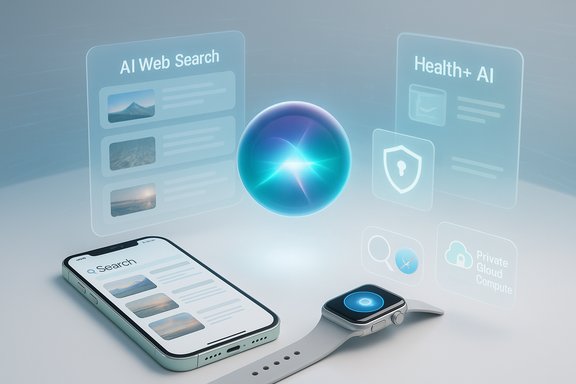
- A native AI-powered web search feature for Apple Intelligence (internal name and UI details remain under wraps), designed to return summaries and multimodal answers (text, images, videos, points of interest). This feature is being positioned to compete with generative search offerings like ChatGPT-style overviews and Perplexity.
- A Siri visual redesign and richer conversational behaviors, with the first wave of Siri intelligence appearing in iOS 26.4 and the refined visual personality and interface arriving as part of iOS 27.
- A subscription-backed Health+ service that includes an AI health agent — a personalized, data-driven coach that can summarize trends, recommend actions, and deliver curated educational content and video explainers. Apple is testing training data and clinician involvement for this agent.
The AI-powered web search: what Apple likely means, and what it won’t
What “AI-powered web search” probably is
The announced concept isn’t “a new search engine” in the traditional sense; it’s a system that augments Siri (and potentially Spotlight/Safari later) with LLM-powered aggregation and summarization of web results. Expect features such as:- Short, conversational summaries of web content that synthesize multiple sources.
- Multimodal outputs combining text, images, and video thumbnails or highlights for quick consumption.
- Local context injection from on-device data (mail, messages, local files) when the user permits it — so results can be personalized without wholesale data exfiltration.
Where the compute and models might come from
Apple has reportedly evaluated several vendors (OpenAI, Anthropic, Google/Gemini) and its own foundation-model work. Multiple industry reports indicate Apple is now testing or negotiating a custom model arrangement with Google’s Gemini to provide the heavy-lift capabilities for some Siri functions, while Apple’s own models handle on-device and personal-data searches. If true, that arrangement would run third-party models inside Apple’s Private Cloud Compute to keep data processing under Apple’s control. Independent press coverage corroborates Apple’s vendor bake-off and Google’s leading position in internal talks.What Apple must solve technically
- Latency: Generative summaries must feel instantaneous to be useful in voice or quick-read contexts — that requires high-performance inference and careful engineering.
- Hallucinations: LLMs “hallucinate” plausible-sounding falsehoods; Apple must build rigorous retrieval, provenance, and citation systems to avoid returning misleading answers.
- Privacy controls: Any third-party model must process personal context without creating legal or perceptual privacy leaks. Apple’s PCC is designed to provide attested, stateless runtime environments, but contractual and engineering guarantees are required.
Comparisons to market alternatives
- Google Search + Gemini: excellent multimodal search and integration with Maps/YouTube; scale advantage.
- OpenAI integrations (ChatGPT): strong conversational synthesis and wide adoption.
- Perplexity/Aggregators: focused on citation and source provenance.
Siri’s staged revamp: iOS 26.4 through iOS 27
Apple appears to be breaking Siri’s overhaul into two visible steps:Phase 1 — iOS 26.4 (spring 2026): AI upgrades without the full UI rebrand
- Initial LLM-powered features: planner, summarizer, on-screen contextual actions and deeper app integrations.
- Siri will gain more context-awareness and the ability to act on richer information pulled from device-local sources when permissioned.
- This release is a testbed for the backend changes and will set the groundwork for the bigger UI/UX changes.
Phase 2 — iOS 27 (preview at WWDC 2026; broad rollout late 2026): Visual redesign and polish
- A new visual personality for Siri — Apple is experimenting with giving Siri a visual presence and lifelike cues to make interactions feel more natural.
- Deeper Spotlight/Safari integration for the AI web search experience and system-wide Apple Intelligence improvements.
Health+ and the AI health agent: opportunity and peril
Apple’s Health app is evolving beyond passive metrics into an active guidance platform. The proposed Health+ service would pair Apple Intelligence with clinical content and coaching features:- The AI agent would ingest Apple Watch and iPhone sensor data, third-party device inputs, and user-provided logs (food, workouts) to offer tailored recommendations.
- Apple reportedly plans to include expert-produced videos (filmed at Apple facilities) and to recruit clinicians as content partners — signaling a hybrid human+AI product model.
- Apple already controls a substantial dataset through the Apple Watch and HealthKit integrations, and it has credibility with general consumers on wellness features.
- Health is a high-margin, sticky domain for subscriptions; a successful Health+ could add a material recurring revenue stream while differentiating iPhone and Apple Watch hardware purchases.
- Clinical accuracy: a misdiagnosis or poor recommendation could have real-world health consequences. Apple must manage medical device and clinical decision support regulatory hurdles (FDA, CE, regional health authorities) depending on the feature set and claims.
- Liability and trust: even with clinician-signed content, AI-driven interpretations of sensor data require transparent limits and strong disclaimers; how Apple frames “advice” vs. “diagnosis” will matter legally and ethically.
- Data sensitivity: health data is among the most personal; Apple’s privacy posture helps, but cross-systems sharing (iCloud, provider portals, third-party apps) expands the attack surface and regulatory scrutiny.
Business and competitive implications
- Platform monetization: A subscription Health+ with an AI agent creates a natural, high-value tether for Apple’s hardware and services businesses. If priced and packaged properly, it could drive attachment and ARPU growth.
- Strategic partnerships: Using an external model (e.g., Google’s Gemini) as part of Siri or search functionality is a pragmatic acceleration tactic but blurs Apple’s independence narrative and could invite regulatory attention — especially given Apple and Google’s search-commercial relationship and ongoing antitrust scrutiny.
- Developer and ecosystem effects: Improved system-level AI search and Spotlight capabilities would give Apple a powerful native toolkit for apps and services; third-party developers will push for APIs, while enterprises will demand governance and non-training assurances.
Technical realism check — can Apple deliver this without compromising privacy and safety?
Short answer: yes — but only with significant engineering and legal work.Apple’s architectural playbook includes:
- On-device models for latency- and privacy-sensitive tasks.
- Private Cloud Compute (PCC) for heavier inference inside Apple-controlled environments with attestation and stateless execution guarantees.
- External model licensing when internal models cannot meet short-term quality or time-to-market targets.
- Retrieval-augmented generation (RAG) with verifiable source citations to mitigate hallucinations.
- Real-time model selection and routing between on-device and PCC-hosted models to balance privacy, latency and cost.
- Safety layers: content filtering, bias mitigation, and escalation paths for sensitive health or legal queries.
- Robust telemetry governance and reproducible model update processes to satisfy internal auditors and external regulators.
What to watch for — practical timelines and indicators
- WWDC June 2026: Apple will preview iOS 27 features and broader Apple Intelligence plans; expect developer APIs and screenshots rather than immediate shipping code.
- iOS 26.4 (spring 2026): the first public test of Siri’s LLM-powered elements and the “World Knowledge” answer engine rollout in limited form. Delivery or delay here will indicate whether engineering is on track.
- Health+ beta programs and clinical partnerships: early sign-ups, clinician-hosted content, and pilot providers will signal Apple’s seriousness and readiness.
- Regulatory signals: FDA/CE consultations or filings (if Apple labels features as diagnostic/support), or questions from data protection authorities, would materially affect rollout timing and scope.
Strengths, weaknesses, and what could derail the plan
Strengths (if executed well)
- Integration advantage: Apple controls the device, OS and app ecosystem — smooth integration could make AI features feel native and polished.
- Privacy brand: Apple can market a privacy-differentiated AI experience that avoids external telemetry for personal data.
- Health cred: Apple Watch + HealthKit data provides a unique dataset for wellness personalization (not clinical-grade by default, but powerful for lifestyle guidance).
Weaknesses & risks
- Dependence on third-party models could create brand and regulatory headaches if Apple must rely on Google or others for core capabilities. Consumer perception may view the assistant as “not fully Apple.”
- Safety and hallucination management: even high-parameter models need careful grounding; errors in health advice could have severe consequences.
- Regulatory scrutiny: deeper ties with Google or aggressive search-market moves may trigger antitrust scrutiny and complicate the US/EU regulatory environment.
Possible derailers
- A failure of the iOS 26.4 preview to show reliable, safe behavior could push back iOS 27 timelines further.
- Contractual or technical disagreements with external model providers (latency, auditability, cost) could force Apple to scale back features or delay them.
Practical advice for readers and IT pros
- For consumers: treat early AI assistant outputs as exploratory, not authoritative. Health guidance from consumer apps should be treated as informational unless explicitly cleared as clinical by regulators.
- For IT and privacy teams: watch the permission flows and default privacy settings. If Apple exposes powerful system-level search or assistant APIs, enterprises must understand data residency, logging, and non-training guarantees before adoption.
- For developers: anticipate new hooks into Spotlight and system search; plan for how agentic or summarization features could be integrated into app experiences while respecting user consent.
Conclusion
Apple’s reported plan to add an AI-powered web search and a Health+ AI agent inside Apple Intelligence — delivered across iOS 26.4 and iOS 27 — is a meaningful strategic pivot. It marries Apple’s device and data advantage with the short-term practicality of licensing or using third-party foundation models where necessary. If executed with technical rigor, clear provenance, and conservative health and safety guardrails, these features could materially improve Siri’s relevance and create a new, sticky services revenue path for Apple.However, the plan also exposes Apple to three large hazards: dependence on external model partners, the difficulty of eliminating hallucinations and delivering evidence-backed answers, and heightened regulatory and public scrutiny — especially in the domain of health. How Apple manages contracts, telemetry, and safety engineering between now and the iOS 26.4 preview in spring 2026 will shape whether iOS 27 becomes a turning point for Siri and Apple Intelligence — or a cautionary tale about the complexity of bringing generative AI responsibly to billions of users.
Source: TechJuice Apple to Bring AI-Powered Web Search and Health Agent with iOS 27
