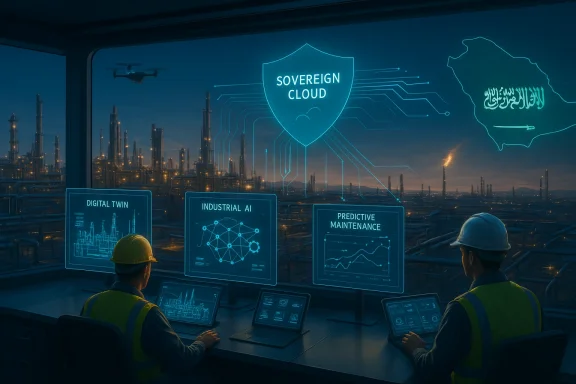
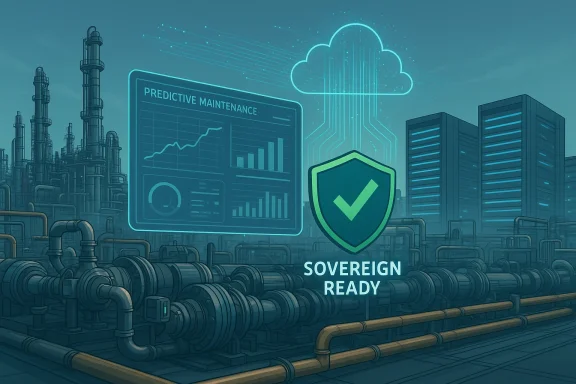
Aramco’s non‑binding Memorandum of Understanding with Microsoft signals a concrete push to move industrial artificial intelligence from pilot projects into core operations, pairing Saudi Arabia’s oil‑and‑gas titan with one of the world’s largest cloud and AI platforms to pursue sovereign‑ready cloud architectures, operational AI use cases, and a large‑scale digital skills pipeline.
The MoU, announced in official statements and reported by major outlets today, frames a multi‑year collaboration aimed at accelerating Aramco’s industrial AI adoption, strengthening digital sovereignty, modernizing operational infrastructure, and scaling workforce skills. The agreement is explicitly non‑binding and will proceed under the usual regulatory and commercial due diligence, but it formalizes a roadmap to test and potentially deploy Microsoft Azure‑based industrial solutions across Aramco’s global operations.
This move is the latest chapter in a multi‑year relationship between Aramco and Microsoft following earlier joint work on edge and distributed cloud architectures in Saudi Arabia—deployments that married Armada’s Galleon edge data centers and management software with Azure tooling to support low‑latency, site‑level AI workloads. That prior collaboration established a working technical baseline which this MoU seeks to expand into co‑innovation, commercialization, and talent initiatives.
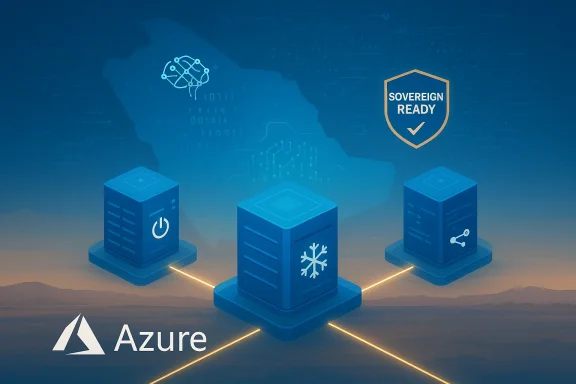
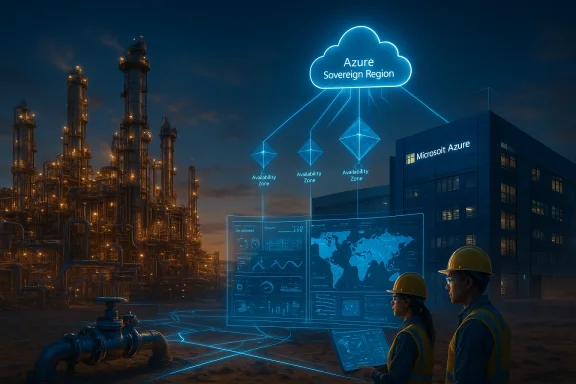
Taken together with Microsoft’s public confirmation that a Saudi Arabia Azure datacenter region will be available to customers from Q4 2026, the MoU frames a practical pathway for Aramco to retain more control over where sensitive industrial data is processed while also leveraging cloud scale. The availability of a local Microsoft region—designed with three availability zones for enterprise resilience—matters for regulated industrial workloads that require local processing and lower latency.
Microsoft’s announced Saudi Arabia region—designed with three availability zones and enterprise resilience features—creates a practical infrastructure layer that can host these production workloads. That regional availability reduces cross‑border latency and simplifies legal compliance because data can be stored and processed inside the Kingdom while still leveraging Microsoft’s broader management, identity, and security controls where appropriate. Analysts familiar with the rollout emphasize that the initial service surface for new Azure regions typically focuses on core IaaS, identity, and management primitives first, with specialized AI runtimes and platform services phased in later—meaning Aramco will likely adopt a staged migration strategy.
From a sovereignty perspective, Microsoft’s "sovereign‑ready" posture—described in its regional announcements and industry analysis—does not necessarily equate to an exclusive or isolated national cloud but rather to a configurable stack that can satisfy in‑country processing and regulatory reporting needs while remaining able to interoperate with global services where permitted. This hybrid posture is important for large regulated enterprises that must balance national requirements with the efficiencies of global cloud platforms.
However, the MoU is not a short‑cut to autonomous plants or fully automated drilling operations. Realistic timelines for certified, closed‑loop AI control that interacts directly with physical processes remain multi‑year efforts with heavy validation and regulatory requirements. Further, measurable ROI will depend on disciplined data engineering, integration with legacy systems, and change management at scale.
But meaningful workforce transformation requires more than online certificates. To deliver operational capability, the program must combine:
At the same time, the deal raises legitimate questions about vendor dependency, operational cyber‑risk, precise IP ownership, and the depth of workforce transformation. The MoU is a starting line, not an end state; success will be measured by whether Aramco and Microsoft can convert the agreement into robust, audited implementations that demonstrably improve safety, availability, and competitiveness—while creating real career pathways and protecting national security interests.
Conclusion
The Aramco‑Microsoft MoU is a realistic, multi‑faceted play that recognizes how industrial AI at scale depends on cloud infrastructure, local regulatory alignment, and human capital as much as on advanced models. The partnership’s success will depend on disciplined engineering, transparent governance, and measurable educational outcomes that move beyond press releases and into sustained operational improvements. If Aramco and Microsoft can align technical architecture, sovereign requirements, and a credible skills pipeline, the collaboration could become a reference case for how large industrial firms adopt AI responsibly—provided the inherent risks are addressed head‑on and with public transparency.
Source: Aramco Aramco signs MoU with Microsoft to help advance industrial AI and digital talent transformation
 Background and immediate significance
The MoU, announced in official statements and reported by major outlets today, frames a multi‑year collaboration aimed at accelerating Aramco’s industrial AI adoption, strengthening digital sovereignty, modernizing operational infrastructure, and scaling workforce skills. The agreement is explicitly non‑binding and will proceed under the usual regulatory and commercial due diligence, but it formalizes a roadmap to test and potentially deploy Microsoft Azure‑based industrial solutions across Aramco’s global operations.This move is the latest chapter in a multi‑year relationship between Aramco and Microsoft following earlier joint work on edge and distributed cloud architectures in Saudi Arabia—deployments that married Armada’s Galleon edge data centers and management software with Azure tooling to support low‑latency, site‑level AI workloads. That prior collaboration established a working technical baseline which this MoU seeks to expand into co‑innovation, commercialization, and talent initiatives.
Taken together with Microsoft’s public confirmation that a Saudi Arabia Azure datacenter region will be available to customers from Q4 2026, the MoU frames a practical pathway for Aramco to retain more control over where sensitive industrial data is processed while also leveraging cloud scale. The availability of a local Microsoft region—designed with three availability zones for enterprise resilience—matters for regulated industrial workloads that require local processing and lower latency.
What the MoU covers — an itemized read
The public summary of the MoU outlines five principal areas of collaboration. Each area carries operational and strategic implications for how Aramco will approach industrial AI.- Digital sovereignty and data residency — The MoU explicitly contemplates a roadmap for deploying solutions on Microsoft cloud infrastructure with sovereign controls to meet national data residency and regulatory requirements. That language signals attention to the Kingdom’s Personal Data Protection Law, sectoral rules, and sovereign security objectives.
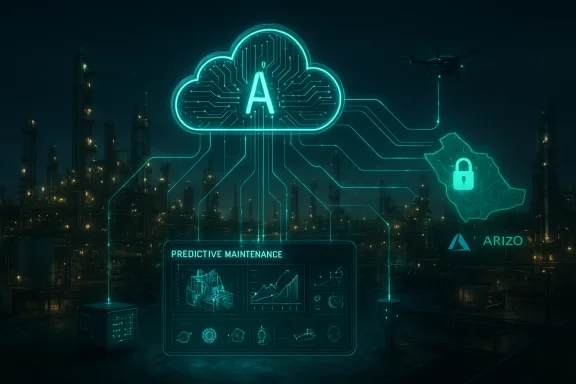
- Operational efficiency and digital infrastructure — Aramco intends to explore Azure‑based solutions aimed at improving asset management, predictive maintenance, process optimization, and other industrial use cases that can reduce operating cost and increase uptime. The aim is to transition from proofs‑of‑concept to production‑grade systems that run reliably at scale.
- Industry alliance framework — The MoU scopes engagements with local systems integrators, technology partners, and Saudi industrial collaborators. That suggests a broad‑based ecosystem approach rather than a 1:1 vendor model, and it aligns with the Kingdom’s focus on industrial localization and supply‑chain participation.
- Industrial AI IP co‑innovation — Aramco and Microsoft will explore co‑development and potential commercialization of operational AI systems for the energy sector, including the possibility of a global marketplace for industrial AI solutions that could showcase Saudi capabilities internationally. This is a strategic step to convert internal know‑how into tradable IP.
- Digital and technical skills development — The MoU includes programs to accelerate training in AI engineering, cybersecurity, data governance, and product management, with measurable outcomes. The intent is to scale local talent so Aramco and its partners can operate and govern AI systems responsibly. Microsoft has an existing footprint of cloud and AI training programs in the Kingdom, and the MoU looks to expand that remit within Aramco’s workforce and supplier base.
Why this matters: the technical and sovereignty angle
Industrial AI for an operator the size of Aramco involves processing petabytes of telemetry and engineering data from pipelines, refineries, drilling operations, and supply logistics. For many of these workloads, low latency, predictable availability, and strict data‑control measures are prerequisites before AI can be trusted to act on or advise critical control systems.Microsoft’s announced Saudi Arabia region—designed with three availability zones and enterprise resilience features—creates a practical infrastructure layer that can host these production workloads. That regional availability reduces cross‑border latency and simplifies legal compliance because data can be stored and processed inside the Kingdom while still leveraging Microsoft’s broader management, identity, and security controls where appropriate. Analysts familiar with the rollout emphasize that the initial service surface for new Azure regions typically focuses on core IaaS, identity, and management primitives first, with specialized AI runtimes and platform services phased in later—meaning Aramco will likely adopt a staged migration strategy.
From a sovereignty perspective, Microsoft’s "sovereign‑ready" posture—described in its regional announcements and industry analysis—does not necessarily equate to an exclusive or isolated national cloud but rather to a configurable stack that can satisfy in‑country processing and regulatory reporting needs while remaining able to interoperate with global services where permitted. This hybrid posture is important for large regulated enterprises that must balance national requirements with the efficiencies of global cloud platforms.
Practical industrial use cases that matter
If Aramco and Microsoft follow through, the following use cases are likely near‑term priorities because they deliver measurable operational impact and are already proven by other major operators.- Predictive maintenance and anomaly detection for rotating equipment, compressors, and pumps—reducing unplanned downtime and maintenance costs.
- Real‑time safety monitoring and anomaly detection using edge inference to supplement human supervision in high‑risk zones.
- Production optimization using AI agents to tune process parameters for emissions and throughput targets.
- Integrated supply‑chain forecasting that links field operations telemetry to logistics and downstream planning.
- Digital twin orchestration for planning and scenario testing using faster model training and inference at scale.
Commercial and strategic implications
For Aramco:- The MoU provides a path to modernize operational IT and OT stacks without having to build every layer in‑house. Co‑innovation and IP commercialization could position Aramco as both a purchaser and a supplier of industrial AI solutions globally.
- A focus on sovereign controls helps Aramco reconcile national compliance and corporate security while still using hyperscale capabilities.
- A deeper relationship with Aramco cements Microsoft’s role as a strategic cloud partner in the Kingdom’s energy sector and accelerates adoption of Azure industrial offerings.
- It positions Microsoft to showcase sovereign‑ready solutions and regional datacenter economics—useful commercial proof points for other governments and regulated industries in the Middle East.
- The collaboration aligns with Vision 2030 goals by aiming to convert industrial scale AI into jobs, upskilling programs, and exportable IP. If successful, it can accelerate the Kingdom’s industrial competitiveness and localization initiatives.
Governance, security, and risk — a sober reality check
The MoU’s ambitions are real, but large industrial AI projects multiply certain risks that require explicit mitigation strategies. Below are the key concerns and recommended governance guardrails.- Data governance and provenance — Industrial models depend on high‑quality, labeled telemetry. Aramco must publish clear policies for data lineage, retention, and model retraining cadence. Without rigorous data governance, models drift and decisions become unreliable.
- Cybersecurity of OT environments — Connecting control systems to cloud services raises attack surface concerns. Segmented architectures, strong identity controls, and OT‑specific intrusion detection are non‑negotiable. The industry has repeatedly shown that OT cyber incidents can cause physical harm; ensuring resilient, air‑gapped fallback operations is essential.
- Vendor lock‑in and portability — Deep engineering into a single cloud stack creates economic dependency and builds migration complexity. Aramco should define clear portability targets (open formats, containerized runtimes, hardware abstraction layers) to preserve strategic options.
- IP ownership and commercial terms — Co‑innovation that leads to commercial products must clarify ownership, royalties, export controls and liability. For dual‑use industrial IP, export restrictions and national security reviews may apply.
- Model validation and safety certification — Operational AI that influences plant controls must pass strict validation. Independent audits, white‑box testing, digital twin simulation, and staged rollouts (shadow mode → advisory mode → closed‑loop control) are best practices.
- Workforce transition and ethics — Scaling AI can change job roles and responsibilities. Skills programs outlined in the MoU are necessary but insufficient on their own; Aramco should commit to measurable retraining targets, career transition pathways, and human‑in‑the‑loop governance for critical decisions.
Where the MoU can create real value — and where it cannot
The most credible near‑term value lies in improving situational awareness, maintenance scheduling, and decision support systems—domains where AI augments human expertise and where performance gains are measurable. Co‑innovation around industrial AI toolkits also offers longer‑term commercial upside because sector‑specific models and feature sets are valuable and often scarce.However, the MoU is not a short‑cut to autonomous plants or fully automated drilling operations. Realistic timelines for certified, closed‑loop AI control that interacts directly with physical processes remain multi‑year efforts with heavy validation and regulatory requirements. Further, measurable ROI will depend on disciplined data engineering, integration with legacy systems, and change management at scale.
The talent dimension: promises and pitfalls
The MoU includes commitments to skill building in AI engineering, cybersecurity, data governance, and product management—areas where the Kingdom needs scale if Vision 2030’s industrial ambitions are to be realized. Microsoft already runs training programs across Saudi Arabia, and local initiatives such as Microsoft‑backed academies are part of the ecosystem that can supply trained engineers and cloud operators.But meaningful workforce transformation requires more than online certificates. To deliver operational capability, the program must combine:
- Intensive, hands‑on apprenticeships inside Aramco operational environments.
- Multi‑disciplinary curricula that bridge OT engineering and data science.
- Measurable placement metrics, progression pathways, and continuing professional education tied to real project milestones.
Regulatory and geopolitical factors to watch
- Regulatory approvals and standards — The MoU is non‑binding and will need to evolve into contractual agreements that pass national security, banking, and sectoral reviews. Saudi regulators’ interpretation of data residency, critical infrastructure protection, and industrial safety will shape implementation timelines.
- Export controls and IP regimes — Industrial AI often uses specialist hardware (GPUs, NPUs) and software with export constraints. Any commercialization outside the Kingdom must comply with international export controls and licensing regimes.
- Geopolitical sensitivity — Energy infrastructure is geopolitically sensitive. Third‑party access or cross‑border replication of certain models may trigger national security scrutiny. Clear protocols and legal structures will be essential.
- Competition and local ecosystem — Other global and regional cloud providers, as well as local sovereign cloud initiatives, will compete for contracts and talent. Aramco’s alliance model suggests it will attempt to distribute opportunity across Saudi integrators and suppliers—an approach that serves national industrial policy if executed inclusively.
Implementation roadmap — sensible milestones to expect
For readers tracking delivery rather than announcements, the likely sequence looks like this:- Regulatory and commercial agreements (0–6 months): moving from MoU to binding contracts and pilot statements of work.
- Pilot deployments (6–18 months): targeted industrial AI pilots at select facilities, run in shadow/advisory mode with human oversight.
- Platform and sovereign controls rollout (12–24 months): configuring Azure services to meet residency and governance specs; deploying regional connectivity and identity frameworks.
- Scale and co‑innovation (24–48 months): expand use cases across sites, harden operational integrations, and begin commercializing select IP if permitted.
- Talent scale‑up and ecosystem maturity (ongoing): certified academies, apprenticeship programs, and supplier enablement to sustain operations.
Competitive context and precedent
Aramco’s outreach is part of a broader surge of hyperscaler investment in the Gulf and the Middle East. Other hyperscalers and equipment vendors have pursued sovereign‑ready options and local regions to meet similar regulatory and latency requirements. Microsoft’s strategy—pairing local datacenter availability with sovereignty features and partner ecosystems—is a model being replicated in neighboring countries as governments demand in‑country processing for critical workloads. That competitive dynamic intensifies the need for robust contracting, talent development, and IP clarity.Bottom line: opportunity and caution in equal measure
Aramco’s MoU with Microsoft is an important, pragmatic signal that industrial AI is moving from experimentation toward production at scale—backed by a major cloud provider and coupled with a plan for sovereign readiness and skills development. If executed with disciplined governance, clear data‑provenance practices, and a staged validation approach, the partnership can deliver measurable operational efficiency gains and accelerate the Kingdom’s industrial ambitions.At the same time, the deal raises legitimate questions about vendor dependency, operational cyber‑risk, precise IP ownership, and the depth of workforce transformation. The MoU is a starting line, not an end state; success will be measured by whether Aramco and Microsoft can convert the agreement into robust, audited implementations that demonstrably improve safety, availability, and competitiveness—while creating real career pathways and protecting national security interests.
What to watch next
- Movement from non‑binding MoU to definitive contracts and pilot SOWs (public notices or procurement filings).
- Published technical architecture for sovereign controls and data residency that clarifies where functions like model training, inference, and log processing will run.
- The first production‑grade industrial AI pilot outcomes and independent audits that report on safety and ROI.
- Enrollment and placement metrics from any joint training academies or apprenticeship programs.
- Microsoft’s regional service availability milestones tied to Q4 2026 and the phased availability of Azure AI platform services.
Conclusion
The Aramco‑Microsoft MoU is a realistic, multi‑faceted play that recognizes how industrial AI at scale depends on cloud infrastructure, local regulatory alignment, and human capital as much as on advanced models. The partnership’s success will depend on disciplined engineering, transparent governance, and measurable educational outcomes that move beyond press releases and into sustained operational improvements. If Aramco and Microsoft can align technical architecture, sovereign requirements, and a credible skills pipeline, the collaboration could become a reference case for how large industrial firms adopt AI responsibly—provided the inherent risks are addressed head‑on and with public transparency.
Source: Aramco Aramco signs MoU with Microsoft to help advance industrial AI and digital talent transformation