

Arccos Caddie launched in May 2017 as a Microsoft Azure-powered golf platform that combined automatic shot tracking, cloud analytics, machine learning, and course data to recommend clubs and strategies for ordinary players before and during rounds. It was a sports-tech story dressed as a golf gadget story. The important part was not that a phone could tell a golfer to hit 7-iron; it was that Microsoft’s cloud pitch had found a surprisingly clean proving ground in the most tradition-bound corner of recreational sport. Golf, with its obsessive measurements and stubborn human variables, became an early test case for consumer AI that felt useful before it felt magical.
Golf has always pretended to be a game of feel, but it has long behaved like a data system. Yardages, handicaps, launch angles, greens in regulation, strokes gained, lie conditions, wind direction, and carry distances are not modern inventions; they are the sport’s native language. Arccos did not have to convince golfers that numbers mattered. It only had to convince them that the numbers could talk back.
That is what made Arccos Caddie different from a conventional GPS app or stat tracker. Earlier tools could show where the green was, how far the bunker sat from the tee, or how badly a player missed fairways. Arccos tried to turn that record into advice: what club to hit, what line to favor, and how to play a hole based on a player’s actual performance rather than the fantasy version of their game.
The Microsoft Azure angle mattered because this was not just a local app doing a few calculations. The system depended on cloud storage, machine-learning models, mapping data, weather context, and a growing corpus of real-world shots. In plain English, the product got more interesting as more golfers used it.
That feedback loop is the heart of modern AI products, whether they live in an enterprise dashboard, a Windows Copilot sidebar, or a golf bag. Data is captured at the edge, processed in the cloud, and returned as a recommendation that appears personal. The miracle is not the sensor. The miracle is the loop.
A golf caddie app was a clever demonstration because it translated the abstract promise of AI into a decision anyone could understand. Should I hit driver? Should I lay up? Is this really a 150-yard shot if the wind is in my face and the green sits uphill? Those are better demo questions than a slide about predictive analytics.
The same Azure story was being sold to enterprises: collect data, normalize it, model it, and push back better decisions. Arccos simply moved that pattern onto a fairway. For WindowsForum readers, the lesson is familiar. Consumer products often make cloud architecture legible before enterprise buyers admit they are already living inside it.
There is also a reason Microsoft liked this kind of example. Sports data feels low-risk compared with medicine, finance, or policing. If the model is wrong, a golfer makes bogey rather than a bank denying a loan. That made Arccos Caddie a safe public face for AI at a time when the term still carried more novelty than dread.
A human caddie watches patterns and tells the player uncomfortable truths. Arccos tried to do something similar with data. If a golfer thinks they hit a club 160 yards but their tracked shots say the real number is 147 with a wide dispersion pattern, the app has a stronger claim on reality than memory does.
That matters because golf is one of the few consumer domains where personal analytics can produce immediate behavioral change. A runner may ignore sleep data. A driver may ignore fuel-economy feedback. A golfer standing over a shot with water short of the green has an immediate incentive to listen.
The best version of Arccos Caddie was not a robot whispering commands. It was a mirror. It showed players the gap between imagined capability and observed performance, then turned that gap into a recommendation.
This is where sports tech often succeeds or fails. The more work the user must do, the more incomplete the dataset becomes. Manual scorekeeping, post-round tagging, and memory-based stat entry all decay under real-world conditions. Golfers forget, embellish, or stop bothering.
Automatic capture changed the bargain. The player gave up some friction at setup in exchange for a round that could be analyzed without becoming homework. That is the consumer version of a lesson IT departments know well: observability only works when telemetry is built into the workflow.
The better the data collection, the more credible the recommendation. A caddie app that knows a golfer’s true club distances, common misses, and approach tendencies can be useful. A caddie app guessing from a handicap index and a few generic averages is mostly vibes with a scorecard.
That distinction is crucial. Amateur golf is not played by averages. It is played by inconsistent people making decisions under pressure. A recommendation that ignores the player’s history is little better than generic instruction.
Arccos’ use of “Smart Distance” club averages and strokes-gained-style analysis pushed the product toward a more useful kind of intelligence. It could show that one player’s conservative choice was actually smarter, while another player’s aggressive line might be justified. Strategy became less about macho distance and more about expected outcome.
This is where golf intersects with the broader AI economy. The most useful AI systems are not always the ones that generate the most impressive answer. They are the ones that understand enough context to make a boring recommendation at the right moment.
Any golfer understands the difference. A 150-yard shot downhill with helping wind is not the same as 150 yards into a coastal gust. Traditional rangefinders and GPS devices can provide distance, but distance alone is a primitive answer to a complex question.
By layering weather and terrain data over personal club performance, Arccos moved closer to the logic of a real caddie. It was not enough to know how far away the target was. The app needed to estimate how the ball would behave and how the player typically delivered it.
That is a useful reminder for anyone watching AI creep into Windows, Microsoft 365, and enterprise management tools. Context is the product. Without it, AI produces fluent generalities. With it, AI can become operational.
This is healthier than it sounds. Constraints force product discipline. Features must be separated, modes must be understandable, and players must know when a function is appropriate for casual play versus tournament play.
That distinction matters because AI products frequently blur the line between assistance and automation. In golf, that line is visible. A player may use data to prepare, but during competition the rules and settings govern what can be used. The result is a product category that must take governance seriously, even for weekend players.
Enterprise IT should recognize the pattern. The hard part is rarely building a feature that can produce an answer. The hard part is building one that behaves differently in different policy contexts without confusing the user.
That is the same platform logic that has reshaped every modern software market. Devices create usage data. Usage data improves services. Better services attract more users. More users create more data. The hardware may be sold once, but the data loop keeps paying.
For golfers, this creates a useful product and a subtle dependency. The more rounds a player records, the more valuable the platform becomes. Leaving means abandoning a personal history that may have taken seasons to build.
For Arccos, that history is the moat. Garmin, Shot Scope, Apple Watch apps, laser rangefinders, and old-fashioned yardage books can all compete on individual features. But a player-specific performance model becomes stickier than a gadget.
The service has ongoing costs: course mapping, app development, cloud infrastructure, analytics, support, weather integrations, and model improvement. Whether golfers like it or not, the economics look more like software-as-a-service than a pro-shop accessory.
That does not make every price increase wise or every bundle defensible. It does mean the product’s value proposition has to be judged differently. A sensor pack is hardware. Arccos Caddie is a continuing decision engine.
The friction is cultural as much as financial. Golfers are used to paying for clubs, balls, gloves, greens fees, and lessons. Paying annually for data about their own game feels different because the ownership boundary is less obvious.
That shift changes how Arccos looks. What once seemed like a futuristic golf app now looks like an early example of a mainstream pattern: a specialized AI assistant grounded in domain-specific data. It did not try to answer every question. It tried to answer one class of questions better than a human’s unreliable memory.
That specificity is why the product remains more interesting than many generic AI assistants. Golf has clear inputs, visible outcomes, and a brutally honest scoring system. If the advice is bad, the scorecard notices.
The same cannot always be said for broad productivity AI. A meeting summary can sound plausible while missing nuance. A golf recommendation that repeatedly sends balls into bunkers will not survive long.
Both stories are about golf becoming more engineered. DeChambeau’s driver exists because the old equipment assumptions buckle under extreme speed. Driving irons return at a windy U.S. Open because trajectory, spin, turf interaction, and course firmness change the optimal tool. Arccos Caddie exists because amateur decision-making also buckles under real conditions.
At the tour level, the engineering is visible in carbon faces, center-of-gravity placement, wedge grinds, lie-angle tweaks, and shaft experiments. At the amateur level, it appears as cloud analytics, sensor telemetry, and AI-assisted strategy. The tools differ, but the premise is the same: golf is less romantic when measured, and more interesting because of it.
That is the bridge between equipment journalism and technology journalism. The modern golfer is surrounded by optimization systems. Some are embedded in the clubhead. Some live in Azure. Some sit on the wrist or phone. All of them are trying to shrink uncertainty.
That is why driving irons become fashionable on firm, windy courses. They are not nostalgia pieces. They are trajectory tools. A player who can keep the ball under the wind and find the correct side of the fairway may gain more than a player who simply chases maximum carry.
This is exactly the kind of thinking an AI caddie tries to bring to ordinary golfers. The amateur version may not involve a custom TaylorMade prototype or a tour van bending a Titleist utility iron flatter. But the strategic question is identical: what shot gives this player the best expected result here?
The answer is often humbling. It may be less club. It may be more club. It may be aiming away from the flag. The machine’s value is not that it flatters the golfer. It is that it can be indifferent to ego.
Good sports technology preserves agency. It should help a player understand risk, not erase the player’s role in choosing it. A golfer may decide to take on a pin because the moment calls for it, even if the expected-value chart says otherwise.
The better future is layered. Before the round, AI can be aggressive: simulate strategies, identify danger holes, recommend practice priorities, and expose weaknesses. During the round, it should be calmer: clarify distance, conditions, and personal tendencies without turning the player into a passenger.
That balance is also relevant to Windows and enterprise AI. Administrators do not want opaque systems making irreversible decisions without oversight. They want systems that surface risk, recommend action, explain tradeoffs, and allow policy to decide how much autonomy is acceptable.
Arccos is hardly alone here. Fitness trackers, smartwatches, cycling computers, running apps, and connected gym equipment all normalize the exchange of personal telemetry for insight. Golf simply adds geography, habit, and social context in unusually clean form.
The privacy question is not whether such products should exist. They clearly provide value. The question is whether users understand the bargain and whether vendors continue earning trust after the novelty wears off.
For IT pros, this is another familiar pattern. The more useful a service becomes, the more data it tends to require. The more data it holds, the more governance matters. AI does not eliminate that equation; it intensifies it.
The client device captures context. The cloud interprets it. The app returns a recommendation. That pattern now appears everywhere in Microsoft’s portfolio, from security analytics to developer tools to productivity assistants.
What makes Arccos useful as a case study is that the feedback is concrete. If the system recommends the wrong club, the user sees the result. In many enterprise AI scenarios, the cost of a bad recommendation is harder to detect. A dashboard may look authoritative while quietly encoding flawed assumptions.
Golf’s clarity is refreshing. Every shot becomes a test. Every round becomes a dataset. Every recommendation faces an outcome that cannot be hand-waved away in a quarterly AI strategy deck.
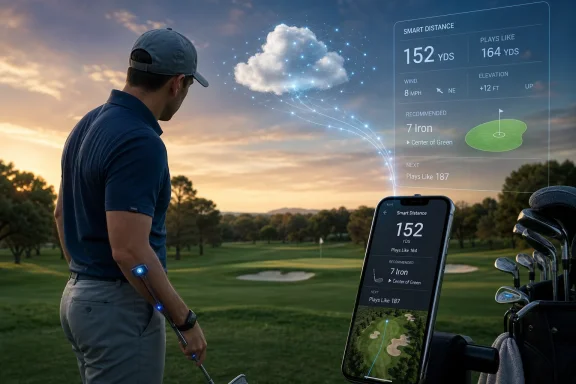 Golf Was Ready for AI Because It Was Already a Spreadsheet
Golf has always pretended to be a game of feel, but it has long behaved like a data system. Yardages, handicaps, launch angles, greens in regulation, strokes gained, lie conditions, wind direction, and carry distances are not modern inventions; they are the sport’s native language. Arccos did not have to convince golfers that numbers mattered. It only had to convince them that the numbers could talk back.That is what made Arccos Caddie different from a conventional GPS app or stat tracker. Earlier tools could show where the green was, how far the bunker sat from the tee, or how badly a player missed fairways. Arccos tried to turn that record into advice: what club to hit, what line to favor, and how to play a hole based on a player’s actual performance rather than the fantasy version of their game.
The Microsoft Azure angle mattered because this was not just a local app doing a few calculations. The system depended on cloud storage, machine-learning models, mapping data, weather context, and a growing corpus of real-world shots. In plain English, the product got more interesting as more golfers used it.
That feedback loop is the heart of modern AI products, whether they live in an enterprise dashboard, a Windows Copilot sidebar, or a golf bag. Data is captured at the edge, processed in the cloud, and returned as a recommendation that appears personal. The miracle is not the sensor. The miracle is the loop.
Microsoft Found a Showcase Far from the Server Room
Microsoft’s involvement gave Arccos Caddie a significance beyond golf retail. In 2017, the company was aggressively repositioning Azure as more than rented compute capacity. The message was that cloud platforms would host intelligence, not merely files and virtual machines.A golf caddie app was a clever demonstration because it translated the abstract promise of AI into a decision anyone could understand. Should I hit driver? Should I lay up? Is this really a 150-yard shot if the wind is in my face and the green sits uphill? Those are better demo questions than a slide about predictive analytics.
The same Azure story was being sold to enterprises: collect data, normalize it, model it, and push back better decisions. Arccos simply moved that pattern onto a fairway. For WindowsForum readers, the lesson is familiar. Consumer products often make cloud architecture legible before enterprise buyers admit they are already living inside it.
There is also a reason Microsoft liked this kind of example. Sports data feels low-risk compared with medicine, finance, or policing. If the model is wrong, a golfer makes bogey rather than a bank denying a loan. That made Arccos Caddie a safe public face for AI at a time when the term still carried more novelty than dread.
The Caddie Was Never Just a Caddie
The phrase “AI caddie” sounds like a replacement for a person, but the more accurate reading is that Arccos was replacing guesswork. Most amateur golfers do not have caddies. They have habits, ego, half-remembered yardages, and one heroic 5-iron from 2019 that continues to distort every decision they make.A human caddie watches patterns and tells the player uncomfortable truths. Arccos tried to do something similar with data. If a golfer thinks they hit a club 160 yards but their tracked shots say the real number is 147 with a wide dispersion pattern, the app has a stronger claim on reality than memory does.
That matters because golf is one of the few consumer domains where personal analytics can produce immediate behavioral change. A runner may ignore sleep data. A driver may ignore fuel-economy feedback. A golfer standing over a shot with water short of the green has an immediate incentive to listen.
The best version of Arccos Caddie was not a robot whispering commands. It was a mirror. It showed players the gap between imagined capability and observed performance, then turned that gap into a recommendation.
Sensors Made the Cloud Honest
The unglamorous foundation of the whole system was automatic shot tracking. Without reliable input, the AI layer becomes theater. Arccos’ club sensors and mobile app created the record: what club was used, where the shot began, where it ended, and how the player actually performed over time.This is where sports tech often succeeds or fails. The more work the user must do, the more incomplete the dataset becomes. Manual scorekeeping, post-round tagging, and memory-based stat entry all decay under real-world conditions. Golfers forget, embellish, or stop bothering.
Automatic capture changed the bargain. The player gave up some friction at setup in exchange for a round that could be analyzed without becoming homework. That is the consumer version of a lesson IT departments know well: observability only works when telemetry is built into the workflow.
The better the data collection, the more credible the recommendation. A caddie app that knows a golfer’s true club distances, common misses, and approach tendencies can be useful. A caddie app guessing from a handicap index and a few generic averages is mostly vibes with a scorecard.
The Real Innovation Was Personalization, Not Prediction
AI marketing often leans on prediction because prediction sounds futuristic. But Arccos’ stronger claim was personalization. It did not merely ask what a good golfer should do from 165 yards. It asked what this golfer should do from 165 yards, under these conditions, with this pattern of misses.That distinction is crucial. Amateur golf is not played by averages. It is played by inconsistent people making decisions under pressure. A recommendation that ignores the player’s history is little better than generic instruction.
Arccos’ use of “Smart Distance” club averages and strokes-gained-style analysis pushed the product toward a more useful kind of intelligence. It could show that one player’s conservative choice was actually smarter, while another player’s aggressive line might be justified. Strategy became less about macho distance and more about expected outcome.
This is where golf intersects with the broader AI economy. The most useful AI systems are not always the ones that generate the most impressive answer. They are the ones that understand enough context to make a boring recommendation at the right moment.
Weather, Elevation, and Wind Turned Yardage into a Model
The later evolution of Arccos Caddie made the platform more ambitious by adding real-time “Plays Like” distances that accounted for wind, elevation, and other conditions. That moved the product beyond stat tracking and into environmental modeling. A shot was no longer just a number to the pin. It was an adjusted problem.Any golfer understands the difference. A 150-yard shot downhill with helping wind is not the same as 150 yards into a coastal gust. Traditional rangefinders and GPS devices can provide distance, but distance alone is a primitive answer to a complex question.
By layering weather and terrain data over personal club performance, Arccos moved closer to the logic of a real caddie. It was not enough to know how far away the target was. The app needed to estimate how the ball would behave and how the player typically delivered it.
That is a useful reminder for anyone watching AI creep into Windows, Microsoft 365, and enterprise management tools. Context is the product. Without it, AI produces fluent generalities. With it, AI can become operational.
Golf’s Rules Forced AI to Behave Like a Product, Not a Party Trick
Golf also imposed constraints that many AI products lack. The Rules of Golf limit what kinds of advice and distance-measuring assistance are permitted in competition, depending on settings and local rules. That means a golf AI cannot simply do everything it is technically capable of doing and call it innovation.This is healthier than it sounds. Constraints force product discipline. Features must be separated, modes must be understandable, and players must know when a function is appropriate for casual play versus tournament play.
That distinction matters because AI products frequently blur the line between assistance and automation. In golf, that line is visible. A player may use data to prepare, but during competition the rules and settings govern what can be used. The result is a product category that must take governance seriously, even for weekend players.
Enterprise IT should recognize the pattern. The hard part is rarely building a feature that can produce an answer. The hard part is building one that behaves differently in different policy contexts without confusing the user.
The Amateur Golfer Became the Dataset
The most valuable asset in the Arccos system was never the plastic sensor. It was the accumulated database of shots. Over time, the platform could learn from millions, then hundreds of millions, and eventually even larger pools of on-course outcomes.That is the same platform logic that has reshaped every modern software market. Devices create usage data. Usage data improves services. Better services attract more users. More users create more data. The hardware may be sold once, but the data loop keeps paying.
For golfers, this creates a useful product and a subtle dependency. The more rounds a player records, the more valuable the platform becomes. Leaving means abandoning a personal history that may have taken seasons to build.
For Arccos, that history is the moat. Garmin, Shot Scope, Apple Watch apps, laser rangefinders, and old-fashioned yardage books can all compete on individual features. But a player-specific performance model becomes stickier than a gadget.
The Subscription Was Inevitable
Once the product became a cloud intelligence service, the business model was always going to drift toward membership. Consumers often dislike subscriptions, especially in categories where they remember buying hardware outright. But cloud AI does not behave like a one-time purchase.The service has ongoing costs: course mapping, app development, cloud infrastructure, analytics, support, weather integrations, and model improvement. Whether golfers like it or not, the economics look more like software-as-a-service than a pro-shop accessory.
That does not make every price increase wise or every bundle defensible. It does mean the product’s value proposition has to be judged differently. A sensor pack is hardware. Arccos Caddie is a continuing decision engine.
The friction is cultural as much as financial. Golfers are used to paying for clubs, balls, gloves, greens fees, and lessons. Paying annually for data about their own game feels different because the ownership boundary is less obvious.
The AI Boom Caught Up to a Product That Arrived Early
In hindsight, Arccos Caddie was early to a vocabulary that later became unavoidable. In 2017, “AI” still sounded like a keynote flourish in many consumer products. By 2026, it is nearly impossible to buy software without being told that some model is optimizing, summarizing, generating, or predicting something.That shift changes how Arccos looks. What once seemed like a futuristic golf app now looks like an early example of a mainstream pattern: a specialized AI assistant grounded in domain-specific data. It did not try to answer every question. It tried to answer one class of questions better than a human’s unreliable memory.
That specificity is why the product remains more interesting than many generic AI assistants. Golf has clear inputs, visible outcomes, and a brutally honest scoring system. If the advice is bad, the scorecard notices.
The same cannot always be said for broad productivity AI. A meeting summary can sound plausible while missing nuance. A golf recommendation that repeatedly sends balls into bunkers will not survive long.
Bryson’s Driver and Arccos’ Caddie Tell the Same Story from Opposite Ends
The supplied GolfWRX material veers into a different but related story: Bryson DeChambeau testing a TaylorMade prototype driver built for ball speeds north of 200 mph, tour players adding driving irons at Shinnecock Hills, and elite golfers reshaping equipment for specific conditions. At first glance, that seems far removed from an AI caddie app. It is not.Both stories are about golf becoming more engineered. DeChambeau’s driver exists because the old equipment assumptions buckle under extreme speed. Driving irons return at a windy U.S. Open because trajectory, spin, turf interaction, and course firmness change the optimal tool. Arccos Caddie exists because amateur decision-making also buckles under real conditions.
At the tour level, the engineering is visible in carbon faces, center-of-gravity placement, wedge grinds, lie-angle tweaks, and shaft experiments. At the amateur level, it appears as cloud analytics, sensor telemetry, and AI-assisted strategy. The tools differ, but the premise is the same: golf is less romantic when measured, and more interesting because of it.
That is the bridge between equipment journalism and technology journalism. The modern golfer is surrounded by optimization systems. Some are embedded in the clubhead. Some live in Azure. Some sit on the wrist or phone. All of them are trying to shrink uncertainty.
The Shinnecock Lesson Is That Context Beats Raw Power
The equipment notes from Shinnecock Hills underline a point Arccos has been making since launch: the best decision depends on the course, not the brochure. A 427-yard drive makes the headline, especially when Bryson DeChambeau is involved. But a U.S. Open setup often rewards the player who controls flight, spin, landing angle, and miss patterns.That is why driving irons become fashionable on firm, windy courses. They are not nostalgia pieces. They are trajectory tools. A player who can keep the ball under the wind and find the correct side of the fairway may gain more than a player who simply chases maximum carry.
This is exactly the kind of thinking an AI caddie tries to bring to ordinary golfers. The amateur version may not involve a custom TaylorMade prototype or a tour van bending a Titleist utility iron flatter. But the strategic question is identical: what shot gives this player the best expected result here?
The answer is often humbling. It may be less club. It may be more club. It may be aiming away from the flag. The machine’s value is not that it flatters the golfer. It is that it can be indifferent to ego.
The Best Golf AI Will Be Conservative in Public and Aggressive in Private
There is a natural temptation for AI golf products to become more directive. If the system knows your tendencies, the weather, the course, and the expected value of different strategies, why not tell you exactly what to hit every time? The answer is that golf is still a game, not a dispatch system.Good sports technology preserves agency. It should help a player understand risk, not erase the player’s role in choosing it. A golfer may decide to take on a pin because the moment calls for it, even if the expected-value chart says otherwise.
The better future is layered. Before the round, AI can be aggressive: simulate strategies, identify danger holes, recommend practice priorities, and expose weaknesses. During the round, it should be calmer: clarify distance, conditions, and personal tendencies without turning the player into a passenger.
That balance is also relevant to Windows and enterprise AI. Administrators do not want opaque systems making irreversible decisions without oversight. They want systems that surface risk, recommend action, explain tradeoffs, and allow policy to decide how much autonomy is acceptable.
Privacy Is the Unplayed Hole
Sports data feels benign until it becomes intimate. A golf app may know where a player was, when they played, who they played with, how often they travel, what courses they frequent, what devices they carry, and how their performance changes over time. That is not medical data, but it is still behavioral data.Arccos is hardly alone here. Fitness trackers, smartwatches, cycling computers, running apps, and connected gym equipment all normalize the exchange of personal telemetry for insight. Golf simply adds geography, habit, and social context in unusually clean form.
The privacy question is not whether such products should exist. They clearly provide value. The question is whether users understand the bargain and whether vendors continue earning trust after the novelty wears off.
For IT pros, this is another familiar pattern. The more useful a service becomes, the more data it tends to require. The more data it holds, the more governance matters. AI does not eliminate that equation; it intensifies it.
The Windows Angle Is the Cloud Angle
A WindowsForum audience does not need every golf product mapped awkwardly onto desktop computing. The connection here is more direct: Arccos Caddie was an Azure AI story before “AI PC” became a hardware category and before Copilot became Microsoft’s default software suffix. It showed the company’s preferred architecture in miniature.The client device captures context. The cloud interprets it. The app returns a recommendation. That pattern now appears everywhere in Microsoft’s portfolio, from security analytics to developer tools to productivity assistants.
What makes Arccos useful as a case study is that the feedback is concrete. If the system recommends the wrong club, the user sees the result. In many enterprise AI scenarios, the cost of a bad recommendation is harder to detect. A dashboard may look authoritative while quietly encoding flawed assumptions.
Golf’s clarity is refreshing. Every shot becomes a test. Every round becomes a dataset. Every recommendation faces an outcome that cannot be hand-waved away in a quarterly AI strategy deck.
The Scorecard for AI Golf Is Finally Coming Into Focus
The most important lesson from Arccos Caddie is not that golfers need artificial intelligence to enjoy the game. They do not. It is that AI becomes genuinely useful when it is narrow, contextual, measurable, and humble about uncertainty.- Arccos Caddie’s original significance was its combination of automatic shot tracking, Azure cloud processing, machine learning, and course strategy in a consumer sports product.
- The product worked because golf already produces structured decisions that can be improved with better context and better personal data.
- The same architecture behind Arccos mirrors the broader Microsoft cloud playbook: capture telemetry, model behavior, and return recommendations through software.
- The supplied tour-equipment examples show the same optimization culture at the elite level, where clubs, shafts, grinds, and trajectories are tuned for specific course demands.
- The biggest long-term risks are not whether AI can suggest a club, but whether users understand data ownership, subscription dependency, competition settings, and privacy tradeoffs.
- The best version of AI in golf will not replace judgment; it will make the consequences of judgment clearer before the player swings.
References
- Primary source: GolfWRX
Published: 2026-06-19T19:30:08.284320
Arccos Caddie: Golf’s first artificial intelligence platform
It’s a brave new golf world. Arccos is launching golf’s first artificial intelligence platform, Arccos Caddie. Arccos, which you know from its shot-tracking app, has integrated the Microsoft Azure cloud platform into the about-to-launch Caddie. The utility uses advanced analytics to help golfers... golfwrx.com
- Related coverage: arccosgolf.com
Arccos Expands Golf’s First Artificial Intelligence Platform, Premiere – Arccos Golf
Arccos Caddie, Powered by Microsoft Azure, Now Available Arccos Golf today announced the launch of several new features for Arccos Caddie, golf’s first artificial intelligence (AI) platform, highlighted by real-time “Plays Like” distance calculations that precisely account for the impact wind... www.arccosgolf.com
- Official source: news.microsoft.com
Arccos Golf’s virtual caddie uses AI to improve your game | Transform
Arccos Golf used tools in Microsoft Azure to create the first virtual caddie— one that uses artificial intelligence to offer personalized recommendations about what clubs to use and how to play a hole.news.microsoft.com - Related coverage: prnewswire.com
Arccos to Introduce Golf's First Artificial Intelligence Platform, Arccos Caddie, Powered by Microsoft Azure
/PRNewswire/ -- Arccos Golf today launched golf's first artificial intelligence platform, Arccos Caddie. Powered by the Microsoft Azure cloud platform, Arccos... www.prnewswire.com
- Related coverage: geekwire.com
For golfers: Arccos unveils AI-powered virtual caddie on a smartphone, powered by Microsoft – GeekWire
Caddies are trying to make a comeback — albeit in a virtual way. Arccos, a Stamford, Conn.-based startup that builds golf-shot tracking technology, todaywww.geekwire.com - Related coverage: si.com
The inside story of Arccos Golf
In this week's episode, host Paul Liberatore interviews Sal Syed, founder and CEO of Arccos, which created golf’s first artificial-intelligence platform. Here you'll learn more about the product and the company behind it.www.si.com
- Related coverage: pcworld.com
Microsoft's big data solves golf's mysteries in the Arccos Caddie app | PCWorld
Microsoft showed the Arccos Caddie app at build to demonstrate the data-crunching powers of its Azure cloud service—in this case, collecting data to help you play better golf. www.pcworld.com
- Related coverage: sportsbusinessjournal.com
Meet The World’s Smartest Golf Caddie, Powered By Artificial Intelligence
Meet The World’s Smartest Golf Caddie, Powered By Artificial Intelligence www.sportsbusinessjournal.com
- Related coverage: eu.arccosgolf.com
Golf's First A.I. Powered GPS Rangefinder – Arccos Golf
Feature within Award-Winning Arccos Caddie App Includes Real-Time Slope and Weather Calculations Plus Altitude Adjustments Based on User’s Home Course STAMFORD, Conn. – Arccos Golf, the pioneer of big data and artificial intelligence for golf, has introduced the world’s first A.I. powered GPS...eu.arccosgolf.com - Related coverage: linkedin.com
Arccos Golf | LinkedIn
Arccos Golf | 8,301 followers on LinkedIn. The Smartest Way to Play Golf. Official Game Tracker of The PGA TOUR. | About Arccos Caddie is golf’s first Artificial Intelligence platform. The award-winning Arccos Caddie app seamlessly syncs with Arccos Caddie sensors to provide golfers with...www.linkedin.com
- Related coverage: golfmonthly.com
Has Arccos Changed Rangefinders Forever With 'First-Of-Its-Kind' Smart Laser? | Golf Monthly
Arccos has announced a new distance measuring device that looks to have taken the concept of accurate distances to a completely new levelwww.golfmonthly.com - Related coverage: 0e190a550a8c4c8c4b93-fcd009c875a5577fd4fe2f5b7e3bf4eb.ssl.cf2.rackcdn.com
EINPresswire 565581911 arccos revolutionizes player analytics with strokes gained insights for each club 2
PDF document0e190a550a8c4c8c4b93-fcd009c875a5577fd4fe2f5b7e3bf4eb.ssl.cf2.rackcdn.com
- Related coverage: ijcem.in
