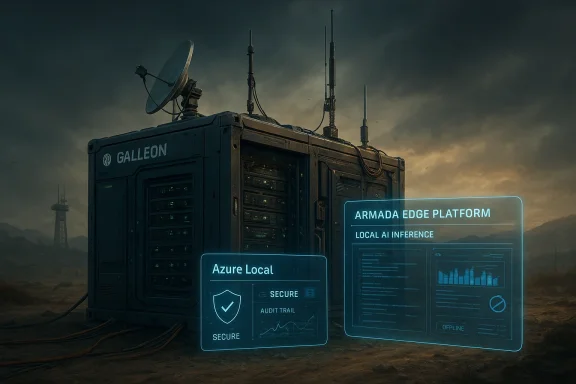
Armada’s new Azure Local collaboration is more than another edge-computing press release. It is a sharp signal that sovereign AI is moving from policy language into deployable infrastructure, especially for customers who need low latency, local control, and resilience in hard-to-reach environments. The combination of Microsoft Azure Local, Armada’s Galleon modular data centers, and the Armada Edge Platform points to a future where AI workloads can run closer to the data source without giving up governance or operational continuity. That matters for defense, energy, industrial sites, and emergency-response teams that cannot depend on always-on connectivity.
The announcement fits into a broader industry shift: AI is no longer assumed to live only in hyperscale cloud regions. Instead, enterprises are asking where the model runs, where the data stays, and who controls the stack when the network drops or sovereignty rules tighten. Microsoft has been steadily building that answer with Azure Local and its wider Sovereign Cloud push, which now explicitly includes locally hosted, hybrid, and fully disconnected operating modes.
Armada is an especially logical partner for that mission because its brand is built around the remote edge. The company markets ruggedized modular data centers, centralized fleet management, and edge AI tooling for environments where traditional cloud assumptions break down. Microsoft’s own Armada partner page says Azure Local can be hosted inside Armada’s Galleons and managed through Armada Edge Platform even in disconnected environments, which is the core of the value proposition here.
This is also not an isolated experiment. Armada and Microsoft have already worked together on distributed cloud deployments, including a 2025 collaboration with Aramco Digital that used Azure Local inside Armada Galleon infrastructure for edge AI and industrial intelligence in Saudi Arabia. That earlier project helps show that this latest collaboration is building on a real deployment pattern rather than a vague strategic alliance.
The timing is important, too. Microsoft’s February 2026 Sovereign Cloud update added Azure Local disconnected operations, Microsoft 365 Local disconnected, and Foundry Local support for large AI models in fully disconnected environments. In other words, the software stack has recently matured to match the edge hardware story Armada has been telling for years.
The sovereign angle is just as significant. Microsoft’s Sovereign Cloud materials emphasize customer-controlled environments, consistent policy enforcement, and the ability to maintain operations even when public cloud connectivity is limited or intentionally absent. For industries that handle classified, sensitive, or geographically constrained data, that distinction is not cosmetic. It is the difference between “cloud-assisted” and “cloud-dependent.”
That is why the phrase sovereign AI edge computing deserves scrutiny. It does not simply mean local inference. It means governance, identity, policy, and workload control staying within a clearly defined operational boundary. Microsoft’s recent sovereign cloud statements frame this as a full-stack model spanning infrastructure, productivity, and AI services under the customer’s control.
The practical implication is that customers may no longer need to choose between cloud-grade tooling and local autonomy. Instead, they can aim for both, provided the software stack, hardware, and operational model all line up. That is precisely the gap Armada appears to be trying to fill.
That makes Armada useful to Microsoft for a simple reason: sovereign AI does not scale on software promises alone. It needs physical delivery models that can survive harsh environments, temporary sites, mobile operations, and limited network access. In that context, modular data centers are not a niche product; they are an enabling technology.
Armada has repeatedly positioned Galleon as a foundation for secure and high-density edge computing, from industrial distributed cloud in Saudi Arabia to U.S. Navy-related work and other disconnected-use cases. That history suggests the company understands a key truth: edge computing is an operations problem as much as a software problem.
The company’s recent partnerships with NVIDIA and OpenAI also reinforce the idea that Armada is building an ecosystem around serious AI workloads, not simply selling hardware containers. It is trying to become the physical layer of a distributed AI stack.
That approach is strategically smart. If Microsoft can preserve tooling familiarity while satisfying sovereignty demands, it reduces the friction that often pushes regulated or state-linked customers toward fragmented bespoke systems. It also gives Microsoft a way to defend against competitors that offer sovereign cloud through narrower regional or partner-hosted models.
That is especially relevant for public sector and critical infrastructure customers, who often need a blend of local data residency, operational autonomy, and enterprise-grade manageability. The latest sovereign cloud updates suggest Microsoft is no longer framing this as future architecture; it is now part of its go-to-market narrative.
The Armada deal fits that agenda because it extends the sovereign story beyond the data center perimeter and into rugged, mobile, and geographically difficult environments. In effect, Microsoft is saying sovereignty should travel with the workload, not just stay in the region. That is a big conceptual shift.
Defense and public safety are the most obvious beneficiaries. Remote missions, temporary command posts, ships, and forward operating sites all struggle with inconsistent connectivity. A sovereign edge stack can support mission autonomy, situational awareness, and operational continuity without requiring a constant trip back to central cloud regions.
That can make AI much more practical. Instead of shipping sensor streams to distant cloud regions and waiting for a response, teams can run inference on-site, trigger alerts locally, and preserve critical workflows even during network outages. The result is not just performance gain; it is operational redesign.
The same logic applies to disaster response and state/local deployments. Emergency systems often need compute that is immediately available and self-contained, especially when broader communications infrastructure is degraded. Armada’s modular approach is attractive precisely because it can be deployed where conventional data center expansion is not realistic.
At the same time, the economic case is not universal. If a workload can run efficiently in a central region, the edge may still be overkill. That is why these solutions will likely be strongest in environments where locality, sovereignty, or resilience justify the premium. Not every application needs a ruggedized data center.
The important point is that the market is maturing enough to support more granular decisions. Customers can now evaluate whether a model belongs in the cloud, at the edge, or in a sovereign private cloud boundary. That flexibility is a sign of ecosystem maturity.
That creates pressure on rivals that sell only one layer of the stack. Hardware vendors without cloud governance may struggle to offer a complete sovereign story. Cloud vendors without deployable rugged infrastructure may be limited in the kinds of environments they can credibly serve. The winners will be the companies that can bridge both worlds.
Armada benefits because its brand already implies hard-use cases, not generic branch-office IT. Microsoft benefits because it can extend Azure’s relevance into deployments where public cloud alone would be insufficient. Together, they can present a stack that is both familiar and physically believable.
Competitively, this also pressures hyperscalers to think more seriously about where cloud actually lives. If sovereign AI can run in a mobile, customer-controlled environment using familiar Azure tooling, then the boundary between cloud and edge becomes less about geography and more about operational control.
For enterprises, the implications are much larger. This kind of architecture can simplify compliance, reduce latency, and make it easier to deploy AI in places where a public cloud dependency would be unacceptable. It also gives IT and OT teams a more consistent operational model across on-premises, disconnected, and cloud-connected footprints.
However, procurement also becomes more complex in a different way. Buyers must assess not just licenses and hardware, but also lifecycle support, site readiness, power constraints, sovereign policy, and local operating procedures. In other words, the buying decision becomes more operationally mature and more demanding.
That complexity is not necessarily a bad thing. It can be a sign that the market is finally matching the real-world needs of critical infrastructure, rather than forcing those environments into generic cloud templates. That is progress, even if it is messy.
Armada and Microsoft have an advantage because they already have shared language around Azure Local and edge deployment. Still, the real test will be repeatability: can the partnership move from marquee demos to reproducible, supportable deployments across industries and geographies? That is where many ambitious edge stories lose momentum.
There is also the risk of overpromising “sovereignty” while still relying on a vendor-controlled stack. Customers will need clarity on what is controlled locally, what is managed remotely, and where dependencies remain. The more mission-critical the workload, the more those details matter.
Finally, there is the integration challenge between AI workloads and operational systems. Running inference locally is useful, but it must still be tied into data pipelines, governance, security, and maintenance. Without that discipline, edge AI can become just another pilot project.
We should also expect more competition around ruggedized AI infrastructure. As Microsoft, NVIDIA, and partner ecosystems continue to expand support for local and disconnected AI, rival vendors will likely chase similar industrial, defense, and telecom opportunities. The market is moving toward a future where edge deployments are no longer exceptions, but standard options in the enterprise architecture toolbox.
Key things to watch:
Source: National Today Armada Unveils Sovereign AI Edge Computing with Microsoft Azure Local - San Francisco Today
 Overview
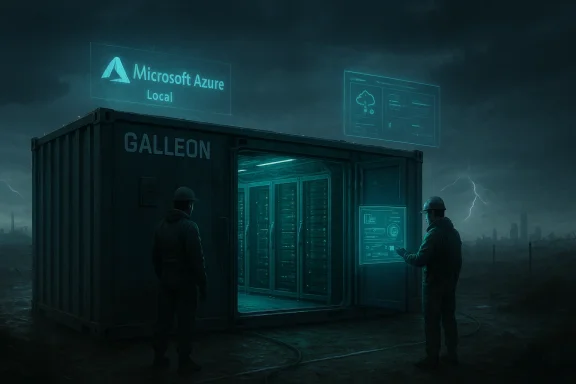
The announcement fits into a broader industry shift: AI is no longer assumed to live only in hyperscale cloud regions. Instead, enterprises are asking where the model runs, where the data stays, and who controls the stack when the network drops or sovereignty rules tighten. Microsoft has been steadily building that answer with Azure Local and its wider Sovereign Cloud push, which now explicitly includes locally hosted, hybrid, and fully disconnected operating modes.Armada is an especially logical partner for that mission because its brand is built around the remote edge. The company markets ruggedized modular data centers, centralized fleet management, and edge AI tooling for environments where traditional cloud assumptions break down. Microsoft’s own Armada partner page says Azure Local can be hosted inside Armada’s Galleons and managed through Armada Edge Platform even in disconnected environments, which is the core of the value proposition here.
This is also not an isolated experiment. Armada and Microsoft have already worked together on distributed cloud deployments, including a 2025 collaboration with Aramco Digital that used Azure Local inside Armada Galleon infrastructure for edge AI and industrial intelligence in Saudi Arabia. That earlier project helps show that this latest collaboration is building on a real deployment pattern rather than a vague strategic alliance.
The timing is important, too. Microsoft’s February 2026 Sovereign Cloud update added Azure Local disconnected operations, Microsoft 365 Local disconnected, and Foundry Local support for large AI models in fully disconnected environments. In other words, the software stack has recently matured to match the edge hardware story Armada has been telling for years.
What Microsoft Is Really Selling Here
At first glance, Azure Local can sound like a rebrand of hybrid cloud. In practice, it is more ambitious. Microsoft describes Azure Local as a distributed infrastructure layer that extends Azure capabilities into customer-owned environments and can run connected or disconnected, using Azure Arc as the unifying control plane. That matters because it makes edge deployments feel like extensions of cloud policy and tooling rather than separate islands of infrastructure.The sovereign angle is just as significant. Microsoft’s Sovereign Cloud materials emphasize customer-controlled environments, consistent policy enforcement, and the ability to maintain operations even when public cloud connectivity is limited or intentionally absent. For industries that handle classified, sensitive, or geographically constrained data, that distinction is not cosmetic. It is the difference between “cloud-assisted” and “cloud-dependent.”
Why edge sovereignty matters
The edge has become a battleground because AI is increasingly used where milliseconds matter and where data cannot leave the site freely. Think of facilities, ships, remote energy assets, defense deployments, and mobile command centers. In those settings, a model that works only when the internet cooperates is not enough.That is why the phrase sovereign AI edge computing deserves scrutiny. It does not simply mean local inference. It means governance, identity, policy, and workload control staying within a clearly defined operational boundary. Microsoft’s recent sovereign cloud statements frame this as a full-stack model spanning infrastructure, productivity, and AI services under the customer’s control.
The practical implication is that customers may no longer need to choose between cloud-grade tooling and local autonomy. Instead, they can aim for both, provided the software stack, hardware, and operational model all line up. That is precisely the gap Armada appears to be trying to fill.
- Azure Local brings Azure-like infrastructure into customer sites.
- Armada Galleon supplies ruggedized modular data-center hardware.
- Armada Edge Platform provides centralized management across cloud, local, and on-premises environments.
- Sovereign AI keeps data, policy, and operations under customer control.
- Disconnected operations protect continuity when networks are absent or restricted.
Why Armada Matters More Than a Typical Partner
Armada is not trying to be a generic systems integrator. Its pitch is that it can deliver compute, storage, connectivity, and edge AI in places where traditional infrastructure is too slow, too brittle, or too expensive to deploy. The company’s main site describes a platform spanning Atlas, Galleon, Bridge, and Marketplace, with Galleon serving as the ruggedized mobile data center at the center of the stack.That makes Armada useful to Microsoft for a simple reason: sovereign AI does not scale on software promises alone. It needs physical delivery models that can survive harsh environments, temporary sites, mobile operations, and limited network access. In that context, modular data centers are not a niche product; they are an enabling technology.
Galleon as a deployment primitive
The Galleon is important because it collapses the time between need and capacity. Instead of waiting for a conventional build-out, customers can drop in a pre-integrated, ruggedized environment and start running workloads. For remote industries, that speed can be worth more than raw theoretical scale.Armada has repeatedly positioned Galleon as a foundation for secure and high-density edge computing, from industrial distributed cloud in Saudi Arabia to U.S. Navy-related work and other disconnected-use cases. That history suggests the company understands a key truth: edge computing is an operations problem as much as a software problem.
The company’s recent partnerships with NVIDIA and OpenAI also reinforce the idea that Armada is building an ecosystem around serious AI workloads, not simply selling hardware containers. It is trying to become the physical layer of a distributed AI stack.
- Faster deployment in remote locations.
- More predictable operating conditions for AI workloads.
- Less dependence on local rack-and-stack expertise.
- Better resilience for mobile or disconnected operations.
- A clearer path from pilot to production.
The Microsoft Strategy: Sovereignty Without Abandoning Azure
Microsoft’s approach is notable because it is not treating sovereignty as a separate product family that lives outside the Azure ecosystem. Instead, it is trying to make sovereignty feel like a deployment option within the Microsoft stack. Azure Local is central to that strategy, and recent Microsoft materials explicitly tie it to sovereign private cloud, disconnected operations, and local AI inference.That approach is strategically smart. If Microsoft can preserve tooling familiarity while satisfying sovereignty demands, it reduces the friction that often pushes regulated or state-linked customers toward fragmented bespoke systems. It also gives Microsoft a way to defend against competitors that offer sovereign cloud through narrower regional or partner-hosted models.
A broader sovereign-cloud playbook
Microsoft has been broadening the Sovereign Cloud message across geographies, including Europe, Canada, India, and Saudi Arabia. The common thread is a promise of local control, stronger compliance posture, and support for modern AI workloads without forcing customers to abandon Microsoft’s platform model.That is especially relevant for public sector and critical infrastructure customers, who often need a blend of local data residency, operational autonomy, and enterprise-grade manageability. The latest sovereign cloud updates suggest Microsoft is no longer framing this as future architecture; it is now part of its go-to-market narrative.
The Armada deal fits that agenda because it extends the sovereign story beyond the data center perimeter and into rugged, mobile, and geographically difficult environments. In effect, Microsoft is saying sovereignty should travel with the workload, not just stay in the region. That is a big conceptual shift.
- Sovereignty is becoming a mainstream Azure pattern.
- Local control is now being tied directly to AI readiness.
- Disconnected support is a major differentiator.
- Microsoft is leveraging partners to reach physical environments it cannot serve alone.
- The edge is becoming part of the sovereign cloud stack.
The Industrial and Defense Use Cases
If you want to understand why this announcement matters, look at the industries named in Armada’s own positioning: defense, oil and gas, mining, manufacturing, telecom, and state and local operations. Those sectors share a common need for resilience, local processing, and strict control over sensitive operational data.Defense and public safety are the most obvious beneficiaries. Remote missions, temporary command posts, ships, and forward operating sites all struggle with inconsistent connectivity. A sovereign edge stack can support mission autonomy, situational awareness, and operational continuity without requiring a constant trip back to central cloud regions.
Industrial data is often too valuable to send away
In energy and industrial settings, latency is only part of the story. Operators also care about uptime, safety, environmental conditions, and the ability to process operational technology data locally without external exposure. The less data leaves the site, the easier it is to preserve control and reduce risk.That can make AI much more practical. Instead of shipping sensor streams to distant cloud regions and waiting for a response, teams can run inference on-site, trigger alerts locally, and preserve critical workflows even during network outages. The result is not just performance gain; it is operational redesign.
The same logic applies to disaster response and state/local deployments. Emergency systems often need compute that is immediately available and self-contained, especially when broader communications infrastructure is degraded. Armada’s modular approach is attractive precisely because it can be deployed where conventional data center expansion is not realistic.
Why remote environments change the economics
Remote deployments are expensive partly because every layer becomes harder: power, cooling, transport, security, staffing, and connectivity all become constraints. Modular infrastructure reduces some of that complexity by pre-integrating the environment before it arrives on site. That can shorten deployment time and reduce operational uncertainty.At the same time, the economic case is not universal. If a workload can run efficiently in a central region, the edge may still be overkill. That is why these solutions will likely be strongest in environments where locality, sovereignty, or resilience justify the premium. Not every application needs a ruggedized data center.
The important point is that the market is maturing enough to support more granular decisions. Customers can now evaluate whether a model belongs in the cloud, at the edge, or in a sovereign private cloud boundary. That flexibility is a sign of ecosystem maturity.
- Defense sites need local autonomy.
- Energy operations need low-latency analytics.
- Emergency-response teams need resilient offline capability.
- Manufacturing sites need continuous process visibility.
- Telecom operators need geographically distributed AI infrastructure.
Competitive Implications
This announcement also tells us something about competition. The edge-AI market is moving beyond point products and into integrated platforms that combine silicon, software, infrastructure, and governance. Microsoft is already deepening ties with NVIDIA and building sovereign cloud capabilities, while Armada is positioning itself as the systems-level partner that can deliver the physical footprint.That creates pressure on rivals that sell only one layer of the stack. Hardware vendors without cloud governance may struggle to offer a complete sovereign story. Cloud vendors without deployable rugged infrastructure may be limited in the kinds of environments they can credibly serve. The winners will be the companies that can bridge both worlds.
The market is shifting from “edge” to “operational edge”
There is a subtle but important shift in language across the sector. The old edge story was about pushing compute closer to devices. The new story is about ensuring that compute stays operational under sovereignty, connectivity, and policy constraints. That is a broader and more demanding brief.Armada benefits because its brand already implies hard-use cases, not generic branch-office IT. Microsoft benefits because it can extend Azure’s relevance into deployments where public cloud alone would be insufficient. Together, they can present a stack that is both familiar and physically believable.
Competitively, this also pressures hyperscalers to think more seriously about where cloud actually lives. If sovereign AI can run in a mobile, customer-controlled environment using familiar Azure tooling, then the boundary between cloud and edge becomes less about geography and more about operational control.
- Hyperscalers must support disconnected environments.
- Infrastructure partners become more strategically important.
- Sovereignty is now a platform feature, not a niche add-on.
- Edge AI competition is becoming ecosystem competition.
- Portability and governance matter as much as raw compute.
Enterprise vs. Consumer Impact
For consumers, this announcement is mostly invisible, at least for now. Most people will not interact directly with Azure Local in an Armada Galleon, and they will not care where a specific industrial AI model executes. But they may benefit indirectly through better resilience in the services they rely on, from logistics to utilities to public safety systems.For enterprises, the implications are much larger. This kind of architecture can simplify compliance, reduce latency, and make it easier to deploy AI in places where a public cloud dependency would be unacceptable. It also gives IT and OT teams a more consistent operational model across on-premises, disconnected, and cloud-connected footprints.
A new model for procurement
Enterprise buyers increasingly want platform contracts that reduce integration sprawl. A solution that pairs Azure Local with a ruggedized hardware platform can be attractive because it consolidates responsibility across infrastructure, orchestration, and deployment. That is especially true when the customer lacks the appetite to become its own systems integrator.However, procurement also becomes more complex in a different way. Buyers must assess not just licenses and hardware, but also lifecycle support, site readiness, power constraints, sovereign policy, and local operating procedures. In other words, the buying decision becomes more operationally mature and more demanding.
That complexity is not necessarily a bad thing. It can be a sign that the market is finally matching the real-world needs of critical infrastructure, rather than forcing those environments into generic cloud templates. That is progress, even if it is messy.
The Timing Problem and the Integration Challenge
The biggest question is not whether the concept is sound. It is whether the integration can be executed smoothly at scale. Hybrid and sovereign deployments often fail in the seams between vendors, especially when hardware, software, policy, and field operations all need to move together.Armada and Microsoft have an advantage because they already have shared language around Azure Local and edge deployment. Still, the real test will be repeatability: can the partnership move from marquee demos to reproducible, supportable deployments across industries and geographies? That is where many ambitious edge stories lose momentum.
What can go wrong
The operational edge can become brittle if deployment templates are too complex or if customers need too much specialized support. Power, cooling, site logistics, and secure connectivity are all nontrivial in remote locations, and any one of them can compromise the value proposition. Modular infrastructure helps, but it does not abolish physics.There is also the risk of overpromising “sovereignty” while still relying on a vendor-controlled stack. Customers will need clarity on what is controlled locally, what is managed remotely, and where dependencies remain. The more mission-critical the workload, the more those details matter.
Finally, there is the integration challenge between AI workloads and operational systems. Running inference locally is useful, but it must still be tied into data pipelines, governance, security, and maintenance. Without that discipline, edge AI can become just another pilot project.
- Deployment complexity remains high.
- Sovereignty must be precise, not marketing-fluffy.
- Remote operations add power and logistics risk.
- Multi-vendor integration can slow adoption.
- Operational support will determine trust.
Strengths and Opportunities
The opportunity here is substantial because the partnership lines up with several durable trends at once: sovereign cloud, edge AI, disconnected operations, and industrial digitization. Microsoft brings the software credibility and the governance model, while Armada contributes the ruggedized delivery mechanism and edge-native operating experience. Together, they can address use cases that neither company could fully solve alone.- Lower latency for AI inference and local decision-making.
- Better data control for sensitive and regulated environments.
- Stronger resilience when connectivity is poor or unavailable.
- Faster deployment through modular infrastructure.
- Cleaner operations via consistent Azure-based management.
- Broader market reach into defense, energy, and industrial sites.
- A more credible sovereign AI story than cloud-only alternatives.
Risks and Concerns
The biggest risks center on execution, not concept. Sovereign AI can become overcomplicated very quickly, and customers may find that the reality of site management, support, and integration is harder than the marketing suggests. A solution that works beautifully in a proof of concept may still be difficult to scale across dozens of locations.- Vendor lock-in if customers cannot easily move workloads.
- High total cost for ruggedized deployments.
- Operational fragility in harsh environments.
- Ambiguous sovereignty claims if dependencies remain external.
- Skills gaps for teams managing cloud and edge together.
- Maintenance burden for distributed hardware fleets.
- Security exposure if governance is not uniformly enforced.
Looking Ahead
The next phase of this story will be about proof, not promise. Watch for named customer deployments, repeatable architecture patterns, and clearer documentation of how Azure Local behaves inside Armada’s Galleon environments under real operational constraints. If those details become public and consistent, the partnership could become a reference model for sovereign edge AI.We should also expect more competition around ruggedized AI infrastructure. As Microsoft, NVIDIA, and partner ecosystems continue to expand support for local and disconnected AI, rival vendors will likely chase similar industrial, defense, and telecom opportunities. The market is moving toward a future where edge deployments are no longer exceptions, but standard options in the enterprise architecture toolbox.
Key things to watch:
- Additional customer case studies in defense, energy, and telecom.
- Expansion of Azure Local support in sovereign and disconnected settings.
- New Armada hardware or platform updates tied to AI workloads.
- Evidence of multi-site deployments beyond flagship pilots.
- Competitive responses from other cloud and modular-infrastructure vendors.
Source: National Today Armada Unveils Sovereign AI Edge Computing with Microsoft Azure Local - San Francisco Today
Last edited: