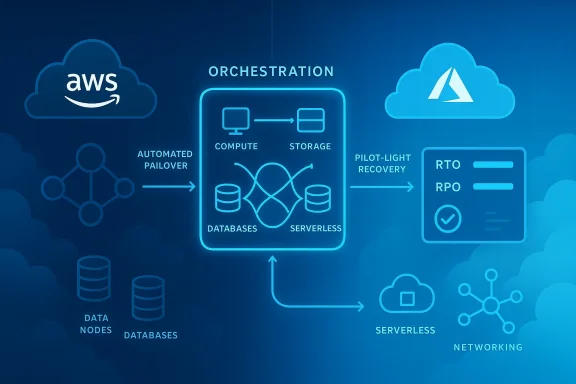
Arpio Expands Cloud Disaster Recovery to Azure with Application-Aware Orchestration

  • Thread Author
Arpio’s Azure launch promises to close a glaring gap for enterprises pursuing consistent, cloud-native disaster recovery across multi‑cloud estates, bringing its automated, application‑aware DR platform — long focused on AWS — into Microsoft Azure environments with the same orchestration-first approach the company has promoted for years.

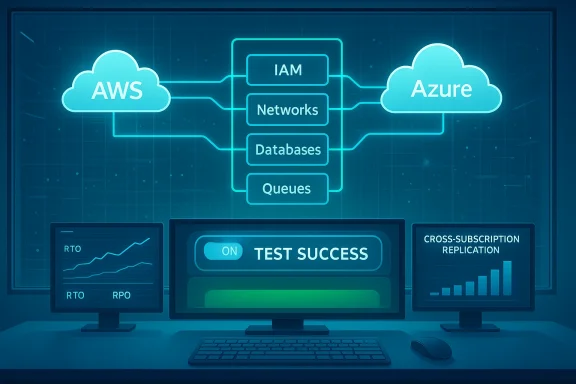
Cloud dashboard showing AWS-Azure integration through IAM, networks, databases, and queues with test success.Background​

Why this matters now​

Cloud outages, ransomware, accidental deletions and configuration mistakes have repeatedly exposed how brittle many cloud recovery strategies still are. Enterprises are increasingly running mixed estates across AWS and Azure, and they need a single policy surface and automation layer that can validate recovery, execute failover, and meet aggressive RTO/RPO targets without manual runbooks. Arpio’s announcement positions the company as a multi‑cloud DR orchestrator that treats Azure as a first‑class target rather than an afterthought.

Short primer: cloud‑native DR vs. legacy backup​

Legacy DR tools and traditional backup products were designed for physical datacenters: they assume static networking, block‑level images and long maintenance windows. Cloud‑native DR instead requires automated dependency mapping, cross‑account/tenant orchestration, and the ability to spin up application stacks — networking, IAM, autoscaling, load balancers, and data — in an isolated recovery environment quickly and non‑disruptively. Arpio’s messaging — “built for the cloud, not retrofitted” — is explicitly framed around these differences.

What Arpio announced​

  • The company has extended its automated disaster recovery capabilities to Microsoft Azure, adding support for full‑application recovery of Azure workloads.
  • Arpio emphasizes continuous, automated replication to maintain a low‑cost “pilot light” recovery environment synchronized with production, enabling more aggressive RTO and RPO targets.
  • The platform claims comprehensive support for enterprise cloud architectural patterns and the ability to orchestrate non‑disruptive tests and rapid spin‑ups of recovery environments.
  • Arpio says Azure support is available immediately to new and existing customers.
Doug Neumann, Arpio’s CEO, framed the launch as a continuation of the company’s mission to replace brittle, manual DR with automated, testable resilience — messaging consistent with Arpio’s prior emphasis on AWS resilience and its AWS Resilience Software Competency.

What the announcement actually means (technical breakdown)​

Application‑aware orchestration​

Arpio’s core differentiator is orchestration: instead of only protecting volumes or VM images, it claims to map application dependencies and recover the whole application stack. That includes:
  • Identity and access controls (IAM/Entra ID roles)
  • Network topology and security groups
  • Platform services (managed databases, message queues, storage)
  • Compute and autoscaling policies
This approach is essential in cloud environments where restoring a VM image alone rarely makes an application functional. Arpio’s documentation and website describe automated dependency mapping and push‑button recovery for both AWS and Azure.

Continuous replication and pilot‑light strategy​

Arpio promotes continuous automated replication so a minimal recovery environment (pilot light) remains synchronized with production. Pilot‑light reduces standby costs while keeping recovery state current; in practice, this requires rigorous replication coverage for storage, databases, and configuration.
Arpio’s public materials indicate the platform supports cloud‑native replication and cross‑subscription orchestration in Azure, but enterprise buyers should validate which Azure resources are supported natively (PaaS services, managed identities, Blob/ADLS preservation, etc.) in their own environment before assuming complete coverage. The company’s prior AWS competency suggests broad coverage there, and the Azure announcement follows the same playbook, but product documentation should be verified for customer‑specific services.

Non‑disruptive testing and validation​

A core operational benefit claimed is the ability to run safe, frequent DR tests that spin up recovery environments while production continues uninterrupted. This capability is a real differentiator when compared to manual failover testing that requires long maintenance windows. Arpio’s platform rhetoric and product pages describe test‑mode validation and automated health checks; customers must confirm whether those tests cover database consistency, external integrations, and slice‑level performance characteristics for their critical services.

How Arpio’s Azure expansion compares to native and third‑party alternatives​

Native Azure options: Azure Site Recovery and Azure Backup​

Microsoft provides native services: Azure Site Recovery (ASR) for orchestrated failover and Azure Backup for long‑term retention. ASR is tightly integrated with Azure and handles replication and failover for VMs and some on‑premises scenarios, but it is primarily an infrastructure replication tool and has documented limitations (for example, retention and replication policies designed around VM recovery rather than application‑aware orchestration). Microsoft’s own community guidance highlights ASR’s design focus on recovery points rather than long‑term backup retention, and customers often pair ASR with other backup tools to meet retention and application‑consistency requirements.

Established DR vendors: Zerto, Veeam, Rubrik and others​

Third‑party vendors have broadened cloud capabilities in recent years, but many originated in virtualization or on‑prem backup paradigms and incrementally added cloud support. Zerto is recognized for continuous data protection and replication but may lack long‑term backup and has been criticized for cost and complexity in cloud contexts. Veeam and Rubrik have strong data protection pedigrees and multi‑cloud strategies, but their platform architectures and customer experiences vary. Buyers should assess whether those platforms offer the same level of application orchestration across AWS and Azure as Arpio claims to provide.

What Arpio brings that’s different​

Arpio markets itself as a DR orchestrator built specifically for cloud‑native architectures, focused on application‑aware recovery rather than incremental additions to backup stacks. The company’s AWS recognition (AWS Resilience Software Competency) underscores a validated depth of AWS integration, and the Azure launch is positioned as parity for Microsoft workloads. For organizations whose priorities are rapid, tested application recovery across clouds, a single orchestrator can reduce operational complexity and governance drift.

Strengths and opportunities​

  • Application‑focused automation: Orchestrating the full application stack is the right mental model for cloud DR and avoids the “restore a VM and hope the app works” problem. This reduces recovery time and manual error during failover.
  • Non‑disruptive testing: Frequent, realistic testing materially improves confidence in DR posture and helps security and compliance teams demonstrate recoverability. Arpio’s promise to spin up test recoveries quickly is operationally valuable.
  • Multi‑cloud governance: Managing DR policies consistently across AWS and Azure from a single control plane simplifies compliance, audits, and runbook consolidation — a major win for enterprises with hybrid and multi‑cloud footprints.
  • Proven AWS pedigree: Arpio’s AWS competency and track record with native AWS resources provide credibility that the company can manage complex cloud recovery scenarios at scale.

Key risks, caveats, and verification checklist​

Arpio’s launch delivers credible capabilities, but buyers must perform due diligence. The following areas deserve specific attention:
  • Coverage matrix — Verify exactly which Azure services and resource types are supported.
  • Does Arpio support recovery for managed PaaS services (Azure SQL Managed Instance, Cosmos DB), platform features (Private Endpoints, Service Endpoints), and advanced networking (ExpressRoute, NAT Gateway)?
  • Confirm failback paths and whether Arpio handles hybrid scenarios where part of the app remains on‑prem.
  • Data consistency and application semantics — Ask for evidence that replication maintains ACID semantics and application consistency for databases and stateful services during failover. Look for documented test cases and customer references.
  • Security and isolation — Understand how the platform isolates recovery accounts and recovers sensitive identities and secrets (Key Vault, managed identities) without elevating risk. Ensure least‑privilege and service‑account hygiene are enforced.
  • Cost and FinOps impact — Pilot‑light architectures reduce standby costs, but cross‑region replication, snapshot storage and test spin‑ups carry consumable costs. Demand transparent cost modeling and FinOps reporting during failure and test scenarios.
  • Operational dependencies — Confirm that Arpio’s automation doesn’t implicitly create single points of failure (for example, central control plane outages) and that runbooks exist if the orchestrator itself is compromised.
  • Vendor lock‑in and portability — Understand what artifacts Arpio leaves behind after failback. Are recovery configurations vendor‑agnostic, or will switching DR platforms require rework?
  • Auditability and compliance — Request sample evidence of compliance support (audit trails, tamper‑evident logs) and test results that Arpio can generate for auditors.
Where Arpio’s public materials make broad claims (for example, “comprehensive support for all enterprise architectural patterns”), treat them as marketing until validated in a technical proof‑of‑concept. Arpio’s AWS competency and company history lend credibility, but granular support matrices and independent customer testimonials are the contract buyers should seek.

Real‑world scenarios: when Arpio’s approach helps — and when it might not​

Cases where Arpio’s model is a strong fit​

  • Enterprises running complex, distributed microservice applications across AWS and Azure that require coordinated recovery of multiple services, identities and networking settings.
  • Organizations that need frequent, non‑disruptive DR testing for regulatory or cyber‑insurance requirements.
  • Teams aiming to centralize DR governance for multi‑cloud estates to reduce runbook sprawl and audit friction.

Cases where caution is warranted​

  • Small shops whose recovery needs are limited to long‑term retention (archival) rather than application orchestration may be better served by simpler backup tools.
  • Workloads dependent on very specific, narrowly supported Azure platform services should be validated for support before large‑scale rollouts.
  • Highly regulated environments that require provider‑managed attestations and specific certifications should verify Arpio’s compliance posture in detail.

Scenario planning and testing — recommended steps for evaluation​

  • Define critical application boundaries and SLOs (RTO, RPO) for the top 10 most critical applications.
  • Run a targeted proof‑of‑concept that includes:
  • A full test failover (not just VM boot) that validates networking, identity, and external integrations.
  • Consistency checks for databases and queues.
  • Cost estimation for pilot‑light replication and test windows.
  • Validate security posture:
  • Confirm the recovery account model, secret/key handling, and least‑privilege roles.
  • Audit the platform’s logging, retention, and tamper‑evidence controls.
  • Produce a synthetic incident playbook:
  • Simulate region failure, ransomware wipe, and configuration‑accident scenarios.
  • Measure recovery times and identify manual steps.
  • Review vendor SLAs, runbook portability, and exit strategies.
These steps help separate platform marketing claims from operational reality and are the fastest route to a defensible multi‑cloud DR strategy.

Broader market context and why multi‑cloud DR matters​

Cloud outages are not hypothetical. Network disruptions — from submarine cable cuts to control plane failures — and platform incidents can cascade into large outages that affect customers globally. Community forums and incident threads have discussed Azure latency incidents due to infrastructure and subsea routing problems, which illustrate the real‑world need to design resilience across providers and regions. Using a consistent DR orchestration approach reduces the operational friction of invoking multi‑cloud failover under stress.
Analyst and buyer‑guide material shows customers still rely on a mix of native and third‑party services to cover functional gaps: ASR for VM failover, Azure Backup for long‑term retention, and specialist vendors for orchestration or cyber recovery. Arpio’s bid is to be that orchestration layer for cloud‑native apps across AWS and Azure — an attractive proposition if the platform lives up to its coverage claims.

Final assessment: where Arpio’s Azure launch lands​

Arpio’s Azure expansion is a logical and strategically sensible next step for a company that built credibility in AWS resilience and now faces customer demand for cross‑cloud uniformity. The core strengths — application‑aware orchestration, continuous replication and frequent, non‑disruptive testing — align tightly with what modern cloud applications need to be recoverable in practice, not just theoretically.
However, the practical value for any specific organization will turn on the granular support matrix for Azure services, the platform’s behavior in complex hybrid scenarios, and transparent cost modeling for replication and testing. Buyers should treat the announcement as a strong reason to test Arpio in a proof‑of‑concept and to insist on documented coverage and runbooks rather than accepting marketing parity claims at face value.

Practical checklist for IT leaders considering Arpio for Azure​

  • Ask for a complete Azure service support matrix and sample test reports.
  • Require a joint runbook and cost model for a pilot application, including test‑mode costs.
  • Validate database and storage consistency guarantees with real application workloads.
  • Inspect the recovery account model and secrets management during failover.
  • Confirm evidence of independent validations or customer references for Azure recovery at scale.
  • Plan a 30‑ to 90‑day phased POC: discovery, replication enablement, non‑disruptive tests, full failover and measured failback.
Following this checklist will minimize surprises and give a defensible path to operationalizing multi‑cloud DR.

Arpio’s announcement that it now supports Azure completes an important piece of the company’s multi‑cloud story: it positions Arpio as a single orchestration layer for enterprises that can — in principle — validate, test and run application recoveries across AWS and Azure from the same control plane. The promise is compelling and technically aligned with modern best practices; the onus now shifts to rigorous, real‑world validation of service coverage, performance, security and cost before organizations commit to operationalizing Arpio as the foundation of their cloud resilience strategy.

Source: Morningstar https://www.morningstar.com/news/pr...re-delivering-best-in-class-cloud-resilience/
 

Arpio’s move to bring full-application, cloud-native disaster recovery to Microsoft Azure closes a visible gap in enterprise resilience planning: after years of focusing on AWS, the company now supports Azure workloads with the same automated orchestration, non-disruptive testing, and application-aware recovery it has been selling to AWS customers.

Neon blue cloud orchestration diagram with AWS and Azure icons, showing compute, storage, databases and serverless.Background and overview​

Enterprises have spent the last half-decade wrestling with a paradox: cloud platforms offer high availability and replication primitives, yet real-world outages, ransomware campaigns, and human error still result in lengthy, costly recoveries. Legacy disaster recovery (DR) tools—born for physical data centers—often force organizations into either expensive always-on replication or brittle, manual playbooks that fail under pressure.
Arpio launched as a cloud-first DR orchestration platform with a stated focus on recovering complex, interdependent cloud applications rather than just copying bytes. The vendor’s move to add Azure support is positioned as an extension of that strategy: rather than bolt-on connectors, Arpio says its orchestration and automation layer provides native recovery workflows across Azure resources and services, enabling full-application failover and non-disruptive validation. The announcement was published through a company press release and Arpio’s own product channels earlier in March 2026.
This development is also visible within the Microsoft ecosystem: Arpio’s Azure offering appears in marketplace and ecosystem listings, underscoring immediate availability for customers.

Why Arpio’s Azure expansion matters​

Cloud-native is not the same as cloud-ready​

Cloud providers supply resilience features—regional redundancy, managed PaaS services, and backup products—but resilience at the application level remains the operator’s responsibility. Modern applications stitch together compute, managed databases, serverless functions, storage, networking constructs, identity, and more. Recovering a single VM or a blob container rarely restores service continuity without orchestration that understands application topology and dependencies.
Arpio’s argument is straightforward: enterprises need an orchestration-first DR layer that is application-aware and automated, not a set of manual runbooks. By extending its automation to Azure, Arpio is promising the same outcomes it claims for AWS customers—fast, validated recovery for multi-component applications with predictable RTO and RPO targets.

Multi-cloud reality for enterprise IT​

A growing number of organizations run production across multiple public clouds. In that context, scattered DR practices create governance headaches, compliance gaps, and inconsistent recovery assurances. A single orchestration plane that enforces consistent DR policies across AWS and Azure simplifies auditing, compliance reporting, and testing cadence—especially when business continuity requirements are high or regulatory oversight demands demonstrable recovery readiness. Arpio’s Azure launch explicitly targets that centralization story.

What Arpio says it provides on Azure: product breakdown​

Arpio’s announcement highlights several core capabilities. Below I break those down and add technical context based on vendor materials and platform comparisons.

Continuous, automated replication and pilot-light recovery​

  • Arpio positions continuous replication as the foundation for a cost-effective “pilot light” strategy: keep a minimal recovery footprint synchronized with production and automatically scale it up during failover.
  • The platform claims to automate replication and state synchronization across services so pilot-light environments remain testable and ready to transition to active workloads without manual provisioning work.
Technical note: Azure already offers platform primitives like Azure Backup and Azure Site Recovery (ASR) for VM replication and backup. Those services are useful but typically oriented at resource-level protection rather than application-wide orchestration. Arpio’s value proposition is the automation that maps application dependencies, exercises failover workflows, and recreates the complete application topology in the recovery subscription or region. This is not a claim exclusive to Arpio—other DR orchestrators also emphasize orchestration—but Arpio’s pitch is that it was built from the ground up for cloud architectures rather than retrofitting legacy DR semantics.

Full-application recovery and aggressive RTO/RPO targets​

  • Arpio highlights “full-application recovery” rather than partial or resource-only failover. That includes restoring storage, compute, networking policy, identity bindings, configuration, and orchestration of start/stop order to maintain application integrity.
  • The company also emphasizes support for aggressive Recovery Time Objectives (RTOs) and Recovery Point Objectives (RPOs) through automation and validated runbooks.
Technical note: Achieving aggressive RTOs in cloud-native stacks often requires pre-provisioned infrastructure (warm or pilot-light environments), fast replication, and highly automated configuration management. These are implementation-level trade-offs between cost and recovery speed, and vendors typically present templates that let customers choose their balance.

Non-disruptive testing and validated readiness​

  • A recurring pain point for IT teams is testing DR without impacting production. Arpio touts the ability to spin up isolated, fully functional recovery copies of production environments for validation and compliance reporting.
  • The vendor claims these tests are non-disruptive and can be completed in minutes rather than overnight maintenance windows.
Technical note: Non-disruptive testing requires strong isolation guarantees (separate networks, identity scopes, and billing boundaries) and careful handling of external integrations (DNS, traffic routing). A robust orchestration layer must also handle secrets, encryption keys, and service endpoints safely during test runs.

Broad support for cloud-native architectural patterns​

  • Arpio states it supports complex architectures that include PaaS services, managed databases, serverless components, and managed messaging services—patterns that traditional tools may not comprehensively cover.
  • The platform cites coverage for a large number of cloud-native resources and indicates an ongoing cadence to add new services and features.
Technical note: The scope of supported services and their recovery semantics is the critical operational detail for any cloud DR solution. Vendors vary in how deeply they can restore PaaS state or whether they rely on re-provisioning and replaying data ingestion to achieve eventual consistency.

How Arpio compares to native Azure options and other DR vendors​

Azure Site Recovery (ASR) and native tooling​

Microsoft offers built-in DR tooling—Azure Site Recovery for VM replication and Azure Backup for data protection. These services integrate tightly with the Azure platform and are often the first stop for Azure-first customers. However, their focus has historically been resource-level replication and backup rather than automated, application-aware orchestration across heterogeneous service types. Microsoft’s own messaging for ASR emphasizes disaster recovery for IaaS virtual machines and disaster scenarios at the compute level.
Strengths of native tooling:
  • Deep platform integration and predictable service-level behavior.
  • Familiar billing and support model inside the Azure ecosystem.
  • Good fit for lift-and-shift IaaS workloads that primarily require VM failover.
Where orchestration layers like Arpio enter:
  • Coordinated failover of mixed topologies (VMs, managed databases, serverless).
  • Cross-cloud policy consistency for multi-cloud estates.
  • Non-disruptive, application-level testing that recreates inter-service dependencies.

Third-party competitors (Zerto, Veeam, Rubrik, others)​

Third-party DR and data management vendors have been extending cloud capabilities for years. Some focus on continuous data protection and replication (Zerto’s CDP model), while others emphasize cyber-resilience and immutable backups (Rubrik, Cohesity, Veeam). Each has trade-offs: some provide deep VM replication, others excel at backup and recovery of data stores or object storage.
Arpio’s market pitch differentiates on being orchestration-first and designed specifically for cloud-native resources from day one. The practical difference for customers will hinge on:
  • Depth of Azure PaaS support (how many managed services are recoverable and how state is handled).
  • Speed and realism of non-disruptive tests.
  • Operational integration with existing platform tooling (identity, networking, monitoring).
    Independent comparisons and real-world pilots will be essential to verify vendor claims. Industry practice is to cross-check vendor recovery demonstrations against a company’s own test objectives rather than accept marketing claims at face value.

Security, ransomware, and compliance considerations​

Ransomware-aware recovery workflows​

Arpio explicitly references ransomware and erase attacks as part of the threat model it defends against, highlighting validated failover and tested restore procedures as a way to reduce pressure during incidents. Automated, repeatable recovery is an important mitigation for ransomware: it reduces the need to consider ransom payments when trusted, rapid recovery is available.
Operational caution: ransomware scenarios require careful safeguards during failover testing and recovery—ensuring that recovery environments are not inadvertently re-infected or that attackers do not maintain persistence in backups. Effective DR for ransomware should include immutable snapshots, air-gapped backups, and forensic readiness. Vendors that claim “ransomware recovery” should be validated on isolation controls, immutability, and chain-of-custody features.

Compliance posture and auditability​

Non-disruptive testing that produces verifiable evidence of recovery readiness is a major win for compliance. Auditors and regulators increasingly expect demonstrable business continuity capabilities, and being able to run repeatable, documented DR tests can shorten audit cycles and reduce regulatory risk.
Technical requirements:
  • Test artifacts must be auditable and include logs, time-stamped results, and a way to map tests to business services.
  • Recovery processes must respect data residency and encryption requirements when moving data between regions or clouds.

Operational and financial impacts​

Cost model trade-offs​

DR is always a cost-versus-recovery-speed decision. Pilot-light or warm-standby strategies reduce ongoing cost compared to fully active duplicates but require orchestration to bring services online quickly.
Arpio’s pitch is to enable aggressive RTOs and RPOs without the traditional repeatedly high operational overhead. Achieving that in practice requires:
  • Automated rehydration of infrastructure-as-code.
  • Fast data replication or targeted state-transfers.
  • Policy-driven choices about when to prefer speed over cost.
Enterprises should model the expected failover costs—including temporary cloud spend during a failover event—when assessing ROI. The presence of an orchestration layer does not eliminate the underlying cloud bill for recovery environments; it merely reduces manual labor and lowers human-error risk.

Day-to-day operations and runbook reductions​

If Arpio’s claims hold in practice, teams will spend less time updating static runbooks and more time overseeing policy and exception cases. That operational shift matters: it reduces the human error component and ensures DR testing is frequent and realistic rather than episodic and brittle.

Limitations and risks to evaluate before adoption​

  • Support surface and service coverage
  • Vendor claims about “broad support” must be validated with a concrete list of Azure services supported and the exact recovery semantics for each (e.g., point-in-time restore for managed database, schema-only provisioning vs. data rehydration).
  • Cloud provider feature drift
  • Cloud platforms evolve quickly. Recovery semantics for a managed service can change; ensure the DR vendor has a rapid cadence for keeping recovery recipes current.
  • Cost realism during failover
  • Simulated tests must demonstrate eventual production-level costs when a pilot-light environment is scaled up—don’t underestimate cloud egress, compute, and licensing during extended outages.
  • Attack surface during tests and failovers
  • Non-disruptive tests that spin up near-production environments can leak secrets or re-route traffic if not properly isolated. Verify the vendor’s test isolation model.
  • Vendor operational maturity
  • Evaluate the vendor’s track record, marketplace presence, and independent customer references. Arpio’s recent AWS competency and investment traction provide confidence markers, but every buyer should conduct a proof-of-concept.

Practical guidance for IT decision-makers​

If you’re responsible for resilience across Azure or a multi-cloud estate, follow this structured approach when evaluating Arpio or any orchestration-first DR solution:
  • Define recovery objectives
  • Map business services and assign precise RTO and RPO targets. Prioritize the top 10–20 business-critical applications for pilot proofs.
  • Inventory application topology
  • Document all dependent services: storage, networking, identity, middleware, and third-party integrations. DR success depends on complete topology modeling.
  • Run a focused proof-of-concept
  • Use a narrowly scoped but representative app stack and test:
  • automated provisioning from scratch in a recovery subscription,
  • non-disruptive test runs and evidence capture,
  • failback workflows and data reconciliation.
  • Validate security controls
  • Confirm isolation for test runs, immutability of backups, and secure handling of secrets and keys.
  • Model costs
  • Simulate a realistic failover period (e.g., 48–72 hours) to understand the peak and sustained cloud cost during an outage.
  • Integrate with governance tooling
  • Ensure the orchestration layer can export audit logs, test reports, and policy attestations for compliance teams.

What to watch next​

  • Service coverage lists: insist on a published, versioned list of supported Azure services and recovery semantics for each.
  • Marketplace and partner ecosystem traction: strong channel presence and integration with managed service providers can indicate production maturity. Arpio appears in marketplace listings and has public messaging about immediate availability.
  • Independent customer reports: post-PoC experiences and recovery test outcomes will be the clearest indicators of real-world effectiveness. Community forums and vendor-neutral reviews can surface the hard lessons and best practices observed by practitioners. For example, early forum threads already show conversation and interest among cloud practitioners evaluating Arpio’s claims.

Critical assessment — strengths and caveats​

Strengths​

  • Orchestration-first approach aligns with the operational reality of cloud-native applications where recovering individual resources isn’t sufficient.
  • Multi-cloud alignment addresses the governance and policy consistency need for organizations operating across AWS and Azure.
  • Non-disruptive testing and automated validation respond directly to auditor and regulator demands for demonstrable resilience.
  • Clear product positioning and marketplace presence lower procurement friction and allow for quicker pilots.

Caveats and potential risks​

  • Proof is in the testing: vendor demonstrations are necessary but not sufficient; you must verify recovery validity and speed against your own application patterns.
  • Coverage gaps for new or niche Azure services may exist; recovery semantics for managed PaaS often differ from IaaS and need explicit confirmation.
  • Operational assumptions (networking, DNS cutover, third-party integrations) are complex and require careful orchestration to avoid surprises during failover.
  • Cost dynamics during extended failovers or large-scale outages must be baked into runbooks and executive cost modeling.

Conclusion​

Arpio’s expansion to Azure is an important, pragmatic step in a market increasingly defined by application-aware resilience and multi-cloud governance. The vendor’s orchestration-first messaging addresses real operational shortcomings in traditional DR approaches—particularly the need to recover entire application topologies quickly and to prove that recovery through non-disruptive tests.
That said, the promises of automation and low-overhead recovery must be validated in each customer environment. The most valuable outcome for IT teams will come from disciplined proofs-of-concept, rigorous testing of recovery semantics, and honest cost modeling for realistic failover durations. Arpio’s entrance into Azure gives enterprises another viable option in the growing field of cloud-native disaster recovery orchestration—one that warrants careful evaluation and, for many organizations, a place on the shortlist for multi-cloud resilience strategies.

Source: StorageNewsletter Arpio Expands Cloud Disaster Recovery to Azure, Delivering Best-in-Class Cloud Resilience
 

Back
Top