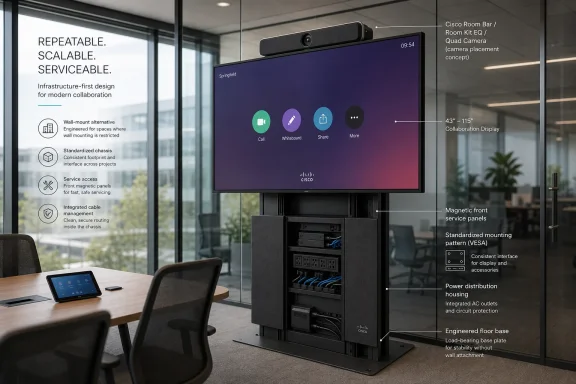
Ashton Bentley launched its ABMX Display Mount range on June 29, 2026, positioning the system as a Cisco MX Series replacement path for organizations moving older video rooms to Cisco Room Bar, Room Bar Pro, Room Kit EQ, and Quad Camera deployments. The announcement is not just another AV furniture release. It is a sign that the meeting-room upgrade cycle has moved from codecs and cameras to something more stubborn: the room itself. For IT teams, the question is no longer simply which collaboration platform wins, but how much physical infrastructure must be rebuilt every time the software stack changes.
The Cisco MX Series belonged to an earlier era of enterprise video conferencing, when a room system was treated as a relatively self-contained appliance. A display, camera, codec, speakers, cabling, and control interface were bought as a package and expected to remain in place for years. That model suited organizations that standardized on a single conferencing environment and viewed the meeting room as a managed endpoint rather than a flexible computing space.
That world has mostly gone. Hybrid work did not merely increase the number of video calls; it changed the politics of the conference room. One meeting may be a Webex call with a major customer, the next a Microsoft Teams stand-up, the next a Zoom session with a vendor, and the next a Google Meet link dropped into a calendar invite by someone outside the organization.
This is why Ashton Bentley’s ABMX range matters beyond the narrow AV channel. It acknowledges that many organizations are not starting from a blank room. They are sitting on estates of older Cisco MX deployments that were expensive, physically integrated, and often installed in rooms whose architectural constraints are harder to change than the endpoint hardware.
The easy headline is that ABMX gives customers a Cisco-friendly replacement chassis. The more interesting story is that it tries to turn the meeting room into an upgradeable platform rather than another custom build.
That specification list sounds mundane until you remember how many “simple” conference room upgrades become minor construction projects. Legacy rooms often hide power, data, cabling, mounting plates, and AV accessories behind cabinetry or inside walls. Replacing the video endpoint can mean disturbing the entire installation, coordinating facilities teams, and rediscovering all the compromises made by the previous integrator.
Ashton Bentley’s pitch is that ABMX reduces that friction. The systems are described as tool-less and capable of being assembled in hours, with the structural load carried by the floor rather than the wall. That last point is critical for offices with glass walls, listed buildings, partition systems, or spaces where landlords and facilities teams are reluctant to approve new load-bearing wall work.
For IT departments, this changes the project calculus. A room refresh that once required surveys, bespoke metalwork, and construction scheduling can begin to look more like a standardized endpoint deployment. That does not make it trivial, but it makes it repeatable.
That is a very IT way of thinking about an AV problem. In the server room, standard racks made hardware refreshes predictable. In the office, monitor arms and docking stations did something similar for desks. ABMX is trying to apply that logic to meeting rooms: build a chassis that can carry displays, collaboration hardware, cable routing, and service access in a way that does not depend on each wall being perfect.
This matters because the modern office is less predictable than the old corporate campus. Many companies occupy leased spaces, co-working floors, refurbished buildings, and glass-heavy meeting suites where traditional wall-mounted AV systems are awkward or forbidden. A floor-to-wall, freestanding, or mobile configuration gives IT and facilities teams more room to maneuver.
It also reduces one of the quiet enemies of standardization: local exception handling. The first ten rooms follow the design guide. The eleventh has a glass wall. The twelfth cannot be drilled. The thirteenth has the wrong power location. Before long, the “standard” has become a family of exceptions, each with different support implications.
A chassis-based approach does not eliminate that mess, but it gives organizations a better chance of containing it.
The problem is that the software story has often moved faster than the room estate. A Room Bar may be compact and modern, but many installed spaces were built around older integrated systems. Replacing the endpoint without rethinking the mount, cabling, display layout, and service model can produce an awkward half-upgrade: modern software perched inside legacy physical assumptions.
ABMX is therefore a companion to Cisco’s platform strategy. If Cisco wants customers to move from MX-era systems to RoomOS-era devices at scale, the migration must be operationally boring. The best endpoint in the world becomes a hard sell if every room requires bespoke design work and a week of disruption.
That is especially true for large organizations with hundreds or thousands of rooms. A pilot room can absorb heroic effort. A global refresh cannot. The business case depends on consistency, predictable labor, predictable parts, and a support model that does not require the original installer to remember what was hidden behind the left-hand panel.
Ashton Bentley is not replacing Cisco’s collaboration stack. It is packaging the physical layer Cisco needs if its newer devices are to displace older room systems in quantity.
For many IT teams, Teams is the collaboration default because it is bundled into the daily workflow of Microsoft 365. But Teams dominance has not erased Cisco, Zoom, or Google Meet from enterprise calendars. It has instead forced meeting-room hardware to support a messy coexistence model.
Cisco’s answer has been to make RoomOS devices more flexible, including support for Microsoft Teams Rooms on Android on selected hardware and join experiences for third-party meetings. That gives enterprises a way to buy premium Cisco hardware without committing every room interaction to Webex alone. It also gives Cisco a path into organizations where Microsoft controls the productivity layer.
But flexibility comes with management complexity. A Cisco device in Teams Rooms mode may be touched by Cisco Control Hub, Teams Admin Center, device firmware policy, room resource accounts, calendar integration, and security settings. The mount does not solve that, but it can remove a source of variability from the deployment.
In a multi-platform room, the physical install should be the boring part. ABMX is useful precisely because the software and identity stack already provide enough excitement.
The pressure now is toward productized deployment. Organizations want repeatable room types, predefined bills of materials, remote management, faster installation, and easier maintenance. They want fewer surprises from the physical environment and fewer custom decisions that become support liabilities.
Ashton Bentley’s ABMX range fits that trend neatly. Magnetic front panels for service access sound like a small detail, but they matter when a support technician needs to reach cabling or power without disassembling furniture. Region-specific power distribution matters when a global company wants the same room design to work across offices. Integrated brackets matter when device placement affects camera angles, microphone performance, and the perceived quality of every meeting.
This is the industrialization of the meeting room. Not every space needs it, and some premium rooms will still justify bespoke work. But for the broad middle of corporate real estate, standardized physical systems are becoming as important as standardized endpoint images.
That may unsettle parts of the AV industry. The more repeatable these systems become, the less value sits in one-off installation labor and the more value moves into design standards, lifecycle planning, remote support, and cross-platform expertise.
Meeting rooms are now production infrastructure. A failed room can derail sales calls, executive reviews, hiring panels, customer briefings, and incident-response meetings. In a hybrid organization, the room is often the bridge between headquarters and everyone else; when it fails, remote participants become second-class attendees immediately.
Legacy MX rooms may still function, but their opportunity cost grows as user expectations rise. People now expect automatic framing, cleaner audio, wireless or USB-C content sharing, calendar-driven join buttons, and the ability to join meetings hosted outside their own organization. An older room that technically still works may feel broken because it no longer fits the workflow.
That is why a structured replacement path is valuable. It gives IT a way to make the upgrade argument in operational terms rather than aesthetic ones. The pitch is not “new screens and nicer furniture.” It is less downtime, fewer custom installs, easier servicing, and a room experience aligned with how meetings actually happen in 2026.
This is the uncomfortable truth of meeting-room interoperability. Vendors have improved dramatically, but the experience still varies depending on whether a device is running a native room mode, joining as a guest, using calendar parsing, using a web-based join flow, or cross-launching into another service’s experience. Users do not care about those distinctions; administrators have to.
The promise of ABMX is that the physical platform can survive those software differences. A room built today around a Cisco Room Bar Pro and dual displays should not need to be reconstructed if the organization changes its meeting-default policy next year. The chassis can remain stable while endpoint configuration, platform registration, and management policy evolve.
That is the strongest interpretation of “future-proofing” in this context. No vendor can future-proof the collaboration market itself. But a well-designed physical system can reduce the penalty for changing direction.
This is particularly important for organizations that have grown through mergers, acquisitions, or departmental autonomy. One division may be standardized on Teams, another on Webex, another on Zoom-heavy customer workflows. The room estate needs to support reality, not the neat platform diagram in a procurement deck.
Cisco MX replacements are not all the same. Some organizations used MX systems in small rooms where a modern video bar is a straightforward successor. Others used them in more prominent spaces where display size, camera coverage, microphone pickup, and room aesthetics carry more weight. A credible replacement platform has to scale across that variety without becoming a custom project every time.
The Cisco Room Bar, Room Bar Pro, Room Kit EQ, and Quad Camera compatibility reflects that range. Room Bar-class systems suit smaller and mid-sized spaces; Room Kit EQ and Quad Camera deployments point toward larger or more demanding rooms. A mount platform that can handle those options gives IT teams a family of designs rather than a single-room recipe.
That is valuable because most enterprises do not need infinite room types. They need a handful of repeatable patterns that cover most use cases and a disciplined exception process for the rest. ABMX looks like a product designed for that model.
Cisco hardware in a Microsoft Teams Rooms deployment complicates the old mental model. The device may be Cisco-built and Cisco-managed in important respects, while the user-facing room experience is Teams. That split can be powerful, but it requires clear ownership. Someone must know which console controls what, which update channel applies, how accounts are secured, and how support tickets are routed when the room behaves badly.
The ABMX chassis does not decide those policies. But by making the physical installation more standardized, it can make the management problem easier to isolate. If every room has different cabling, power access, display mounting, and device placement, troubleshooting becomes detective work. If the physical layer is consistent, administrators can focus faster on firmware, configuration, network, calendar, and service-side issues.
This is where the interests of AV teams and IT teams increasingly converge. AV wants reliable rooms that look good and work consistently. IT wants managed endpoints with predictable lifecycle behavior. Facilities wants minimal construction disruption. Security wants fewer unmanaged boxes and fewer unknown cables. ABMX is positioned at that intersection.
The right way to evaluate ABMX is not only as a mount. It should be tested as part of a room standard. That means measuring installation time, service access, camera framing, display ergonomics, acoustic performance, cable strain, power access, network placement, and user behavior across real meetings.
Organizations should also test the administrative workflow. If the room runs Microsoft Teams Rooms on Cisco hardware, the pilot should include firmware updates, Teams policy changes, calendar configuration, third-party meeting joins, device recovery, and support escalation. The pretty part of the room is only half the story.
There is also a procurement lesson here. A structured chassis may reduce installation complexity, but it does not remove the need for governance. Standard room designs should specify not only the hardware, but the supported modes, update responsibilities, and lifecycle assumptions. Otherwise, the organization risks buying standard-looking rooms that behave differently under the hood.
That is why replacement systems matter. They are the bridge between product strategy and operational reality. Without them, “modernize the meeting estate” becomes a slogan that collides with glass partitions, missing conduit, landlord rules, and rooms that cannot be offline for a week.
Ashton Bentley’s collaboration with Cisco is therefore strategically sensible. Cisco gets a cleaner migration story for customers moving away from MX-era deployments. Ashton Bentley gets to sit in the path of a major refresh cycle. Customers get a way to make room modernization less bespoke.
The risk is that the word “replacement” may make the project sound simpler than it is. Replacing an MX system with a RoomOS-era deployment is not just a hardware swap. It is a chance to revisit room standards, platform policy, user training, management ownership, and support expectations. Organizations that treat it as a furniture exercise will miss the point.
ABMX appears to understand that. By supporting multiple Cisco room devices, multiple display sizes, and multiple physical configurations, it tries to make the chassis the stable layer beneath a changing collaboration stack. That is a practical form of future-proofing, not the magical kind promised in too many vendor decks.
For sysadmins, the lesson is familiar. Standardize the parts that should not change often. Keep the changeable parts accessible. Document the management boundaries. Avoid custom work that only one installer understands. Make the next refresh easier than the last one.
That thinking has governed good endpoint management for years. Meeting rooms are finally catching up.
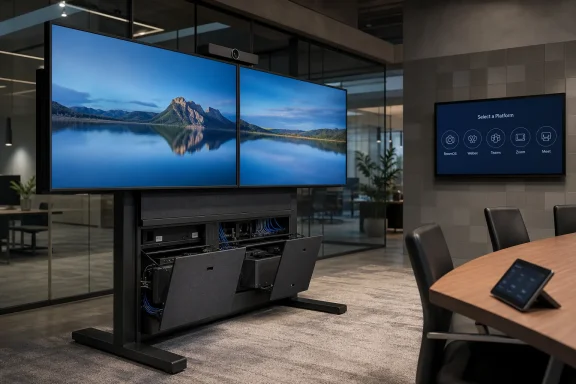 The Real Cisco MX Replacement Problem Was Never Only the Codec
The Cisco MX Series belonged to an earlier era of enterprise video conferencing, when a room system was treated as a relatively self-contained appliance. A display, camera, codec, speakers, cabling, and control interface were bought as a package and expected to remain in place for years. That model suited organizations that standardized on a single conferencing environment and viewed the meeting room as a managed endpoint rather than a flexible computing space.That world has mostly gone. Hybrid work did not merely increase the number of video calls; it changed the politics of the conference room. One meeting may be a Webex call with a major customer, the next a Microsoft Teams stand-up, the next a Zoom session with a vendor, and the next a Google Meet link dropped into a calendar invite by someone outside the organization.
This is why Ashton Bentley’s ABMX range matters beyond the narrow AV channel. It acknowledges that many organizations are not starting from a blank room. They are sitting on estates of older Cisco MX deployments that were expensive, physically integrated, and often installed in rooms whose architectural constraints are harder to change than the endpoint hardware.
The easy headline is that ABMX gives customers a Cisco-friendly replacement chassis. The more interesting story is that it tries to turn the meeting room into an upgradeable platform rather than another custom build.
Ashton Bentley Is Selling the Upgrade Path, Not Just the Mount
The ABMX Display Mount range is based on Ashton Bentley’s Cisco Certified Display Mount Chassis platform. It supports single and dual display configurations and display sizes from 43 inches to 115 inches. It is designed for Cisco Room Bar, Room Bar Pro, Room Kit EQ, and Quad Camera deployments, with integrated brackets, cable management, regional power distribution, and magnetic front panels for service access.That specification list sounds mundane until you remember how many “simple” conference room upgrades become minor construction projects. Legacy rooms often hide power, data, cabling, mounting plates, and AV accessories behind cabinetry or inside walls. Replacing the video endpoint can mean disturbing the entire installation, coordinating facilities teams, and rediscovering all the compromises made by the previous integrator.
Ashton Bentley’s pitch is that ABMX reduces that friction. The systems are described as tool-less and capable of being assembled in hours, with the structural load carried by the floor rather than the wall. That last point is critical for offices with glass walls, listed buildings, partition systems, or spaces where landlords and facilities teams are reluctant to approve new load-bearing wall work.
For IT departments, this changes the project calculus. A room refresh that once required surveys, bespoke metalwork, and construction scheduling can begin to look more like a standardized endpoint deployment. That does not make it trivial, but it makes it repeatable.
The Floor Becomes Part of the IT Architecture
The most revealing part of the ABMX design is not the compatibility list. It is the structural assumption. By shifting the load to the floor, Ashton Bentley is treating the physical room as a constraint to be abstracted away.That is a very IT way of thinking about an AV problem. In the server room, standard racks made hardware refreshes predictable. In the office, monitor arms and docking stations did something similar for desks. ABMX is trying to apply that logic to meeting rooms: build a chassis that can carry displays, collaboration hardware, cable routing, and service access in a way that does not depend on each wall being perfect.
This matters because the modern office is less predictable than the old corporate campus. Many companies occupy leased spaces, co-working floors, refurbished buildings, and glass-heavy meeting suites where traditional wall-mounted AV systems are awkward or forbidden. A floor-to-wall, freestanding, or mobile configuration gives IT and facilities teams more room to maneuver.
It also reduces one of the quiet enemies of standardization: local exception handling. The first ten rooms follow the design guide. The eleventh has a glass wall. The twelfth cannot be drilled. The thirteenth has the wrong power location. Before long, the “standard” has become a family of exceptions, each with different support implications.
A chassis-based approach does not eliminate that mess, but it gives organizations a better chance of containing it.
Cisco’s Room Bar Strategy Needs the Room to Catch Up
Cisco’s newer Room devices are designed for a collaboration market that no longer tolerates single-platform rigidity. Room Bar and related devices support native Cisco experiences while also accommodating Microsoft Teams Rooms and interoperability with Zoom and Google Meet in various configurations. That is now table stakes in enterprise collaboration hardware.The problem is that the software story has often moved faster than the room estate. A Room Bar may be compact and modern, but many installed spaces were built around older integrated systems. Replacing the endpoint without rethinking the mount, cabling, display layout, and service model can produce an awkward half-upgrade: modern software perched inside legacy physical assumptions.
ABMX is therefore a companion to Cisco’s platform strategy. If Cisco wants customers to move from MX-era systems to RoomOS-era devices at scale, the migration must be operationally boring. The best endpoint in the world becomes a hard sell if every room requires bespoke design work and a week of disruption.
That is especially true for large organizations with hundreds or thousands of rooms. A pilot room can absorb heroic effort. A global refresh cannot. The business case depends on consistency, predictable labor, predictable parts, and a support model that does not require the original installer to remember what was hidden behind the left-hand panel.
Ashton Bentley is not replacing Cisco’s collaboration stack. It is packaging the physical layer Cisco needs if its newer devices are to displace older room systems in quantity.
Microsoft Teams Rooms Changes the Meaning of a Cisco Room
The ABMX announcement also points to a larger shift: Cisco hardware is increasingly expected to live comfortably in Microsoft Teams environments. Ashton Bentley says its Display Mount platform is approved for Cisco deployments with Microsoft Teams Rooms under Microsoft Express Install solution guidelines. That is more than a certification footnote.For many IT teams, Teams is the collaboration default because it is bundled into the daily workflow of Microsoft 365. But Teams dominance has not erased Cisco, Zoom, or Google Meet from enterprise calendars. It has instead forced meeting-room hardware to support a messy coexistence model.
Cisco’s answer has been to make RoomOS devices more flexible, including support for Microsoft Teams Rooms on Android on selected hardware and join experiences for third-party meetings. That gives enterprises a way to buy premium Cisco hardware without committing every room interaction to Webex alone. It also gives Cisco a path into organizations where Microsoft controls the productivity layer.
But flexibility comes with management complexity. A Cisco device in Teams Rooms mode may be touched by Cisco Control Hub, Teams Admin Center, device firmware policy, room resource accounts, calendar integration, and security settings. The mount does not solve that, but it can remove a source of variability from the deployment.
In a multi-platform room, the physical install should be the boring part. ABMX is useful precisely because the software and identity stack already provide enough excitement.
The AV Integrator’s Craft Is Being Productized
Traditional AV integration has long depended on skilled design, careful site work, and a fair amount of local improvisation. That craft still matters, especially in complex boardrooms, auditoriums, divisible spaces, and rooms with serious acoustic demands. But the commodity meeting room is moving in a different direction.The pressure now is toward productized deployment. Organizations want repeatable room types, predefined bills of materials, remote management, faster installation, and easier maintenance. They want fewer surprises from the physical environment and fewer custom decisions that become support liabilities.
Ashton Bentley’s ABMX range fits that trend neatly. Magnetic front panels for service access sound like a small detail, but they matter when a support technician needs to reach cabling or power without disassembling furniture. Region-specific power distribution matters when a global company wants the same room design to work across offices. Integrated brackets matter when device placement affects camera angles, microphone performance, and the perceived quality of every meeting.
This is the industrialization of the meeting room. Not every space needs it, and some premium rooms will still justify bespoke work. But for the broad middle of corporate real estate, standardized physical systems are becoming as important as standardized endpoint images.
That may unsettle parts of the AV industry. The more repeatable these systems become, the less value sits in one-off installation labor and the more value moves into design standards, lifecycle planning, remote support, and cross-platform expertise.
The Hidden Cost of Legacy Rooms Is Downtime
The most expensive part of a room refresh is not always the hardware. It is the time the room is unusable, the coordination required to schedule work, and the support burden when the result is inconsistent. This is where Ashton Bentley’s “assembled in hours” claim is aimed.Meeting rooms are now production infrastructure. A failed room can derail sales calls, executive reviews, hiring panels, customer briefings, and incident-response meetings. In a hybrid organization, the room is often the bridge between headquarters and everyone else; when it fails, remote participants become second-class attendees immediately.
Legacy MX rooms may still function, but their opportunity cost grows as user expectations rise. People now expect automatic framing, cleaner audio, wireless or USB-C content sharing, calendar-driven join buttons, and the ability to join meetings hosted outside their own organization. An older room that technically still works may feel broken because it no longer fits the workflow.
That is why a structured replacement path is valuable. It gives IT a way to make the upgrade argument in operational terms rather than aesthetic ones. The pitch is not “new screens and nicer furniture.” It is less downtime, fewer custom installs, easier servicing, and a room experience aligned with how meetings actually happen in 2026.
Multi-Platform Support Is a Feature and a Warning
The announcement frames newer Cisco Room devices on RoomOS 27 as supporting Webex, Microsoft Teams, Zoom, and Google Meet environments. That is the right direction, but IT teams should read it carefully. Support for multiple platforms does not mean every platform behaves identically, exposes the same features, or follows the same management model.This is the uncomfortable truth of meeting-room interoperability. Vendors have improved dramatically, but the experience still varies depending on whether a device is running a native room mode, joining as a guest, using calendar parsing, using a web-based join flow, or cross-launching into another service’s experience. Users do not care about those distinctions; administrators have to.
The promise of ABMX is that the physical platform can survive those software differences. A room built today around a Cisco Room Bar Pro and dual displays should not need to be reconstructed if the organization changes its meeting-default policy next year. The chassis can remain stable while endpoint configuration, platform registration, and management policy evolve.
That is the strongest interpretation of “future-proofing” in this context. No vendor can future-proof the collaboration market itself. But a well-designed physical system can reduce the penalty for changing direction.
This is particularly important for organizations that have grown through mergers, acquisitions, or departmental autonomy. One division may be standardized on Teams, another on Webex, another on Zoom-heavy customer workflows. The room estate needs to support reality, not the neat platform diagram in a procurement deck.
The Display Size Range Signals a Broader Ambition
Support for displays from 43 inches to 115 inches suggests Ashton Bentley is not targeting only small huddle rooms. The range spans focus spaces, standard meeting rooms, and larger collaboration rooms where dual displays and more capable camera systems become important. That breadth matters because standardization usually fails when it applies only to the easiest rooms.Cisco MX replacements are not all the same. Some organizations used MX systems in small rooms where a modern video bar is a straightforward successor. Others used them in more prominent spaces where display size, camera coverage, microphone pickup, and room aesthetics carry more weight. A credible replacement platform has to scale across that variety without becoming a custom project every time.
The Cisco Room Bar, Room Bar Pro, Room Kit EQ, and Quad Camera compatibility reflects that range. Room Bar-class systems suit smaller and mid-sized spaces; Room Kit EQ and Quad Camera deployments point toward larger or more demanding rooms. A mount platform that can handle those options gives IT teams a family of designs rather than a single-room recipe.
That is valuable because most enterprises do not need infinite room types. They need a handful of repeatable patterns that cover most use cases and a disciplined exception process for the rest. ABMX looks like a product designed for that model.
WindowsForum Readers Should Watch the Management Plane
This story may sound like AV news, but it belongs on the radar of Windows and Microsoft 365 administrators. Microsoft Teams Rooms has pulled meeting spaces into the same operational orbit as identity, endpoint management, compliance, and service health. The room is no longer a mysterious AV appliance maintained by someone else; it is part of the collaboration estate.Cisco hardware in a Microsoft Teams Rooms deployment complicates the old mental model. The device may be Cisco-built and Cisco-managed in important respects, while the user-facing room experience is Teams. That split can be powerful, but it requires clear ownership. Someone must know which console controls what, which update channel applies, how accounts are secured, and how support tickets are routed when the room behaves badly.
The ABMX chassis does not decide those policies. But by making the physical installation more standardized, it can make the management problem easier to isolate. If every room has different cabling, power access, display mounting, and device placement, troubleshooting becomes detective work. If the physical layer is consistent, administrators can focus faster on firmware, configuration, network, calendar, and service-side issues.
This is where the interests of AV teams and IT teams increasingly converge. AV wants reliable rooms that look good and work consistently. IT wants managed endpoints with predictable lifecycle behavior. Facilities wants minimal construction disruption. Security wants fewer unmanaged boxes and fewer unknown cables. ABMX is positioned at that intersection.
Certification Is Not a Substitute for Testing
Cisco certification and Microsoft approval language will reassure buyers, but they should not replace pilot testing. Meeting rooms are full of edge cases. Camera placement may look correct on paper and still disappoint in a room with unusual seating. Cable access may be easy in a lab and awkward next to a real wall. A cross-platform join flow may be acceptable for trained users and confusing for guests.The right way to evaluate ABMX is not only as a mount. It should be tested as part of a room standard. That means measuring installation time, service access, camera framing, display ergonomics, acoustic performance, cable strain, power access, network placement, and user behavior across real meetings.
Organizations should also test the administrative workflow. If the room runs Microsoft Teams Rooms on Cisco hardware, the pilot should include firmware updates, Teams policy changes, calendar configuration, third-party meeting joins, device recovery, and support escalation. The pretty part of the room is only half the story.
There is also a procurement lesson here. A structured chassis may reduce installation complexity, but it does not remove the need for governance. Standard room designs should specify not only the hardware, but the supported modes, update responsibilities, and lifecycle assumptions. Otherwise, the organization risks buying standard-looking rooms that behave differently under the hood.
The Most Important Part of ABMX Is the Admission It Makes
The ABMX launch admits something the collaboration industry has spent years dancing around: the installed base is the product battlefield. Vendors can announce brilliant new room devices, but enterprises still have old rooms, old walls, old budgets, old procurement cycles, and old assumptions embedded in physical space.That is why replacement systems matter. They are the bridge between product strategy and operational reality. Without them, “modernize the meeting estate” becomes a slogan that collides with glass partitions, missing conduit, landlord rules, and rooms that cannot be offline for a week.
Ashton Bentley’s collaboration with Cisco is therefore strategically sensible. Cisco gets a cleaner migration story for customers moving away from MX-era deployments. Ashton Bentley gets to sit in the path of a major refresh cycle. Customers get a way to make room modernization less bespoke.
The risk is that the word “replacement” may make the project sound simpler than it is. Replacing an MX system with a RoomOS-era deployment is not just a hardware swap. It is a chance to revisit room standards, platform policy, user training, management ownership, and support expectations. Organizations that treat it as a furniture exercise will miss the point.
The Chassis Becomes the Constant in a Volatile Collaboration Market
The collaboration market remains unsettled. Microsoft, Cisco, Zoom, and Google are not going away, and most enterprises will continue to live with more than one of them. The winning room design is therefore not the one that bets perfectly on a single platform. It is the one that limits the cost of being wrong.ABMX appears to understand that. By supporting multiple Cisco room devices, multiple display sizes, and multiple physical configurations, it tries to make the chassis the stable layer beneath a changing collaboration stack. That is a practical form of future-proofing, not the magical kind promised in too many vendor decks.
For sysadmins, the lesson is familiar. Standardize the parts that should not change often. Keep the changeable parts accessible. Document the management boundaries. Avoid custom work that only one installer understands. Make the next refresh easier than the last one.
That thinking has governed good endpoint management for years. Meeting rooms are finally catching up.
The Cisco MX Refresh Just Became a Facilities, IT, and Platform Decision
The ABMX launch is concrete enough to matter now, but its implications are broader than the product sheet. It marks another step in the convergence of AV infrastructure and enterprise IT operations. The organizations that benefit most will be the ones that treat the room as a managed system, not a decorative endpoint.- The ABMX Display Mount range gives Cisco MX Series customers a more structured path toward Room Bar, Room Bar Pro, Room Kit EQ, and Quad Camera deployments.
- The floor-supported architecture could reduce installation barriers in glass-walled offices, listed buildings, leased spaces, and rooms where wall loading is restricted.
- The range’s single and dual display support, from 43 inches to 115 inches, makes it relevant to more than small huddle-room refreshes.
- Cisco’s multi-platform RoomOS direction makes the physical room platform more important, because collaboration software policy will keep changing.
- Microsoft Teams Rooms support on Cisco hardware increases the need for clear operational ownership across Cisco, Microsoft, AV, network, and facilities teams.
- Certification and approval language should start the evaluation, but real pilots should test service access, update behavior, third-party meeting joins, and user experience under normal working conditions.
References
- Primary source: Inavate
Published: 2026-06-29T09:42:08.380620
Ashton Bentley launches Cisco MX replacement system
Ashton Bentley has launched its ABMX Display Mount range, strengthening its collaboration with Cisco and expanding its portfolio of meeting room systems optimiswww.inavateonthenet.net - Official source: microsoft.com
Microsoft Teams enabled devices
www.microsoft.com
- Related coverage: roomos.cisco.com
RoomOS for Collab Devices
 roomos.cisco.com
- Related coverage: installation-international.com
Ashton Bentley launches mount range for Cisco MX upgrades - Installation
ABMX Display Mount range offers a tool-less upgrade path from legacy Cisco MX Series systems to Cisco Room Bar and Room Kit deployments, supporting displays from 43in to 115inwww.installation-international.com - Related coverage: cisco.com
Cisco Room Bar Data Sheet - Cisco
Cisco Room Bar, a compact video collaboration device, provides stunning video conferencing, boundless flexibility, and inclusive meeting experiences to focus rooms, huddle spaces, and small-to-medium meeting rooms, powering the best of video meetings.www.cisco.com - Related coverage: community.cisco.com