

Microsoft and Q-SYS used InfoComm 2026 in Las Vegas to argue that AI-ready meeting rooms now require connected AV infrastructure, reliable device telemetry, and richer environmental context for Microsoft Teams Rooms, Copilot, and Facilitator workflows. The pitch sounds like a partnership update, but the real story is more consequential: the conference room is being recast as a data-producing endpoint. In Microsoft’s version of the future, the room is no longer just where a meeting happens. It is one of the systems the AI must understand before it can be trusted to act.
For years, enterprise collaboration vendors treated the meeting room as a stubborn analog edge case. The strategic center of gravity was the cloud service, the calendar invite, the identity system, and the laptop. The room itself was something IT tried to standardize, monitor, and rescue when an executive found the camera pointing at the ceiling.
That model is running out of road. Microsoft Copilot and Facilitator in Teams Rooms are not merely adding better note-taking to the old meeting experience. They are moving collaboration software toward situational awareness, where an AI assistant is expected to know who is present, what was decided, what needs follow-up, and whether the room itself is fit to support the conversation.
That shift makes AV infrastructure matter in a way it did not when the meeting room was just a peripheral attached to Teams. A bad microphone is no longer only a user-experience problem. It becomes a data-quality problem. A camera that frames the wrong people is not only awkward. It can distort the AI’s understanding of who contributed what.
This is why the UC Today interview with Microsoft’s Sohail Tariq and Q-SYS’ Nathan Glotfelty lands as more than InfoComm booth chatter. Their argument is that enterprises cannot treat agentic AI as a software-only rollout. If AI is going to summarize, assign, infer, alert, and eventually coordinate workflows on behalf of people, the physical room must feed it trustworthy signals.
Facilitator in Microsoft Teams Rooms makes the challenge visible. Microsoft describes it as an AI-powered agent for scheduled and ad hoc meetings, capable of generating notes, summaries, and action items. In the room scenario, participants can start it from a Teams Room device, and the agent becomes a meeting assistant for an in-person discussion that might never have existed as a traditional Teams call.
That sounds simple until you consider what the AI has to know. It needs a clean transcript. It needs enough speaker attribution to avoid collapsing a room full of employees into a single anonymous blob. It needs to understand whether the meeting was actually captured correctly, whether audio was usable, and whether the devices that produced the input were operating as expected.
Microsoft’s own documentation has acknowledged limits in this area, including cases where in-room speakers may be identified generically rather than by name unless the right recognition, enrollment, hardware, and policy conditions are in place. That is not a minor footnote. It is the difference between “Pat agreed to deliver the security review by Friday” and “Speaker 2 said something about Friday.”
For executives, that distinction may sound like polish. For IT and compliance teams, it is the difference between a usable record and a liability.
That matters because enterprise meeting estates rarely look like vendor marketing photos. A typical large organization has huddle rooms, divisible training rooms, boardrooms, experience centers, classrooms, executive spaces, specialty rooms, and aging installs that have accumulated hardware across multiple purchasing cycles. Standardizing all of that into a single collaboration experience is hard enough before AI enters the room.
Nathan Glotfelty’s description of Q-SYS helping Microsoft consolidate multiple subsystems onto a flat Q-SYS network is therefore central to the argument. The promise is not just fewer boxes or cleaner wiring. It is a consistent data and control plane across many kinds of spaces.
That is what makes Q-SYS strategically useful to Microsoft. Teams Rooms can be the user-facing collaboration environment, but the room’s underlying AV behavior still depends on a large ecosystem of hardware, sensors, firmware, and local control logic. If those systems remain fragmented, the AI layer receives fragments. If they are integrated, the AI has a better chance of knowing what is happening.
The recent Q-SYS RoomSuite Collaboration Bar for Microsoft Teams Rooms fits this same direction. Collaboration bars are often framed as convenience products for simpler rooms, but Q-SYS is presenting this one as part of a broader full-stack portfolio. In other words, the same vendor wants to cover both repeatable rooms and high-impact spaces, reducing the gap between commodity deployment and custom AV engineering.
That makes them a revealing test case. Microsoft has every incentive to make those rooms embody the future it wants customers to buy: Teams Rooms, Copilot, room intelligence, high-end AV, and operational visibility. If the experience centers need deep telemetry and integrated AV control to make that future credible, then ordinary enterprises should assume they will need some version of the same discipline.
The point is not that every company needs a Redmond-grade executive briefing center. Most do not. The point is that Microsoft’s own showcase spaces underline the gap between AI demos and operational reality.
A Copilot-branded meeting assistant can look impressive in a controlled demo. At scale, the problems become mundane and brutal: Was the microphone muted? Did the DSP route correctly? Is the camera online? Did the room PC update overnight? Is the network path healthy? Did a firmware change break the touch panel? Did the system capture the people actually speaking?
AI does not make those questions disappear. It makes them more important, because every failure contaminates the layer above it.
Meeting rooms are where that promise becomes uncomfortable. If an agent merely summarizes a transcript, bad room data produces a bad summary. If an agent begins assigning tasks, preparing follow-ups, escalating issues, or coordinating room behavior based on meeting context, bad room data can trigger the wrong downstream action.
That is why the “room readiness” framing matters. A room that is ready for a human meeting is not necessarily ready for an AI-mediated meeting. Humans can compensate for weak signals. They can say, “Who just said that?” or “Let’s repeat that for the people online.” AI systems tend to convert ambiguity into confident prose unless they are designed to surface uncertainty.
The enterprise risk is not science fiction. It is bureaucratic. A misattributed action item becomes a missed deadline. A garbled decision becomes an inaccurate recap. A transcript gap becomes a compliance dispute. A room that silently degrades creates a chain of errors that looks, to the user, like an AI failure but begins as an infrastructure failure.
This is the meeting room reckoning Microsoft and Q-SYS are pointing toward. The industry cannot promise AI-enhanced collaboration while continuing to tolerate rooms that work only when a patient employee knows which cable to reseat.
AI reverses that drift. Once meeting output becomes part of the organization’s knowledge fabric, room performance becomes an IT governance issue. The question is no longer only whether people can hear and see each other. It is whether the organization can trust the data produced by the meeting.
That creates new pressure on administrators. Teams Rooms Pro licensing, device management, voice and face recognition policy, transcription settings, Copilot availability, room account configuration, privacy controls, hardware certification, and AV telemetry all become part of the same deployment conversation. A room is not “AI-ready” because it has a camera and a Teams panel. It is AI-ready only if the identity, policy, hardware, and operational layers line up.
This is where many organizations will discover the uncomfortable difference between a pilot and a fleet. A handful of executive rooms can be tuned carefully. Hundreds or thousands of meeting spaces require repeatable designs, remote monitoring, lifecycle management, and a way to diagnose problems before users turn them into folklore.
The pitch from Q-SYS is that a software-defined AV platform can help make that fleet manageable. The pitch from Microsoft is that Teams Rooms can become the collaboration endpoint where AI becomes practical in shared physical spaces. Both pitches are plausible. Neither eliminates the work.
That simplicity is the standard by which this whole strategy will be judged. If Facilitator in Teams Rooms requires too much ritual, too many permissions, or too much troubleshooting, users will route around it. If Copilot-generated notes are inconsistent because speaker attribution fails or room audio is poor, employees will stop trusting them. If IT cannot explain what is recorded, stored, retained, or attributed, security teams will slow adoption.
Microsoft knows this. The company’s collaboration business has long depended on hiding complexity behind familiar workflows. Teams Rooms succeeded where older conferencing systems struggled because the user interaction mapped to something people already understood: join the meeting on the calendar.
AI meetings need the same kind of obviousness. The room should know enough to help without turning the start of every discussion into an administrative ceremony. That is precisely why the infrastructure matters. The more the room can reliably report its own state, the less the user has to think about it.
But there is a fine line between helpful intelligence and a room that feels over-instrumented. Organizations deploying AI-enabled meeting spaces will have to communicate clearly about transcription, identity, retention, and consent. The best room in the world will fail politically if employees conclude that “AI-ready” means “always watching.”
AI gives the room a new claim on relevance. If the best meeting output comes from spaces with high-quality capture, accurate identity, and integrated workflow automation, then enterprise rooms become productivity infrastructure rather than real-estate leftovers. That is an attractive argument for Microsoft, Q-SYS, AV integrators, and corporate workplace teams.
It is also an argument with budget consequences. AI-ready rooms are not free. Better microphones, cameras, control systems, room compute, licensing, network design, support contracts, and management tooling all cost money. The return on that investment will be uneven unless organizations are honest about which rooms matter most.
Not every four-person huddle room needs the same treatment as a boardroom. Not every brainstorming corner needs full AI capture. But the old binary distinction between “video room” and “non-video room” is becoming obsolete. The new distinction is between rooms that produce trustworthy collaboration data and rooms that do not.
That is the market Q-SYS wants to serve and the platform Microsoft wants to absorb into Teams.
That is a mature way to think about enterprise AV. Device-by-device decisions create inconsistency, and inconsistency is poison for AI-enabled workflows. If one room attributes speakers, another does not, a third has poor audio, and a fourth cannot report device health, the organization ends up with an uneven knowledge layer.
Enterprise IT has seen this pattern before. Endpoint management became essential when PCs moved from isolated productivity tools to networked, policy-governed assets. Mobile device management became essential when phones became corporate data endpoints. Meeting room management is now heading in the same direction because rooms are becoming AI data endpoints.
That does not mean every AV component becomes an IT-managed commodity. Specialized spaces will still need expert design. Acoustics still matter. Human factors still matter. But the direction is clear: collaboration rooms are being pulled into the same governance logic as the rest of the digital workplace.
The vendors that can bridge AV reality and IT manageability will have the advantage. Microsoft brings the collaboration cloud, identity layer, and Copilot strategy. Q-SYS brings the room-side platform and AV control model. The partnership makes sense because neither side can solve the whole problem alone.
Microsoft’s enterprise posture is built around tenant controls, compliance commitments, and administrative policy. That helps, but it does not remove the need for local decisions. Companies still need to decide which meetings should be transcribed, who can invoke AI notes, how long records should be retained, how external participants are handled, and whether voice or face recognition is appropriate in their jurisdiction and culture.
The risk is that AI meeting features spread through enthusiasm before governance catches up. A department head sees useful summaries. A project team starts relying on automatic action items. A facilities team likes room analytics. Then legal, HR, security, and employee representatives arrive late to discover that the organization has created a new class of workplace record.
That is not an argument against AI meeting rooms. It is an argument for treating them as infrastructure with policy consequences. The more useful these systems become, the more important it is to define their boundaries.
The irony is that strong governance may increase adoption. Employees are more likely to trust AI-enabled rooms if they understand when the system is active, what it captures, how the data is used, and who can access it. Trust is not a soft issue here. It is a deployment prerequisite.
That is a cultural shift. Traditional AV excellence prized custom design, local reliability, and tuned experiences. Enterprise IT prizes repeatability, visibility, policy, and remote management. AI meeting rooms require both instincts at once.
Q-SYS has been moving in this direction for years by emphasizing software-defined AV and control. Microsoft’s involvement raises the stakes because Teams Rooms is not just another UC endpoint. It is a managed part of the Microsoft 365 collaboration estate, and Copilot makes its output part of the organization’s broader productivity graph.
The winners in this market will not be the vendors with the flashiest camera demo alone. They will be the vendors that can make rooms predictable at scale. Predictability is what lets IT support the experience, what lets users trust the output, and what lets AI act without guessing.
For AV professionals, that may be both opportunity and warning. Their work is becoming more central to enterprise productivity, but it is also becoming more measurable. Once rooms emit operational data, customers will expect them to be managed with the same rigor as other endpoints.
That is why “room data” has become the phrase to watch. It sounds dry, but it is the foundation for everything the AI layer wants to do. Without accurate data from the room, agents are forced to infer too much from too little. With better data, they can become more useful and less brittle.
Enterprises should still be skeptical of grand claims. The collaboration industry has a long history of promising seamless meetings and delivering firmware archaeology. AI will not magically fix bad acoustics, sloppy deployments, or confused ownership. In some cases, it will expose those weaknesses faster.
But skepticism should not become denial. The direction of travel is obvious. Meeting rooms are becoming intelligent endpoints, and the organizations that manage them as such will be better positioned than those that treat them as furniture with HDMI ports.
That is why products such as the Q-SYS RoomSuite Collaboration Bar are strategically important. They aim to shrink the gap between bespoke high-end rooms and scalable everyday deployments. If Microsoft and Q-SYS can make AI-ready room infrastructure repeatable, the market expands beyond flagship spaces.
Still, organizations should resist the temptation to declare every room AI-ready by procurement memo. The useful approach is to classify spaces by business value, meeting patterns, privacy requirements, and supportability. Some rooms need full intelligence. Some need reliable Teams joining and basic capture. Some may not need AI at all.
The best enterprise strategy will look less like a gadget refresh and more like an endpoint roadmap. It will define standards, telemetry expectations, lifecycle plans, and governance rules before the meeting estate becomes another unmanaged sprawl.
For WindowsForum.com readers, the lesson is that the meeting room is becoming a first-class endpoint in the Microsoft estate. That means administrators will increasingly need to understand the relationship between room hardware, Teams Rooms configuration, Microsoft 365 Copilot licensing, transcription policy, identity, and device health.
It also means troubleshooting will become more interdisciplinary. A poor AI summary might begin with a room microphone issue. A missing speaker name might involve user enrollment, hardware support, policy configuration, or feature limitations. A failed ad hoc Facilitator session might involve licensing, mobile authentication, Teams Rooms settings, or network conditions.
The helpdesk script will need to evolve. “Can you hear me now?” is no longer enough when the meeting output is feeding tasks, summaries, and decisions.
The Microsoft-Q-SYS argument only works if those groups stop treating the room as someone else’s problem. Agentic AI does not respect organizational silos. It consumes signals across them and produces outputs that affect all of them.
That makes governance boringly essential. Enterprises need room standards, not just room projects. They need support models, not just installation handoffs. They need privacy decisions before deployment, not after employee complaints. They need executive sponsors who understand that AI meeting quality depends on physical infrastructure.
The organizations that get this right will not necessarily be the ones that buy the most expensive rooms. They will be the ones that align ownership before scale turns small inconsistencies into systemic failures.
A practical roadmap starts with the rooms where meeting output has the highest value. It then works backward from the AI use case: accurate summaries, action items, speaker attribution, room readiness, remote participant equity, or operational monitoring. From there, the required hardware, policy, network, licensing, and support model become easier to define.
This is where vendor positioning should be separated from operational truth. Microsoft wants Teams Rooms and Copilot to be the center of gravity. Q-SYS wants its platform to be the room-side foundation. Customers should evaluate both claims by asking whether the combined system reduces ambiguity, improves supportability, and produces more trustworthy meeting records.
The wrong metric is whether the demo looks futuristic. The right metric is whether the 300th room works predictably on a Tuesday morning after updates, staff turnover, and six months of normal abuse.
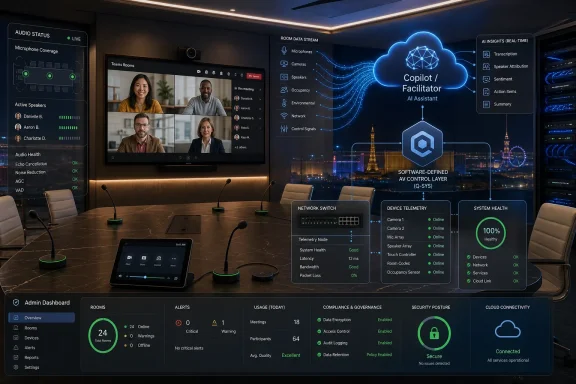 The Meeting Room Has Become Part of the AI Stack
For years, enterprise collaboration vendors treated the meeting room as a stubborn analog edge case. The strategic center of gravity was the cloud service, the calendar invite, the identity system, and the laptop. The room itself was something IT tried to standardize, monitor, and rescue when an executive found the camera pointing at the ceiling.That model is running out of road. Microsoft Copilot and Facilitator in Teams Rooms are not merely adding better note-taking to the old meeting experience. They are moving collaboration software toward situational awareness, where an AI assistant is expected to know who is present, what was decided, what needs follow-up, and whether the room itself is fit to support the conversation.
That shift makes AV infrastructure matter in a way it did not when the meeting room was just a peripheral attached to Teams. A bad microphone is no longer only a user-experience problem. It becomes a data-quality problem. A camera that frames the wrong people is not only awkward. It can distort the AI’s understanding of who contributed what.
This is why the UC Today interview with Microsoft’s Sohail Tariq and Q-SYS’ Nathan Glotfelty lands as more than InfoComm booth chatter. Their argument is that enterprises cannot treat agentic AI as a software-only rollout. If AI is going to summarize, assign, infer, alert, and eventually coordinate workflows on behalf of people, the physical room must feed it trustworthy signals.
Microsoft’s AI Meeting Vision Depends on Messy Physical Reality
Microsoft has spent the Copilot era trying to make work legible to AI. Documents, chats, calendars, emails, and meetings all become inputs into a system that promises to reduce friction and surface the next action. But physical rooms are a harder problem than Microsoft 365 data because they are full of unstructured reality: overlapping voices, bad acoustics, failing devices, local controls, network quirks, and human behavior that refuses to fit a product diagram.Facilitator in Microsoft Teams Rooms makes the challenge visible. Microsoft describes it as an AI-powered agent for scheduled and ad hoc meetings, capable of generating notes, summaries, and action items. In the room scenario, participants can start it from a Teams Room device, and the agent becomes a meeting assistant for an in-person discussion that might never have existed as a traditional Teams call.
That sounds simple until you consider what the AI has to know. It needs a clean transcript. It needs enough speaker attribution to avoid collapsing a room full of employees into a single anonymous blob. It needs to understand whether the meeting was actually captured correctly, whether audio was usable, and whether the devices that produced the input were operating as expected.
Microsoft’s own documentation has acknowledged limits in this area, including cases where in-room speakers may be identified generically rather than by name unless the right recognition, enrollment, hardware, and policy conditions are in place. That is not a minor footnote. It is the difference between “Pat agreed to deliver the security review by Friday” and “Speaker 2 said something about Friday.”
For executives, that distinction may sound like polish. For IT and compliance teams, it is the difference between a usable record and a liability.
Q-SYS Is Selling the Room as an Operating Platform
Q-SYS’ role in the story is not simply that it makes AV gear that works with Microsoft Teams Rooms. The company is positioning its platform as a kind of operating layer for complex spaces, one that can consolidate cameras, microphones, speakers, controls, scheduling panels, and telemetry into a coherent system.That matters because enterprise meeting estates rarely look like vendor marketing photos. A typical large organization has huddle rooms, divisible training rooms, boardrooms, experience centers, classrooms, executive spaces, specialty rooms, and aging installs that have accumulated hardware across multiple purchasing cycles. Standardizing all of that into a single collaboration experience is hard enough before AI enters the room.
Nathan Glotfelty’s description of Q-SYS helping Microsoft consolidate multiple subsystems onto a flat Q-SYS network is therefore central to the argument. The promise is not just fewer boxes or cleaner wiring. It is a consistent data and control plane across many kinds of spaces.
That is what makes Q-SYS strategically useful to Microsoft. Teams Rooms can be the user-facing collaboration environment, but the room’s underlying AV behavior still depends on a large ecosystem of hardware, sensors, firmware, and local control logic. If those systems remain fragmented, the AI layer receives fragments. If they are integrated, the AI has a better chance of knowing what is happening.
The recent Q-SYS RoomSuite Collaboration Bar for Microsoft Teams Rooms fits this same direction. Collaboration bars are often framed as convenience products for simpler rooms, but Q-SYS is presenting this one as part of a broader full-stack portfolio. In other words, the same vendor wants to cover both repeatable rooms and high-impact spaces, reducing the gap between commodity deployment and custom AV engineering.
The Redmond Experience Centers Are a Useful Clue
Microsoft’s Redmond Experience Centers, EC1 and EC2, are not normal conference rooms. They are showcase environments built for senior customers, partners, and decision makers. When something fails there, it is not merely a helpdesk ticket. It is a brand problem.That makes them a revealing test case. Microsoft has every incentive to make those rooms embody the future it wants customers to buy: Teams Rooms, Copilot, room intelligence, high-end AV, and operational visibility. If the experience centers need deep telemetry and integrated AV control to make that future credible, then ordinary enterprises should assume they will need some version of the same discipline.
The point is not that every company needs a Redmond-grade executive briefing center. Most do not. The point is that Microsoft’s own showcase spaces underline the gap between AI demos and operational reality.
A Copilot-branded meeting assistant can look impressive in a controlled demo. At scale, the problems become mundane and brutal: Was the microphone muted? Did the DSP route correctly? Is the camera online? Did the room PC update overnight? Is the network path healthy? Did a firmware change break the touch panel? Did the system capture the people actually speaking?
AI does not make those questions disappear. It makes them more important, because every failure contaminates the layer above it.
Agentic AI Turns Room Failures Into Workflow Failures
The word agentic is doing a lot of work in the collaboration industry right now. At its weakest, it is marketing shorthand for an assistant that does more than answer a prompt. At its strongest, it implies software that can observe, decide, and act across systems with some degree of autonomy.Meeting rooms are where that promise becomes uncomfortable. If an agent merely summarizes a transcript, bad room data produces a bad summary. If an agent begins assigning tasks, preparing follow-ups, escalating issues, or coordinating room behavior based on meeting context, bad room data can trigger the wrong downstream action.
That is why the “room readiness” framing matters. A room that is ready for a human meeting is not necessarily ready for an AI-mediated meeting. Humans can compensate for weak signals. They can say, “Who just said that?” or “Let’s repeat that for the people online.” AI systems tend to convert ambiguity into confident prose unless they are designed to surface uncertainty.
The enterprise risk is not science fiction. It is bureaucratic. A misattributed action item becomes a missed deadline. A garbled decision becomes an inaccurate recap. A transcript gap becomes a compliance dispute. A room that silently degrades creates a chain of errors that looks, to the user, like an AI failure but begins as an infrastructure failure.
This is the meeting room reckoning Microsoft and Q-SYS are pointing toward. The industry cannot promise AI-enhanced collaboration while continuing to tolerate rooms that work only when a patient employee knows which cable to reseat.
IT Is Being Pulled Back Into the Conference Room
One of the strange consequences of cloud collaboration was that it sometimes encouraged executives to underestimate physical infrastructure. If Teams, Zoom, or Webex worked on a laptop, the room became a peripheral concern. Facilities owned some pieces, AV integrators owned others, IT inherited the user complaints, and nobody wanted the whole mess.AI reverses that drift. Once meeting output becomes part of the organization’s knowledge fabric, room performance becomes an IT governance issue. The question is no longer only whether people can hear and see each other. It is whether the organization can trust the data produced by the meeting.
That creates new pressure on administrators. Teams Rooms Pro licensing, device management, voice and face recognition policy, transcription settings, Copilot availability, room account configuration, privacy controls, hardware certification, and AV telemetry all become part of the same deployment conversation. A room is not “AI-ready” because it has a camera and a Teams panel. It is AI-ready only if the identity, policy, hardware, and operational layers line up.
This is where many organizations will discover the uncomfortable difference between a pilot and a fleet. A handful of executive rooms can be tuned carefully. Hundreds or thousands of meeting spaces require repeatable designs, remote monitoring, lifecycle management, and a way to diagnose problems before users turn them into folklore.
The pitch from Q-SYS is that a software-defined AV platform can help make that fleet manageable. The pitch from Microsoft is that Teams Rooms can become the collaboration endpoint where AI becomes practical in shared physical spaces. Both pitches are plausible. Neither eliminates the work.
The User Experience Still Has to Survive the Architecture
There is a danger in letting the industry’s AI language outrun the employee’s lived experience. Most users do not care whether a room has a flat AV network, a full-stack control architecture, or a telemetry-rich hardware layer. They care whether they can walk in, start the meeting, be heard, and leave with useful notes.That simplicity is the standard by which this whole strategy will be judged. If Facilitator in Teams Rooms requires too much ritual, too many permissions, or too much troubleshooting, users will route around it. If Copilot-generated notes are inconsistent because speaker attribution fails or room audio is poor, employees will stop trusting them. If IT cannot explain what is recorded, stored, retained, or attributed, security teams will slow adoption.
Microsoft knows this. The company’s collaboration business has long depended on hiding complexity behind familiar workflows. Teams Rooms succeeded where older conferencing systems struggled because the user interaction mapped to something people already understood: join the meeting on the calendar.
AI meetings need the same kind of obviousness. The room should know enough to help without turning the start of every discussion into an administrative ceremony. That is precisely why the infrastructure matters. The more the room can reliably report its own state, the less the user has to think about it.
But there is a fine line between helpful intelligence and a room that feels over-instrumented. Organizations deploying AI-enabled meeting spaces will have to communicate clearly about transcription, identity, retention, and consent. The best room in the world will fail politically if employees conclude that “AI-ready” means “always watching.”
Microsoft and Q-SYS Are Also Defending the Value of the Room
The larger backdrop is the long post-pandemic argument over whether offices still matter. Hybrid work reduced the automatic centrality of the conference room, but it did not eliminate the need for high-quality shared spaces. If anything, it raised the bar. A room now has to justify the commute, support remote participants fairly, and produce a useful record afterward.AI gives the room a new claim on relevance. If the best meeting output comes from spaces with high-quality capture, accurate identity, and integrated workflow automation, then enterprise rooms become productivity infrastructure rather than real-estate leftovers. That is an attractive argument for Microsoft, Q-SYS, AV integrators, and corporate workplace teams.
It is also an argument with budget consequences. AI-ready rooms are not free. Better microphones, cameras, control systems, room compute, licensing, network design, support contracts, and management tooling all cost money. The return on that investment will be uneven unless organizations are honest about which rooms matter most.
Not every four-person huddle room needs the same treatment as a boardroom. Not every brainstorming corner needs full AI capture. But the old binary distinction between “video room” and “non-video room” is becoming obsolete. The new distinction is between rooms that produce trustworthy collaboration data and rooms that do not.
That is the market Q-SYS wants to serve and the platform Microsoft wants to absorb into Teams.
The Partnership Signals a Shift From Devices to Estates
The most interesting thing about the Microsoft-Q-SYS conversation is that it is not centered on a single device. Yes, the RoomSuite Collaboration Bar matters. Yes, scheduling panels, specialty spaces, camera systems, and Teams Rooms compatibility matter. But the strategic unit is the estate.That is a mature way to think about enterprise AV. Device-by-device decisions create inconsistency, and inconsistency is poison for AI-enabled workflows. If one room attributes speakers, another does not, a third has poor audio, and a fourth cannot report device health, the organization ends up with an uneven knowledge layer.
Enterprise IT has seen this pattern before. Endpoint management became essential when PCs moved from isolated productivity tools to networked, policy-governed assets. Mobile device management became essential when phones became corporate data endpoints. Meeting room management is now heading in the same direction because rooms are becoming AI data endpoints.
That does not mean every AV component becomes an IT-managed commodity. Specialized spaces will still need expert design. Acoustics still matter. Human factors still matter. But the direction is clear: collaboration rooms are being pulled into the same governance logic as the rest of the digital workplace.
The vendors that can bridge AV reality and IT manageability will have the advantage. Microsoft brings the collaboration cloud, identity layer, and Copilot strategy. Q-SYS brings the room-side platform and AV control model. The partnership makes sense because neither side can solve the whole problem alone.
The Privacy Conversation Cannot Be Bolted On Later
Any serious discussion of AI meeting rooms has to confront privacy early, not as an appendix. Richer room data may improve AI performance, but it also increases the sensitivity of what is captured. Speaker identity, transcripts, action items, attendance signals, device telemetry, and room usage patterns can reveal more than employees expect.Microsoft’s enterprise posture is built around tenant controls, compliance commitments, and administrative policy. That helps, but it does not remove the need for local decisions. Companies still need to decide which meetings should be transcribed, who can invoke AI notes, how long records should be retained, how external participants are handled, and whether voice or face recognition is appropriate in their jurisdiction and culture.
The risk is that AI meeting features spread through enthusiasm before governance catches up. A department head sees useful summaries. A project team starts relying on automatic action items. A facilities team likes room analytics. Then legal, HR, security, and employee representatives arrive late to discover that the organization has created a new class of workplace record.
That is not an argument against AI meeting rooms. It is an argument for treating them as infrastructure with policy consequences. The more useful these systems become, the more important it is to define their boundaries.
The irony is that strong governance may increase adoption. Employees are more likely to trust AI-enabled rooms if they understand when the system is active, what it captures, how the data is used, and who can access it. Trust is not a soft issue here. It is a deployment prerequisite.
The AV Industry Is Being Asked to Speak IT
InfoComm has always been a place where the AV industry shows off impressive systems. But the Microsoft-Q-SYS message reflects a deeper convergence: AV vendors now have to speak the language of cloud administration, security, telemetry, lifecycle management, and software-defined infrastructure.That is a cultural shift. Traditional AV excellence prized custom design, local reliability, and tuned experiences. Enterprise IT prizes repeatability, visibility, policy, and remote management. AI meeting rooms require both instincts at once.
Q-SYS has been moving in this direction for years by emphasizing software-defined AV and control. Microsoft’s involvement raises the stakes because Teams Rooms is not just another UC endpoint. It is a managed part of the Microsoft 365 collaboration estate, and Copilot makes its output part of the organization’s broader productivity graph.
The winners in this market will not be the vendors with the flashiest camera demo alone. They will be the vendors that can make rooms predictable at scale. Predictability is what lets IT support the experience, what lets users trust the output, and what lets AI act without guessing.
For AV professionals, that may be both opportunity and warning. Their work is becoming more central to enterprise productivity, but it is also becoming more measurable. Once rooms emit operational data, customers will expect them to be managed with the same rigor as other endpoints.
The Real Product Is Confidence
The deepest product Microsoft and Q-SYS are selling is not Copilot, Facilitator, a collaboration bar, or a control platform. It is confidence. Confidence that a room is ready before the meeting starts. Confidence that the AI notes reflect what happened. Confidence that IT can diagnose issues remotely. Confidence that a deployment can scale without every room becoming its own bespoke support adventure.That is why “room data” has become the phrase to watch. It sounds dry, but it is the foundation for everything the AI layer wants to do. Without accurate data from the room, agents are forced to infer too much from too little. With better data, they can become more useful and less brittle.
Enterprises should still be skeptical of grand claims. The collaboration industry has a long history of promising seamless meetings and delivering firmware archaeology. AI will not magically fix bad acoustics, sloppy deployments, or confused ownership. In some cases, it will expose those weaknesses faster.
But skepticism should not become denial. The direction of travel is obvious. Meeting rooms are becoming intelligent endpoints, and the organizations that manage them as such will be better positioned than those that treat them as furniture with HDMI ports.
The Rooms That Matter Most Will Get Smarter First
The near-term adoption pattern is likely to be selective rather than universal. Executive briefing centers, boardrooms, training rooms, customer-facing spaces, and high-value project rooms will get the most attention first because the cost of failure is highest there. Routine huddle rooms will follow where standardization and simplified deployment make the economics work.That is why products such as the Q-SYS RoomSuite Collaboration Bar are strategically important. They aim to shrink the gap between bespoke high-end rooms and scalable everyday deployments. If Microsoft and Q-SYS can make AI-ready room infrastructure repeatable, the market expands beyond flagship spaces.
Still, organizations should resist the temptation to declare every room AI-ready by procurement memo. The useful approach is to classify spaces by business value, meeting patterns, privacy requirements, and supportability. Some rooms need full intelligence. Some need reliable Teams joining and basic capture. Some may not need AI at all.
The best enterprise strategy will look less like a gadget refresh and more like an endpoint roadmap. It will define standards, telemetry expectations, lifecycle plans, and governance rules before the meeting estate becomes another unmanaged sprawl.
The InfoComm Message for Windows and Teams Admins Is Uncomfortably Practical
The Microsoft-Q-SYS showcase may have been staged for the AV crowd, but its implications land directly on Windows and Microsoft 365 administrators. Teams Rooms are Windows-based or Android-based endpoints with room accounts, licenses, update channels, peripherals, and management dependencies. Copilot and Facilitator add another layer of sensitivity because they turn meetings into structured outputs.For WindowsForum.com readers, the lesson is that the meeting room is becoming a first-class endpoint in the Microsoft estate. That means administrators will increasingly need to understand the relationship between room hardware, Teams Rooms configuration, Microsoft 365 Copilot licensing, transcription policy, identity, and device health.
It also means troubleshooting will become more interdisciplinary. A poor AI summary might begin with a room microphone issue. A missing speaker name might involve user enrollment, hardware support, policy configuration, or feature limitations. A failed ad hoc Facilitator session might involve licensing, mobile authentication, Teams Rooms settings, or network conditions.
The helpdesk script will need to evolve. “Can you hear me now?” is no longer enough when the meeting output is feeding tasks, summaries, and decisions.
The Reckoning Is Really About Ownership
Every enterprise technology shift eventually becomes a question of ownership. Who owns the AI meeting room? IT owns Teams and identity. Facilities owns the physical space. AV teams or integrators own the room design. Security owns risk. Legal owns retention and compliance. Business leaders own the productivity demand.The Microsoft-Q-SYS argument only works if those groups stop treating the room as someone else’s problem. Agentic AI does not respect organizational silos. It consumes signals across them and produces outputs that affect all of them.
That makes governance boringly essential. Enterprises need room standards, not just room projects. They need support models, not just installation handoffs. They need privacy decisions before deployment, not after employee complaints. They need executive sponsors who understand that AI meeting quality depends on physical infrastructure.
The organizations that get this right will not necessarily be the ones that buy the most expensive rooms. They will be the ones that align ownership before scale turns small inconsistencies into systemic failures.
The Practical Shape of an AI-Ready Meeting Estate
The useful lesson from InfoComm 2026 is not that every customer should copy Microsoft’s Redmond Experience Centers or standardize blindly on one AV platform. It is that AI-ready collaboration spaces require a more disciplined model than the industry has often tolerated.A practical roadmap starts with the rooms where meeting output has the highest value. It then works backward from the AI use case: accurate summaries, action items, speaker attribution, room readiness, remote participant equity, or operational monitoring. From there, the required hardware, policy, network, licensing, and support model become easier to define.
This is where vendor positioning should be separated from operational truth. Microsoft wants Teams Rooms and Copilot to be the center of gravity. Q-SYS wants its platform to be the room-side foundation. Customers should evaluate both claims by asking whether the combined system reduces ambiguity, improves supportability, and produces more trustworthy meeting records.
The wrong metric is whether the demo looks futuristic. The right metric is whether the 300th room works predictably on a Tuesday morning after updates, staff turnover, and six months of normal abuse.
The Signal From Las Vegas Is That the Room Is No Longer Passive
The Microsoft and Q-SYS story from InfoComm 2026 points to a practical set of consequences for enterprise collaboration teams. The room is becoming an active participant in the meeting workflow, and that changes what administrators must plan, buy, monitor, and govern.- Enterprises should treat AI-enabled meeting rooms as managed endpoints, not as isolated AV installations.
- Copilot and Facilitator will be only as trustworthy as the audio, identity, policy, and telemetry feeding them.
- Q-SYS’ value to Microsoft is its ability to connect complex physical spaces into a more coherent AV and data platform.
- Microsoft’s Redmond Experience Centers show that showcase-quality AI meetings require operational visibility, not just premium hardware.
- Privacy, retention, and employee trust must be designed into AI meeting deployments before features are broadly enabled.
- The first successful AI-ready rooms will likely be high-value spaces where the business case for reliability and rich capture is clearest.
References
- Primary source: UC Today
Published: Wed, 24 Jun 2026 11:14:29 GMT
InfoComm 2026: Q-SYS and Microsoft Prepare Teams Rooms for AI - UC Today
Q-SYS and Microsoft discuss AI-ready meeting rooms, Teams Rooms, Copilot, Facilitator, and the future of intelligent workplace AV at InfoComm 2026www.uctoday.com - Official source: learn.microsoft.com
Facilitator in Teams Rooms - Microsoft Teams | Microsoft Learn
This user guide provides comprehensive setup instructions and information on using the Facilitator agent within Teams Rooms. The AI-powered Facilitator agent or app lets meeting participants hold unscheduled meetings and use Facilitator to transcribe the entire meeting conversation and create...learn.microsoft.com - Official source: support.microsoft.com
Facilitator in Microsoft Teams meetings | Microsoft Support
AI-generated notes automate note-taking during Teams meetings to capture the discussion in real-time with action items and follow-up tasks.support.microsoft.com - Related coverage: support.qsys.com
Awareness | Enabling Microsoft Teams Rooms with Q-SYS - Q-SYS
Information Requirements Physical Components Windows or Android Based Microsoft Teams Room Compute and Controller Q-SYS Core processor connected to the samsupport.qsys.com
- Related coverage: windowscentral.com
Microsoft Copilot Wave 3 adds AI agents and E7 Frontier Suite | Windows Central
Microsoft Copilot is rolling out more agentic AI control and model support in a new subscription tier for Microsoft 365.www.windowscentral.com - Related coverage: services.global.ntt
Print
Large group of programmers working in a modern office of a software company. Copy space.services.global.ntt
