

QSC announced on June 4, 2026, that Q-SYS is adding a Windows-based RoomSuite Collaboration Bar for Microsoft Teams Rooms, a Teams-certified Q-SYS Scheduling Panel, and a planned Microsoft Places data-integration partnership through Q-SYS Reflect. The move matters less because of another meeting-room bar and more because it shows where workplace collaboration hardware is going. Microsoft’s meeting-room strategy is becoming an ecosystem of devices, cloud telemetry, room booking, and occupancy intelligence. Q-SYS is trying to make itself the connective layer between the conference room, the IT help desk, and the workplace-planning dashboard.
For years, the conference room was the awkward stepchild of enterprise IT: half AV project, half facilities expense, and half user-support nightmare, which is one half too many. Teams Rooms changed that by making rooms look more like managed computing endpoints, but the messy physical reality remained. Cameras, microphones, DSPs, control panels, speakers, USB bridges, occupancy sensors, and room schedulers still had to behave like one coherent product.
Q-SYS’s announcement is a bet that the next phase of Teams Rooms will not be won solely by the best camera or the loudest speaker. It will be won by vendors that can make standard rooms easy to deploy while still feeding the operational data that IT and workplace teams increasingly expect.
The new Q-SYS RoomSuite Collaboration Bar is aimed directly at the repeatable-room problem. It is a Windows-based Microsoft Teams Rooms device designed for common collaboration spaces rather than bespoke boardrooms. That distinction is important: Q-SYS has long had credibility in higher-performance AV deployments, but standard rooms are where enterprises multiply cost, support overhead, and user frustration at scale.
The collaboration bar is still in the process of achieving Microsoft Teams certification, which means buyers should treat the launch as a roadmap signal rather than a fully checked-off procurement item. But the direction is clear. Q-SYS wants to move from being the platform behind complex rooms to being a more visible participant in the standardized Teams Rooms estate.
That is not merely a convenience product. It is an attempt to compress the kind of room experience usually assembled from separate components into a deployable package that can be rolled out repeatedly. In plain terms, Q-SYS is trying to take some of the custom-engineered aura out of better meeting rooms.
The ability to connect up to four Q-SYS RoomSuite table microphone accessories is the key tell. Many collaboration bars work well in smaller rooms and then become acoustically optimistic in larger or stranger layouts. By allowing table microphones to extend pickup and provide physical mute controls, Q-SYS is acknowledging that the real world rarely conforms to the marketing photo of a six-person glass box.
That expansion path also protects Q-SYS from the usual all-in-one trap. A bar that cannot grow becomes a dead end as soon as the room changes. A bar that can fold into a broader platform has a better chance of surviving the inevitable furniture shuffle, hybrid-work rethink, or executive demand that “this room should work like the big one downstairs.”
That is where Q-SYS has historically played well. Its strength is not just that it can connect audio and video devices; it is that it can coordinate them inside rooms that refuse to be simple. Training spaces, boardrooms, divisible rooms, flex spaces, and all-hands areas often need more than a bar on a wall.
The Microsoft quote in the announcement leans into this exact positioning. Microsoft frames the joint work as giving Teams Rooms customers more platform choice while combining Teams Rooms on Windows with simpler deployment. That is the argument Microsoft wants its hardware partners to make: Teams Rooms can be standardized without becoming simplistic.
For IT departments, this matters because meeting-room estates are no longer side projects. A broken room can derail an executive meeting, a customer briefing, or a hybrid all-hands. The support model increasingly resembles endpoint management, with firmware, health monitoring, remote diagnostics, policy, and lifecycle planning becoming just as important as the user-facing interface.
A scheduling panel sounds mundane until you consider what it represents. It is a physical interface between the digital calendar and the actual workplace. It tells employees whether a room is free, helps reduce ghost bookings, and becomes one more data point in the organization’s understanding of how space is used.
The QSP-11 integrates with Q-SYS systems through Q-SYS Reflect, the company’s cloud monitoring and management platform. That matters because it suggests the panel is not being treated as a standalone accessory. It is part of a broader telemetry and management layer.
MDEP is also worth watching. Microsoft has been using it as a foundation for more consistent, secure, and manageable Android-based Teams devices. A scheduling panel built on that platform fits Microsoft’s desire to make Teams-connected hardware more predictable for administrators, even when the device itself is not a Windows PC.
Q-SYS says Reflect unifies systemwide data and gives administrators a cloud-based way to monitor and manage Q-SYS RoomSuite solutions as well as Q-SYS Core-based systems. Reflect Plus adds features intended to streamline installation and maintenance, including preset and firmware deployment across RoomSuite systems and visibility into timebound space-usage insights.
That language is not accidental. The modern workplace stack is increasingly obsessed with signals: whether rooms are booked, whether people actually showed up, whether equipment is healthy, whether spaces are oversized for their usage, and whether real estate is being wasted. Reflect is being positioned as the pipe through which those signals can move.
This is where the AV industry and IT management collide. AV teams care about audio quality, camera behavior, room control, and installation complexity. IT teams care about fleet health, tickets, uptime, security posture, and integration with existing workflows. Facilities teams care about occupancy, utilization, and space planning. The vendor that can speak all three languages has a stronger claim on the budget.
This is not just about making a room easier to book. The ambition is to feed richer data from Q-SYS cloud-enabled systems and verified partner assets into Places so organizations can better understand booking patterns, space usage, and workplace optimization. In other words, the meeting room becomes not just a collaboration endpoint, but an input into corporate real-estate decisions.
That is a powerful shift. Historically, AV data was trapped inside specialist tools or noticed only when something broke. If Q-SYS Reflect becomes a “connective highway,” as the announcement puts it, then audio and video infrastructure can inform everyday workplace planning.
There is a risk here, too. Once room systems become data sources for workplace analytics, organizations need to be much clearer about governance, privacy, retention, and employee trust. Occupancy data can be useful without becoming creepy, but only if companies draw the line before workers feel like the conference-room microphone array has become a proxy attendance system.
ServiceNow is where many organizations already manage incidents, assets, change workflows, and service operations. Teams Rooms Pro Management is Microsoft’s own operational layer for monitoring and managing Teams Rooms devices. If Q-SYS Reflect can connect room-level signals into those systems, then AV faults can become ordinary IT events instead of mysterious calls to a specialist integrator.
That has real value. A microphone fault, a firmware mismatch, a control-panel issue, or a device offline event should not require someone to walk the floor with a laptop and a hunch. It should be visible, triaged, and routed like any other managed endpoint problem.
The bigger win is lifecycle control. Enterprises do not struggle only with day-one deployment; they struggle with year-two drift. Firmware versions diverge, room templates mutate, devices age, accessories disappear, and nobody remembers why one supposedly standard room behaves differently from the other fifteen. Reflect Plus’s promised preset and firmware deployment is aimed squarely at that problem.
Teams certification is more than a badge on a product page. For many enterprise buyers, it is a procurement threshold, a support expectation, and a risk-control mechanism. Certified devices have been tested against Microsoft’s requirements, which gives administrators more confidence that the device will behave properly in the Teams Rooms ecosystem.
That does not mean uncertified or pending devices are necessarily poor products. It does mean large buyers should be careful about timing. A product that is “in process” may be promising, but rollout plans should account for certification status, availability, support terms, and the possibility that final certification introduces changes.
Q-SYS has already been expanding its certified Teams portfolio, including more advanced room components such as processors and AI-assisted room systems. The new collaboration bar appears to extend that arc into standardized spaces. But until certification is complete, the safest reading is that Q-SYS has announced its direction, not finished the whole journey.
The difference Q-SYS is trying to claim is platform continuity. It wants a customer to use a RoomSuite Collaboration Bar in common spaces, Q-SYS Core-based systems in higher-end spaces, Q-SYS scheduling panels at the door, and Reflect as the management and analytics layer above them all. The bar is the visible endpoint; the platform is the lock-in.
That strategy could appeal to organizations tired of mixing unrelated devices room by room. Standardization has become a practical necessity because hybrid work exposed the unevenness of enterprise meeting spaces. Employees do not care whether a room was designed by AV, IT, facilities, or procurement. They care whether the meeting starts and whether remote participants can see and hear.
Still, platform strategies cut both ways. A unified ecosystem can reduce complexity, but it can also increase dependency on a single vendor’s roadmap, licensing, cloud service, and partner integrations. IT buyers will want to understand what happens if they mix Q-SYS with other certified Teams devices, how open the telemetry model is, and how much value depends on paid Reflect Plus features.
Hybrid work made space planning harder. Many companies downsized offices, redesigned floors, added collaboration spaces, and then discovered that booking data alone does not tell the whole story. A room can be booked and empty. A space can be occupied but not reserved. A large room can host two people while smaller rooms are unavailable. A collaboration technology estate can look healthy in a spreadsheet while users quietly avoid certain rooms.
That is why Microsoft Places matters. It gives Microsoft a way to connect calendars, workplace apps, floor plans, and occupancy signals. It also gives hardware partners an incentive to make their devices produce useful data rather than merely perform in meetings.
For Q-SYS, the opportunity is to turn its installed systems into data assets. A Q-SYS room already knows things: whether devices are online, whether a call is active, what microphones or cameras are present, what accessories are connected, and potentially how space is being used over time. The question is how much of that can be converted into trustworthy workplace intelligence without creating privacy or administrative headaches.
The best meeting-room technology disappears. It lets users walk in, tap join, speak naturally, share content, and leave without filing a ticket. The best management technology is similarly unglamorous. It tells administrators what is failing before users complain, updates fleets without drama, and keeps rooms consistent across geographies.
Q-SYS’s announcement is strongest where it serves that boring ideal. A standardized bar for common Teams Rooms, an exterior scheduling panel, cloud-based monitoring, firmware and preset deployment, ServiceNow integration, Teams Rooms Pro Management integration, and Places data sharing all point toward operational maturity.
The weakest version of this future is a stack of subscriptions, dashboards, certifications, portals, and partner dependencies that makes the meeting room feel more complex, not less. Enterprises have already lived through that movie in endpoint management, security tooling, and SaaS administration. The room cannot become another place where every operational improvement arrives with another pane of glass.
Organizations considering the RoomSuite Collaboration Bar should watch for final Microsoft Teams certification, regional availability, and deployment guidance. They should also test the device in the kinds of rooms they actually have, not the ones shown in product photography. Camera quality, microphone pickup, speaker performance, and table-mic expansion should be judged in real acoustics with real users.
The scheduling panel is a cleaner near-term story because it is already described as certified for Teams and built for room booking workflows. But even there, buyers should evaluate how it fits into existing Exchange, Teams, room-resource, facilities, and workplace-management practices. A panel outside the door is useful only if the booking culture behind it works.
Reflect and Reflect Plus deserve special scrutiny because that is where long-term operational value and long-term vendor dependency both live. If Q-SYS can genuinely simplify monitoring, maintenance, firmware deployment, and analytics across mixed room types, it becomes more than an AV platform. It becomes part of the enterprise workplace operating model.
 The Meeting Room Is Becoming a Managed Endpoint
For years, the conference room was the awkward stepchild of enterprise IT: half AV project, half facilities expense, and half user-support nightmare, which is one half too many. Teams Rooms changed that by making rooms look more like managed computing endpoints, but the messy physical reality remained. Cameras, microphones, DSPs, control panels, speakers, USB bridges, occupancy sensors, and room schedulers still had to behave like one coherent product.Q-SYS’s announcement is a bet that the next phase of Teams Rooms will not be won solely by the best camera or the loudest speaker. It will be won by vendors that can make standard rooms easy to deploy while still feeding the operational data that IT and workplace teams increasingly expect.
The new Q-SYS RoomSuite Collaboration Bar is aimed directly at the repeatable-room problem. It is a Windows-based Microsoft Teams Rooms device designed for common collaboration spaces rather than bespoke boardrooms. That distinction is important: Q-SYS has long had credibility in higher-performance AV deployments, but standard rooms are where enterprises multiply cost, support overhead, and user frustration at scale.
The collaboration bar is still in the process of achieving Microsoft Teams certification, which means buyers should treat the launch as a roadmap signal rather than a fully checked-off procurement item. But the direction is clear. Q-SYS wants to move from being the platform behind complex rooms to being a more visible participant in the standardized Teams Rooms estate.
Q-SYS Moves Down-Market Without Abandoning the High End
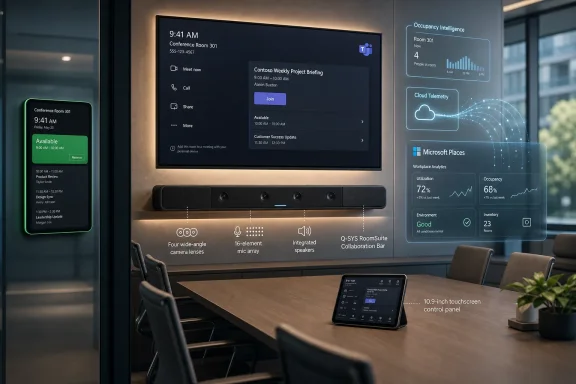
The headline hardware is familiar in outline: an all-in-one collaboration bar with cameras, microphones, speakers, and a dedicated controller. The details are more aggressive. Q-SYS says the RoomSuite Collaboration Bar includes four high-resolution 50 MP cameras, a 16-element microphone array, integrated loudspeakers, and a 10.9-inch touchscreen for meeting and device control.That is not merely a convenience product. It is an attempt to compress the kind of room experience usually assembled from separate components into a deployable package that can be rolled out repeatedly. In plain terms, Q-SYS is trying to take some of the custom-engineered aura out of better meeting rooms.
The ability to connect up to four Q-SYS RoomSuite table microphone accessories is the key tell. Many collaboration bars work well in smaller rooms and then become acoustically optimistic in larger or stranger layouts. By allowing table microphones to extend pickup and provide physical mute controls, Q-SYS is acknowledging that the real world rarely conforms to the marketing photo of a six-person glass box.
That expansion path also protects Q-SYS from the usual all-in-one trap. A bar that cannot grow becomes a dead end as soon as the room changes. A bar that can fold into a broader platform has a better chance of surviving the inevitable furniture shuffle, hybrid-work rethink, or executive demand that “this room should work like the big one downstairs.”
Microsoft Teams Rooms on Windows Remains the Enterprise Gravity Well
The collaboration bar being Windows-based is not incidental. Microsoft Teams Rooms exists in both Windows and Android flavors, and each has its place, but the Windows version remains particularly attractive for enterprises that want deeper manageability, richer peripheral ecosystems, and more complex room integration.That is where Q-SYS has historically played well. Its strength is not just that it can connect audio and video devices; it is that it can coordinate them inside rooms that refuse to be simple. Training spaces, boardrooms, divisible rooms, flex spaces, and all-hands areas often need more than a bar on a wall.
The Microsoft quote in the announcement leans into this exact positioning. Microsoft frames the joint work as giving Teams Rooms customers more platform choice while combining Teams Rooms on Windows with simpler deployment. That is the argument Microsoft wants its hardware partners to make: Teams Rooms can be standardized without becoming simplistic.
For IT departments, this matters because meeting-room estates are no longer side projects. A broken room can derail an executive meeting, a customer briefing, or a hybrid all-hands. The support model increasingly resembles endpoint management, with firmware, health monitoring, remote diagnostics, policy, and lifecycle planning becoming just as important as the user-facing interface.
The Scheduling Panel Is the Small Device With the Bigger Signal
The Q-SYS Scheduling Panel, or QSP-11, may look like the less glamorous product in the announcement, but it points to the deeper strategy. It is built on the Microsoft Device Ecosystem Platform, or MDEP, and is certified for Teams. It is designed to sit outside conference rooms on walls or glass and make booking status visible and usable.A scheduling panel sounds mundane until you consider what it represents. It is a physical interface between the digital calendar and the actual workplace. It tells employees whether a room is free, helps reduce ghost bookings, and becomes one more data point in the organization’s understanding of how space is used.
The QSP-11 integrates with Q-SYS systems through Q-SYS Reflect, the company’s cloud monitoring and management platform. That matters because it suggests the panel is not being treated as a standalone accessory. It is part of a broader telemetry and management layer.
MDEP is also worth watching. Microsoft has been using it as a foundation for more consistent, secure, and manageable Android-based Teams devices. A scheduling panel built on that platform fits Microsoft’s desire to make Teams-connected hardware more predictable for administrators, even when the device itself is not a Windows PC.
Reflect Is Where the Hardware Story Turns Into a Cloud Story
The most important product in the announcement may not be the collaboration bar or the scheduling panel. It may be Q-SYS Reflect, because Reflect is what turns room hardware into a managed services story.Q-SYS says Reflect unifies systemwide data and gives administrators a cloud-based way to monitor and manage Q-SYS RoomSuite solutions as well as Q-SYS Core-based systems. Reflect Plus adds features intended to streamline installation and maintenance, including preset and firmware deployment across RoomSuite systems and visibility into timebound space-usage insights.
That language is not accidental. The modern workplace stack is increasingly obsessed with signals: whether rooms are booked, whether people actually showed up, whether equipment is healthy, whether spaces are oversized for their usage, and whether real estate is being wasted. Reflect is being positioned as the pipe through which those signals can move.
This is where the AV industry and IT management collide. AV teams care about audio quality, camera behavior, room control, and installation complexity. IT teams care about fleet health, tickets, uptime, security posture, and integration with existing workflows. Facilities teams care about occupancy, utilization, and space planning. The vendor that can speak all three languages has a stronger claim on the budget.
Microsoft Places Gives Room Data a Corporate Audience
The Microsoft Places integration is the most strategically revealing part of Q-SYS’s announcement. Places is Microsoft’s workplace experience platform for hybrid organizations, designed to connect people, rooms, schedules, floor plans, services, and occupancy signals. Q-SYS becoming a Places data integration partner puts its room telemetry into a broader Microsoft workplace context.This is not just about making a room easier to book. The ambition is to feed richer data from Q-SYS cloud-enabled systems and verified partner assets into Places so organizations can better understand booking patterns, space usage, and workplace optimization. In other words, the meeting room becomes not just a collaboration endpoint, but an input into corporate real-estate decisions.
That is a powerful shift. Historically, AV data was trapped inside specialist tools or noticed only when something broke. If Q-SYS Reflect becomes a “connective highway,” as the announcement puts it, then audio and video infrastructure can inform everyday workplace planning.
There is a risk here, too. Once room systems become data sources for workplace analytics, organizations need to be much clearer about governance, privacy, retention, and employee trust. Occupancy data can be useful without becoming creepy, but only if companies draw the line before workers feel like the conference-room microphone array has become a proxy attendance system.
ServiceNow and Teams Rooms Pro Management Complete the IT Triangle
Q-SYS also points to integrations with ServiceNow and the Microsoft Teams Rooms Pro Management portal. That is not decorative partner-logo language. It is the practical architecture of enterprise support.ServiceNow is where many organizations already manage incidents, assets, change workflows, and service operations. Teams Rooms Pro Management is Microsoft’s own operational layer for monitoring and managing Teams Rooms devices. If Q-SYS Reflect can connect room-level signals into those systems, then AV faults can become ordinary IT events instead of mysterious calls to a specialist integrator.
That has real value. A microphone fault, a firmware mismatch, a control-panel issue, or a device offline event should not require someone to walk the floor with a laptop and a hunch. It should be visible, triaged, and routed like any other managed endpoint problem.
The bigger win is lifecycle control. Enterprises do not struggle only with day-one deployment; they struggle with year-two drift. Firmware versions diverge, room templates mutate, devices age, accessories disappear, and nobody remembers why one supposedly standard room behaves differently from the other fifteen. Reflect Plus’s promised preset and firmware deployment is aimed squarely at that problem.
Certification Is Still the Gate Enterprises Cannot Ignore
The scheduling panel is certified for Teams. The collaboration bar is currently in the process of achieving Microsoft Teams certification. That difference should not be glossed over.Teams certification is more than a badge on a product page. For many enterprise buyers, it is a procurement threshold, a support expectation, and a risk-control mechanism. Certified devices have been tested against Microsoft’s requirements, which gives administrators more confidence that the device will behave properly in the Teams Rooms ecosystem.
That does not mean uncertified or pending devices are necessarily poor products. It does mean large buyers should be careful about timing. A product that is “in process” may be promising, but rollout plans should account for certification status, availability, support terms, and the possibility that final certification introduces changes.
Q-SYS has already been expanding its certified Teams portfolio, including more advanced room components such as processors and AI-assisted room systems. The new collaboration bar appears to extend that arc into standardized spaces. But until certification is complete, the safest reading is that Q-SYS has announced its direction, not finished the whole journey.
The Collaboration Bar Market Is Crowded, but Q-SYS Is Not Selling Only a Bar
Q-SYS is entering a crowded field. Teams Rooms bars and appliances already come from well-known vendors across enterprise AV, unified communications, and peripheral hardware. Many offer strong cameras, beamforming microphones, integrated speakers, companion touch panels, and simplified setup.The difference Q-SYS is trying to claim is platform continuity. It wants a customer to use a RoomSuite Collaboration Bar in common spaces, Q-SYS Core-based systems in higher-end spaces, Q-SYS scheduling panels at the door, and Reflect as the management and analytics layer above them all. The bar is the visible endpoint; the platform is the lock-in.
That strategy could appeal to organizations tired of mixing unrelated devices room by room. Standardization has become a practical necessity because hybrid work exposed the unevenness of enterprise meeting spaces. Employees do not care whether a room was designed by AV, IT, facilities, or procurement. They care whether the meeting starts and whether remote participants can see and hear.
Still, platform strategies cut both ways. A unified ecosystem can reduce complexity, but it can also increase dependency on a single vendor’s roadmap, licensing, cloud service, and partner integrations. IT buyers will want to understand what happens if they mix Q-SYS with other certified Teams devices, how open the telemetry model is, and how much value depends on paid Reflect Plus features.
Workplace Analytics Is the New Battleground for AV Vendors
The most interesting part of this announcement is how little it resembles old-fashioned AV product news. Yes, there are cameras, microphones, loudspeakers, and panels. But the strategic center of gravity is analytics.Hybrid work made space planning harder. Many companies downsized offices, redesigned floors, added collaboration spaces, and then discovered that booking data alone does not tell the whole story. A room can be booked and empty. A space can be occupied but not reserved. A large room can host two people while smaller rooms are unavailable. A collaboration technology estate can look healthy in a spreadsheet while users quietly avoid certain rooms.
That is why Microsoft Places matters. It gives Microsoft a way to connect calendars, workplace apps, floor plans, and occupancy signals. It also gives hardware partners an incentive to make their devices produce useful data rather than merely perform in meetings.
For Q-SYS, the opportunity is to turn its installed systems into data assets. A Q-SYS room already knows things: whether devices are online, whether a call is active, what microphones or cameras are present, what accessories are connected, and potentially how space is being used over time. The question is how much of that can be converted into trustworthy workplace intelligence without creating privacy or administrative headaches.
The Best Version of This Future Is Boring Reliability
There is a temptation to frame every workplace technology announcement as an AI story. Microsoft Places certainly sits adjacent to Microsoft’s broader Copilot and AI workplace strategy, and Q-SYS’s ecosystem includes advanced camera and room-intelligence tools. But the more immediate prize is simpler: fewer bad meetings.The best meeting-room technology disappears. It lets users walk in, tap join, speak naturally, share content, and leave without filing a ticket. The best management technology is similarly unglamorous. It tells administrators what is failing before users complain, updates fleets without drama, and keeps rooms consistent across geographies.
Q-SYS’s announcement is strongest where it serves that boring ideal. A standardized bar for common Teams Rooms, an exterior scheduling panel, cloud-based monitoring, firmware and preset deployment, ServiceNow integration, Teams Rooms Pro Management integration, and Places data sharing all point toward operational maturity.
The weakest version of this future is a stack of subscriptions, dashboards, certifications, portals, and partner dependencies that makes the meeting room feel more complex, not less. Enterprises have already lived through that movie in endpoint management, security tooling, and SaaS administration. The room cannot become another place where every operational improvement arrives with another pane of glass.
IT Buyers Should Read the Fine Print Before They Standardize
The strategic appeal of Q-SYS’s expanded Teams and Places story is obvious, but the procurement questions are equally obvious. Certification status, licensing, data governance, interoperability, support ownership, and lifecycle management all matter.Organizations considering the RoomSuite Collaboration Bar should watch for final Microsoft Teams certification, regional availability, and deployment guidance. They should also test the device in the kinds of rooms they actually have, not the ones shown in product photography. Camera quality, microphone pickup, speaker performance, and table-mic expansion should be judged in real acoustics with real users.
The scheduling panel is a cleaner near-term story because it is already described as certified for Teams and built for room booking workflows. But even there, buyers should evaluate how it fits into existing Exchange, Teams, room-resource, facilities, and workplace-management practices. A panel outside the door is useful only if the booking culture behind it works.
Reflect and Reflect Plus deserve special scrutiny because that is where long-term operational value and long-term vendor dependency both live. If Q-SYS can genuinely simplify monitoring, maintenance, firmware deployment, and analytics across mixed room types, it becomes more than an AV platform. It becomes part of the enterprise workplace operating model.
The New Q-SYS Stack Is Really a Workplace Data Play
The concrete news is simple, but the implications are broader:- Q-SYS is adding a Windows-based RoomSuite Collaboration Bar for Microsoft Teams Rooms that combines cameras, microphones, speakers, and a dedicated touchscreen into one deployable package.
- The collaboration bar is still working toward Microsoft Teams certification, so enterprises should distinguish between announced capability and certified procurement readiness.
- The QSP-11 Scheduling Panel is certified for Teams, built on Microsoft’s device platform, and designed to connect room booking with the Q-SYS management layer.
- Q-SYS Reflect is being positioned as the cloud bridge between room hardware, fleet management, IT workflows, and workplace analytics.
- The Microsoft Places partnership moves Q-SYS from meeting-room infrastructure into the larger conversation about occupancy data, space planning, and hybrid-work optimization.
- The real test will be whether Q-SYS can make this integrated stack simpler for administrators and users, rather than merely broader.
References
- Primary source: avinteractive.com
Published: Thu, 04 Jun 2026 10:52:00 GMT
Q-SYS adds Teams devices and Microsoft Places integration | AV Magazine
QSC has launched a Q-SYS RoomSuite collaboration bar for MTRoW and an MDEP scheduling panel and announced that it has become a Microsoft Places data integration partner.www.avinteractive.com - Official source: learn.microsoft.com
Microsoft Places integration partners - Microsoft Places | Microsoft Learn
Learn more about the different types of integration partners for Microsoft Places.learn.microsoft.com - Related coverage: av.technology
QSC Teams Certification — AV.technology
Q-SYS expands portfolio of certified for Teams solutionsav.technology - Related coverage: ai-in-av.com
QSC Brings AI-Powered Meeting Intelligence to Microsoft Teams with VisionSuite VSA-100 Certification — AI in AV
QSC has taken a major step forward in enterprise collaboration by achieving Microsoft Teams certification for its Q-SYS VisionSuite VSA-100 AI accelerator...ai-in-av.com - Related coverage: qsys.com
Alliances & Partnerships
www.qsys.com
- Related coverage: qsc.com
- Related coverage: qscaudio.com
