

QSC announced on June 3, 2026, that it is expanding the Q-SYS workplace portfolio with the Q-SYS RoomSuite Collaboration Bar, a Windows-based Microsoft Teams Rooms device, and the Q-SYS Scheduling Panel QSP-11 for Teams room booking. The launch is not just another AV hardware refresh; it is Q-SYS moving deeper into the standardized meeting-room stack that IT departments increasingly own. For WindowsForum readers, the interesting part is not the number of cameras or the size of the touchscreen, but the way Q-SYS is trying to make enterprise AV look more like fleet-managed endpoint computing.
For years, Q-SYS has been strongest in spaces where the word “room” undersells the job: divisible boardrooms, auditoriums, training suites, lecture halls, hybrid event rooms, and corporate environments where audio, video, lighting, control, paging, and automation all collide. Those rooms do not lend themselves to appliance thinking. They require design, commissioning, signal flow, DSP knowledge, network discipline, and the occasional late-night séance with firmware, Dante, USB bridging, and room-control logic.
The new RoomSuite Collaboration Bar points Q-SYS toward a different battlefield. This is the world of repeatable collaboration spaces: the huddle room, the medium conference room, the standardized Teams Rooms rollout, the room whose value is measured not by design elegance but by whether a user can walk in, press join, and be intelligible to everyone outside the building.
That market has been dominated by appliance vendors whose pitch is brutally effective: buy a bar, mount it, enroll it, and manage it centrally. Logitech, Yealink, Poly, Neat, Cisco, and others have trained IT buyers to expect meeting rooms to deploy like endpoints. Q-SYS is now answering that expectation without entirely abandoning its traditional argument that serious workplaces eventually need a platform, not a pile of gadgets.
That is why this launch matters. The RoomSuite Collaboration Bar and QSP-11 scheduling panel are not merely two new devices. They are Q-SYS trying to close the gap between bespoke AV engineering and modern IT standardization.
On paper, that sounds like the expected spec sheet for a modern collaboration bar: multi-camera imaging, beamforming microphone coverage, built-in speakers, and a touch controller in the box. But the Windows-based Teams Rooms detail is important. Q-SYS is choosing to sit inside Microsoft’s managed-room ecosystem rather than pitch a parallel collaboration experience.
That matters because Teams Rooms on Windows remains a major enterprise standard, particularly where organizations want tighter integration with Microsoft 365 administration, familiar update channels, peripheral certification, and security controls. Android-based Teams devices have become increasingly capable, but Windows-based MTR systems still carry weight in organizations that treat meeting rooms as managed Windows endpoints with attached AV.
The catch is certification. QSC says the RoomSuite Collaboration Bar is currently in the process of achieving Microsoft Teams certification. That wording should make cautious IT teams pause before treating the device as production-ready for standardized deployment at scale. “In process” is not the same as certified, and Microsoft Teams Rooms certification exists precisely because audio, video, firmware, and user experience need to survive more than a demo.
Still, the direction is clear. Q-SYS wants the bar to serve the spaces where a full custom Core-based design may be excessive, while still leaving room to expand into the broader Q-SYS ecosystem when the room grows more complex.
A scheduling panel is easy to underestimate because it looks like a commodity. Every modern office has seen these things: a screen outside the door, green when the room is free, red when occupied, with a button to reserve now or extend a meeting. In practice, scheduling panels are where the workplace promise either feels seamless or starts to fray.
The QSP-11 matters because it ties room identity to the Q-SYS management layer. QSC emphasizes integration with Q-SYS Reflect, its cloud-based monitoring and management service, and says the panel can integrate with any Q-SYS system through Reflect. That positions the scheduler not as a standalone Teams accessory but as another sensor and control surface in a larger workplace fabric.
For IT administrators, this is the difference between “a screen on the wall” and “another managed object in the collaboration estate.” The former is purchased by facilities and forgotten until the battery dies, the mount slips, or the room calendar stops syncing. The latter participates in monitoring, alerts, lifecycle management, and fleet visibility.
Microsoft’s Device Ecosystem Platform is part of that story. MDEP is designed to give device makers a more secure, manageable Android-based foundation for Teams devices, with Microsoft services and management expectations closer to the center. By building the QSP-11 on MDEP, Q-SYS is signaling that the scheduling panel is not a one-off accessory. It is meant to fit into Microsoft’s modern device-management model.
Q-SYS is leaning into that shift with Reflect and, according to its announcement, new integration into Microsoft Places as a data integration partner. Microsoft Places is Microsoft’s hybrid-workplace product for coordinating office presence, room usage, and location-aware workplace planning. For Q-SYS, plugging into that orbit makes strategic sense. If Teams is the meeting layer and Places becomes the workplace-planning layer, then AV systems become data-producing endpoints.
That should interest sysadmins as much as facilities managers. The old AV mental model was largely reactive: a user reports that a microphone is dead, someone checks the rack, and a ticket begins its slow journey through IT, AV, facilities, and vendor support. The newer model is supposed to be telemetry-driven: the platform knows a room is offline, knows the panel has lost contact, knows the processor is unreachable, and may know enough to flag the problem before the next executive steering committee call implodes.
There is a practical payoff if it works. Standardized monitoring across collaboration bars, scheduling panels, Core-based rooms, and high-impact spaces could help organizations maintain mixed estates without pretending every room should be identical. A small Teams room and a divisible training suite have different requirements, but they can still report into the same operational view.
The risk is that “space intelligence” becomes another dashboard nobody owns. Workplace data is only valuable if an organization has a governance model for acting on it. If room telemetry goes to AV, booking data goes to facilities, device health goes to IT, and budget authority lives somewhere else, then intelligence becomes a prettier form of fragmentation.
That has benefits. Teams Rooms gives users a familiar interface, administrators a known management plane, and procurement teams a certification framework. A Teams-certified device has, at least in theory, passed audio, video, user-interface, and reliability expectations defined by Microsoft. In large organizations, that can reduce the chaos of one-off designs and unsupported USB contraptions.
It also creates dependency. When a room is a Teams room, the Teams update cycle, certification matrix, device support lifecycle, and Microsoft admin center become part of the AV experience. A camera bug is no longer just a camera bug. It may involve Windows updates, Teams Rooms app versions, firmware, drivers, network policy, conditional access, Intune configuration, and vendor support boundaries.
Q-SYS knows this terrain because its existing Teams integrations already sit at the junction of AV and IT. The difference now is that the company is putting more complete, room-shaped products into that junction. That is both opportunity and exposure. A platform vendor can solve more problems, but it also inherits more blame when the user presses “Join” and nothing happens.
For WindowsForum’s audience, the Windows-based RoomSuite bar is especially notable. It suggests Q-SYS is targeting environments where Teams Rooms on Windows remains the standard operating model, rather than trying to win solely on low-touch Android appliances. That may appeal to enterprises with mature Windows endpoint practices, but it also means Q-SYS must meet the operational expectations of IT teams used to imaging, patching, compliance, and lifecycle discipline.
Before the pandemic-era collaboration reset, many organizations tolerated uneven room quality. A few prestige rooms received serious AV design, while smaller spaces limped along with webcams, puck microphones, or a speakerphone dragged from a drawer. Hybrid meetings exposed the weakness of that model. Remote participants became second-class attendees whenever the room could not frame faces, capture voices, or manage echo.
The obvious answer was to standardize. But standardization has its own trap: not all rooms fit the same appliance. Some need more microphone coverage. Some need better camera positioning. Some need local reinforcement, control integration, room combining, divisible layouts, overflow audio, assistive listening, or integration with lighting and shades. The collaboration bar solved many rooms, but not all rooms.
Q-SYS is trying to say: start simple, but do not strand yourself. The RoomSuite Collaboration Bar handles the repeatable room. Table microphones stretch it into larger or more flexible spaces. The scheduling panel brings room booking into the same orbit. Reflect gives administrators a cloud management story. Existing Q-SYS Core systems remain available for high-impact spaces.
That is a coherent portfolio argument. It is also one that competes directly with the simplicity pitch from appliance-first vendors. Q-SYS has to convince buyers that its platform value is worth any additional cost, learning curve, or ecosystem commitment. In a small room with no special requirements, a simpler bar from a commodity vendor may still be easier to justify.
In enterprise collaboration, certification is more than a marketing badge. It is a risk-control mechanism. IT teams need to know whether a device is supported in the platform’s management tools, whether updates are coordinated, whether performance has been validated, and whether Microsoft will recognize the configuration as within the supported ecosystem. The larger the deployment, the less appetite there is for “almost certified.”
That does not make the RoomSuite bar uninteresting. Many products are announced before certification is complete, and vendors often use launch windows to build channel awareness before broad availability. But it does mean procurement teams should treat certification status as a gating item, not a footnote.
This is especially true for Microsoft Teams Rooms because the experience is a chain. A beautiful camera array cannot compensate for unstable Teams behavior. A clever microphone system cannot fix a device that falls outside supported update paths. A great touch controller is only useful if it behaves predictably after Microsoft, Windows, firmware, and vendor software all take their turns at the room.
Q-SYS has an advantage here because it is not entering Teams Rooms from nowhere. Its existing Microsoft-oriented AV portfolio gives it credibility, and the scheduling panel’s certified status shows the company can work inside Microsoft’s device ecosystem. But the Collaboration Bar will ultimately be judged by the dullest enterprise criteria imaginable: certification, manageability, supportability, and repeatability.
A fleet mindset changes the questions. Instead of asking whether one demo room looks impressive, administrators ask how 200 rooms are enrolled, monitored, updated, secured, and retired. They ask whether every device has an owner, whether telemetry is actionable, whether alerts route to the right team, and whether support can distinguish a network issue from a device issue from a user issue.
Q-SYS Reflect is central to that pitch. If Reflect can give administrators a coherent view across RoomSuite bars, scheduling panels, and Core-based systems, then Q-SYS can reduce one of the worst problems in enterprise AV: mixed-room opacity. Many organizations have rooms built across several years, several vendors, several standards, and several generations of collaboration technology. The result is often a museum of good intentions.
The Q-SYS approach says the room estate does not have to be uniform to be manageable. That is a persuasive claim because uniformity is rarely real. Companies merge, buildings differ, budgets shift, and executive spaces always become exceptions. A platform that can manage repeatable rooms and custom spaces under one operational model has real appeal.
But the burden is on Q-SYS to make that model feel like modern IT, not classic AV wrapped in cloud branding. Admins will expect role-based access, clear update handling, useful alerts, inventory visibility, lifecycle reporting, and integrations that do not require artisanal care. The more Q-SYS sells to IT rather than AV specialists, the more it will be judged by IT standards.
Users do not care whether the bar is Windows-based, MDEP powers the panel, Reflect monitors the fleet, or Microsoft Places receives space data. They care whether the meeting appears, whether the Join button works, whether the camera frames people properly, whether the room mutes when they ask it to, and whether remote participants can hear everyone. The enterprise buyer may purchase a platform; the employee experiences a button.
This is where Teams Rooms has made the market both easier and harder. Easier, because the interface is familiar and the user journey is standardized. Harder, because users now expect every certified or Teams-aligned room to behave like every other one. Any deviation feels like failure.
The RoomSuite Collaboration Bar’s multi-camera design and microphone expansion are clearly meant to address the messy realities of physical rooms. A single camera location can be a compromise, especially in longer rooms or spaces with flexible furniture. Table microphones can improve coverage when the integrated array is not enough. The mute button on the accessory microphones is a small but important concession to user behavior: people trust physical controls when the stakes are social.
Still, the all-in-one form factor has limits. Mounting height, table length, glass walls, HVAC noise, reflective surfaces, and seating layouts all affect performance. Q-SYS can mitigate those problems with expansion accessories and platform know-how, but it cannot repeal physics. That is precisely why the company’s hybrid strategy — simple where possible, expandable where necessary — is more credible than pretending one bar conquers every room.
The appliance vendors have a powerful story: fast deployment, lower complexity, predictable user experience, and clear certification. They win when rooms are standard, budgets are tight, and IT wants fewer moving parts. In that world, Q-SYS must prove that its platform value does not introduce unnecessary overhead.
The high-end AV world has a different pressure. It asks whether simplified RoomSuite products can preserve the quality and flexibility that made Q-SYS attractive in the first place. Integrators and advanced customers will watch closely for how the new devices interact with existing Q-SYS designs, licensing, monitoring, and control workflows. If the products feel too closed, they risk looking like me-too appliances. If they feel too complex, they lose the appliance fight.
That balancing act is difficult but potentially rewarding. The room market is not neatly divided into “simple” and “custom.” Many organizations want a standard kit that can be adapted without becoming a science project. They want the confidence of a platform but the deployment speed of an appliance. They want IT manageability without giving up the ability to handle a boardroom that does not behave like a huddle room.
This is where Q-SYS has a plausible opening. Its brand already means something in professional AV, and its Microsoft alignment gives it a route into IT-led collaboration procurement. The new RoomSuite products are an attempt to make those two worlds meet before a competitor defines the middle without it.
Windows meeting-room systems are not generic PCs, but they still live in the Windows ecosystem. That means administrators think about update rings, device accounts, Teams Rooms app versions, identity, policy, network access, and security baselines. If the room is down because of an update conflict, the end user will not distinguish between the AV vendor, Microsoft, and the internal endpoint team.
The collaboration bar market has partly shifted toward Android appliances because they promise simpler lifecycle management and fewer moving parts. Windows-based rooms persist because they offer flexibility, maturity, and fit with Microsoft-heavy enterprise operations. Q-SYS choosing Windows for the bar suggests it is aiming at customers who value that fit.
The QSP-11, meanwhile, is Android-based through MDEP for Teams Panel use. That gives Q-SYS a split-platform portfolio: Windows in the room for the Teams Rooms device, MDEP Android at the doorway for scheduling. That is not unusual in modern Teams deployments, but it reinforces the need for unified management above the device layer.
Reflect is the bridge Q-SYS wants to provide. Microsoft’s admin tools manage Teams devices from the collaboration-platform side; Q-SYS Reflect watches the AV estate from the systems side. The promise is that admins get the best of both views. The danger is that they get another pane of glass unless integration and operational ownership are clearly defined.
For Q-SYS, the lifecycle question cuts several ways. How fast will the RoomSuite Collaboration Bar complete Teams certification? How cleanly will it enroll into Microsoft’s management ecosystem? How will firmware updates be staged and reported? How will Reflect represent mixed deployments? How will Q-SYS support integrators and IT teams when a problem spans Microsoft Teams, Windows, network policy, audio processing, and hardware?
There is also the procurement question. Q-SYS has historically been associated with powerful, professional systems that can be cost-effective in the right context but are not always the cheapest answer to a small-room problem. The RoomSuite Collaboration Bar will need to be priced and packaged carefully if it is to compete in standardized room rollouts against appliance vendors with aggressive bundles.
The scheduling panel may face a different hurdle. Teams panels are well understood, and the QSP-11’s value will depend on how much organizations care about tying booking surfaces into the Q-SYS monitoring and workplace-intelligence story. If an enterprise already uses Q-SYS widely, that integration could be compelling. If it only needs a door panel, the argument becomes thinner.
The broader bet is that more organizations will decide meeting rooms are too important to manage piecemeal. Hybrid work made room quality a business issue. Real estate pressure made room utilization a finance issue. Security and manageability made collaboration devices an IT issue. Q-SYS is packaging itself for that convergence.
 Q-SYS Wants the Meeting Room to Behave Like an IT Platform
For years, Q-SYS has been strongest in spaces where the word “room” undersells the job: divisible boardrooms, auditoriums, training suites, lecture halls, hybrid event rooms, and corporate environments where audio, video, lighting, control, paging, and automation all collide. Those rooms do not lend themselves to appliance thinking. They require design, commissioning, signal flow, DSP knowledge, network discipline, and the occasional late-night séance with firmware, Dante, USB bridging, and room-control logic.The new RoomSuite Collaboration Bar points Q-SYS toward a different battlefield. This is the world of repeatable collaboration spaces: the huddle room, the medium conference room, the standardized Teams Rooms rollout, the room whose value is measured not by design elegance but by whether a user can walk in, press join, and be intelligible to everyone outside the building.
That market has been dominated by appliance vendors whose pitch is brutally effective: buy a bar, mount it, enroll it, and manage it centrally. Logitech, Yealink, Poly, Neat, Cisco, and others have trained IT buyers to expect meeting rooms to deploy like endpoints. Q-SYS is now answering that expectation without entirely abandoning its traditional argument that serious workplaces eventually need a platform, not a pile of gadgets.
That is why this launch matters. The RoomSuite Collaboration Bar and QSP-11 scheduling panel are not merely two new devices. They are Q-SYS trying to close the gap between bespoke AV engineering and modern IT standardization.
The Collaboration Bar Is a Concession to Reality, Not a Retreat From High-End AV
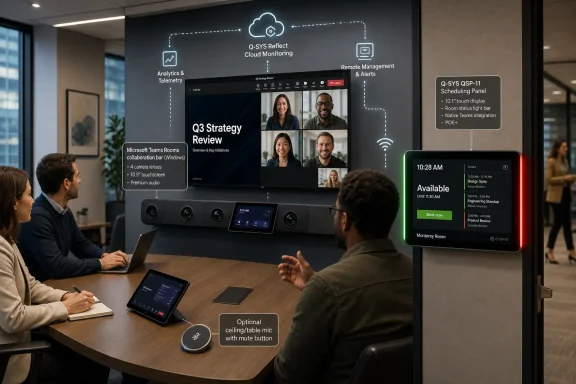
The Q-SYS RoomSuite Collaboration Bar is described as a Windows-based device for Microsoft Teams Rooms, designed for common, repeatable collaboration spaces. It has four 50-megapixel cameras, a 16-element microphone array, integrated loudspeakers, and a dedicated 10.9-inch touchscreen for meeting and device control. It also supports up to four RoomSuite Table Microphone accessories, each intended to expand pickup coverage and give participants a physical mute button.On paper, that sounds like the expected spec sheet for a modern collaboration bar: multi-camera imaging, beamforming microphone coverage, built-in speakers, and a touch controller in the box. But the Windows-based Teams Rooms detail is important. Q-SYS is choosing to sit inside Microsoft’s managed-room ecosystem rather than pitch a parallel collaboration experience.
That matters because Teams Rooms on Windows remains a major enterprise standard, particularly where organizations want tighter integration with Microsoft 365 administration, familiar update channels, peripheral certification, and security controls. Android-based Teams devices have become increasingly capable, but Windows-based MTR systems still carry weight in organizations that treat meeting rooms as managed Windows endpoints with attached AV.
The catch is certification. QSC says the RoomSuite Collaboration Bar is currently in the process of achieving Microsoft Teams certification. That wording should make cautious IT teams pause before treating the device as production-ready for standardized deployment at scale. “In process” is not the same as certified, and Microsoft Teams Rooms certification exists precisely because audio, video, firmware, and user experience need to survive more than a demo.
Still, the direction is clear. Q-SYS wants the bar to serve the spaces where a full custom Core-based design may be excessive, while still leaving room to expand into the broader Q-SYS ecosystem when the room grows more complex.
The Scheduling Panel Shows Where the Real Platform Play Begins
The Q-SYS Scheduling Panel, model QSP-11, may be the less glamorous product, but it may be the more revealing one. It is built on the Microsoft Device Ecosystem Platform, runs as a Teams Panel, and is certified for Teams. It has a 10.95-inch display, 1920-by-1200 resolution, anti-glare and oleophobic glass, side light bars for room status, proximity wake, Power over Ethernet, optional Wi-Fi with DC power, and mounting options for walls, glass, or mullions.A scheduling panel is easy to underestimate because it looks like a commodity. Every modern office has seen these things: a screen outside the door, green when the room is free, red when occupied, with a button to reserve now or extend a meeting. In practice, scheduling panels are where the workplace promise either feels seamless or starts to fray.
The QSP-11 matters because it ties room identity to the Q-SYS management layer. QSC emphasizes integration with Q-SYS Reflect, its cloud-based monitoring and management service, and says the panel can integrate with any Q-SYS system through Reflect. That positions the scheduler not as a standalone Teams accessory but as another sensor and control surface in a larger workplace fabric.
For IT administrators, this is the difference between “a screen on the wall” and “another managed object in the collaboration estate.” The former is purchased by facilities and forgotten until the battery dies, the mount slips, or the room calendar stops syncing. The latter participates in monitoring, alerts, lifecycle management, and fleet visibility.
Microsoft’s Device Ecosystem Platform is part of that story. MDEP is designed to give device makers a more secure, manageable Android-based foundation for Teams devices, with Microsoft services and management expectations closer to the center. By building the QSP-11 on MDEP, Q-SYS is signaling that the scheduling panel is not a one-off accessory. It is meant to fit into Microsoft’s modern device-management model.
The Office Is Becoming a Sensor Network With Conference Tables
The phrase “space intelligence” appears often in workplace technology marketing, usually alongside glossy renders of offices where nobody appears to have a backpack, a coffee stain, or a meeting that should have been an email. But behind the jargon is a genuine shift: organizations are trying to measure how rooms are used, how often they fail, and whether expensive office footprints match hybrid-work reality.Q-SYS is leaning into that shift with Reflect and, according to its announcement, new integration into Microsoft Places as a data integration partner. Microsoft Places is Microsoft’s hybrid-workplace product for coordinating office presence, room usage, and location-aware workplace planning. For Q-SYS, plugging into that orbit makes strategic sense. If Teams is the meeting layer and Places becomes the workplace-planning layer, then AV systems become data-producing endpoints.
That should interest sysadmins as much as facilities managers. The old AV mental model was largely reactive: a user reports that a microphone is dead, someone checks the rack, and a ticket begins its slow journey through IT, AV, facilities, and vendor support. The newer model is supposed to be telemetry-driven: the platform knows a room is offline, knows the panel has lost contact, knows the processor is unreachable, and may know enough to flag the problem before the next executive steering committee call implodes.
There is a practical payoff if it works. Standardized monitoring across collaboration bars, scheduling panels, Core-based rooms, and high-impact spaces could help organizations maintain mixed estates without pretending every room should be identical. A small Teams room and a divisible training suite have different requirements, but they can still report into the same operational view.
The risk is that “space intelligence” becomes another dashboard nobody owns. Workplace data is only valuable if an organization has a governance model for acting on it. If room telemetry goes to AV, booking data goes to facilities, device health goes to IT, and budget authority lives somewhere else, then intelligence becomes a prettier form of fragmentation.
Microsoft Teams Rooms Has Become the Gravity Well
The Q-SYS launch also reinforces a broader industry reality: Teams Rooms has become one of the gravitational centers of enterprise AV. Vendors do not merely support Teams; they design around it, certify for it, and structure hardware portfolios to fit Microsoft’s meeting-room categories. The meeting room is no longer a neutral space where the AV system sits above the collaboration platform. Increasingly, the collaboration platform defines the room.That has benefits. Teams Rooms gives users a familiar interface, administrators a known management plane, and procurement teams a certification framework. A Teams-certified device has, at least in theory, passed audio, video, user-interface, and reliability expectations defined by Microsoft. In large organizations, that can reduce the chaos of one-off designs and unsupported USB contraptions.
It also creates dependency. When a room is a Teams room, the Teams update cycle, certification matrix, device support lifecycle, and Microsoft admin center become part of the AV experience. A camera bug is no longer just a camera bug. It may involve Windows updates, Teams Rooms app versions, firmware, drivers, network policy, conditional access, Intune configuration, and vendor support boundaries.
Q-SYS knows this terrain because its existing Teams integrations already sit at the junction of AV and IT. The difference now is that the company is putting more complete, room-shaped products into that junction. That is both opportunity and exposure. A platform vendor can solve more problems, but it also inherits more blame when the user presses “Join” and nothing happens.
For WindowsForum’s audience, the Windows-based RoomSuite bar is especially notable. It suggests Q-SYS is targeting environments where Teams Rooms on Windows remains the standard operating model, rather than trying to win solely on low-touch Android appliances. That may appeal to enterprises with mature Windows endpoint practices, but it also means Q-SYS must meet the operational expectations of IT teams used to imaging, patching, compliance, and lifecycle discipline.
The Bar-and-Panel Bundle Aims at the Middle of the Room Market
The most interesting strategic move here is not that Q-SYS has a new bar. It is that the company is trying to occupy the middle ground between commodity appliances and full custom AV systems. That middle has become extremely valuable because hybrid work has made meeting-room quality visible to everyone, not just executives.Before the pandemic-era collaboration reset, many organizations tolerated uneven room quality. A few prestige rooms received serious AV design, while smaller spaces limped along with webcams, puck microphones, or a speakerphone dragged from a drawer. Hybrid meetings exposed the weakness of that model. Remote participants became second-class attendees whenever the room could not frame faces, capture voices, or manage echo.
The obvious answer was to standardize. But standardization has its own trap: not all rooms fit the same appliance. Some need more microphone coverage. Some need better camera positioning. Some need local reinforcement, control integration, room combining, divisible layouts, overflow audio, assistive listening, or integration with lighting and shades. The collaboration bar solved many rooms, but not all rooms.
Q-SYS is trying to say: start simple, but do not strand yourself. The RoomSuite Collaboration Bar handles the repeatable room. Table microphones stretch it into larger or more flexible spaces. The scheduling panel brings room booking into the same orbit. Reflect gives administrators a cloud management story. Existing Q-SYS Core systems remain available for high-impact spaces.
That is a coherent portfolio argument. It is also one that competes directly with the simplicity pitch from appliance-first vendors. Q-SYS has to convince buyers that its platform value is worth any additional cost, learning curve, or ecosystem commitment. In a small room with no special requirements, a simpler bar from a commodity vendor may still be easier to justify.
Certification Is the Line Between Launch and Deployment
The QSP-11 scheduling panel is certified for Teams. The RoomSuite Collaboration Bar is not yet described as certified; it is in the process of achieving Microsoft Teams certification. That distinction should not be glossed over.In enterprise collaboration, certification is more than a marketing badge. It is a risk-control mechanism. IT teams need to know whether a device is supported in the platform’s management tools, whether updates are coordinated, whether performance has been validated, and whether Microsoft will recognize the configuration as within the supported ecosystem. The larger the deployment, the less appetite there is for “almost certified.”
That does not make the RoomSuite bar uninteresting. Many products are announced before certification is complete, and vendors often use launch windows to build channel awareness before broad availability. But it does mean procurement teams should treat certification status as a gating item, not a footnote.
This is especially true for Microsoft Teams Rooms because the experience is a chain. A beautiful camera array cannot compensate for unstable Teams behavior. A clever microphone system cannot fix a device that falls outside supported update paths. A great touch controller is only useful if it behaves predictably after Microsoft, Windows, firmware, and vendor software all take their turns at the room.
Q-SYS has an advantage here because it is not entering Teams Rooms from nowhere. Its existing Microsoft-oriented AV portfolio gives it credibility, and the scheduling panel’s certified status shows the company can work inside Microsoft’s device ecosystem. But the Collaboration Bar will ultimately be judged by the dullest enterprise criteria imaginable: certification, manageability, supportability, and repeatability.
The Admin Story Is Strongest When It Admits the Room Is a Fleet
The best part of the Q-SYS argument is the idea that collaboration spaces should be managed as a fleet. That is how IT already thinks about laptops, phones, access points, printers, and increasingly kiosks and digital signage. Meeting rooms are simply late to the discipline because AV historically lived in its own procurement and support culture.A fleet mindset changes the questions. Instead of asking whether one demo room looks impressive, administrators ask how 200 rooms are enrolled, monitored, updated, secured, and retired. They ask whether every device has an owner, whether telemetry is actionable, whether alerts route to the right team, and whether support can distinguish a network issue from a device issue from a user issue.
Q-SYS Reflect is central to that pitch. If Reflect can give administrators a coherent view across RoomSuite bars, scheduling panels, and Core-based systems, then Q-SYS can reduce one of the worst problems in enterprise AV: mixed-room opacity. Many organizations have rooms built across several years, several vendors, several standards, and several generations of collaboration technology. The result is often a museum of good intentions.
The Q-SYS approach says the room estate does not have to be uniform to be manageable. That is a persuasive claim because uniformity is rarely real. Companies merge, buildings differ, budgets shift, and executive spaces always become exceptions. A platform that can manage repeatable rooms and custom spaces under one operational model has real appeal.
But the burden is on Q-SYS to make that model feel like modern IT, not classic AV wrapped in cloud branding. Admins will expect role-based access, clear update handling, useful alerts, inventory visibility, lifecycle reporting, and integrations that do not require artisanal care. The more Q-SYS sells to IT rather than AV specialists, the more it will be judged by IT standards.
The User Experience Still Comes Down to One Button
All of the platform strategy in the world eventually collapses into a user standing in a room, late for a call, staring at a touch panel. That is why the dedicated 10.9-inch touchscreen with the RoomSuite Collaboration Bar matters. The meeting-room controller is not glamorous, but it is the place where user trust is either created or destroyed.Users do not care whether the bar is Windows-based, MDEP powers the panel, Reflect monitors the fleet, or Microsoft Places receives space data. They care whether the meeting appears, whether the Join button works, whether the camera frames people properly, whether the room mutes when they ask it to, and whether remote participants can hear everyone. The enterprise buyer may purchase a platform; the employee experiences a button.
This is where Teams Rooms has made the market both easier and harder. Easier, because the interface is familiar and the user journey is standardized. Harder, because users now expect every certified or Teams-aligned room to behave like every other one. Any deviation feels like failure.
The RoomSuite Collaboration Bar’s multi-camera design and microphone expansion are clearly meant to address the messy realities of physical rooms. A single camera location can be a compromise, especially in longer rooms or spaces with flexible furniture. Table microphones can improve coverage when the integrated array is not enough. The mute button on the accessory microphones is a small but important concession to user behavior: people trust physical controls when the stakes are social.
Still, the all-in-one form factor has limits. Mounting height, table length, glass walls, HVAC noise, reflective surfaces, and seating layouts all affect performance. Q-SYS can mitigate those problems with expansion accessories and platform know-how, but it cannot repeal physics. That is precisely why the company’s hybrid strategy — simple where possible, expandable where necessary — is more credible than pretending one bar conquers every room.
The Competitive Pressure Is Coming From Both Ends
Q-SYS is being squeezed from two directions. From below, appliance vendors are making better bars, better management portals, and better bundles. From above, traditional AV expectations remain unforgiving in complex spaces where audio quality, control flexibility, and reliability are non-negotiable.The appliance vendors have a powerful story: fast deployment, lower complexity, predictable user experience, and clear certification. They win when rooms are standard, budgets are tight, and IT wants fewer moving parts. In that world, Q-SYS must prove that its platform value does not introduce unnecessary overhead.
The high-end AV world has a different pressure. It asks whether simplified RoomSuite products can preserve the quality and flexibility that made Q-SYS attractive in the first place. Integrators and advanced customers will watch closely for how the new devices interact with existing Q-SYS designs, licensing, monitoring, and control workflows. If the products feel too closed, they risk looking like me-too appliances. If they feel too complex, they lose the appliance fight.
That balancing act is difficult but potentially rewarding. The room market is not neatly divided into “simple” and “custom.” Many organizations want a standard kit that can be adapted without becoming a science project. They want the confidence of a platform but the deployment speed of an appliance. They want IT manageability without giving up the ability to handle a boardroom that does not behave like a huddle room.
This is where Q-SYS has a plausible opening. Its brand already means something in professional AV, and its Microsoft alignment gives it a route into IT-led collaboration procurement. The new RoomSuite products are an attempt to make those two worlds meet before a competitor defines the middle without it.
The Windows Angle Is Bigger Than the Spec Sheet
A Windows-based Teams Rooms device carries implications beyond compatibility. It places the RoomSuite Collaboration Bar in the same conceptual category as other Windows endpoints that enterprises already secure, patch, monitor, and audit. That can be an advantage for organizations with established Microsoft management practices, but it also raises expectations.Windows meeting-room systems are not generic PCs, but they still live in the Windows ecosystem. That means administrators think about update rings, device accounts, Teams Rooms app versions, identity, policy, network access, and security baselines. If the room is down because of an update conflict, the end user will not distinguish between the AV vendor, Microsoft, and the internal endpoint team.
The collaboration bar market has partly shifted toward Android appliances because they promise simpler lifecycle management and fewer moving parts. Windows-based rooms persist because they offer flexibility, maturity, and fit with Microsoft-heavy enterprise operations. Q-SYS choosing Windows for the bar suggests it is aiming at customers who value that fit.
The QSP-11, meanwhile, is Android-based through MDEP for Teams Panel use. That gives Q-SYS a split-platform portfolio: Windows in the room for the Teams Rooms device, MDEP Android at the doorway for scheduling. That is not unusual in modern Teams deployments, but it reinforces the need for unified management above the device layer.
Reflect is the bridge Q-SYS wants to provide. Microsoft’s admin tools manage Teams devices from the collaboration-platform side; Q-SYS Reflect watches the AV estate from the systems side. The promise is that admins get the best of both views. The danger is that they get another pane of glass unless integration and operational ownership are clearly defined.
The Smart Money Watches the Lifecycle, Not the Launch Demo
Product launches in AV tend to emphasize the visible: resolution, microphones, touchscreens, mounting, and elegant conference-room renders. Enterprise value usually hides in the lifecycle. The devices that win are not merely the ones that look good on day one; they are the ones that remain supportable after two years of updates, office moves, network changes, and staff turnover.For Q-SYS, the lifecycle question cuts several ways. How fast will the RoomSuite Collaboration Bar complete Teams certification? How cleanly will it enroll into Microsoft’s management ecosystem? How will firmware updates be staged and reported? How will Reflect represent mixed deployments? How will Q-SYS support integrators and IT teams when a problem spans Microsoft Teams, Windows, network policy, audio processing, and hardware?
There is also the procurement question. Q-SYS has historically been associated with powerful, professional systems that can be cost-effective in the right context but are not always the cheapest answer to a small-room problem. The RoomSuite Collaboration Bar will need to be priced and packaged carefully if it is to compete in standardized room rollouts against appliance vendors with aggressive bundles.
The scheduling panel may face a different hurdle. Teams panels are well understood, and the QSP-11’s value will depend on how much organizations care about tying booking surfaces into the Q-SYS monitoring and workplace-intelligence story. If an enterprise already uses Q-SYS widely, that integration could be compelling. If it only needs a door panel, the argument becomes thinner.
The broader bet is that more organizations will decide meeting rooms are too important to manage piecemeal. Hybrid work made room quality a business issue. Real estate pressure made room utilization a finance issue. Security and manageability made collaboration devices an IT issue. Q-SYS is packaging itself for that convergence.
The New Q-SYS RoomsSuite Pitch Has Five Moving Parts
The launch is best understood as a portfolio move rather than a gadget announcement. The Collaboration Bar, the QSP-11 panel, Reflect, Teams integration, and Microsoft Places alignment all point in the same direction: Q-SYS wants the modern workplace to be designed, monitored, and optimized as a connected system.- The Q-SYS RoomSuite Collaboration Bar is aimed at repeatable Microsoft Teams Rooms spaces, not the bespoke high-impact rooms where Q-SYS first built much of its reputation.
- The bar’s four 50-megapixel cameras, 16-element microphone array, integrated speakers, and optional table microphones show Q-SYS trying to stretch the all-in-one category without abandoning simplicity.
- The QSP-11 scheduling panel is already certified for Teams and built on Microsoft’s Device Ecosystem Platform, making it a more immediately deployable Microsoft-aligned product than the still-pending Collaboration Bar.
- Q-SYS Reflect is the strategic glue, because centralized monitoring and management are what could make these devices feel like part of an IT fleet rather than isolated AV endpoints.
- The Microsoft Places integration points toward a future where meeting-room hardware feeds workplace analytics, not just meetings.
- The open question is whether Q-SYS can make its broader platform feel simple enough for standardized rollouts while remaining powerful enough for the complex rooms that made customers choose Q-SYS in the first place.
References
- Primary source: Inavate Magazine
Published: 2026-06-08T09:42:07.808771
Q-SYS launches Q-SYS RoomSuite collaboration bar and scheduling panel
QSC has added to its Q-SYS workplace portfolio with the launch of the Q-SYS RoomSuite collaboration bar and Q-SYS scheduling panel.Together with recent expansiowww.inavateonthenet.net - Related coverage: qsys.com
Q-SYS Scheduling Panel
www.qsys.com
- Related coverage: support.qsys.com
FAQ | Which UC platforms is Q-SYS RoomSuite Modular System certified for? - Q-SYS
Answer Q-SYS RoomSuite Modular System supports Bring Your Own Meeting (BYOM), Microsoft Teams Rooms (MTR), and Zoom Rooms (ZR) compatibility modes. MTR comsupport.qsys.com
- Related coverage: de.qsys.com
- Related coverage: jp.qsys.com
QSCがスケーラブルなQ-SYS™コラボレーションソリューションを発売し、商業施設およびエンターテインメントアプリケーションを拡張
QSC は、コラボレーション、商業施設、エンターテイメントスペース向けの新しい Q-SYS ソリューションを発表します。jp.qsys.com
- Related coverage: qsysasia.cn
- Related coverage: software.qsc.com
My Document
</rdf:Alt> </dc:description> <dc:creator> <rdf:Seq> <rdf:li>Charlie_Abrischsoftware.qsc.com
- Related coverage: kr.qsys.com
