

Ilya Bukshteyn, Microsoft’s corporate vice president for Teams Calling, Meetings and Devices, will deliver an InfoComm 2026 keynote on Wednesday, June 17, at 1:30 p.m., framing Microsoft Teams as the front door to an AI-powered workplace built around rooms, meetings, devices, and agents. That is not merely a conference pitch for the pro AV crowd. It is Microsoft’s clearest signal yet that the meeting room is becoming a compute surface, not just a place with a camera and a table. The company’s bet is that the next phase of hybrid work will be won by whoever controls the conversation between humans, rooms, and AI systems.
For years, the conference room was treated as a hardware problem. The industry argued over cameras, microphones, codecs, control panels, certified peripherals, and whether a room could be made simple enough that an executive would not summon IT before every call. Microsoft’s latest Teams Rooms message moves the center of gravity away from hardware alone and toward intelligence layered across the room.
Bukshteyn’s framing is revealing because he does not describe AI as a feature tucked inside Teams. He describes it as something that participates in work. Dictation, noise suppression, smart framing, and transcription were the warm-up act; the main event is the arrival of what Microsoft increasingly calls agentic co-workers.
That phrase can sound like enterprise marketing fog, but the operational claim underneath it is concrete. If AI is listening, summarizing, identifying speakers, understanding location context, and helping route follow-up work, then the room is no longer simply carrying a meeting. It is generating structured data from the meeting, feeding that data into productivity systems, and shaping what people do after they leave.
For WindowsForum readers, the interesting part is not whether Microsoft can produce a slick keynote demo. Microsoft can always produce a slick keynote demo. The more consequential question is whether Teams Rooms becomes another managed Windows estate with cameras attached, a new identity-and-compliance surface, and a dependency chain that runs from endpoint firmware to Microsoft 365 Copilot.
The problem is that hybrid meetings remain socially and technically uneven. In-room participants can see side conversations, body language, and who is about to interrupt. Remote participants often get a panoramic view of distant heads, a microphone mix that flattens voices, and a creeping sense that the real meeting is happening somewhere else.
Microsoft’s answer is to treat the inclusivity gap as an AI problem. Cloud IntelliFrame, speaker recognition, intelligent audio processing, and meeting recap features are all attempts to give the remote participant something closer to a seat at the table. Instead of one camera feed representing “the room,” AI breaks the room into people, voices, frames, and signals.
That is a real improvement when it works. It is also a quiet admission that the first decade of modern videoconferencing did not solve the hardest problem. We connected rooms to calls, but we did not make the room legible to the people outside it.
That matters because representation is power in a meeting. Who is visible, who is centered, who is identified, and who appears as part of a crowd all affect participation. Microsoft’s claim is that AI can correct the old bias of the conference room, where the people physically present were naturally advantaged.
But IntelliFrame also shows the administrative complexity of the new workplace stack. A feature that sounds simple to users depends on room licensing, supported devices, camera behavior, tenant policy, user controls, and IT’s willingness to let cloud intelligence process room video. The “AI-powered workplace” is not a magic layer sprinkled over existing rooms; it is a managed architecture.
That is where the pro AV world and the Windows admin world increasingly overlap. Integrators can no longer think only in terms of signal flow, sight lines, acoustics, and device placement. They have to understand identity, policy, endpoint health, update cadence, and the consequences of handing more meeting context to cloud services.
Bukshteyn’s comments about keeping thousands of rooms healthy are aimed directly at enterprise scale. One room with a bad microphone is an annoyance. Five thousand rooms with inconsistent camera firmware, failed sign-ins, missing updates, and flaky peripherals are an operations problem.
Microsoft’s strategic advantage is that it can make the room part of the Microsoft 365 estate. The same organization already paying for Teams, Entra ID, Intune, Defender, Purview, and Copilot is being invited to treat meeting spaces as another managed workplace endpoint. That is powerful because it simplifies procurement logic, but it also deepens platform dependence.
The AV integrator may install the room, but the tenant admin increasingly defines what the room is allowed to do. That shift changes who has authority, who gets blamed when things fail, and who owns the data generated by meetings. The glossy keynote version calls this intelligent workplace transformation. The sysadmin version calls it another fleet.
That is why room quality suddenly matters in a different way. A human can infer meaning from a bad microphone mix, a half-visible whiteboard, or a remote participant whose name was not captured correctly. An AI system is far less forgiving. Bad inputs become bad summaries, misattributed comments, missing action items, and automation that confidently misunderstands what happened.
In that sense, the pro AV industry is being promoted and burdened at the same time. Better cameras and microphones are no longer just about participant experience. They are about feeding the machine-readable record of work. Acoustic treatment, camera placement, speaker identification, and device health become part of the AI pipeline.
This is where Microsoft’s story is strongest. If enterprises are going to rely on Copilot and agents to summarize meetings, draft follow-ups, and reason over collaboration history, then meeting capture must be more reliable than the average laptop webcam and ceiling microphone can provide. The room becomes infrastructure for knowledge work.
Microsoft will argue, as it usually does, that enterprise controls, tenant policies, compliance tooling, and security architecture can manage this responsibly. In many regulated organizations, that argument will be persuasive only if administrators can show exactly what is captured, where it is processed, how long it is retained, and who can query it later. The pro AV keynote version of AI is about presence and productivity; the governance version is about boundaries.
The phrase agentic co-worker also raises a practical identity problem. Human coworkers have roles, managers, permissions, responsibilities, and consequences. AI agents need equivalents: scopes, logs, approvals, audit trails, and limits. If Teams becomes the place where human and AI coworkers collaborate, then Teams governance becomes AI governance.
The meeting room makes that governance harder because it is a shared endpoint. A personal device generally maps to a user. A room maps to a space, a schedule, a device account, and a rotating cast of participants. That complexity is manageable, but it is not trivial, and it should not be hidden behind the language of seamless collaboration.
Organizations want to know which spaces are used, which rooms fail, which teams come in together, and whether expensive office footprints match actual behavior. Microsoft’s pitch is that workplace intelligence can help shape those decisions. That is a reasonable business case, and it may save companies from designing offices around anecdotes.
It also changes the meaning of occupancy. A badge swipe tells a company that someone entered a building. A room system, calendar signal, meeting transcript, device health record, and workplace analytics layer can tell a much richer story. The richer the story, the more carefully it needs to be governed.
This is the pattern across Microsoft’s AI workplace strategy. Every productivity gain has a corresponding data expansion. Every smart feature turns previously ephemeral behavior into something that can be processed, summarized, measured, or acted upon.
This is not inherently bad. Enterprises often prefer predictable managed services over bespoke room setups that age badly. Standardization can reduce support burden, improve security posture, and deliver features faster than forklift hardware upgrades.
But it means buyers must read the roadmap differently. The question is not simply whether a camera or room system supports Teams today. It is whether the room will support the AI features Microsoft makes central tomorrow, whether those features require a Pro license, whether they depend on specific cameras or intelligent speakers, and whether the organization is comfortable with the cloud processing model.
For IT pros, the lesson is familiar from Windows, Office, and Microsoft 365: the product is no longer the thing you install. The product is the evolving service you continuously administer.
But the industry should also recognize the shift in accountability. If AI summaries are poor because the room audio is bad, the AV design becomes a productivity problem. If remote participants are excluded because camera coverage is weak, the room design becomes an equity problem. If device health is inconsistent, the integrator’s choices become part of the IT operations story.
That is a higher-value role, but it is also a more exposed one. Pro AV vendors and integrators will need to speak the language of security reviews, management portals, device enrollment, network segmentation, and data residency. The best firms already do; the rest will find that “it works in the room” is no longer enough.
Microsoft’s keynote is therefore not just a product message. It is a labor-market message to an industry being absorbed into enterprise IT. The future conference room will be judged less by whether the picture looks good on opening day and more by whether the space remains intelligent, compliant, measurable, and reliable for years.
That is exactly how platform shifts take hold. Users adopt the feature because it removes friction, then organizations build processes around the feature, and only later does everyone realize the feature has changed expectations. Once meeting summaries become normal, not having one feels like a failure. Once rooms identify participants, anonymous room audio feels obsolete. Once AI agents can act on meeting context, a meeting without structured output looks wasteful.
The danger is that convenience can outrun literacy. Users need to understand when AI is listening, what it is doing with the meeting, and where the resulting artifacts go. They also need controls that are understandable in the moment, not buried in tenant documentation or admin portals.
Microsoft has been here before. Teams itself became essential faster than many organizations could develop healthy norms around chat overload, meeting sprawl, and notification fatigue. AI in Teams Rooms could repeat that pattern unless enterprises pair deployment with policy, training, and cultural restraint.
That is the optimistic version. The pessimistic version is that organizations will generate more meetings because AI makes them easier to digest afterward. Recording, summarizing, and delegating do not automatically make a meeting worth holding. They can simply make bad meetings more scalable.
The better outcome requires discipline. AI should reduce the need for status meetings, not preserve them in summarized form. It should help teams make decisions faster, not produce polished recaps of ambiguity. It should expose when a meeting lacked a decision, not pretend that every discussion produced progress.
That is why Microsoft’s claim that AI is foundational to the future of work deserves both attention and skepticism. Foundation is not the same as solution. AI can improve the mechanics of collaboration, but it cannot decide whether an organization knows how to collaborate.
A pilot in a showcase boardroom tells only part of the story. The real test is the ordinary room on the third floor with imperfect lighting, a legacy display, a camera mounted too high, a device account nobody has audited recently, and users who expect everything to work because the calendar invite says “Teams.” AI does not eliminate that mess; it often reveals it.
Enterprises should also resist buying the keynote as destiny. Microsoft’s roadmap is influential, but customers still have leverage in how they configure, govern, and pace adoption. Not every room needs every AI feature on day one, and not every meeting deserves the same level of capture.
The winners will be organizations that treat AI rooms as part of a broader workplace architecture, not a gadget refresh. That means aligning facilities, IT, security, legal, HR, and end users before the procurement order goes out.
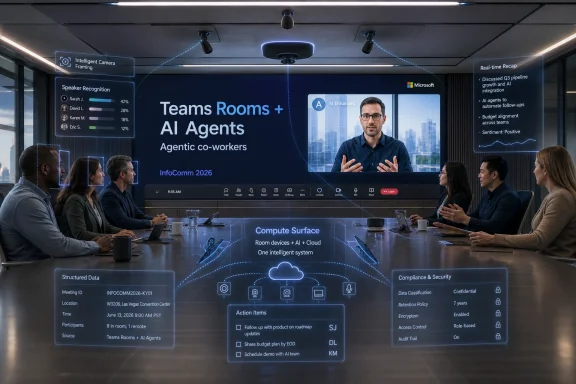 Microsoft Is Turning the Meeting Room Into an AI Endpoint
For years, the conference room was treated as a hardware problem. The industry argued over cameras, microphones, codecs, control panels, certified peripherals, and whether a room could be made simple enough that an executive would not summon IT before every call. Microsoft’s latest Teams Rooms message moves the center of gravity away from hardware alone and toward intelligence layered across the room.Bukshteyn’s framing is revealing because he does not describe AI as a feature tucked inside Teams. He describes it as something that participates in work. Dictation, noise suppression, smart framing, and transcription were the warm-up act; the main event is the arrival of what Microsoft increasingly calls agentic co-workers.
That phrase can sound like enterprise marketing fog, but the operational claim underneath it is concrete. If AI is listening, summarizing, identifying speakers, understanding location context, and helping route follow-up work, then the room is no longer simply carrying a meeting. It is generating structured data from the meeting, feeding that data into productivity systems, and shaping what people do after they leave.
For WindowsForum readers, the interesting part is not whether Microsoft can produce a slick keynote demo. Microsoft can always produce a slick keynote demo. The more consequential question is whether Teams Rooms becomes another managed Windows estate with cameras attached, a new identity-and-compliance surface, and a dependency chain that runs from endpoint firmware to Microsoft 365 Copilot.
Hybrid Work Won, But the Room Still Lost
The return-to-office debate has often been framed as a cultural tug-of-war between managers and employees. Bukshteyn’s answer cuts through that framing: people may be coming back to offices, but work remains distributed across geographies, time zones, and partner organizations. That is the reality Teams was built to exploit, and it is the reality that keeps video meetings from receding even as badge swipes rise.The problem is that hybrid meetings remain socially and technically uneven. In-room participants can see side conversations, body language, and who is about to interrupt. Remote participants often get a panoramic view of distant heads, a microphone mix that flattens voices, and a creeping sense that the real meeting is happening somewhere else.
Microsoft’s answer is to treat the inclusivity gap as an AI problem. Cloud IntelliFrame, speaker recognition, intelligent audio processing, and meeting recap features are all attempts to give the remote participant something closer to a seat at the table. Instead of one camera feed representing “the room,” AI breaks the room into people, voices, frames, and signals.
That is a real improvement when it works. It is also a quiet admission that the first decade of modern videoconferencing did not solve the hardest problem. We connected rooms to calls, but we did not make the room legible to the people outside it.
IntelliFrame Is the Small Feature With the Big Subtext
Cloud IntelliFrame sounds modest: it uses AI to create more useful video views of people in a Teams Room. In practice, it is one of the most important clues to Microsoft’s direction. The room camera is no longer just a camera; it is an input device feeding cloud models that decide how a meeting should be visually represented.That matters because representation is power in a meeting. Who is visible, who is centered, who is identified, and who appears as part of a crowd all affect participation. Microsoft’s claim is that AI can correct the old bias of the conference room, where the people physically present were naturally advantaged.
But IntelliFrame also shows the administrative complexity of the new workplace stack. A feature that sounds simple to users depends on room licensing, supported devices, camera behavior, tenant policy, user controls, and IT’s willingness to let cloud intelligence process room video. The “AI-powered workplace” is not a magic layer sprinkled over existing rooms; it is a managed architecture.
That is where the pro AV world and the Windows admin world increasingly overlap. Integrators can no longer think only in terms of signal flow, sight lines, acoustics, and device placement. They have to understand identity, policy, endpoint health, update cadence, and the consequences of handing more meeting context to cloud services.
Microsoft’s Real Audience Is Not Just the AV Buyer
InfoComm is a natural venue for this message because AV professionals are being pulled into IT’s orbit. The old model of designing rooms around displays, cameras, and audio gear is giving way to a model where room systems are enrolled, licensed, monitored, patched, and governed. Microsoft Teams Rooms Pro Management is not a side note in that world; it is part of the control plane.Bukshteyn’s comments about keeping thousands of rooms healthy are aimed directly at enterprise scale. One room with a bad microphone is an annoyance. Five thousand rooms with inconsistent camera firmware, failed sign-ins, missing updates, and flaky peripherals are an operations problem.
Microsoft’s strategic advantage is that it can make the room part of the Microsoft 365 estate. The same organization already paying for Teams, Entra ID, Intune, Defender, Purview, and Copilot is being invited to treat meeting spaces as another managed workplace endpoint. That is powerful because it simplifies procurement logic, but it also deepens platform dependence.
The AV integrator may install the room, but the tenant admin increasingly defines what the room is allowed to do. That shift changes who has authority, who gets blamed when things fail, and who owns the data generated by meetings. The glossy keynote version calls this intelligent workplace transformation. The sysadmin version calls it another fleet.
AI Coworkers Need Better Rooms Than Humans Did
The most provocative part of Bukshteyn’s argument is that meeting spaces will carry conversations not only among humans, but between humans and AI agents. That sounds futuristic until one remembers that Teams meetings already generate transcripts, summaries, action items, speaker attributions, and searchable meeting artifacts. An agent does not need a robot body to become a participant; it needs access to context.That is why room quality suddenly matters in a different way. A human can infer meaning from a bad microphone mix, a half-visible whiteboard, or a remote participant whose name was not captured correctly. An AI system is far less forgiving. Bad inputs become bad summaries, misattributed comments, missing action items, and automation that confidently misunderstands what happened.
In that sense, the pro AV industry is being promoted and burdened at the same time. Better cameras and microphones are no longer just about participant experience. They are about feeding the machine-readable record of work. Acoustic treatment, camera placement, speaker identification, and device health become part of the AI pipeline.
This is where Microsoft’s story is strongest. If enterprises are going to rely on Copilot and agents to summarize meetings, draft follow-ups, and reason over collaboration history, then meeting capture must be more reliable than the average laptop webcam and ceiling microphone can provide. The room becomes infrastructure for knowledge work.
The Privacy Debate Is Moving From Chat Logs to Physical Space
There is an obvious tension in Microsoft’s vision: the more useful AI becomes in meetings, the more intimate the data it needs. A chat message is explicit. A meeting room is full of ambient context: faces, voices, attendance patterns, seating behavior, interruptions, reactions, and sometimes sensitive side conversations before someone remembers the meeting is live.Microsoft will argue, as it usually does, that enterprise controls, tenant policies, compliance tooling, and security architecture can manage this responsibly. In many regulated organizations, that argument will be persuasive only if administrators can show exactly what is captured, where it is processed, how long it is retained, and who can query it later. The pro AV keynote version of AI is about presence and productivity; the governance version is about boundaries.
The phrase agentic co-worker also raises a practical identity problem. Human coworkers have roles, managers, permissions, responsibilities, and consequences. AI agents need equivalents: scopes, logs, approvals, audit trails, and limits. If Teams becomes the place where human and AI coworkers collaborate, then Teams governance becomes AI governance.
The meeting room makes that governance harder because it is a shared endpoint. A personal device generally maps to a user. A room maps to a space, a schedule, a device account, and a rotating cast of participants. That complexity is manageable, but it is not trivial, and it should not be hidden behind the language of seamless collaboration.
Microsoft Places Turns the Office Into a Dataset
Bukshteyn’s mention of Microsoft Places is more important than it may first appear. Teams Rooms AI improves the meeting itself; Places connects those meetings to the broader question of how offices are used. In a world where hybrid work is permanent but real estate costs remain very physical, location intelligence becomes executive catnip.Organizations want to know which spaces are used, which rooms fail, which teams come in together, and whether expensive office footprints match actual behavior. Microsoft’s pitch is that workplace intelligence can help shape those decisions. That is a reasonable business case, and it may save companies from designing offices around anecdotes.
It also changes the meaning of occupancy. A badge swipe tells a company that someone entered a building. A room system, calendar signal, meeting transcript, device health record, and workplace analytics layer can tell a much richer story. The richer the story, the more carefully it needs to be governed.
This is the pattern across Microsoft’s AI workplace strategy. Every productivity gain has a corresponding data expansion. Every smart feature turns previously ephemeral behavior into something that can be processed, summarized, measured, or acted upon.
The New Teams Room Is a Subscription, Not a Room
One of the least romantic but most important consequences of Microsoft’s direction is the continuing migration of meeting-room value into software licensing. A room used to be a capital project: buy hardware, install it, maintain it, replace it years later. The modern Teams Room is increasingly a subscription experience with feature gates, management tiers, AI services, and cloud dependencies.This is not inherently bad. Enterprises often prefer predictable managed services over bespoke room setups that age badly. Standardization can reduce support burden, improve security posture, and deliver features faster than forklift hardware upgrades.
But it means buyers must read the roadmap differently. The question is not simply whether a camera or room system supports Teams today. It is whether the room will support the AI features Microsoft makes central tomorrow, whether those features require a Pro license, whether they depend on specific cameras or intelligent speakers, and whether the organization is comfortable with the cloud processing model.
For IT pros, the lesson is familiar from Windows, Office, and Microsoft 365: the product is no longer the thing you install. The product is the evolving service you continuously administer.
The AV Industry Is Being Drafted Into the AI Stack
InfoComm’s audience will hear plenty of optimism about AI collaboration, and much of it will be justified. Better framing, better audio, healthier rooms, and smarter occupancy planning are useful. Anyone who has spent years watching remote participants struggle to follow in-room conversations should welcome serious investment in fixing that experience.But the industry should also recognize the shift in accountability. If AI summaries are poor because the room audio is bad, the AV design becomes a productivity problem. If remote participants are excluded because camera coverage is weak, the room design becomes an equity problem. If device health is inconsistent, the integrator’s choices become part of the IT operations story.
That is a higher-value role, but it is also a more exposed one. Pro AV vendors and integrators will need to speak the language of security reviews, management portals, device enrollment, network segmentation, and data residency. The best firms already do; the rest will find that “it works in the room” is no longer enough.
Microsoft’s keynote is therefore not just a product message. It is a labor-market message to an industry being absorbed into enterprise IT. The future conference room will be judged less by whether the picture looks good on opening day and more by whether the space remains intelligent, compliant, measurable, and reliable for years.
Users Will Notice the Magic Before They Notice the Trade-Offs
For ordinary workers, the first impression of AI-powered Teams Rooms will be convenience. The meeting looks better. The room identifies speakers. The recap is more useful. The remote colleague can finally see the person talking from the far end of the table.That is exactly how platform shifts take hold. Users adopt the feature because it removes friction, then organizations build processes around the feature, and only later does everyone realize the feature has changed expectations. Once meeting summaries become normal, not having one feels like a failure. Once rooms identify participants, anonymous room audio feels obsolete. Once AI agents can act on meeting context, a meeting without structured output looks wasteful.
The danger is that convenience can outrun literacy. Users need to understand when AI is listening, what it is doing with the meeting, and where the resulting artifacts go. They also need controls that are understandable in the moment, not buried in tenant documentation or admin portals.
Microsoft has been here before. Teams itself became essential faster than many organizations could develop healthy norms around chat overload, meeting sprawl, and notification fatigue. AI in Teams Rooms could repeat that pattern unless enterprises pair deployment with policy, training, and cultural restraint.
The Copilot Era Makes Meetings More Valuable and More Dangerous
Meetings have long been mocked as the place productivity goes to die. Microsoft’s AI strategy depends on reframing them as structured knowledge events. If Copilot can extract decisions, assign tasks, summarize disagreements, and connect discussion to documents and workflows, then the meeting becomes an input source for enterprise automation.That is the optimistic version. The pessimistic version is that organizations will generate more meetings because AI makes them easier to digest afterward. Recording, summarizing, and delegating do not automatically make a meeting worth holding. They can simply make bad meetings more scalable.
The better outcome requires discipline. AI should reduce the need for status meetings, not preserve them in summarized form. It should help teams make decisions faster, not produce polished recaps of ambiguity. It should expose when a meeting lacked a decision, not pretend that every discussion produced progress.
That is why Microsoft’s claim that AI is foundational to the future of work deserves both attention and skepticism. Foundation is not the same as solution. AI can improve the mechanics of collaboration, but it cannot decide whether an organization knows how to collaborate.
Enterprises Should Treat the Keynote as a Procurement Warning
The immediate temptation after a keynote like Bukshteyn’s is to ask which features are available and which devices support them. Those questions matter, but they are not enough. The more strategic question is whether the organization has a room, identity, licensing, privacy, and support model capable of absorbing AI collaboration at scale.A pilot in a showcase boardroom tells only part of the story. The real test is the ordinary room on the third floor with imperfect lighting, a legacy display, a camera mounted too high, a device account nobody has audited recently, and users who expect everything to work because the calendar invite says “Teams.” AI does not eliminate that mess; it often reveals it.
Enterprises should also resist buying the keynote as destiny. Microsoft’s roadmap is influential, but customers still have leverage in how they configure, govern, and pace adoption. Not every room needs every AI feature on day one, and not every meeting deserves the same level of capture.
The winners will be organizations that treat AI rooms as part of a broader workplace architecture, not a gadget refresh. That means aligning facilities, IT, security, legal, HR, and end users before the procurement order goes out.
Bukshteyn’s Keynote Is Really a Map of the Next Admin Burden
The practical read of Microsoft’s InfoComm message is that Teams Rooms are moving from collaboration accessories to AI-enabled managed endpoints. The payoff could be better hybrid meetings and more useful workplace intelligence, but the operational burden will land on the people who already manage identity, devices, networks, compliance, and user expectations.- Microsoft is positioning Teams as the place where employees collaborate with both human coworkers and AI agents.
- Teams Rooms are becoming more dependent on AI features such as intelligent framing, speaker recognition, audio enhancement, recap, and room health monitoring.
- Hybrid work remains the baseline assumption, even as organizations continue pushing employees back into offices.
- Pro AV decisions now have IT consequences because room hardware affects AI output, compliance posture, and meeting reliability.
- Microsoft Places extends the AI workplace story from individual meetings to broader office utilization and real estate strategy.
- Enterprises should evaluate AI meeting rooms as governed systems, not as isolated AV upgrades.
References
- Primary source: AVNetwork
Published: 2026-06-01T10:42:06.489929
InfoComm 2026 Microsoft Keynote: Bukshteyn Talks How AI Is Impacting Teams | AVNetwork
Find out if AI is a tool or a collaborator—and how this is impacting the company's cloud-based platform.www.avnetwork.com - Official source: learn.microsoft.com
Cloud IntelliFrame - Microsoft Teams | Microsoft Learn
This article describes the Cloud IntelliFrame feature for Teams Rooms.learn.microsoft.com - Official source: support.microsoft.com
Enhance hybrid meetings with Microsoft IntelliFrame for Teams Rooms | Microsoft Support
Use Microsoft IntelliFrame intelligent camera experience in Microsoft Teams Rooms conference rooms for an AI-driven improved hybrid meeting experience.support.microsoft.com - Related coverage: infocommshow.org
- Official source: microsoft.com
Your request has been blocked. This could be due to several reasons.
www.microsoft.com
- Official source: techcommunity.microsoft.com
A deep dive into intelligent cameras Multi-Stream and Cloud IntelliFrame for Teams Rooms | Microsoft Community Hub
When you join a meeting in Teams, what do you expect to see when you have participants in a shared, physical space? Today, most cameras in Teams Rooms show a... techcommunity.microsoft.com
- Related coverage: sixteen-nine.net
Microsoft Teams Exec To Keynote At Infocomm 2026 | invidis
A senior Microsoft executive responsible for the company’s Teams collaboration platform will deliver a keynote at next year’s Infocomm 2026 in Las Vegas. Ilya Bukshteyn, Corporate Vice President for Teams Calling, Devices and Premium Experiences at Microsoft, is scheduled to speak on Wednesday...www.sixteen-nine.net - Related coverage: iseurope.org
AI and the Next Era of Collaboration in Teams - ISE 2026
www.iseurope.org
- Official source: blogs.microsoft.com
How Microsoft is empowering Frontier Transformation with Intelligence + Trust - The Official Microsoft Blog
At Microsoft Ignite in November, we introduced Frontier Transformation — a holistic reimagining of business aligning AI with human ambition to help organizations achieve their highest aspirations and growth potential. While AI Transformation centered on efficiency and productivity, Frontier...blogs.microsoft.com - Official source: partner.rooms.microsoft.com
- Related coverage: m365maps.com
- Related coverage: studioai.lenovo.com
- Related coverage: its.fsu.edu
