

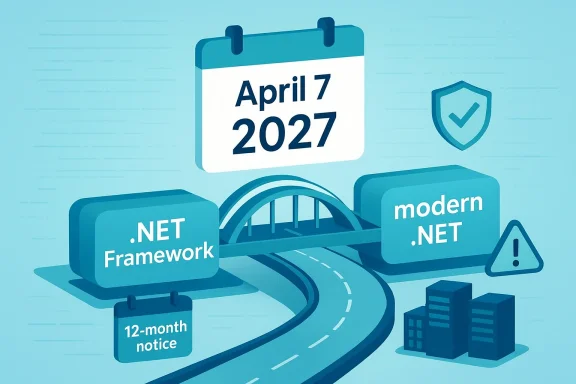
Microsoft’s decision to put ASP.NET Core 2.3 on a fixed end-of-support clock is more than a housekeeping note for enterprise developers. It marks the final stretch for a package family that has long served as a bridge between the old .NET Framework world and the modern .NET platform, and it gives organizations a clear date to move off a stack that will stop receiving security updates on April 7, 2027. Microsoft says the product was announced as ending support on April 7, 2026, satisfying the company’s 12-month notification rule for tools, which is exactly how the lifecycle policy is supposed to work. (dotnet.microsoft.com)
ASP.NET Core 2.3 occupies a strange and often misunderstood place in Microsoft’s platform history. It is not a mainstream “runtime release” in the same sense as .NET 8 or .NET 10; instead, it is a package-based support line for applications that still target .NET Framework but want to use ASP.NET Core components as a migration path. Microsoft’s support policy explicitly says that these packages were intended to help customers move applications from the legacy framework to modern .NET, and that the supported 2.3 packages follow the support cycle of the underlying .NET Framework version they ride on. (dotnet.microsoft.com)
That framing matters because .NET itself and .NET Framework do not behave the same way. Microsoft’s modern .NET releases follow a clear cadence of STS and LTS versions, with servicing updates shipped monthly and support windows measured in years. By contrast, .NET Framework remains supported as part of Windows and continues to receive cumulative security and reliability updates through its own lifecycle policy. Microsoft’s current documentation says .NET Framework will be supported “for years to come,” and its release notes continue to show fresh cumulative updates in 2025 and 2026. (learn.microsoft.com)
The confusion around ASP.NET Core 2.3 is partly historical. The package line was introduced because Microsoft needed a safe migration bridge for organizations that were not ready to jump directly to .NET Core or later .NET versions. The company then classified ASP.NET Core 2.3 as a “Tool” under its support lifecycle policy, which gives Microsoft a minimum of 12 months’ notice before end of support. That designation is why April 2027 is not a surprise, even if many developers may still regard the product as a niche compatibility layer rather than a product category with its own end date. (dotnet.microsoft.com)
There is also a deeper strategic tension here. On one side, Microsoft still supports the underlying .NET Framework and continues to ship servicing updates for it. On the other side, Microsoft is clearly steering developers toward modern .NET releases, where the company can focus engineering resources on a smaller number of active platforms. That tension explains why the ASP.NET Core 2.3 announcement feels, to some developers, like an abrupt cutoff even though it is actually consistent with the policy language. (dotnet.microsoft.com)
This announcement does not mean applications will suddenly stop running on that date. Rather, it means Microsoft will no longer provide security fixes, bug fixes, or technical support for the 2.3 package line after the deadline. In practical terms, the code will continue to execute so long as the hosting environment remains functional, but the software will become progressively harder to defend and maintain. That distinction between runtime behavior and support status is one of the most important points for decision-makers to understand. (dotnet.microsoft.com)
That said, notice is only useful if organizations act on it. The biggest risk is not April 2027 itself, but the delay between awareness and migration planning. Many application teams will discover late in the process that their “simple” upgrade is tangled up with older authentication modules, custom middleware, or dependencies that have not been touched in years. That is the real cost of long-lived compatibility layers. (dotnet.microsoft.com)
That bridge was useful precisely because many enterprises were not ready to abandon the .NET Framework ecosystem overnight. Large estates often depended on Windows-specific libraries, older hosting setups, or vendor products with no immediate .NET Core equivalent. For those companies, ASP.NET Core 2.3 offered a way to modernize web application code incrementally while preserving operational continuity. (dotnet.microsoft.com)
Microsoft’s documentation now reflects that unusual arrangement more clearly. The support policy lists a dedicated page for ASP.NET Core 2.3 Supported Packages, and that page enumerates the exact package versions still in scope. The supported versions are defined by the last patched package version, which is another reminder that this is a servicing branch rather than a living feature platform. (dotnet.microsoft.com)
But “no support” is not the same as “won’t run.” Applications built on the package line can continue operating if the surrounding .NET Framework environment remains intact. This is why the date is often underestimated in organizations: the first day after support ends usually looks identical to the day before. The risk is cumulative, not immediate. (learn.microsoft.com)
This is especially true for organizations that rely on internet-facing workloads. Internal line-of-business apps are not immune either, but the attack surface is usually smaller. The more integrated the application is with identity systems, legacy middleware, and data access layers, the more pressure there is to move quickly rather than hope that “it still works” will remain a sufficient risk strategy.
That distinction explains why Microsoft can simultaneously say that .NET Framework remains supported while also ending support for ASP.NET Core 2.3. The former is a platform lifecycle decision; the latter is a package-family decision. These are separate clocks, even if they are often conflated in migration discussions. (learn.microsoft.com)
This is also why the migration message is so strong. Microsoft’s current platform guidance increasingly frames modern .NET as the best path for performance, security, and productivity, while the legacy framework is described as something you should keep only when you need specific technologies that are unavailable elsewhere. The company’s own guidance on choosing between .NET and .NET Framework underscores that point.
This is why reports framing the decision as cost-driven are plausible even if the exact internal calculus is opaque. Microsoft does not need to publish a budget spreadsheet to make the strategic direction obvious. Its lifecycle policies, release cadence, and support pages all point in the same direction: shorter-lived bridging technologies, longer-lived modern releases, and a sharper push toward cross-platform development. (learn.microsoft.com)
For Microsoft, the downside of keeping legacy compatibility alive too long is fragmentation. For customers, the downside of moving too quickly is operational risk. Those interests are not perfectly aligned, and the support announcement is one more reminder that Microsoft’s long-term platform strategy will usually win out over the convenience of lagging migrations. That is the real subtext of the entire story.
The cost is not just engineering time. Testing, rollback planning, certificate handling, identity integration, and compliance review all add overhead. If an application is critical and customer-facing, the migration has to be sequenced carefully to avoid downtime or subtle regressions that could be more expensive than the upgrade itself.
A sensible enterprise response usually begins with triage. Not every app needs a full rewrite, but every app does need a plan. That plan may involve upgrading to a supported .NET LTS release, isolating the application behind compensating controls, or retiring the service if its business value no longer justifies the maintenance burden.
That matters because developers often inherit decisions made years earlier by a previous team. A project that was “good enough” in 2020 may now be difficult to update because the original assumptions—hosting model, package compatibility, or server dependency—no longer align with current best practices. The sunset of ASP.NET Core 2.3 will accelerate that cleanup.
The good news is that Microsoft’s modern LTS cadence gives developers a clearer destination. If teams are going to migrate, they can now justify moving to a stable current release rather than trying to preserve an old bridge indefinitely. That is especially relevant for teams with long-running products that need a predictable support horizon.
There is also the reputational risk of being caught on an unsupported stack in an audit or incident review. For regulated organizations, that can be as damaging as the technical issue itself. Unsupported does not always mean broken, but it often means harder to defend.
Microsoft’s likely direction is already visible: keep promoting modern .NET, keep the LTS story strong, and let the bridge technologies sunset on schedule. That approach is consistent with the broader platform strategy and with the company’s support policy language. The question is not whether Microsoft will stay the course; it is whether customers will use the notice period effectively.
The broader lesson is that platform transitions are rarely about a single version number. They are about how long an organization can afford to keep old assumptions alive, and how quickly it can turn a warning into an executable plan. ASP.NET Core 2.3 now has that warning in writing, and the clock is running.
Source: Techzine Global End of support approaches for ASP.NET Core 2.3 on the .NET framework
 Background
ASP.NET Core 2.3 occupies a strange and often misunderstood place in Microsoft’s platform history. It is not a mainstream “runtime release” in the same sense as .NET 8 or .NET 10; instead, it is a package-based support line for applications that still target .NET Framework but want to use ASP.NET Core components as a migration path. Microsoft’s support policy explicitly says that these packages were intended to help customers move applications from the legacy framework to modern .NET, and that the supported 2.3 packages follow the support cycle of the underlying .NET Framework version they ride on. (dotnet.microsoft.com)That framing matters because .NET itself and .NET Framework do not behave the same way. Microsoft’s modern .NET releases follow a clear cadence of STS and LTS versions, with servicing updates shipped monthly and support windows measured in years. By contrast, .NET Framework remains supported as part of Windows and continues to receive cumulative security and reliability updates through its own lifecycle policy. Microsoft’s current documentation says .NET Framework will be supported “for years to come,” and its release notes continue to show fresh cumulative updates in 2025 and 2026. (learn.microsoft.com)
The confusion around ASP.NET Core 2.3 is partly historical. The package line was introduced because Microsoft needed a safe migration bridge for organizations that were not ready to jump directly to .NET Core or later .NET versions. The company then classified ASP.NET Core 2.3 as a “Tool” under its support lifecycle policy, which gives Microsoft a minimum of 12 months’ notice before end of support. That designation is why April 2027 is not a surprise, even if many developers may still regard the product as a niche compatibility layer rather than a product category with its own end date. (dotnet.microsoft.com)
There is also a deeper strategic tension here. On one side, Microsoft still supports the underlying .NET Framework and continues to ship servicing updates for it. On the other side, Microsoft is clearly steering developers toward modern .NET releases, where the company can focus engineering resources on a smaller number of active platforms. That tension explains why the ASP.NET Core 2.3 announcement feels, to some developers, like an abrupt cutoff even though it is actually consistent with the policy language. (dotnet.microsoft.com)
What Microsoft Actually Announced
The most important detail is the date: April 7, 2027 is the scheduled end-of-support day for ASP.NET Core 2.3 on .NET Framework. Microsoft’s support policy page states plainly that the product was announced on April 7, 2026 and will stop receiving support one year later. That one-year lead time is not accidental; it is the minimum notice Microsoft promises for products categorized as tools. (dotnet.microsoft.com)This announcement does not mean applications will suddenly stop running on that date. Rather, it means Microsoft will no longer provide security fixes, bug fixes, or technical support for the 2.3 package line after the deadline. In practical terms, the code will continue to execute so long as the hosting environment remains functional, but the software will become progressively harder to defend and maintain. That distinction between runtime behavior and support status is one of the most important points for decision-makers to understand. (dotnet.microsoft.com)
Why the notice period matters
Microsoft’s lifecycle rules are designed to avoid abrupt support withdrawal. For products governed by the Modern Lifecycle Policy, Microsoft says it provides at least 12 months’ notification if no successor product is offered. ASP.NET Core 2.3 fits that expectation because Microsoft has treated it as a support-lifecycle tool rather than a core runtime release. The policy is meant to give enterprises time to budget, test, certify, and deploy migrations. (learn.microsoft.com)That said, notice is only useful if organizations act on it. The biggest risk is not April 2027 itself, but the delay between awareness and migration planning. Many application teams will discover late in the process that their “simple” upgrade is tangled up with older authentication modules, custom middleware, or dependencies that have not been touched in years. That is the real cost of long-lived compatibility layers. (dotnet.microsoft.com)
- Microsoft has set April 7, 2027 as the support cutoff. (dotnet.microsoft.com)
- The announcement was made on April 7, 2026, giving a full year of notice. (dotnet.microsoft.com)
- The 2.3 package line is treated as a tool, not a standard runtime release. (dotnet.microsoft.com)
- After support ends, Microsoft stops servicing the packages. (dotnet.microsoft.com)
The real-world implication
From a governance standpoint, the announcement creates a hard planning boundary. Compliance teams can now add ASP.NET Core 2.3 to their vulnerability-exposure inventories with a known sunset date. App owners, meanwhile, can use the notice period to prioritize systems that still depend on the older package set and to determine whether a direct migration or a broader application rewrite is the better move. That difference between “known risk” and “managed risk” is where the entire discussion turns.Why ASP.NET Core 2.3 Exists at All
ASP.NET Core 2.3 is unusual because it exists to solve a migration problem rather than to define a generational platform shift. Microsoft’s own support policy says these packages were provided to help move applications to ASP.NET Core on .NET Core while still running on .NET Framework in the interim. That makes them a compatibility bridge, not a destination architecture. (dotnet.microsoft.com)That bridge was useful precisely because many enterprises were not ready to abandon the .NET Framework ecosystem overnight. Large estates often depended on Windows-specific libraries, older hosting setups, or vendor products with no immediate .NET Core equivalent. For those companies, ASP.NET Core 2.3 offered a way to modernize web application code incrementally while preserving operational continuity. (dotnet.microsoft.com)
A versioning oddity that caused confusion
The naming itself was part of the problem. ASP.NET Core 2.3 was widely understood as a successor to 2.1, but it was not a conventional product release in the way developers expect from major framework updates. That led to confusion because some users naturally assumed the version number mapped to a normal lifecycle trajectory, when in reality it was a package support strategy layered atop .NET Framework. That mismatch between name and purpose is one reason the announcement lands so awkwardly.Microsoft’s documentation now reflects that unusual arrangement more clearly. The support policy lists a dedicated page for ASP.NET Core 2.3 Supported Packages, and that page enumerates the exact package versions still in scope. The supported versions are defined by the last patched package version, which is another reminder that this is a servicing branch rather than a living feature platform. (dotnet.microsoft.com)
- It was designed as a migration bridge. (dotnet.microsoft.com)
- It allowed ASP.NET Core components to run on .NET Framework. (dotnet.microsoft.com)
- The naming led many developers to overread it as a normal product generation.
- The package list is maintained as a fixed support catalog, not an open-ended branch. (dotnet.microsoft.com)
Why Microsoft used this approach
There is a practical engineering reason for the model. A package-based bridge lets Microsoft support a narrow set of dependencies while encouraging the ecosystem to move toward a cleaner platform boundary. That reduces long-term duplication, but it also leaves a smaller set of legacy adopters exposed when the bridge finally closes. In other words, the design solved one migration bottleneck while creating a future deprecation problem.What Happens After April 2027
The most immediate post-support effect is straightforward: no more security servicing. Microsoft’s support page says that after the end date, ASP.NET Core 2.3 will no longer receive support, which includes the things administrators care most about in production—security fixes, bug fixes, and Microsoft assistance when something breaks. That puts the burden of risk management entirely on the customer. (dotnet.microsoft.com)But “no support” is not the same as “won’t run.” Applications built on the package line can continue operating if the surrounding .NET Framework environment remains intact. This is why the date is often underestimated in organizations: the first day after support ends usually looks identical to the day before. The risk is cumulative, not immediate. (learn.microsoft.com)
Security posture changes, even if uptime doesn’t
The biggest technical issue is that the software becomes a static target. Vulnerabilities discovered later will not be patched by Microsoft, and attackers often focus on exactly these kinds of long-tail legacy dependencies because they remain attractive and predictable. That means a stable application can still become a liability if it handles authentication, session state, or other sensitive web traffic.This is especially true for organizations that rely on internet-facing workloads. Internal line-of-business apps are not immune either, but the attack surface is usually smaller. The more integrated the application is with identity systems, legacy middleware, and data access layers, the more pressure there is to move quickly rather than hope that “it still works” will remain a sufficient risk strategy.
- Applications will generally continue to run after the deadline. (dotnet.microsoft.com)
- Microsoft will stop providing patches and support. (dotnet.microsoft.com)
- The operational risk increases over time as new vulnerabilities emerge.
- Deprecated package status will make the stack harder to justify in audits and reviews.
Deprecated status matters
Microsoft also says the relevant packages will be marked deprecated. That matters because deprecation is not just a label; it is an ecosystem signal that future investment should shift elsewhere. For teams with internal platform standards, deprecation often triggers procurement, governance, or security-review consequences long before the actual end-of-support date arrives. That policy effect can be almost as disruptive as the technical one.The .NET Framework Relationship
One of the most misunderstood parts of the story is the relationship between ASP.NET Core 2.3 and .NET Framework. Microsoft’s support page makes clear that the package line follows the support cycle of the .NET Framework versions it depends on, but only for as long as ASP.NET Core 2.3 itself remains in support. After April 2027, that linkage no longer matters because the package line is out of support regardless of the underlying framework version. (dotnet.microsoft.com)That distinction explains why Microsoft can simultaneously say that .NET Framework remains supported while also ending support for ASP.NET Core 2.3. The former is a platform lifecycle decision; the latter is a package-family decision. These are separate clocks, even if they are often conflated in migration discussions. (learn.microsoft.com)
Support is not symmetrical
The asymmetry here is instructive. Microsoft continues to deliver .NET Framework security and reliability updates through Windows servicing channels, which keeps many older applications viable. But ASP.NET Core 2.3 is an optional package layer, and Microsoft is comfortable retiring it sooner because it wants developers moving toward modern .NET instead of relying on compatibility scaffolding. That is a strategic choice, not an accident of maintenance. (learn.microsoft.com)This is also why the migration message is so strong. Microsoft’s current platform guidance increasingly frames modern .NET as the best path for performance, security, and productivity, while the legacy framework is described as something you should keep only when you need specific technologies that are unavailable elsewhere. The company’s own guidance on choosing between .NET and .NET Framework underscores that point.
- .NET Framework continues to receive servicing updates. (learn.microsoft.com)
- ASP.NET Core 2.3 has its own separate support clock. (dotnet.microsoft.com)
- The package line ends even if the underlying framework is still supported. (dotnet.microsoft.com)
- Microsoft wants the ecosystem on modern .NET, not compatibility layers.
Why this matters for enterprise architecture
For enterprise architects, the practical implication is that support matrices must be evaluated at the package level as well as the runtime level. An application might be “on a supported Windows Server” and “on a supported .NET Framework,” yet still rely on a deprecated ASP.NET Core package set. That can create a false sense of compliance unless the software bill of materials and dependency inventories are kept current.Microsoft’s Strategic Motive
The strategic angle is hard to miss. Microsoft has spent years urging customers to adopt modern .NET because it gives the company a simpler engineering surface and customers a more coherent platform story. Legacy compatibility layers like ASP.NET Core 2.3 are useful, but they also consume support resources and prolong fragmentation. That makes them expensive in the very way the company has long tried to avoid. (learn.microsoft.com)This is why reports framing the decision as cost-driven are plausible even if the exact internal calculus is opaque. Microsoft does not need to publish a budget spreadsheet to make the strategic direction obvious. Its lifecycle policies, release cadence, and support pages all point in the same direction: shorter-lived bridging technologies, longer-lived modern releases, and a sharper push toward cross-platform development. (learn.microsoft.com)
Migration is the business message
Microsoft’s support page is explicit that migration to newer versions of .NET is the best route. The company points to modern releases as delivering better performance, security, and development productivity, and it highlights .NET 10 as an LTS target in the current guidance ecosystem. That recommendation is not just technical advice; it is a market signal about where Microsoft wants tooling, documentation, and partner investment to converge.For Microsoft, the downside of keeping legacy compatibility alive too long is fragmentation. For customers, the downside of moving too quickly is operational risk. Those interests are not perfectly aligned, and the support announcement is one more reminder that Microsoft’s long-term platform strategy will usually win out over the convenience of lagging migrations. That is the real subtext of the entire story.
- Microsoft wants more developers on modern .NET.
- Compatibility layers prolong fragmentation and support overhead.
- LTS releases give enterprises a clearer planning target. (learn.microsoft.com)
- The support notice signals platform direction, not just a calendar event.
Why cost and architecture converge
When support ends for an older bridge layer, Microsoft is effectively saying the migration window has been long enough. That helps the company rationalize support spend, but it also pushes the ecosystem toward a cleaner development model where deployment, runtime behavior, and tooling are less split across eras. The same decision looks like a cost cut from one angle and architecture cleanup from another—and both readings can be true at once.Enterprise Impact
Enterprise users will feel the announcement far more than consumers, because the affected software usually sits inside larger systems with change-management hurdles. ASP.NET Core 2.3 is the kind of dependency that may be buried in line-of-business applications, portal front ends, authentication services, or middleware that developers barely touch anymore. Once a package becomes deprecated, the organization has to decide whether to patch around it, isolate it, or replace it entirely. (dotnet.microsoft.com)The cost is not just engineering time. Testing, rollback planning, certificate handling, identity integration, and compliance review all add overhead. If an application is critical and customer-facing, the migration has to be sequenced carefully to avoid downtime or subtle regressions that could be more expensive than the upgrade itself.
The audit and compliance angle
Security teams will likely treat this as a deadline for inventory hygiene. A library that is still technically functional but no longer supported becomes a weak point in audits, vendor assessments, and policy enforcement. The smarter organizations will use the 12-month window to identify every dependency chain that touches the affected packages and then map those chains to business criticality.A sensible enterprise response usually begins with triage. Not every app needs a full rewrite, but every app does need a plan. That plan may involve upgrading to a supported .NET LTS release, isolating the application behind compensating controls, or retiring the service if its business value no longer justifies the maintenance burden.
- Identify applications that reference the 2.3 package set.
- Classify each app by business criticality and exposure.
- Determine whether the app can migrate directly to modern .NET.
- Build a testing plan for authentication, session, and data access paths.
- Track compensating controls for anything that must stay online longer.
- Update compliance inventories before the deadline, not after it.
Why some enterprises will delay anyway
There is always a temptation to wait because “the app still works.” But legacy software tends to become more expensive to move with each passing year as institutional knowledge fades and dependencies age out. The companies that have the least painful upgrades are usually the ones that treat lifecycle notices as planning inputs, not as post-it reminders they revisit in the final quarter.Consumer and Developer Impact
For individual developers and smaller teams, the issue is less about corporate compliance and more about ecosystem drift. Support deadlines influence package choices, project templates, hosting strategies, and framework recommendations in tutorials and samples. Once a package family is deprecated, the gravity shifts sharply toward whatever Microsoft currently treats as the default path. (dotnet.microsoft.com)That matters because developers often inherit decisions made years earlier by a previous team. A project that was “good enough” in 2020 may now be difficult to update because the original assumptions—hosting model, package compatibility, or server dependency—no longer align with current best practices. The sunset of ASP.NET Core 2.3 will accelerate that cleanup.
Developer productivity versus stability
Microsoft’s modern .NET guidance emphasizes speed of servicing, security fixes, and cleaner platform behavior. For new projects, that is a compelling pitch. For legacy projects, the trade-off is that a stable but old stack can become a productivity sink if it forces teams to keep nursing outdated dependencies just to avoid one difficult upgrade. In practice, the hidden tax is often time, not money.The good news is that Microsoft’s modern LTS cadence gives developers a clearer destination. If teams are going to migrate, they can now justify moving to a stable current release rather than trying to preserve an old bridge indefinitely. That is especially relevant for teams with long-running products that need a predictable support horizon.
- Older tutorial content may no longer represent a safe target.
- Project templates and defaults increasingly assume modern .NET.
- Smaller teams benefit from clear LTS destinations.
- Legacy upgrade debt tends to compound faster than expected.
A warning for greenfield work
The simplest lesson is not to start new work on a dying compatibility layer. If a project is greenfield, it should probably be built on a current supported .NET release rather than on a package family that exists mainly to usher old systems out the door. The longer teams try to preserve the past, the more likely they are to inherit its maintenance costs later.Strengths and Opportunities
The announcement has a harsh edge, but it also creates clarity. Developers and IT leaders now have a firm deadline, an official support page, and a clean policy explanation that removes ambiguity about the future of ASP.NET Core 2.3. That clarity is valuable because it turns vague technical debt into a tractable migration project.- Clear April 7, 2027 deadline. (dotnet.microsoft.com)
- One year of notice aligns with Microsoft lifecycle policy. (learn.microsoft.com)
- Strong incentive to modernize toward .NET LTS releases. (learn.microsoft.com)
- Better security posture for teams that move proactively.
- Opportunity to reduce legacy dependency sprawl.
- Chance to reassess architecture, deployment, and test coverage.
- Cleaner documentation and support alignment for future projects.
Why this can be a positive inflection point
For some teams, this will finally unlock budget and attention for a migration that has been deferred for years. That is not ideal, but it can still be productive if it forces a systematic platform review instead of a piecemeal patch cycle. Sometimes a deadline is the only thing that makes modernization real.Risks and Concerns
The biggest concern is that organizations will underestimate the complexity of the move. If ASP.NET Core 2.3 is embedded in a critical application, the migration could involve much more than updating a package reference. Authentication flows, server integration, build tooling, and third-party libraries may all need changes, and any one of those can delay a deployment.- Security exposure increases after support ends. (dotnet.microsoft.com)
- Legacy apps may depend on outdated libraries with no easy replacement.
- Compliance teams may flag the stack before engineers are ready.
- “It still runs” can create dangerous complacency.
- Teams may lack knowledge of the original implementation.
- Migration testing may be more time-consuming than expected.
- Vendor dependencies may block fast upgrades.
Operational risk after the sunset date
The risk is not a dramatic shutdown; it is the slow accumulation of unpatched exposure. Once Microsoft stops servicing the package line, every newly discovered issue becomes the customer’s problem, and security teams will have to compensate with network segmentation, stricter access controls, or other defensive layers. Those measures can reduce risk, but they do not replace vendor support.There is also the reputational risk of being caught on an unsupported stack in an audit or incident review. For regulated organizations, that can be as damaging as the technical issue itself. Unsupported does not always mean broken, but it often means harder to defend.
Looking Ahead
The next year will likely reveal how many organizations still have meaningful dependence on ASP.NET Core 2.3. Some will treat the announcement as a routine lifecycle event and move quickly to a modern .NET release. Others will discover that the package line is tucked away inside applications that are too important to ignore but too old to upgrade cheaply.Microsoft’s likely direction is already visible: keep promoting modern .NET, keep the LTS story strong, and let the bridge technologies sunset on schedule. That approach is consistent with the broader platform strategy and with the company’s support policy language. The question is not whether Microsoft will stay the course; it is whether customers will use the notice period effectively.
- Inventory every app and service that uses the affected packages.
- Prioritize internet-facing and identity-sensitive workloads first.
- Map each app to a target supported .NET LTS version.
- Build a migration timeline that includes test, rollback, and security review.
- Decide early whether any workloads should be retired instead of upgraded.
The likely end state
By the time April 2027 arrives, many teams will already be on modern .NET, and the remaining holdouts will likely be the ones with the most stubborn dependencies. That is usually how these transitions unfold: the easy migrations happen early, the complicated ones linger, and the support deadline exposes the projects that were never fully owned.The broader lesson is that platform transitions are rarely about a single version number. They are about how long an organization can afford to keep old assumptions alive, and how quickly it can turn a warning into an executable plan. ASP.NET Core 2.3 now has that warning in writing, and the clock is running.
Source: Techzine Global End of support approaches for ASP.NET Core 2.3 on the .NET framework
Last edited:
