

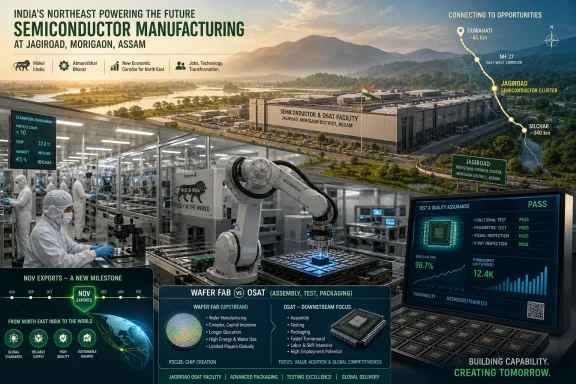
Assam Chief Minister Himanta Biswa Sarma said on June 22, 2026, at the Republic Summit in New Delhi that Tata Semiconductor would begin exporting chips from Guwahati by November, positioning Assam as an emerging semiconductor hub in India’s northeast. The claim is politically useful, economically significant, and technically easy to misunderstand. Assam is not suddenly becoming another Taiwan, but it may be becoming something just as important for India’s industrial map: proof that advanced electronics manufacturing can move beyond the usual coastal and western corridors.
The headline number — 48 million chips — does a lot of work. In several official and semi-official descriptions of the Tata project, that figure refers to daily capacity at scale, not merely a one-time export consignment. Either way, the more important story is that Assam’s semiconductor pitch is not about a glamorous front-end wafer fab; it is about assembly, packaging, and testing, the downstream part of the chip supply chain where finished silicon becomes usable products.
That distinction matters because it separates hype from substance. If Assam can execute, the Jagiroad project will not just give the state a new industrial talking point. It will test whether India’s semiconductor strategy can create durable manufacturing ecosystems in places long treated as peripheral to the country’s technology economy.
Sarma framed Assam’s transformation in sweeping terms: from insurgency to semiconductor hub, from a frontier state to a future engine of India’s economy. That kind of language is expected from a chief minister on a national stage. But beneath the rhetoric is a harder industrial question: can a state historically associated with conflict, distance, floods, and logistical bottlenecks support a high-reliability electronics manufacturing operation?
Semiconductor packaging is less capital-intensive than wafer fabrication, but it is not forgiving. It needs stable power, clean operating environments, disciplined logistics, trained labor, reliable water and waste handling, and vendor networks that can keep production lines moving. A missed delivery, a utility interruption, or a process-control failure can turn a prestige project into a costly lesson.
That is why the Assam announcement should be read less as a victory lap and more as a public deadline. If exports begin in November, the state and Tata will be judged not by speeches but by throughput, yield, customer qualification, and repeatability. In chips, almost ready is not ready.
The location also matters. The Tata Semiconductor Assembly and Test facility is being developed at Jagiroad in Morigaon district, not in the middle of an established electronics cluster like Bengaluru, Hyderabad, Pune, Chennai, or the Gujarat industrial belt. That makes the project both more ambitious and more exposed. It is trying to build not only a plant, but the first serious layer of a regional industrial ecosystem around it.
Sarma’s broader argument is that Assam’s geography has flipped from handicap to advantage. The state sits at India’s northeastern gateway, close to Bangladesh, Bhutan, Myanmar, and Southeast Asian trade routes. That pitch is familiar in policy circles, but semiconductors give it a sharper edge: if India wants resilient supply chains, it cannot afford to concentrate every advanced manufacturing bet in a few already-crowded regions.
This is not a small distinction. A factory capable of handling 48 million chip units per day at maturity is different from a plant exporting 48 million units in a specific batch. The former describes industrial scale; the latter describes a shipment. Both would be meaningful, but they are not the same claim.
The technical nature of the project also deserves precision. Assam is not getting a cutting-edge wafer fab that prints transistors onto silicon wafers. It is getting an assembly, test, and packaging facility — the part of the chain that takes manufactured dies, connects them to substrates or packages, tests them, and prepares them for use in products such as cars, telecom gear, consumer electronics, and AI-related hardware.
That does not make the project trivial. Advanced packaging has become more important as the industry runs into cost and physics limits at the leading edge. Chiplets, heterogeneous integration, system-in-package designs, and high-performance packaging are increasingly central to how modern systems are built. But it does mean the public conversation should avoid collapsing all semiconductor manufacturing into one word: “fab.”
India’s semiconductor push has often suffered from that confusion. A front-end fab, an ATMP facility, an OSAT plant, a display unit, and a compound semiconductor line all sit inside the broader electronics manufacturing story, but they have different economics, workforce needs, technology risks, and strategic value. Assam’s role is potentially important precisely because it occupies a practical, scalable part of that chain.
This does not mean India is suddenly vertically integrated. Semiconductor supply chains are global by design and brutally specialized. Tools, chemicals, substrates, gases, wafers, EDA software, process recipes, test equipment, and customer certifications come from a web of suppliers and partners built over decades. One country does not become self-sufficient by approving a handful of plants.
But the Tata combination matters because it gives India a domestic anchor. If the Dholera fab eventually produces wafers and the Assam facility packages and tests chips, India can begin to build operational knowledge across more than one layer of the semiconductor stack. That knowledge is not merely technical. It includes procurement discipline, process engineering, quality systems, export compliance, customer support, and the unglamorous art of keeping factories running every day.
For Assam, the downstream plant may be the more realistic entry point. Packaging and testing can create large employment numbers, absorb technical graduates, and support adjacent suppliers without requiring the extreme capital intensity and process-node sophistication of a leading-edge fab. That makes it a better fit for a region trying to build industrial depth from a lower base.
The danger is symbolic overclaiming. If every assembly plant is sold as a “chip factory” in the same breath as Taiwan Semiconductor Manufacturing Company or Samsung, the public will eventually feel misled. Assam’s plant should be judged on what it actually is: a major semiconductor assembly and test facility that could give the northeast its first credible foothold in advanced electronics manufacturing.
That shift is important. Roads, bridges, rail links, airports, inland waterways, and border trade corridors can move goods through a region. But they do not automatically create high-value jobs inside it. A semiconductor packaging plant, if it anchors suppliers and training systems, has the potential to turn connectivity into production rather than transit.
The old model of Indian industrial growth concentrated opportunity in a few clusters and then expected labor to migrate. That produced growth, but it also deepened regional imbalance. If Assam can attract complex manufacturing, it offers a different model: moving the factory closer to regions that have historically exported workers rather than imported investment.
The location of the Tata plant at the former Nagaon paper mill site in Jagiroad adds a symbolic layer. Paper mills once represented an older industrial promise for Assam, one tied to natural resources and public-sector-era development. Their decline left economic and emotional scars. Replacing that landscape with semiconductor assembly is a deliberate statement about industrial transition.
But symbolism will not train technicians or create suppliers. Assam will need engineering institutes, vocational programs, cleanroom discipline, local vendor development, housing, transport, and urban planning around the plant. If those pieces lag, the project risks becoming an isolated high-tech island surrounded by underprepared infrastructure.
That competition can be productive. States that once focused on land, tax incentives, and generic industrial parks now have to talk about power quality, logistics, talent pipelines, and supplier ecosystems. Semiconductors force governments to learn the language of execution.
It can also distort incentives. When every state wants a “semiconductor hub,” the phrase loses meaning. A real hub is not a single plant with a ribbon-cutting ceremony. It is a concentration of firms, skills, suppliers, research institutions, logistics providers, and customers that reinforce one another over time.
Assam is at the beginning of that journey, not the end. The Tata plant can be a seed, but a seed is not a forest. The state’s challenge is to convert a flagship investment into a cluster without assuming that one marquee project will automatically generate an ecosystem.
This is where the central government’s role becomes decisive. Semiconductor policy requires patient capital, stable incentives, import-export clarity, standards alignment, and long-term coordination. If policy changes with headlines, companies will hesitate. If approvals, customs, and infrastructure are predictable, suppliers may start to follow.
From one angle, industrialization can strengthen frontier regions. Better jobs, better roads, better communications, and stronger state presence can reduce the vacuum in which instability grows. A high-profile manufacturing project also signals that the region is not merely to be policed, but invested in.
From another angle, high-value manufacturing raises the stakes for security and resilience. Semiconductor facilities depend on predictable operations. They must be protected from physical disruption, cyber risks, supply interruptions, labor instability, and environmental shocks. In a region prone to floods and complex border dynamics, resilience planning cannot be an afterthought.
The cyber dimension deserves more attention than it usually receives in industrial announcements. Modern semiconductor plants run on tightly integrated operational technology systems, manufacturing execution software, equipment controllers, quality databases, and remote support channels. The more strategically important the plant, the more attractive it becomes as a target for espionage, sabotage, or ransomware.
That is where a WindowsForum audience should pay attention. The semiconductor story is not only about chips that may eventually power devices. It is also about the computing infrastructure required to make them, test them, track them, and ship them. Industrial policy now depends on IT hygiene.
That means Assam’s semiconductor story will run through enterprise software, databases, identity systems, endpoint management, industrial networks, and cloud or hybrid analytics. It will require disciplined patching without reckless downtime, strong segmentation between office IT and operational technology, and a security culture that treats manufacturing equipment as critical infrastructure rather than expensive machinery with Ethernet ports.
For administrators, the lesson is familiar but newly urgent. Plants like this do not fail only because a machine breaks. They fail because a certificate expires, an identity provider is misconfigured, a test database becomes a bottleneck, a vendor remote-access path is left exposed, or a rushed software update disrupts production.
India’s broader electronics ambitions will therefore depend heavily on sysadmins, network engineers, security architects, and plant IT teams. Their work will rarely appear in political speeches, but it will determine whether the plant can meet customer expectations. Semiconductor customers do not merely buy capacity; they buy confidence.
If Assam wants to become more than a one-plant story, it will need a local technical workforce that understands this software spine. That includes not only chip packaging technicians, but also people who can run secure networks, automate production reporting, manage Windows and Linux endpoints, maintain industrial control systems, and respond quickly when something breaks at 2 a.m.
But job creation in advanced manufacturing has a catch: the best jobs go to regions that prepare for them. Cleanroom operators, equipment maintenance technicians, process engineers, test engineers, quality specialists, logistics managers, and IT administrators require training pipelines. If those pipelines are weak, companies import talent from elsewhere and local resentment grows.
Assam’s government appears aware of the need to create an investor-friendly environment, but the skills challenge is more granular than slogans. Technical institutes need curricula aligned with actual plant operations. Students need exposure to electronics manufacturing discipline, not just theory. Local contractors need to learn the compliance expectations of global supply chains.
There is also a social infrastructure question. A major plant brings demand for housing, transport, healthcare, schools, retail, and urban services. If Jagiroad and surrounding areas grow chaotically, the project may create avoidable pressure on land and communities. If growth is planned, the plant could become the anchor of a more balanced industrial township.
This is where Assam’s development model will be tested. The state can either treat the semiconductor facility as an isolated trophy or as the core of a broader regional upgrade. The latter is harder, slower, and less photogenic. It is also the only path that makes the “hub” label credible.
The important point is not whether every political growth claim survives statistical cross-examination. It is that Assam is no longer content to be framed primarily through conflict, migration, tea, oil, and floods. The semiconductor announcement gives the state a new development vocabulary.
That vocabulary can be empowering, but it can also conceal old problems. Industrial projects do not erase rural distress, ethnic tensions, land anxieties, environmental vulnerabilities, or uneven public services. A semiconductor plant may become a symbol of modern Assam, but it will coexist with all the older Assams that still require governance.
A mature reading of Sarma’s announcement therefore avoids both cynicism and boosterism. It is not absurd for Assam to host advanced electronics manufacturing. Nor is it guaranteed that the state will become a semiconductor hub because one large company is building one large plant.
The right question is whether the project changes the state’s capabilities. Does it improve workforce training? Does it attract suppliers? Does it raise infrastructure standards? Does it create export discipline? Does it give local firms a path into national and global electronics supply chains? If the answer is yes, the political rhetoric will have substance behind it.
But the first export is not the same as industrial maturity. Semiconductor facilities ramp through stages: installation, qualification, pilot runs, customer validation, volume production, yield improvement, and capacity expansion. A plant can technically begin operations while still being far from full-scale output.
This is especially true in assembly and test, where different customers and package types may require different qualification processes. Automotive chips, for example, demand reliability standards and traceability that are more stringent than many consumer applications. Telecom and AI-related hardware bring their own performance and quality expectations.
That means the public should expect a ramp, not a switch. The first shipments will matter, but the bigger signal will be whether the plant can sustain production, diversify customers, and move up the packaging complexity ladder. Volume alone is not the only measure; capability mix matters.
If Assam becomes known only for low-margin, high-volume assembly, the benefits may still be substantial. But if the plant develops advanced packaging expertise and anchors design, reliability, materials, and test capabilities nearby, the state’s position becomes much stronger. The difference between those futures is execution.
The world is not standing still while India builds. Taiwan, South Korea, the United States, Japan, China, and Europe are all spending heavily on semiconductor capacity, packaging, and supply-chain resilience. Customers will not buy Indian output out of patriotic sympathy; they will buy it if the price, quality, reliability, and delivery make sense.
Assam’s plant therefore enters a competitive global market. Its success will depend on Tata’s ability to meet customer standards and India’s ability to support predictable operations. Government announcements can open doors, but customers decide whether the facility becomes strategic or merely symbolic.
There is also a timing issue. The semiconductor industry is cyclical. Demand surges and collapses across memory, automotive, consumer electronics, and AI infrastructure do not move in neat policy cycles. A plant that ramps into the wrong market window can face pressure even if it is technically competent.
That makes the Assam project a long game. The real payoff may not come from the first export announcement, but from the accumulation of capability over five to ten years. India’s semiconductor mission will be judged less by opening ceremonies than by whether companies keep reinvesting after the first subsidy-backed wave.
That requires political patience. High-tech manufacturing does not follow the rhythm of election campaigns. Plants take years to stabilize. Training systems take years to mature. Supplier ecosystems take years to deepen. The temptation will be to declare victory early.
It also requires public honesty. Assam should celebrate the Tata project without pretending that packaging is the same as leading-edge fabrication. It should welcome investment without ignoring land, labor, and environmental concerns. It should promote the northeast’s strategic location without reducing the region to a corridor for other people’s goods.
For India, the project is a reminder that semiconductor resilience is not only a national-security slogan. It is a place-based development problem. Where factories are built, who gets trained, which regions gain suppliers, and how infrastructure is upgraded will shape the country’s industrial geography for decades.
For the global chip industry, Assam is still a small dot on a very large map. For Assam, it may be the beginning of a new map entirely.
The headline number — 48 million chips — does a lot of work. In several official and semi-official descriptions of the Tata project, that figure refers to daily capacity at scale, not merely a one-time export consignment. Either way, the more important story is that Assam’s semiconductor pitch is not about a glamorous front-end wafer fab; it is about assembly, packaging, and testing, the downstream part of the chip supply chain where finished silicon becomes usable products.
That distinction matters because it separates hype from substance. If Assam can execute, the Jagiroad project will not just give the state a new industrial talking point. It will test whether India’s semiconductor strategy can create durable manufacturing ecosystems in places long treated as peripheral to the country’s technology economy.
 Assam’s Chip Moment Is Really an Infrastructure Verdict
Sarma framed Assam’s transformation in sweeping terms: from insurgency to semiconductor hub, from a frontier state to a future engine of India’s economy. That kind of language is expected from a chief minister on a national stage. But beneath the rhetoric is a harder industrial question: can a state historically associated with conflict, distance, floods, and logistical bottlenecks support a high-reliability electronics manufacturing operation?Semiconductor packaging is less capital-intensive than wafer fabrication, but it is not forgiving. It needs stable power, clean operating environments, disciplined logistics, trained labor, reliable water and waste handling, and vendor networks that can keep production lines moving. A missed delivery, a utility interruption, or a process-control failure can turn a prestige project into a costly lesson.
That is why the Assam announcement should be read less as a victory lap and more as a public deadline. If exports begin in November, the state and Tata will be judged not by speeches but by throughput, yield, customer qualification, and repeatability. In chips, almost ready is not ready.
The location also matters. The Tata Semiconductor Assembly and Test facility is being developed at Jagiroad in Morigaon district, not in the middle of an established electronics cluster like Bengaluru, Hyderabad, Pune, Chennai, or the Gujarat industrial belt. That makes the project both more ambitious and more exposed. It is trying to build not only a plant, but the first serious layer of a regional industrial ecosystem around it.
Sarma’s broader argument is that Assam’s geography has flipped from handicap to advantage. The state sits at India’s northeastern gateway, close to Bangladesh, Bhutan, Myanmar, and Southeast Asian trade routes. That pitch is familiar in policy circles, but semiconductors give it a sharper edge: if India wants resilient supply chains, it cannot afford to concentrate every advanced manufacturing bet in a few already-crowded regions.
The 48 Million Figure Needs Translation, Not Amplification
The most eye-catching line from Sarma’s remarks was that Tata Semiconductor would export 48 million chips from Guwahati by November. In political speech, that sounds like an immediate export milestone. In semiconductor industry language, the number more commonly tracks the planned daily capacity of the Assam OSAT facility once it is fully operational.This is not a small distinction. A factory capable of handling 48 million chip units per day at maturity is different from a plant exporting 48 million units in a specific batch. The former describes industrial scale; the latter describes a shipment. Both would be meaningful, but they are not the same claim.
The technical nature of the project also deserves precision. Assam is not getting a cutting-edge wafer fab that prints transistors onto silicon wafers. It is getting an assembly, test, and packaging facility — the part of the chain that takes manufactured dies, connects them to substrates or packages, tests them, and prepares them for use in products such as cars, telecom gear, consumer electronics, and AI-related hardware.
That does not make the project trivial. Advanced packaging has become more important as the industry runs into cost and physics limits at the leading edge. Chiplets, heterogeneous integration, system-in-package designs, and high-performance packaging are increasingly central to how modern systems are built. But it does mean the public conversation should avoid collapsing all semiconductor manufacturing into one word: “fab.”
India’s semiconductor push has often suffered from that confusion. A front-end fab, an ATMP facility, an OSAT plant, a display unit, and a compound semiconductor line all sit inside the broader electronics manufacturing story, but they have different economics, workforce needs, technology risks, and strategic value. Assam’s role is potentially important precisely because it occupies a practical, scalable part of that chain.
Tata Is Building a Supply Chain, Not a Symbol
The Tata project in Assam is reported as a ₹27,000 crore investment, one of the largest private-sector industrial bets in the northeast. Its significance is amplified by Tata’s simultaneous work on a wafer fabrication project in Dholera, Gujarat, where the group is partnering with Powerchip Semiconductor Manufacturing Corporation of Taiwan. That pairing gives India a more complete semiconductor story: front-end manufacturing in Gujarat, downstream assembly and testing in Assam.This does not mean India is suddenly vertically integrated. Semiconductor supply chains are global by design and brutally specialized. Tools, chemicals, substrates, gases, wafers, EDA software, process recipes, test equipment, and customer certifications come from a web of suppliers and partners built over decades. One country does not become self-sufficient by approving a handful of plants.
But the Tata combination matters because it gives India a domestic anchor. If the Dholera fab eventually produces wafers and the Assam facility packages and tests chips, India can begin to build operational knowledge across more than one layer of the semiconductor stack. That knowledge is not merely technical. It includes procurement discipline, process engineering, quality systems, export compliance, customer support, and the unglamorous art of keeping factories running every day.
For Assam, the downstream plant may be the more realistic entry point. Packaging and testing can create large employment numbers, absorb technical graduates, and support adjacent suppliers without requiring the extreme capital intensity and process-node sophistication of a leading-edge fab. That makes it a better fit for a region trying to build industrial depth from a lower base.
The danger is symbolic overclaiming. If every assembly plant is sold as a “chip factory” in the same breath as Taiwan Semiconductor Manufacturing Company or Samsung, the public will eventually feel misled. Assam’s plant should be judged on what it actually is: a major semiconductor assembly and test facility that could give the northeast its first credible foothold in advanced electronics manufacturing.
The Northeast Wants to Stop Being a Corridor and Start Being a Market
For decades, the northeast has been described in Delhi policy language as a gateway. The phrase sounds flattering, but it often reduces the region to geography: a passage to somewhere else, a strategic buffer, a map problem to be solved. Sarma’s speech tried to push a different idea — that Assam and the wider northeast should become an industrial and consumer market in their own right.That shift is important. Roads, bridges, rail links, airports, inland waterways, and border trade corridors can move goods through a region. But they do not automatically create high-value jobs inside it. A semiconductor packaging plant, if it anchors suppliers and training systems, has the potential to turn connectivity into production rather than transit.
The old model of Indian industrial growth concentrated opportunity in a few clusters and then expected labor to migrate. That produced growth, but it also deepened regional imbalance. If Assam can attract complex manufacturing, it offers a different model: moving the factory closer to regions that have historically exported workers rather than imported investment.
The location of the Tata plant at the former Nagaon paper mill site in Jagiroad adds a symbolic layer. Paper mills once represented an older industrial promise for Assam, one tied to natural resources and public-sector-era development. Their decline left economic and emotional scars. Replacing that landscape with semiconductor assembly is a deliberate statement about industrial transition.
But symbolism will not train technicians or create suppliers. Assam will need engineering institutes, vocational programs, cleanroom discipline, local vendor development, housing, transport, and urban planning around the plant. If those pieces lag, the project risks becoming an isolated high-tech island surrounded by underprepared infrastructure.
India’s Semiconductor Strategy Is Becoming More Regional — and More Political
India’s semiconductor mission is no longer just a technology policy. It is a regional development strategy, a geopolitical bet, and a political story about national self-confidence. Gujarat, Assam, Uttar Pradesh, Odisha, and other states are competing to host pieces of the electronics value chain, and chief ministers understand the power of being photographed near a chip facility.That competition can be productive. States that once focused on land, tax incentives, and generic industrial parks now have to talk about power quality, logistics, talent pipelines, and supplier ecosystems. Semiconductors force governments to learn the language of execution.
It can also distort incentives. When every state wants a “semiconductor hub,” the phrase loses meaning. A real hub is not a single plant with a ribbon-cutting ceremony. It is a concentration of firms, skills, suppliers, research institutions, logistics providers, and customers that reinforce one another over time.
Assam is at the beginning of that journey, not the end. The Tata plant can be a seed, but a seed is not a forest. The state’s challenge is to convert a flagship investment into a cluster without assuming that one marquee project will automatically generate an ecosystem.
This is where the central government’s role becomes decisive. Semiconductor policy requires patient capital, stable incentives, import-export clarity, standards alignment, and long-term coordination. If policy changes with headlines, companies will hesitate. If approvals, customs, and infrastructure are predictable, suppliers may start to follow.
The Security Story Cuts Both Ways
Sarma’s remarks also touched on border security, illegal infiltration, and the need for balanced development in frontier states. That is not incidental. In Assam politics, development and security are often intertwined, and the semiconductor announcement sits inside that larger narrative of state capacity.From one angle, industrialization can strengthen frontier regions. Better jobs, better roads, better communications, and stronger state presence can reduce the vacuum in which instability grows. A high-profile manufacturing project also signals that the region is not merely to be policed, but invested in.
From another angle, high-value manufacturing raises the stakes for security and resilience. Semiconductor facilities depend on predictable operations. They must be protected from physical disruption, cyber risks, supply interruptions, labor instability, and environmental shocks. In a region prone to floods and complex border dynamics, resilience planning cannot be an afterthought.
The cyber dimension deserves more attention than it usually receives in industrial announcements. Modern semiconductor plants run on tightly integrated operational technology systems, manufacturing execution software, equipment controllers, quality databases, and remote support channels. The more strategically important the plant, the more attractive it becomes as a target for espionage, sabotage, or ransomware.
That is where a WindowsForum audience should pay attention. The semiconductor story is not only about chips that may eventually power devices. It is also about the computing infrastructure required to make them, test them, track them, and ship them. Industrial policy now depends on IT hygiene.
The Manufacturing Plant Will Need a Software Spine
A semiconductor assembly and test facility is a physical plant, but it is also a data machine. Every lot, die, package, test result, defect class, equipment event, and process deviation generates information. The ability to capture and act on that data is what separates modern electronics manufacturing from a conventional factory floor.That means Assam’s semiconductor story will run through enterprise software, databases, identity systems, endpoint management, industrial networks, and cloud or hybrid analytics. It will require disciplined patching without reckless downtime, strong segmentation between office IT and operational technology, and a security culture that treats manufacturing equipment as critical infrastructure rather than expensive machinery with Ethernet ports.
For administrators, the lesson is familiar but newly urgent. Plants like this do not fail only because a machine breaks. They fail because a certificate expires, an identity provider is misconfigured, a test database becomes a bottleneck, a vendor remote-access path is left exposed, or a rushed software update disrupts production.
India’s broader electronics ambitions will therefore depend heavily on sysadmins, network engineers, security architects, and plant IT teams. Their work will rarely appear in political speeches, but it will determine whether the plant can meet customer expectations. Semiconductor customers do not merely buy capacity; they buy confidence.
If Assam wants to become more than a one-plant story, it will need a local technical workforce that understands this software spine. That includes not only chip packaging technicians, but also people who can run secure networks, automate production reporting, manage Windows and Linux endpoints, maintain industrial control systems, and respond quickly when something breaks at 2 a.m.
The Jobs Promise Is Real, but It Will Not Be Automatic
Large semiconductor packaging plants can create significant employment, both directly and indirectly. Public claims around the Tata Assam project have often cited tens of thousands of jobs when direct and indirect roles are combined. Even if the eventual number varies, the employment potential is one reason the project has such political force.But job creation in advanced manufacturing has a catch: the best jobs go to regions that prepare for them. Cleanroom operators, equipment maintenance technicians, process engineers, test engineers, quality specialists, logistics managers, and IT administrators require training pipelines. If those pipelines are weak, companies import talent from elsewhere and local resentment grows.
Assam’s government appears aware of the need to create an investor-friendly environment, but the skills challenge is more granular than slogans. Technical institutes need curricula aligned with actual plant operations. Students need exposure to electronics manufacturing discipline, not just theory. Local contractors need to learn the compliance expectations of global supply chains.
There is also a social infrastructure question. A major plant brings demand for housing, transport, healthcare, schools, retail, and urban services. If Jagiroad and surrounding areas grow chaotically, the project may create avoidable pressure on land and communities. If growth is planned, the plant could become the anchor of a more balanced industrial township.
This is where Assam’s development model will be tested. The state can either treat the semiconductor facility as an isolated trophy or as the core of a broader regional upgrade. The latter is harder, slower, and less photogenic. It is also the only path that makes the “hub” label credible.
Assam’s Claim to Growth Needs Scrutiny, Not Dismissal
Sarma said Assam has been growing faster than the national average, with some reports quoting him as claiming sustained growth of 12–13 percent over recent years. Such figures should be read carefully because state growth rates can vary depending on whether one is discussing nominal or real growth, the base year, sectoral composition, and post-pandemic rebound effects. Still, the direction of the claim is plausible: Assam has been trying to reposition itself as a faster-growing regional economy with stronger infrastructure and investment momentum.The important point is not whether every political growth claim survives statistical cross-examination. It is that Assam is no longer content to be framed primarily through conflict, migration, tea, oil, and floods. The semiconductor announcement gives the state a new development vocabulary.
That vocabulary can be empowering, but it can also conceal old problems. Industrial projects do not erase rural distress, ethnic tensions, land anxieties, environmental vulnerabilities, or uneven public services. A semiconductor plant may become a symbol of modern Assam, but it will coexist with all the older Assams that still require governance.
A mature reading of Sarma’s announcement therefore avoids both cynicism and boosterism. It is not absurd for Assam to host advanced electronics manufacturing. Nor is it guaranteed that the state will become a semiconductor hub because one large company is building one large plant.
The right question is whether the project changes the state’s capabilities. Does it improve workforce training? Does it attract suppliers? Does it raise infrastructure standards? Does it create export discipline? Does it give local firms a path into national and global electronics supply chains? If the answer is yes, the political rhetoric will have substance behind it.
The “Hub” Label Has to Be Earned After November
November is now the month to watch because Sarma made it the public marker. If Tata begins exports from Assam by then, the project will cross from construction narrative into operational reality. That is a meaningful threshold.But the first export is not the same as industrial maturity. Semiconductor facilities ramp through stages: installation, qualification, pilot runs, customer validation, volume production, yield improvement, and capacity expansion. A plant can technically begin operations while still being far from full-scale output.
This is especially true in assembly and test, where different customers and package types may require different qualification processes. Automotive chips, for example, demand reliability standards and traceability that are more stringent than many consumer applications. Telecom and AI-related hardware bring their own performance and quality expectations.
That means the public should expect a ramp, not a switch. The first shipments will matter, but the bigger signal will be whether the plant can sustain production, diversify customers, and move up the packaging complexity ladder. Volume alone is not the only measure; capability mix matters.
If Assam becomes known only for low-margin, high-volume assembly, the benefits may still be substantial. But if the plant develops advanced packaging expertise and anchors design, reliability, materials, and test capabilities nearby, the state’s position becomes much stronger. The difference between those futures is execution.
India’s Chip Ambition Is Moving From Announcement to Accountability
India has spent years announcing semiconductor ambitions, often against skepticism from an industry that remembers failed attempts and delayed projects. The current cycle feels more serious because large domestic conglomerates, global partners, and central incentives are now aligned in ways they were not before. But seriousness does not eliminate risk.The world is not standing still while India builds. Taiwan, South Korea, the United States, Japan, China, and Europe are all spending heavily on semiconductor capacity, packaging, and supply-chain resilience. Customers will not buy Indian output out of patriotic sympathy; they will buy it if the price, quality, reliability, and delivery make sense.
Assam’s plant therefore enters a competitive global market. Its success will depend on Tata’s ability to meet customer standards and India’s ability to support predictable operations. Government announcements can open doors, but customers decide whether the facility becomes strategic or merely symbolic.
There is also a timing issue. The semiconductor industry is cyclical. Demand surges and collapses across memory, automotive, consumer electronics, and AI infrastructure do not move in neat policy cycles. A plant that ramps into the wrong market window can face pressure even if it is technically competent.
That makes the Assam project a long game. The real payoff may not come from the first export announcement, but from the accumulation of capability over five to ten years. India’s semiconductor mission will be judged less by opening ceremonies than by whether companies keep reinvesting after the first subsidy-backed wave.
The Real Test Is Whether Assam Can Make High Tech Ordinary
The most powerful outcome for Assam would not be a single viral headline about chips leaving Guwahati. It would be the normalization of advanced manufacturing in a region that outsiders have too often treated as remote. When cleanrooms, test floors, supplier audits, export documentation, and industrial cybersecurity become ordinary parts of Assam’s economy, the transformation becomes real.That requires political patience. High-tech manufacturing does not follow the rhythm of election campaigns. Plants take years to stabilize. Training systems take years to mature. Supplier ecosystems take years to deepen. The temptation will be to declare victory early.
It also requires public honesty. Assam should celebrate the Tata project without pretending that packaging is the same as leading-edge fabrication. It should welcome investment without ignoring land, labor, and environmental concerns. It should promote the northeast’s strategic location without reducing the region to a corridor for other people’s goods.
For India, the project is a reminder that semiconductor resilience is not only a national-security slogan. It is a place-based development problem. Where factories are built, who gets trained, which regions gain suppliers, and how infrastructure is upgraded will shape the country’s industrial geography for decades.
For the global chip industry, Assam is still a small dot on a very large map. For Assam, it may be the beginning of a new map entirely.
The November Export Promise Narrows the Story to Five Tests
Sarma’s announcement gives Assam a clean political narrative, but the industrial reality will be measured in operational details. The most useful way to read the next phase is not through another round of “hub” declarations, but through the concrete tests that determine whether the Jagiroad project becomes a durable manufacturing anchor.- Tata’s Assam facility is best understood as a semiconductor assembly, test, and packaging plant, not a front-end wafer fabrication facility.
- The 48 million-chip figure should be treated as a capacity claim unless confirmed as a specific shipment volume.
- The November export timeline gives Assam and Tata a visible milestone, but full production maturity will require a longer ramp.
- The project’s regional impact will depend on whether suppliers, training programs, housing, logistics, and technical services grow around the plant.
- Assam’s semiconductor ambitions will rise or fall on execution in infrastructure, workforce development, cybersecurity, and customer qualification.
- The plant’s success would strengthen India’s semiconductor strategy by proving that advanced electronics manufacturing can expand beyond established industrial corridors.
References
- Primary source: The News Mill
Published: 2026-06-24T09:50:11.473108
Assam semiconductor hub development announced by CM Himanta Biswa Sarma
Assam's transformation into a semiconductor manufacturing hub is underway, with Tata Semiconductor set to export 48 million chips from Guwahati by November.thenewsmill.com - Related coverage: morungexpress.com
Assam to export 48 million semiconductor chips daily from Nov: CM Sarma | MorungExpress | morungexpress.com
New Delhi/Guwahati, June 22 (IANS) Assam Chief Minister Himanta Biswa Sarma on Monday said the state has been registering sustained economic growth of 12-13 per cent over the last seven to eight years, significantly higher than the national average, and i morungexpress.com
- Related coverage: timesofindia.indiatimes.com
Tech push: Assam to join global semiconductor map by 2026; FM Sitharaman reviews Rs 27,000 cr Tata OSAT project - The Times of India
India Business News: Finance Minister Nirmala Sitharaman reviewed the progress of the Tata Electronics’ Outsourced Semiconductor Assembly and Test (OSAT) facility at Jagir.timesofindia.indiatimes.com - Related coverage: gktoday.in
Tata Semiconductor Plant in Assam – GKToday
Tata Electronics’ semiconductor assembly and test facility is located at Jagiroad in Morigaon district of Assam. Prime Minister Narendra Modi virtually inaugurated the co www.gktoday.in
- Related coverage: thenortheastpost.com
Assam CM Says ‘Made in Assam’ Semiconductor Production to Begin Soon at Tata Plant in Jagiroad
Assam CM Himanta Biswa Sarma said ‘Made in Assam’ semiconductor chip production will begin soon at the Tata plant in Jagiroad.www.thenortheastpost.com
- Related coverage: moneycontrol.com
Tata Electronics to begin semiconductor chip packaging at Assam plant
The strategy is aimed at showcasing Tata Electronics’ manufacturing capabilities to overseas clients while rapidly scaling production to meet growing demand from automobile and industrial sectors.www.moneycontrol.com
- Related coverage: newkerala.com
Assam Transforms From Insurgency to Semiconductor Hub: CM
Assam CM Himanta Biswa Sarma highlights the state's transformation from insurgency to a semiconductor hub, with Tata Semiconductor set to export chips by November.www.newkerala.com - Related coverage: communicationstoday.co.in
Tata Electronics to launch chip packaging at Assam OSAT in 2026 | Communications Today
Important referral for telecom, networking, IT solution equipment buyer, and broadcasters since the last 25 years.www.communicationstoday.co.in - Related coverage: tribuneindia.com
Tata is going to produce 48 million chips per day at Jagiroad plant in Assam: Himanta Biswa Sarma - The Tribune
Assam Chief Minister Himanta Biswa Sarma on Monday said the Tata semiconductor facility at Jagiroad in the state will start manufacturing chips by the end of the current financial year, 2025-26.www.tribuneindia.com
- Related coverage: circuitdigest.com
Tata’s New Semiconductor Unit in Assam to Produce 48 Million Chips Daily
Tata Semiconductor Assembly and Test Pvt Ltd (TSAT) is developing a world-class semiconductor unit in Morigaon, Assam, under India’s Semicon India program. This facility will produce 48 million chips daily, create 26000+ jobs and reduce India’s reliance on imports, marking a significant...circuitdigest.com - Related coverage: goodreturns.in
Tata Electronics to Launch Semiconductor Plant in Assam by 2025, Creating 27,000 Jobs - Goodreturns
Tatas new Rs 27,000-crore semiconductor plant in Assam, set for a 2025 launch, aims to create 27,000 jobs and boost local tech development.www.goodreturns.in - Related coverage: tomshardware.com
ASML to equip India’s first commercial chip fab — $11 billion Dholera project targets 50,000 wafers a month | Tom's Hardware
The new Dholera facility will produce chips for automotive, mobile, and AI.www.tomshardware.com - Related coverage: diginews360.com
