Assassin’s Creed Black Flag Resynced launches July 9, 2026, for PC, PlayStation 5, PS5 Pro, and Xbox Series X/S, with PC unlocking globally at 2:00 PM UTC while consoles unlock at local midnight in each region. That split is the practical story: Ubisoft is treating PC like a synchronized online launch and consoles like a traditional retail-era midnight release. As detailed by Ubisoft and echoed in GameSpot’s launch-time roundup, the remake’s release is straightforward only until you ask where and on what. For Windows players, it is also a neat little stress test of modern AAA assumptions: SSD required, 16 GB RAM as the floor, ray tracing baked into the pitch, and a 2013 classic rebuilt for a 2026 hardware market.
The cleanest answer is that PC players get a single worldwide unlock: 2:00 PM UTC on July 9. That applies across Steam, the Epic Games Store, Ubisoft Connect, and supported cloud platforms including GeForce Now and Blacknut, according to Ubisoft’s launch materials and the schedule summarized by GameSpot.
In the United States, that means 7:00 AM Pacific and 10:00 AM Eastern on July 9. In the UK, it lands at 3:00 PM BST; in Central Europe, 4:00 PM CEST; in Kyiv, 5:00 PM EEST. Eastern Australia crosses into July 10 at midnight AEST, while New Zealand lands at 2:00 AM NZST on July 10.
Console players are on a different map. PlayStation 5 and Xbox Series X/S unlock at 12:00 AM local time on July 9, which means the first players in some regions will be sailing before PC users anywhere can launch the game. It also means the familiar console-region dance returns, especially on Xbox, where changing the console region to New Zealand has long been a folk ritual for eager players.
The key distinction is that PC is global-time locked and console is local-midnight locked. That sounds like a scheduling footnote, but it changes launch day in practice. PC users around the world enter together; console users enter in waves.
UTC is 2:00 PM on July 9. US Pacific time is 7:00 AM on July 9. US Eastern time is 10:00 AM on July 9. UK time is 3:00 PM BST on July 9. Central Europe is 4:00 PM CEST on July 9. Kyiv is 5:00 PM EEST on July 9. Eastern Australia is 12:00 AM AEST on July 10. New Zealand is 2:00 AM NZST on July 10.
That is orderly, fair, and a little dull. Everyone waits for the same switch to flip, which is sensible for a PC ecosystem spread across multiple storefronts and cloud services. It also avoids the awkwardness of one PC region flooding social platforms with spoilers while another region still sees a countdown timer.
Consoles preserve the old midnight-launch rhythm. If you are on PS5 or Xbox Series X/S, your unlock is midnight where your store region says you are. That makes the launch feel more local, more ceremonial, and slightly more exploitable.
Xbox users can generally use the well-known New Zealand-region trick to start early, assuming Ubisoft’s console entitlement behaves as expected. PlayStation users have a harder wall: the same result usually requires buying through or using a New Zealand PlayStation account, which is less convenient and more likely to collide with wallet, DLC, and account-region friction.
The more important number is not the preload date. It is the storage requirement. Ubisoft lists 65 GB of SSD space across every PC configuration, from minimum settings through 4K Ultra, and the wording matters: this is not a “recommended SSD” situation in the old PC sense. A solid-state drive is part of the baseline.
That follows the broader direction of current-generation games. Once developers design around fast asset streaming, the old hard drive becomes not merely slower but structurally wrong for the game’s assumptions. For Windows users still treating a large SATA hard drive as the place where “big games go,” Resynced is another reminder that 2026 AAA PC gaming has effectively moved on.
The 65 GB footprint is not outrageous by modern standards. But it is large enough to matter on 512 GB SSD systems, gaming laptops, and handheld-adjacent Windows devices. If you are juggling Game Pass installs, a few Ubisoft titles, and shader caches, the preload window may begin with a cleanup job.
For 1080p/30, Ubisoft lists a Ryzen 5 3600 or Intel Core i7-8700K, paired with a Radeon RX 5500 XT 8 GB, Intel Arc A580 8 GB, or GeForce GTX 1660 6 GB. That tier targets Low settings, standard ray tracing, and a Balanced upscaling profile. The GTX 1660 inclusion is notable because it keeps the floor within reach of many older gaming PCs, though “standard ray tracing” language around a non-RT GeForce card will likely depend on what the game can disable, emulate, or scale down.
For 1080p/60, the CPU floor remains modest: Ryzen 5 3600 or Core i5-10600K. The GPU expectation rises to a Radeon RX 6600 XT 8 GB, Intel Arc B580 12 GB, or GeForce RTX 3060 12 GB. That is the sensible mainstream target and probably the one most WindowsForum readers will use as the dividing line between “runs” and “runs comfortably.”
At 1440p/60, Ubisoft asks for a Ryzen 5 5600X or Core i5-11600K, with a Radeon RX 6800 XT 16 GB or GeForce RTX 3080 10 GB. Settings move to High, ray tracing remains Standard, and the upscaling profile stays Balanced. This is where the remake starts to look less like a nostalgic return and more like a contemporary Anvil Engine showcase.
The 4K/60 tier is where the bill comes due. Ubisoft lists a Ryzen 7 5700X3D or Core i7-12700K, alongside a Radeon RX 7900 XTX 24 GB or GeForce RTX 4090 24 GB. The target is Ultra settings, RT Extended, and Quality upscaling. That is not a casual recommendation; it is a flagship-GPU statement.
But operating-system support should not be mistaken for old-PC friendliness. The real floor is 16 GB of dual-channel memory, SSD storage, DirectX 12, and a six-core-class CPU from the late 2010s or newer. That is reasonable in 2026, but it shuts the door on a lot of “it still plays esports games” machines.
The dual-channel RAM note is also worth taking seriously. On paper, 16 GB is common; in practice, some budget desktops and laptops still ship with single-channel configurations that quietly kneecap performance. Open-world games with heavy streaming, dense crowds, and modern rendering pipelines are exactly the kind of software that exposes that corner-cutting.
For sysadmins and family tech-support departments, the advice is simple: do not look only at the GPU. Check whether the game is on an SSD, whether memory is actually dual-channel, and whether the installed Windows build has a current GPU driver path. Many “why does this stutter?” complaints begin outside the spec table.
That matters because Black Flag is one of the Assassin’s Creed games with the broadest legacy footprint. The original arrived in 2013 across a transitional console moment, spanning PlayStation 3, Xbox 360, Wii U, PC, PlayStation 4, and Xbox One. The remake is not trying to repeat that sprawl.
The narrowing also helps explain the SSD requirement and the ray-tracing-heavy marketing. Ubisoft is not selling Resynced as a preservation wrapper. It is selling the idea that a beloved design can be rebuilt around modern lighting, water, animation, and rendering assumptions.
Whether that is good news depends on what you want from a remake. If you want the cleanest, most compatible way to replay the original, the old versions still exist. If you want Ubisoft to justify returning to Edward Kenway with more than higher-resolution textures, the current-gen-only strategy gives the studio room to argue that this is a true reconstruction.
That pricing is more interesting than it first appears. A full $70 base price would have invited the usual remake argument: how much should players pay for a modern version of a game they may already own? By keeping the standard edition at $60, Ubisoft gives itself a little rhetorical cover without abandoning premium pricing.
The Deluxe Edition at $70 is the predictable pressure point. Publishers have learned that many buyers anchor on the base price and then drift upward for cosmetics, digital extras, or convenience. For a single-player action-adventure remake, the value of that upgrade depends heavily on what the included content actually means to you.
The Collector’s Edition is for a different audience entirely. At $200, it is not competing with the standard digital purchase; it is competing with display shelves, statues, steelbooks, and the emotional economy of franchise loyalty. For Black Flag, a game whose iconography remains unusually strong inside the Assassin’s Creed catalog, Ubisoft probably knows exactly who that box is for.
That history cuts both ways. On the optimistic read, Ubisoft Singapore is the obvious team to rebuild the pirate fantasy because it knows the water, the ships, and the fantasy of wind, cannon fire, and pursuit. On the skeptical read, Skull and Bones proved that “more naval stuff” is not automatically the same as a better pirate game.
The useful distinction is that Resynced is not trying to become Skull and Bones. Ubisoft’s official materials describe a faithful recreation of Edward Kenway’s story, enhanced with new content, modernized combat, better visuals, ray-traced lighting, improved water, and expanded systems around the Jackdaw. The pitch is not “what if Black Flag became a service?” but “what if Black Flag had been built for today’s machines?”
That is the right pitch because Black Flag was never loved only for ship combat. It worked because the ships, islands, stealth, cities, shanties, and swagger all reinforced one another. A remake that overcorrects toward any single system risks misunderstanding the original’s balance.
On PS5 Pro, Sony’s PlayStation Blog and Ubisoft’s promotional materials have highlighted PSSR upscaling and ray tracing across modes. TechRadar and other outlets have reported that PS5 Pro enhancements are a major part of Ubisoft’s console messaging. For console buyers deciding between base PS5, PS5 Pro, and Xbox Series X, graphics modes may become a bigger part of the conversation than the release date itself.
For PC players, the spec table tells the same story in a less glamorous way. Ray tracing appears in every preset description, though the degree and implementation will matter more than the label. The phrase “RT Extended” at 4K/60 is the high-end promise; the practical question is how well the lower tiers preserve image quality and frame pacing.
That is where Windows enthusiasts should wait for benchmarks. Ubisoft’s listed targets are useful, but they are not a substitute for real-world testing across shader compilation, traversal stutter, CPU scaling, VRAM pressure, and driver behavior. The difference between “average 60 FPS” and “feels good at 60 FPS” is often the whole story on PC.
That makes the remake’s job harder. A remaster can survive by being cleaner. A remake has to justify the risks it introduces.
Ubisoft has pointed to new officers for the Jackdaw, reworked playas, additional missions and scenes with returning voice talent, improved parry-driven combat, new customization, and modernized environments. Those are meaningful additions, but they also touch delicate parts of a familiar machine. Too little change and the project feels unnecessary; too much and players accuse Ubisoft of sanding away the thing they came back for.
This is why the launch-time coverage matters more than it normally would. Players are not only asking when they can press Play. They are preparing to compare a memory against a product, and the first hours will be dominated by feel: movement, combat, camera, sailing, UI, performance, and whether the Caribbean still has that old pull.
Still, there are caveats. The RTX 3060’s 12 GB of VRAM may age better here than some faster cards with less memory, especially if texture quality and ray-tracing buffers are heavy. The RX 6600 XT’s 8 GB allocation should be enough for the recommended target, but users pushing above 1080p may run into sharper compromises.
Intel Arc support in the listed requirements is also worth watching. Ubisoft naming Arc A580 and Arc B580 options is encouraging, but Arc performance can vary sharply by game, driver, API behavior, and shader compilation. If you are on Arc, launch-week driver notes may matter as much as Ubisoft’s table.
The 4K recommendation is unambiguous: RTX 4090 or RX 7900 XTX. That does not mean lesser cards cannot render at 4K with reduced settings or more aggressive upscaling. It means Ubisoft’s official Ultra/RT Extended/Quality target belongs to the top end of the market.
But the buying decision has more layers. If you are on console, the question is whether you care enough about performance modes, PS5 Pro enhancements, or early regional access to pick one platform over another. If you are on PC, the question is whether your machine fits the real target you expect, not just the minimum line.
The Standard Edition at $59.99 is the safest purchase. The Deluxe Edition at $69.99 is for players who already know they want the extras. The Collector’s Edition at $200 is not a value proposition in the normal sense; it is a fan object with a game attached.
The most rational move for uncertain PC players is to preload only if they are confident in the platform and wait for launch-day performance reports if they are not. Ubisoft’s recent PC releases have varied enough that caution is not cynicism. It is just good system administration applied to entertainment.
Players now expect shader compilation to be managed, ultrawide support to behave, frame pacing to be stable, upscalers to be implemented cleanly, and settings menus to explain themselves. They expect a game that asks for an SSD and 16 GB of RAM to use those resources intelligently. They expect a remake to preserve the feel of the original while removing the friction that time has made more obvious.
That is not an impossible bar. It is simply a higher one than the remake label sometimes implies.
For Ubisoft, Resynced is also a reputational exercise. The company is revisiting one of the safest and most beloved pieces of its catalog at a moment when big publishers are leaning hard on known brands. If this works, it strengthens the argument for careful, technically ambitious remakes. If it stumbles, it reinforces the suspicion that no classic is safe from modern production habits.
 Ubisoft Sets One Clock for PC and Many Clocks for Consoles
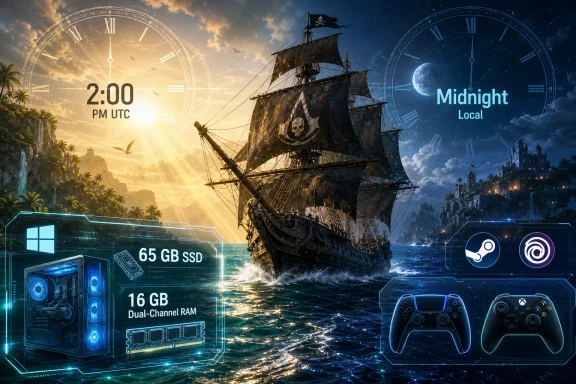
The cleanest answer is that PC players get a single worldwide unlock: 2:00 PM UTC on July 9. That applies across Steam, the Epic Games Store, Ubisoft Connect, and supported cloud platforms including GeForce Now and Blacknut, according to Ubisoft’s launch materials and the schedule summarized by GameSpot.In the United States, that means 7:00 AM Pacific and 10:00 AM Eastern on July 9. In the UK, it lands at 3:00 PM BST; in Central Europe, 4:00 PM CEST; in Kyiv, 5:00 PM EEST. Eastern Australia crosses into July 10 at midnight AEST, while New Zealand lands at 2:00 AM NZST on July 10.
Console players are on a different map. PlayStation 5 and Xbox Series X/S unlock at 12:00 AM local time on July 9, which means the first players in some regions will be sailing before PC users anywhere can launch the game. It also means the familiar console-region dance returns, especially on Xbox, where changing the console region to New Zealand has long been a folk ritual for eager players.
The key distinction is that PC is global-time locked and console is local-midnight locked. That sounds like a scheduling footnote, but it changes launch day in practice. PC users around the world enter together; console users enter in waves.
The Exact Regional Times Make PC the Less Romantic Option
For PC, the main unlock times are:UTC is 2:00 PM on July 9. US Pacific time is 7:00 AM on July 9. US Eastern time is 10:00 AM on July 9. UK time is 3:00 PM BST on July 9. Central Europe is 4:00 PM CEST on July 9. Kyiv is 5:00 PM EEST on July 9. Eastern Australia is 12:00 AM AEST on July 10. New Zealand is 2:00 AM NZST on July 10.
That is orderly, fair, and a little dull. Everyone waits for the same switch to flip, which is sensible for a PC ecosystem spread across multiple storefronts and cloud services. It also avoids the awkwardness of one PC region flooding social platforms with spoilers while another region still sees a countdown timer.
Consoles preserve the old midnight-launch rhythm. If you are on PS5 or Xbox Series X/S, your unlock is midnight where your store region says you are. That makes the launch feel more local, more ceremonial, and slightly more exploitable.
Xbox users can generally use the well-known New Zealand-region trick to start early, assuming Ubisoft’s console entitlement behaves as expected. PlayStation users have a harder wall: the same result usually requires buying through or using a New Zealand PlayStation account, which is less convenient and more likely to collide with wallet, DLC, and account-region friction.
Preload Is the First Real Test of the 65 GB SSD Requirement
Preload begins before launch, but the schedule again depends on platform. PC preload starts July 7 at 2:00 PM UTC, 48 hours before the global PC unlock, with the Steam download listed at roughly 65 GB. PS5 preload begins at local midnight on July 7. Xbox Series X/S preload is already live, according to the rollout details reported by GameSpot.The more important number is not the preload date. It is the storage requirement. Ubisoft lists 65 GB of SSD space across every PC configuration, from minimum settings through 4K Ultra, and the wording matters: this is not a “recommended SSD” situation in the old PC sense. A solid-state drive is part of the baseline.
That follows the broader direction of current-generation games. Once developers design around fast asset streaming, the old hard drive becomes not merely slower but structurally wrong for the game’s assumptions. For Windows users still treating a large SATA hard drive as the place where “big games go,” Resynced is another reminder that 2026 AAA PC gaming has effectively moved on.
The 65 GB footprint is not outrageous by modern standards. But it is large enough to matter on 512 GB SSD systems, gaming laptops, and handheld-adjacent Windows devices. If you are juggling Game Pass installs, a few Ubisoft titles, and shader caches, the preload window may begin with a cleanup job.
The PC Specs Say This Is a Modern Remake, Not a Texture Pack
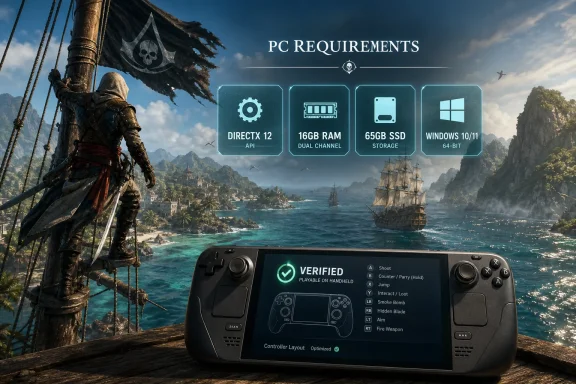
Ubisoft’s published PC requirements divide the game into four targets: 1080p at 30 FPS, 1080p at 60 FPS, 1440p at 60 FPS, and 4K at 60 FPS. Every tier requires Windows 10 or Windows 11 64-bit, 16 GB of dual-channel RAM, DirectX 12, and 65 GB of SSD storage. The escalation is in CPU, GPU, graphics preset, ray-tracing profile, and upscaling quality.For 1080p/30, Ubisoft lists a Ryzen 5 3600 or Intel Core i7-8700K, paired with a Radeon RX 5500 XT 8 GB, Intel Arc A580 8 GB, or GeForce GTX 1660 6 GB. That tier targets Low settings, standard ray tracing, and a Balanced upscaling profile. The GTX 1660 inclusion is notable because it keeps the floor within reach of many older gaming PCs, though “standard ray tracing” language around a non-RT GeForce card will likely depend on what the game can disable, emulate, or scale down.
For 1080p/60, the CPU floor remains modest: Ryzen 5 3600 or Core i5-10600K. The GPU expectation rises to a Radeon RX 6600 XT 8 GB, Intel Arc B580 12 GB, or GeForce RTX 3060 12 GB. That is the sensible mainstream target and probably the one most WindowsForum readers will use as the dividing line between “runs” and “runs comfortably.”
At 1440p/60, Ubisoft asks for a Ryzen 5 5600X or Core i5-11600K, with a Radeon RX 6800 XT 16 GB or GeForce RTX 3080 10 GB. Settings move to High, ray tracing remains Standard, and the upscaling profile stays Balanced. This is where the remake starts to look less like a nostalgic return and more like a contemporary Anvil Engine showcase.
The 4K/60 tier is where the bill comes due. Ubisoft lists a Ryzen 7 5700X3D or Core i7-12700K, alongside a Radeon RX 7900 XTX 24 GB or GeForce RTX 4090 24 GB. The target is Ultra settings, RT Extended, and Quality upscaling. That is not a casual recommendation; it is a flagship-GPU statement.
Windows 10 Survives, but the Hardware Floor Has Moved
One of the more welcome details is Windows 10 support. Ubisoft’s requirements list Windows 10 and Windows 11, both 64-bit, across every tier. In a year when Windows 10’s mainstream support story has become more complicated for consumers and enterprises, that matters.But operating-system support should not be mistaken for old-PC friendliness. The real floor is 16 GB of dual-channel memory, SSD storage, DirectX 12, and a six-core-class CPU from the late 2010s or newer. That is reasonable in 2026, but it shuts the door on a lot of “it still plays esports games” machines.
The dual-channel RAM note is also worth taking seriously. On paper, 16 GB is common; in practice, some budget desktops and laptops still ship with single-channel configurations that quietly kneecap performance. Open-world games with heavy streaming, dense crowds, and modern rendering pipelines are exactly the kind of software that exposes that corner-cutting.
For sysadmins and family tech-support departments, the advice is simple: do not look only at the GPU. Check whether the game is on an SSD, whether memory is actually dual-channel, and whether the installed Windows build has a current GPU driver path. Many “why does this stutter?” complaints begin outside the spec table.
The Platform List Is Narrow by Design
Resynced launches on PC, PS5, PS5 Pro, and Xbox Series X/S. There is no Xbox One version, no PS4 version, and no native Switch version in the announced launch lineup. Ubisoft’s own materials frame the remake as a current-generation rebuild using the latest Anvil Engine technology, which makes that platform cutoff unsurprising.That matters because Black Flag is one of the Assassin’s Creed games with the broadest legacy footprint. The original arrived in 2013 across a transitional console moment, spanning PlayStation 3, Xbox 360, Wii U, PC, PlayStation 4, and Xbox One. The remake is not trying to repeat that sprawl.
The narrowing also helps explain the SSD requirement and the ray-tracing-heavy marketing. Ubisoft is not selling Resynced as a preservation wrapper. It is selling the idea that a beloved design can be rebuilt around modern lighting, water, animation, and rendering assumptions.
Whether that is good news depends on what you want from a remake. If you want the cleanest, most compatible way to replay the original, the old versions still exist. If you want Ubisoft to justify returning to Edward Kenway with more than higher-resolution textures, the current-gen-only strategy gives the studio room to argue that this is a true reconstruction.
The Editions Are Priced Like a Conservative AAA Release
The Ubisoft Store currently lists the Standard Edition at $59.99 and the Deluxe Edition at $69.99 in the United States. GameSpot’s preorder roundup also lists a Collector’s Edition at $200. That positions Resynced below the increasingly common $70 standard-price tier, while still giving Ubisoft a $70 digital upsell and a high-margin physical collector option.That pricing is more interesting than it first appears. A full $70 base price would have invited the usual remake argument: how much should players pay for a modern version of a game they may already own? By keeping the standard edition at $60, Ubisoft gives itself a little rhetorical cover without abandoning premium pricing.
The Deluxe Edition at $70 is the predictable pressure point. Publishers have learned that many buyers anchor on the base price and then drift upward for cosmetics, digital extras, or convenience. For a single-player action-adventure remake, the value of that upgrade depends heavily on what the included content actually means to you.
The Collector’s Edition is for a different audience entirely. At $200, it is not competing with the standard digital purchase; it is competing with display shelves, statues, steelbooks, and the emotional economy of franchise loyalty. For Black Flag, a game whose iconography remains unusually strong inside the Assassin’s Creed catalog, Ubisoft probably knows exactly who that box is for.
Ubisoft Singapore Carries Both the Right Resume and the Awkward Baggage
Ubisoft says Resynced is led by Ubisoft Singapore, with many original developers returning. That is a meaningful detail because Singapore contributed to the original game’s naval sailing, the very system that made Black Flag feel different from the Assassin’s Creed titles around it. The studio later built Skull and Bones, a much longer and more troubled attempt to turn naval combat into its own live-service product.That history cuts both ways. On the optimistic read, Ubisoft Singapore is the obvious team to rebuild the pirate fantasy because it knows the water, the ships, and the fantasy of wind, cannon fire, and pursuit. On the skeptical read, Skull and Bones proved that “more naval stuff” is not automatically the same as a better pirate game.
The useful distinction is that Resynced is not trying to become Skull and Bones. Ubisoft’s official materials describe a faithful recreation of Edward Kenway’s story, enhanced with new content, modernized combat, better visuals, ray-traced lighting, improved water, and expanded systems around the Jackdaw. The pitch is not “what if Black Flag became a service?” but “what if Black Flag had been built for today’s machines?”
That is the right pitch because Black Flag was never loved only for ship combat. It worked because the ships, islands, stealth, cities, shanties, and swagger all reinforced one another. A remake that overcorrects toward any single system risks misunderstanding the original’s balance.
The Ray-Tracing Pitch Is Now Part of the Identity
Ubisoft’s official feature list emphasizes ray-traced lighting with global illumination and reflections, modernized water rendering, physically based rendering assets, and a rebuilt Anvil Engine foundation related to the tech used in Assassin’s Creed Shadows. That is the language of a studio trying to convince players that Resynced is a modern production, not merely a polished back-catalog asset.On PS5 Pro, Sony’s PlayStation Blog and Ubisoft’s promotional materials have highlighted PSSR upscaling and ray tracing across modes. TechRadar and other outlets have reported that PS5 Pro enhancements are a major part of Ubisoft’s console messaging. For console buyers deciding between base PS5, PS5 Pro, and Xbox Series X, graphics modes may become a bigger part of the conversation than the release date itself.
For PC players, the spec table tells the same story in a less glamorous way. Ray tracing appears in every preset description, though the degree and implementation will matter more than the label. The phrase “RT Extended” at 4K/60 is the high-end promise; the practical question is how well the lower tiers preserve image quality and frame pacing.
That is where Windows enthusiasts should wait for benchmarks. Ubisoft’s listed targets are useful, but they are not a substitute for real-world testing across shader compilation, traversal stutter, CPU scaling, VRAM pressure, and driver behavior. The difference between “average 60 FPS” and “feels good at 60 FPS” is often the whole story on PC.
The Remake Has to Beat Memory, Not Just Nostalgia
The strange burden on Resynced is that Black Flag is not an obscure cult game rescued from technical decay. It is one of Ubisoft’s most widely remembered entries, and many players already have a vivid sense of what it felt like: sea shanties rolling over open water, a spyglass on the horizon, a fort waiting to be softened by broadsides, Edward Kenway bluffing his way through history.That makes the remake’s job harder. A remaster can survive by being cleaner. A remake has to justify the risks it introduces.
Ubisoft has pointed to new officers for the Jackdaw, reworked playas, additional missions and scenes with returning voice talent, improved parry-driven combat, new customization, and modernized environments. Those are meaningful additions, but they also touch delicate parts of a familiar machine. Too little change and the project feels unnecessary; too much and players accuse Ubisoft of sanding away the thing they came back for.
This is why the launch-time coverage matters more than it normally would. Players are not only asking when they can press Play. They are preparing to compare a memory against a product, and the first hours will be dominated by feel: movement, combat, camera, sailing, UI, performance, and whether the Caribbean still has that old pull.
PC Players Should Treat the Spec Sheet as a Starting Point
The recommended 1080p/60 tier is the most practical target for many users: Ryzen 5 3600 or Core i5-10600K, RTX 3060 12 GB or RX 6600 XT 8 GB, 16 GB dual-channel RAM, and an SSD. That is a healthy but not absurd machine. It also suggests that the game is designed to scale down to hardware that was mainstream several years ago.Still, there are caveats. The RTX 3060’s 12 GB of VRAM may age better here than some faster cards with less memory, especially if texture quality and ray-tracing buffers are heavy. The RX 6600 XT’s 8 GB allocation should be enough for the recommended target, but users pushing above 1080p may run into sharper compromises.
Intel Arc support in the listed requirements is also worth watching. Ubisoft naming Arc A580 and Arc B580 options is encouraging, but Arc performance can vary sharply by game, driver, API behavior, and shader compilation. If you are on Arc, launch-week driver notes may matter as much as Ubisoft’s table.
The 4K recommendation is unambiguous: RTX 4090 or RX 7900 XTX. That does not mean lesser cards cannot render at 4K with reduced settings or more aggressive upscaling. It means Ubisoft’s official Ultra/RT Extended/Quality target belongs to the top end of the market.
The Calendar Is Simple; the Buying Decision Is Not
There is a version of this story that is just a countdown: July 9, 2:00 PM UTC for PC, midnight local for consoles, preload from July 7 for most players, Xbox already available to preload. That is useful information, and for many readers it is the only thing they came to check.But the buying decision has more layers. If you are on console, the question is whether you care enough about performance modes, PS5 Pro enhancements, or early regional access to pick one platform over another. If you are on PC, the question is whether your machine fits the real target you expect, not just the minimum line.
The Standard Edition at $59.99 is the safest purchase. The Deluxe Edition at $69.99 is for players who already know they want the extras. The Collector’s Edition at $200 is not a value proposition in the normal sense; it is a fan object with a game attached.
The most rational move for uncertain PC players is to preload only if they are confident in the platform and wait for launch-day performance reports if they are not. Ubisoft’s recent PC releases have varied enough that caution is not cynicism. It is just good system administration applied to entertainment.
Edward Kenway Returns to a Less Forgiving PC Audience
The original Black Flag arrived in a different PC era. Players expected compromises, ports were often uneven, and a game could become beloved despite rough edges because the underlying adventure was strong enough. In 2026, the tolerance curve is harsher.Players now expect shader compilation to be managed, ultrawide support to behave, frame pacing to be stable, upscalers to be implemented cleanly, and settings menus to explain themselves. They expect a game that asks for an SSD and 16 GB of RAM to use those resources intelligently. They expect a remake to preserve the feel of the original while removing the friction that time has made more obvious.
That is not an impossible bar. It is simply a higher one than the remake label sometimes implies.
For Ubisoft, Resynced is also a reputational exercise. The company is revisiting one of the safest and most beloved pieces of its catalog at a moment when big publishers are leaning hard on known brands. If this works, it strengthens the argument for careful, technically ambitious remakes. If it stumbles, it reinforces the suspicion that no classic is safe from modern production habits.
The Launch-Day Map for WindowsForum Readers
The useful version of the launch plan is short, but it sits on top of a lot of platform complexity. If you are planning around work, bandwidth, or a regional storefront, these are the facts that matter most.- PC unlocks globally at 2:00 PM UTC on July 9, which is 7:00 AM Pacific, 10:00 AM Eastern, 3:00 PM BST, and 4:00 PM CEST.
- PS5 and Xbox Series X/S unlock at midnight local time on July 9, so console access rolls out by region rather than all at once.
- PC preload begins July 7 at 2:00 PM UTC, PS5 preload begins July 7 at local midnight, and Xbox Series X/S preload is already live.
- Every PC tier requires Windows 10 or Windows 11 64-bit, 16 GB dual-channel RAM, DirectX 12, 65 GB of SSD storage, and no hard-drive fallback.
- The practical 1080p/60 target is an RTX 3060 12 GB, RX 6600 XT 8 GB, or Arc B580 12 GB paired with a Ryzen 5 3600 or Core i5-10600K-class CPU.
- The US pricing is $59.99 for the Standard Edition, $69.99 for the Deluxe Edition, and about $200 for the Collector’s Edition.
References
- Primary source: EGamersWorld
Published: 2026-07-06T19:20:12.206966
Black Flag Resynced Release Time by Region + PC Specs
Assassin's Creed Black Flag Resynced release date is July 9, 2026. Get exact launch times by region, PC system requirements, platforms, and prices.egamersworld.com - Related coverage: gamesradar.com
Upcoming Assassin's Creed games | GamesRadar+
All of the upcoming Assassin's Creed games on the way, from Assassin's Creed Black Flag Resynced to Assassin's Creed Hexewww.gamesradar.com - Related coverage: windowscentral.com
Assassin's Creed Black Flag Resynced targets 60 FPS on Xbox Series X, but Series S misses out — limited to 30 FPS | Windows Central
Assassin's Creed Black Flag Resynced targets 60FPS on Xbox Series X, while Series S is limited to a single graphics mode.www.windowscentral.com - Related coverage: techradar.com
Assassin’s Creed Black Flag Resynced is getting a proper PS5 Pro upgrade — and every graphics mode benefits | TechRadar
Ubisoft has unveiled the PlayStation features for Assassin’s Creed Black Flag Resynced, which is set to have three graphics modes across PS5 and PS5 Pro.www.techradar.com - Related coverage: news.ubisoft.com
Assassin's Creed Black Flag Resynced Out July 9: Everything You Need to Know
Get all the details on Resynced including release date, PC specs, new content, the different editions available, and more.news.ubisoft.com - Related coverage: gematsu.com
Assassin’s Creed Black Flag Resynced launches July 9 for PS5, Xbox Series, and PC - Gematsu
Publisher Ubisoft and developer Ubisoft Quebec have announced Assassin’s Creed Black Flag Resynced, a remake of Assassin’s Creed IV: Black Flag.www.gematsu.com
- Related coverage: notebookcheck.net
Assassin's Creed Black Flag Resynced launch details revealed - Notebookcheck News
Get ready for the official release of Assassin's Creed Black Flag Resynced on July 9, 2026. Find launch times and platform availability here. www.notebookcheck.net
- Related coverage: store.ubisoft.com
- Related coverage: newsroom.ubisoft-press.com
Das legendäre Piratenabenteuer kehrt zurück: Assassin’s Creed™ Black Flag Resynced erscheint am 9. Juli 2026
Spieler:innen hissen die schwarze Flagge und starten ihre Herrschaft über die Meere. Zudem wurden die PC-Anforderungen und verfügbaren Editionen vorgestellt.newsroom.ubisoft-press.com - Related coverage: gadgets360.com
- Related coverage: blog.latam.playstation.com
Assassin’s Creed Black Flag Resynced: explicamos las mejoras de PS5 Pro – PlayStation.Blog LATAM
Información sobre los gráficos mejorados de la PSSR, un Caribe sumamente inmersivo y más novedades a partir del 9 de julio.blog.latam.playstation.com - Related coverage: gamespot.com
Assassin's Creed: Black Flag Resynced Launch Times And Preload Schedule Revealed - GameSpot
We're shipping off to Barbuda soon.www.gamespot.com - Related coverage: gamesbeat.com
Ubisoft reveals Assassin's Creed IV: Black Flag Resynced, launching on July 9 - GamesBeat
Ubisoft officially revealed the remake of Assassin's Creed IV: Black Flag, which launches on July 9 with fresh gameplay and story.gamesbeat.com - Related coverage: dotesports.com
AC Black Flag Resynced release date & countdown
Assassin’s Creed Black Flag Resynced is almost here, and here's a countdown plus release times for different time zones.dotesports.com - Related coverage: blog.br.playstation.com
Assassin’s Creed Black Flag Resynced: detalhes sobre as melhorias para PS5 Pro – PlayStation.Blog BR
Informações sobre gráficos PSSR aprimorados, um Caribe altamente imersivo e muito mais chegando em 9 de julho.blog.br.playstation.com - Related coverage: ubistatic-a.ubisoft.com