

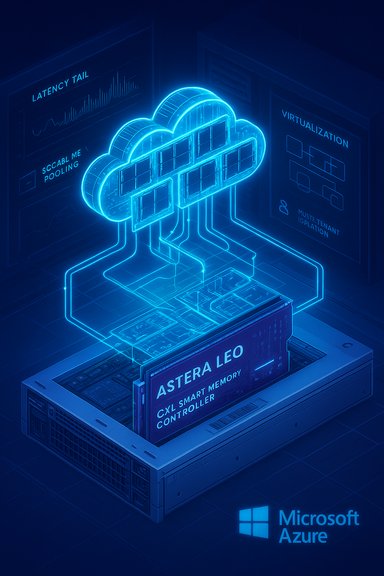
Astera Labs’ Leo CXL Smart Memory Controllers appearing in Microsoft Azure’s M‑series preview is more than a product announcement — it is a practical proof point that the industry’s long-standing “memory wall” is being attacked with real silicon, platform integration, and cloud‑scale evaluation opportunities. The joint preview shows Leo delivering CXL 2.0 semantics and vendor‑stated configurations that present up to 2 TB of CXL‑attached DDR5 memory per controller, enabling cloud hosts to increase usable memory capacity by more than 1.5× for selected workloads.
In short: the Leo + Azure collaboration is a positive technical milestone and a sign that the memory wall is being addressed with practical infrastructure engineering. The next months of real‑world benchmarks, platform documentation, and multi‑vendor interoperability results will determine whether CXL becomes a standard cloud primitive or a powerful but specialized tool in the memory architect’s toolbox.
Source: Finviz https://finviz.com/news/248515/why-...m-series-signals-progress-on-the-memory-wall/
 Background / Overview
Why the “memory wall” still matters
Modern server and AI workloads increasingly expose a mismatch between compute capability and available low‑latency memory. CPUs and accelerators have continued to scale compute throughput, but platform memory is limited by DIMM slots, thermal and power limits, and cost. That leads to three common operational trade‑offs: buy larger, more expensive single‑socket servers; repartition applications across more nodes (adding coordination cost and latency); or fall back to storage tiers that degrade response times. CXL was designed to change that balance by decoupling memory capacity from CPU DIMM sockets while preserving coherent memory semantics.What changed with Astera + Azure
On November 18, 2025, Astera Labs announced that its Leo CXL Smart Memory Controllers are enabled in a preview of Azure M‑series virtual machines, enabling customers to evaluate CXL‑attached memory with their own workloads. Microsoft and Astera framed the Azure M‑series preview as the industry’s first announced cloud VM deployment of CXL‑attached memory, and Astera’s technical material lists Leo support for CXL 2.0 and deployment SKUs that support up to 2 TB of DDR5‑5600 CXL memory per controller. That combination — shipping controller silicon, platform integration with a hyperscaler, and a public preview — moves CXL from lab demos toward real workload evaluation.What CXL 2.0 actually enables (short primer)
- Switching and memory pooling — CXL 2.0 adds switch support and pooling semantics so memory devices can be shared or partitioned among multiple hosts, enabling rack‑ and fabric‑scale memory topologies rather than one‑to‑one host+DRAM.
- Device partitioning and EDSFF — Devices can be partitioned into multiple logical regions and deployed in EDSFF form factors, allowing memory modules to occupy disk bays or add‑in slots.
- Persistent memory and management primitives — CXL 2.0 includes management and persistence features that make pooled memory practical for cloud operations.
Technical deep dive: what Leo controllers bring to the table
Leo’s role in a CXL stack
Astera’s Leo family acts as the endpoint and management plane between CXL hosts (CPU/hypervisor) and DDR5 memory modules. In practical terms Leo:- Implements CXL.mem (and CXL.cache/CXL.io where applicable) to present remote DDR5 as host memory.
- Performs hardware interleaving and presents aggregated memory to the OS/hypervisor to reduce the need for application changes.
- Provides RAS (reliability, availability, serviceability) features and telemetry hooks for hyperscale fleet management via Astera’s management suite.
Performance envelope: latency, bandwidth, and interleaving
CXL‑attached DRAM aims to be DRAM‑like in latency, but not identical to CPU‑attached DIMMs. Latency and bandwidth depend on:- Link width and lane rate (PCIe/CXL physical layer characteristics).
- Controller microarchitecture (how quickly requests are handled and interleaving performed).
- Topology (direct add‑in card vs. switch‑based pooling; presence of retimers).
- Workload access patterns (random small accesses vs. large streaming transfers).
Observability and operational controls
Astera emphasizes telemetry and fleet management capabilities in its COSMOS management stack to make CXL devices visible and manageable at scale. For hyperscalers, visibility at the link, card, and pool level is essential for debugging, capacity planning, and automated remediation during controller resets or link events. The presence of robust telemetry materially reduces risk when rolling CXL into production fleets.The Azure M‑series preview: signal vs. production
Why the preview matters
A hyperscaler preview does three things simultaneously:- Validates systems integration across firmware, BIOS, hypervisor and orchestration layers in real production‑like environments.
- Exposes the technology to real workloads — customers can run in‑memory databases, inference pipelines, and KV caches to see practical trade‑offs.
- Signals commercial intent — being first to announce a CXL VM family provides marketing leverage and early tenant feedback.
But preview ≠ GA
It’s critical to read the announcement precisely: Azure’s M‑series is in preview for CXL‑attached memory. Preview programs help uncover corner‑cases but also mean firmware stacks, tooling, availability, and SLAs will evolve before general availability. Buyers should treat the deployment as a real testbed — not a turnkey production guarantee.Which workloads benefit most (and why)
CXL‑attached DDR5 gives cloud operators a new lever: increase usable memory capacity without proportionally adding CPU sockets. That benefits workloads where capacity — not raw CPU cycles or internal DRAM bandwidth — is the bottleneck.- In‑memory databases (Redis, SAP HANA, single‑host analytics) — larger, lower‑latency working sets reduce spills to storage and lower TCO for memory‑sized problems.
- LLM KV caches and inference caches — KV stores for retrieval or cache layers that back large models can be consolidated into larger memory pools, reducing per‑query latency and replication overhead.
- Large graph analytics and joins — jobs that previously required wide sharding can benefit from larger per‑node memory capacity.
Performance and operational trade‑offs — what to test
- Measure latency tails — average latency hides the critical tail behavior that influences SLAs. Run synthetic and production‑like loads to reveal variance.
- Quantify bandwidth and contention — pooled memory implies potential cross‑host contention. Test interleaving strategies, QoS, and switch buffering under load.
- Validate NUMA and OS behavior — large secondary memory pools alter NUMA visibility and kernel allocators; hot‑plug semantics and GC behaviour (for managed runtimes) must be validated.
- Test failure and recovery scenarios — controller resets, link failures, and pool reclamation must have deterministic recovery actions and automation hooks.
Security, isolation, and governance concerns
Memory pooling and multi‑host sharing change the attack surface. Key areas for security validation:- Encryption of in‑flight CXL links — verify link encryption and hardware attestation support across the stack.
- Firmware and supply‑chain controls — controllers and add‑in cards introduce firmware vectors; enterprises should insist on firmware attestation and update governance.
- Tenant isolation in shared pool scenarios — partitioning must ensure cryptographic and logical separation; until independent audits are published, multi‑tenant pooling requires careful risk weighting.
Operational checklist: how to run a safe, informative pilot
- Identify the highest‑value, memory‑bound workload that currently forces expensive scale‑up decisions.
- Negotiate preview access and collect vendor compatibility and telemetry matrices from the provider.
- Define SLOs that emphasize latency tails, recovery objectives, and cost‑per‑job comparisons.
- Deploy parallel baselines (non‑CXL VMs or bare‑metal) and run production‑like traffic patterns.
- Simulate failure modes (controller reset, link drop) and measure detection and recovery times.
- Validate NUMA and guest kernel behavior under heap growth and GC stress.
- Integrate telemetry into the monitoring stack and demand deep diagnostics from the vendor.
- Model TCO across multiple scenarios (best case, median, and worst case) and negotiate rollback support with the cloud provider.
Market implications: who wins, who must adapt
- For Astera Labs — a fielded Leo integration in Azure is a technical validation and commercial signal. If previews convert to GA services and design wins, Astera’s controller silicon plus software stack (COSMOS) could capture significant rack‑scale connectivity dollar content.
- For Microsoft/Azure — offering large memory instances via CXL provides product differentiation for memory‑bound tenants; it also requires Azure to document billing, isolation, and failure semantics clearly — or risk customer surprise.
- For other hyperscalers and OEMs — the competitive response matters. If more clouds adopt CXL, best practices and portability expectations will emerge; if adoption remains isolated, customers may face portability friction.
- For the broader ecosystem — success depends on multi‑vendor interoperability: controllers (Astera, others), add‑in cards, switch silicon, and host firmware must all align. Early previews accelerate interoperability testing and platform maturity.
Risks and limitations to keep in view
- Vendor spec vs. real‑world behavior — the 2 TB per controller and “>1.5× memory scaling” numbers are vendor‑published capabilities tied to specific Leo SKUs and DIMM mixes. They are credible engineering targets but require independent validation under representative workloads.
- Latency delta matters — for ultra‑latency‑sensitive kernels, CXL cannot replace on‑package HBM or direct CPU DIMM bandwidth. Applications must accept slightly higher tail latency to gain capacity.
- Operational complexity — helm of firmware updates, device enumeration, hypervisor drivers, and orchestration increases operational burden, especially early in preview phases. Expect rapid iteration across firmware and tooling.
- Security and compliance — multi‑tenant pooling requires convincing evidence of isolation, encryption, and attestation before many enterprises will adopt pooled memory models.
What to watch next (short to medium term signals)
- Public benchmarks from the Azure M‑series preview that publish tail latency, throughput, and cost‑per‑job vs baseline configurations. These will be the most persuasive data points for enterprise buyers.
- Microsoft technical documentation clarifying how CXL memory is exposed, billed, and isolated — critical to move from pilot to production.
- Additional hyperscaler pilots or GA announcements — multi‑cloud availability will determine portability and help standardize operational playbooks.
- Independent interoperability tests and security audits from third parties, validating cross‑vendor stability and isolation.
Practical verdict: measured optimism
Astera’s Leo controllers in an Azure M‑series preview represent a meaningful, concrete step against the memory wall. The announcement wraps three valuable elements into one package: shipping controller silicon, cloud platform integration, and a public evaluation surface where customers can run real workloads. Those are the exact conditions needed to move technology from promising demos into practical infrastructure choices. That said, this is still the first mile of operational adoption. Preview status, vendor‑published specs, and remaining ecosystem work mean IT teams should proceed with disciplined pilots, focused on tail latency, recovery behavior, and transparent TCO models. For memory‑bound workloads that can tolerate modest latency increases in return for substantially larger memory footprints — KV caches for LLMs, in‑memory databases, and large analytics jobs — CXL‑enabled instances offer a promising new option that could materially reduce cost and complexity. But for microsecond‑sensitive streaming kernels, existing high‑bandwidth, low‑latency architectures remain necessary.In short: the Leo + Azure collaboration is a positive technical milestone and a sign that the memory wall is being addressed with practical infrastructure engineering. The next months of real‑world benchmarks, platform documentation, and multi‑vendor interoperability results will determine whether CXL becomes a standard cloud primitive or a powerful but specialized tool in the memory architect’s toolbox.
Source: Finviz https://finviz.com/news/248515/why-...m-series-signals-progress-on-the-memory-wall/
