

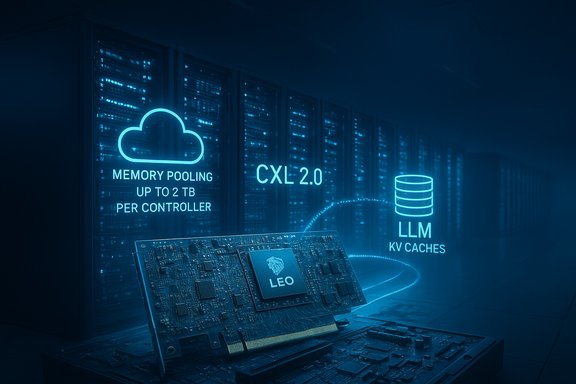
Astera Labs’ Leo CXL Smart Memory Controllers are now powering a private preview of Microsoft Azure’s M‑series virtual machines, marking the first publicized deployment of CXL‑attached memory in a major cloud provider and opening a practical path to break the long‑standing memory wall for memory‑bound enterprise and AI workloads.
Background
What changed: CXL memory expansion on Azure M‑series
Microsoft and Astera Labs are enabling customer evaluation of Compute Express Link (CXL) memory expansion inside Azure’s M‑series VMs, with Astera’s Leo controllers offering CXL 2.0 support and up to 2 TB of CXL‑attached memory per controller. The move is described as a preview (evaluation) capability rather than general availability today, letting customers test memory‑heavy workloads at scale on cloud VMs that extend memory beyond CPU‑attached DRAM limits.Why it matters: the “memory wall”
Traditional server designs tie DRAM capacity and bandwidth to CPU memory channels. That architecture creates two recurring problems for modern data centers: limited in‑node memory capacity and insufficient streaming memory bandwidth for workloads like in‑memory databases, large‑context ML inference, and KV caches for large language models (LLMs). CXL creates a standardized PCIe‑based fabric to attach additional memory to a host CPU with a coherent interface, enabling memory expansion, pooling, and (in some implementations) sharing across devices without rewriting applications. By appearing in Azure’s M‑series preview, CXL moves from lab demonstrations into practical cloud evaluation for customer workloads.Overview of the technology and products
Astera Labs’ Leo CXL Smart Memory Controllers — what they do
Astera’s Leo family is a purpose‑built CXL memory connectivity platform that acts as a bridge between CXL hosts and DDR5 memory modules, with features targeted at cloud and AI infrastructure:- Supports CXL 1.1 / CXL 2.0 host interfaces while presenting DDR5 memory to the system.
- Hardware‑level interleaving and telemetry for performance and reliability.
- Designs today support up to 2 TB of memory per controller on select Leo parts and target DDR5 speeds up to 5600 MT/s on the DIMM side.
Microsoft’s Azure M‑series: a testbed for CXL in the cloud
Azure’s M‑series VMs were announced as the industry’s first publicized deployment of CXL‑attached memory in a cloud VM family, designed to host memory‑intensive applications that previously forced users to adopt large single‑tenant bare‑metal or on‑prem servers. Microsoft’s engineering leadership is quoted in the Astera announcement as having collaborated from architecture through platform integration for the preview, reflecting the complexity of aligning hardware, firmware, hypervisor, and orchestration layers for CXL.Technical verification and key specs
The most load‑bearing technical claims in the joint announcement and product documentation are:- Leo controllers support CXL 2.0 and CXL.memory semantics.
- Selected Leo SKUs are designed to support up to 2 TB of CXL‑attached memory per controller.
- The Azure M‑series preview is described as the first announced deployment of CXL‑attached memory in the industry, intended for testing memory‑bound cloud workloads.
What this enables for real workloads
Target workloads and business cases
CXL‑attached memory is relevant when working sets exceed CPU‑attached DRAM capacity or when workloads benefit from larger in‑memory datasets without expensive application refactors. Typical high‑value use cases include:- In‑memory databases (Redis, SAP HANA, MemSQL) where scale‑out costs and latency tradeoffs are critical.
- LLM KV caches and inference memory caches for reducing token‑serving latency and increasing effective context windows.
- Large graph and analytics workloads that stream in‑memory datasets across many threads.
- Big data analytics and large in‑memory joins where memory pressure creates costly disk spillover.
Strengths and near‑term opportunities
1. Practical bridge to deployable CXL
Astera’s Leo family is not a conceptual demonstrator — it’s a shipping product portfolio with SKUs, board designs, and interoperability testing labs. That ecosystem readiness lowers risk for hyperscalers like Microsoft and expedites preview pilots that matter to enterprise customers.2. A cloud‑native way to mitigate memory bottlenecks
CXL enables cloud operators to treat memory as a scalable resource that can be expanded or pooled independently from the CPU sockets. For memory‑bound workloads, this is a fundamental architectural shift from “buy more sockets” toward “attach more memory” — potentially improving utilization and reducing stranded capacity across heterogeneous server fleets.3. Faster on‑ramp for customers who cannot re‑architect software
Because Leo implements CXL.mem hardware semantics and interleaving to present additional memory transparently, many workloads can benefit without code changes. That pragmatic compatibility is a high‑value property when adoption depends on short migration cycles and predictable behavior.Risks, limitations, and unknowns
1. Preview status — not yet GA
The Azure M‑series deployment is described as a preview for customer evaluation. Preview programs are essential, but they also carry caveats: limited availability, evolving firmware and software stacks, incomplete tooling, and potential changes before general availability. Enterprises should not assume immediate production readiness.2. Latency and performance variance vs. native DRAM
CXL provides coherent memory access semantics but does not magically make CXL‑attached memory identical to CPU‑direct DRAM in raw latency. The practical, application‑visible difference depends on interleaving, caching policies, NUMA characteristics, and workload access patterns. Real workload benchmarking (not vendor‑reported peak numbers) is essential before concluding cost‑efficiency or SLA‑suitability. Independent testing and tuned STREAM‑like runs are the reliable way to quantify expected gains and tradeoffs.3. Operational complexity at hyperscale
Deploying CXL in a cloud fleet raises non‑trivial orchestration questions: device enumeration, hot‑plug semantics, driver maturity across hypervisor and guest OS, firmware update paths, and telemetry/observability for memory pools. Hyperscalers are used to solving these problems, but customers must expect rolling software and operational updates during the preview window.4. Security and isolation concerns
Memory pooling and shared memory scenarios introduce new attack surfaces. Astera’s product brief mentions end‑to‑end datapath security and telemetry, but operators must validate isolation guarantees, encryption‑in‑transit, and hardware‑rooted attestation for multi‑tenant scenarios. Until independent security audits or third‑party validations appear, some enterprise customers may prefer isolated, single‑tenant deployments.5. Cost per GB and vendor lock‑in
HBM, DRAM, and add‑in controller economics differ: increasing memory capacity via add‑in CXL controllers will have a different cost profile than populating additional DIMMs or buying larger NUMA systems. The procurement calculus must weigh per‑GB price, power, rack density, and performance per workload. Additionally, close integration between a cloud provider and a third‑party controller supplier requires careful contractual and supply‑chain review to avoid future lock‑in.How enterprise architects and cloud teams should evaluate the preview
- Identify representative memory‑bound workloads (in‑memory DBs, LLM KV cache tests, large analytics joins).
- Build microbenchmarks and end‑to‑end job runs that mimic production access patterns (not synthetic, one‑off kernels).
- Measure not only throughput but latency tail, error handling, and failure modes under node churn.
- Track telemetry and diagnostics exposed by the Leo/CXL stack — examine visibility for allocation, hot‑plug, and failure recovery.
- Compare cost‑per‑job between native high‑capacity servers, scaled‑out clusters, and CXL‑enabled M‑series nodes to determine the right economic model.
Competitive landscape and market implications
Vendors and ecosystems
CXL is an open standard backed by major CPU and memory vendors; the actual CXL ecosystem will include silicon vendors (Intel, AMD), retimer and switch vendors, and controller suppliers like Astera Labs. The first cloud deployments will set expectations for interoperability, vendor cooperation, and how the stack from silicon to orchestration behaves in production. Astera’s strategy — building controllers, retimers, and interop labs — positions it to be a reliable partner for early hyperscaler deployments.Hyperscaler dynamics
If Microsoft’s public preview proves operationally successful, other cloud providers will accelerate their own CXL pilots or partner choices. Early mover advantage matters here: being first to operationalize CXL in the cloud gives Azure a narrative and a real capability to attract memory‑heavy customers who previously had only on‑premises options. That could tilt some buying decisions for demanding workloads toward Azure during the transition window.Longer term: standardization and portability
CXL’s value depends on cross‑vendor interoperability. Successful adoption by hyperscalers will push OEMs, OS vendors, and memory suppliers to harden drivers, provisioning APIs, and telemetry standards — making CXL a standard cloud primitive rather than a bespoke platform feature. Astera’s interop lab work and field‑testing help advance that path, but customers should demand clear compatibility matrices and validated configurations.Practical cautions and unverifiable claims
- Astera’s and press reports’ headline numbers (2 TB per controller; >1.5× memory scaling) come from vendor documentation and press statements. These are credible and consistent across multiple vendor and press releases, but real‑world performance will vary by workload and configuration. Treat vendor specs as design targets and use independent test runs for procurement decisions.
- Microsoft’s role in the announcement is confirmed via quoted engineering leadership and inclusion in the preview program, but there is no Microsoft‑hosted technical deep‑dive linked in the press release at the time of the announcement. The Astera press release references a short Microsoft technical resource link; practitioners should wait for or request Microsoft’s formal documentation for production planning.
Short‑term checklist for IT decision‑makers
- Confirm preview access and availability for your tenant and regions.
- Select 2–3 critical workloads to instantiate on M‑series CXL preview nodes.
- Define SLOs and metrics up front: throughput, 95/99/99.9% latency tails, recovery time after controller failover.
- Budget for a parallel cost study — compare price/performance between CXL‑enabled VMs and equivalent bare‑metal or memory‑optimized SKU alternatives.
- Require security and telemetry proofs from the vendor: datapath encryption options, attestation, and forensic logs for memory allocation events.
Conclusion
Astera Labs’ announcement that its Leo CXL Smart Memory Controllers are enabling Microsoft Azure’s M‑series CXL memory preview is a substantive milestone: it shifts CXL from ecosystem demos and lab interop to a cloud operator’s evaluation program and gives customers a tangible way to test memory expansion in the cloud. The combination of Astera’s shipping product portfolio, established interop testing, and a hyperscaler preview program creates a credible path for memory expansion to become a practical, cloud‑native capability for memory‑bound workloads. That said, the technology is still in preview. Realizing the promise — lower cost per job, better consolidation, and simpler scaling for in‑memory applications — depends on rigorous, workload‑specific testing, transparent operational controls (telemetry, firmware and driver maturity), and clear security guarantees. The Azure M‑series preview is the beginning of a transition, not the end; when it comes to CXL and cloud memory expansion, the next months of field experience and independent benchmarks will determine whether this becomes a mainstream cloud architecture or a valuable niche for specific, high‑value workloads.Astera Labs’ product documentation and Microsoft‑collaborative press materials provide the technical baseline for the claims above; technology teams planning to adopt CXL‑attached memory should align procurement, workload validation, and security reviews with the preview program timelines and vendor release notes.
Source: Investing.com UK Astera Labs powers Microsoft’s first CXL memory expansion for Azure By Investing.com
