

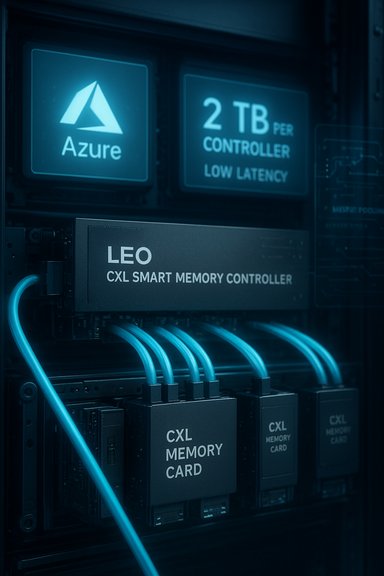
Astera Labs’ announcement that its Leo CXL Smart Memory Controllers are enabling evaluation of Compute Express Link (CXL) memory expansion on Microsoft Azure M‑series virtual machines marks a practical milestone in the industry push to break the long‑standing memory wall — the gap between CPU compute capacity and the amount and flexibility of memory available to modern, memory‑hungry workloads. The company says Leo supports CXL 2.0 with up to 2 TB of CXL‑attached memory per controller, allowing server memory capacity to scale by more than 1.5× for workloads such as in‑memory databases, AI inference, KV cache for LLMs, and large‑scale analytics. This article explains what that claim means in practice, places it in the context of other memory innovations, evaluates the technical and operational implications, and offers a clear checklist for IT teams considering a pilot.
Source: The Manila Times Astera Labs' Leo CXL Smart Memory Controllers on Microsoft Azure M-series Virtual Machines Overcome the Memory Wall
Source: Stock Titan Astera Labs (Nasdaq: ALAB) enables 2TB CXL memory for Azure M-series VMs
 Background / Overview
Why the “memory wall” still matters
For many modern enterprise and AI workloads, raw compute (CPU or accelerator) no longer limits performance — the bottleneck is moving enough data in and out of memory at low latency. This is especially true for large‑scale simulations, real‑time analytics, and AI inference patterns where working sets exceed a single host’s DRAM or where many concurrent instances (for example, multiple LLM sessions) must share memory efficiently. Traditional server architectures bind memory tightly to CPU sockets via DIMM channels. That model forces trade‑offs: either add expensive, oversized DRAM per host or repartition work across more nodes, which increases coordination overhead and latency. CXL was designed to change that model by decoupling memory capacity from host CPU sockets while preserving coherency and low latency.What CXL 2.0 enables
The CXL 2.0 specification introduced three capabilities critical to cloud use cases: switching (device fan‑out), memory pooling (shared, manageable memory pools), and persistent memory support, along with management and security primitives to make those modes practical for datacenter use. Those features let cloud providers and system designers allocate memory more flexibly, migrate resources, and build fabrics rather than one‑to‑one host+DRAM topologies. However, moving a standard into production requires silicon (controllers and switches), firmware, OS/hypervisor support, and validated platform integration — which is where vendors like Astera Labs fit in.What Astera Labs announced — the headline claims
- Astera Labs says the Leo CXL Smart Memory Controllers can be used to evaluate CXL memory expansion on Azure M‑series VMs (preview), supporting CXL 2.0 and up to 2 TB of memory per controller, and can scale server memory capacity by more than 1.5×. The company highlights targeted workloads: in‑memory databases, big data analytics, AI inference, LLM KV cache, machine learning, and recommendation systems.
- Microsoft is quoted in the announcement characterizing the Azure M‑series preview as “the industry’s first announced deployment of CXL‑attached memory,” and Microsoft and Astera emphasize collaboration from architecture through platform integration in the preview activity. The release frames the capability as a preview evaluation, not a broad general‑availability product rollout.
- Astera’s own product pages and demo materials show Leo integrated with add‑in CXL memory cards (SMART Modular and others) and published demos with AI inference stacks (FlexGen) that report meaningful throughput and utilization improvements under certain conditions — one demo referenced a 5.5× throughput jump with 90% GPU utilization in a FlexGen inference scenario when adding CXL memory. Those demos illustrate the potential value but are workload‑specific and were run in controlled environments.
Technical analysis — how Leo and CXL fit into the platform
What a “Leo CXL Smart Memory Controller” actually does
At a high level, Leo controllers act as the endpoint and management layer that bridges host systems (or hypervisors) to CXL‑attached memory devices. Functions include:- Implementing the CXL.mem / CXL.cache / CXL.io protocol stack and managing coherency semantics required by hosts and devices.
- Providing RAS (reliability, availability, serviceability) features, diagnostic telemetry, and fleet management hooks (Astera’s COSMOS stack) to track health and performance in hyperscale deployments.
- Supporting memory expansion and pooling topologies, enabling host software to address additional capacity presented via CXL.
Where latency and bandwidth matter
CXL is designed to be low latency compared to networked or remote memory but cannot match on‑package HBM3 streaming bandwidth for microsecond‑sensitive streaming workloads. Two important architectural contrasts:- CXL memory expansion gives higher capacity and flexible allocation with reasonable latency and coherent access semantics — ideal for workloads that are capacity constrained or require flexible per‑VM memory pools (e.g., KV caches for LLMs, in‑memory DBs).
- On‑package HBM (HBM3) or HBM‑adjacent solutions prioritize raw bandwidth and lowest latency for streaming inner loops (for example, Azure HBv5’s HBM3 packaging), and are a different engineering trade‑off: exceptional bandwidth, but higher cost per GB and different deployment models. Both approaches have an audience; one is not a universal replacement for the other. Independent reports on Azure’s HBM offerings show enormous streaming throughput gains for memory‑bound HPC workloads, underscoring how different memory topologies serve different workload classes.
Software stack and hypervisor considerations
For CXL memory to be useful inside VMs, the stack must be coordinated:- Host firmware and hypervisor need to enumerate and present CXL memory as attachable memory resources.
- Guest OS kernels need drivers and memory hotplug support to accept and use remote/polled memory.
- Orchestration and cloud control planes must expose memory pools and accounting to tenants and schedulers.
Real‑world benefits for target workloads
Astera and Microsoft call out a predictable list of winners for CXL memory expansion. Here’s a practical translation of those claims and where the benefits are likely strongest:- Large in‑memory databases: These systems trade latency for capacity and can often benefit immediately from extra attached memory to reduce I/O and cross‑node sharding. CXL can reduce out‑of‑core operations and lower the need for expensive vertical DRAM upgrades.
- AI inference and LLM KV cache: For LLMs, storing the embedding/kv cache in a large low‑latency attached memory pool lets many model instances run concurrently without replicating the same large cache in each GPU or host. That improves throughput per rack and increases GPU utilization — the exact metric vendors highlight in inference demos. Results will depend heavily on cache hit rates and access patterns.
- Big data analytics and ETL pipelines: Workloads that stage or join large datasets in memory can see faster runtimes when they avoid swapping or distributed sharding overhead. CXL’s pooled memory can make single‑node analysis possible where previously jobs required complex distributed staging.
- ML training (selectively): Training pipelines that need large host memory footprints for preprocessing or caching may find value, but training’s hottest kernels often benefit more from accelerator memory bandwidth (HBM on GPUs). For training, CXL is most valuable for ancillary tasks around the training loop (data staging, caching), not necessarily replacing accelerator memory.
Risks, caveats, and unknowns
No platform shift is without trade‑offs. The announcement is promising but should be read with operational caution.- Preview vs GA: The Azure M‑series CXL capability is described as a preview evaluation. Preview environments are for validation and are not production guarantees. IT teams should plan pilots accordingly.
- Performance variability: The real benefit depends on workload characteristics (random vs streaming access, locality, concurrency). Controlled demos showing large throughput improvements are compelling, but they do not guarantee equal improvements across all deployments or datasets. Expect to validate with representative traces.
- Ecosystem maturity and interoperability: CXL is evolving rapidly. While CXL 2.0 provides switching and pooling, the ecosystem components (controllers, memory cards, switches, OS support) require rigorous interoperability testing. Buyers should confirm compliance, test vendor interop, and demand vendor SLAs where production reliability is essential. The CXL Consortium’s ongoing spec work (3.x) shows the ecosystem is active and improving, but that also means the feature set and management models are evolving.
- Security and data integrity: CXL 2.0 introduced link‑level integrity and encryption primitives, but security in disaggregated memory fabrics includes new threat models (memory sharing across tenants, metadata leakage via fabric telemetry). Designs must include access control, encryption, and robust tenancy isolation.
- Cost and economics: Adding CXL controllers and memory cards changes per‑GB cost profiles. While CXL can reduce total cost of ownership by improving utilization, the upfront cost and operational complexity may not make economic sense for smaller or lightly memory‑bound workloads. Run job‑level cost‑per‑run and time‑to‑solution modeling before committing.
- Alternative architectures: For extreme bandwidth‑bound workloads, on‑package HBM or specialized memory architectures (for example, Azure HBv5 with HBM3) may still be the better choice. Cloud architects should treat CXL as complementary, not necessarily a replacement. Discussion and benchmarks of such HBM‑based offerings show substantial bandwidth advantages for streaming workloads, while CXL offers capacity and flexibility.
How to evaluate CXL memory expansion on Azure — a pragmatic checklist
Organizations planning to test Leo CXL controllers on Azure M‑series VMs (or any CXL environment) should follow a repeatable evaluation approach:- Identify representative workloads and define clear performance metrics.
- Measure time‑to‑solution, throughput, memory footprint, CPU/GPU utilization, latency percentiles, and cost‑per‑run.
- Prepare baseline runs on currently‑deployed VM families (for example, Azure M‑series or other large‑memory sizes) to establish realistic comparators.
- Run controlled A/B tests with and without CXL memory for:
- Cold‑start latency and steady‑state throughput.
- Concurrency scenarios (multiple simultaneous LLM sessions, parallel SQL queries).
- Validate stack support:
- Hypervisor/host BIOS and driver compatibility.
- Guest OS hotplug and memory management correctness.
- Orchestration integration (how will tenant quotas, billing, and failure/recovery be handled?.
- Test failure modes and RAS:
- Controller/card failures, hot‑plug events, fabric segmentation, and recovery.
- Verify telemetry and logging for root‑cause analysis.
- Model economics:
- Measure cost per job for the new config vs baseline.
- Factor in operational overhead and any premium for preview/early access instances.
- Security review:
- Ensure CXL link encryption and host isolation meet enterprise requirements.
- Validate tenant separation and any firmware supply‑chain concerns.
- Operational pilot:
- Start with noncritical workloads for a production pilot (small‑scale) and run for several weeks to capture variability.
- Procurement and SLA negotiation:
- If promising, negotiate firm capacities, SLAs, and documented interoperability across the chosen vendors (controller, memory vendor, cloud offering).
What this means for cloud providers, OEMs, and enterprise architects
- Cloud providers can use CXL to offer differentiated memory tiers: large, flexible memory pools for capacity‑bound tenants and ultra‑bandwidth nodes (HBM‑based) for streaming HPC workloads. Doing so will enable more efficient hardware utilization and new pricing models based on memory elasticity.
- OEMs and hyperscalers will need to invest in rigorous firmware, test automation, and management abstractions (fabric managers) to make CXL memory simple and safe to operate at scale.
- Enterprise architects should treat CXL as another lever. For applications already constrained by host DRAM or by high replication costs (e.g., model parameter caches duplicated across nodes), CXL may immediately improve economics. For others, the benefit will need to be validated through careful pilots.
The competitive landscape and where to watch next
Astera Labs is one of several vendors building CXL controllers and ecosystem components; other silicon and memory vendors are pursuing memory expander chips, add‑in cards, and switch silicon. The CXL Consortium continues to iterate the standard (with active 3.x work on fabric improvements), and vendors are racing to ship interoperable, tested platforms. Hyperscalers’ choices — whether to deploy CXL, HBM3, or hybrid topologies — will define common operational patterns for the next few years. Expect announcements and real‑world benchmarks to accumulate over the next 6–12 months as more preview programs move toward broader availability.Conclusion — practical verdict
Astera Labs’ Leo CXL Smart Memory Controllers being validated on Azure M‑series preview VMs is an important milestone for CXL adoption in the cloud: it demonstrates vendor silicon, cloud platform integration, and measurable benefits in targeted demos. The core promise — break the memory wall by decoupling capacity from CPU DIMM channels — is technically real and now moving from whitepaper to platform preview. That said, the announcement must be read with operational judgment: the 2 TB per controller capability is a product specification, not a universal property of CXL; Azure’s M‑series CXL offering is in preview and should be validated with representative workloads; and ecosystem maturity, management, and security practices remain active areas of work. IT teams should run controlled pilots, validate the full stack, and model job‑level economics before migrating production workloads. For memory‑bound applications that cannot be rewritten for accelerator‑local memory, CXL presents a compelling new option — but it is one more tool in an expanding memory architecture toolbox that also includes HBM, persistent memory, and improved DRAM topologies.Quick reference — key facts at a glance
- Product: Astera Labs Leo CXL Smart Memory Controllers — supports CXL 2.0 and up to 2 TB per controller (product‑level figure).
- Platform: Microsoft Azure M‑series VMs (preview) — described by vendors as the first announced CXL‑attached memory deployment in cloud. Preview status; confirm availability and region coverage before planning.
- Best fit workloads: In‑memory databases, KV cache for LLMs, AI inference, big data analytics, some ML preprocessing.
- Specification context: CXL 2.0 adds switching, memory pooling, and persistent memory management — the features that make cloud fabric topologies possible; ecosystem implementations vary.
Source: The Manila Times Astera Labs' Leo CXL Smart Memory Controllers on Microsoft Azure M-series Virtual Machines Overcome the Memory Wall
Source: Stock Titan Astera Labs (Nasdaq: ALAB) enables 2TB CXL memory for Azure M-series VMs
