

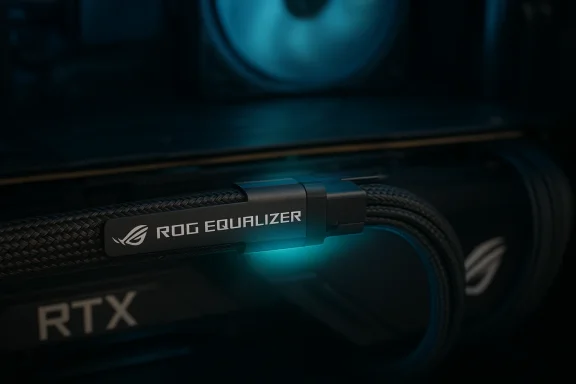
The timing is no accident. Nvidia’s move to the 16-pin power ecosystem began with the RTX 4090 and continued through the RTX 50-series, including the RTX 5090, which Nvidia officially lists with a 575W total graphics power rating and a 600W PCIe Gen 5 cable option. That design reduced cable clutter and aligned with newer power-delivery standards, but it also created a very public failure mode: if the plug was not fully seated, or if contact quality deteriorated, localized heat could become destructive. ASUS’s answer is not to abandon the connector, but to engineer around its weakest point.
For builders, this matters because the industry has now moved from treating 16-pin issues as isolated mishaps to treating them as a real design constraint. ASUS says the ROG Equalizer is bundled with its 2026 ROG Thor III and ROG Strix Platinum power supplies, and also compatible with ATX 3.1 PSUs from other leading manufacturers that use a native 12V-2x6 connector. In other words, the problem is no longer theoretical, and the market response is no longer limited to firmware, adapters, or “just make sure it clicks.”
Background
The connector story starts with the broader shift from legacy 8-pin PCIe power to compact, high-density 16-pin designs. The older approach was simple, familiar, and forgiving: several 8-pin leads, each with plenty of headroom, distributed current across a larger set of contacts. By contrast, the 12VHPWR and later 12V-2x6 ecosystem was intended to simplify cabling and support the power demands of next-generation GPUs, but it did so by concentrating more current into a much smaller physical footprint. That tradeoff was manageable on paper and much less comfortable in real-world enthusiast PCs.
When the RTX 4090 arrived, the conversation shifted quickly from elegance to reliability. Some failures were tied to poor insertion, others to bends near the connector, and others to suspected contact issues between plugs, adapters, and card sockets. What made the issue especially frustrating was that many owners did everything “right” and still found themselves staring at melted plastic or scorched pins. The result was a rare but damaging public perception problem for premium PC hardware: if the most expensive graphics card in the stack can be physically endangered by its power lead, then the ecosystem itself feels unfinished.
The successor standard, 12V-2x6, was meant to address some of those shortcomings by improving safety and connector behavior, and PCI-SIG’s updates formalized the new connector type for PCIe Base 6.0. That did help standardize the market, but it did not magically erase the physics involved in pushing hundreds of watts through compact contact points. In practice, the industry has continued to learn that better standardization is not the same thing as zero-risk operation.
ASUS has been leaning into this transition for some time. Its PSU lineup already emphasized ATX 3.1 compliance and native 16-pin support, and the company has previously marketed 16-pin cabling as part of the next wave of GPU readiness. The ROG Equalizer is therefore not a sudden departure; it is the logical next step in a strategy that assumes the 16-pin future is here, but that the connector itself still deserves a better implementation.
Why this issue became so visible
The meltdowns were not just a technical curiosity. They became a consumer trust issue because flagship GPUs are bought by enthusiasts who expect a premium experience end to end. When the power connector becomes the thing people worry about most, the conversation changes from frame rates to failure rates. That is a terrible look for any product class marketed as elite.
The problem also amplified because the most visible failures happened on the most visible cards. The RTX 4090 became the poster child, and with the RTX 50-series pushing even more serious power budgets in the same direction, the old fears never really disappeared. Instead, they got carried forward into the next product cycle.
Why ASUS is acting now
ASUS has both a commercial incentive and an engineering one. Commercially, it can differentiate its premium power supplies with a feature that directly addresses a pain point. Technically, it can try to control current behavior in a way the generic cable market never did. That combination makes the ROG Equalizer less like a gimmick and more like an ecosystem play.
- Problem: concentrated current at a small connector
- Risk: localized heat and degraded contact behavior
- Response: balance current more evenly across pins
- Business value: premium PSU differentiation
- User value: more peace of mind for expensive GPUs
What the ROG Equalizer Claims to Fix
ASUS says the core innovation in the ROG Equalizer is current balancing. In standard 12V-2x6 implementations, uneven resistance or contact quality can lead to disproportionate current flow through individual pins, which in turn creates heat concentration at a single point. The Equalizer’s job is to spread that load more evenly from the PSU side so no one contact path is taking the full punishment when a GPU pulls hard.
The company is also framing the cable as a thermal safeguard. Its product page says the design is intended to lower connector temperatures and keep thermal performance below the 105°C material limit. ASUS further claims that in a stress test where the middle four wires were removed to simulate current imbalance, the Equalizer held around 73.4°C while a normal 12V-2x6 cable reached roughly 146°C. Those are dramatic numbers, and they suggest ASUS is trying to prove the concept with more than marketing language.
That said, the underlying issue is not only cable design. The GPU socket, the plug, the PSU, and the installation quality all matter. A better cable may help reduce worst-case thermal behavior, but it does not cancel the requirement for a secure connection or a healthy socket. In that sense, ASUS is addressing one pressure point in a chain that still depends on every link behaving properly.
The engineering significance
The important part is not merely that the cable is “stronger.” It is that ASUS is explicitly treating connector current distribution as something that can be managed at the cable level rather than left to the nominal standard alone. That is a subtle but meaningful shift in thinking. It implies the company believes the margin in typical 12V-2x6 setups is too thin for comfort when paired with top-tier GPUs.
This is also why the ROG Equalizer feels like a response to the reality of enthusiast systems, not just the spec sheet. A GPU that can spike hard under boost, in a warm case, with a slightly imperfect plug insertion, is a very different use case from a lab-perfect benchmark setup.
What ASUS is promising in plain English
ASUS is basically saying: if you are going to run a power-hungry Nvidia card, you should not have to accept that the connector itself is the weak link. The company is betting that customers will pay for a more robust path between PSU and GPU if that path reduces anxiety. That bet only works, however, if the cable is widely compatible and does not introduce new headaches.
- Balanced load delivery across pins
- Higher current headroom
- Lower connector temperatures
- Premium cable construction
- Compatibility with native 12V-2x6 ATX 3.1 PSUs
Nvidia’s Power Problem Is Also a Platform Problem
The ROG Equalizer exists because Nvidia’s most powerful consumer cards have become tied to a power-delivery design that still makes some PC builders uneasy. Nvidia’s RTX 5090 page lists a 600W PCIe Gen 5 cable as an option, while the card itself carries a 575W graphics power figure. That is an enormous amount of energy to push through a single compact connector in a consumer tower, even before you account for cable routing, case airflow, and installation variables.
This is not a problem AMD chose to take on in the same way. Many Radeon cards continue to use traditional 8-pin arrangements, which spread current across more familiar cabling and avoid the same kind of visible 16-pin anxiety. That does not make AMD’s approach inherently better in every respect, but it does mean the most public connector drama has been concentrated in Nvidia’s ecosystem. For consumers comparing platforms, that distinction matters more than any abstract specification debate.
Why high wattage changes everything
At lower power levels, connector design flaws can hide in the background for years. At the top end, they become impossible to ignore. A 300W or 350W board gives engineers more breathing room than a 575W or 600W design, because every degree of heat and every fraction of resistance matters less. Once you get to flagship-class power budgets, however, the margin disappears fast.
This is why the connector story has become a proxy for the industry’s appetite for risk. Nvidia chose density and simplicity; users got cleaner cabling but also a new set of failure concerns. ASUS is now trying to offset that by making the cable itself more forgiving.
Enterprise vs. consumer implications
For enterprise and workstation users, connector reliability is not just about annoyance. Downtime, replacement logistics, and service calls cost money, and a power connector that inspires doubt becomes a procurement issue. In consumer gaming PCs, by contrast, the risk is often psychological first: people hesitate to spend on a flagship card when they have to think about whether they are also buying a fire prevention strategy.
That split matters because it changes purchasing behavior. A workstation buyer may accept a pricier PSU accessory if it increases operational confidence. A gamer, on the other hand, may simply decide the whole experience feels over-engineered.
Why the Cable Still Depends on Proper Installation
ASUS has not claimed that the ROG Equalizer makes sloppy installation safe. Quite the opposite: the company’s guidance still emphasizes a fully seated plug with an audible or tactile click, because a partially inserted 12V-2x6 connector remains a hazard regardless of cable quality. That point is easy to miss, but it is probably the most important practical detail in the whole story.
In other words, ASUS is not offering a magic fix. It is offering a better margin for error, and even then only within reason. The physical act of installation still matters, as does the quality of the socket on the GPU side. If the socket is poor, worn, misaligned, or otherwise compromised, no cable can fully compensate.
That reality is why the cable matters so much for the enthusiast audience. Builders do not just want higher specifications; they want reassurance that the product ecosystem respects how PCs are actually assembled. A cable that reduces heat but still demands discipline is more believable than one that pretends the discipline is unnecessary.
The enduring importance of socket quality
ASUS specifically notes that compatibility with third-party GPUs depends on socket quality. That is a subtle admission that the cable is part of a larger reliability chain rather than a standalone cure. It also suggests the company is trying to position the Equalizer as a mitigation tool, not a blanket guarantee.
That distinction is vital in a market where users often expect accessories to solve structural problems. Better power delivery can reduce stress, but it does not eliminate the consequences of a bad fit, a damaged receptacle, or a careless bend at the connector.
Practical guidance for builders
- Use a native ATX 3.1 / 12V-2x6 PSU when possible.
- Insert the plug fully until it clicks.
- Avoid sharp bends immediately at the connector.
- Inspect sockets for visible wear before final installation.
- Do not assume a premium cable overrides poor seating.
Pricing, Bundles, and the Premium PSU Strategy
ASUS has not yet published a standalone retail price for the ROG Equalizer, which makes sense if the company intends to use it as a value-add tied to higher-end PSUs rather than as a mass-market accessory. The cable will ship with the ROG Thor III and ROG Strix Platinum PSU lines, and ASUS says existing owners may be able to buy it separately at a discount. That bundling strategy is classic premium-hardware positioning: make the solution feel exclusive, then decide how wide to open the door later.
From a consumer standpoint, that creates a mixed message. On one hand, users get a more confidence-inspiring option from a reputable vendor. On the other, the industry is effectively asking them to buy a special accessory to reduce worry around a connector standard they were already told should be safe. That tension is hard to ignore, especially when GPU and PSU prices are already stretched.
The broader market context is that flagship hardware now asks buyers to spend far more than in previous generations, and the accessories around those systems are becoming more specialized. A premium PSU, a premium GPU, and now a premium cable to calm connector fears is a lot to absorb emotionally and financially. In that sense, the ROG Equalizer is as much a symbol of the current PC hardware economy as it is a technical product.
Why bundling matters strategically
Bundling lets ASUS control the narrative. Instead of the cable showing up as a separate aftermarket patch, it can be presented as part of a complete, engineered power ecosystem. That is a powerful message, because enthusiasts often trust integrated solutions more than random third-party add-ons.
It also gives ASUS a way to differentiate otherwise similar PSUs. If two 1200W Platinum units are technically close on paper, the one bundled with the heat-reducing 16-pin cable suddenly has a clearer story.
Market positioning in one glance
- Premium PSU upsell
- Ecosystem lock-in potential
- Better perceived safety
- Competitive feature differentiation
- Accessory as trust signal
How This Compares With the Rest of the Industry
The rest of the PSU and GPU world has been moving more cautiously. Some vendors have emphasized native 16-pin support, but very few have tried to redesign the cable around explicit current balancing in the way ASUS is describing. Many companies have settled for compliance language and cable quality claims rather than a branded mitigation product with a named function. That makes the ROG Equalizer unusual, even if it is not entirely unprecedented.
Nvidia’s own documentation and user guides continue to emphasize correct installation, proper seating, and suitable PSU choice. That is the right baseline, but it is also a tacit acknowledgment that the connector ecosystem has not become invisible to users. The fact that a large vendor like ASUS is moving to reduce thermal variation at the cable level suggests the industry is still looking for a more elegant answer.
Competitively, this could influence how other PSU makers market their own ATX 3.1 products. If ASUS gets credit for reducing connector anxiety, rivals may need to explain why their cables, adapters, or bundled leads are equally safe or better. That could raise the bar for an entire category that has mostly relied on certification and trust.
What rivals may have to answer
Other vendors will likely need to address a few uncomfortable questions. How do their 16-pin cables manage heat under stress? What margins do they offer against uneven pin loading? And are they willing to publish more concrete thermal claims the way ASUS has done? Those are not easy questions, and that is exactly why ASUS’s move is notable.
The answer may not always be a new cable design. Rivals could lean on better socket tolerances, stricter quality control, or more conservative adapter guidance. Still, the mere existence of the Equalizer changes the conversation.
The bigger ecosystem effect
If consumers start associating premium 16-pin reliability with named cable technology rather than generic compliance, the market may shift toward more visible engineering claims. That could be good for users if it produces better hardware, but it could also encourage marketing inflation. The danger is that every cable becomes “advanced” without necessarily being meaningfully safer.
- Higher expectations for cable safety
- More pressure on PSU vendors
- Potential spread of thermal-balancing designs
- Greater scrutiny of connector QC
- Marketing race around reliability claims
Strengths and Opportunities
The strongest argument for the ROG Equalizer is that it tackles a very real user fear with a concrete engineering response. ASUS is not pretending the connector issue never happened; it is acknowledging the risk and trying to lower it. That alone gives the product credibility, especially in a segment where trust is as valuable as raw output.
The opportunity is even larger if ASUS can make the cable feel like a standard premium inclusion rather than a niche fix. If bundled smartly, it could become the thing people look for in a serious GPU-ready PSU, much like 80 PLUS ratings or ATX compliance once did.
- Direct response to a real pain point
- Improved thermal headroom
- Premium ecosystem differentiation
- Potential consumer confidence boost
- Better fit for top-tier Nvidia cards
- Useful bundled value in high-end PSUs
- Possible category leadership in safe cabling
Risks and Concerns
The obvious risk is that the product may be interpreted as proof that the 16-pin ecosystem remains inherently fragile. Even if the ROG Equalizer works well, some users will read its existence as an admission that the standard needs help. That perception could hurt as much as it helps, especially among buyers who already mistrust the connector.
There is also the danger of overpromising. A cable can improve current distribution, but it cannot guarantee safety if the socket is damaged, the connection is loose, or the system is assembled poorly. If consumers treat the Equalizer as a substitute for good installation practice, the product could become part of the problem rather than the solution.
- May reinforce fears about 16-pin reliability
- Does not eliminate bad installation risk
- Dependent on socket quality
- Could be expensive or hard to source separately
- May add complexity to an already expensive build
- Could encourage false confidence
- Compatibility questions may still arise
What to Watch Next
The most important next step is pricing. If ASUS prices the cable reasonably, it can be framed as a practical reliability upgrade. If the standalone cost feels excessive, the Equalizer risks becoming another premium accessory that enthusiasts resent even as they reluctantly buy it.
The second thing to watch is how broadly ASUS allows the cable to be used with non-ASUS PSUs and third-party GPUs. The company says compatibility extends to ATX 3.1 units with native 12V-2x6 connectors from leading manufacturers, but real-world adoption will depend on how smoothly that promise translates into user experience.
The third factor is whether competing PSU makers respond with their own current-balancing designs or stronger thermal claims. If they do, the ROG Equalizer may end up remembered less as a one-off ASUS product and more as the beginning of a new safety race in high-power PC hardware.
- Standalone price announcement
- Retail availability outside bundled PSUs
- Third-party PSU compatibility testing
- Real-world adoption by RTX 5090 owners
- Competitive responses from rival PSU brands
The broader lesson here is that the PC industry is still paying for the mistakes and compromises of the 16-pin transition. ASUS’s ROG Equalizer does not erase those lessons, but it does show where the market is headed: toward more explicit engineering around the fears users actually have, not just the specifications vendors prefer to advertise. If the cable proves itself in the wild, it could become one of those rare accessories that changes behavior because it speaks to a problem people have been reluctant to admit is real.