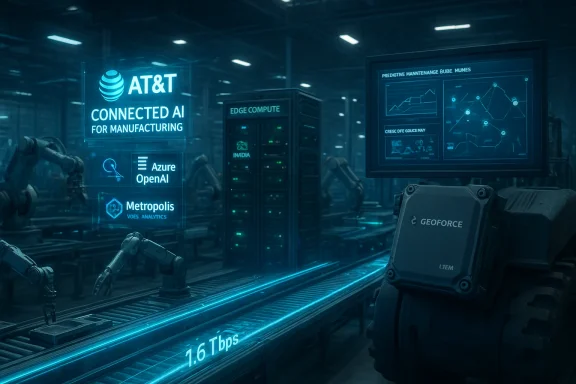
AT&T’s march into the industrial AI market is no longer experimental — at Mobile World Congress this week the operator rolled out a three‑pronged commercial strategy that stitches together expanded fiber, last‑mile 5G/fixed wireless, hyperscaler interconnects, and edge‑AI stacks aimed squarely at smart manufacturing and industrial IoT.
AT&T’s announcements introduce two named products — Connected AI for Manufacturing and Connected Spaces for Enterprise — alongside a preview of a new “AWS Interconnect – last mile” connectivity service and a commercial collaboration with industrial asset‑tracking specialist Geoforce. Together these moves frame a broader positioning: AT&T intends to sell not just connectivity but a platform for edge AI workloads spanning data centers, metro edge sites, private premises, and the factory floor.
The messaging is explicit and multi‑vendor. AT&T pairs Microsoft Azure (and Azure OpenAI) for enterprise edge and generative‑AI services, brings NVIDIA accelerated computing and Metropolis video search and summarization for video/vision analytics, and ties deeper into AWS for cloud interconnect, Outposts migration, and agentic AI services. The Geoforce tie addresses a classic Industry 4.0 problem — tracking non‑powered heavy equipment across remote sites — using AT&T’s LTE‑M footprint.
This article explains what AT&T announced, verifies the key technical claims, breaks down the architecture and use cases, assesses commercial and technical strengths, and flags the practical risks enterprises should weigh before adopting these bundled operator‑led AI offerings.
That convenience has real value: it reduces integration risk, accelerates time to value for predictable industrial workloads, and leverages AT&T’s nationwide footprint. But the move also raises classic questions — vendor lock‑in, data governance, private RAN options, and the reproducibility of pilot results — that buyers must explicitly address in contracts and implementation plans.
For industrial digital leaders the pragmatic advice is straightforward: test fast, instrument carefully, demand transparency on data flows and model portability, and treat AT&T as a powerful integrator rather than a one‑stop certainty. If AT&T can deliver consistent SLAs, clear governance, and interoperable tools across Microsoft, AWS, and NVIDIA stacks, the operator could become a major conduit for turning the promise of edge AI into sustained factory‑floor productivity gains.
Source: RCR Wireless News AT&T builds out ‘connected AI’ strategy for industrial edge
 Background / Overview
AT&T’s announcements introduce two named products — Connected AI for Manufacturing and Connected Spaces for Enterprise — alongside a preview of a new “AWS Interconnect – last mile” connectivity service and a commercial collaboration with industrial asset‑tracking specialist Geoforce. Together these moves frame a broader positioning: AT&T intends to sell not just connectivity but a platform for edge AI workloads spanning data centers, metro edge sites, private premises, and the factory floor.The messaging is explicit and multi‑vendor. AT&T pairs Microsoft Azure (and Azure OpenAI) for enterprise edge and generative‑AI services, brings NVIDIA accelerated computing and Metropolis video search and summarization for video/vision analytics, and ties deeper into AWS for cloud interconnect, Outposts migration, and agentic AI services. The Geoforce tie addresses a classic Industry 4.0 problem — tracking non‑powered heavy equipment across remote sites — using AT&T’s LTE‑M footprint.
This article explains what AT&T announced, verifies the key technical claims, breaks down the architecture and use cases, assesses commercial and technical strengths, and flags the practical risks enterprises should weigh before adopting these bundled operator‑led AI offerings.
What AT&T actually announced
The pieces of the puzzle
- Connected AI for Manufacturing — a packaged platform that “unifies 5G, IoT, and generative AI” for smart manufacturing. AT&T positions this as an edge‑first stack combining network‑grade connectivity, on‑prem or near‑prem compute, NVIDIA accelerated inference and video analytics, and Azure‑backed generative AI for natural‑language interaction and knowledge‑management at the shop floor.
- Connected Spaces for Enterprise — an “intelligent edge and connectivity” service delivered with Microsoft Azure, designed to bring sensors, cameras, and devices into a single architecture for analytics across retail, hospitality, and other physical environments.
- AWS Interconnect – last mile (preview) — a preview service to embed AT&T fiber and 5G fixed wireless last‑mile connectivity directly into AWS environments, with the goal of simplifying premises‑to‑cloud pathways for latency‑sensitive and data‑hungry AI workloads.
- Geoforce collaboration — AT&T Business will resell and integrate Geoforce’s rugged asset‑tracking platform (LTE‑M and hybrid connectivity) to support industrial equipment tracking across oil & gas, construction, rail, and logistics customers.
Numbers called out by AT&T
- AT&T says it will grow fiber capacity to support up to 1.6 Tbps on key metro and long‑haul routes to serve distributed AI needs.
- Geoforce currently tracks ~300,000 assets in 110+ countries, and AT&T notes its network carries roughly one exabyte of data per day — a claim used to underline scale for enterprise IoT.
- AT&T reported controlled pilot results for Connected AI: up to 70% reduction in waste on an injection‑molding line, 2.5–4 hours earlier detection for pre‑failure faults, and ~35% improvement in fulfillment‑center efficiency. These figures are presented as early, pilot‑level outcomes.
The technical architecture — from fiber to the factory floor
Core components and vendor roles
- Fibre and metro transport (AT&T): AT&T frames fiber expansion and higher‑capacity wavelengths as the backbone to move terabytes of telemetry and video between sites and cloud/edge data centers. The 1.6 Tbps reference signals adoption of next‑generation optical channels for metro/long‑haul links.
- Last‑mile access (AT&T 5G / fixed wireless / fiber): The AWS Interconnect preview aims to insert AT&T‑managed last‑mile links directly into AWS provisioning workflows — an attempt to make the network appear as a native part of cloud networking.
- Edge compute and orchestration (Azure + AWS + AT&T): AT&T positions Azure for enterprise edge analytics and generative AI at the premises (Connected Spaces) and uses AWS Outposts/migration for hybrid cloud and metropolitan interconnects. AT&T’s model mixes hyperscaler edge hardware with operator‑managed connectivity and orchestration.
- Accelerators and AI tooling (NVIDIA, MicroAI, Azure OpenAI): NVIDIA supplies accelerated inference (and Metropolis VSS for video search/summarization), MicroAI provides specialized edge AI tooling and model runtime for resource‑constrained devices, and Azure OpenAI underpins local generative capabilities and natural‑language operator interfaces.
- Industrial IoT and tracking (Geoforce + AT&T LTE‑M): Rugged GPS/LTE‑M devices and Geoforce’s asset platform fill the niche of low‑power, non‑powered equipment tracking.
How the data flows in a Connected AI deployment
- Sensors, PLCs, and cameras on the shop floor emit telemetry and video.
- Local edge compute (co‑located AT&T/Azure or AWS Outposts hardware) performs inference — e.g., predictive maintenance models, video analytics, or anomaly detection.
- Summaries, embeddings, and selected telemetry are transported over AT&T fiber or 5G last‑mile links to hyperscaler services for cross‑site training, model updates, observability, or larger analytics runs.
- Operators interact with the system using generative AI agents (Azure OpenAI) to ask natural‑language questions, receive action recommendations, or access knowledge‑management outputs.
- Asset location and lifecycle data from Geoforce augment operational workflows, feeding into inventory, rental, and maintenance systems.
What’s new here — and why it matters
Integration over point solutions
AT&T’s pitch is less about inventing new models and more about tightly integrating connectivity, edge compute, and hyperscaler AI stacks into a single commercial offering. For mid‑market and large industrial customers that lack deep cloud/edge integration teams, that packaged approach reduces integration friction.Network as an operational enabler for AI
Two practical constraints limit enterprise AI at the edge: connectivity consistency and operational manageability. By offering last‑mile integration into AWS and Azure‑backed edge services, AT&T tries to make networks a managed extension of cloud infrastructure — offering predictable latency and simplified provisioning.Video and vision as first‑order workloads
NVIDIA Metropolis VSS and edge accelerators mean AT&T expects video analytics to be a mainstream driver for near‑real‑time inference at the edge. Video generates the highest data volumes on many factory floors and warehouses, and compressing the path from camera to inference to action is critical for meaningful automation.Hyperscaler multi‑cloud posture
AT&T’s split strategy — AWS for cloud interconnect and Outposts, Azure for enterprise edge and generative AI — reflects the practical reality of multi‑cloud customer preferences. Rather than exclusivity, AT&T appears to be choosing best‑of‑breed components for different layers.Strengths: what AT&T does well here
- Operational scale and distribution: AT&T is a Tier‑1 network with broad fiber and wireless reach in the U.S., making it a logical integrator for national industrial enterprises.
- Multi‑vendor credibility: Partnering simultaneously with AWS, Microsoft, and NVIDIA reduces single‑provider risk for customers and offers richer integration options.
- Edge + generative UX: Embedding generative AI at the edge (for natural‑language querying and knowledge retrieval) addresses a major usability hurdle for factory operators who are not data scientists.
- Targeted industrial use cases: Predictive maintenance, OEE optimization, and video analytics are mature, near‑term use cases where ROI can be measured quickly, making AT&T’s pitch pragmatic rather than speculative.
- Asset tracking extension: The Geoforce partnership fills a distinct gap — rugged, battery‑efficient tracking for non‑powered heavy assets — which complements powered vehicle telematics and digital inventory management.
Risks, limitations, and open questions
1) Pilot claims vs. reproducibility
AT&T’s pilot numbers (70% waste reduction, 35% fulfillment lift, 2.5–4 hour earlier fault detection) are compelling, but they originate from controlled pilots described in vendor materials. The deployments cited are unnamed and the company itself states results vary by deployment environment, integration scope, and operational practices. Enterprises should regard these as indicative potential rather than guaranteed outcomes until independent or customer‑published case studies appear.2) Latency and topology nuances
“Edge” is a spectrum. Real end‑to‑end latency depends on where inference runs (on‑device, local edge, or in a metro cloud), the specific networking hops, and how workloads are partitioned between local and cloud models. AT&T’s 1.6 Tbps fiber upgrades and last‑mile integration reduce transport friction, but they do not eliminate the need for careful colocated compute sizing and architectural decisions to meet strict millisecond SLAs.3) Vendor and cloud lock‑in complexity
AT&T’s solution deliberately mixes Azure, AWS, and NVIDIA stacks. While multi‑cloud offers flexibility, it also creates integration complexity and potential lock‑in at the platform layer (e.g., Azure OpenAI agent workflows vs AWS agentic tooling). Customers should negotiate portability clauses, model exportability, and standards for observability and model governance.4) Private 5G ambiguity
AT&T’s announcements emphasize 5G and 5G‑like connectivity but are light on details about private 5G configurations, CBRS use, or on‑site radio control. Enterprises that need completely independent private cellular deployments — for security, sovereignty, or regulatory reasons — must clarify whether AT&T’s approach supports dedicated RAN or whether it’s primarily using shared public 5G slices and managed VPNs.5) Data governance and model provenance
Edge deployments that blend telemetry, video, and generative responses raise privacy and compliance issues. Where do raw video streams get stored? Which cloud processes sensitive images or personally identifiable information? Customers must insist on transparent data flow diagrams, retention policies, and options to keep training data on‑premises when necessary.6) Optical supply and upgrade cycle realities
Pushing capacity to 1.6 Tbps per wavelength implies adoption of new optical modules and routers. That requires capital investment, spare parts, and vendor interoperability testing. The industry has begun moving to 1.6 Tbps hardware, but availability and cost vary. Enterprises that expect ubiquitous 1.6 Tbps connectivity should anticipate a multi‑year transition.Competitive context — how this compares to other U.S. carriers and hyperscaler options
- Verizon Business: Verizon has been vocal about edge AI, private 5G, and telco‑owned edge compute. Verizon’s early positioning emphasized private cellular and edge application platforms. AT&T’s new approach mirrors many of those elements but leans harder on hyperscaler integration rather than proprietary developer stacks.
- T‑Mobile US: T‑Mobile has been more incremental on enterprise edge and private network messaging; its recent moves show a shift toward enterprise AI but it currently lags AT&T and Verizon in broad enterprise telco‑cloud partnerships.
- Hyperscalers (AWS, Azure, GCP): Cloud providers are themselves pushing edge hardware (Outposts, Azure Stack, Anthropic/Microsoft deals, etc.). AT&T’s strategy is to act as a managed integrator that simplifies cross‑domain connectivity. For enterprises, the decision will hinge on whether they want a cloud‑centric architecture (hyperscaler‑led) or a telco‑managed network + cloud hybrid.
Practical guidance for industrial customers
- Start with a use‑case playbook: Identify 2–3 narrowly scoped pilots (e.g., predictive maintenance on critical assets, video‑based safety monitoring, or asset tracking for rental fleets) and define KPIs (MTTR, waste reduction, OEE uplift) before engaging for a multi‑plant roll‑out.
- Demand data flow and governance maps: Insist on diagrams showing where raw telemetry and video will be stored, what is sent to the cloud, and how long data is retained. Confirm options for on‑premises training data isolation.
- Clarify the RAN model: If private 5G is a requirement, ask specifically how AT&T will deliver dedicated radio resources — through CBRS/OnGo, an enterprise RAN, or logical slices — and whether you can operate in an isolated mode.
- Negotiate portability of models and agents: Ensure that trained models, prompts, and agent configurations can be exported and redeployed outside AT&T ecosystems to prevent vendor lock‑in.
- Benchmark end‑to‑end latency with realistic loads: Run pre‑production tests with the same camera counts, frame rates, and telemetry rates you expect in production to validate latency, jitter, and scaling.
- Procure observability and incident SLAs: AI in production needs ROI visibility. Define service levels for model accuracy drift detection, model update frequency, and remediation timelines.
Strategic takeaways for CIOs and digital‑operations leaders
- AT&T’s approach reflects a pragmatic, operator‑led path to scale edge AI: anchor the offering in connectivity and make cloud/hardware integrations optional but available. For companies that lack deep edge engineering teams, this provides a faster route from pilot to production.
- The hyperscaler‑agnostic posture (AWS for metro/cloud interconnect; Azure for edge GenAI) is commercially sensible but increases architectural complexity. Successful adopters will be those who treat AT&T as an integration partner and retain internal expertise to map business processes onto platform capabilities.
- The economics of edge AI are dominated by two factors: bandwidth (video, telemetry) and management/ops. AT&T’s value prop is that it can reduce both friction points — but only if customers accept a managed, operator‑centric model that blends cloud vendor services.
- Enterprises must budget for lifecycle costs beyond connectivity: model maintenance, edge‑hardware refresh, sensor replacement, and cyber‑resilience testing. These recurring costs can dominate the total cost of ownership for distributed AI initiatives.
What to watch next
- Look for independent customer case studies that name the deploying company, outline the baseline metrics, and show longer‑term results beyond pilot timelines. Those will be the best signals that the claimed ROI is reproducible at scale.
- Clarify how AT&T will support model governance and chain of custody for training data used across plants and regions — a key issue for regulated industries.
- Watch for more technical disclosures on where inference runs by default (on‑device vs local edge vs metro cloud) and which orchestration tools AT&T will provide for deploying model updates and managing software inventory.
- Keep an eye on optical hardware availability and price trends for 1.6 Tbps modules; wider adoption will hinge on supply chain realities and capital planning across operators.
Conclusion
AT&T’s Connected AI and Connected Spaces announcements mark a substantive shift from pure connectivity toward operator‑led, platformized industrial AI offerings. By combining expanded fiber capacity, last‑mile 5G/fixed wireless, hyperscaler edge services, NVIDIA acceleration, and rugged asset tracking through Geoforce, AT&T is selling a simplified path for enterprises that want edge AI outcomes without building the full stack themselves.That convenience has real value: it reduces integration risk, accelerates time to value for predictable industrial workloads, and leverages AT&T’s nationwide footprint. But the move also raises classic questions — vendor lock‑in, data governance, private RAN options, and the reproducibility of pilot results — that buyers must explicitly address in contracts and implementation plans.
For industrial digital leaders the pragmatic advice is straightforward: test fast, instrument carefully, demand transparency on data flows and model portability, and treat AT&T as a powerful integrator rather than a one‑stop certainty. If AT&T can deliver consistent SLAs, clear governance, and interoperable tools across Microsoft, AWS, and NVIDIA stacks, the operator could become a major conduit for turning the promise of edge AI into sustained factory‑floor productivity gains.
Source: RCR Wireless News AT&T builds out ‘connected AI’ strategy for industrial edge