

Atlassian’s Rovo is becoming a serious candidate for the company’s next growth pillar in fiscal 2026, as customers using the AI platform reportedly expand annual recurring revenue at roughly twice the rate of non-Rovo customers. That is the kind of metric software investors notice because it links AI not to demos, but to wallet share. The harder question is whether Rovo is a durable platform shift or simply the latest packaging layer in the enterprise AI arms race. For Atlassian, the answer may decide whether Jira and Confluence remain systems of record for work—or become the orchestration layer for AI-assisted work itself.
The enterprise AI market has spent two years drowning in screenshots, copilots, and productivity claims that are hard to audit. Atlassian’s latest Rovo story is more interesting because it points to a commercial behavior: customers using Rovo are increasing their spend faster than customers that are not. That does not prove causation, but it does suggest that Rovo is showing up in the same accounts where Atlassian is becoming more embedded.
That distinction matters. A chatbot that summarizes a page is a feature. A system that makes Jira, Confluence, Loom, service management, code, and organizational knowledge more valuable together is closer to a platform strategy. Atlassian is trying to move the conversation from “AI add-on” to “AI reason to standardize on our cloud.”
The company’s claim that AI credit usage is rising more than 20 percent month over month gives the narrative a second leg. Usage-based metrics can be slippery, especially when vendors seed adoption through bundles or generous entitlements. Still, consumption growth is the early signal every SaaS company wants before it tries to turn AI into a larger monetization engine.
Rovo’s importance is not that it exists. Every major software vendor now has an AI assistant, an agent framework, or both. Its importance is that Atlassian can attach it to the work graph that already lives inside millions of Jira tickets, Confluence pages, support requests, project updates, and software-development workflows.
The company has spent years nudging customers through the end of Server, the maturation of Data Center, and the steady rise of Cloud. AI gives that migration effort a new emotional center. Instead of telling admins that cloud is the future because Atlassian says so, it can argue that cloud is where the useful automation, search, and agent workflows will live.
That message is especially potent for teams that already use Jira and Confluence as the messy middle of work. Atlassian does not need to persuade a company to create a new knowledge base from scratch. It needs to persuade the company that the knowledge already trapped in issues, pages, incidents, pull requests, and service tickets can be made more useful if connected through Rovo.
The tension is obvious for regulated or heavily customized environments. Admins who have spent years carefully partitioning permissions, workflows, and apps will not simply hand the keys to an AI agent because the keynote was polished. But Atlassian’s advantage is that it can frame Rovo as an extension of existing work controls rather than a totally separate AI surface.
That is why the Teamwork Graph is the center of the pitch. The graph is Atlassian’s way of saying that it knows how work connects: who is doing it, what it depends on, where the decision was recorded, which code changed, and what customer pain triggered the issue. In an AI market obsessed with model choice, Atlassian is betting that context is the scarcer asset.
Atlassian cannot out-Microsoft Microsoft in the inbox or office suite. Its counterargument is that the most operationally important work often lives outside documents and meetings. Software teams live in Jira. Support teams live in service queues. Product teams live in roadmaps, feedback, and prioritization rituals. Engineering organizations live across code repositories, incident timelines, documentation, and deployment histories.
Rovo’s opportunity is to become useful in the places where work is assigned, debated, blocked, and completed. That is a different center of gravity from Copilot’s office-productivity framing. Microsoft wants AI to be the assistant across the Microsoft estate; Atlassian wants AI to become the teammate inside the system of work.
That is also why Atlassian’s open, vendor-neutral positioning matters. Enterprises rarely run on one collaboration stack, even when one vendor wishes they did. A real work graph has to understand GitHub, Slack, Google Drive, Salesforce, Zendesk, Microsoft Teams, and a long tail of internal systems. Atlassian’s credibility depends on whether Rovo can help users traverse that sprawl without becoming another silo.
The company’s challenge is that openness is easy to market and hard to govern. The more systems Rovo touches, the more customers will ask about permissions, audit trails, data boundaries, and hallucinated actions. Atlassian’s history with admin-heavy deployments may help here, but it also means its users will be unusually unforgiving when governance feels vague.
That shift changes the stakes. A recommendation engine can be wrong and still be useful. An agent that edits issues, drafts plans, routes service requests, creates tasks, or acts on code-related context must be observable and controllable. Once AI begins executing work, the enterprise buyer stops asking whether the answer sounds good and starts asking who approved the action.
Jira is a natural place to stage that transition because it already records accountability. Work items have owners, comments, histories, statuses, links, permissions, and dependencies. If agents are going to participate in enterprise work, they need the equivalent of a paper trail. Atlassian’s argument is that Jira can provide it.
Rovo Service shows why service management may be the fastest proving ground. Support workflows are repetitive, knowledge-heavy, and measurable. If an AI agent can deflect common requests, gather context, suggest resolutions, and escalate cleanly, the ROI is more visible than in generalized knowledge work. Faster resolution times and higher automation rates are the kind of operational metrics IT leaders can defend.
The same logic applies to software development, but with sharper edges. Code intelligence that understands multi-repository environments, business context, documentation, and issue history could be genuinely valuable. It could also create new review burdens if teams cannot trust what the agent inferred. In development, bad automation does not merely waste time; it can ship risk.
Service management is a particularly attractive category because it cuts across IT, HR, facilities, finance, and customer support-adjacent functions. The workflows are structured enough for automation but varied enough to benefit from contextual intelligence. That is exactly where AI agents are supposed to shine.
The reported growth rate above 30 percent year over year suggests that Atlassian is still taking share in a market long associated with heavier ITSM platforms. Its pitch is familiar: faster deployment, tighter connection to development teams, and a less bureaucratic experience than traditional enterprise service management. Rovo adds a new layer by promising to make service desks not just more organized, but more autonomous.
This is where Atlassian’s platform strategy becomes financially interesting. A customer may begin with Jira Software, expand into Confluence, adopt Jira Service Management, and then move into Teamwork Collection or Service Collection because Rovo makes the bundle feel more coherent. AI becomes the connective tissue that justifies consolidation.
But consolidation cuts both ways. The more Atlassian asks customers to place critical workflows on its platform, the more it will be judged like a core enterprise infrastructure vendor. Reliability, compliance, permission fidelity, data residency, auditability, and admin ergonomics become part of the AI product whether or not they appear in the launch video.
Microsoft’s answer is the productivity cloud: email, meetings, documents, identity, collaboration, and Azure. Salesforce’s answer is the customer platform: CRM records, service histories, marketing journeys, Slack conversations, Data Cloud, and automation around revenue-facing work. Atlassian’s answer is the work system: plans, tickets, incidents, docs, code context, goals, and team coordination.
Each vendor is strongest where its data is most authoritative. Microsoft knows what was said and written. Salesforce knows what was sold, serviced, and forecast. Atlassian knows what was planned, assigned, blocked, shipped, and fixed. Enterprise AI will likely require all three, which is why integration claims are now strategic rather than decorative.
Salesforce’s Agentforce momentum raises the pressure. Its customer-facing workflows map naturally to measurable business outcomes: cases handled, leads routed, sales tasks automated, service costs reduced. When Salesforce says agentic AI is becoming part of CRM, it is talking to executives who already manage revenue and customer experience through its software.
Atlassian’s challenge is subtler. Internal collaboration is harder to monetize than customer operations because the productivity gains are more distributed. A Rovo agent that saves 20 minutes across a project team may be valuable, but the value is harder to prove than a deflected support case or closed deal. That is why Atlassian’s ARR expansion metric is so important: it gives investors a proxy for perceived value.
Microsoft, meanwhile, can absorb slower paid conversion because Copilot is tied to a much larger platform and infrastructure strategy. Atlassian does not have that luxury at the same scale. Rovo has to strengthen product adoption, accelerate cloud migration, and support higher-tier packaging without making customers feel they are paying an AI tax for features they did not ask for.
The company’s valuation picture is complicated. A lower price-to-sales multiple can make the stock look more attractive relative to faster-growing or more richly valued peers, but it can also reflect doubts about how much growth is already embedded in expectations. Investors are effectively asking whether Atlassian can turn usage into paid expansion at scale without sacrificing profitability.
The Zacks framing is bullish, pointing to expected fiscal 2026 revenue growth and rising earnings estimates. That is a useful snapshot of sentiment, but not the whole story. Atlassian must still prove that Rovo-driven expansion is broad, durable, and incremental rather than concentrated among enthusiastic early adopters.
There is also the question of AI cost. Every software company selling generative AI must manage the spread between what customers pay and what inference, infrastructure, support, and development cost. AI credits make consumption visible, but they also make economics visible. If usage rises faster than monetization, the story becomes less attractive.
Atlassian’s best path is to make Rovo less like a metered novelty and more like a reason to buy a higher-value collection. That is why Teamwork Collection matters. Bundles can hide some complexity, encourage broader adoption, and tie AI to a larger workflow transformation instead of a standalone SKU that procurement can cut.
Atlassian’s customer base includes organizations with years of accumulated Jira projects, Confluence spaces, custom fields, automations, marketplace apps, and exception-laden workflows. That history is a gold mine for AI context. It is also a liability if the data is stale, over-permissioned, contradictory, or poorly structured.
Rovo’s usefulness will depend on how well Atlassian handles inherited messiness. Search and agents are only as good as the corpus they interpret. If Confluence is full of outdated runbooks, Jira has duplicate workflows, and permissions are maintained by institutional memory, AI may accelerate confusion rather than clarity.
That does not make Rovo doomed. It means the real implementation work will look familiar to anyone who has managed Microsoft 365, SharePoint, ServiceNow, Salesforce, or identity systems. Clean up access. Define ownership. Audit sensitive spaces. Decide which agents can act, which can only recommend, and which workflows require human approval.
The most successful customers will treat Rovo adoption as an operating-model project, not a feature rollout. The least successful will turn it on broadly, celebrate early novelty, and then discover that agent sprawl is just automation debt with better branding.
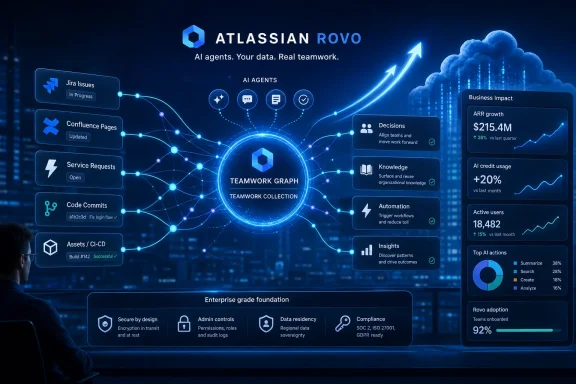 Atlassian Has Found the AI Metric That Actually Matters
The enterprise AI market has spent two years drowning in screenshots, copilots, and productivity claims that are hard to audit. Atlassian’s latest Rovo story is more interesting because it points to a commercial behavior: customers using Rovo are increasing their spend faster than customers that are not. That does not prove causation, but it does suggest that Rovo is showing up in the same accounts where Atlassian is becoming more embedded.That distinction matters. A chatbot that summarizes a page is a feature. A system that makes Jira, Confluence, Loom, service management, code, and organizational knowledge more valuable together is closer to a platform strategy. Atlassian is trying to move the conversation from “AI add-on” to “AI reason to standardize on our cloud.”
The company’s claim that AI credit usage is rising more than 20 percent month over month gives the narrative a second leg. Usage-based metrics can be slippery, especially when vendors seed adoption through bundles or generous entitlements. Still, consumption growth is the early signal every SaaS company wants before it tries to turn AI into a larger monetization engine.
Rovo’s importance is not that it exists. Every major software vendor now has an AI assistant, an agent framework, or both. Its importance is that Atlassian can attach it to the work graph that already lives inside millions of Jira tickets, Confluence pages, support requests, project updates, and software-development workflows.
Rovo Is Not Selling AI So Much as Selling the Cloud Migration Again
Atlassian’s AI strategy is inseparable from its cloud strategy. Rovo’s richest capabilities are tied to Atlassian Cloud plans, which gives the company another reason to pull customers away from older deployment models and toward subscription tiers with more expansion potential. That is not a side effect; it is the business model.The company has spent years nudging customers through the end of Server, the maturation of Data Center, and the steady rise of Cloud. AI gives that migration effort a new emotional center. Instead of telling admins that cloud is the future because Atlassian says so, it can argue that cloud is where the useful automation, search, and agent workflows will live.
That message is especially potent for teams that already use Jira and Confluence as the messy middle of work. Atlassian does not need to persuade a company to create a new knowledge base from scratch. It needs to persuade the company that the knowledge already trapped in issues, pages, incidents, pull requests, and service tickets can be made more useful if connected through Rovo.
The tension is obvious for regulated or heavily customized environments. Admins who have spent years carefully partitioning permissions, workflows, and apps will not simply hand the keys to an AI agent because the keynote was polished. But Atlassian’s advantage is that it can frame Rovo as an extension of existing work controls rather than a totally separate AI surface.
That is why the Teamwork Graph is the center of the pitch. The graph is Atlassian’s way of saying that it knows how work connects: who is doing it, what it depends on, where the decision was recorded, which code changed, and what customer pain triggered the issue. In an AI market obsessed with model choice, Atlassian is betting that context is the scarcer asset.
The Teamwork Graph Is Atlassian’s Answer to Microsoft’s Gravity
Microsoft remains the most obvious competitive threat because it owns the productivity layer where many workers begin and end their day. Microsoft 365 Copilot sits inside Outlook, Teams, Word, Excel, PowerPoint, SharePoint, and the broader Microsoft cloud. For many CIOs, that integration is not merely convenient; it is procurement gravity.Atlassian cannot out-Microsoft Microsoft in the inbox or office suite. Its counterargument is that the most operationally important work often lives outside documents and meetings. Software teams live in Jira. Support teams live in service queues. Product teams live in roadmaps, feedback, and prioritization rituals. Engineering organizations live across code repositories, incident timelines, documentation, and deployment histories.
Rovo’s opportunity is to become useful in the places where work is assigned, debated, blocked, and completed. That is a different center of gravity from Copilot’s office-productivity framing. Microsoft wants AI to be the assistant across the Microsoft estate; Atlassian wants AI to become the teammate inside the system of work.
That is also why Atlassian’s open, vendor-neutral positioning matters. Enterprises rarely run on one collaboration stack, even when one vendor wishes they did. A real work graph has to understand GitHub, Slack, Google Drive, Salesforce, Zendesk, Microsoft Teams, and a long tail of internal systems. Atlassian’s credibility depends on whether Rovo can help users traverse that sprawl without becoming another silo.
The company’s challenge is that openness is easy to market and hard to govern. The more systems Rovo touches, the more customers will ask about permissions, audit trails, data boundaries, and hallucinated actions. Atlassian’s history with admin-heavy deployments may help here, but it also means its users will be unusually unforgiving when governance feels vague.
Agents in Jira Turn AI From Advice Into Workflow
The most consequential Team ’26 announcements were not about Rovo answering questions better. They were about agents doing work where teams already coordinate work. Agents in Jira, Rovo Service, and code intelligence all point in the same direction: Atlassian wants AI to move from the side panel into the workflow itself.That shift changes the stakes. A recommendation engine can be wrong and still be useful. An agent that edits issues, drafts plans, routes service requests, creates tasks, or acts on code-related context must be observable and controllable. Once AI begins executing work, the enterprise buyer stops asking whether the answer sounds good and starts asking who approved the action.
Jira is a natural place to stage that transition because it already records accountability. Work items have owners, comments, histories, statuses, links, permissions, and dependencies. If agents are going to participate in enterprise work, they need the equivalent of a paper trail. Atlassian’s argument is that Jira can provide it.
Rovo Service shows why service management may be the fastest proving ground. Support workflows are repetitive, knowledge-heavy, and measurable. If an AI agent can deflect common requests, gather context, suggest resolutions, and escalate cleanly, the ROI is more visible than in generalized knowledge work. Faster resolution times and higher automation rates are the kind of operational metrics IT leaders can defend.
The same logic applies to software development, but with sharper edges. Code intelligence that understands multi-repository environments, business context, documentation, and issue history could be genuinely valuable. It could also create new review burdens if teams cannot trust what the agent inferred. In development, bad automation does not merely waste time; it can ship risk.
Service Collection Shows the Platform Story Has Teeth
Atlassian’s Service Collection passing $1 billion in annual recurring revenue is more than a milestone for one product line. It shows that the company’s expansion beyond developer tooling is not theoretical. Jira Service Management has become a major business in its own right, and AI gives Atlassian a fresh way to push it deeper into enterprise operations.Service management is a particularly attractive category because it cuts across IT, HR, facilities, finance, and customer support-adjacent functions. The workflows are structured enough for automation but varied enough to benefit from contextual intelligence. That is exactly where AI agents are supposed to shine.
The reported growth rate above 30 percent year over year suggests that Atlassian is still taking share in a market long associated with heavier ITSM platforms. Its pitch is familiar: faster deployment, tighter connection to development teams, and a less bureaucratic experience than traditional enterprise service management. Rovo adds a new layer by promising to make service desks not just more organized, but more autonomous.
This is where Atlassian’s platform strategy becomes financially interesting. A customer may begin with Jira Software, expand into Confluence, adopt Jira Service Management, and then move into Teamwork Collection or Service Collection because Rovo makes the bundle feel more coherent. AI becomes the connective tissue that justifies consolidation.
But consolidation cuts both ways. The more Atlassian asks customers to place critical workflows on its platform, the more it will be judged like a core enterprise infrastructure vendor. Reliability, compliance, permission fidelity, data residency, auditability, and admin ergonomics become part of the AI product whether or not they appear in the launch video.
The Rivalry Is Really About Where Enterprise Memory Lives
The comparison with Microsoft and Salesforce is useful, but only if it is framed correctly. This is not a three-way contest to build the cleverest chatbot. It is a fight over where enterprises believe their operational memory lives.Microsoft’s answer is the productivity cloud: email, meetings, documents, identity, collaboration, and Azure. Salesforce’s answer is the customer platform: CRM records, service histories, marketing journeys, Slack conversations, Data Cloud, and automation around revenue-facing work. Atlassian’s answer is the work system: plans, tickets, incidents, docs, code context, goals, and team coordination.
Each vendor is strongest where its data is most authoritative. Microsoft knows what was said and written. Salesforce knows what was sold, serviced, and forecast. Atlassian knows what was planned, assigned, blocked, shipped, and fixed. Enterprise AI will likely require all three, which is why integration claims are now strategic rather than decorative.
Salesforce’s Agentforce momentum raises the pressure. Its customer-facing workflows map naturally to measurable business outcomes: cases handled, leads routed, sales tasks automated, service costs reduced. When Salesforce says agentic AI is becoming part of CRM, it is talking to executives who already manage revenue and customer experience through its software.
Atlassian’s challenge is subtler. Internal collaboration is harder to monetize than customer operations because the productivity gains are more distributed. A Rovo agent that saves 20 minutes across a project team may be valuable, but the value is harder to prove than a deflected support case or closed deal. That is why Atlassian’s ARR expansion metric is so important: it gives investors a proxy for perceived value.
Microsoft, meanwhile, can absorb slower paid conversion because Copilot is tied to a much larger platform and infrastructure strategy. Atlassian does not have that luxury at the same scale. Rovo has to strengthen product adoption, accelerate cloud migration, and support higher-tier packaging without making customers feel they are paying an AI tax for features they did not ask for.
The Stock Market Wants Proof, Not Poetry
Atlassian’s share-price weakness this year underlines the gap between a strong product story and investor patience. A stock can trade at a lower sales multiple than parts of the broader software sector and still face skepticism if the market worries about execution, margins, competition, or the durability of AI monetization. “AI momentum” is no longer enough on its own.The company’s valuation picture is complicated. A lower price-to-sales multiple can make the stock look more attractive relative to faster-growing or more richly valued peers, but it can also reflect doubts about how much growth is already embedded in expectations. Investors are effectively asking whether Atlassian can turn usage into paid expansion at scale without sacrificing profitability.
The Zacks framing is bullish, pointing to expected fiscal 2026 revenue growth and rising earnings estimates. That is a useful snapshot of sentiment, but not the whole story. Atlassian must still prove that Rovo-driven expansion is broad, durable, and incremental rather than concentrated among enthusiastic early adopters.
There is also the question of AI cost. Every software company selling generative AI must manage the spread between what customers pay and what inference, infrastructure, support, and development cost. AI credits make consumption visible, but they also make economics visible. If usage rises faster than monetization, the story becomes less attractive.
Atlassian’s best path is to make Rovo less like a metered novelty and more like a reason to buy a higher-value collection. That is why Teamwork Collection matters. Bundles can hide some complexity, encourage broader adoption, and tie AI to a larger workflow transformation instead of a standalone SKU that procurement can cut.
Admins Will Decide Whether Rovo Becomes Infrastructure or Shelfware
For WindowsForum’s IT-pro audience, the most relevant question is not whether Rovo sounds impressive in investor language. It is whether administrators can govern it without losing control of the environment. Enterprise AI succeeds or fails at the permission boundary.Atlassian’s customer base includes organizations with years of accumulated Jira projects, Confluence spaces, custom fields, automations, marketplace apps, and exception-laden workflows. That history is a gold mine for AI context. It is also a liability if the data is stale, over-permissioned, contradictory, or poorly structured.
Rovo’s usefulness will depend on how well Atlassian handles inherited messiness. Search and agents are only as good as the corpus they interpret. If Confluence is full of outdated runbooks, Jira has duplicate workflows, and permissions are maintained by institutional memory, AI may accelerate confusion rather than clarity.
That does not make Rovo doomed. It means the real implementation work will look familiar to anyone who has managed Microsoft 365, SharePoint, ServiceNow, Salesforce, or identity systems. Clean up access. Define ownership. Audit sensitive spaces. Decide which agents can act, which can only recommend, and which workflows require human approval.
The most successful customers will treat Rovo adoption as an operating-model project, not a feature rollout. The least successful will turn it on broadly, celebrate early novelty, and then discover that agent sprawl is just automation debt with better branding.
The Rovo Bet Comes Down to These Enterprise Realities
The emerging picture is neither hype-free nor hollow. Atlassian has credible assets, real usage signals, and a natural place for AI agents to operate. It also faces giant rivals, skeptical admins, and a market that is becoming less patient with vague AI promises.- Rovo matters because Atlassian says customers using it are expanding ARR at about twice the rate of non-Rovo customers.
- Teamwork Collection is the clearest monetization path because it packages Rovo with Jira, Confluence, Loom, and broader platform adoption.
- Service Collection is the strongest near-term proof point because service workflows are repetitive, measurable, and already growing rapidly.
- Microsoft and Salesforce remain formidable because their AI strategies are anchored in productivity and customer data systems that enterprises already fund.
- Atlassian’s biggest technical and trust challenge is making agents auditable, permission-aware, and useful across messy real-world deployments.
- The stock story depends on whether Rovo can become an expansion engine rather than a temporary AI adoption spike.
References
- Primary source: TradingView
Published: 2026-06-03T17:12:09.331037
Atlassian's AI Momentum Builds: Is Rovo the Next Growth Pillar? — TradingView News
Atlassian Corporation’s TEAM AI momentum continues to build, with Rovo emerging as a potential new growth pillar that is driving higher customer spending, stronger cloud adoption and deeper platform engagement. The company noted that customers using Rovo are growing their annual recurring revenue…www.tradingview.com
- Related coverage: support.atlassian.com
- Related coverage: atlassian.com
From agent sprawl to seamless alignment: Introducing agents in Jira - Inside Atlassian
With agents in Jira (open beta), you can assign work to agents, @mention them in comments, and put them in workflows at enterprise scale.www.atlassian.com - Related coverage: community.atlassian.com
Agents in Jira now in open beta
🚀 Update (May 2026): Agents in Jira is now generally available for all Jira Cloud Standard, Premium, and Enterprise plans. When we first shared thiscommunity.atlassian.com - Related coverage: businesswire.com
- Related coverage: automation-consultants.com
202504 Automation Consultants The Next Chapter of Jira Service Management
PDF documentwww.automation-consultants.com
- Related coverage: investors.atlassian.com
