

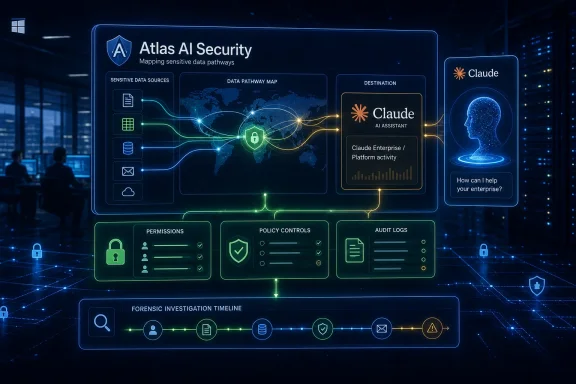
Varonis Systems announced on May 21, 2026, that it has integrated Anthropic’s Claude Compliance API into its Atlas AI Security Platform, giving enterprises a way to monitor Claude Enterprise and Claude Platform activity alongside sensitive-data context, permissions, policy controls, and audit workflows. The move is not merely another logo-swap partnership in the AI security boom. It is a bet that the next phase of enterprise AI adoption will be governed less by model enthusiasm than by auditability, data lineage, and the uncomfortable question of who can see what. For Varonis, that makes Anthropic’s compliance plumbing a growth story only if customers decide AI usage oversight belongs inside the data security stack, not as a checkbox in a broader platform bundle.
The cleanest way to read the Varonis-Anthropic tie-up is that it shifts the AI security conversation from abstract risk to observable behavior. Claude Enterprise chats, uploaded files, projects, platform events, admin actions, and configuration changes are exactly the kind of material that legal, compliance, and security teams will eventually ask to reconstruct after something goes wrong. The question is whether they can do so before an incident becomes a disclosure problem.
That is where Varonis wants Atlas to sit. The company’s historical pitch has been that sensitive data is dangerous when it is overexposed, poorly classified, or accessed by the wrong identities. Generative AI makes that old problem stranger, faster, and more politically charged, because the user interface is no longer a file share or a SaaS app but a conversational system that can ingest, transform, summarize, and leak context in ways traditional controls were not built to parse.
Anthropic’s Claude Compliance API gives vendors programmatic access to a richer stream of enterprise AI activity. Varonis is using that stream to connect AI behavior to its own maps of sensitive data, permissions, access risk, and policy enforcement. In plain English: the company wants security teams to know not just that an employee used Claude, but whether the interaction touched regulated data, exceeded policy, or created a forensic trail worth investigating.
That distinction matters. AI governance is quickly becoming a market category filled with dashboards that count usage and declare readiness. Varonis is trying to argue that governance without data context is decorative. If an AI assistant can reach confidential files, summarize customer records, or help build an agent connected to business systems, the meaningful control point is not the chatbot alone; it is the data path around it.
The harder problem is evidence. If an employee asks Claude to analyze a spreadsheet containing customer data, an auditor may later need to know what was uploaded, what was returned, whether the session was retained, and whether the action violated an internal rule or external requirement. If a developer uses Claude Platform to build an agent, security teams may need to understand which credentials, repositories, APIs, or business systems that agent can touch.
This is why the Compliance API matters more than the announcement language suggests. It creates a way for enterprise security tools to ingest AI activity as first-class telemetry rather than treating AI as a black-box productivity app. For security operations teams, that means Claude can start looking more like a monitored enterprise service and less like an unstructured side channel.
Varonis’s opportunity is to enrich that telemetry with the thing security teams already struggle to maintain: a current understanding of sensitive data exposure. The company is not alone in that ambition, and Anthropic’s list of compliance partners includes much larger names across identity, DLP, SIEM, cloud security, eDiscovery, and security operations. But Varonis’s pitch is narrower and therefore potentially sharper: if AI risk begins with sensitive data, then the vendor that understands sensitive data should govern AI use around it.
This is a familiar move in enterprise software. A category that once sounded defensive — data classification, permissions cleanup, exposure remediation — gets repositioned around a growth budget. AI programs have executive sponsorship. Data governance often does not. By tying Atlas to Claude Enterprise and Claude Platform, Varonis can walk into accounts with a more urgent story: your AI rollout depends on knowing what data your AI tools can reach.
That is a stronger sales motion than telling customers their file permissions are messy, even if the underlying technical work is closely related. It gives CISOs and data leaders a way to participate in AI enablement rather than being cast as the department of no. In the best version of the pitch, Atlas helps organizations adopt Claude faster because it gives them visibility, audit trails, and controls that reduce internal resistance.
The risk is that every security vendor is making a version of the same claim. Microsoft can tie AI governance to Purview, Entra, Defender, and Copilot. Palo Alto Networks and CrowdStrike can argue that AI activity belongs in broader security operations and threat detection platforms. Netskope, Zscaler, Proofpoint, Okta, SailPoint, Wiz, and others all have credible reasons to place themselves in the AI governance conversation. Varonis has to prove that its data-centric lens is not just differentiated in a demo, but decisive in procurement.
The Claude Compliance API is an acknowledgment that enterprises do not want AI governance trapped inside model-provider consoles. They want Claude activity to flow into systems of record: SIEM platforms, DLP tools, eDiscovery systems, identity governance platforms, and data security products. That is how regulated organizations make new technology survivable.
For Anthropic, this also helps counter one of the major objections to deploying frontier AI systems in sensitive environments. Security leaders are more likely to approve a tool when they can inspect activity, investigate misuse, and integrate policy enforcement into existing workflows. The compliance ecosystem around Claude is therefore not a side feature. It is part of Anthropic’s enterprise distribution strategy.
Varonis benefits from that strategy, but it does not own it. The same API that feeds Atlas can feed other platforms. That creates a subtle tension in the partnership: the integration makes Varonis more relevant to Claude customers, while also making Claude telemetry broadly available to Varonis competitors. In platform markets, access to the pipe is useful; the durable value is what a vendor does with the data once it arrives.
That question is especially sharp because AI governance is not emerging in a vacuum. Microsoft 365, Copilot, Purview, Defender, Sentinel, and Entra already occupy the budgets, admin consoles, and mental models of many enterprise IT departments. If a customer’s AI adoption is heavily Microsoft-centric, Varonis has to demonstrate that its controls are deeper, faster, or more data-aware than the bundled alternatives.
The Anthropic angle gives Varonis a useful counterweight. Enterprises are not standardizing on a single model provider as cleanly as vendors might prefer. Claude is used in business workflows, developer tooling, and platform integrations that may sit outside Microsoft’s direct control. If companies end up with Copilot for office work, Claude for analysis or development, OpenAI models in applications, and open models in internal systems, then cross-platform governance becomes more valuable.
That is the architecture Varonis wants to inhabit. Atlas can be pitched as an AI security layer that follows data and access risk across SaaS, cloud, code repositories, AI platforms, and enterprise applications. The more fragmented AI adoption becomes, the stronger that argument gets. The more Microsoft or another mega-platform succeeds in collapsing governance into its own suite, the harder life becomes for focused vendors.
Recent sell-side commentary has emphasized automation, data security demand, Microsoft ecosystem exposure, and the company’s role in helping organizations manage AI-related data risk. The Anthropic integration fits neatly into that narrative. It gives investors a concrete product event rather than another abstract mention of “AI tailwinds.”
But the word tailwind deserves suspicion in security software. Every vendor can claim AI makes its market bigger. The real test is whether AI changes buying urgency, expansion rates, sales cycles, and pricing power. If Atlas becomes a required control for organizations deploying Claude and other AI tools, Varonis can turn AI governance into a meaningful expansion lever. If customers treat it as a useful but nonessential overlay, the story becomes more defensive.
Varonis also has to navigate the economics of being a focused specialist in a market where larger rivals can bundle. Bundling does not always win on quality, but it often wins on procurement simplicity. Security teams may admire a best-of-breed product and still choose the tool already attached to their E5 agreement, cloud security platform, or SOC workflow.
That is not cynicism. It is how business technology matures. Email became searchable and discoverable. SaaS apps became governed by identity, CASB, DLP, and retention systems. Cloud workloads became visible through posture management, workload protection, and audit trails. AI systems are now entering the same cycle, only faster.
The unusual part is the content itself. AI sessions can include prompts, uploaded documents, generated answers, code, summaries, decisions, and instructions to agents. That makes them richer than many traditional logs and more sensitive than many collaboration records. A compliance API that exposes this activity is therefore powerful, but also delicate.
Enterprises will need policies not only for what AI systems may do, but for how AI activity records are stored, searched, retained, and accessed. Security teams want visibility; employees may worry about surveillance; legal teams will care about discovery; privacy teams will care about minimization. Varonis can help organize that complexity, but it cannot make the governance tradeoffs disappear.
That is exactly where data security becomes harder. If an AI agent can access a repository, query a database, create a ticket, or invoke an internal API, then organizations need to know not just what data it saw but what authority it exercised. Traditional identity systems were built around human users and service accounts. Agentic systems introduce a messier chain of intent, permission, and accountability.
Varonis’s Atlas messaging around lineage graphs, AI inventories, model and agent dependencies, and runtime guardrails is designed for this world. The company wants to map what AI exists, what it connects to, what data it can reach, and what actions it can take. That is the kind of inventory many enterprises lack today, especially when developers can experiment quickly and business teams can adopt AI tools before central IT has finished the policy deck.
The Anthropic integration gives Atlas a stronger signal from one major AI provider, but it also highlights the broader challenge. No single API will cover the full enterprise AI estate. Real governance will require stitching together telemetry from model providers, cloud platforms, SaaS applications, browsers, identity systems, developer environments, and data stores. The vendor that makes that stitching coherent will have a more durable claim than the vendor with the longest partner slide.
Varonis’s data context is meant to solve that problem. A prompt involving public marketing copy is not the same as a prompt involving regulated customer data or privileged engineering secrets. A user experimenting with Claude in an approved workspace is not the same as a service account invoking platform APIs in an unusual pattern. Good governance products reduce noise by ranking risk in context.
That promise will be judged in the field. Security teams have learned to be wary of tools that produce dashboards faster than they produce decisions. If Atlas can surface the few Claude sessions that truly deserve investigation, it becomes useful. If it becomes another pane of alerts requiring manual interpretation, customers will struggle to justify expanding it.
This is where automation, a recurring theme in Varonis coverage, becomes central. AI governance cannot scale if every exception requires a meeting. The practical value will come from automated classification, remediation guidance, access cleanup, policy enforcement, and investigation workflows that reduce the burden on already stretched teams.
For Varonis, the crowded field is both validation and threat. Validation, because the number of partners suggests real enterprise demand for AI compliance integration. Threat, because Varonis is not the only vendor that can claim a governance role. Customers may already have CrowdStrike in the SOC, Microsoft Purview in compliance, Okta or SailPoint in identity, Netskope or Zscaler in traffic control, and Wiz in cloud security.
The battle will therefore be fought on workflow ownership. If compliance teams lead the buying process, eDiscovery and governance vendors may have an advantage. If security operations leads, SIEM and detection vendors gain ground. If cloud teams lead, cloud security platforms will press their case. Varonis’s strongest route is through data owners, CISOs, and risk teams that believe sensitive data exposure is the root issue.
That is a credible position, but it is not automatic. In many enterprises, data security has been fragmented across compliance, storage, identity, and application teams. Varonis has long argued that this fragmentation is exactly the problem it solves. AI gives that argument new urgency, because fragmented data governance becomes much more dangerous when employees and agents can feed that data into generative systems.
The skeptical case is just as straightforward. AI governance features become expected table stakes inside larger security and productivity platforms. Customers prefer bundled controls that are “good enough,” particularly when budgets are constrained. Varonis gains product credibility but not enough pricing power, and Atlas becomes a defensive feature set rather than a growth accelerator.
Both cases can be true in different accounts. Highly regulated companies with complex data estates may value Varonis’s depth. Smaller or more standardized enterprises may accept bundled governance. Organizations with multi-model AI strategies may need independent oversight. Microsoft-heavy shops may prefer native controls unless Varonis proves a clear gap.
That makes the Anthropic integration important but not decisive. It gives Varonis a timely product hook and a stronger AI governance story. It does not by itself answer whether the company can turn that story into durable revenue growth, margin improvement, or competitive insulation.
 Varonis Is Selling Control, Not Claude Hype
The cleanest way to read the Varonis-Anthropic tie-up is that it shifts the AI security conversation from abstract risk to observable behavior. Claude Enterprise chats, uploaded files, projects, platform events, admin actions, and configuration changes are exactly the kind of material that legal, compliance, and security teams will eventually ask to reconstruct after something goes wrong. The question is whether they can do so before an incident becomes a disclosure problem.That is where Varonis wants Atlas to sit. The company’s historical pitch has been that sensitive data is dangerous when it is overexposed, poorly classified, or accessed by the wrong identities. Generative AI makes that old problem stranger, faster, and more politically charged, because the user interface is no longer a file share or a SaaS app but a conversational system that can ingest, transform, summarize, and leak context in ways traditional controls were not built to parse.
Anthropic’s Claude Compliance API gives vendors programmatic access to a richer stream of enterprise AI activity. Varonis is using that stream to connect AI behavior to its own maps of sensitive data, permissions, access risk, and policy enforcement. In plain English: the company wants security teams to know not just that an employee used Claude, but whether the interaction touched regulated data, exceeded policy, or created a forensic trail worth investigating.
That distinction matters. AI governance is quickly becoming a market category filled with dashboards that count usage and declare readiness. Varonis is trying to argue that governance without data context is decorative. If an AI assistant can reach confidential files, summarize customer records, or help build an agent connected to business systems, the meaningful control point is not the chatbot alone; it is the data path around it.
The Enterprise AI Problem Has Moved From Access To Evidence
The first wave of enterprise AI anxiety centered on access: block ChatGPT, approve Copilot, restrict uploads, issue a policy memo, and hope shadow AI does not get too creative. That phase is already fading. Companies are discovering that AI cannot be governed only by saying yes or no at the network edge.The harder problem is evidence. If an employee asks Claude to analyze a spreadsheet containing customer data, an auditor may later need to know what was uploaded, what was returned, whether the session was retained, and whether the action violated an internal rule or external requirement. If a developer uses Claude Platform to build an agent, security teams may need to understand which credentials, repositories, APIs, or business systems that agent can touch.
This is why the Compliance API matters more than the announcement language suggests. It creates a way for enterprise security tools to ingest AI activity as first-class telemetry rather than treating AI as a black-box productivity app. For security operations teams, that means Claude can start looking more like a monitored enterprise service and less like an unstructured side channel.
Varonis’s opportunity is to enrich that telemetry with the thing security teams already struggle to maintain: a current understanding of sensitive data exposure. The company is not alone in that ambition, and Anthropic’s list of compliance partners includes much larger names across identity, DLP, SIEM, cloud security, eDiscovery, and security operations. But Varonis’s pitch is narrower and therefore potentially sharper: if AI risk begins with sensitive data, then the vendor that understands sensitive data should govern AI use around it.
Atlas Turns A Defensive Category Into An AI Budget Pitch
Varonis launched Atlas as an AI security platform earlier this year, positioning it as a layer for discovering AI risk, remediating vulnerabilities, enforcing guardrails, and governing AI usage across the AI lifecycle. That framing is important because Varonis is not merely adding Claude logs to an existing product. It is recasting data security as the control plane for AI adoption.This is a familiar move in enterprise software. A category that once sounded defensive — data classification, permissions cleanup, exposure remediation — gets repositioned around a growth budget. AI programs have executive sponsorship. Data governance often does not. By tying Atlas to Claude Enterprise and Claude Platform, Varonis can walk into accounts with a more urgent story: your AI rollout depends on knowing what data your AI tools can reach.
That is a stronger sales motion than telling customers their file permissions are messy, even if the underlying technical work is closely related. It gives CISOs and data leaders a way to participate in AI enablement rather than being cast as the department of no. In the best version of the pitch, Atlas helps organizations adopt Claude faster because it gives them visibility, audit trails, and controls that reduce internal resistance.
The risk is that every security vendor is making a version of the same claim. Microsoft can tie AI governance to Purview, Entra, Defender, and Copilot. Palo Alto Networks and CrowdStrike can argue that AI activity belongs in broader security operations and threat detection platforms. Netskope, Zscaler, Proofpoint, Okta, SailPoint, Wiz, and others all have credible reasons to place themselves in the AI governance conversation. Varonis has to prove that its data-centric lens is not just differentiated in a demo, but decisive in procurement.
Anthropic Is Building The Compliance Layer Its Enterprise Customers Demanded
Anthropic’s move is also telling. Claude has been aggressively pushed into enterprise workflows, from knowledge work to software development to agentic applications. As adoption grows, the company has had to meet the boring requirements that separate consumer AI enthusiasm from enterprise deployment: logging, oversight, retention, investigation, compliance review, and integration with the security tools companies already own.The Claude Compliance API is an acknowledgment that enterprises do not want AI governance trapped inside model-provider consoles. They want Claude activity to flow into systems of record: SIEM platforms, DLP tools, eDiscovery systems, identity governance platforms, and data security products. That is how regulated organizations make new technology survivable.
For Anthropic, this also helps counter one of the major objections to deploying frontier AI systems in sensitive environments. Security leaders are more likely to approve a tool when they can inspect activity, investigate misuse, and integrate policy enforcement into existing workflows. The compliance ecosystem around Claude is therefore not a side feature. It is part of Anthropic’s enterprise distribution strategy.
Varonis benefits from that strategy, but it does not own it. The same API that feeds Atlas can feed other platforms. That creates a subtle tension in the partnership: the integration makes Varonis more relevant to Claude customers, while also making Claude telemetry broadly available to Varonis competitors. In platform markets, access to the pipe is useful; the durable value is what a vendor does with the data once it arrives.
The Microsoft Shadow Hangs Over Every AI Governance Deal
No WindowsForum audience needs reminding that Microsoft is the gravitational force in enterprise productivity and identity. Any AI governance product that hopes to scale must answer a simple question: why would a customer buy this instead of leaning on Microsoft’s stack?That question is especially sharp because AI governance is not emerging in a vacuum. Microsoft 365, Copilot, Purview, Defender, Sentinel, and Entra already occupy the budgets, admin consoles, and mental models of many enterprise IT departments. If a customer’s AI adoption is heavily Microsoft-centric, Varonis has to demonstrate that its controls are deeper, faster, or more data-aware than the bundled alternatives.
The Anthropic angle gives Varonis a useful counterweight. Enterprises are not standardizing on a single model provider as cleanly as vendors might prefer. Claude is used in business workflows, developer tooling, and platform integrations that may sit outside Microsoft’s direct control. If companies end up with Copilot for office work, Claude for analysis or development, OpenAI models in applications, and open models in internal systems, then cross-platform governance becomes more valuable.
That is the architecture Varonis wants to inhabit. Atlas can be pitched as an AI security layer that follows data and access risk across SaaS, cloud, code repositories, AI platforms, and enterprise applications. The more fragmented AI adoption becomes, the stronger that argument gets. The more Microsoft or another mega-platform succeeds in collapsing governance into its own suite, the harder life becomes for focused vendors.
The Stock Story Is Really A Product-Market Timing Story
The investor framing around Varonis is easy to state and harder to prove. The company’s shares have recently shown a mixed profile: a sharp rebound over the last month, longer-term gains over three years, and meaningful declines over one- and five-year periods. That pattern is less a verdict than a reminder that the market has not settled on how to value Varonis through its transition and AI repositioning.Recent sell-side commentary has emphasized automation, data security demand, Microsoft ecosystem exposure, and the company’s role in helping organizations manage AI-related data risk. The Anthropic integration fits neatly into that narrative. It gives investors a concrete product event rather than another abstract mention of “AI tailwinds.”
But the word tailwind deserves suspicion in security software. Every vendor can claim AI makes its market bigger. The real test is whether AI changes buying urgency, expansion rates, sales cycles, and pricing power. If Atlas becomes a required control for organizations deploying Claude and other AI tools, Varonis can turn AI governance into a meaningful expansion lever. If customers treat it as a useful but nonessential overlay, the story becomes more defensive.
Varonis also has to navigate the economics of being a focused specialist in a market where larger rivals can bundle. Bundling does not always win on quality, but it often wins on procurement simplicity. Security teams may admire a best-of-breed product and still choose the tool already attached to their E5 agreement, cloud security platform, or SOC workflow.
Compliance APIs Make AI Less Magical And More Regulated
One reason this announcement matters beyond Varonis is that it signals the normalization of AI as an auditable enterprise system. The romance of generative AI has been that it feels conversational, fluid, and creative. The reality of enterprise AI is that every meaningful deployment eventually becomes a log management problem.That is not cynicism. It is how business technology matures. Email became searchable and discoverable. SaaS apps became governed by identity, CASB, DLP, and retention systems. Cloud workloads became visible through posture management, workload protection, and audit trails. AI systems are now entering the same cycle, only faster.
The unusual part is the content itself. AI sessions can include prompts, uploaded documents, generated answers, code, summaries, decisions, and instructions to agents. That makes them richer than many traditional logs and more sensitive than many collaboration records. A compliance API that exposes this activity is therefore powerful, but also delicate.
Enterprises will need policies not only for what AI systems may do, but for how AI activity records are stored, searched, retained, and accessed. Security teams want visibility; employees may worry about surveillance; legal teams will care about discovery; privacy teams will care about minimization. Varonis can help organize that complexity, but it cannot make the governance tradeoffs disappear.
The Agent Era Raises The Stakes For Data Security
The Claude Platform piece may prove more consequential than Claude Enterprise chat monitoring. Chats are familiar enough: a user uploads a document, asks questions, receives output. Agents are different. They can call tools, interact with systems, maintain context, and perform sequences of actions that blur the line between user assistance and delegated execution.That is exactly where data security becomes harder. If an AI agent can access a repository, query a database, create a ticket, or invoke an internal API, then organizations need to know not just what data it saw but what authority it exercised. Traditional identity systems were built around human users and service accounts. Agentic systems introduce a messier chain of intent, permission, and accountability.
Varonis’s Atlas messaging around lineage graphs, AI inventories, model and agent dependencies, and runtime guardrails is designed for this world. The company wants to map what AI exists, what it connects to, what data it can reach, and what actions it can take. That is the kind of inventory many enterprises lack today, especially when developers can experiment quickly and business teams can adopt AI tools before central IT has finished the policy deck.
The Anthropic integration gives Atlas a stronger signal from one major AI provider, but it also highlights the broader challenge. No single API will cover the full enterprise AI estate. Real governance will require stitching together telemetry from model providers, cloud platforms, SaaS applications, browsers, identity systems, developer environments, and data stores. The vendor that makes that stitching coherent will have a more durable claim than the vendor with the longest partner slide.
Security Teams Will Like The Visibility And Fear The Workload
There is an operational catch to every new source of security telemetry: someone has to triage it. Claude activity logs, conversation records, uploaded-file evidence, policy violations, and agent events can improve visibility, but they can also increase alert fatigue if not tied to meaningful risk.Varonis’s data context is meant to solve that problem. A prompt involving public marketing copy is not the same as a prompt involving regulated customer data or privileged engineering secrets. A user experimenting with Claude in an approved workspace is not the same as a service account invoking platform APIs in an unusual pattern. Good governance products reduce noise by ranking risk in context.
That promise will be judged in the field. Security teams have learned to be wary of tools that produce dashboards faster than they produce decisions. If Atlas can surface the few Claude sessions that truly deserve investigation, it becomes useful. If it becomes another pane of alerts requiring manual interpretation, customers will struggle to justify expanding it.
This is where automation, a recurring theme in Varonis coverage, becomes central. AI governance cannot scale if every exception requires a meeting. The practical value will come from automated classification, remediation guidance, access cleanup, policy enforcement, and investigation workflows that reduce the burden on already stretched teams.
The Competitive Field Is Crowded Because The Prize Is Real
Anthropic’s partner list around the Compliance API reads like a map of modern enterprise security. It includes vendors associated with cloud security, identity, DLP, eDiscovery, observability, security operations, governance, and data protection. That breadth is not accidental. AI activity cuts across all of those domains.For Varonis, the crowded field is both validation and threat. Validation, because the number of partners suggests real enterprise demand for AI compliance integration. Threat, because Varonis is not the only vendor that can claim a governance role. Customers may already have CrowdStrike in the SOC, Microsoft Purview in compliance, Okta or SailPoint in identity, Netskope or Zscaler in traffic control, and Wiz in cloud security.
The battle will therefore be fought on workflow ownership. If compliance teams lead the buying process, eDiscovery and governance vendors may have an advantage. If security operations leads, SIEM and detection vendors gain ground. If cloud teams lead, cloud security platforms will press their case. Varonis’s strongest route is through data owners, CISOs, and risk teams that believe sensitive data exposure is the root issue.
That is a credible position, but it is not automatic. In many enterprises, data security has been fragmented across compliance, storage, identity, and application teams. Varonis has long argued that this fragmentation is exactly the problem it solves. AI gives that argument new urgency, because fragmented data governance becomes much more dangerous when employees and agents can feed that data into generative systems.
The Growth Case Depends On Becoming Necessary Before Bundles Catch Up
The optimistic case for Varonis is straightforward. AI adoption increases the amount of sensitive data flowing through conversational and agentic systems. Regulators, auditors, customers, and boards demand evidence that companies can govern that activity. Varonis extends its data security platform into AI usage, wins expansions inside existing accounts, and becomes a focused way to invest in AI-driven security demand.The skeptical case is just as straightforward. AI governance features become expected table stakes inside larger security and productivity platforms. Customers prefer bundled controls that are “good enough,” particularly when budgets are constrained. Varonis gains product credibility but not enough pricing power, and Atlas becomes a defensive feature set rather than a growth accelerator.
Both cases can be true in different accounts. Highly regulated companies with complex data estates may value Varonis’s depth. Smaller or more standardized enterprises may accept bundled governance. Organizations with multi-model AI strategies may need independent oversight. Microsoft-heavy shops may prefer native controls unless Varonis proves a clear gap.
That makes the Anthropic integration important but not decisive. It gives Varonis a timely product hook and a stronger AI governance story. It does not by itself answer whether the company can turn that story into durable revenue growth, margin improvement, or competitive insulation.
The Claude Deal Gives Varonis A Sharper Test
This is the practical read for IT buyers and investors watching the space:- Varonis’s Anthropic integration is most meaningful where Claude Enterprise or Claude Platform is already approved for sensitive work, because that is where activity monitoring and data context move from convenience to control.
- Atlas’s differentiation depends on whether Varonis can connect AI usage to sensitive-data exposure, permissions, access risk, and policy enforcement more effectively than broader platform vendors.
- The partnership validates AI compliance as an enterprise requirement, but Anthropic’s broad partner ecosystem means Varonis must compete on workflow depth rather than API access alone.
- Microsoft’s gravitational pull remains the biggest strategic pressure, especially in organizations that expect Purview, Defender, Entra, and Copilot controls to cover much of the governance burden.
- The investor case will depend less on announcement momentum than on customer adoption, upsell evidence, sales-cycle commentary, and whether AI governance improves Varonis’s pricing power.
References
- Primary source: simplywall.st
Published: 2026-06-07T02:36:07.674887
Varonis Anthropic Alliance Puts AI Governance At Center Of Growth Story - Simply Wall St News
Varonis Systems (NasdaqGS:VRNS) has partnered with Anthropic to add advanced AI usage tracking and governance capabilities to its Atlas AI Security Platform. The collaboration focuses on AI compliance and data governance for enterprises at a time when AI adoption is driving new security and...simplywall.st - Related coverage: varonis.com
Varonis Announces Integration with the Claude Compliance API
Varonis Atlas secures Claude Enterprise and Claude Platform by detecting misuse and threats in the context of sensitive data, permissions, and access risk.www.varonis.com
- Related coverage: globenewswire.com
Varonis Announces Integration with the Claude Compliance
Varonis announced an integration with the Claude Compliance API that brings Anthropic’s Claude Enterprise and Claude Platform activity into Varonis Atlas ...www.globenewswire.com - Related coverage: stockanalysis.com
Varonis Systems (VRNS) Stock Price & Overview
A detailed overview of Varonis Systems, Inc. (VRNS) stock, including real-time price, chart, key statistics, news, and more.stockanalysis.com - Related coverage: newsroom.ibm.com
IBM and Anthropic Partner to Advance Enterprise Software Development with Proven Security and Governance
PDF documentnewsroom.ibm.com
- Related coverage: publicservicesalliance.org
Anthropic expands its partnership with PwC as it pushes to get Claude into the hands of corporate America
PDF documentpublicservicesalliance.org
- Related coverage: labs.cloudsecurityalliance.org
Pentagon Designates Anthropic: Enterprise AI Vendor Risk
PDF documentlabs.cloudsecurityalliance.org
- Related coverage: thetalake.com
