

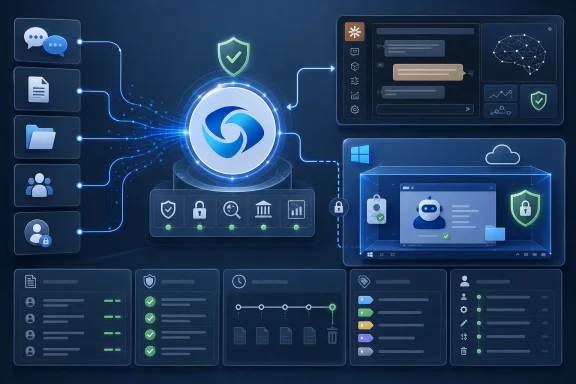
Microsoft has added Anthropic Claude Enterprise activity to Microsoft Purview in late May 2026, using Anthropic’s Compliance API to bring Claude conversations, files, projects, logins, admin actions, and configuration events into Microsoft’s security and compliance tooling. The move is less about blessing one rival model than about acknowledging the obvious: enterprise AI is already multi-model, and governance that only watches Microsoft’s own assistants is no longer credible. Alongside the Claude integration, Microsoft is pushing Windows 365 for Agents as a managed execution environment for AI agents, tying model choice to identity, policy, auditability, and Cloud PC isolation. The bet is that the winning AI platform will not be the one with the flashiest chatbot, but the one that gives IT a way to say yes without losing the plot.
The headline version is simple: Microsoft is extending Purview controls to Anthropic Claude. The more interesting version is that Microsoft is quietly reframing Purview from a Microsoft 365 compliance product into a cross-model AI governance layer.
That matters because Claude is no longer merely a third-party chatbot employees might use on the side. Anthropic’s models have become part of Microsoft’s broader AI strategy, appearing in Microsoft Foundry and Microsoft 365 Copilot scenarios where customers want choice beyond OpenAI models. Once Microsoft invites Claude into the enterprise workflow, it also inherits the enterprise question: who can see what Claude saw, what Claude generated, and what users did with it?
Purview’s Claude support is meant to answer that question with the same vocabulary administrators already use for email, documents, Teams messages, endpoints, and Copilot activity. The new connector can bring Claude Enterprise conversation content into Microsoft’s compliance perimeter, including chats, uploaded files, and projects. It can also expose event signals from Claude Enterprise and the Claude Platform, such as user logins, administrator actions, and configuration changes.
That is the practical heart of the announcement. Microsoft is not merely saying, “Claude is secure.” It is saying Claude can be made visible inside the security machinery many organizations already operate. In regulated environments, that distinction is everything.
That flexibility creates a governance problem. A single organization may now have employees using Microsoft 365 Copilot, developers calling Azure-hosted models, analysts working inside Claude Enterprise, and business units experimenting with specialized agent platforms. The old admin instinct — pick one approved AI tool and block the rest — is unlikely to survive contact with how workers actually adopt software.
This is why the Claude Compliance API integration is strategically important. Anthropic is opening enterprise telemetry and content access to approved compliance partners, and Microsoft is positioning Purview as one of the places where that information can be centrally governed. The value is not that Purview has suddenly become omniscient; it is that the walls between model vendors and compliance platforms are beginning to look more porous.
For IT teams, that is the beginning of a more realistic posture. The question shifts from “Can we stop everyone from using outside AI?” to “Can we monitor, classify, retain, investigate, and restrict AI activity across the tools the business is actually adopting?” That is a less satisfying sentence, but a much more useful operating model.
In the old SaaS world, compliance teams worried about where a file was stored and who had access to it. In the AI world, they must also worry about what a user pasted into a prompt, what the model inferred, what files were uploaded for context, and whether an answer effectively repackaged confidential information in a new form. The record is no longer just a document. It is a conversation, a tool call, an uploaded attachment, and a generated output.
That is why bringing Claude activity into Purview is more than a checkbox integration. If conversation content can be surfaced to Microsoft’s compliance tooling, organizations can begin applying familiar disciplines such as eDiscovery, audit review, data loss prevention, retention, and insider risk workflows to AI interactions outside Microsoft’s own assistant family. In plain English: the AI chat stops being an invisible side channel.
The event side matters just as much. Logins, admin changes, configuration updates, and platform activity give security teams the operational trail they need when something goes wrong. If a sensitive file appears in a Claude project, the investigation cannot begin and end with the prompt. Administrators need to know which account accessed the system, whether settings changed, whether an integration was enabled, and whether the activity fits normal behavior.
Microsoft’s pitch is that Purview can turn AI adoption from a shadow-IT panic into a managed deployment. That is not just security theater. In many organizations, the blocker to AI use is not that leaders distrust the model’s prose; it is that they cannot answer basic questions from legal, compliance, and risk teams. Where is the data going? Can we discover it later? Can we enforce retention? Can we stop restricted information from being exposed? Can we prove what happened?
By integrating Claude, Microsoft is giving customers a way to approve a non-Microsoft model without treating it as a compliance exception. That may actually help Anthropic as much as Microsoft. Claude’s appeal in the enterprise depends not only on model quality, but on whether a bank, insurer, hospital, manufacturer, or government contractor can fit it into existing control frameworks.
The subtext is also competitive. If Microsoft can govern Claude better than a standalone toolchain can, it becomes harder for customers to separate “AI model choice” from “Microsoft administrative control.” The company does not need to own every model to own the control plane around them.
That is the line every enterprise is now approaching. A chatbot that summarizes a policy is one kind of risk. An agent that logs into applications, reads files, edits records, sends messages, runs scripts, or manipulates business workflows is another. The first creates information governance problems. The second creates operational security problems.
Windows 365 for Agents is Microsoft’s attempt to give those agents a controlled place to operate. Instead of letting an agent run loosely on a user’s desktop, a developer workstation, or an ad hoc cloud environment, Microsoft wants agents to execute inside managed Cloud PCs. These environments can be governed through familiar enterprise plumbing such as Microsoft Intune, identity controls, policy enforcement, monitoring, and audit trails.
The idea is appealing because it treats agents less like features and more like workers with constrained workstations. They get an environment, an identity, approved applications, defined permissions, and logs. That framing may sound bureaucratic, but bureaucracy is exactly what enterprise AI has been missing.
This is classic Microsoft platform strategy. The company rarely wins solely by having the first or flashiest user-facing product. It wins by turning messy enterprise adoption into admin surfaces, policy templates, licensing bundles, identity dependencies, and compliance workflows. If AI agents become as common as service accounts, scheduled jobs, bots, and automation scripts, then the organization that inventories and governs them has enormous leverage.
The challenge is that “agent” remains a slippery category. A Copilot Studio agent, a Claude-powered workflow, a developer’s local coding assistant, a browser automation bot, and a custom Python script calling an LLM API may all be described as agents. They do not share the same runtime, permission model, logging design, or threat surface.
Microsoft’s answer is to make the management plane broader than the model. Whether the agent is built by Microsoft or a third party, the company wants organizations to define policies, manage permissions, and maintain visibility from a shared administrative layer. That is a sensible goal, but it will only be as strong as the coverage. Shadow agents, unmanaged developer tools, browser extensions, and personal AI accounts remain the messy edge cases.
A managed Cloud PC is not magic. It does not make an agent safe by default. But it gives IT departments a familiar object to secure. Administrators know how to apply conditional access, endpoint management, app control, logging, patching, and identity policies to Windows environments. By putting agents into that world, Microsoft is trying to avoid a parallel universe of AI runtime security that every organization must invent from scratch.
The model also creates a useful separation between the user’s normal workspace and the agent’s workspace. If an agent needs to interact with applications, browse internal sites, or manipulate documents, it can do so in an environment designed to be observed and constrained. That reduces the temptation to give agents broad access to the same desktop context as a human employee.
The audit angle is just as important. An agent that performs work inside a managed desktop leaves traces administrators can investigate. In a breach, compliance review, or internal dispute, that record may matter more than whatever assurance the model vendor offered about safety.
An agent with access to business tools can make changes. It can submit forms, update tickets, modify documents, trigger workflows, send communications, and interact with systems in ways that look legitimate because they happen under approved identities. The nightmare scenario is not only that an agent reveals confidential information. It is that an agent faithfully executes the wrong instruction at scale.
This is where Microsoft’s identity-centric approach becomes important. If agents are treated as governed actors, not invisible software features, organizations can apply concepts they already understand: least privilege, lifecycle management, access review, logging, and conditional access. The agent needs a defined scope. It needs an owner. It needs a kill switch. It needs a place in the audit trail.
That is also where the marketing language should be handled carefully. A “secure agent execution” environment does not eliminate prompt injection, tool misuse, over-permissioning, bad instructions, or flawed business logic. It gives administrators better places to enforce boundaries and better records when boundaries fail. In enterprise security, that is valuable — but it is not the same as solved.
The early platform instinct in AI was enclosure. Keep users in one assistant, one model family, one cloud, one subscription bundle. But enterprises are already comparing models by task. One model may be preferred for coding, another for document reasoning, another for long-context analysis, another for spreadsheet workflows, and another for internal knowledge retrieval. Business units do not wait for architecture committees when a tool materially improves a workflow.
By extending Purview to Claude, Microsoft is positioning itself less as the sole model provider and more as the institutional layer around AI. That resembles the role Windows and Active Directory played in earlier eras: not always the most elegant part of the stack, but the part that made heterogeneous computing governable at scale.
This is also a hedge. If model leadership shifts — and it almost certainly will — Microsoft still benefits if customers use Microsoft identity, Microsoft compliance, Microsoft endpoint management, Microsoft virtual desktops, and Microsoft administrative policy to manage whichever models win particular workloads. Owning the rails can be more durable than owning the train.
That consolidation has benefits. Security teams do not want five different audit consoles for five different AI tools. Compliance teams do not want to relearn retention, investigation, and DLP workflows for every new model vendor. Desktop teams do not want agents running in unmanaged environments that nobody can patch, isolate, or inventory.
But there is a cost. The more Microsoft becomes the governance layer for third-party AI, the more enterprise AI adoption may depend on Microsoft licensing, Microsoft previews, Microsoft roadmap timing, and Microsoft’s interpretation of what “managed” means. Customers gain coherence, but they also deepen dependency.
That trade-off is not new. Microsoft has always sold the enterprise on integration. The question is whether the AI era makes that integration indispensable or merely convenient. For many regulated organizations, the answer may be uncomfortably close to indispensable.
The same caution applies to Windows 365 for Agents. A managed Cloud PC is a strong pattern for agent execution, but only for agents that are actually routed into that environment. Developers and power users can still create automation elsewhere. SaaS vendors can embed agents inside their own platforms. Browser-based agents can operate in ways that do not neatly map to a Windows desktop metaphor.
This does not make Microsoft’s approach weak. It makes it partial, which is normal for an emerging category. The danger for IT leaders is buying the narrative that a control plane equals total control. In practice, the first job is inventory: discovering which AI tools, accounts, agents, APIs, connectors, and automation paths already exist.
Only then does Purview become powerful. Governance tools work best when the organization has decided what sanctioned use looks like, where sensitive data may travel, which agent actions require approval, and how incidents will be investigated. Without that policy groundwork, dashboards become a prettier form of uncertainty.
For two years, AI vendors have sold transformation through demos: write this memo, summarize this meeting, build this app, automate this process. Enterprises are now entering the less cinematic phase. They need role-based access, retention schedules, administrator logs, DLP policies, endpoint controls, lifecycle management, and incident response. The magic has to survive procurement.
Microsoft is good at this part. Not perfect, not always elegant, and certainly not cheap — but good. The company understands that enterprise adoption is not won only in the hands of enthusiastic users. It is won in security reviews, compliance meetings, budget committees, admin centers, and the long operational grind after the pilot ends.
Claude’s arrival inside Purview is therefore a milestone not because it makes Claude uniquely safe, but because it signals that major AI systems are being pulled into the same governance expectations as the rest of the enterprise stack. The agent runtime story pushes in the same direction. If an AI can act on behalf of a business, then it must be managed like something that can affect the business.
Security leaders can ask for Claude Enterprise telemetry rather than relying on trust. Compliance teams can evaluate whether conversation content and audit events meet retention and investigation needs. Endpoint and identity teams can decide whether agent workloads belong in Cloud PCs instead of unmanaged machines. Business leaders can pursue model choice without pretending that model choice is separate from governance.
The uncomfortable part is that this creates more work before it creates less. Someone has to map which AI tools are approved, which data classes can be used, which users are eligible, which agent actions are allowed, and which logs must be retained. The tooling is arriving, but the operating model still has to be built.
That is where many AI programs will succeed or fail. The organizations that treat Purview and Agent 365 as procurement checkboxes will get dashboards. The organizations that use them to define enforceable AI boundaries may get something more valuable: permission to scale.
 Microsoft’s Claude Embrace Is Really a Purview Story
The headline version is simple: Microsoft is extending Purview controls to Anthropic Claude. The more interesting version is that Microsoft is quietly reframing Purview from a Microsoft 365 compliance product into a cross-model AI governance layer.That matters because Claude is no longer merely a third-party chatbot employees might use on the side. Anthropic’s models have become part of Microsoft’s broader AI strategy, appearing in Microsoft Foundry and Microsoft 365 Copilot scenarios where customers want choice beyond OpenAI models. Once Microsoft invites Claude into the enterprise workflow, it also inherits the enterprise question: who can see what Claude saw, what Claude generated, and what users did with it?
Purview’s Claude support is meant to answer that question with the same vocabulary administrators already use for email, documents, Teams messages, endpoints, and Copilot activity. The new connector can bring Claude Enterprise conversation content into Microsoft’s compliance perimeter, including chats, uploaded files, and projects. It can also expose event signals from Claude Enterprise and the Claude Platform, such as user logins, administrator actions, and configuration changes.
That is the practical heart of the announcement. Microsoft is not merely saying, “Claude is secure.” It is saying Claude can be made visible inside the security machinery many organizations already operate. In regulated environments, that distinction is everything.
The Multi-Model Enterprise Has Arrived Before the Governance Model Was Ready
Microsoft’s AI posture has changed dramatically from the early Copilot era. The company still has a deep OpenAI relationship, but it is increasingly presenting AI as a portfolio: OpenAI models where they fit, Microsoft-built orchestration where it adds value, and third-party models like Claude where customers want different reasoning, writing, coding, or workflow characteristics.That flexibility creates a governance problem. A single organization may now have employees using Microsoft 365 Copilot, developers calling Azure-hosted models, analysts working inside Claude Enterprise, and business units experimenting with specialized agent platforms. The old admin instinct — pick one approved AI tool and block the rest — is unlikely to survive contact with how workers actually adopt software.
This is why the Claude Compliance API integration is strategically important. Anthropic is opening enterprise telemetry and content access to approved compliance partners, and Microsoft is positioning Purview as one of the places where that information can be centrally governed. The value is not that Purview has suddenly become omniscient; it is that the walls between model vendors and compliance platforms are beginning to look more porous.
For IT teams, that is the beginning of a more realistic posture. The question shifts from “Can we stop everyone from using outside AI?” to “Can we monitor, classify, retain, investigate, and restrict AI activity across the tools the business is actually adopting?” That is a less satisfying sentence, but a much more useful operating model.
Claude’s Compliance API Turns AI Conversations Into Governable Records
The Claude Compliance API gives enterprise security and compliance teams access to two broad categories of information: conversation content and events. That sounds dry until you consider what modern AI work actually contains. A Claude project may include sensitive strategy decks, customer data, source code, HR policy drafts, financial forecasts, and the user’s own prompts explaining what they want done with that information.In the old SaaS world, compliance teams worried about where a file was stored and who had access to it. In the AI world, they must also worry about what a user pasted into a prompt, what the model inferred, what files were uploaded for context, and whether an answer effectively repackaged confidential information in a new form. The record is no longer just a document. It is a conversation, a tool call, an uploaded attachment, and a generated output.
That is why bringing Claude activity into Purview is more than a checkbox integration. If conversation content can be surfaced to Microsoft’s compliance tooling, organizations can begin applying familiar disciplines such as eDiscovery, audit review, data loss prevention, retention, and insider risk workflows to AI interactions outside Microsoft’s own assistant family. In plain English: the AI chat stops being an invisible side channel.
The event side matters just as much. Logins, admin changes, configuration updates, and platform activity give security teams the operational trail they need when something goes wrong. If a sensitive file appears in a Claude project, the investigation cannot begin and end with the prompt. Administrators need to know which account accessed the system, whether settings changed, whether an integration was enabled, and whether the activity fits normal behavior.
Microsoft Is Selling Permission, Not Just Protection
There is a familiar rhythm to enterprise technology adoption. Employees find a useful tool, security teams discover it after the fact, executives demand policy, and vendors arrive with dashboards promising control. AI is compressing that cycle into months.Microsoft’s pitch is that Purview can turn AI adoption from a shadow-IT panic into a managed deployment. That is not just security theater. In many organizations, the blocker to AI use is not that leaders distrust the model’s prose; it is that they cannot answer basic questions from legal, compliance, and risk teams. Where is the data going? Can we discover it later? Can we enforce retention? Can we stop restricted information from being exposed? Can we prove what happened?
By integrating Claude, Microsoft is giving customers a way to approve a non-Microsoft model without treating it as a compliance exception. That may actually help Anthropic as much as Microsoft. Claude’s appeal in the enterprise depends not only on model quality, but on whether a bank, insurer, hospital, manufacturer, or government contractor can fit it into existing control frameworks.
The subtext is also competitive. If Microsoft can govern Claude better than a standalone toolchain can, it becomes harder for customers to separate “AI model choice” from “Microsoft administrative control.” The company does not need to own every model to own the control plane around them.
Windows 365 for Agents Moves the Fight From Chat to Execution
The Claude integration addresses visibility into AI interactions. Windows 365 for Agents addresses a different problem: what happens when AI stops answering questions and starts doing work.That is the line every enterprise is now approaching. A chatbot that summarizes a policy is one kind of risk. An agent that logs into applications, reads files, edits records, sends messages, runs scripts, or manipulates business workflows is another. The first creates information governance problems. The second creates operational security problems.
Windows 365 for Agents is Microsoft’s attempt to give those agents a controlled place to operate. Instead of letting an agent run loosely on a user’s desktop, a developer workstation, or an ad hoc cloud environment, Microsoft wants agents to execute inside managed Cloud PCs. These environments can be governed through familiar enterprise plumbing such as Microsoft Intune, identity controls, policy enforcement, monitoring, and audit trails.
The idea is appealing because it treats agents less like features and more like workers with constrained workstations. They get an environment, an identity, approved applications, defined permissions, and logs. That framing may sound bureaucratic, but bureaucracy is exactly what enterprise AI has been missing.
Agent 365 Is Microsoft’s Attempt to Name the New Control Plane
Microsoft Agent 365 is being positioned as the governance layer for AI agents. Windows 365 for Agents supplies the managed execution environment; Agent 365 helps define what agents are allowed to do, how they are governed, and how their behavior is observed across the organization.This is classic Microsoft platform strategy. The company rarely wins solely by having the first or flashiest user-facing product. It wins by turning messy enterprise adoption into admin surfaces, policy templates, licensing bundles, identity dependencies, and compliance workflows. If AI agents become as common as service accounts, scheduled jobs, bots, and automation scripts, then the organization that inventories and governs them has enormous leverage.
The challenge is that “agent” remains a slippery category. A Copilot Studio agent, a Claude-powered workflow, a developer’s local coding assistant, a browser automation bot, and a custom Python script calling an LLM API may all be described as agents. They do not share the same runtime, permission model, logging design, or threat surface.
Microsoft’s answer is to make the management plane broader than the model. Whether the agent is built by Microsoft or a third party, the company wants organizations to define policies, manage permissions, and maintain visibility from a shared administrative layer. That is a sensible goal, but it will only be as strong as the coverage. Shadow agents, unmanaged developer tools, browser extensions, and personal AI accounts remain the messy edge cases.
The Cloud PC Becomes a Sandbox With an Audit Trail
Windows 365 has often been discussed as a virtual desktop product for humans. Windows 365 for Agents gives it a more interesting second life: a purpose-built execution environment for non-human work.A managed Cloud PC is not magic. It does not make an agent safe by default. But it gives IT departments a familiar object to secure. Administrators know how to apply conditional access, endpoint management, app control, logging, patching, and identity policies to Windows environments. By putting agents into that world, Microsoft is trying to avoid a parallel universe of AI runtime security that every organization must invent from scratch.
The model also creates a useful separation between the user’s normal workspace and the agent’s workspace. If an agent needs to interact with applications, browse internal sites, or manipulate documents, it can do so in an environment designed to be observed and constrained. That reduces the temptation to give agents broad access to the same desktop context as a human employee.
The audit angle is just as important. An agent that performs work inside a managed desktop leaves traces administrators can investigate. In a breach, compliance review, or internal dispute, that record may matter more than whatever assurance the model vendor offered about safety.
The Security Risk Is No Longer Just Data Leakage
AI governance discussions often begin with data loss prevention, and for good reason. Users paste secrets into prompts. Files are uploaded to services without review. Sensitive outputs can be shared too broadly. But agentic AI expands the risk beyond leakage into action.An agent with access to business tools can make changes. It can submit forms, update tickets, modify documents, trigger workflows, send communications, and interact with systems in ways that look legitimate because they happen under approved identities. The nightmare scenario is not only that an agent reveals confidential information. It is that an agent faithfully executes the wrong instruction at scale.
This is where Microsoft’s identity-centric approach becomes important. If agents are treated as governed actors, not invisible software features, organizations can apply concepts they already understand: least privilege, lifecycle management, access review, logging, and conditional access. The agent needs a defined scope. It needs an owner. It needs a kill switch. It needs a place in the audit trail.
That is also where the marketing language should be handled carefully. A “secure agent execution” environment does not eliminate prompt injection, tool misuse, over-permissioning, bad instructions, or flawed business logic. It gives administrators better places to enforce boundaries and better records when boundaries fail. In enterprise security, that is valuable — but it is not the same as solved.
Purview’s Expansion Shows Microsoft Learning From the Browser Wars of AI
The most revealing part of the Claude integration is not that Microsoft is working with Anthropic. It is that Microsoft is accepting a world in which customers will not live entirely inside one AI assistant. That is a mature reading of the market.The early platform instinct in AI was enclosure. Keep users in one assistant, one model family, one cloud, one subscription bundle. But enterprises are already comparing models by task. One model may be preferred for coding, another for document reasoning, another for long-context analysis, another for spreadsheet workflows, and another for internal knowledge retrieval. Business units do not wait for architecture committees when a tool materially improves a workflow.
By extending Purview to Claude, Microsoft is positioning itself less as the sole model provider and more as the institutional layer around AI. That resembles the role Windows and Active Directory played in earlier eras: not always the most elegant part of the stack, but the part that made heterogeneous computing governable at scale.
This is also a hedge. If model leadership shifts — and it almost certainly will — Microsoft still benefits if customers use Microsoft identity, Microsoft compliance, Microsoft endpoint management, Microsoft virtual desktops, and Microsoft administrative policy to manage whichever models win particular workloads. Owning the rails can be more durable than owning the train.
The Enterprise Trade-Off Is Familiar: More Control, More Microsoft Gravity
For WindowsForum readers, the practical consequence is obvious. If your organization already relies on Microsoft 365, Entra ID, Intune, Defender, Purview, and Windows 365, Microsoft is making the path of least resistance even more Microsoft-shaped. AI governance becomes another reason to consolidate around the Microsoft management stack.That consolidation has benefits. Security teams do not want five different audit consoles for five different AI tools. Compliance teams do not want to relearn retention, investigation, and DLP workflows for every new model vendor. Desktop teams do not want agents running in unmanaged environments that nobody can patch, isolate, or inventory.
But there is a cost. The more Microsoft becomes the governance layer for third-party AI, the more enterprise AI adoption may depend on Microsoft licensing, Microsoft previews, Microsoft roadmap timing, and Microsoft’s interpretation of what “managed” means. Customers gain coherence, but they also deepen dependency.
That trade-off is not new. Microsoft has always sold the enterprise on integration. The question is whether the AI era makes that integration indispensable or merely convenient. For many regulated organizations, the answer may be uncomfortably close to indispensable.
Admins Should Read the Fine Print Before Declaring Victory
The Purview-Claude integration is useful, but it should not be mistaken for blanket AI visibility. It applies to specific Anthropic enterprise surfaces and depends on configuration, licensing, permissions, supported regions, and the maturity of the underlying APIs. If employees use personal Claude accounts, unmanaged browser sessions, local tools, or other AI services outside approved channels, those activities may still evade the clean governance story.The same caution applies to Windows 365 for Agents. A managed Cloud PC is a strong pattern for agent execution, but only for agents that are actually routed into that environment. Developers and power users can still create automation elsewhere. SaaS vendors can embed agents inside their own platforms. Browser-based agents can operate in ways that do not neatly map to a Windows desktop metaphor.
This does not make Microsoft’s approach weak. It makes it partial, which is normal for an emerging category. The danger for IT leaders is buying the narrative that a control plane equals total control. In practice, the first job is inventory: discovering which AI tools, accounts, agents, APIs, connectors, and automation paths already exist.
Only then does Purview become powerful. Governance tools work best when the organization has decided what sanctioned use looks like, where sensitive data may travel, which agent actions require approval, and how incidents will be investigated. Without that policy groundwork, dashboards become a prettier form of uncertainty.
The Real Test Is Whether AI Becomes Boring Enough to Manage
The most promising thing about Microsoft’s announcement is also the least glamorous: it makes AI sound more like normal enterprise IT. That is exactly where the technology has to go.For two years, AI vendors have sold transformation through demos: write this memo, summarize this meeting, build this app, automate this process. Enterprises are now entering the less cinematic phase. They need role-based access, retention schedules, administrator logs, DLP policies, endpoint controls, lifecycle management, and incident response. The magic has to survive procurement.
Microsoft is good at this part. Not perfect, not always elegant, and certainly not cheap — but good. The company understands that enterprise adoption is not won only in the hands of enthusiastic users. It is won in security reviews, compliance meetings, budget committees, admin centers, and the long operational grind after the pilot ends.
Claude’s arrival inside Purview is therefore a milestone not because it makes Claude uniquely safe, but because it signals that major AI systems are being pulled into the same governance expectations as the rest of the enterprise stack. The agent runtime story pushes in the same direction. If an AI can act on behalf of a business, then it must be managed like something that can affect the business.
The Practical Read for Windows Shops Is Narrower Than the Marketing
For Microsoft-heavy organizations, the immediate implication is not “turn on Claude everywhere.” It is that sanctioned Claude use can now be discussed in the same room as Purview policy, Microsoft 365 compliance, and Windows 365 management. That changes the internal politics of AI approval.Security leaders can ask for Claude Enterprise telemetry rather than relying on trust. Compliance teams can evaluate whether conversation content and audit events meet retention and investigation needs. Endpoint and identity teams can decide whether agent workloads belong in Cloud PCs instead of unmanaged machines. Business leaders can pursue model choice without pretending that model choice is separate from governance.
The uncomfortable part is that this creates more work before it creates less. Someone has to map which AI tools are approved, which data classes can be used, which users are eligible, which agent actions are allowed, and which logs must be retained. The tooling is arriving, but the operating model still has to be built.
That is where many AI programs will succeed or fail. The organizations that treat Purview and Agent 365 as procurement checkboxes will get dashboards. The organizations that use them to define enforceable AI boundaries may get something more valuable: permission to scale.
The Claude Connector Makes AI Governance Less Hypothetical
Microsoft’s move gives administrators a concrete set of items to evaluate rather than another abstract promise of responsible AI. The details will vary by tenant, licensing, geography, and preview availability, but the direction is now clear enough for IT teams to plan against.- Microsoft Purview is expanding beyond Microsoft’s own AI experiences to cover Claude Enterprise activity through Anthropic’s Compliance API.
- Claude conversation content, uploaded files, projects, platform events, logins, admin actions, and configuration changes are the kinds of records enterprises should expect to govern.
- Windows 365 for Agents is Microsoft’s attempt to give AI agents a managed Cloud PC workspace rather than letting them execute in unmanaged or poorly audited environments.
- Agent 365 is emerging as Microsoft’s control plane for agent identity, policy, permissions, and visibility across Microsoft-built and third-party agents.
- The biggest remaining risk is not whether Microsoft can govern sanctioned AI, but whether organizations can discover and constrain the unsanctioned AI already in use.
References
- Primary source: Cloud Wars
Published: 2026-06-03T15:12:19.629926
Microsoft Extends Purview With Visibility and Control of Anthropic Claude - Cloud Wars
Support for Compliance API gives Purview visibility into conversations and events, bringing both data types in Claude under broader enterprise controls.cloudwars.com - Official source: learn.microsoft.com
Use Microsoft Purview to manage data security & compliance for Microsoft Agent 365 | Microsoft Learn
Use Microsoft Purview to help you protect and manage data security and compliance protections for Microsoft Agent 365.learn.microsoft.com - Official source: microsoft.com
Expanding model choice in Microsoft 365 Copilot | Microsoft 365 Blog
We’re excited to announce that we’re expanding the models that power Microsoft 365 Copilot with the addition of Anthropic models.www.microsoft.com - Official source: anthropic.com
Claude now available in Microsoft Foundry and Microsoft 365 Copilot \ Anthropic
Claude Sonnet 4.5, Haiku 4.5, and Opus 4.1 models are now available in public preview in Microsoft Foundry, where Azure customers can build production applications and enterprise agents.www.anthropic.com - Official source: support.claude.com
Microsoft 365 コネクタ セキュリティ ガイド | Anthropicヘルプセンター
support.claude.com
- Related coverage: sougataroy.com
Microsoft Purview Adds Anthropic Claude Connector for Enterprise AI Visibility, May 2026
Microsoft Purview can now see Anthropic Claude activity, but seeing an agent act is not the same as owning who authorized it.sougataroy.com
- Official source: devblogs.microsoft.com
Microsoft 365 Copilot APIs: Unlocking enterprise knowledge for AI with the Retrieval API — Now in Public Preview
Read how the Retrieval API gives developers a secure, compliant and scalable way to integrate enterprise content into their AI workflows.devblogs.microsoft.com - Related coverage: windowscentral.com
Claude AI now plugs into Outlook, Teams, and OneDrive | Windows Central
Microsoft's AI diversification continues as it pulls away from overreliance on OpenAI.www.windowscentral.com - Official source: cdn-dynmedia-1.microsoft.com
- Related coverage: iris365.cloud
