

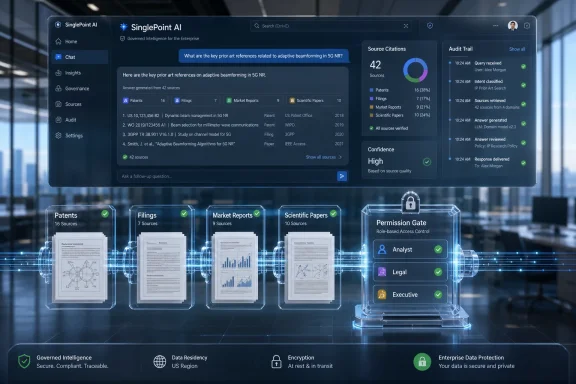
Northern Light Group is positioning its SinglePoint AI platform as a governed enterprise intelligence system that gives strategy teams access to licensed research, curated market data, patents, filings, and scientific literature that general-purpose AI tools often cannot legally or reliably use. The pitch is not that another chatbot can write a better summary. It is that the next fight in enterprise AI will be over the provenance, permissions, and auditability of the information underneath the answer. For WindowsForum readers, that matters because the same Copilot-era question now facing Microsoft customers is spreading across the whole enterprise stack: what, exactly, is the AI allowed to know?
For the first two years of the generative AI boom, the public conversation revolved around models: GPT versus Claude, Gemini versus Copilot, open weights versus closed APIs. That framing made sense when the novelty was a machine that could draft, summarize, code, and converse with a plausible command of language. But enterprise buyers have always had a colder question: can this thing safely reason over the documents that actually matter to our business?
Northern Light’s latest positioning of SinglePoint AI lands squarely in that gap. The company is not trying to out-ChatGPT ChatGPT. It is arguing that mainstream AI assistants, no matter how polished their interfaces, are structurally limited when their answers depend on open-web material, user-uploaded fragments, or whatever internal files an organization has connected through its own tenant.
That distinction sounds abstract until it collides with a real boardroom decision. A product strategy team does not merely need a passable overview of a competitor. It needs licensed analyst research, regulatory filings, patent activity, financial disclosures, trade coverage, scientific literature, and the company’s own internal research history, all filtered through permissions that do not violate subscriptions or leak sensitive material.
This is the part of the AI market that looks less like magic and more like plumbing. The models may be extraordinary, but enterprise intelligence is still constrained by access rights, metadata, identity, licensing, and source trust. Northern Light is betting that the expensive, boring layer below the chatbot will become the valuable one.
That matters because many of the highest-value business sources sit outside the open web. Analyst notes, subscription databases, paid market reports, proprietary survey work, specialized industry news, and internal competitive intelligence collections are precisely the sources that shape corporate decisions. They are also the sources least likely to be freely available to a general-purpose model.
This is where the hype around retrieval-augmented generation, or RAG, runs into operational reality. Connecting a model to documents is not the same thing as building a governed research environment. A useful enterprise system has to know which user can access which report, which license covers which use, which source is current, which document is superseded, and which generated answer needs a traceable evidentiary trail.
Microsoft has pushed Copilot as the natural AI layer for Microsoft 365 content, and for many organizations that is a powerful starting point. But Microsoft 365 is not the whole information universe of a Fortune 500 strategy team. The same is true for ChatGPT Enterprise, Claude, and Gemini: they can be secured, governed, and connected, but they do not magically confer legal access to every premium source an organization wishes it had.
Northern Light’s argument is therefore less anti-chatbot than anti-amnesia. If the AI layer cannot see the research library, patent corpus, market archive, and filing history, it will produce answers from an incomplete institutional memory. In strategic work, an incomplete memory can be worse than no memory at all, because it arrives wrapped in fluent confidence.
The company says its governed content foundation includes more than 150 licensed syndicated research providers, thousands of curated competitive intelligence and market news sources, millions of patent records across more than 100 countries, corporate financial reports, and scientific literature. Those categories are not incidental. They map closely to the daily diet of strategy, product, market access, R&D, and competitive intelligence teams.
The deeper claim is that source curation becomes a defensible moat. Anyone can place a model behind a text box. Fewer companies can assemble licensed content, normalize it, index it, govern access to it, and make it usable inside enterprise workflows without turning compliance into a science project.
That is also why the company’s positioning is investor-friendly. Northern Light is not presenting SinglePoint AI as a one-off productivity feature. It is presenting it as recurring enterprise infrastructure, embedded in workflows where information quality affects decisions about markets, competitors, launches, regulation, and investment.
There is a familiar software-business logic here. If a platform becomes the place where a strategy team finds, validates, summarizes, and distributes intelligence, it gains more than usage. It gains habit. And in enterprise software, habit plus governed data is often stickier than interface novelty.
The important word is not “multi-agent.” That term is rapidly becoming the new “cloud-native”: sometimes meaningful, sometimes decorative. The important word is “auditable,” because it separates a useful executive brief from a hallucinated confidence trick.
For enterprise research teams, auditability is not academic. A competitive claim may need to be defended in front of a product council. A market forecast may influence capital allocation. A scientific or patent insight may shape an R&D decision. If an AI-generated report cannot show where its claims came from, it is a risky draft rather than a decision asset.
The Deep Research framing also acknowledges something that many AI vendors underplay: good research is iterative. A serious query often begins badly formed. Analysts refine the question, narrow the scope, identify missing context, and separate relevant evidence from noise. A system that asks clarifying questions before generating a polished answer is closer to how research actually works.
That may not sound revolutionary to people who have spent years in knowledge management, but it is a corrective to the consumer AI habit of treating the first prompt as sacred. In enterprise strategy, the first prompt is usually the beginning of the work, not the specification for the final answer.
MCP, short for Model Context Protocol, has become one of the more important integration ideas in enterprise AI because it gives models a standardized way to interact with external tools and data sources. The practical implication is straightforward: users may want to ask questions inside the assistant they already use, while the enterprise wants the answer grounded in approved data rather than whatever the model can infer.
That is a smart compromise. Enterprises rarely standardize on one AI interface forever, especially at this early stage of the market. Microsoft may dominate where Microsoft 365 dominates. Developers may prefer other tools. Research teams may use specialized systems. Executives may demand whatever assistant was demonstrated most impressively at the last board meeting.
By making SinglePoint available as a governed source behind multiple front ends, Northern Light is trying to avoid betting everything on its own user interface. The company is essentially saying: use Copilot, use Claude, use ChatGPT, but when the question requires licensed intelligence, let SinglePoint be the content authority.
That is a subtle but important shift in platform strategy. In the old enterprise-search world, vendors fought to be the destination. In the AI-agent world, the destination may be fluid. The durable value may sit in the governed corpus, permissions model, indexing layer, and evidentiary trail.
That is why SinglePoint AI’s argument should sound familiar to Microsoft shops. AI does not eliminate document governance; it exposes it. If sensitive documents are over-permissioned, an assistant may surface them. If important documents are buried in disconnected repositories, an assistant may ignore them. If licensed research sits outside the system, the assistant cannot responsibly synthesize it.
The difference is that competitive intelligence and market research have a sharper licensing edge than ordinary internal documents. A company may own its PowerPoint decks, but it does not necessarily own unrestricted AI usage rights for every analyst report it subscribes to. The fact that an employee can read a report does not automatically mean a model can ingest, transform, and redistribute its contents across the enterprise.
This is where Northern Light’s old-fashioned content-management DNA becomes relevant. The company’s pitch depends on the unglamorous disciplines that predate generative AI: entitlements, taxonomies, metadata, source normalization, custom portals, and role-based access. In the Copilot era, those disciplines look less like legacy overhead and more like the foundation for safe AI.
It also explains why the positioning is aimed at Fortune 500 strategy and competitive intelligence teams rather than casual office users. The value proposition is strongest where the cost of a wrong or unsupported answer is high. A small business may tolerate a rough AI summary. A pharmaceutical, financial services, manufacturing, or technology enterprise making market decisions needs a better chain of custody.
That is a more plausible enterprise strategy than trying to compete at the foundation-model layer. The largest AI labs are spending enormous sums on compute, data centers, talent, and model training. A specialized vendor can instead compete by owning a high-value context layer that the general-purpose assistants lack.
The risk is that platform giants may try to absorb this value. Microsoft, Google, OpenAI, and Anthropic all have incentives to make their enterprise products better at connecting to approved external data. Content vendors may also strike their own AI licensing deals. If the market standardizes around native connectors and broad content partnerships, specialized platforms will need to prove that their governance and workflow depth justify their place in the stack.
But the counterargument is strong. Enterprise content rights are messy, and messy markets often reward specialists. A single global company may have different licenses by region, business unit, content provider, and user role. It may need to combine paid research with internal reports, patents, filings, public data, scientific papers, and curated news. That is not a trivial connector problem.
In that environment, the value of a platform is not merely that it can retrieve a document. It is that it can retrieve the right document for the right person under the right terms, then produce an answer that an organization can defend. That is less glamorous than a benchmark score, but it is closer to how enterprise software budgets get approved.
Primary research is expensive because organizations commission it when existing knowledge is hard to find, fragmented, outdated, or insufficiently trusted. If a governed AI platform can surface already-paid-for research, connect it to internal knowledge, and synthesize it into decision-ready form, some new research projects may become unnecessary. That is not AI replacing strategy; it is AI reducing the penalty for institutional forgetfulness.
This matters because many enterprises are drowning in content they already bought. Analyst reports sit in portals. Market studies live in shared drives. Competitive notes are scattered across teams. Patent insights sit with specialists. Financial filings are public but underused. The waste is not only duplicated subscriptions; it is duplicated effort.
A credible governed research system attacks that waste from two directions. It increases reuse of existing knowledge, and it shortens the time between question and answer. In strategy work, speed has value because decisions often move on planning cycles, launch windows, investor expectations, or competitive threats.
The caveat is that savings claims depend heavily on adoption. A platform that merely stores more content will not change behavior. Analysts and executives need to trust the outputs, understand the source trail, and see the platform as faster than their existing workaround. In enterprise AI, deployment is easy compared with habit change.
Northern Light’s SinglePoint AI positioning fits that second wave. It treats governance not as a compliance appendix but as the core product attribute. That is a sensible stance in industries where legal, regulatory, scientific, and competitive claims need to be traceable.
It also reflects a broader backlash against “AI answer machines” that cannot explain themselves. In consumer contexts, a plausible answer may be enough. In enterprise contexts, plausibility without provenance is a liability. The more consequential the decision, the more the system must show its work.
For IT leaders, this creates a new evaluation burden. Buying AI is no longer just about model quality, license price, or integration with existing productivity suites. It is about information architecture, content rights, identity integration, data residency, logging, retention, and downstream use of generated outputs.
That is not a small checklist. But it is the checklist that separates a demo from production. Northern Light’s opportunity lies in the fact that many companies are discovering this distinction the hard way.
The strongest part of its argument is the specificity of its content stack. Licensed syndicated research providers, curated market news, patent records, financial reports, and scientific literature are more tangible than vague promises about “trusted data.” They suggest a platform built around the actual materials strategy teams use.
The weaker point, at least from the outside, is that much of the proof depends on customer outcomes that are hard to independently inspect. Cost savings, faster decisions, and reduced research duplication are plausible, but they are also the kinds of benefits every enterprise software vendor claims. Buyers will need to ask for measurable baselines, reference customers, and clarity on what is included versus custom integration work.
There is also a cultural risk. Competitive intelligence teams may welcome AI that accelerates synthesis, but they may resist systems that appear to flatten expert judgment into automated reports. The best version of SinglePoint AI augments analysts by handling discovery, source assembly, and first-draft synthesis. The worst version would be used by executives as a shortcut around the people trained to interpret ambiguous signals.
Northern Light seems aware of that line, which is why the language around guided dialogue, validation, and audit-ready deliverables matters. The platform’s credibility will depend on whether it preserves expert review or encourages management to mistake generated prose for settled truth.
A governed intelligence platform gains power as more sources, taxonomies, workflows, and user habits accumulate inside it. Over time, the cost of leaving rises. The enterprise may benefit from consistency and reuse, but it may also become dependent on one vendor’s indexing, metadata, connectors, and entitlement model.
This is where the MCP strategy cuts both ways. On one hand, exposing governed content to multiple AI assistants could reduce interface lock-in. Users can work through Copilot, Claude, ChatGPT, or other clients while SinglePoint remains the source layer. On the other hand, if SinglePoint becomes the canonical broker for premium intelligence, the dependency simply moves down the stack.
That is not inherently bad. Enterprise software is full of systems of record, from identity providers to ERP platforms to document repositories. The question is whether the platform preserves portability, transparency, and administrative control. In AI, those questions become more urgent because generated outputs may influence decisions long after the original query is forgotten.
For buyers, the practical test is straightforward. Can the organization export its metadata? Can it audit usage by source and user? Can it change model providers? Can it enforce license restrictions consistently across interfaces? Can it prove which documents supported a particular answer months later? These are not edge cases. They are the future shape of AI governance.
Replacing familiar messes is hard. Strategy teams often survive through human networks: who knows the market, who has the latest deck, who remembers the study from last year, who can interpret the analyst note. A governed AI platform has to outperform not only search but also organizational habit.
The opportunity is that generative AI changes the tolerance for fragmentation. Once users experience a competent assistant that can synthesize across sources, they become less patient with systems that require manual digging. The demand for a unified research layer grows because the interface has changed expectations.
That is why SinglePoint AI’s timing is favorable. Enterprises are no longer debating whether AI will enter knowledge work. They are debating how to stop it from becoming an uncontrolled overlay on messy data. A vendor that can say “we already organize the premium content your strategy teams need” enters the conversation with a concrete answer.
Still, success will depend on execution rather than positioning. The platform must be fast, explainable, permission-aware, and pleasant enough that analysts use it under deadline pressure. In enterprise research, the system that wins is not the one with the best slogan. It is the one that becomes the path of least resistance when the executive asks for an answer by Friday.
The company’s differentiation rests on licensed content, curated sources, AI-assisted research workflows, and the ability to expose that governed knowledge through other assistants. If that works as advertised, SinglePoint AI becomes less like a chatbot and more like an intelligence substrate for corporate strategy. If it does not, it risks being perceived as another knowledge portal with a generative wrapper.
For WindowsForum’s IT-pro audience, the lesson is broader than one vendor. Copilot and its rivals will keep improving, but their enterprise value will depend on the quality and legality of the context they can reach. The next phase of AI deployment will be won not merely by models that answer quickly, but by systems that answer from the right corpus, under the right permissions, with evidence a human can inspect.
 The Enterprise AI Race Is Moving From Models to Inputs
For the first two years of the generative AI boom, the public conversation revolved around models: GPT versus Claude, Gemini versus Copilot, open weights versus closed APIs. That framing made sense when the novelty was a machine that could draft, summarize, code, and converse with a plausible command of language. But enterprise buyers have always had a colder question: can this thing safely reason over the documents that actually matter to our business?Northern Light’s latest positioning of SinglePoint AI lands squarely in that gap. The company is not trying to out-ChatGPT ChatGPT. It is arguing that mainstream AI assistants, no matter how polished their interfaces, are structurally limited when their answers depend on open-web material, user-uploaded fragments, or whatever internal files an organization has connected through its own tenant.
That distinction sounds abstract until it collides with a real boardroom decision. A product strategy team does not merely need a passable overview of a competitor. It needs licensed analyst research, regulatory filings, patent activity, financial disclosures, trade coverage, scientific literature, and the company’s own internal research history, all filtered through permissions that do not violate subscriptions or leak sensitive material.
This is the part of the AI market that looks less like magic and more like plumbing. The models may be extraordinary, but enterprise intelligence is still constrained by access rights, metadata, identity, licensing, and source trust. Northern Light is betting that the expensive, boring layer below the chatbot will become the valuable one.
General-Purpose Assistants Have a Premium Content Problem
The critique embedded in Northern Light’s messaging is simple: ChatGPT, Microsoft Copilot, Claude, and Gemini are useful, but they are not automatically enterprise research libraries. They can synthesize what they can access, and that access is often narrower than executives assume. Premium research, proprietary market intelligence, and licensed publications are not just “content”; they are contract-bound assets.That matters because many of the highest-value business sources sit outside the open web. Analyst notes, subscription databases, paid market reports, proprietary survey work, specialized industry news, and internal competitive intelligence collections are precisely the sources that shape corporate decisions. They are also the sources least likely to be freely available to a general-purpose model.
This is where the hype around retrieval-augmented generation, or RAG, runs into operational reality. Connecting a model to documents is not the same thing as building a governed research environment. A useful enterprise system has to know which user can access which report, which license covers which use, which source is current, which document is superseded, and which generated answer needs a traceable evidentiary trail.
Microsoft has pushed Copilot as the natural AI layer for Microsoft 365 content, and for many organizations that is a powerful starting point. But Microsoft 365 is not the whole information universe of a Fortune 500 strategy team. The same is true for ChatGPT Enterprise, Claude, and Gemini: they can be secured, governed, and connected, but they do not magically confer legal access to every premium source an organization wishes it had.
Northern Light’s argument is therefore less anti-chatbot than anti-amnesia. If the AI layer cannot see the research library, patent corpus, market archive, and filing history, it will produce answers from an incomplete institutional memory. In strategic work, an incomplete memory can be worse than no memory at all, because it arrives wrapped in fluent confidence.
SinglePoint AI Is Being Sold as the System of Record for Strategy
SinglePoint has long been described by Northern Light as a platform for market and competitive intelligence rather than a consumer-style search box. The newer AI framing builds on that history by presenting the platform as a governed content stack for enterprise decision-making. In this model, the chatbot is an interface; the real product is the curated, permission-aware body of knowledge beneath it.The company says its governed content foundation includes more than 150 licensed syndicated research providers, thousands of curated competitive intelligence and market news sources, millions of patent records across more than 100 countries, corporate financial reports, and scientific literature. Those categories are not incidental. They map closely to the daily diet of strategy, product, market access, R&D, and competitive intelligence teams.
The deeper claim is that source curation becomes a defensible moat. Anyone can place a model behind a text box. Fewer companies can assemble licensed content, normalize it, index it, govern access to it, and make it usable inside enterprise workflows without turning compliance into a science project.
That is also why the company’s positioning is investor-friendly. Northern Light is not presenting SinglePoint AI as a one-off productivity feature. It is presenting it as recurring enterprise infrastructure, embedded in workflows where information quality affects decisions about markets, competitors, launches, regulation, and investment.
There is a familiar software-business logic here. If a platform becomes the place where a strategy team finds, validates, summarizes, and distributes intelligence, it gains more than usage. It gains habit. And in enterprise software, habit plus governed data is often stickier than interface novelty.
Deep Research Makes the Research Workflow the Product
The first usage mode Northern Light highlights is a Deep Research application. That phrase has become fashionable across AI products, but the implementation matters. In Northern Light’s telling, the system uses a multi-agent pipeline to clarify the user’s objective, develop a research plan, search internal and licensed external content, validate sources, and produce reports designed to be auditable.The important word is not “multi-agent.” That term is rapidly becoming the new “cloud-native”: sometimes meaningful, sometimes decorative. The important word is “auditable,” because it separates a useful executive brief from a hallucinated confidence trick.
For enterprise research teams, auditability is not academic. A competitive claim may need to be defended in front of a product council. A market forecast may influence capital allocation. A scientific or patent insight may shape an R&D decision. If an AI-generated report cannot show where its claims came from, it is a risky draft rather than a decision asset.
The Deep Research framing also acknowledges something that many AI vendors underplay: good research is iterative. A serious query often begins badly formed. Analysts refine the question, narrow the scope, identify missing context, and separate relevant evidence from noise. A system that asks clarifying questions before generating a polished answer is closer to how research actually works.
That may not sound revolutionary to people who have spent years in knowledge management, but it is a corrective to the consumer AI habit of treating the first prompt as sacred. In enterprise strategy, the first prompt is usually the beginning of the work, not the specification for the final answer.
The MCP Server Strategy Turns Rival Assistants Into Front Ends
The second usage mode is more strategically interesting: Northern Light says SinglePoint AI can expose the same governed content through an MCP server to interfaces such as Microsoft Copilot, Claude, and ChatGPT. That makes the company’s posture less like a direct challenger to the big AI assistants and more like an infrastructure layer underneath them.MCP, short for Model Context Protocol, has become one of the more important integration ideas in enterprise AI because it gives models a standardized way to interact with external tools and data sources. The practical implication is straightforward: users may want to ask questions inside the assistant they already use, while the enterprise wants the answer grounded in approved data rather than whatever the model can infer.
That is a smart compromise. Enterprises rarely standardize on one AI interface forever, especially at this early stage of the market. Microsoft may dominate where Microsoft 365 dominates. Developers may prefer other tools. Research teams may use specialized systems. Executives may demand whatever assistant was demonstrated most impressively at the last board meeting.
By making SinglePoint available as a governed source behind multiple front ends, Northern Light is trying to avoid betting everything on its own user interface. The company is essentially saying: use Copilot, use Claude, use ChatGPT, but when the question requires licensed intelligence, let SinglePoint be the content authority.
That is a subtle but important shift in platform strategy. In the old enterprise-search world, vendors fought to be the destination. In the AI-agent world, the destination may be fluid. The durable value may sit in the governed corpus, permissions model, indexing layer, and evidentiary trail.
Microsoft Customers Should Recognize the Governance Pattern
Windows and Microsoft 365 administrators have seen this movie before. Every powerful collaboration layer eventually becomes a governance problem. SharePoint sprawled. Teams sprawled. OneDrive synced things it probably should not have. Now Copilot inherits the permissions, hygiene, and information architecture of everything below it.That is why SinglePoint AI’s argument should sound familiar to Microsoft shops. AI does not eliminate document governance; it exposes it. If sensitive documents are over-permissioned, an assistant may surface them. If important documents are buried in disconnected repositories, an assistant may ignore them. If licensed research sits outside the system, the assistant cannot responsibly synthesize it.
The difference is that competitive intelligence and market research have a sharper licensing edge than ordinary internal documents. A company may own its PowerPoint decks, but it does not necessarily own unrestricted AI usage rights for every analyst report it subscribes to. The fact that an employee can read a report does not automatically mean a model can ingest, transform, and redistribute its contents across the enterprise.
This is where Northern Light’s old-fashioned content-management DNA becomes relevant. The company’s pitch depends on the unglamorous disciplines that predate generative AI: entitlements, taxonomies, metadata, source normalization, custom portals, and role-based access. In the Copilot era, those disciplines look less like legacy overhead and more like the foundation for safe AI.
It also explains why the positioning is aimed at Fortune 500 strategy and competitive intelligence teams rather than casual office users. The value proposition is strongest where the cost of a wrong or unsupported answer is high. A small business may tolerate a rough AI summary. A pharmaceutical, financial services, manufacturing, or technology enterprise making market decisions needs a better chain of custody.
The Moat Is Not the Model, and That Is the Point
Northern Light’s implied moat is not that it has a better large language model than OpenAI, Anthropic, Google, or Microsoft. It almost certainly does not, and it does not need to. The moat is the governed content supply chain: licensed sources, curated collections, enterprise indexing, permissions, and established customer workflows.That is a more plausible enterprise strategy than trying to compete at the foundation-model layer. The largest AI labs are spending enormous sums on compute, data centers, talent, and model training. A specialized vendor can instead compete by owning a high-value context layer that the general-purpose assistants lack.
The risk is that platform giants may try to absorb this value. Microsoft, Google, OpenAI, and Anthropic all have incentives to make their enterprise products better at connecting to approved external data. Content vendors may also strike their own AI licensing deals. If the market standardizes around native connectors and broad content partnerships, specialized platforms will need to prove that their governance and workflow depth justify their place in the stack.
But the counterargument is strong. Enterprise content rights are messy, and messy markets often reward specialists. A single global company may have different licenses by region, business unit, content provider, and user role. It may need to combine paid research with internal reports, patents, filings, public data, scientific papers, and curated news. That is not a trivial connector problem.
In that environment, the value of a platform is not merely that it can retrieve a document. It is that it can retrieve the right document for the right person under the right terms, then produce an answer that an organization can defend. That is less glamorous than a benchmark score, but it is closer to how enterprise software budgets get approved.
The Customer Anecdote Points to Cost Avoidance, Not Just Productivity
The TipRanks write-up references a customer anecdote claiming material cost savings and faster decision-making from reduced primary research needs. Like most vendor-cited anecdotes, it should be treated as directional rather than definitive. Still, the economic logic is worth unpacking.Primary research is expensive because organizations commission it when existing knowledge is hard to find, fragmented, outdated, or insufficiently trusted. If a governed AI platform can surface already-paid-for research, connect it to internal knowledge, and synthesize it into decision-ready form, some new research projects may become unnecessary. That is not AI replacing strategy; it is AI reducing the penalty for institutional forgetfulness.
This matters because many enterprises are drowning in content they already bought. Analyst reports sit in portals. Market studies live in shared drives. Competitive notes are scattered across teams. Patent insights sit with specialists. Financial filings are public but underused. The waste is not only duplicated subscriptions; it is duplicated effort.
A credible governed research system attacks that waste from two directions. It increases reuse of existing knowledge, and it shortens the time between question and answer. In strategy work, speed has value because decisions often move on planning cycles, launch windows, investor expectations, or competitive threats.
The caveat is that savings claims depend heavily on adoption. A platform that merely stores more content will not change behavior. Analysts and executives need to trust the outputs, understand the source trail, and see the platform as faster than their existing workaround. In enterprise AI, deployment is easy compared with habit change.
Governance Is Becoming the Enterprise AI Buying Criterion
The early generative AI sales pitch was productivity. The mature enterprise sales pitch is control. This shift is visible across the market, from Microsoft’s emphasis on tenant boundaries and permissions to the broader rise of private AI deployments, retrieval systems, model monitoring, and audit trails.Northern Light’s SinglePoint AI positioning fits that second wave. It treats governance not as a compliance appendix but as the core product attribute. That is a sensible stance in industries where legal, regulatory, scientific, and competitive claims need to be traceable.
It also reflects a broader backlash against “AI answer machines” that cannot explain themselves. In consumer contexts, a plausible answer may be enough. In enterprise contexts, plausibility without provenance is a liability. The more consequential the decision, the more the system must show its work.
For IT leaders, this creates a new evaluation burden. Buying AI is no longer just about model quality, license price, or integration with existing productivity suites. It is about information architecture, content rights, identity integration, data residency, logging, retention, and downstream use of generated outputs.
That is not a small checklist. But it is the checklist that separates a demo from production. Northern Light’s opportunity lies in the fact that many companies are discovering this distinction the hard way.
The Risk Is That “Governed AI” Becomes Another Vendor Slogan
There is a danger in this market: every AI vendor now claims to be secure, governed, trusted, enterprise-grade, and auditable. These words are becoming the wallpaper of procurement decks. Northern Light’s challenge is to make the terms concrete.The strongest part of its argument is the specificity of its content stack. Licensed syndicated research providers, curated market news, patent records, financial reports, and scientific literature are more tangible than vague promises about “trusted data.” They suggest a platform built around the actual materials strategy teams use.
The weaker point, at least from the outside, is that much of the proof depends on customer outcomes that are hard to independently inspect. Cost savings, faster decisions, and reduced research duplication are plausible, but they are also the kinds of benefits every enterprise software vendor claims. Buyers will need to ask for measurable baselines, reference customers, and clarity on what is included versus custom integration work.
There is also a cultural risk. Competitive intelligence teams may welcome AI that accelerates synthesis, but they may resist systems that appear to flatten expert judgment into automated reports. The best version of SinglePoint AI augments analysts by handling discovery, source assembly, and first-draft synthesis. The worst version would be used by executives as a shortcut around the people trained to interpret ambiguous signals.
Northern Light seems aware of that line, which is why the language around guided dialogue, validation, and audit-ready deliverables matters. The platform’s credibility will depend on whether it preserves expert review or encourages management to mistake generated prose for settled truth.
The Content Layer Could Become the New Enterprise Lock-In
If Northern Light succeeds, SinglePoint AI will not just be another application in the enterprise portfolio. It will become a content and context layer that other AI systems call into. That has obvious benefits for customers, but it also raises the familiar question of lock-in.A governed intelligence platform gains power as more sources, taxonomies, workflows, and user habits accumulate inside it. Over time, the cost of leaving rises. The enterprise may benefit from consistency and reuse, but it may also become dependent on one vendor’s indexing, metadata, connectors, and entitlement model.
This is where the MCP strategy cuts both ways. On one hand, exposing governed content to multiple AI assistants could reduce interface lock-in. Users can work through Copilot, Claude, ChatGPT, or other clients while SinglePoint remains the source layer. On the other hand, if SinglePoint becomes the canonical broker for premium intelligence, the dependency simply moves down the stack.
That is not inherently bad. Enterprise software is full of systems of record, from identity providers to ERP platforms to document repositories. The question is whether the platform preserves portability, transparency, and administrative control. In AI, those questions become more urgent because generated outputs may influence decisions long after the original query is forgotten.
For buyers, the practical test is straightforward. Can the organization export its metadata? Can it audit usage by source and user? Can it change model providers? Can it enforce license restrictions consistently across interfaces? Can it prove which documents supported a particular answer months later? These are not edge cases. They are the future shape of AI governance.
The Real Competition Is the Enterprise’s Own Mess
Northern Light’s fiercest competitor may not be Microsoft, OpenAI, Anthropic, or Google. It may be the enterprise’s existing patchwork of subscriptions, SharePoint sites, inboxes, dashboards, research portals, analyst relationships, and informal expert networks. That mess is frustrating, but it is familiar.Replacing familiar messes is hard. Strategy teams often survive through human networks: who knows the market, who has the latest deck, who remembers the study from last year, who can interpret the analyst note. A governed AI platform has to outperform not only search but also organizational habit.
The opportunity is that generative AI changes the tolerance for fragmentation. Once users experience a competent assistant that can synthesize across sources, they become less patient with systems that require manual digging. The demand for a unified research layer grows because the interface has changed expectations.
That is why SinglePoint AI’s timing is favorable. Enterprises are no longer debating whether AI will enter knowledge work. They are debating how to stop it from becoming an uncontrolled overlay on messy data. A vendor that can say “we already organize the premium content your strategy teams need” enters the conversation with a concrete answer.
Still, success will depend on execution rather than positioning. The platform must be fast, explainable, permission-aware, and pleasant enough that analysts use it under deadline pressure. In enterprise research, the system that wins is not the one with the best slogan. It is the one that becomes the path of least resistance when the executive asks for an answer by Friday.
The SinglePoint Bet Comes Down to Trust at Scale
Northern Light’s argument can be reduced to one claim: enterprise AI needs governed knowledge more than it needs another general-purpose interface. That claim is persuasive because it matches what IT departments have learned from every previous collaboration wave. The more powerful the interface becomes, the more dangerous bad information architecture becomes beneath it.The company’s differentiation rests on licensed content, curated sources, AI-assisted research workflows, and the ability to expose that governed knowledge through other assistants. If that works as advertised, SinglePoint AI becomes less like a chatbot and more like an intelligence substrate for corporate strategy. If it does not, it risks being perceived as another knowledge portal with a generative wrapper.
For WindowsForum’s IT-pro audience, the lesson is broader than one vendor. Copilot and its rivals will keep improving, but their enterprise value will depend on the quality and legality of the context they can reach. The next phase of AI deployment will be won not merely by models that answer quickly, but by systems that answer from the right corpus, under the right permissions, with evidence a human can inspect.
Where the Vendor Pitch Meets the Procurement Checklist
Northern Light’s positioning gives enterprise buyers a useful lens for evaluating the next wave of AI knowledge tools. The question is not whether a system can generate fluent prose. The question is whether it can turn expensive, permission-bound, fragmented research into defensible decisions.- Enterprises should treat licensed research as governed infrastructure, not as miscellaneous content that can be casually dumped into an AI pipeline.
- General-purpose assistants can be valuable front ends, but they do not automatically solve premium content access, source rights, or auditability.
- Deep Research features are most credible when they clarify scope, search across approved sources, validate evidence, and preserve a traceable source trail.
- MCP-style integrations may let companies keep preferred AI assistants while centralizing control over premium enterprise intelligence.
- Buyers should press vendors for proof of adoption, measurable savings, entitlement enforcement, export options, and post-answer audit capabilities.
- The biggest operational risk is not that AI lacks confidence, but that it produces confident answers from incomplete or improperly governed information.
References
- Primary source: TipRanks
Published: 2026-06-05T06:50:09.743529
Northern Light Positions SinglePoint AI as Governed Content Platform for Enterprise Strategy - TipRanks.com
According to a recent LinkedIn post from Northern Light Group, the company is positioning its SinglePoint AI platform as a solution to a structural limitation in ma...www.tipranks.com
- Related coverage: northernlight.com
SinglePoint Knowledge Management Platform | Northern Light
SinglePoint is a custom-built enterprise knowledge management platform that enables full-text search of all your research resources in one place.www.northernlight.com - Related coverage: app.dealroom.co
Northern Light launches Aurora, advancing SinglePoint platform with multi-agent AI research and expanded intelligence coverage | Dealroom.co
Northern Light has announced Aurora, a major advancement to its SinglePoint enterprise intelligence platform. The update introduces Multi-Agent Deep Research, new curated intelligence collections, and a modernised user interface. Aurora's centrepiece is Deep Research, a conversation-led...app.dealroom.co - Related coverage: tmcnet.com
Northern Light Announces Aurora, Advancing the SinglePoint Intelligence Platform with Multi-Agent Deep Research
Northern Light Announces Aurora, Advancing the SinglePoint Intelligence Platform with Multi-Agent Deep Researchwww.tmcnet.com - Related coverage: builtin.com

Product Manager - Singlepoint Application Platform - Northern Light | Built In
Northern Light is hiring for a Product Manager - Singlepoint Application Platform in Somerville, MA, USA. Find more details about the job and how to apply at Built In.
builtin.com
- Related coverage: kwfoundation.org
