

Samsung SDS will begin supplying ChatGPT, Gemini, and Claude to Samsung Group affiliates by the end of June 2026, acting as the internal reseller and operator for a groupwide enterprise AI transformation spanning R&D, manufacturing, marketing, management support, and software development. The decision is not merely another Fortune 500 AI licensing story. It is Samsung turning generative AI from a tolerated productivity shortcut into centrally brokered infrastructure. That shift should interest every Windows administrator and enterprise architect because it sketches the next phase of corporate AI: less browser-tab experimentation, more governed multi-model deployment.
Samsung’s reported plan puts Samsung SDS in the middle of the group’s generative AI adoption, and that placement matters. The company is not simply telling employees to use whichever assistant they prefer, nor is it standardizing on a single vendor’s platform. It is creating a managed internal channel through which affiliates can buy, deploy, support, and secure different AI services according to job function.
That is a more mature posture than the first wave of enterprise generative AI, when employees smuggled prompts into public chatbots and security teams belatedly discovered that source code, meeting notes, customer details, and product plans had become copy-and-paste fodder. Samsung knows that story better than most. Its earlier caution around external AI tools became part of the corporate folklore of the ChatGPT era, a warning that convenience could outrun policy.
The new arrangement suggests Samsung has decided the answer is not permanent prohibition but controlled industrialization. ChatGPT and Codex may be better fits for developers and automation-heavy teams. Gemini may fit collaboration and document workflows. Claude may appeal where long-context reasoning, coding assistance, or structured analysis is valuable. The important point is that Samsung SDS becomes the wrapper around those choices.
In enterprise IT terms, this is the difference between an app and a program. A chatbot rollout can be expensed, announced, and forgotten. A program requires identity, procurement, compliance, audit, data classification, training, help desk readiness, vendor management, usage telemetry, and integration with the systems where work actually happens. Samsung SDS is positioning itself to own that less glamorous but more durable layer.
That is why the SDS role is strategically useful. A conglomerate the size of Samsung cannot treat every AI vendor relationship as a separate departmental experiment. The value lies in building repeatable patterns: how a chip design team safely uses coding agents, how a finance group drafts and checks internal reports, how a manufacturing unit summarizes operational data without exposing sensitive plant information, and how a legal or HR team prevents confidential material from drifting into unmanaged systems.
This is also where “AI transformation,” or AX, stops being sloganware. A company does not transform because workers get access to a chatbot. It transforms when workflows are redesigned around machine assistance and when the organization accepts the operational burden that comes with that redesign. Samsung SDS appears to be betting that this burden will become a business line.
For WindowsForum readers, the implication is familiar. Every major productivity revolution eventually becomes an administration problem. The PC, email, mobile devices, SaaS apps, cloud storage, and endpoint management all followed the same curve: first novelty, then sprawl, then governance, then platformization. Generative AI is moving along that curve faster because the risks are obvious from day one.
A multi-model approach gives Samsung leverage. It can compare performance, pricing, data controls, regional availability, and integration roadmaps across OpenAI, Google, and Anthropic. It can also avoid binding its entire internal AI strategy to a single vendor’s product cycle or policy change. In a market still changing monthly, optionality is not indecision; it is risk management.
The tradeoff is complexity. Supporting three major AI platforms across a sprawling corporate group means more administrative surfaces, more contract terms, more security reviews, and more user education. If Samsung SDS does this well, employees see a curated set of tools. If it does it poorly, IT teams inherit three overlapping AI estates with inconsistent governance.
This is where the Windows ecosystem becomes relevant even though the story is not formally about Microsoft. Many Samsung employees will consume these services through Windows PCs, browsers, IDEs, office suites, collaboration tools, and identity-managed enterprise endpoints. The practical question for sysadmins will not be which model has the cleverest demo. It will be whether the AI layer respects conditional access, data loss prevention, device posture, browser policy, endpoint logging, and corporate retention rules.
For a company like Samsung, that is both irresistible and dangerous. The productivity upside in R&D and software engineering could be enormous. A coding assistant that helps engineers navigate large repositories, produce test scaffolding, analyze bugs, or automate repetitive development tasks is not a toy. At scale, even modest improvements per engineer become a serious operational advantage.
But coding agents also force companies to confront accountability. If an AI-generated patch introduces a vulnerability, who owns the mistake? If a model suggests code based on patterns learned elsewhere, how should legal teams evaluate licensing and provenance? If an agent is connected to internal repositories, what guardrails prevent accidental exposure or unauthorized modification?
The mature answer is not to ban these tools, because developers will seek them out anyway. The mature answer is to wrap them in policy, review, telemetry, and secure development practices. Samsung SDS’s operational role will likely matter most here, because coding agents are where enterprise AI crosses from advisory software into semi-autonomous production influence.
That makes governance harder, not easier. Office workers handle commercial plans, employee information, customer records, vendor negotiations, legal drafts, and strategy documents. They may not think of themselves as working with sensitive data, but they often do. The risk is not only that a model leaks information; it is that employees over-trust a confident answer, misclassify a generated summary, or circulate AI-produced material without review.
Windows administrators have seen this pattern before with cloud file sharing and collaboration platforms. The most dangerous data handling often occurs in routine work, not in exotic engineering systems. A spreadsheet emailed to the wrong person, a Teams message pasted into an unmanaged tool, or a meeting summary stored outside retention policy can create more exposure than a theoretical zero-day.
Enterprise AI therefore has to meet ordinary workers where they are. Policies buried in a compliance portal will not be enough. Users need friction at the right points, templates that steer safe behavior, and defaults that make the approved path easier than the shadow-IT path. Samsung’s affiliate-by-affiliate adoption model may help if it produces workflows tailored to real teams rather than a single corporate memo about “responsible AI.”
Enterprise AI buyers are already discovering that model access is commoditizing. One month’s leader in coding, reasoning, summarization, or multimodal search can be matched or leapfrogged. What remains valuable is the ability to make those models usable inside a regulated, security-conscious, politically complex organization. Samsung SDS is effectively saying: let the model companies fight over benchmarks; we will own the transformation layer.
That could also create a feedback loop inside Samsung Group. As affiliates adopt different tools, SDS gains insight into what works by function, business unit, and risk level. It can see where users actually derive value, where costs spike, where security controls break down, and where integrations are repeatedly requested. Those observations are worth more than a generic market survey because they come from operating at scale.
There is a potential conflict, of course. A reseller and operator may have incentives that differ from individual affiliates. Standardization can reduce complexity, but it can also slow experimentation. Central governance can improve security, but it can also frustrate teams that need rapid iteration. Samsung’s challenge will be to make SDS an accelerator rather than a gatekeeper.
Samsung’s move toward approved external AI tools reflects a tacit admission that containment is now preferable to denial. Workers want these systems because they are useful. Developers want coding assistance. Managers want summaries. Analysts want faster drafts. Executives want the organization to appear serious about AI. If official channels are too restrictive, unofficial channels will reappear.
That does not mean every concern has been solved. Generative AI still raises unresolved questions around hallucination, confidential data handling, intellectual property, model retention policies, jurisdictional exposure, and auditability. Enterprise editions generally offer stronger administrative controls than consumer tools, but “enterprise” is not a magic word. Contracts, configurations, and user behavior still decide the real security posture.
For Windows shops, this is where endpoint and identity strategy intersect with AI strategy. Browser controls, application allow lists, single sign-on, device compliance, network routing, DLP, and logging all become part of AI governance. An organization that treats AI as a procurement project will miss that. An organization that treats it as part of its broader digital workplace architecture has a better chance.
The more interesting point is that these vendors are no longer competing only in public benchmarks or consumer mindshare. They are competing in procurement committees, security questionnaires, admin consoles, data residency reviews, support escalations, and integration backlogs. The winning model is the one that survives contact with enterprise reality.
That reality is messy. A tool can be excellent in isolation and still lose because it lacks a needed connector, creates unclear compliance exposure, costs too much at scale, or does not fit existing identity architecture. Conversely, a model that is not the benchmark leader may win a department because it is packaged into the workflow employees already use.
Samsung’s multi-vendor adoption will give the market a useful test case. If one platform naturally expands beyond its assigned use cases, that will say something about enterprise preference. If usage remains fragmented by function, that will support the argument that the AI market will look less like search and more like cloud computing: a few large providers, many specialized workloads, and constant pressure on integration layers.
Boring is not an insult in IT. Boring means repeatable. Boring means someone has thought about access control, support tickets, offboarding, logging, and disaster scenarios. Boring means the tool is no longer a novelty sitting outside the organization’s operating model. It has become something the business expects to rely on.
That may disappoint those who imagined generative AI would sweep away corporate process. In practice, powerful tools tend to attract more process, not less. The more useful a technology becomes, the more organizations need to govern it. Email, cloud storage, mobile access, and collaboration suites all followed that logic. AI will not be exempt just because the interface feels conversational.
Samsung’s move is therefore less a sudden embrace than a sign of institutional digestion. The company appears to be absorbing external AI into the machinery of a conglomerate: procurement, affiliates, internal service providers, training, security, and operations. That is how experimental technology becomes corporate infrastructure.
That makes AI governance a fleet management problem. Admins will need to know which users can access which tools, from which devices, under which conditions. They will need to distinguish consumer AI services from enterprise-approved tenants. They will need to decide whether browser-based controls are sufficient or whether managed desktop applications and network controls are required. They will need to work with security teams on logging and with legal teams on retention.
This is also where Microsoft’s own ecosystem remains part of the background, even when the named vendors are OpenAI, Google, and Anthropic. Windows endpoints, Microsoft Entra ID, Microsoft 365, Defender, Intune, Edge policies, and developer tools are often the administrative substrate through which non-Microsoft AI services are accessed. Enterprise AI may be multi-vendor at the model layer while still deeply dependent on Microsoft infrastructure at the management layer.
That tension will define the next phase of IT operations. Companies want choice among AI models, but they do not want chaos across devices and identities. The practical winners may be the organizations that separate those layers cleanly: flexible at the model level, strict at the access and data-control level.
There is also the problem of evaluation. Generative AI productivity is notoriously easy to claim and hard to measure. A worker may feel faster because a tool produces a draft instantly, but the organization still needs to account for review time, error correction, compliance checks, and downstream rework. The best enterprise AI programs will measure outcomes, not vibes.
Samsung SDS will need to prove that it can convert access into durable operating improvements. That means identifying where AI shortens cycle times, reduces toil, improves code review, accelerates research, or improves support quality. It also means admitting where tools do not help. A serious AX program should be willing to retire weak use cases, not merely expand licenses because adoption graphs look good.
The company’s scale cuts both ways. Samsung has the resources to make this work, but also the organizational complexity to make it difficult. Affiliates may have different data regimes, engineering cultures, regulatory pressures, and legacy systems. A centrally supported program must be flexible enough to respect those differences while firm enough to prevent fragmentation.
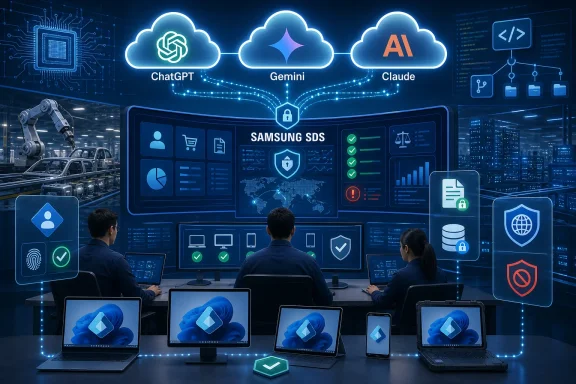 Samsung Chooses the Broker Model Over the Chatbot Free-for-All
Samsung’s reported plan puts Samsung SDS in the middle of the group’s generative AI adoption, and that placement matters. The company is not simply telling employees to use whichever assistant they prefer, nor is it standardizing on a single vendor’s platform. It is creating a managed internal channel through which affiliates can buy, deploy, support, and secure different AI services according to job function.That is a more mature posture than the first wave of enterprise generative AI, when employees smuggled prompts into public chatbots and security teams belatedly discovered that source code, meeting notes, customer details, and product plans had become copy-and-paste fodder. Samsung knows that story better than most. Its earlier caution around external AI tools became part of the corporate folklore of the ChatGPT era, a warning that convenience could outrun policy.
The new arrangement suggests Samsung has decided the answer is not permanent prohibition but controlled industrialization. ChatGPT and Codex may be better fits for developers and automation-heavy teams. Gemini may fit collaboration and document workflows. Claude may appeal where long-context reasoning, coding assistance, or structured analysis is valuable. The important point is that Samsung SDS becomes the wrapper around those choices.
In enterprise IT terms, this is the difference between an app and a program. A chatbot rollout can be expensed, announced, and forgotten. A program requires identity, procurement, compliance, audit, data classification, training, help desk readiness, vendor management, usage telemetry, and integration with the systems where work actually happens. Samsung SDS is positioning itself to own that less glamorous but more durable layer.
The Real Product Is Not ChatGPT, Gemini, or Claude
The headline names are OpenAI, Google, and Anthropic, but the commercial center of gravity may sit closer to Samsung SDS. Reselling licenses is the easiest part of enterprise AI. The harder and more profitable work begins when affiliates ask how to connect AI tools to source repositories, document management systems, ERP platforms, customer support knowledge bases, manufacturing data, and internal approval chains.That is why the SDS role is strategically useful. A conglomerate the size of Samsung cannot treat every AI vendor relationship as a separate departmental experiment. The value lies in building repeatable patterns: how a chip design team safely uses coding agents, how a finance group drafts and checks internal reports, how a manufacturing unit summarizes operational data without exposing sensitive plant information, and how a legal or HR team prevents confidential material from drifting into unmanaged systems.
This is also where “AI transformation,” or AX, stops being sloganware. A company does not transform because workers get access to a chatbot. It transforms when workflows are redesigned around machine assistance and when the organization accepts the operational burden that comes with that redesign. Samsung SDS appears to be betting that this burden will become a business line.
For WindowsForum readers, the implication is familiar. Every major productivity revolution eventually becomes an administration problem. The PC, email, mobile devices, SaaS apps, cloud storage, and endpoint management all followed the same curve: first novelty, then sprawl, then governance, then platformization. Generative AI is moving along that curve faster because the risks are obvious from day one.
Multi-Model AI Is Becoming an Enterprise Default
Samsung’s plan is notable because it resists the tidy vendor narrative that one assistant will dominate every enterprise use case. That story is attractive to vendors and exhausting for customers. Real organizations do not work that way. Developers, analysts, executives, designers, procurement teams, and manufacturing engineers all bring different inputs, risk profiles, and success criteria.A multi-model approach gives Samsung leverage. It can compare performance, pricing, data controls, regional availability, and integration roadmaps across OpenAI, Google, and Anthropic. It can also avoid binding its entire internal AI strategy to a single vendor’s product cycle or policy change. In a market still changing monthly, optionality is not indecision; it is risk management.
The tradeoff is complexity. Supporting three major AI platforms across a sprawling corporate group means more administrative surfaces, more contract terms, more security reviews, and more user education. If Samsung SDS does this well, employees see a curated set of tools. If it does it poorly, IT teams inherit three overlapping AI estates with inconsistent governance.
This is where the Windows ecosystem becomes relevant even though the story is not formally about Microsoft. Many Samsung employees will consume these services through Windows PCs, browsers, IDEs, office suites, collaboration tools, and identity-managed enterprise endpoints. The practical question for sysadmins will not be which model has the cleverest demo. It will be whether the AI layer respects conditional access, data loss prevention, device posture, browser policy, endpoint logging, and corporate retention rules.
Codex Turns AI Adoption Into a Software Supply Chain Issue
The mention of ChatGPT Codex and Claude for developer-heavy organizations moves this rollout beyond generic office productivity. Coding agents create a different class of enterprise risk because they do not merely summarize information; they propose changes to systems. They can write scripts, modify repositories, generate infrastructure-as-code, refactor applications, and produce plausible but flawed fixes at impressive speed.For a company like Samsung, that is both irresistible and dangerous. The productivity upside in R&D and software engineering could be enormous. A coding assistant that helps engineers navigate large repositories, produce test scaffolding, analyze bugs, or automate repetitive development tasks is not a toy. At scale, even modest improvements per engineer become a serious operational advantage.
But coding agents also force companies to confront accountability. If an AI-generated patch introduces a vulnerability, who owns the mistake? If a model suggests code based on patterns learned elsewhere, how should legal teams evaluate licensing and provenance? If an agent is connected to internal repositories, what guardrails prevent accidental exposure or unauthorized modification?
The mature answer is not to ban these tools, because developers will seek them out anyway. The mature answer is to wrap them in policy, review, telemetry, and secure development practices. Samsung SDS’s operational role will likely matter most here, because coding agents are where enterprise AI crosses from advisory software into semi-autonomous production influence.
Gemini’s Office Pitch Shows Why AI Governance Cannot Stay in Engineering
Samsung’s reported expectation that Gemini will fit general office work is equally important. Developer tools draw attention because they are technically dramatic, but office AI may reach a broader population more quickly. Drafting documents, searching information, summarizing meetings, preparing presentations, analyzing spreadsheets, and coordinating work are the everyday surfaces where generative AI becomes habit.That makes governance harder, not easier. Office workers handle commercial plans, employee information, customer records, vendor negotiations, legal drafts, and strategy documents. They may not think of themselves as working with sensitive data, but they often do. The risk is not only that a model leaks information; it is that employees over-trust a confident answer, misclassify a generated summary, or circulate AI-produced material without review.
Windows administrators have seen this pattern before with cloud file sharing and collaboration platforms. The most dangerous data handling often occurs in routine work, not in exotic engineering systems. A spreadsheet emailed to the wrong person, a Teams message pasted into an unmanaged tool, or a meeting summary stored outside retention policy can create more exposure than a theoretical zero-day.
Enterprise AI therefore has to meet ordinary workers where they are. Policies buried in a compliance portal will not be enough. Users need friction at the right points, templates that steer safe behavior, and defaults that make the approved path easier than the shadow-IT path. Samsung’s affiliate-by-affiliate adoption model may help if it produces workflows tailored to real teams rather than a single corporate memo about “responsible AI.”
Samsung SDS Gets the Hard Part and the Upside
For Samsung SDS, the reseller role is less about clipping a margin on licenses than about becoming the service integrator for AI-era operations. The company can consult on use cases, design security architectures, connect AI services to internal systems, operate support channels, and build repeatable deployment playbooks. That is not as glamorous as launching a new model, but it may be the more defensible business.Enterprise AI buyers are already discovering that model access is commoditizing. One month’s leader in coding, reasoning, summarization, or multimodal search can be matched or leapfrogged. What remains valuable is the ability to make those models usable inside a regulated, security-conscious, politically complex organization. Samsung SDS is effectively saying: let the model companies fight over benchmarks; we will own the transformation layer.
That could also create a feedback loop inside Samsung Group. As affiliates adopt different tools, SDS gains insight into what works by function, business unit, and risk level. It can see where users actually derive value, where costs spike, where security controls break down, and where integrations are repeatedly requested. Those observations are worth more than a generic market survey because they come from operating at scale.
There is a potential conflict, of course. A reseller and operator may have incentives that differ from individual affiliates. Standardization can reduce complexity, but it can also slow experimentation. Central governance can improve security, but it can also frustrate teams that need rapid iteration. Samsung’s challenge will be to make SDS an accelerator rather than a gatekeeper.
The Security Story Is About Containment, Not Trust
The old enterprise question was whether companies could trust public generative AI services. The new question is whether they can contain them. Trust is too broad and too emotional a standard for corporate technology. Containment is measurable: which data can be used, which users have access, which prompts are logged, which outputs enter official records, which integrations are allowed, and which actions require human approval.Samsung’s move toward approved external AI tools reflects a tacit admission that containment is now preferable to denial. Workers want these systems because they are useful. Developers want coding assistance. Managers want summaries. Analysts want faster drafts. Executives want the organization to appear serious about AI. If official channels are too restrictive, unofficial channels will reappear.
That does not mean every concern has been solved. Generative AI still raises unresolved questions around hallucination, confidential data handling, intellectual property, model retention policies, jurisdictional exposure, and auditability. Enterprise editions generally offer stronger administrative controls than consumer tools, but “enterprise” is not a magic word. Contracts, configurations, and user behavior still decide the real security posture.
For Windows shops, this is where endpoint and identity strategy intersect with AI strategy. Browser controls, application allow lists, single sign-on, device compliance, network routing, DLP, and logging all become part of AI governance. An organization that treats AI as a procurement project will miss that. An organization that treats it as part of its broader digital workplace architecture has a better chance.
The Vendor War Moves Inside the Enterprise
OpenAI, Google, and Anthropic all benefit from being inside Samsung’s groupwide AI program, but they benefit in different ways. OpenAI gains another high-profile enterprise foothold and a path for Codex into developer workflows. Google gains an opening for Gemini in collaboration and knowledge work, areas where its productivity ecosystem gives it natural leverage. Anthropic gains validation for Claude as a serious enterprise option rather than a specialist tool for AI enthusiasts and startups.The more interesting point is that these vendors are no longer competing only in public benchmarks or consumer mindshare. They are competing in procurement committees, security questionnaires, admin consoles, data residency reviews, support escalations, and integration backlogs. The winning model is the one that survives contact with enterprise reality.
That reality is messy. A tool can be excellent in isolation and still lose because it lacks a needed connector, creates unclear compliance exposure, costs too much at scale, or does not fit existing identity architecture. Conversely, a model that is not the benchmark leader may win a department because it is packaged into the workflow employees already use.
Samsung’s multi-vendor adoption will give the market a useful test case. If one platform naturally expands beyond its assigned use cases, that will say something about enterprise preference. If usage remains fragmented by function, that will support the argument that the AI market will look less like search and more like cloud computing: a few large providers, many specialized workloads, and constant pressure on integration layers.
The Lesson for IT Is That AI Rollouts Are Becoming Boring on Purpose
The most revealing part of Samsung’s plan is how administrative it sounds. Supplying services. Supporting operations. Matching tools to job characteristics. Consulting. Security architecture. Integration with in-house systems. This is the language of enterprise normalization, and it is exactly what generative AI needed to become more than a boardroom slide.Boring is not an insult in IT. Boring means repeatable. Boring means someone has thought about access control, support tickets, offboarding, logging, and disaster scenarios. Boring means the tool is no longer a novelty sitting outside the organization’s operating model. It has become something the business expects to rely on.
That may disappoint those who imagined generative AI would sweep away corporate process. In practice, powerful tools tend to attract more process, not less. The more useful a technology becomes, the more organizations need to govern it. Email, cloud storage, mobile access, and collaboration suites all followed that logic. AI will not be exempt just because the interface feels conversational.
Samsung’s move is therefore less a sudden embrace than a sign of institutional digestion. The company appears to be absorbing external AI into the machinery of a conglomerate: procurement, affiliates, internal service providers, training, security, and operations. That is how experimental technology becomes corporate infrastructure.
The Windows Admin’s AI Problem Is Now a Fleet Problem
For Windows administrators, Samsung’s rollout is a preview of conversations that will happen in many large organizations this year. The issue will not be whether AI exists in the workplace; it already does. The issue will be how many AI endpoints, browser sessions, plug-ins, desktop apps, IDE extensions, and collaboration integrations are allowed to touch corporate data.That makes AI governance a fleet management problem. Admins will need to know which users can access which tools, from which devices, under which conditions. They will need to distinguish consumer AI services from enterprise-approved tenants. They will need to decide whether browser-based controls are sufficient or whether managed desktop applications and network controls are required. They will need to work with security teams on logging and with legal teams on retention.
This is also where Microsoft’s own ecosystem remains part of the background, even when the named vendors are OpenAI, Google, and Anthropic. Windows endpoints, Microsoft Entra ID, Microsoft 365, Defender, Intune, Edge policies, and developer tools are often the administrative substrate through which non-Microsoft AI services are accessed. Enterprise AI may be multi-vendor at the model layer while still deeply dependent on Microsoft infrastructure at the management layer.
That tension will define the next phase of IT operations. Companies want choice among AI models, but they do not want chaos across devices and identities. The practical winners may be the organizations that separate those layers cleanly: flexible at the model level, strict at the access and data-control level.
The Samsung Playbook Has a Few Sharp Edges
Samsung’s strategy is rational, but it is not risk-free. Multi-model adoption can become political theater if every affiliate chooses tools based on executive preference rather than measured workflow fit. It can also become costly if usage grows faster than governance, especially with coding agents and high-volume document workflows.There is also the problem of evaluation. Generative AI productivity is notoriously easy to claim and hard to measure. A worker may feel faster because a tool produces a draft instantly, but the organization still needs to account for review time, error correction, compliance checks, and downstream rework. The best enterprise AI programs will measure outcomes, not vibes.
Samsung SDS will need to prove that it can convert access into durable operating improvements. That means identifying where AI shortens cycle times, reduces toil, improves code review, accelerates research, or improves support quality. It also means admitting where tools do not help. A serious AX program should be willing to retire weak use cases, not merely expand licenses because adoption graphs look good.
The company’s scale cuts both ways. Samsung has the resources to make this work, but also the organizational complexity to make it difficult. Affiliates may have different data regimes, engineering cultures, regulatory pressures, and legacy systems. A centrally supported program must be flexible enough to respect those differences while firm enough to prevent fragmentation.
Samsung’s AI Rollout Turns the Hype Cycle Into an Operations Manual
Samsung’s reported SDS-led rollout is worth watching because it compresses the enterprise AI story into one corporate case study. The lesson is not that every company should buy the same three tools. The lesson is that unmanaged AI enthusiasm is giving way to structured deployment, and structured deployment is where the real work begins.- Samsung SDS is becoming the operational broker for ChatGPT, Gemini, and Claude across Samsung Group affiliates rather than leaving adoption to isolated teams.
- The multi-model approach gives Samsung flexibility, but it also increases the burden on identity, security, support, procurement, and compliance teams.
- Developer-focused tools such as Codex and Claude make AI adoption part of the software supply chain, not just a productivity-suite upgrade.
- Office-focused AI use may create broader data governance challenges because everyday documents often contain sensitive business information.
- Windows and Microsoft 365 administrators should treat enterprise AI as an endpoint, identity, browser, and data-control issue, not merely a vendor licensing matter.
- Samsung SDS’s success will depend less on license distribution than on whether it can build repeatable, secure workflows that affiliates actually use.
References
- Primary source: Chosunbiz
Published: Tue, 23 Jun 2026 01:37:00 GMT
Samsung SDS drives groupwide AX, resells generative AI across Samsung - CHOSUNBIZ
Samsung SDS drives groupwide AX, resells generative AI across Samsung Samsung SDS to steer Samsungs company-wide AX push while reselling ChatGPT, Gemibiz.chosun.com - Related coverage: thrumos.com
Samsung Lifts Gen AI Ban, Deploys ChatGPT, Gemini & Claude
Samsung reversed its 2023 generative AI ban and is now rolling out ChatGPT, Gemini, and Claude company-wide as part of a full AI transformation initiative. www.thrumos.com
- Related coverage: techtimes.com
Samsung Embraces ChatGPT, Gemini, Claude Groupwide Three Years After Banning Public AI Tools
Samsung said on June 9 that it will roll out external generative AI tools — Google’s Gemini, OpenAI’s ChatGPT, and Anthropic’s Claude — across all of its affiliates this month, the first time thewww.techtimes.com - Related coverage: aibyteslearning.com
Samsung Deploys ChatGPT to All Staff in OpenAI's Biggest Enterprise Bet | AI Bytes Learning | AI Bytes Learning
Samsung Electronics just handed ChatGPT Enterprise and Codex to its entire global workforce — and this is the clearest signal yet that enterprise AI adoptiwww.aibyteslearning.com - Related coverage: cio.com
Samsung reverses years-long ban on external gen AI use | CIO
Samsung, which had previously taken a cautious approach to the use of generative AI due to concerns about internal data leaks, has changed course after three years. Samsung Electronics’ DX Division is officially introducing external generative AI services such as ChatGPT, Gemini, and Claude for...www.cio.com
- Related coverage: invenglobal.com
Samsung Electronics Officially Approves Use of External Generative AI Tools Including ChatGPT and Claude Starting the 12nd - Inven Global
Source: Samsung Electronics©Samsung ElectronicsSamsung Electronics has begun its full-scale 'AI Transformation (AX)' by integrating generative AI across its operations.Samsung...www.invenglobal.com
- Related coverage: chosun.com
OpenAI Integrates Codex with ChatGPT, Pledges No Enterprise Competition
OpenAI Integrates Codex with ChatGPT, Pledges No Enterprise Competition At New York event, OpenAI highlights Proactive AI and enterprise focus amid Anwww.chosun.com - Related coverage: techradar.com
ICYMI: the week's 7 biggest tech news stories from Claude showing up ChatGPT to Samsung teasing its Galaxy S26 smartphones | TechRadar
Here's your firmware update for February 14, 2026www.techradar.com - Related coverage: androidcentral.com
Samsung is putting Gemini on a fridge, and it'll debut at CES 2026 | Android Central
Gemini will show up on a home appliance for the first time.www.androidcentral.com
