

Hexaware announced on July 27, 2023, that it is collaborating with Microsoft to bring its Tenjin for Knowledge Services platform to enterprises using Microsoft Azure OpenAI Service for generative AI-powered knowledge management. The announcement is not merely another partner press release in the AI gold rush. It is a useful snapshot of where enterprise generative AI is actually landing: not as a magic chatbot bolted onto everything, but as a managed layer over messy institutional knowledge. For WindowsForum readers, the story matters because the real action around Microsoft’s AI strategy is increasingly happening inside the enterprise stack that surrounds Windows, Azure, Microsoft 365, identity, security, and support operations.
The first phase of the generative AI boom was about spectacle. Chatbots wrote poems, generated code snippets, summarized emails, and convinced executives that every product roadmap needed an AI slide. That phase was loud, useful, and often unserious.
The Hexaware-Microsoft collaboration belongs to the next phase. Tenjin for Knowledge Services is pitched as a way to build “dynamic, scalable, and high-precision knowledge ecosystems,” which is corporate language for a very old enterprise problem: organizations have too much knowledge, stored in too many places, updated by too few people, and retrieved too late by the workers who need it.
That problem predates AI by decades. It lives in SharePoint sites nobody maintains, PDF libraries nobody trusts, ticketing systems full of tribal fixes, Teams threads that vanish into search purgatory, and customer-service macros that are either obsolete or too generic to help. The value proposition of generative AI in this setting is not that it “knows” the answer. It is that it can mediate between a worker’s natural-language need and a company’s scattered knowledge estate.
This is why Tenjin is more interesting than the average AI branding exercise. It is aimed at knowledge services, not general creativity. It is wrapped around Microsoft Azure OpenAI Service, not a consumer chatbot. And it claims measurable operational gains: a tenfold increase in efficiency, a 30–40 percent rise in customer satisfaction, and an 80 percent reduction in knowledge ecosystem management costs.
Those are vendor-supplied figures, and they deserve the usual skepticism. But the direction of travel is credible. The enterprise AI winners are likely to be the platforms that make internal knowledge more usable while satisfying governance, privacy, auditability, and security requirements. That is a much narrower, harder, and more commercially durable challenge than simply giving every employee a text box.
Hexaware’s Tenjin platform uses Azure OpenAI Service as the foundation for features including an intuitive user interface, custom learning modules, partner ecosystem integration, and dashboards with actionable insights. Those features sound familiar because they map directly to the checklist enterprise buyers now bring to AI procurement meetings. The model is only one component; the rest is plumbing.
For Microsoft, this is the right strategy. The company does not need to build every vertical knowledge product itself. It needs Azure to be the trusted substrate on which system integrators, consultants, and software vendors build those products. In that sense, a collaboration with Hexaware serves Microsoft’s broader ambition: make Azure OpenAI the default enterprise route for generative AI workloads.
That is also why these partner announcements are worth watching even when they are heavy on marketing language. They show where Microsoft’s AI platform is being operationalized. A bank may not buy “AI transformation” in the abstract, but it might buy a knowledge service that helps agents answer customer questions faster while masking sensitive data in real time. A support desk may not need a general-purpose assistant, but it may need a model-backed retrieval layer over incident histories, runbooks, and service documentation.
The distinction is crucial. Consumer AI is judged by how impressive it feels. Enterprise AI is judged by whether it reduces handle time, lowers escalation rates, improves first-contact resolution, avoids compliance violations, and survives procurement.
Each system accumulates partial truths. The official documentation says one thing, the ticket history says another, the senior support engineer knows the workaround, and the customer-facing team has a spreadsheet that contradicts all three. The longer a business operates, the more its knowledge base becomes a maze of dated procedures, duplicated content, undocumented exceptions, and politically sensitive ownership.
Tenjin’s promise is that generative AI can help turn that mess into something more usable. According to Hexaware, the platform is designed to construct scalable, high-precision knowledge environments and improve collaboration and dissemination. In practice, that likely means a combination of ingestion, retrieval, summarization, classification, role-aware access, workflow integration, and analytics.
The important word is precision. Generative AI systems are impressive at producing fluent responses, but enterprise knowledge tools cannot merely be fluent. They have to be correct enough, current enough, and traceable enough to be useful. A hallucinated answer in a public chatbot is embarrassing. A hallucinated answer in a regulated support environment can become a compliance incident.
That is why the most serious enterprise deployments increasingly resemble retrieval systems with generative interfaces, not free-floating model conversations. The AI does not replace the knowledge base; it changes how workers query, synthesize, and act on it. If the underlying content is wrong, stale, or poorly permissioned, the model will amplify those flaws with confidence.
This is where platforms like Tenjin will succeed or fail. The breakthrough is not whether a language model can summarize a policy. It is whether the system can surface the right policy, respect the user’s permissions, preserve sensitive data boundaries, indicate when the source is weak, and route unresolved gaps back into knowledge management. The AI layer is only as good as the operating discipline beneath it.
Financial services firms have exactly the kind of knowledge problem generative AI vendors love to describe. They operate across products, jurisdictions, compliance regimes, customer segments, escalation paths, and constantly changing policies. Support workers need answers quickly, but those answers often depend on context. The wrong answer can trigger regulatory exposure, customer harm, or reputational damage.
This is why data protection is not an optional feature in this market. If an AI system helps a service representative respond to a customer, it may encounter account information, personally identifiable information, transaction details, complaints, or regulated disclosures. Any useful system must therefore combine knowledge retrieval with data controls.
The announcement’s emphasis on protecting sensitive customer data in real-time interactions is notable. It points to a more mature pattern for enterprise AI: not just “ask the model anything,” but “allow the model to assist within policy boundaries.” That shift matters for CIOs and CISOs who have spent the past two years trying to prevent well-meaning employees from pasting confidential data into public AI tools.
It also suggests that the customer-service use case remains one of the strongest early markets for generative AI. The work is knowledge-intensive, repetitive, measurable, and expensive. It also has obvious performance metrics: handle time, transfer rate, satisfaction, compliance outcomes, training time, and cost per contact. If an AI knowledge layer can move those metrics without creating new risks, the business case becomes easier to defend.
A tenfold efficiency gain may be plausible in narrow workflows where employees previously spent minutes searching across multiple systems and now retrieve useful answers in seconds. An 80 percent reduction in knowledge management costs may be plausible where manual content maintenance, tagging, duplication cleanup, and training support were inefficient. A 30–40 percent customer satisfaction improvement may be plausible in operations where poor knowledge access was a major source of friction.
But the baseline matters. If a knowledge process is broken, almost any well-integrated system can produce dramatic gains. If the organization already has mature content governance, strong search, well-maintained documentation, and tightly integrated support workflows, the incremental improvement may be smaller.
There is also the question of how “efficiency” is defined. Does it mean faster article creation? Reduced search time? Fewer support escalations? Lower training effort? More tickets handled per agent? Without the measurement frame, the number is more marketing than evidence.
That does not make the claim meaningless. It means IT leaders should ask better questions. The right procurement conversation is not “How much efficiency will AI give us?” It is “Which workflow is slow today, what is the baseline, what will change operationally, and how will we validate improvement without degrading quality or compliance?”
That context includes identity integration, networking patterns, monitoring, compliance posture, access control, data governance, and the broader Azure ecosystem. For organizations already standardized on Microsoft technologies, that matters. The closer an AI service sits to existing identity, security, and data platforms, the easier it is to govern.
This is especially relevant for Windows-heavy enterprises. The desktop may still be where users experience productivity, but the policy center has moved to cloud identity, endpoint management, conditional access, collaboration platforms, and data protection tooling. AI services that plug into that environment have a natural advantage over standalone products that require new governance models.
Microsoft has also spent the last few years turning AI into a layer across its portfolio. Copilot branding gets the headlines, but Azure OpenAI is arguably the more flexible enterprise play. It lets partners like Hexaware build domain-specific applications while keeping Microsoft in the infrastructure and platform position.
For customers, that can be attractive. It offers a path between two extremes: building everything from scratch on raw model APIs or accepting a one-size-fits-all assistant. Tenjin appears to sit in the middle, packaging a specific knowledge-services workflow on top of Microsoft’s AI infrastructure.
Hexaware is positioning itself accordingly. The company describes itself as a global IT services and digital solutions provider, and the Tenjin collaboration places its domain expertise alongside Microsoft’s platform capability. This is the classic partner model, updated for the AI era.
The logic is straightforward. Microsoft supplies the cloud platform and model access. Hexaware supplies the industry workflow, implementation labor, automation experience, and client-specific adaptation. The customer gets a solution that promises to be more concrete than a toolkit and more adaptable than a shrink-wrapped product.
This model will be familiar to anyone who has watched previous enterprise waves: ERP, CRM, cloud migration, robotic process automation, analytics modernization, and now AI. The technology changes, but the services economy remains. Enterprises need someone to map messy reality onto platform capability.
The risk is that “AI transformation” becomes another expensive consulting cycle with uneven results. The opportunity is that generative AI, properly scoped, can solve painful knowledge problems that previous search and automation tools only partially addressed. The difference will come down to implementation discipline, not slideware.
That makes identity, classification, access control, and auditability central to AI knowledge systems. The model interface may look conversational, but the control plane behind it must be strict. Who can ask what? Which repositories can be searched? How are sensitive fields masked? Are responses logged? Can administrators inspect the sources behind an answer? What happens when the system is uncertain?
These are not bureaucratic objections. They are the difference between safe productivity and accidental data leakage. A generative AI knowledge system in a bank, insurer, healthcare organization, or government contractor cannot be evaluated like a public chatbot.
Tenjin’s financial services example hints at this reality by emphasizing real-time protection of sensitive customer data. That is the right framing. AI systems in customer operations should not simply retrieve knowledge; they should enforce boundaries while doing so.
For WindowsForum’s sysadmin and IT pro audience, this is where the work becomes familiar. AI governance will not live only with data scientists. It will land on the desks of identity admins, endpoint teams, compliance officers, security architects, records managers, and support operations leaders. The model may be new, but the failure modes rhyme with old ones: over-permissioned shares, stale groups, unmanaged content, shadow IT, and poor logging.
Managers will want to know what employees are asking, where answers are failing, which content is stale, which topics drive escalations, and whether the system is improving over time. Without that feedback loop, a generative AI tool becomes another black box layered on top of a broken knowledge base.
The best version of a platform like Tenjin would not merely answer questions. It would reveal where institutional knowledge is missing. If support agents repeatedly ask about a policy exception, that is a documentation signal. If the AI frequently returns low-confidence answers for a product line, that is a content-quality issue. If customer satisfaction improves in one workflow but not another, that is an operational clue.
This is where generative AI could improve knowledge management beyond search. Traditional knowledge bases often decay because maintenance is manual and disconnected from actual usage. AI-assisted systems can, in theory, turn usage patterns into editorial priorities. They can identify duplicate articles, suggest updates, flag gaps, and help subject-matter experts maintain content more efficiently.
But dashboards can also become theater. A chart showing AI interactions is not the same as proof of value. Enterprises should demand operational metrics tied to outcomes, not just engagement statistics. The question is not whether employees used the tool. The question is whether the tool improved work.
Windows sits inside a larger Microsoft-controlled environment: Entra ID, Microsoft 365, Teams, SharePoint, Intune, Defender, Purview, Azure, Power Platform, and now Copilot and Azure OpenAI-backed applications. The operating system is still important, but the enterprise experience is increasingly mediated through cloud identity, collaboration data, endpoint policy, and AI-enhanced workflows.
That shift changes what Windows administrators need to pay attention to. AI adoption will not always arrive as a Windows feature update. It may arrive as a service desk tool, a Teams-integrated assistant, a knowledge portal, a Power Platform workflow, or a vendor-managed application tied into Azure. The risk and benefit may land in the browser before it lands in the shell.
This is why partner solutions matter. A company may standardize on Windows endpoints while adopting AI through a third-party platform that uses Microsoft’s cloud AI services. The user may never know where the model runs, but the admin still has to govern authentication, data access, browser controls, endpoint security, and compliance.
In that sense, the Hexaware-Microsoft collaboration is part of the same story as Copilot, even if it is not a Copilot product. Microsoft is trying to make AI a default expectation across enterprise work. Partners are turning that expectation into narrower solutions. IT departments are left to decide which ones create value and which ones create another layer of complexity.
For a Tenjin-style deployment, the hard questions are practical. Where does the source knowledge live? How is it ingested? How often is it refreshed? What permissions are preserved? How are answers grounded? Can users see source material? How are hallucinations detected? What data is logged? What happens to customer information? How is the system tested before customer-facing use?
Those questions are not anti-AI. They are how AI becomes production software. The faster the market matures, the more buyers will move from demos to controls, from pilots to baselines, and from excitement to accountability.
Hexaware’s stated gains give buyers something to interrogate. If the platform can reduce knowledge management costs by 80 percent, which cost centers are affected? If customer satisfaction rises by 30–40 percent, what was the initial score and what changed in the workflow? If efficiency improves tenfold, which task was measured and how much human review remains?
The companies that answer those questions clearly will earn trust. The ones that hide behind generic AI language will struggle as procurement teams become more sophisticated.
A Tenjin-style system can accelerate knowledge work, but it cannot magically repair organizational neglect. If a company has no owner for policy content, AI will not invent accountability. If teams disagree about the correct answer, AI will not resolve governance. If access controls are broken, AI may make the breakage more visible and more dangerous.
That is not a reason to dismiss the technology. It is a reason to deploy it with adult supervision. The organizations that benefit most will likely be those that treat generative AI as part of knowledge operations, not as a novelty interface.
This also creates a real opportunity for IT professionals. The next wave of AI work will need people who understand both systems and process. Someone has to connect the model to the repository, the repository to permissions, permissions to roles, roles to workflows, workflows to metrics, and metrics back to business outcomes.
In other words, AI does not eliminate the need for enterprise IT judgment. It raises the premium on it.
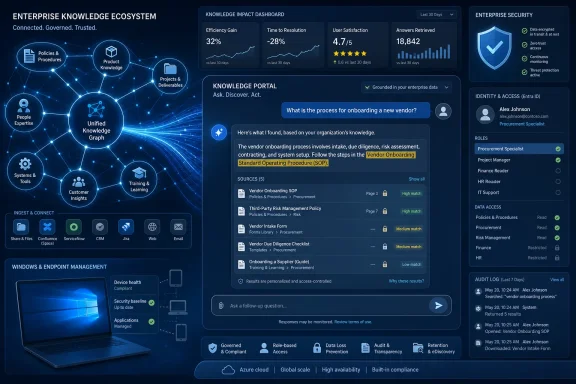 The AI Race Has Moved From Demos to Knowledge Plumbing
The first phase of the generative AI boom was about spectacle. Chatbots wrote poems, generated code snippets, summarized emails, and convinced executives that every product roadmap needed an AI slide. That phase was loud, useful, and often unserious.The Hexaware-Microsoft collaboration belongs to the next phase. Tenjin for Knowledge Services is pitched as a way to build “dynamic, scalable, and high-precision knowledge ecosystems,” which is corporate language for a very old enterprise problem: organizations have too much knowledge, stored in too many places, updated by too few people, and retrieved too late by the workers who need it.
That problem predates AI by decades. It lives in SharePoint sites nobody maintains, PDF libraries nobody trusts, ticketing systems full of tribal fixes, Teams threads that vanish into search purgatory, and customer-service macros that are either obsolete or too generic to help. The value proposition of generative AI in this setting is not that it “knows” the answer. It is that it can mediate between a worker’s natural-language need and a company’s scattered knowledge estate.
This is why Tenjin is more interesting than the average AI branding exercise. It is aimed at knowledge services, not general creativity. It is wrapped around Microsoft Azure OpenAI Service, not a consumer chatbot. And it claims measurable operational gains: a tenfold increase in efficiency, a 30–40 percent rise in customer satisfaction, and an 80 percent reduction in knowledge ecosystem management costs.
Those are vendor-supplied figures, and they deserve the usual skepticism. But the direction of travel is credible. The enterprise AI winners are likely to be the platforms that make internal knowledge more usable while satisfying governance, privacy, auditability, and security requirements. That is a much narrower, harder, and more commercially durable challenge than simply giving every employee a text box.
Microsoft’s Partner Strategy Turns Azure OpenAI Into an Enterprise Distribution Channel
Microsoft’s role here is not incidental. Azure OpenAI Service has become one of the company’s most important enterprise wedges: it lets partners and customers access OpenAI models through Azure’s security, compliance, networking, identity, and billing machinery. That matters because large organizations rarely want to send sensitive knowledge into unmanaged consumer AI services.Hexaware’s Tenjin platform uses Azure OpenAI Service as the foundation for features including an intuitive user interface, custom learning modules, partner ecosystem integration, and dashboards with actionable insights. Those features sound familiar because they map directly to the checklist enterprise buyers now bring to AI procurement meetings. The model is only one component; the rest is plumbing.
For Microsoft, this is the right strategy. The company does not need to build every vertical knowledge product itself. It needs Azure to be the trusted substrate on which system integrators, consultants, and software vendors build those products. In that sense, a collaboration with Hexaware serves Microsoft’s broader ambition: make Azure OpenAI the default enterprise route for generative AI workloads.
That is also why these partner announcements are worth watching even when they are heavy on marketing language. They show where Microsoft’s AI platform is being operationalized. A bank may not buy “AI transformation” in the abstract, but it might buy a knowledge service that helps agents answer customer questions faster while masking sensitive data in real time. A support desk may not need a general-purpose assistant, but it may need a model-backed retrieval layer over incident histories, runbooks, and service documentation.
The distinction is crucial. Consumer AI is judged by how impressive it feels. Enterprise AI is judged by whether it reduces handle time, lowers escalation rates, improves first-contact resolution, avoids compliance violations, and survives procurement.
Tenjin Is Selling Order in the Place Enterprises Are Messiest
The phrase “knowledge ecosystem” can sound inflated, but the underlying problem is brutally concrete. In most large organizations, knowledge is not a library. It is sediment.Each system accumulates partial truths. The official documentation says one thing, the ticket history says another, the senior support engineer knows the workaround, and the customer-facing team has a spreadsheet that contradicts all three. The longer a business operates, the more its knowledge base becomes a maze of dated procedures, duplicated content, undocumented exceptions, and politically sensitive ownership.
Tenjin’s promise is that generative AI can help turn that mess into something more usable. According to Hexaware, the platform is designed to construct scalable, high-precision knowledge environments and improve collaboration and dissemination. In practice, that likely means a combination of ingestion, retrieval, summarization, classification, role-aware access, workflow integration, and analytics.
The important word is precision. Generative AI systems are impressive at producing fluent responses, but enterprise knowledge tools cannot merely be fluent. They have to be correct enough, current enough, and traceable enough to be useful. A hallucinated answer in a public chatbot is embarrassing. A hallucinated answer in a regulated support environment can become a compliance incident.
That is why the most serious enterprise deployments increasingly resemble retrieval systems with generative interfaces, not free-floating model conversations. The AI does not replace the knowledge base; it changes how workers query, synthesize, and act on it. If the underlying content is wrong, stale, or poorly permissioned, the model will amplify those flaws with confidence.
This is where platforms like Tenjin will succeed or fail. The breakthrough is not whether a language model can summarize a policy. It is whether the system can surface the right policy, respect the user’s permissions, preserve sensitive data boundaries, indicate when the source is weak, and route unresolved gaps back into knowledge management. The AI layer is only as good as the operating discipline beneath it.
The Financial Services Example Reveals the Real Buyer
Hexaware cites a global financial services firm that used Tenjin to help protect sensitive customer data during real-time interactions while giving customer service teams access to needed knowledge. That example is doing a lot of work. It tells us the target market is not casual internal experimentation; it is high-volume, regulated, customer-facing operations.Financial services firms have exactly the kind of knowledge problem generative AI vendors love to describe. They operate across products, jurisdictions, compliance regimes, customer segments, escalation paths, and constantly changing policies. Support workers need answers quickly, but those answers often depend on context. The wrong answer can trigger regulatory exposure, customer harm, or reputational damage.
This is why data protection is not an optional feature in this market. If an AI system helps a service representative respond to a customer, it may encounter account information, personally identifiable information, transaction details, complaints, or regulated disclosures. Any useful system must therefore combine knowledge retrieval with data controls.
The announcement’s emphasis on protecting sensitive customer data in real-time interactions is notable. It points to a more mature pattern for enterprise AI: not just “ask the model anything,” but “allow the model to assist within policy boundaries.” That shift matters for CIOs and CISOs who have spent the past two years trying to prevent well-meaning employees from pasting confidential data into public AI tools.
It also suggests that the customer-service use case remains one of the strongest early markets for generative AI. The work is knowledge-intensive, repetitive, measurable, and expensive. It also has obvious performance metrics: handle time, transfer rate, satisfaction, compliance outcomes, training time, and cost per contact. If an AI knowledge layer can move those metrics without creating new risks, the business case becomes easier to defend.
The Claimed Efficiency Gains Are Plausible, but the Fine Print Matters
Hexaware says organizations using Tenjin have reported a tenfold increase in efficiency, a 30–40 percent surge in customer satisfaction, and an 80 percent reduction in knowledge ecosystem management costs. Those numbers are eye-catching, and they should be treated as directional claims rather than universal expectations.A tenfold efficiency gain may be plausible in narrow workflows where employees previously spent minutes searching across multiple systems and now retrieve useful answers in seconds. An 80 percent reduction in knowledge management costs may be plausible where manual content maintenance, tagging, duplication cleanup, and training support were inefficient. A 30–40 percent customer satisfaction improvement may be plausible in operations where poor knowledge access was a major source of friction.
But the baseline matters. If a knowledge process is broken, almost any well-integrated system can produce dramatic gains. If the organization already has mature content governance, strong search, well-maintained documentation, and tightly integrated support workflows, the incremental improvement may be smaller.
There is also the question of how “efficiency” is defined. Does it mean faster article creation? Reduced search time? Fewer support escalations? Lower training effort? More tickets handled per agent? Without the measurement frame, the number is more marketing than evidence.
That does not make the claim meaningless. It means IT leaders should ask better questions. The right procurement conversation is not “How much efficiency will AI give us?” It is “Which workflow is slow today, what is the baseline, what will change operationally, and how will we validate improvement without degrading quality or compliance?”
Azure Gives the AI Story Its Enterprise Armor
Microsoft Azure OpenAI Service is important here because it gives partners a way to talk about generative AI without sounding reckless. Enterprises are not merely buying model access. They are buying a deployment context with familiar controls.That context includes identity integration, networking patterns, monitoring, compliance posture, access control, data governance, and the broader Azure ecosystem. For organizations already standardized on Microsoft technologies, that matters. The closer an AI service sits to existing identity, security, and data platforms, the easier it is to govern.
This is especially relevant for Windows-heavy enterprises. The desktop may still be where users experience productivity, but the policy center has moved to cloud identity, endpoint management, conditional access, collaboration platforms, and data protection tooling. AI services that plug into that environment have a natural advantage over standalone products that require new governance models.
Microsoft has also spent the last few years turning AI into a layer across its portfolio. Copilot branding gets the headlines, but Azure OpenAI is arguably the more flexible enterprise play. It lets partners like Hexaware build domain-specific applications while keeping Microsoft in the infrastructure and platform position.
For customers, that can be attractive. It offers a path between two extremes: building everything from scratch on raw model APIs or accepting a one-size-fits-all assistant. Tenjin appears to sit in the middle, packaging a specific knowledge-services workflow on top of Microsoft’s AI infrastructure.
The System Integrator Is Back at the Center of the Stack
The rise of generative AI has revived an old truth: enterprise technology rarely implements itself. Models may be accessible through APIs, but business value comes from process redesign, data preparation, integration, change management, and governance. That is the territory of system integrators and services firms.Hexaware is positioning itself accordingly. The company describes itself as a global IT services and digital solutions provider, and the Tenjin collaboration places its domain expertise alongside Microsoft’s platform capability. This is the classic partner model, updated for the AI era.
The logic is straightforward. Microsoft supplies the cloud platform and model access. Hexaware supplies the industry workflow, implementation labor, automation experience, and client-specific adaptation. The customer gets a solution that promises to be more concrete than a toolkit and more adaptable than a shrink-wrapped product.
This model will be familiar to anyone who has watched previous enterprise waves: ERP, CRM, cloud migration, robotic process automation, analytics modernization, and now AI. The technology changes, but the services economy remains. Enterprises need someone to map messy reality onto platform capability.
The risk is that “AI transformation” becomes another expensive consulting cycle with uneven results. The opportunity is that generative AI, properly scoped, can solve painful knowledge problems that previous search and automation tools only partially addressed. The difference will come down to implementation discipline, not slideware.
Knowledge Management Is Becoming a Security Boundary
The most underappreciated part of enterprise AI is that knowledge access is a security problem. When a system can synthesize information across repositories, the blast radius of bad permissions expands. A worker who could previously access one obscure document might now receive a polished answer that draws on several poorly governed sources.That makes identity, classification, access control, and auditability central to AI knowledge systems. The model interface may look conversational, but the control plane behind it must be strict. Who can ask what? Which repositories can be searched? How are sensitive fields masked? Are responses logged? Can administrators inspect the sources behind an answer? What happens when the system is uncertain?
These are not bureaucratic objections. They are the difference between safe productivity and accidental data leakage. A generative AI knowledge system in a bank, insurer, healthcare organization, or government contractor cannot be evaluated like a public chatbot.
Tenjin’s financial services example hints at this reality by emphasizing real-time protection of sensitive customer data. That is the right framing. AI systems in customer operations should not simply retrieve knowledge; they should enforce boundaries while doing so.
For WindowsForum’s sysadmin and IT pro audience, this is where the work becomes familiar. AI governance will not live only with data scientists. It will land on the desks of identity admins, endpoint teams, compliance officers, security architects, records managers, and support operations leaders. The model may be new, but the failure modes rhyme with old ones: over-permissioned shares, stale groups, unmanaged content, shadow IT, and poor logging.
The Dashboard Promise Is Really a Management Promise
Hexaware’s announcement mentions customizable dashboards with actionable insights. That may sound like a standard enterprise software flourish, but it points to a critical requirement. AI knowledge systems must be observable.Managers will want to know what employees are asking, where answers are failing, which content is stale, which topics drive escalations, and whether the system is improving over time. Without that feedback loop, a generative AI tool becomes another black box layered on top of a broken knowledge base.
The best version of a platform like Tenjin would not merely answer questions. It would reveal where institutional knowledge is missing. If support agents repeatedly ask about a policy exception, that is a documentation signal. If the AI frequently returns low-confidence answers for a product line, that is a content-quality issue. If customer satisfaction improves in one workflow but not another, that is an operational clue.
This is where generative AI could improve knowledge management beyond search. Traditional knowledge bases often decay because maintenance is manual and disconnected from actual usage. AI-assisted systems can, in theory, turn usage patterns into editorial priorities. They can identify duplicate articles, suggest updates, flag gaps, and help subject-matter experts maintain content more efficiently.
But dashboards can also become theater. A chart showing AI interactions is not the same as proof of value. Enterprises should demand operational metrics tied to outcomes, not just engagement statistics. The question is not whether employees used the tool. The question is whether the tool improved work.
The Windows Enterprise Angle Is Bigger Than the Desktop
At first glance, this story may seem distant from Windows itself. Tenjin is a knowledge services platform, Azure OpenAI is a cloud service, and the announcement is about an IT services collaboration. But the modern Windows enterprise is no longer defined only by the operating system image deployed to laptops.Windows sits inside a larger Microsoft-controlled environment: Entra ID, Microsoft 365, Teams, SharePoint, Intune, Defender, Purview, Azure, Power Platform, and now Copilot and Azure OpenAI-backed applications. The operating system is still important, but the enterprise experience is increasingly mediated through cloud identity, collaboration data, endpoint policy, and AI-enhanced workflows.
That shift changes what Windows administrators need to pay attention to. AI adoption will not always arrive as a Windows feature update. It may arrive as a service desk tool, a Teams-integrated assistant, a knowledge portal, a Power Platform workflow, or a vendor-managed application tied into Azure. The risk and benefit may land in the browser before it lands in the shell.
This is why partner solutions matter. A company may standardize on Windows endpoints while adopting AI through a third-party platform that uses Microsoft’s cloud AI services. The user may never know where the model runs, but the admin still has to govern authentication, data access, browser controls, endpoint security, and compliance.
In that sense, the Hexaware-Microsoft collaboration is part of the same story as Copilot, even if it is not a Copilot product. Microsoft is trying to make AI a default expectation across enterprise work. Partners are turning that expectation into narrower solutions. IT departments are left to decide which ones create value and which ones create another layer of complexity.
The Hype Cycle Is Giving Way to Procurement Questions
The useful thing about announcements like this is that they force the conversation away from abstract AI enthusiasm and toward procurement reality. Enterprises do not need another debate about whether generative AI is transformative. They need to know which workflows justify investment, which vendors can implement safely, and which risks remain unresolved.For a Tenjin-style deployment, the hard questions are practical. Where does the source knowledge live? How is it ingested? How often is it refreshed? What permissions are preserved? How are answers grounded? Can users see source material? How are hallucinations detected? What data is logged? What happens to customer information? How is the system tested before customer-facing use?
Those questions are not anti-AI. They are how AI becomes production software. The faster the market matures, the more buyers will move from demos to controls, from pilots to baselines, and from excitement to accountability.
Hexaware’s stated gains give buyers something to interrogate. If the platform can reduce knowledge management costs by 80 percent, which cost centers are affected? If customer satisfaction rises by 30–40 percent, what was the initial score and what changed in the workflow? If efficiency improves tenfold, which task was measured and how much human review remains?
The companies that answer those questions clearly will earn trust. The ones that hide behind generic AI language will struggle as procurement teams become more sophisticated.
The AI Knowledge Layer Will Reward Boring Excellence
There is an irony in this market. Generative AI is the flashiest technology trend in years, but the deployments most likely to endure will reward boring excellence. Clean permissions. Good documentation. Strong taxonomy. Measured workflows. Sensible escalation paths. Security review. User training. Content ownership. Audit logs.A Tenjin-style system can accelerate knowledge work, but it cannot magically repair organizational neglect. If a company has no owner for policy content, AI will not invent accountability. If teams disagree about the correct answer, AI will not resolve governance. If access controls are broken, AI may make the breakage more visible and more dangerous.
That is not a reason to dismiss the technology. It is a reason to deploy it with adult supervision. The organizations that benefit most will likely be those that treat generative AI as part of knowledge operations, not as a novelty interface.
This also creates a real opportunity for IT professionals. The next wave of AI work will need people who understand both systems and process. Someone has to connect the model to the repository, the repository to permissions, permissions to roles, roles to workflows, workflows to metrics, and metrics back to business outcomes.
In other words, AI does not eliminate the need for enterprise IT judgment. It raises the premium on it.
The Tenjin Deal Shows Where Microsoft’s AI Bet Becomes Real
The Hexaware-Microsoft collaboration is a small piece of a much larger platform shift, but it captures several concrete lessons about where enterprise AI is heading. The winners will not be determined by model cleverness alone. They will be determined by integration, governance, measurable workflow improvement, and trust.- Tenjin for Knowledge Services is aimed at enterprise knowledge management, not general-purpose consumer chatbot use.
- The platform’s use of Microsoft Azure OpenAI Service reflects the enterprise preference for AI services wrapped in familiar cloud security, compliance, and identity controls.
- Hexaware’s reported gains are significant, but buyers should validate them against specific baselines, workflows, and operational metrics.
- Customer-service and financial-services scenarios are likely early proving grounds because they combine high knowledge intensity with measurable business outcomes.
- The biggest risks are not only hallucinations, but also stale content, poor permissions, weak auditability, and unclear ownership of institutional knowledge.
- For Windows and Microsoft-centric IT teams, AI adoption will increasingly arrive through cloud services and partner platforms rather than only through visible desktop features.
References
- Primary source: Technuter
Published: 2026-06-18T07:30:17.705169
Hexaware collaborates with Microsoft to propel innovation with generative AI – Tenjin for Knowledge Services - Technuter
Hexaware announced its collaboration with Microsoft to propel technological advancement for businesses ready to embrace the future, harnessing the power of generative artificial intelligence (AI).technuter.com - Related coverage: hexaware.com
Hexaware Launches Tensai GPT Using Microsoft Azure AI
Hexaware introduces tensai GPT, an AI web app in partnership with Microsoft. Unlock enterprise knowledge to inspire creativity and transform industries with AI.hexaware.com - Related coverage: prnewswire.com
Hexaware collaborates with Microsoft to propel innovation with generative AI - Tenjin for Knowledge Services
/PRNewswire/ -- Hexaware, a global frontrunner in IT services and digital solutions, is excited to announce its collaboration with Microsoft to propel... www.prnewswire.com
- Official source: azure.microsoft.com
- Related coverage: technologymagazine.com
Hexaware & Microsoft to propel innovation with generative AI | Technology Magazine
IT services company Hexaware and Microsoft have announced a partnership aimed at helping enterprises unlock the potential of generative AI technology technologymagazine.com
- Related coverage: ciotechoutlook.com
- Related coverage: timesofindia.indiatimes.com
Hexaware, Microsoft collaborate for generative AI-powered innovation - The Times of India
IT services company Hexaware has partnered with Microsoft to develop AI-based technologies to aid businesses' technological evolution processes. Hexawtimesofindia.indiatimes.com - Related coverage: business-standard.com
- Related coverage: datacentre.solutions
Hexaware collaborates with Microsoft
Hexaware is working with Microsoft to propel technological advancement for businesses ready to embrace the future, harnessing the power of generative artificial intelligence (AI).datacentre.solutions - Related coverage: pwc.com
1487780_MICROSOFT_FINAL_QUILTS_tr_01
Woman surrounded by computer monitors in a dark roomwww.pwc.com
- Related coverage: newsroom.ibm.com
IBM Consulting Collaborates with Microsoft to Help Companies Accelerate Adoption of Generative AI
PDF documentnewsroom.ibm.com
