

Atos’ announcement that the Autonomous Data & AI Engineer is now available on Microsoft Azure marks a concrete step in the move from promise to production for agentic AI in enterprise data operations, pairing Atos’ newly minted Polaris platform with Azure Databricks and Snowflake on Azure to deliver prepackaged, marketplace-ready DataOps automation.
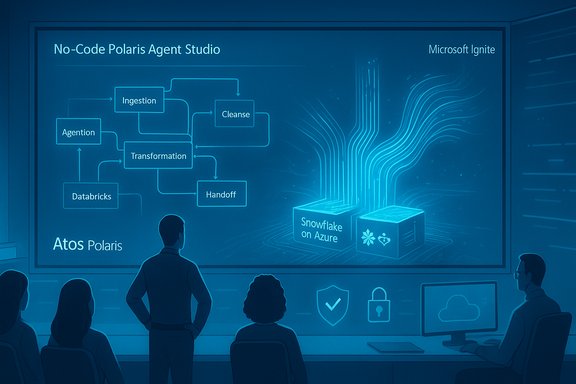
Atos has positioned the Autonomous Data & AI Engineer as a purpose-built, agentic DataOps offering that automates multistep data engineering workflows: ingestion, cleansing, transformation, curation of analytics-ready views, and hand-off to visualization or conversational insight agents. The product is presented as available for both Azure Databricks and Snowflake on Azure and is listed in the Microsoft Marketplace as specialized consulting/solution packages for those platforms. The capability is tightly coupled with the Atos Polaris AI Platform—Atos’ agentic framework launched earlier in 2025—whose stated intent is to deliver an ecosystem for building, orchestrating and operating autonomous AI agents at scale. The Polaris platform includes a no-code Agent Studio for composing multi-agent workflows and claims to support interoperability standards such as the Model Context Protocol (MCP) and Agent-to-Agent (A2A) communication patterns. Atos demonstrated Polaris and the Autonomous Data & AI Engineer at Microsoft Ignite and is using marketplace packaging to accelerate proofs-of-value for Azure-first customers. The go-to-market emphasis is clear: reduce friction to trial, speed pilot-to-scale timelines, and align with Microsoft’s agent governance and identity primitives in Azure.
Microsoft’s platform strategy—introducing agent-centered tooling in Azure (Copilot Studio, Azure AI Foundry, Model Context Protocol adoption and agent governance primitives)—creates a favorable environment for partners like Atos to surface agentic solutions that adhere to Microsoft’s identity and policy controls. For Azure-first organizations investing in Databricks or Snowflake, an off-the-shelf agent stack reduces integration friction and shortens procurement cycles.
For IT leaders, the prudent path is pragmatic optimism: shorten the proof-of-value window using the Marketplace packaging, but insist on concrete governance, measurable SLAs, and repeatable benchmarks. If pilots validate the Atos claims, organizations can realize meaningful reductions in data engineering toil and faster time-to-insight—while also navigating the new operational responsibilities that agentic automation brings.
Source: ePressi https://www.epressi.com/tiedotteet/...-powered-by-the-atos-polaris-ai-platform.html
 Background / Overview
Atos has positioned the Autonomous Data & AI Engineer as a purpose-built, agentic DataOps offering that automates multistep data engineering workflows: ingestion, cleansing, transformation, curation of analytics-ready views, and hand-off to visualization or conversational insight agents. The product is presented as available for both Azure Databricks and Snowflake on Azure and is listed in the Microsoft Marketplace as specialized consulting/solution packages for those platforms. The capability is tightly coupled with the Atos Polaris AI Platform—Atos’ agentic framework launched earlier in 2025—whose stated intent is to deliver an ecosystem for building, orchestrating and operating autonomous AI agents at scale. The Polaris platform includes a no-code Agent Studio for composing multi-agent workflows and claims to support interoperability standards such as the Model Context Protocol (MCP) and Agent-to-Agent (A2A) communication patterns. Atos demonstrated Polaris and the Autonomous Data & AI Engineer at Microsoft Ignite and is using marketplace packaging to accelerate proofs-of-value for Azure-first customers. The go-to-market emphasis is clear: reduce friction to trial, speed pilot-to-scale timelines, and align with Microsoft’s agent governance and identity primitives in Azure. What the Autonomous Data & AI Engineer Does
Core capabilities (vendor-stated)
- Autonomous ingestion of both structured and unstructured sources into Azure Databricks or Snowflake on Azure, with prebuilt connectors to common enterprise sources.
- Automated data quality checks and transformations that produce curated, analytics-ready views suitable for BI and model training.
- Orchestration via Atos Polaris Agent Studio, a no-code surface that enables both technical and business users to compose, configure and coordinate multi-agent flows.
- Integration with LLMs and external tooling using open agent protocols (Atos cites MCP and A2A patterns).
- Handoff and composition with downstream AI or visualization agents to expose derived insights to business users.
Claimed outcomes and performance numbers
Atos’ materials advertise measurable business benefits: up to 60% reduction in development and deployment time for data operations and up to 35% reduction in operational costs via DataOps agents that speed ticket handling and routine fixes. These percentages are provided as vendor claims and are highlighted across Atos’ press materials and the Marketplace product pages. Treat these figures as vendor-reported until validated in a customer context.Why This Matters Now: Market Context
The data engineering bottleneck remains a primary barrier to faster analytics, ML model development, and enterprise AI. Human-intensive ETL/ELT, schema wrangling, and validation work routinely derail model timelines. The industry’s next wave of productivity gains is expected to come from automation that is both goal-directed and auditable—precisely the problems agentic DataOps claims to address.Microsoft’s platform strategy—introducing agent-centered tooling in Azure (Copilot Studio, Azure AI Foundry, Model Context Protocol adoption and agent governance primitives)—creates a favorable environment for partners like Atos to surface agentic solutions that adhere to Microsoft’s identity and policy controls. For Azure-first organizations investing in Databricks or Snowflake, an off-the-shelf agent stack reduces integration friction and shortens procurement cycles.
Technical Integration & Interoperability
Platform fit: Databricks and Snowflake on Azure
Atos has published separate marketplace listings and product pages that explicitly target both Databricks and Snowflake, indicating prebuilt connectors and reference integrations with Azure Data Factory, Power BI, and Azure AI services. That packaging implies Atos is selling engineered, repeatable solution templates rather than only bespoke consulting engagements. The marketplace presence also supports faster procurement for POCs and proofs-of-value.Standards and agent protocols
Vendor messaging explicitly references the Model Context Protocol (MCP) for tool and data grounding and Agent-to-Agent (A2A) patterns for multi-agent cooperation. Those protocols are increasingly accepted in the Azure agent ecosystem, where Copilot Studio and Azure AI Foundry provide tool onboarding and runtime tooling compatible with MCP-like behaviors. Integration with these standards matters because it affects portability, governance, and future-proofing—agents built to standards are easier to audit, extend and recompose.Governance and Responsible AI
Atos states the solution adheres to Microsoft Responsible AI principles and will run under Azure governance primitives—identity via Entra ID, policy enforcement via Azure Policy and Purview, and audit/observability via Azure logging and SIEM integrations. Practically, that means the product must be configured with agent identities, RBAC-limited privileges, immutable action logs and human-in-loop approval gates before it can safely operate on production data. The presence of these primitives in Azure makes the design feasible; buyers must insist on concrete proof that the Atos implementation wires these controls into agent runtime, not just in high-level marketing language.Strengths — What Atos Brings to Enterprise DataOps
- Productized, Azure-native packaging: Marketplace listings for Databricks and Snowflake lower procurement friction and accelerate PoC deployment for Azure customers.
- End-to-end automation narrative: Atos combines ingestion, transformation, curation and downstream agent hand-off in a single stack, reducing integration complexity for teams that want to operationalize RAG, dashboards and model training pipelines.
- No-code orchestration surface: Polaris Agent Studio enables business and data teams to compose multi-agent flows without deep engineering, which is key to scaling agent adoption across domains.
- Standards orientation: Explicit mention of MCP and A2A increases the chance that agent workflows will be portable, auditable and interoperable with Microsoft’s agent ecosystem.
- Partner alignment and co-marketing: Atos’ long-standing Microsoft partnership and presence at Microsoft Ignite indicate close platform alignment—critical for enterprise buyers who prefer validated partner stacks.
Risks, Caveats & Operational Realities
1. Vendor-reported ROI needs proof
The advertised 30–60% developer-time reduction and 35% operational cost savings are plausible in repeated, well-scoped automation tasks, but they are vendor claims that require pilot validation. Buyers must instrument POCs to measure: time-to-ingest, time-to-curate, downstream model accuracy, and incident frequency post-automation. Until validated, treat headline percentages as target outcomes, not guarantees.2. Silent data-change risk
Automated transformations that run without strong schema checks, test harnesses, and rollback mechanisms can silently degrade downstream analytics or ML models. Agents must produce machine-readable action plans, dry-run outputs, and explainable change logs before any production writes occur. Integrate unit tests for transformation logic and consider shadow or propose-only modes during early deployments.3. Agent identity, least privilege and lifecycle management
Treat agents as first-class principals in identity systems. Enforce least privilege, rotate agent credentials, and include agents in access reviews. Agent-to-agent communications should be authenticated and scoped; otherwise, an errant or compromised agent can propagate unsafe actions across pipelines. Azure Entra and policy primitives provide the tools; the implementation must prove it uses them.4. Observability and audit trails
Full auditability is non-negotiable. Enterprises should require immutable provenance for data changes, tool-level logs that map to agent decision steps, and SIEM/SOAR integration for incident analysis. Ensure logs capture agent prompts, intermediate tool outputs, and the exact transformations applied to data. Without these artifacts, regulators and internal auditors will flag automated pipelines.5. Cost modeling and hidden platform charges
Agent runtime, Azure Agent Units (where applicable), LLM usage, Databricks compute, Snowflake credits and data egress are all levers that can compound costs. Buyers need a detailed consumption model for agent execution, model inference, and long-running orchestration. Contractual SLAs for execution throughput and support must be negotiated to avoid surprise bills. The marketplace packaging helps with procurement but doesn’t replace careful capacity and cost modeling.6. Regulatory and data residency constraints
For regulated industries, automated ingestion and transformation must obey data residency, retention and privacy laws. Enterprises must map agent data flows to Purview classifications and enforce policy-based gating for PII or regulated data types. If agents move or transform sensitive data, legal and compliance teams must sign off on guardrails and rollback procedures.Practical Evaluation Checklist for IT Leaders
- Define a narrow, high-value pilot (e.g., a single ingestion source feeding a finance or product analytics use case).
- Specify objective baseline metrics (ingest latency, time-to-clean, ticket-handling time, downstream model drift) so ROI claims can be verified.
- Require machine-readable action plans, dry-run capabilities and proposal-only modes for early tests.
- Verify agent identity, RBAC assignment, and lifecycle controls before enabling any write access to production datasets.
- Insist on immutable, correlated audit trails: agent prompts → tool calls → data diffs → final artifacts.
- Model the full cost stack: Databricks/Snowflake compute, Azure AI inference, any consumption-based agent runtime fees, and long-term storage/egress.
- Negotiate SLA and incident-response clauses that cover erroneous agent-driven changes and provide for third-party auditability.
Step-by-Step Pilot Plan (recommended)
- Scoping (Week 0–2)
- Select one dataset and one analytics consumer.
- Define success metrics and rollback thresholds.
- Sandbox Deployment (Week 2–4)
- Deploy Atos Autonomous Data & AI Engineer in a sandbox Azure tenancy.
- Connect sample ingestion sources and enable proposal-only mode.
- Validation & Testing (Week 4–8)
- Run dry-runs, unit tests, and schema checks.
- Measure quality metrics and compare to baseline.
- Shadow Mode & Human-in-Loop (Week 8–12)
- Let agents propose but require manual approval for writes.
- Collect false-positive/false-negative rates and decision rationales.
- Limited Production (Months 3–6)
- Enable low-risk idempotent automations under approval gates.
- Monitor telemetry, cost, and compliance metrics.
- Scale & Iterate (Months 6+)
- Expand to more sources and automated tasks as confidence and governance matures.
How This Compares to Alternatives
Several integrators and platform vendors are racing to productize agentic DataOps and agent orchestration. The differentiators that will matter in procurement are:- Governance-first runtime — does the product make audits, approvals, and identity controls easy?
- Portability & Standards — does it adopt MCP/A2A to avoid brittle point integrations?
- Measurable, reproducible outcomes — can the vendor provide reproducible benchmark runs on representative datasets?
- Operational support & SLA — does the vendor accept responsibility if an agent’s action causes production impact?
Developer & Architect Notes: Implementation Considerations
- Ensure transformation pipelines are covered by automated tests that run as part of every agent proposal.
- Capture and store model prompts, agent plan graphs, and tool outputs as immutable artifacts for future audit and retraining needs.
- Design fail-safe behaviors: default to human approval on high-impact transforms; implement rate limits and circuit-breakers for agent actions.
- Use Azure Policy to automatically block agent attempts to touch restricted resources and configure Purview classifications as gating inputs to agent decisions.
- Integrate with existing CI/CD and data catalog pipelines so agent changes are visible to engineering teams and registered in change control logs.
Final Assessment: Who Should Evaluate Atos’ Offering?
- Enterprise teams that are Azure-first and rely on Databricks or Snowflake should evaluate the Autonomous Data & AI Engineer for fast pilots because of the marketplace availability and Atos’ prebuilt connectors.
- Organizations that need to accelerate time-to-insight for recurring, repeatable ingestion patterns stand to gain the most in early pilots.
- Regulated sectors (finance, healthcare, public sector) should proceed with caution: require shadow-mode validation, human-in-loop gating, and contractual commitments for auditability and incident remediation.
Conclusion
Atos’ release of the Autonomous Data & AI Engineer—powered by Atos Polaris and packaged for Azure Databricks and Snowflake—represents a meaningful move toward making agentic DataOps tangible for enterprise customers. The offering’s strengths are clear: marketplace-ready packaging, a no-code orchestration surface, and alignment with Microsoft’s agent ecosystem. However, the headline efficiency claims remain vendor-reported and require rigorous pilot-based verification, coupled with robust governance, observability and identity controls before wide deployment.For IT leaders, the prudent path is pragmatic optimism: shorten the proof-of-value window using the Marketplace packaging, but insist on concrete governance, measurable SLAs, and repeatable benchmarks. If pilots validate the Atos claims, organizations can realize meaningful reductions in data engineering toil and faster time-to-insight—while also navigating the new operational responsibilities that agentic automation brings.
Source: ePressi https://www.epressi.com/tiedotteet/...-powered-by-the-atos-polaris-ai-platform.html
