Atos Group and Microsoft announced on June 9, 2026, that Atos will deploy Microsoft 365 Copilot to 56,000 employees in 54 countries while expanding its use of Microsoft 365 E7, Agent 365, Copilot Studio, and Microsoft Foundry for enterprise AI services. This is not another pilot dressed up as transformation theater. It is Microsoft’s clearest enterprise proof point yet for a new thesis: agentic AI only becomes a serious business platform when identity, security, compliance, and software distribution are sold as one stack. For Atos, the move is equally strategic, because a global services firm cannot credibly sell governed AI at scale unless it first proves it can survive the blast radius inside its own estate.

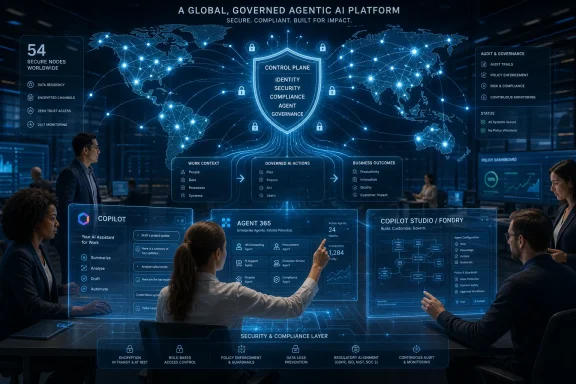
Promotional tech graphic showing “Global Reach” agentic AI with Microsoft 365 Copilot, security, and analytics dashboards.Microsoft Turns Copilot From a Seat License Into an Operating Model​

The headline number is simple enough: 56,000 Atos employees will get Microsoft 365 Copilot across Outlook, Teams, Word, Excel, PowerPoint, and SharePoint. That is the sort of deployment Microsoft has wanted to showcase since Copilot moved from executive demo to line-item budget request. It puts the assistant not just in the hands of consultants and engineers, but across a professional-services workforce that is itself expected to advise clients on the same technology.
But the more important detail is not Copilot. It is Microsoft 365 E7, the new premium enterprise bundle Microsoft introduced this year as its so-called Frontier Suite. E7 combines Microsoft 365 E5, Microsoft 365 Copilot, and Agent 365 into a single package, wrapping productivity AI together with security, compliance, identity, and agent governance.
That bundling matters because the enterprise AI fight is shifting. The first wave was about who had the best chatbot. The second was about whose chatbot could read the most documents without causing a privacy incident. The third is about whether software agents can act across a company without turning every tenant into a sprawling, ungoverned automation experiment.
Atos is buying into that third wave. It is not merely handing employees a prompt box and hoping productivity emerges. It is standardizing on Microsoft’s control plane for the agents, identities, devices, permissions, content stores, and compliance boundaries that make those prompts safe enough to use in regulated work.

The Real Product Is the Control Plane​

Microsoft’s language around Agent 365 is telling. It describes the product less as an application than as a control plane for observing, governing, and securing AI agents across the enterprise. That framing borrows from cloud infrastructure, where the control plane is the part of the system that tells everything else what is allowed to happen.
That is exactly where agentic AI creates a management problem. A conventional chatbot answers a question. An agent can carry out a task, retrieve information, invoke tools, use credentials, write to systems, and hand work to other agents. The moment software starts acting on behalf of users or operating with its own identity, IT departments need something more durable than trust, screenshots, and vendor promises.
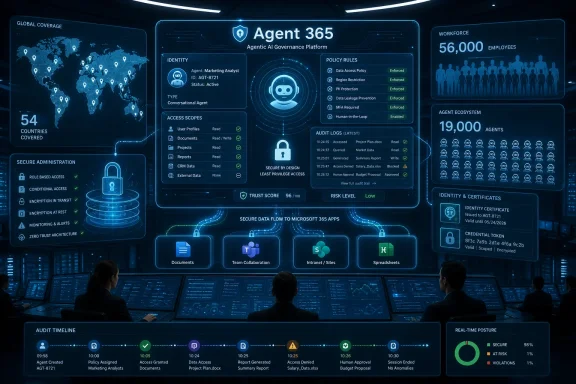
Atos says it will use Agent 365 to govern a fast-growing population of 19,000 AI agents. That number is the quiet shock in the announcement. The company is not talking about a few sanctioned productivity assistants; it is describing an emerging machine workforce large enough to require its own administrative discipline.
The governance challenge is also more complicated than licensing. Some agents act for users. Some run under their own credentials. Some come from vendors or clients. Some may be built in Copilot Studio, others in Microsoft Foundry, and still others may sit outside the neat boundaries of Microsoft 365. A serious control layer has to inventory them, evaluate their permissions, enforce policy, monitor behavior, and give security teams a way to respond when something misfires.
That is why Microsoft’s preferred AI sales motion now looks less like “buy Copilot” and more like “standardize your AI estate around the Microsoft identity and security model.” It is a familiar playbook. The company won the enterprise desktop by making Windows and Office the default environment for work. It won a large slice of enterprise cloud by connecting Azure, Entra, Defender, Purview, and Intune into a management story. Now it is trying to make agentic AI feel like the next logical layer in that same administrative universe.

Atos Becomes Client Zero Because It Has to Be​

Atos calls itself “Client Zero” in this rollout, and the phrase is doing real work. The company is both customer and reseller, internal adopter and external adviser. If it can prove that agentic AI can be deployed across its own workforce, it gets a sales story for clients in defense, finance, healthcare, public administration, and other markets where “move fast and break things” reads less like inspiration than negligence.
That is also why the announcement leans heavily on security and sovereignty. Atos is a European-headquartered services firm with customers who care about where data flows, who controls infrastructure, and which legal regimes apply. For those buyers, agentic AI is not simply a productivity feature. It is a new class of operational dependency.
Atos has spent the last several years navigating a painful corporate reset, including restructuring, a narrower go-forward perimeter, and a clearer division between services under the Atos brand and products and systems under Eviden. The company’s latest public materials describe a business still significant in scale but operating under sharper financial and strategic constraints than in its older, more sprawling form. A workforce-wide AI deployment therefore serves two purposes: it modernizes internal delivery, and it signals to the market that Atos wants to be seen as a practitioner of governed AI rather than a legacy outsourcer attaching “AI” to a slide deck.
That signal is useful, but it is not proof by itself. The hard part is not announcing that every employee has Copilot. The hard part is changing how delivery teams estimate work, how consultants draft client artifacts, how engineers troubleshoot systems, how sales teams assemble proposals, and how regulated clients audit the work product. Productivity gains in enterprise software are often declared centrally and discovered unevenly at the edge.

The E7 Bet Is a Bet on Fewer Procurement Arguments​

Microsoft 365 E7 is a packaging move, but packaging is never trivial in enterprise software. By bundling E5, Copilot, and Agent 365, Microsoft is reducing the number of separate conversations a CIO has to have about security, compliance, AI, and governance. It is also raising the ceiling on what Microsoft can charge for the workplace stack.
The pitch is obvious. If a company already depends on Microsoft 365, already uses Entra for identity, already has Defender in the security stack, already manages devices through Intune, and already relies on Purview for compliance and data governance, then E7 presents AI as an extension of existing architecture rather than a separate platform bet. Microsoft is not asking customers to trust a new universe. It is asking them to deepen the one they are already in.
That is powerful for administrators. Fragmented AI adoption is exhausting. One team wants a meeting assistant. Another builds a workflow bot. A third connects a model to a customer database. A vendor ships embedded AI into a SaaS tool. Suddenly, the security team has to answer basic questions that should not be hard: which agents exist, what can they access, which data can they read, who approved them, and how do we shut them down?
Microsoft’s answer is to make agent governance look like familiar tenant governance. That does not solve every problem, but it changes the shape of the problem. Instead of treating AI as a thousand exceptions, the organization can treat it as another class of workload inside its identity, endpoint, information protection, and audit model.
The risk, of course, is lock-in. The more an enterprise relies on Microsoft as the broker for work context, agent identity, compliance policy, and productivity tooling, the harder it becomes to move critical AI workflows elsewhere. CIOs may accept that tradeoff, especially if the alternative is ungoverned sprawl. But they should understand that E7 is not merely a bundle; it is a strategy for making Microsoft the administrative substrate of enterprise AI.

Work IQ Makes the Graph More Valuable and More Dangerous​

Work IQ is Microsoft’s name for the workplace intelligence layer that gives agents context about people, files, meetings, emails, organizational relationships, and work patterns. In plain English, it is the difference between a generic model that can write plausible business prose and an enterprise assistant that knows enough about your business to be useful.
That context is the point. A Copilot that cannot see the right documents, meetings, and relationships is a polished autocomplete engine. A Copilot that can reason across the Microsoft 365 environment becomes something closer to a work broker. It can summarize a project, infer stakeholders, prepare a meeting, draft a response, and potentially trigger downstream work.
For WindowsForum readers who live in admin centers and PowerShell sessions, this is where the excitement and anxiety meet. Context makes AI useful, but context also creates exposure. The better the model understands the enterprise, the more important it becomes to ensure that permissions, sensitivity labels, retention policies, and access reviews are correct before AI starts amplifying old mistakes.
Many organizations still carry years of SharePoint drift, Teams sprawl, over-permissive groups, stale accounts, and poorly classified documents. Copilot does not invent those weaknesses, but it can make them newly visible. An employee who previously would never find a confidential file may now be able to surface a summary if the permissions model says they are allowed to see it.
That is why Microsoft and Atos are presenting governance as foundational rather than decorative. The old approach to collaboration cleanup was easy to postpone because the harm was often hidden. Agentic AI changes the urgency. If software can act across your work graph, the work graph has to be treated as critical infrastructure.

Sovereignty Becomes the Enterprise AI Sales Language​

Atos’ mention of Sovereign Agentic AI studios is not an accidental flourish. European customers, public-sector buyers, and regulated industries increasingly want AI capabilities that preserve control over data, decision-making, residency, and accountability. “Sovereign” has become one of the most important words in the European cloud and AI market because it condenses legal, political, and operational concerns into a single procurement demand.
Microsoft has spent years trying to make its cloud acceptable to those customers through data boundary commitments, regional cloud investments, compliance certifications, and partnerships. Atos brings services credibility in precisely the sectors where sovereign technology narratives resonate. Together, they are trying to make agentic AI sound less like Silicon Valley experimentation and more like governed industrial infrastructure.
The phrase “agentic AI for mission-critical environments” also deserves scrutiny. Mission-critical environments are not impressed by a model that performs well in a demo but fails unpredictably under operational pressure. They require observability, rollback, human escalation, separation of duties, audit trails, and well-defined responsibility when something goes wrong.
That last point remains unresolved across the industry. If an agent drafts a bad contract clause, exposes sensitive information, approves an incorrect workflow, or takes action based on a hallucinated premise, responsibility will not rest neatly with the software. It will move through the vendor, integrator, customer, administrator, data owner, and end user. That liability chain is precisely why large systems integrators see opportunity. The world will need not just AI tools, but operating models, controls, and blame maps.

Copilot at Every Desk Does Not Automatically Redesign Work​

Microsoft’s Jared Spataro framed the Atos rollout as part of a new era in which ambitious companies redesign work from the ground up around AI. That is the right aspiration, but it is also where enterprise software rhetoric tends to outrun reality. Giving everyone an AI assistant is not the same as redesigning work.
A real redesign changes incentives, workflows, governance, training, measurement, and management expectations. It determines which tasks should be automated, which should remain human-led, and which should be restructured because AI has altered the cost of coordination. It also decides what counts as quality in a world where first drafts, meeting notes, research briefs, and slide outlines can be generated instantly.
Professional services firms are unusually exposed to this question because much of their work product is knowledge packaging. Consultants write proposals, summarize workshops, produce architecture documents, generate status reports, prepare executive briefings, and translate technical work into client-facing narratives. These are exactly the tasks Copilot is designed to accelerate.
But acceleration creates its own management burden. If every employee can produce more drafts, the bottleneck may move to review. If every consultant can generate a polished artifact, the differentiator becomes judgment, originality, and domain expertise. If agents can complete routine delivery tasks, firms must decide whether the savings flow to clients, margins, or expanded scope.
The productivity story therefore cuts both ways. Atos may become more efficient, but its clients will eventually ask why AI-assisted work should be billed like pre-AI work. That pressure is coming for the entire consulting and systems integration sector. The firms that embrace AI earliest may gain delivery leverage, but they also train customers to expect faster, cheaper, and more transparent execution.

Windows Administrators Will Meet Agents Through Policy Before Magic​

For many Windows and Microsoft 365 administrators, agentic AI will not arrive as a philosophical debate. It will arrive as a policy assignment, a licensing change, a compliance review, a user complaint, and a security exception request. The Atos rollout is interesting because it previews the operational shape of that future.
Admins will need to know which users have Copilot, which agents exist, which connectors are enabled, which data sources are available, and how agent actions are logged. They will need to coordinate with legal teams on retention and eDiscovery, with security teams on detection and response, and with business units on acceptable use. The work will be less glamorous than Microsoft’s product videos, but it will determine whether the deployment is trusted.
The introduction of agents with their own credentials is especially significant. Traditional user-centric security models assume that a person’s identity is the primary unit of access. Service accounts complicated that model, and agents will complicate it further. If an agent can act persistently, independently, or across systems, it needs lifecycle management as strict as any privileged identity.
That means joiner-mover-leaver processes for agents, not just humans. It means access reviews that include non-human actors. It means conditional access policies, monitoring, and least-privilege assumptions that account for software workers. The industry is only beginning to normalize this discipline, and large deployments like Atos will surface the rough edges.
Microsoft’s advantage is that many of these controls already exist in adjacent form. Entra knows identities. Defender watches threats. Purview handles information governance. Intune manages devices and endpoints. Agent 365’s promise is to extend those muscles to agents before the unmanaged population becomes too large to control.

The Competitive Message Is Aimed at Integrators as Much as Customers​

This announcement is also a partner-market maneuver. Microsoft needs global systems integrators to convert AI enthusiasm into billable transformation. Customers may buy Copilot licenses directly, but complex deployments require assessment, data governance, workflow redesign, security architecture, user training, and industry-specific integration. That is integrator territory.
Atos, for its part, needs to show that it belongs in the top tier of AI transformation partners. The company is not alone. Accenture, Capgemini, Kyndryl, IBM, Deloitte, and others are all racing to turn generative and agentic AI into repeatable service lines. The difference between a press release and a durable practice will be whether these firms can industrialize delivery instead of staffing bespoke experiments.
Microsoft’s partner strategy appears to be converging around repeatability. Copilot Studio gives organizations a way to build agents. Microsoft Foundry provides a broader platform for AI development and operations. Agent 365 supplies governance. E7 wraps the commercial and security story. A services partner can then package assessment, migration, development, and managed operations around those pieces.
That is a cleaner story than the fragmented AI market of 2023 and 2024, when enterprises often had to stitch together foundation models, vector databases, orchestration frameworks, cloud services, security tooling, and custom governance. The simplification is attractive, particularly for customers that already standardize on Microsoft. It may also reduce room for independent AI infrastructure vendors unless they can prove better performance, lower cost, or stronger portability.

The Numbers Are Large Enough to Matter, but Not Enough to Settle the Debate​

A 56,000-person deployment is substantial. So is a 19,000-agent governance target. Those figures give Microsoft and Atos a credible scale story, especially because Atos operates across dozens of countries and regulated sectors. But the numbers do not automatically answer the questions enterprise buyers care about most.
How many employees will use Copilot daily after the launch excitement fades? Which roles will see measurable productivity gains? How much rework will AI-generated content require? Will agents reduce operational risk or introduce new forms of silent failure? How will Atos measure quality, customer satisfaction, security incidents, and margin impact over time?
These are not cynical questions. They are the questions that determine whether agentic AI becomes enterprise infrastructure or another expensive layer of software underutilization. Microsoft has learned from previous enterprise adoption waves that seat deployment and business value are not the same thing. The company can count licenses quickly; customers feel outcomes slowly.
Atos’ position as a services firm makes the measurement problem both easier and harder. Easier, because professional-services workflows produce artifacts, tickets, proposals, documentation, and project metrics that can be compared over time. Harder, because knowledge work is messy, client-specific, and vulnerable to false precision. A faster slide deck is not always a better recommendation.
The most useful signal will not be whether Atos employees can summarize meetings or draft emails. It will be whether the company can shorten delivery cycles, improve consistency, reduce support burden, and create new services clients will pay for. That evidence will take quarters, not launch-day quotes.

The Atos Deal Shows Where Microsoft Wants the AI Stack to Harden​

The Atos-Microsoft expansion is a useful marker because it shows the enterprise AI stack hardening around four layers: the assistant employees touch, the agent tools developers use, the organizational context that grounds the work, and the governance plane that keeps the whole system inside policy. Microsoft wants to own or orchestrate all four.
That ambition will be welcomed by some IT leaders and resisted by others. The case for Microsoft is operational coherence. One vendor, one identity layer, one admin model, one security ecosystem, one set of compliance hooks. The case against Microsoft is concentration. One vendor, one roadmap, one pricing strategy, one set of architectural assumptions.
Both arguments are valid. In heavily regulated enterprises, consolidation can be a security advantage. In innovation-heavy environments, it can become a constraint. The right answer will depend less on abstract platform purity than on whether Microsoft can make its agent governance genuinely interoperable and whether customers can avoid building workflows so tightly coupled to one vendor that future bargaining power disappears.
For now, Atos has made its choice. It is betting that the fastest path to production agentic AI runs through Microsoft’s existing enterprise estate, not around it. That bet is rational, especially for a company that must reassure clients about security and sovereignty while also moving quickly enough to remain competitive.

The Practical Lesson Is That AI Readiness Starts Before the AI Rollout​

The most concrete lesson from the Atos announcement is that enterprise AI readiness is not primarily a model-selection exercise. It is a governance, identity, data, and operating-model exercise. Copilot may be the visible product, but the deployment depends on the plumbing most users never see.
That should sound familiar to anyone who has managed Microsoft 365 at scale. The organizations that will benefit most from agentic AI are likely to be the ones that already know where their data is, have cleaned up permissions, understand their compliance obligations, and can enforce policy consistently. The organizations that have treated collaboration platforms as digital junk drawers may find that AI makes old disorder newly expensive.
There is also a cultural readiness test. Employees need to understand when AI is a drafting partner, when it is an automation engine, and when it is not appropriate at all. Managers need to avoid measuring adoption by prompt volume alone. Security teams need to distinguish normal agent behavior from suspicious activity. Legal teams need to decide how AI-generated work should be retained, reviewed, and disclosed.
This is the unglamorous center of the story. The next phase of AI work will be less about surprise and more about administration. That may disappoint people who want every AI announcement to feel revolutionary, but it is exactly what makes the technology enterprise-relevant.

Atos Hands Microsoft the Case Study It Needed​

Atos’ deployment gives Microsoft a case study with unusually convenient ingredients: a large global workforce, regulated-industry exposure, European sovereignty concerns, a systems integrator’s client-facing business model, and a declared move from pilot to production. It is the kind of customer story that can be reused in boardrooms where AI ambition is high but tolerance for risk is limited.
The announcement also lets Microsoft position E7 as more than an upsell. By tying Copilot, Agent 365, Entra, Defender, Intune, and Purview together, Microsoft is arguing that secure agentic AI is not a feature you bolt on after procurement. It is an architecture you choose at the beginning.
Atos benefits because it can now point to its own estate when advising customers. That does not guarantee success, but it gives the company a stronger claim than firms selling AI transformation from the outside. If Atos can show measurable internal gains and disciplined governance, it will have a more credible story in the crowded AI services market.
The danger for both companies is that expectations are now explicit. A workforce-wide deployment invites workforce-wide judgment. If employees find Copilot useful but agents cumbersome, if governance slows development too much, if clients remain hesitant, or if savings are hard to prove, the deployment could become a cautionary tale about ambition exceeding readiness. At this scale, success and friction will both be visible.
The Copilot Era Gets Its Enterprise Stress Test​

The Atos rollout reduces a sprawling announcement to a few practical facts that matter for WindowsForum readers, Microsoft 365 administrators, and enterprise technology buyers.
  • Atos is deploying Microsoft 365 Copilot to 56,000 employees across 54 countries, making this a full-company production rollout rather than a limited departmental pilot.
  • Microsoft 365 E7 is the strategic center of the deal because it bundles Copilot, E5-class security and compliance, and Agent 365 governance into one enterprise platform.
  • Atos plans to govern a population of 19,000 AI agents, which shows how quickly non-human digital workers can become an administrative category of their own.
  • The deployment depends on Microsoft’s broader security and management stack, including Entra, Defender, Intune, and Purview, not just the Copilot user experience.
  • Atos is using its internal transformation as a client-facing proof point for regulated industries that want agentic AI without surrendering governance, auditability, or sovereignty.
  • The real test will be measured in adoption, workflow redesign, risk reduction, and client delivery outcomes, not in the number of Copilot seats assigned on launch day.
Atos and Microsoft are not merely expanding a partnership; they are sketching the enterprise AI bargain of the next several years. Companies will get more capable assistants, more autonomous agents, and more deeply contextual software, but only if they accept that AI belongs inside the same hard machinery of identity, security, compliance, and administrative control that governs the rest of enterprise IT. The organizations that understand that bargain early will shape agentic AI into infrastructure; the ones that treat it as another app rollout will spend the next few years discovering that agents, unlike chatbots, do not stay politely inside the box.

References​

  1. Primary source: Microsoft Source
    Published: Tue, 09 Jun 2026 12:05:11 GMT
  2. Related coverage: windowscentral.com
  3. Related coverage: tomsguide.com
  4. Related coverage: atosgroup.com
  5. Official source: devblogs.microsoft.com
  6. Official source: blogs.microsoft.com
  1. Official source: learn.microsoft.com
  2. Official source: microsoft.com
  3. Related coverage: windowsforum.com
  4. Related coverage: techradar.com
  5. Related coverage: itpro.com
  6. Related coverage: atos.net
 

Atos Group and Microsoft announced on June 9, 2026, in Redmond and Paris that Atos will deploy Microsoft 365 Copilot to roughly 56,000 employees across 54 countries while expanding a broader partnership around secure agentic AI for clients. The deal is not merely another “Copilot rollout” press release dressed in enterprise language. It is Microsoft’s new AI operating model being tested inside a global systems integrator that sells exactly this kind of transformation to other companies. If it works, Atos becomes a proof point; if it stumbles, it becomes a warning label for the agentic enterprise.

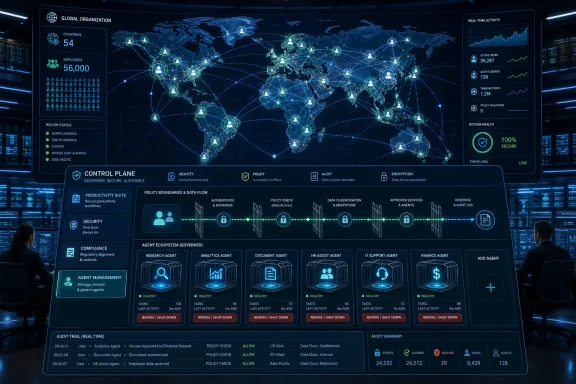
Team views a global AI governance control-plane dashboard with secure agent analytics over a world map.Microsoft’s AI Pitch Has Moved From Seat Licenses to Operating Models​

For most of the Copilot era, Microsoft’s enterprise AI story has been easy to understand and hard to justify. Buy a license, wire it into Microsoft 365, and hope employees save enough time in Outlook, Teams, Word, Excel, PowerPoint, and SharePoint to offset the cost. That was the assistant phase: AI as a productivity layer riding on top of work.
The Atos announcement belongs to a different phase. Microsoft is now pushing agentic AI as an organizational architecture, not simply as a feature set. The key phrase in the release is not “56,000 employees,” impressive as that number is. It is the claim that Atos is unifying identity, security, compliance, and agent governance into a single enterprise control plane.
That is the bet behind Microsoft 365 E7, also branded as the Frontier Suite. Microsoft 365 E7 bundles Microsoft 365 E5, Microsoft 365 Copilot, Agent 365, Entra Suite, and advanced Defender, Intune, and Purview capabilities into one package aimed at organizations that want AI agents to act across business data without creating an unmanageable security problem. The bundle became generally available on May 1, 2026, which makes Atos one of the first large, France-headquartered enterprises to turn the strategy into a global deployment.
This matters because Microsoft is trying to define the next procurement category before customers define it for themselves. The company does not want Copilot judged only as a smarter autocomplete tool or meeting summarizer. It wants Copilot, Agent 365, Work IQ, and the surrounding security stack judged as the enterprise substrate for human-led, agent-operated work.

Atos Is Buying the Same Future It Wants to Sell​

Atos is not a normal customer in this story. It is a global systems integrator, a Microsoft partner, and a company that intends to help clients implement the same class of technology it is adopting internally. That makes the deployment both an IT modernization project and a go-to-market asset.
The company says it will roll out Microsoft 365 Copilot to all employees across Atos and Eviden, covering consultants, engineers, business functions, and frontline workers. It also says it will use Copilot Studio and Microsoft Foundry to build and operate agents for internal IT, business functions, and client work. In plain English, Atos wants its own workforce to become the reference implementation.
That “Client Zero” positioning is familiar in enterprise tech, but it carries unusual weight here. Agentic AI is not just another cloud migration or endpoint management program. It changes who, or what, is allowed to initiate actions, retrieve data, summarize sensitive material, create drafts, trigger workflows, and potentially make operational recommendations.
For Atos, the internal deployment gives sales teams a story that goes beyond slideware. The firm can tell regulated clients that it has already had to wrestle with identity boundaries, agent sprawl, data governance, employee adoption, and compliance inside its own multinational environment. That does not guarantee success, but it is more persuasive than a lab demo.
The symmetry is also commercially useful for Microsoft. If a large integrator standardizes on E7 and Agent 365, it gains an incentive to build services, migration playbooks, governance frameworks, and industry accelerators around Microsoft’s stack. That is how platforms become ecosystems: not just through software, but through armies of consultants who turn software into budgeted transformation programs.

The Real Product Is Governance, Not the Chatbot​

The press release leads with Copilot, but the deeper product story is Agent 365. Microsoft’s challenge is no longer convincing executives that generative AI can write emails or summarize meetings. The challenge is convincing security leaders that thousands of AI agents can operate inside an enterprise without becoming a new shadow IT disaster.
Atos says it expects to manage a population of 19,000 AI agents through Agent 365. That number is the tell. Once organizations start building agents for procurement, HR, finance, engineering, customer support, incident response, and project delivery, the problem quickly stops being “Can we build one?” and becomes “Can we see all of them?”
An enterprise agent is not like a macro in an Excel workbook. It may have access to email, documents, calendars, ticketing systems, code repositories, CRM records, HR data, operational dashboards, or customer environments. It may act on behalf of a human user, operate with its own credentials, or integrate with third-party services. Each of those patterns creates a different risk model.
Microsoft is positioning Agent 365 as the inventory, policy, and security layer for that world. The promise is that IT and security teams can observe, govern, and secure agents using workflows that resemble the ones they already use for users, devices, apps, identities, and data. That is a pragmatic pitch because no CISO wants a separate console for every new AI abstraction.
The hard part is that governance in the agentic era is less about static configuration and more about behavior. A user account has permissions. A device has posture. An app has an owner. An agent has instructions, tools, data access, delegated authority, prompts, memory, runtime context, and a habit of behaving differently when the input changes. Governing that at scale is not simply a licensing feature; it is an operational discipline.

France, Sovereignty, and the Politics of the AI Stack​

Atos’s France-headquartered status is not a decorative detail. European enterprises, especially those serving defense, public administration, healthcare, and financial services, have spent years navigating cloud sovereignty, data residency, regulatory exposure, and dependence on U.S. hyperscalers. The arrival of agentic AI sharpens those concerns.
The announcement repeatedly frames the deployment around sovereignty, cybersecurity, and mission-critical environments. Atos says its Sovereign Agentic AI studios will use Microsoft technologies as components for bringing AI safely into production. That phrase does a lot of political work. It suggests that sovereignty is not being treated as a rejection of Microsoft’s cloud, but as a governance and operating model layered on top of it.
That framing will not satisfy everyone. For some European policymakers and customers, digital sovereignty means reducing strategic dependence on non-European platforms. For others, it means maintaining control, auditability, encryption, access boundaries, legal clarity, and operational resilience regardless of provider. Atos is clearly working in the second tradition.
The tension is unavoidable. Microsoft can supply a mature productivity suite, identity platform, endpoint tooling, compliance controls, and AI infrastructure at a scale few competitors can match. But the more agentic work becomes embedded in Microsoft 365, the more organizational knowledge, workflow, and decision support accumulate inside Microsoft’s orbit.
For Atos customers, the question will not be whether Microsoft’s stack is capable. It is whether the stack’s governance model, contractual protections, regional controls, and auditability are sufficient for their risk appetite. Atos is betting that it can answer yes often enough to build a major services business around the answer.

E7 Is Microsoft’s Attempt to Make AI Spend Feel Inevitable​

Microsoft 365 E7 is a clever packaging move because it turns the AI budget conversation into a platform conversation. Instead of selling Copilot as an add-on that must prove productivity uplift one user at a time, Microsoft can sell E7 as the complete enterprise tier for organizations that expect AI agents to become part of daily operations.
That does not make the economics simple. E7’s retail pricing, publicized at $99 per user per month, puts it firmly in premium territory. For a 56,000-person organization, list-price arithmetic quickly reaches numbers large enough to attract board-level scrutiny, even before implementation, change management, governance, and integration costs enter the picture.
Large enterprise agreements rarely map cleanly to retail pricing, and companies like Atos negotiate differently from ordinary customers. Still, the headline economics matter because they define the perceived burden of proof. Microsoft is not selling a cheap convenience feature. It is selling a new enterprise software layer that must eventually justify itself through productivity, quality, speed, reduced operational friction, improved security posture, or new revenue.
This is where systems integrators become especially important. Microsoft can supply the product, but customers need someone to map it to process redesign, compliance requirements, training, adoption metrics, and industry-specific workflows. Atos’s deployment gives Microsoft a partner that can say, in effect, “We have already absorbed the organizational pain.”
The risk is that the bundle becomes another premium suite where the theoretical value is high but realized value varies wildly by department. Copilot’s usefulness depends on data quality, permissions hygiene, user habits, workflow integration, and managerial willingness to redesign work. Agentic AI raises the dependency bar even higher.

The Security Stack Is Doing Reputational Heavy Lifting​

Microsoft’s AI narrative increasingly rests on a security argument: enterprises will adopt agents only if they can govern them. That is why the Atos deployment emphasizes Entra, Defender, Intune, Purview, and Agent 365 alongside Copilot. The assistant may be the visible interface, but the security stack is the permission structure that makes the sale plausible.
This is a smart move because AI adoption in regulated enterprises rarely fails due to lack of enthusiasm. It fails when legal, compliance, security, procurement, data protection, and business owners cannot agree on what is safe enough. By bundling AI with familiar identity and compliance controls, Microsoft is trying to reduce the number of reasons for internal veto.
But Microsoft also inherits a credibility burden. The company’s security record has been under heavy scrutiny in recent years, and enterprise customers are increasingly aware that consolidation can create both efficiency and concentration risk. A unified control plane is attractive when it works. It is alarming when misconfiguration, identity compromise, or vendor outage has broad blast radius.
Atos’s regulated-industry footprint makes this more than a theoretical concern. Defense, healthcare, public sector, and financial services customers do not merely need AI features; they need demonstrable controls, audit trails, incident response patterns, data protection policies, and human accountability. Agentic systems must be designed so that a helpful assistant does not quietly become an unauthorized actor.
The phrase “secure agentic AI” will appear in many vendor announcements this year. The practical test is whether organizations can answer basic questions under pressure: Which agents exist? Who owns them? What data can they access? What actions can they take? Which identities do they use? What happened yesterday at 3:17 p.m. when an agent touched a sensitive workflow?

Work IQ Is the New Name for an Old Enterprise Problem​

Microsoft’s Work IQ branding describes the intelligence layer that draws on Microsoft 365 signals, organizational context, content, and activity to ground Copilot and agents in real work. The concept is intuitive. An AI assistant becomes more useful when it understands the documents, meetings, conversations, relationships, and business context that shape a user’s day.
It also revives one of the oldest problems in enterprise computing: the system is only as good as the information architecture beneath it. Many organizations have years of accumulated SharePoint sites, poorly labeled documents, stale Teams channels, over-permissive groups, duplicated files, and informal workarounds. AI does not magically turn that into clean institutional knowledge.
In fact, AI can make messy information environments more consequential. A search result buried on page four is one thing. A confident AI-generated answer synthesized from outdated or overexposed material is another. When agents begin taking actions based on that context, the stakes rise again.
Atos’s scale makes the problem visible. A 56,000-person workforce across 54 countries almost certainly contains varied practices, languages, regulatory contexts, and data cultures. Rolling out Copilot everywhere is the easy part compared with making sure the underlying permissions, retention policies, sensitivity labels, and knowledge sources are ready for AI-mediated work.
This is why the deployment’s governance language matters. The promise of agentic AI depends on a paradox: the more autonomous systems become, the more disciplined the human organization must be. Without that discipline, the agentic layer becomes a faster way to expose old weaknesses.

The Productivity Story Is No Longer Enough​

The first wave of enterprise generative AI was sold on time savings. Employees would draft faster, summarize faster, find information faster, and prepare meetings faster. Those benefits are real for many workers, but they are uneven, difficult to measure, and sometimes too soft to justify aggressive enterprise-wide spending.
The Atos-Microsoft deal points to a more ambitious claim. The goal is not simply to make individuals more productive, but to redesign how work flows through the organization. Agents can monitor, coordinate, draft, route, retrieve, analyze, and in some cases act. That begins to move AI from personal productivity into operational fabric.
This is a much more interesting claim, and a much riskier one. Productivity tools can disappoint quietly. Operating-model transformations fail publicly. If a company says it is redesigning work around AI, it must confront job design, managerial control, employee trust, process ownership, and the boundary between assistance and automation.
Atos’s own quote frames the deployment as the most significant technology investment in its people in a generation. That is deliberately expansive language. It suggests a workforce strategy, not just a software rollout. Yet employees may hear a different message: their work is being restructured around systems that can increasingly perform pieces of it.
The best version of this future gives workers better leverage, reduces drudgery, improves service quality, and lets specialists spend more time on judgment-heavy tasks. The worst version creates surveillance anxiety, brittle automation, unclear accountability, and a new layer of AI busywork where employees must manage machines that were supposed to save them time.

Systems Integrators Are Becoming AI Change-Management Factories​

The consulting industry has a strong incentive to make agentic AI feel both inevitable and difficult. If it is inevitable, clients must act. If it is difficult, clients need help. Atos’s announcement sits exactly at that intersection.
For years, systems integrators made money moving workloads to cloud platforms, modernizing applications, deploying collaboration suites, and building security programs. Agentic AI gives them a new transformation category that touches all of those domains at once. It is cloud, data, identity, security, process automation, employee experience, and governance bundled into one executive priority.
That is why “Sovereign Agentic AI studios” is a commercially important phrase. It packages experimentation into something that sounds repeatable, governable, and enterprise-ready. Clients do not want a random collection of demos; they want factories that can turn business problems into controlled AI deployments.
Still, the integrator model has an unresolved tension. A systems integrator can help clients adopt Microsoft’s stack, but it may also deepen dependency on that stack. Once agents are designed around Microsoft 365 context, Entra identity, Purview policies, Copilot Studio workflows, and Agent 365 governance, switching becomes harder. The more successful the transformation, the stickier the platform.
That does not make the model wrong. Enterprises have always traded flexibility for integration. But agentic AI raises the switching cost from software licensing to organizational cognition. If agents become embedded in how work is remembered, routed, and executed, the platform is no longer just hosting work. It is shaping work.

The 19,000-Agent Claim Is Both Impressive and Unsettling​

The announcement’s reference to 19,000 AI agents is perhaps the most revealing number in the release. It indicates that Atos is not thinking in terms of a handful of flagship assistants. It is preparing for an environment where agents proliferate across functions, teams, and client-facing services.
That level of agent density could be transformative. Small teams could automate routine coordination. IT could triage incidents faster. Consultants could generate structured project artifacts. Security teams could accelerate investigations. Finance and HR could streamline repetitive workflows. Client delivery teams could codify reusable expertise into agents that augment service quality.
But proliferation has a way of changing the management problem. Organizations that once struggled with app sprawl, SaaS sprawl, and Teams sprawl may soon face agent sprawl. Each agent may be created for a rational local reason, but collectively they can become a maze of overlapping responsibilities, duplicated logic, unclear ownership, and hidden dependencies.
The danger is not science-fiction autonomy. It is enterprise ambiguity. An agent recommends a change, another drafts the communication, a third updates a record, a fourth monitors exceptions, and a human approves something without fully understanding the upstream chain. When outcomes are good, everyone praises acceleration. When outcomes are bad, accountability becomes a forensic exercise.
Agent 365 is designed to answer that concern, but technology alone cannot settle it. Atos will need naming conventions, ownership models, lifecycle policies, review cycles, kill switches, escalation paths, and clear human accountability. An agent without an owner is not innovation. It is technical debt with a conversational interface.

For Windows and Microsoft 365 Admins, This Is the Shape of Things Coming​

WindowsForum readers should see this announcement as more than a big-company AI story. It is a preview of the administrative model Microsoft wants to normalize across the Microsoft 365 estate. The center of gravity is moving from managing users, devices, mailboxes, and apps to managing humans, agents, identities, data flows, and delegated actions.
That shift will affect the daily work of IT pros. Tenant hygiene becomes AI readiness. Conditional access becomes agent access. Data loss prevention becomes prompt and response governance. Endpoint posture becomes part of a larger map that includes where agents run and what resources they can reach. Audit logs become narratives of hybrid human-machine activity.
The practical burden will fall on administrators long before the executive vision is fully realized. Someone will have to decide which users get which agents, which connectors are allowed, which data sources are grounded, which departments can build custom agents, and what happens when an agent produces a wrong or risky output. The admin center will not be a passive configuration surface; it will become a policy cockpit.
Microsoft’s advantage is that many organizations already live inside its identity, productivity, security, and endpoint ecosystem. Its challenge is that admins have learned to be skeptical of licensing bundles that promise simplicity while increasing operational complexity. The more Microsoft integrates, the more customers expect the pieces to work together cleanly.
Atos’s deployment will therefore be watched not only by CIOs, but by the people who must make the machinery run. If a global integrator can establish workable patterns for agent governance, smaller enterprises may benefit from templates and lessons learned. If even Atos struggles, customers will know the glossy frontier still has potholes.

The Client-Zero Story Will Be Judged by Boring Metrics​

The rhetoric around agentic AI is grand, but the success of this deployment will be measured by unglamorous indicators. Adoption rates. Help desk volume. Policy violations. Time-to-resolution. Employee satisfaction. Reduction in manual steps. Audit findings. Security incidents. License utilization. Client project margins. The future of work will arrive, if it arrives, through spreadsheets and dashboards.
Atos has an advantage because it can align internal incentives with external offerings. If its consultants use Copilot and agents to deliver faster or with better quality, that can feed directly into client value propositions. If internal IT uses Agent 365 to manage agent sprawl effectively, that can become a packaged service. If the deployment exposes pain points, those lessons can become advisory revenue.
But there is also reputational exposure. A failed pilot is forgettable. A workforce-wide deployment announced as a generational investment is harder to walk back. Atos is telling the market that agentic AI is production-ready enough for its own global operating model. That invites clients, competitors, and employees to ask for evidence.
The most credible evidence will not be a single productivity statistic. It will be a pattern of operational maturity. Can Atos show that agents are governed consistently across countries and functions? Can it demonstrate that sensitive industries receive appropriate controls? Can it reduce friction without increasing risk? Can employees see the tools as empowering rather than imposed?
Those questions will matter more than the announcement’s first-mover claims. Being early is useful only if it produces learning faster than it produces complexity.

The Frontier Is Becoming an Admin Boundary, Not a Marketing Slogan​

Microsoft’s “Frontier” language can sound like executive theater, but it describes a real product strategy. The company is attempting to draw a boundary around the next enterprise tier: AI grounded in work context, agents governed through a control plane, and security integrated from identity to endpoint to data. Atos is one of the first major service providers to step fully inside that boundary.
The concrete implications are already visible:
  • Atos is rolling out Microsoft 365 Copilot to about 56,000 employees across 54 countries, making the deployment global rather than experimental.
  • Microsoft 365 E7 is the foundation of the deployment, combining Microsoft 365 E5, Copilot, Agent 365, Entra Suite, and advanced security and compliance tooling.
  • Atos expects Agent 365 to govern a large agent population, including agents acting for users, agents with their own credentials, and agents from its broader ecosystem.
  • Copilot Studio and Microsoft Foundry are positioned as build-and-operate tools for internal Atos agents and client-facing agentic solutions.
  • The partnership gives Microsoft a major systems-integrator proof point while giving Atos a live internal reference model for selling agentic AI services.
  • The biggest risk is not whether employees can use a chatbot, but whether Atos can impose durable governance on thousands of AI agents operating across regulated environments.
The Atos-Microsoft expansion is therefore best understood as a marker in the enterprise AI transition from experimentation to institutionalization. The industry is leaving the period when AI success could be demonstrated by a clever prompt or a polished demo. The next phase will be judged by whether companies can make agents useful, accountable, secure, and economically rational at scale. Atos has chosen to make that test public, and Microsoft has chosen to make it strategic; now the frontier has to survive contact with the admin console.

References​

  1. Primary source: The Manila Times
    Published: Tue, 09 Jun 2026 12:39:52 GMT
  2. Related coverage: tomsguide.com
  3. Official source: blogs.microsoft.com
  4. Official source: microsoft.com
  5. Official source: news.microsoft.com
  6. Official source: techcommunity.microsoft.com
  1. Official source: partner.microsoft.com
  2. Related coverage: windowscentral.com
  3. Related coverage: itpro.com
  4. Related coverage: techradar.com
  5. Official source: adoption.microsoft.com
  6. Related coverage: techriver.com
  7. Related coverage: atos.net
  8. Related coverage: its.fsu.edu
  9. Related coverage: investor.cisco.com
 

Atos Group said on June 9, 2026, that it will deploy Microsoft 365 Copilot and Microsoft 365 E7 to 56,000 employees in 54 countries while using Microsoft Agent 365 to govern roughly 19,000 AI agents across its business. The French IT services group is not merely buying another productivity add-on; it is trying to turn its own workforce into a reference architecture for regulated enterprise AI. Microsoft, meanwhile, gets something it needs just as badly as licensing revenue: large, conservative organizations willing to prove that agentic AI can be governed rather than merely demoed. The wager is that the next phase of Copilot will be won less by clever prompts than by audit trails, identity controls, data boundaries, and operational discipline.

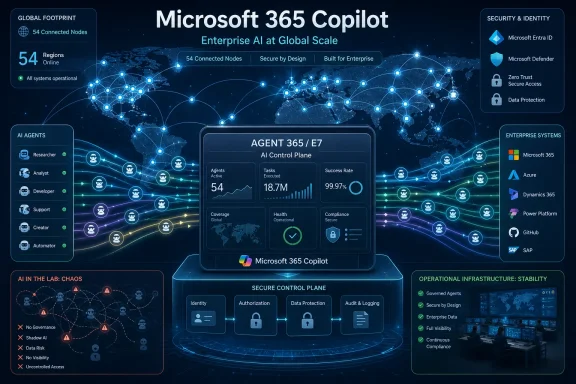
Futuristic global control dashboard shows live network security status and data flow across a world map.Microsoft’s Copilot Story Has Moved From Chatbot to Control Plane​

The first wave of Microsoft 365 Copilot was sold as an assistant for Outlook, Teams, Word, Excel, and PowerPoint. That framing made sense in 2023 and 2024, when enterprises were still trying to understand whether generative AI could summarize meetings without embarrassing itself or draft emails without inventing policy. But the Atos announcement shows how quickly the pitch has changed.
Microsoft now wants Copilot to be the front door to a broader enterprise AI system. The prize is not a smarter Clippy. It is a governed layer where human workers, corporate data, security policy, and autonomous or semi-autonomous agents all meet.
That is why E7 matters. Microsoft 365 E7 packages Copilot, E5-grade security and compliance capabilities, and Agent 365 into a single enterprise proposition. It is an attempt to collapse the procurement argument: instead of asking customers to buy AI, then separately buy the controls needed to keep AI from becoming a risk event, Microsoft is bundling the two ideas together.
Atos is useful to Microsoft because it embodies the customer Microsoft is trying to reassure. This is not a digital-native startup giving engineers a sandbox. Atos serves governments, defense organizations, healthcare providers, financial institutions, and critical infrastructure customers. If Copilot and agents can be made respectable there, Microsoft can argue they can be made respectable almost anywhere.

Atos Is Selling the Blueprint by Becoming the Blueprint​

The phrase “Client Zero” has become a familiar bit of enterprise transformation theater. Consulting firms adopt a platform internally, turn the scars into methodology, and then sell the playbook to clients. Sometimes that produces genuine operational learning. Sometimes it produces a glossy case study with more adjectives than evidence.
Atos’ version is more interesting because the deployment is not just about individual productivity. The company is talking about managing an ecosystem of 19,000 AI agents, with Microsoft Entra, Defender, Intune, Purview, Copilot, and Agent 365 forming the governance fabric. That moves the story from “employees use AI” to “the company operates AI as an enterprise asset.”
That distinction matters. An employee asking Copilot to summarize a Teams meeting is a productivity scenario. An agent that can act on business data, trigger workflows, or interact with systems of record is closer to enterprise automation. The second category demands identity, lifecycle management, monitoring, permissions, logging, and revocation.
Atos is betting that regulated customers will not ask whether AI agents are impressive. They will ask who owns them, what data they can see, what actions they can take, how their behavior is monitored, and how quickly they can be shut down. The firms that can answer those questions credibly will have an advantage over those still selling AI as a brainstorming tool.

The Same-Day KPMG Move Shows This Is a Market Pattern, Not a One-Off​

Atos was not alone on the calendar. On the same day, Microsoft and KPMG announced a global push around Agent 365 and Microsoft 365 Copilot, expanding access across KPMG’s global workforce of more than 276,000 professionals. That correction matters because the scale is larger than the 100,000-plus figure circulating in some summaries, and it sharpens the point: Microsoft is lining up professional services giants as proof that agentic AI is ready for mass deployment.
KPMG’s emphasis differs from Atos’. Where Atos leads with cybersecurity, regulated infrastructure, and the mechanics of secure deployment, KPMG leads with trust in audit, tax, and advisory work. The firm’s risk profile is not about running a hospital network or defense environment. It is about whether AI-assisted professional judgment can be explainable, reviewable, and acceptable to clients and regulators.
Together, the announcements sketch Microsoft’s preferred enterprise narrative. Agentic AI is not a rogue bot army. It is an extension of Microsoft 365, governed through familiar identity, security, compliance, and management tools. If that story holds, Microsoft turns its incumbency in enterprise productivity into a distribution advantage for AI agents.
The competitive message is also hard to miss. Accenture, Deloitte, Capgemini, IBM, Infosys, TCS, Wipro, PwC, and others all want to be the trusted AI transformation partner. Microsoft is giving several of them a platform on which to demonstrate scale, but it is also standardizing the substrate. The services firms can differentiate on industry knowledge and delivery, while Microsoft owns more of the control plane.

The Agent Boom Creates a Governance Problem Before It Creates a Productivity Miracle​

The seductive version of agentic AI says agents will remove drudgery, coordinate workflows, and let workers focus on judgment. That may happen in pockets. But at enterprise scale, agents first create an inventory problem.
Every agent needs a purpose, an owner, a set of permissions, an approved data boundary, a monitoring model, and a retirement plan. Without that, organizations will recreate the worst parts of shadow IT, except with software that can generate text, invoke tools, and act across connected systems. The operational risk is not science fiction. It is the familiar mess of unmanaged automation with a more fluent interface.
This is why Agent 365 is strategically important for Microsoft. The company is effectively arguing that agents should be treated like a class of enterprise identity and workload. They should be discoverable, governable, and subject to policy. That framing is exactly what security teams want to hear.
But it also raises the bar for Microsoft. If the company sells Agent 365 as the place where enterprises observe, secure, and govern agents, then failures will be judged against that promise. A rogue agent that exposes data, takes an unauthorized action, or produces an unrecoverable compliance gap will not be dismissed as a chatbot hallucination. It will be read as a control failure.
Atos’ 19,000-agent figure is therefore both impressive and daunting. It suggests ambition, but it also implies a large surface area for drift, duplication, stale permissions, and inconsistent behavior. The harder part of the project will not be creating agents. It will be keeping them useful, compliant, and boring over time.

Digital Sovereignty Is the Subtext Microsoft Cannot Ignore​

Atos is a French global systems integrator with deep roots in European public-sector and critical-infrastructure work. That makes the Microsoft partnership politically and commercially delicate. European customers want AI capability, but they also worry about dependency on US hyperscalers, cross-border data exposure, and the concentration of operational control in a small number of platforms.
Microsoft has spent years trying to address those concerns through regional cloud commitments, EU data boundary messaging, sovereign cloud offerings, and partnerships with European providers. The Atos deal fits that broader strategy. Microsoft needs European integrators that can translate its platform into locally credible deployments.
For Atos, the sovereignty issue cuts both ways. On one hand, aligning closely with Microsoft gives it access to a mature productivity, identity, security, and AI stack that many customers already use. On the other, highly regulated clients may ask whether “secure agentic AI” built on Microsoft’s platform is sufficiently sovereign for their risk model.
The answer will vary by sector and country. Some customers will accept Microsoft plus local integration, contractual controls, and technical safeguards. Others will demand tighter jurisdictional guarantees or hybrid architectures. Atos’ job will be to make the Microsoft platform feel less like a foreign dependency and more like an enterprise-controlled operating environment.
That is not just a legal argument. It is a trust argument. In regulated markets, the winning AI provider will not be the one with the flashiest demo. It will be the one whose architecture can survive procurement, legal review, security assessment, and political scrutiny.

The ROI Question Is Still Waiting at the Door​

The enterprise AI market has become fluent in the language of transformation. It is less fluent in the language of measurable returns. Copilot deployments have often produced anecdotal wins: faster meeting summaries, better first drafts, easier search, quicker synthesis of email and documents. Those gains are real, but they are not always easy to convert into budget math.
Atos and KPMG will both have to prove that broad access produces broad value. Seat deployment is not adoption. Adoption is not productivity. Productivity is not necessarily profit. The chain has to be demonstrated, not assumed.
For Microsoft, this is the central commercial risk of E7. A premium suite can look attractive when compared with buying separate AI, security, compliance, and agent-management products. But CIOs and CFOs will still ask whether the incremental spend changes business outcomes. If Copilot becomes another expensive entitlement that only a subset of workers use deeply, the backlash will be sharp.
Atos’ “Client Zero” role gives it a chance to answer that objection with evidence. It can measure internal use cases, identify where agents reduce manual work, document where controls prevented risk, and package those lessons for customers. But the burden of proof is higher than it was during the first Copilot pilots. Enterprises have moved past curiosity.
The next buyer conversation will be more severe: which workflows changed, which costs fell, which risks were reduced, and which employees actually changed how they work? If those answers are vague, scale will start to look like theater.

Security-First AI Is Becoming the New Enterprise Sales Pitch​

The most important part of the Atos announcement is not the employee count. It is the fusion of AI deployment with security and compliance architecture. That reflects a broader shift in how enterprise AI is being sold.
In the early generative AI boom, vendors emphasized capability. Models could write, summarize, translate, generate code, and answer questions. Enterprises listened, experimented, and then quickly rediscovered the same old constraints: data classification, access control, retention, regulatory exposure, insider risk, and vendor lock-in.
Now the sales motion has matured. The pitch is no longer “look what the model can do.” It is “look how safely the organization can let the model do it.” Microsoft is particularly well positioned for that shift because many enterprises already rely on its identity, endpoint, productivity, and compliance tools.
This is the logic behind bringing Entra, Defender, Intune, and Purview into the Copilot story. Entra handles identity and access. Defender speaks to threat protection. Intune manages devices and applications. Purview addresses data governance, compliance, and information protection. Agent 365 adds a governance layer for the agents themselves.
The architecture is coherent. The open question is whether it will be clean in practice. Most large enterprises have messy tenants, inherited permissions, overshared SharePoint sites, inconsistent labeling, and years of collaboration sprawl. Copilot and agents do not magically fix that; they can expose it.
That may be uncomfortable, but it is also a business opportunity for Atos. Before a customer can safely scale agents, it may need identity cleanup, data governance work, endpoint modernization, and security operations maturity. In other words, agentic AI becomes a wedge for a much larger modernization program.

The Services Firms Are Racing to Own the Operating Model​

The emerging battle among global systems integrators is not just about who can resell Microsoft licenses. It is about who defines the operating model for AI inside large organizations.
That operating model includes how use cases are selected, how agents are approved, how prompts and instructions are governed, how outputs are reviewed, how exceptions are handled, and how business value is measured. It also includes training users to work with AI without either blindly trusting it or ignoring it entirely. This is organizational design as much as technology deployment.
Atos has a natural angle in cybersecurity and regulated infrastructure. KPMG has a natural angle in trust, auditability, and professional services workflows. Accenture will bring industry-scale transformation machinery. Deloitte and PwC will tie AI to risk, tax, consulting, and assurance. IBM will emphasize hybrid environments, governance, and enterprise-grade AI platforms. Capgemini will lean on engineering and European credibility.
Microsoft benefits from all of them competing on top of its stack. The more the services firms frame enterprise agentic AI as a Microsoft-governed deployment problem, the more Microsoft’s platform becomes the default assumption. That is the same playbook Microsoft used with Windows, Office, Active Directory, SharePoint, Teams, and Azure: become the layer around which partners build practices.
But services firms also need to avoid becoming interchangeable implementation arms. If every GSI says it can deploy Copilot, configure Purview, govern agents, and train users, customers will compare them on price. The differentiator will be evidence: sector-specific accelerators, proven controls, reusable agents, migration tooling, and credible post-deployment metrics.
Atos’ best chance is to turn its internal rollout into a defensible body of operational knowledge. If it can show how 19,000 agents are cataloged, governed, secured, optimized, and retired, it will have something more valuable than a launch announcement. It will have a model.

Windows and Microsoft 365 Admins Will Inherit the Hard Part​

For WindowsForum readers, the Atos and KPMG announcements are not abstract boardroom news. They point to the kind of work that will land on Microsoft 365 administrators, security teams, endpoint managers, compliance officers, and service-desk staff over the next two years.
The first practical challenge is permissions hygiene. Copilot can surface information a user already has access to, which means bad access practices become more visible and more consequential. Overshared files, stale groups, poorly governed Teams channels, and legacy SharePoint permissions can turn AI rollout into an uncomfortable audit of collaboration debt.
The second challenge is endpoint and identity consistency. If agents are going to act across applications, the organization needs confidence in device posture, conditional access, privileged identity management, and session controls. AI does not reduce the need for identity discipline. It increases it.
The third challenge is user support. Workers will ask why Copilot cannot find something, why it found too much, why an answer was wrong, why an agent behaved differently from yesterday, or why a workflow suddenly requires approval. Traditional help desks will need new triage paths that combine productivity support, data governance, and AI behavior analysis.
The fourth challenge is change management. Some users will overtrust AI because it sounds authoritative. Others will dismiss it after one bad answer. Administrators and business leaders will need to teach a middle path: use AI aggressively where it helps, verify where consequences matter, and keep humans accountable for judgment.
This is where the Atos deployment becomes a useful signal. If a 56,000-person IT services company finds the operational model difficult, ordinary enterprises should not expect a frictionless rollout. The technology may be packaged as a suite, but the adoption burden remains human, procedural, and political.

The Real Standard Will Be Set After the Launch Slides Fade​

Atos and Microsoft are making a plausible argument: secure agentic AI will become an enterprise standard only if it is integrated with identity, security, compliance, endpoint management, and lifecycle governance from the start. That is the right argument. It is also the easier half of the story.
The harder half comes after deployment. Organizations will need to know which agents are actually used, which ones create measurable value, which ones duplicate existing automation, which ones introduce risk, and which ones should be removed. The lifecycle of an agent may end up looking less like a chatbot subscription and more like application portfolio management.
That means enterprises should be skeptical of raw agent counts. Nineteen thousand agents sounds impressive, but the more meaningful questions are qualitative. Are they tied to business processes? Are they monitored? Do they have owners? Are they versioned? Can their permissions be reviewed? Can their decisions be reconstructed? Can they be disabled without breaking operations?
If Microsoft and Atos can answer those questions, the deployment could become an important reference point. If they cannot, it will become another example of enterprise AI enthusiasm outrunning operational reality.
The market is moving quickly enough that both outcomes may coexist. Some workflows will become genuinely better through Copilot and agents. Some deployments will disappoint. Some organizations will discover that their biggest AI blocker was never the model; it was their own data and permission sprawl.

The Atos Bet Narrows the Enterprise AI Debate​

The useful lesson from the Atos announcement is that enterprise AI is becoming less mystical and more managerial. The conversation is shifting from model capability to operating discipline, and that is healthy for customers.
  • Atos is deploying Microsoft 365 Copilot and Microsoft 365 E7 to 56,000 employees across 54 countries.
  • The deployment is designed to govern roughly 19,000 AI agents through Microsoft’s broader security, compliance, identity, endpoint, and agent-management stack.
  • KPMG’s same-day Microsoft announcement shows that large professional services firms are racing to turn internal AI deployments into client-facing proof points.
  • The strongest enterprise use case for Agent 365 may be governance rather than productivity, because unmanaged agents could recreate shadow IT at machine speed.
  • The biggest blockers will be familiar ones: permissions sprawl, data governance gaps, inconsistent change management, unclear ROI, and organizational trust.
  • Microsoft’s opportunity is to make Copilot the enterprise interface for AI work, but its risk is that customers will hold it responsible when the control plane fails.
Atos is right that secure agentic AI could redefine enterprise standards, but only if the industry stops treating scale as the finish line. The next standard will not be set by the company with the most Copilot seats or the largest agent count. It will be set by the organizations that can prove AI agents are useful, governed, auditable, and reversible in the messy conditions of real enterprise IT. That is a less glamorous benchmark than the launch-day numbers, but it is the one that will decide whether agentic AI becomes infrastructure or another expensive layer of enterprise aspiration.

References​

  1. Primary source: The Futurum Group
    Published: Tue, 09 Jun 2026 20:17:08 GMT
  2. Official source: news.microsoft.com
  3. Official source: microsoft.com
  4. Related coverage: techradar.com
  5. Related coverage: windowscentral.com
  6. Related coverage: kpmg.com
  1. Related coverage: europapress.es
  2. Related coverage: prodad-software.es
  3. Related coverage: marketscreener.com
  4. Related coverage: pwc.com
  5. Related coverage: atos.net
  6. Related coverage: assets.kpmg.com
 

Atos Group and Microsoft announced on June 9, 2026, that Atos will deploy Microsoft 365 Copilot to 56,000 employees in 54 countries while standardizing on Microsoft 365 E7, Agent 365, Copilot Studio, and Microsoft Foundry for secure agentic AI. The deal is not just another Copilot rollout dressed up as transformation theater. It is a test of whether the next wave of enterprise AI can be governed like infrastructure rather than indulged like a lab experiment. For WindowsForum readers, the interesting part is not that a big services firm bought a big Microsoft bundle; it is that Microsoft’s agentic AI strategy is now being sold as an operating model for regulated work.

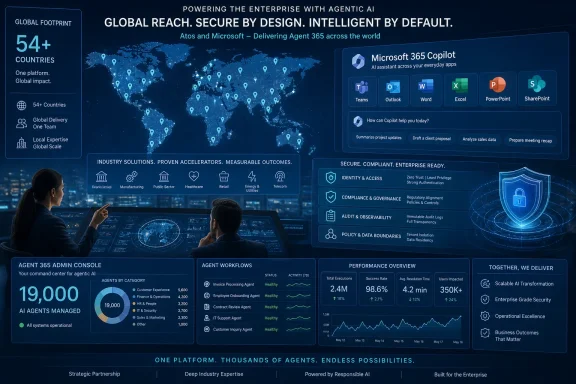
Illustration of Microsoft 365 Copilot global AI control plane with security, identity, and operational infrastructure.Microsoft’s Copilot Story Has Moved From Seats to Systems​

The first phase of Microsoft 365 Copilot adoption was easy to understand: give knowledge workers an assistant inside Outlook, Teams, Word, Excel, PowerPoint, and SharePoint, then hope the productivity gains justify the bill. That phase produced demos, pilots, and plenty of awkward boardroom arithmetic. It also exposed the central problem with enterprise AI: a chatbot is simple to provision, but hard to institutionalize.
Atos’ expanded partnership with Microsoft belongs to the second phase. The company is not merely giving employees access to Copilot; it is adopting Microsoft 365 E7 as a foundation that combines Microsoft 365 E5 security and compliance, Microsoft 365 Copilot, Microsoft Agent 365, and the broader Microsoft security stack. That matters because Microsoft’s pitch has shifted from “AI in your apps” to “AI under management.”
The language around the announcement is revealing. Atos and Microsoft talk about a “control plane” for observing, governing, and securing agents. That is cloud infrastructure language, not office productivity language. It suggests that Microsoft wants AI agents to be treated less like clever macros and more like identities, workloads, and endpoints.
That is the right conceptual move. It is also the beginning of a much harder argument. Once agents can act on behalf of users, operate with their own credentials, and participate in business workflows, enterprises need to answer the same questions they ask about human users and service accounts: who authorized this, what data was touched, what action was taken, and how do we revoke it?

Atos Is Trying to Become “Client Zero” Before Selling the Playbook​

Atos has a particular reason to make this announcement loudly. The company sells digital transformation, cloud, cybersecurity, and managed services to large organizations, including customers in defense, financial services, healthcare, and public administration. A services firm cannot credibly sell AI industrialization forever on slideware; eventually it needs to show that it has done the work on itself.
That is why the “Client Zero” framing is more than marketing garnish. Atos is positioning its own internal rollout as the reference architecture for customers that want agentic AI but cannot tolerate unmanaged experimentation. The company says it will use Copilot Studio and Microsoft Foundry to design, build, and operate agents for internal IT, business functions, and clients, then fold those capabilities into its Sovereign Agentic AI studios.
There is a pragmatic commercial angle here. If Atos can turn its internal deployment into a repeatable consulting pattern, Microsoft gets a global systems integrator pushing its AI stack into regulated accounts, and Atos gets a story that sounds more mature than “we can help you prompt better.” That is the kind of partner motion Microsoft has relied on for decades: make the platform the default, then let integrators turn complexity into billable roadmaps.
But this is also where the risk concentrates. A systems integrator that standardizes its own workforce on a vendor’s most integrated AI-and-security bundle may become more efficient, but it also becomes a living advertisement for that vendor’s worldview. Customers will need to ask whether the resulting advice is architecture-led, Microsoft-led, or inevitably both.

The E7 Bundle Is Microsoft’s Answer to AI Sprawl​

Microsoft 365 E7 is important because it packages the AI conversation with the security conversation. The bundle brings together E5, Copilot, Agent 365, and Entra Suite capabilities under the “Frontier Suite” banner. Microsoft made E7 generally available on May 1, 2026, with Agent 365 positioned as the governance layer for agents across the enterprise.
This bundling is a classic Microsoft move. The company has often won enterprise markets by integrating the thing customers want with the thing administrators already need to manage. Windows Server, Active Directory, Office, Teams, Defender, Intune, Purview, and Entra all participate in that same gravitational field.
Agentic AI makes the bundle more compelling because the administrative problem is real. If every department creates agents, and those agents can retrieve documents, schedule meetings, query systems, trigger workflows, or interact with third-party services, then “AI adoption” quickly becomes an identity and compliance problem. A governance layer is no longer optional decoration.
The question is whether Microsoft 365 E7 becomes a sensible consolidation point or a premium toll booth. At $99 per user per month at retail, E7 is not a casual upgrade for large organizations. Atos’ 56,000-seat deployment is therefore a signal to the market: Microsoft wants major enterprises to think of AI governance as part of the core Microsoft 365 estate, not as a separate procurement category.

Agent 365 Turns the AI Assistant Into an Administrative Object​

The most consequential phrase in the Atos announcement is not “Copilot.” It is “19,000 AI agents.” That number changes the scale of the problem. One assistant per employee is a licensing exercise; tens of thousands of agents are an estate.
Agent 365 is Microsoft’s attempt to make that estate legible. The product is designed to observe, manage, govern, and secure agents, including agents that act on behalf of users and agents that operate with their own credentials. In practical terms, Microsoft is trying to create the administrative equivalent of a directory for software workers.
That framing will resonate with Windows administrators who have lived through the evolution of identity management. Service accounts, app registrations, OAuth permissions, privileged access, conditional access policies, audit logs, and endpoint management all became indispensable because software gained agency long before the industry started using the word agentic. AI agents make the old problem more visible and potentially more dangerous.
The danger is not science-fiction autonomy. It is boring enterprise failure at machine speed. An agent with excessive permissions can summarize documents it should not see, automate a workflow no one validated, leak sensitive context into an unintended system, or take a sequence of individually permitted actions that collectively violate policy.
That is why governance has to be designed into the deployment rather than added after the first audit finding. Atos’ decision to emphasize Entra, Defender, Intune, Purview, and Agent 365 is an acknowledgment that agentic AI is not primarily a user-interface upgrade. It is a new class of operational actor inside the tenant.

The Sovereignty Angle Is More Than European Branding​

Atos’ invocation of “sovereign” AI is predictable, but not empty. A France-headquartered company operating across 54 countries, including regulated and public-sector markets, cannot treat AI governance as a generic productivity issue. Data residency, operational control, auditability, and legal responsibility all matter more when AI systems are embedded into business processes.
European enterprises have been especially sensitive to the dependency problem. They want the productivity and automation benefits promised by US hyperscalers, but they also want credible assurances about control, jurisdiction, and compliance. Atos is trying to occupy that middle ground: use Microsoft’s platform, but wrap it in consulting, governance, and sovereignty-oriented operating models.
That is a delicate balance. Microsoft’s cloud and AI stack gives Atos reach, integration, and velocity. At the same time, sovereignty claims become harder to sustain if the most important control plane, productivity surface, identity fabric, and agent framework all come from the same American vendor.
The honest answer is that sovereignty in enterprise IT is rarely absolute. It is usually a negotiated architecture of controls, contracts, regional operations, encryption, access boundaries, audit trails, and fallback plans. Atos’ announcement should be read in that light: not as a declaration of technological independence, but as an attempt to make dependence governable.
For customers in defense, healthcare, finance, and government, that distinction is crucial. They are not simply buying AI features; they are buying evidence that the AI estate can survive procurement review, regulator scrutiny, internal audit, and incident response.

The Real Contest Is Over Who Defines Enterprise AI Governance​

Microsoft is not alone in seeing governance as the next AI battleground. Every major cloud and enterprise software vendor is racing to define the administrative model for agents. The winner gets more than licensing revenue; it gets to shape how organizations think about trust, identity, compliance, and automation.
Atos’ move strengthens Microsoft’s hand because systems integrators are force multipliers. A platform vendor can publish guidance, but an integrator turns that guidance into migration plans, operating procedures, security baselines, and board-level transformation narratives. When a global services firm standardizes internally and then sells the same pattern externally, the platform becomes harder to dislodge.
That does not mean customers should sleepwalk into the model. Microsoft’s integrated stack has obvious advantages, especially for organizations already invested in Microsoft 365, Entra, Defender, Intune, and Purview. It also raises familiar concerns about lock-in, licensing complexity, and the risk that the answer to every governance problem becomes another Microsoft SKU.
The best customers will treat Microsoft’s model as a strong default, not a theological commitment. They will ask how Agent 365 handles third-party agents, how logs flow into existing SIEM and SOC processes, how policies map to non-Microsoft environments, and what happens when a business unit wants an agent built on another model or platform.
This is where Atos could add real value if it resists becoming merely a Microsoft deployment arm. Regulated enterprises do not need cheerleaders for agentic AI. They need sober architects who can separate what belongs in Microsoft 365 from what belongs in sector-specific systems, sovereign clouds, private environments, or custom controls.

Employees Will Feel the Change Before the Org Chart Does​

For Atos employees, the visible part of the announcement will be Copilot inside familiar Microsoft 365 applications. The more significant change will be the gradual redesign of work around agents that can retrieve information, draft content, coordinate tasks, and automate routine processes. That will not arrive as a single dramatic event. It will arrive as hundreds of small workflow substitutions.
The promise is obvious. Consultants can prepare client materials faster. Engineers can summarize technical context across chats, documents, and tickets. Finance, HR, legal, and operations teams can automate repetitive document and communication tasks. Frontline and support roles can get faster access to institutional knowledge.
The unease is just as obvious. When AI is embedded into every application, the boundary between assistance and surveillance becomes harder to see. If agents are observable and governable, workers may reasonably ask who observes the observer, how performance data is interpreted, and whether productivity narratives become pressure campaigns.
Microsoft and Atos will emphasize empowerment, speed, quality, and innovation. Those benefits are plausible, but they are not automatic. The difference between a useful AI assistant and an exhausting layer of automated bureaucracy will depend on training, policy, measurement, and managerial restraint.
For IT pros, the cultural lesson is technical too. Adoption cannot be measured only by active usage. It has to be measured by whether outputs are trusted, whether errors are caught, whether sensitive data is protected, and whether employees understand when an AI-generated answer is merely a draft rather than a decision.

Security Teams Inherit the Agent Problem​

Security teams have spent years trying to reduce identity sprawl, tame SaaS permissions, classify sensitive data, and consolidate endpoint management. Agentic AI threatens to reopen all of those wounds under a more glamorous name. Every useful agent needs access; every access grant creates risk.
Atos’ decision to center the deployment on Microsoft Entra, Defender, Intune, Purview, and Agent 365 is therefore sensible. Identity should determine what agents can do. Defender should help detect suspicious behavior. Intune should maintain device and application posture. Purview should classify and protect sensitive data. Agent 365 should make the agent population visible enough to govern.
The hard part will be operational discipline. A control plane is only as useful as the policies behind it. If organizations create thousands of agents without lifecycle management, owner accountability, permission review, and retirement processes, Agent 365 will become a prettier inventory of future incidents.
There is also a subtle detection challenge. Traditional security tools look for compromise, malware, anomalous login patterns, and known bad behavior. AI agents may cause harm while behaving exactly as authorized. They may over-share, over-automate, or over-trust, not because they were hacked, but because they were badly designed.
That is why agent governance must include not only cybersecurity controls but business-process controls. Who approves an agent before production? What test data is used? How are prompts, tools, connectors, and permissions reviewed? What constitutes a material change? Who signs off when an agent moves from advisory mode to action mode?

The Windows Ecosystem Gets Pulled Deeper Into Microsoft 365​

Windows itself is not the centerpiece of this announcement, but the Windows ecosystem is implicated throughout. The modern enterprise desktop is no longer defined only by the operating system; it is defined by identity, endpoint management, productivity applications, browser controls, cloud policy, and security telemetry. Microsoft 365 E7 sits squarely in that expanded definition of the Windows workplace.
For administrators, this means AI readiness will increasingly look like tenant hygiene. Conditional Access, data classification, device compliance, least privilege, retention policies, sensitivity labels, and audit logging become prerequisites for safe Copilot and agent deployment. The organizations that skipped the boring governance work will discover that AI makes their mess searchable, actionable, and harder to ignore.
For Windows power users, the change will feel uneven. Some Copilot experiences will be helpful, especially where they summarize meetings, draft documents, or surface information buried in SharePoint. Others will feel intrusive, redundant, or prematurely automated. Microsoft’s challenge is to make AI feel like a power tool rather than a mandatory overlay.
For developers and automation specialists, the center of gravity is also shifting. Copilot Studio and Microsoft Foundry point toward a world where business users, IT teams, and professional developers all participate in agent creation. That can accelerate delivery, but it can also create a new shadow IT problem if governance does not keep up.
The WindowsForum audience has seen this movie before. Visual Basic macros, SharePoint workflows, Power Automate flows, Teams apps, and low-code platforms all promised local productivity and later required central discipline. Agentic AI is the same pattern with higher stakes.

The Consulting Market Gets Its Next Great Migration Story​

Large consulting firms need migration stories. They need a reason for customers to reassess architecture, budgets, governance, training, and managed services. Agentic AI provides one, and Microsoft is giving partners a packaged enterprise platform around which to build it.
Atos’ announcement should therefore be seen partly as a market signal to CIOs. If a global systems integrator is willing to standardize internally on Microsoft 365 E7 and agent governance, then customers are invited to view the same move as safe, modern, and strategically inevitable. That is powerful positioning.
But inevitability is a dangerous word in enterprise technology. Many organizations are still struggling to demonstrate measurable returns from first-wave generative AI deployments. Copilot adoption has often moved faster than process redesign, and process redesign is where the real gains or failures will appear.
The strongest case for Atos’ strategy is that it acknowledges this. The company is not saying that prompts alone transform work. It is saying that agentic AI must be industrialized: designed, governed, secured, deployed, monitored, and improved. That is a more credible message than the usual productivity magic show.
The weakest case is that the announcement still leans heavily on the assumption that Microsoft’s integrated stack is the natural home for this transformation. For many Microsoft-centered enterprises, it may be. For heterogeneous, highly specialized, or sovereignty-constrained environments, the architecture will need more nuance.

The 19,000-Agent Number Is Both Impressive and Alarming​

There is a reason the 19,000-agent figure jumps out. It suggests Atos has already moved beyond the pilot vocabulary that still dominates many corporate AI conversations. It also forces a practical question: how many agents can an organization responsibly operate before governance becomes the product?
At small numbers, agents can be reviewed manually. At large numbers, the review process itself has to become systematic. Agents need owners, classifications, permission boundaries, logs, version histories, risk ratings, and decommissioning rules. They need the same lifecycle thinking that mature IT shops apply to applications and identities.
The danger is that organizations will confuse quantity with maturity. Having thousands of agents does not necessarily mean an enterprise is advanced. It may mean business units are creating automation faster than central teams can understand it.
Atos seems aware of that risk, which is why the announcement emphasizes a single coherent operating model. The phrase may sound bland, but it points to the only viable path. Agentic AI cannot be allowed to become a federation of clever experiments with no shared policy spine.
If Atos can show that 19,000 agents can be governed without crushing innovation, the company will have a valuable proof point. If it cannot, the number will become a warning label for every customer rushing to scale.

Microsoft Wins If Governance Becomes the Upgrade Path​

The strategic beauty of E7 is that it makes governance the justification for a higher tier. Microsoft does not have to persuade customers that every employee will instantly become dramatically more productive. It can argue that once AI agents enter the enterprise, organizations need a more advanced security, compliance, identity, and management bundle.
That is a stronger argument than pure productivity. Productivity claims are difficult to measure and vary widely by role. Risk management is easier to defend in regulated environments, especially when boards and auditors are asking how AI is controlled.
This is why the Atos partnership is important for Microsoft beyond the seat count. It validates the idea that AI scale requires Microsoft’s control plane. It also gives Microsoft a marquee French-headquartered services partner to carry that message into European and global enterprise accounts.
The competitive implication is clear. If Microsoft can make Agent 365 the default governance layer for enterprise agents, it can extend Microsoft 365’s administrative reach into a new category of work. That would make Copilot more than an assistant and E7 more than a bundle. It would make Microsoft 365 the management substrate for human-and-agent organizations.
That outcome is not guaranteed. Customers will test the limits. Regulators will ask uncomfortable questions. Competitors will offer alternative governance models. Open-source and multi-model strategies will keep pressure on closed stacks. But Atos’ move shows that Microsoft’s version of the future is now credible enough for a major integrator to bet its own operations on it.

The Fine Print Behind the AI Factory​

The practical take is not that every enterprise should copy Atos. It is that every enterprise considering agentic AI needs to stop treating the subject as a feature rollout. Atos’ deployment is notable because it ties AI access, security, identity, compliance, agent governance, and client delivery into one operating story.
  • Atos is deploying Microsoft 365 Copilot to all 56,000 employees across 54 countries, making the rollout workforce-wide rather than a limited executive or pilot deployment.
  • Microsoft 365 E7 is the foundation of the Atos plan because it bundles Copilot, E5 security and compliance, Agent 365, and Entra Suite capabilities into a single enterprise package.
  • Agent 365 is the strategic center of the announcement because Atos needs a governance layer for a reported population of 19,000 AI agents.
  • The partnership is designed to become a customer-facing playbook, with Atos using its own transformation as evidence for regulated industries considering agentic AI.
  • The biggest operational risks are permission sprawl, unclear ownership, weak lifecycle management, and the possibility that authorized agents produce unauthorized business outcomes.
  • The strongest version of the strategy treats AI agents as managed enterprise actors, not as experimental chatbots attached to productivity apps.
Atos and Microsoft are making a bet that the next phase of enterprise AI will be won not by the flashiest model demo, but by the company that can make agents governable, auditable, and boring enough for production. That is exactly the right battlefield for regulated enterprises, and exactly the kind of battlefield Microsoft knows how to fight. The open question now is whether Atos can prove that agentic AI at scale is a disciplined operating model rather than a new name for automation sprawl.

References​

  1. Primary source: The Fast Mode
    Published: 2026-06-10T02:50:08.126770
  2. Official source: news.microsoft.com
  3. Official source: microsoft.com
  4. Official source: learn.microsoft.com
  5. Related coverage: windowsforum.com
  6. Official source: partner.microsoft.com
  1. Related coverage: windowscentral.com
  2. Related coverage: techradar.com
  3. Related coverage: itpro.com
  4. Official source: adoption.microsoft.com
  5. Related coverage: atos.net
  6. Related coverage: news.cognizant.com
 

Back
Top