

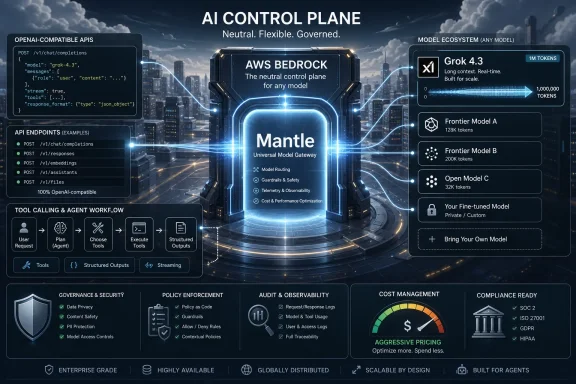
AWS Is Turning Bedrock Into the Neutral Ground for AI Rivalries
Amazon Bedrock began as a practical answer to a procurement problem. Enterprises did not want to bet everything on one lab, one API, or one licensing model, and AWS did not want Azure or Google Cloud to become the default destination for model choice. The pitch was straightforward: bring Anthropic, Meta, Amazon’s own Nova models, open-weight contenders, and eventually OpenAI-style interfaces into one managed service.
Grok 4.3 strengthens that pitch because xAI is not just another niche model provider. It is part of the small group of companies trying to build frontier-scale systems, and it comes with the cultural force field that surrounds Elon Musk’s companies. For AWS, adding Grok means Bedrock can claim a broader version of neutrality: not ideological neutrality, but purchasing neutrality.
That matters because enterprise AI buying has become less like choosing software and more like choosing infrastructure exposure. A bank, insurer, law firm, or government contractor may want Claude for drafting, GPT for coding, DeepSeek or Qwen for cost-sensitive workloads, and Grok for long-context or tool-heavy experiments. Bedrock’s value is that those choices can be tested without every team reinventing authentication, billing, regional controls, and vendor review.
The Grok launch also shows how quickly Bedrock is moving away from being merely a wrapper around model APIs. Mantle, the new inference path under this deployment, is an explicit attempt to make Bedrock feel more like a native high-performance AI runtime. AWS does not want to be seen as a reseller of other people’s intelligence; it wants to own the operational layer where that intelligence is metered, secured, routed, and governed.
Grok’s Enterprise Pitch Is Built on Context, Cost, and Agents
The headline feature is the 1 million-token context window. In enterprise terms, that is not a parlor trick. Long context changes what can be submitted to a model in a single run: litigation bundles, credit agreements, security logs, customer histories, application repositories, or messy internal policy archives.
The catch is that long context is only useful if the model remains disciplined across the whole window. Anyone who has tested large-context models knows the difference between accepting a huge prompt and reliably reasoning over it. Grok 4.3’s promise is that its reasoning-first design and configurable effort levels can help developers spend more compute only when a task actually requires it.
That configurability is important. Enterprise AI workloads are rarely one uniform stream of brilliant questions. They are a mix of routing, extraction, summarization, compliance checks, edge-case reasoning, and chained tool calls. A model that lets teams dial reasoning effort from none to high gives engineers a lever to manage latency and cost without maintaining multiple separate model integrations.
The other notable piece is OpenAI API compatibility through Mantle. In practical terms, this lowers the switching cost for developers who have already built around OpenAI-style SDKs and response formats. AWS is not saying every app can be ported by changing one environment variable, but it is clearly trying to make Bedrock a destination for teams that want model optionality without rewriting their software stack.
Mantle Is the Real AWS Product Hiding Beneath the Model Launch
Grok 4.3 is the news hook, but Mantle may be the more consequential product. AWS has spent years selling customers on the idea that cloud infrastructure abstracts away hardware complexity. In AI, that abstraction is harder because model performance, regional capacity, GPU scarcity, token throughput, and API shape all leak into application design.
Mantle is AWS’s attempt to put that complexity back behind a service boundary. It supports response streaming, structured outputs, tool calling, and OpenAI-compatible endpoints. Those are not flashy features in isolation, but together they describe the platform layer enterprises need before they can move beyond demos.
This is also why the Grok deployment should be read alongside Bedrock’s broader 2026 model expansion. AWS has been adding open-weight and proprietary models while unifying more of the developer experience around modern API conventions. The company is not merely adding logos to a catalog; it is trying to make Bedrock the place where model churn becomes manageable.
For WindowsForum readers running mixed estates, this has a familiar shape. It resembles the way organizations standardized on identity providers, endpoint management, or virtualization platforms not because any one workload demanded it, but because the alternative was operational sprawl. Bedrock is making the same argument for AI inference: let the labs fight over benchmarks, while AWS sells the control plane.
The Price Is Aggressive Enough to Force a Serious Test
Grok 4.3’s pricing is the part that will get budget owners to pay attention. At $1.25 per million input tokens and $2.50 per million output tokens on Bedrock’s on-demand tier, it comes in far below many premium frontier models. Cached input pricing makes repeated analysis of stable documents even more attractive.
That does not make Grok the cheapest model on Bedrock. Open-weight models and smaller systems can undercut it, especially for extraction, classification, or high-volume customer service tasks where frontier reasoning is unnecessary. But Grok’s point is not to beat every model on raw price; it is to offer enough frontier capability at a price that makes experimentation politically easy.
This matters inside enterprises because AI adoption is increasingly constrained by unit economics rather than executive enthusiasm. A proof of concept that costs a few dollars looks magical. A production workflow that burns through millions of tokens per day looks like a new cloud bill category waiting to embarrass someone. Cheaper reasoning changes which workloads survive the trip from demo to deployment.
The more interesting comparison is not simply Grok versus Claude or GPT. It is Grok versus the habit of overusing the most prestigious model for every task. If Bedrock makes it easy to evaluate Grok against other models under the same governance umbrella, then AWS is nudging customers toward portfolio thinking: use the best model where it matters, the cheapest model where it suffices, and a long-context specialist where the input size would otherwise break the workflow.
Benchmarks Help Grok, but They Do Not Settle the Enterprise Question
xAI’s marketing leans heavily on Grok 4.3’s strengths in hallucination resistance, telecom-style tool calling, legal document understanding, and corporate finance tasks. Those are not random showcase categories. They map to precisely the workloads where enterprises are willing to pay for better reasoning: support automation, legal review, regulated document analysis, and agentic workflows that call tools rather than merely generate prose.
Still, benchmarks are only a starting point. Enterprise buyers have learned that a model can perform well on public leaderboards and still fail in production because it mishandles internal vocabulary, produces unstable structured output, or behaves differently when chained to tools. The important test is not whether Grok scores well in isolation; it is whether it behaves predictably inside the messy systems companies already operate.
That is where Bedrock’s side-by-side evaluation experience becomes strategically useful. AWS wants teams to compare models on their own prompts, with their own constraints, while keeping the procurement and security apparatus constant. If Grok wins enough of those bake-offs on price-adjusted performance, it does not need to be the smartest model in the catalog.
The phrase cost-to-intelligence curve has become a favorite in AI infrastructure circles because it captures the new buying reality. Enterprises are not buying intelligence in the abstract. They are buying acceptable failure rates, acceptable latency, acceptable governance, and acceptable cost for a specific workflow. Grok 4.3’s bet is that it can win enough of those tradeoffs even if it does not always top the leaderboard.
The Grok Brand Carries Baggage AWS Cannot Abstract Away
The hardest part of Grok’s enterprise story is not technical. It is reputational. xAI has cultivated Grok as a model with a more irreverent, less constrained personality than some competitors, and that positioning has made it attractive to certain users while making risk teams nervous.
For consumers, personality can be part of the product. For enterprises, personality is usually a liability unless it is tightly bounded. A model used for customer support, HR workflows, legal research, or government services needs to be boring in very specific ways. It needs to be auditable, stable, policy-compliant, and unlikely to surprise the people who sign risk attestations.
AWS can reduce some of that concern by wrapping Grok in Bedrock’s security model, access controls, logging patterns, and regional infrastructure. But AWS cannot fully launder a model’s public reputation. If an AI system is known outside the enterprise for edgy behavior or controversial outputs, compliance teams will ask whether the managed-cloud version is materially different enough to trust.
That does not mean Grok is unusable in serious environments. It means adoption will likely start where the blast radius is controlled: internal research, document review, developer tooling, support-assist scenarios, and agent experiments behind human review. The more public, regulated, or legally consequential the workflow, the more Grok will have to prove that its Bedrock deployment behaves like enterprise software rather than a social product with an API.
AWS May Care More About Infrastructure Commitments Than Grok Usage
There is another layer to the partnership that should not be ignored. Cloud AI deals are rarely just about inference access. They are also about compute commitments, accelerator strategy, and the long contest to reduce dependence on Nvidia GPUs.
AWS has already used strategic AI partnerships to create demand for its infrastructure and custom silicon. Anthropic became central to that strategy, and AWS has been eager to show that Trainium can support serious frontier-scale AI workloads. If xAI eventually moves meaningful training or inference work onto AWS infrastructure, the value of the relationship could exceed whatever Bedrock customers spend on Grok API calls.
This is where the public enterprise adoption question may be too narrow. Even if Grok 4.3 becomes a mid-tier Bedrock model by usage, the partnership can still help AWS. It broadens the catalog, signals relevance in the frontier-model race, and potentially brings xAI closer to Amazon’s compute ecosystem.
That dynamic also explains why AWS would take the reputational tradeoff. Cloud providers are fighting not only for application developers, but for the labs themselves. The labs need enormous compute; the clouds need proof that their platforms are indispensable to the AI economy. Bedrock is the customer-facing storefront, but the deeper game is capacity, chips, and leverage.
Windows Shops Should Watch the API Shape, Not Just the Model Name
For many Windows-centric IT teams, the immediate relevance of Grok on Bedrock will not be whether the model writes better poetry or wins a benchmark. It will be whether the deployment model fits into existing enterprise controls. Identity, network isolation, auditability, billing, and developer workflow matter more than model fandom.
The OpenAI-compatible API path is especially relevant because many internal AI tools already assume that ecosystem. Developers experimenting with .NET services, PowerShell automation, internal copilots, or support workflows often start from OpenAI-style examples. If Bedrock can absorb those patterns while letting administrators keep AWS governance, the switching friction drops.
There is also a Microsoft angle that should not be missed. Azure AI Foundry and Microsoft’s broader Copilot stack continue to pull enterprises toward Microsoft-native AI integration. AWS responding with a broader Bedrock catalog is a direct challenge to that gravity. For hybrid shops, this increases choice but also increases the need for model governance that spans clouds.
The risk is that teams end up with AI sprawl by another name. One department uses Azure, another uses Bedrock, a third signs a direct xAI contract, and a fourth routes through a third-party model broker. The arrival of Grok on Bedrock is useful only if organizations treat it as part of a governed model strategy, not as another shiny endpoint to be added to the pile.
The First Workloads Will Be Boring, Which Is Exactly the Point
The most plausible early Grok 4.3 workloads are not dramatic autonomous agents making executive decisions. They are tedious, document-heavy tasks where long context and lower prices are immediately useful. Think first-pass contract review, support transcript analysis, legal memo comparison, policy Q&A, due diligence packets, and financial document triage.
These are the areas where a 1 million-token context window can reduce pre-processing complexity. Instead of chunking documents into fragments and hoping retrieval finds the right passage, teams can test whether Grok can reason across larger bundles directly. That will not eliminate retrieval-augmented generation, but it may simplify some workflows that have become over-engineered to compensate for smaller context windows.
Tool calling is the other serious enterprise use case. Models that can reliably call systems, parse responses, and continue reasoning are more valuable than models that merely answer in fluent paragraphs. If Grok performs well in customer support and telecom-style tool benchmarks, Bedrock customers will try it in agentic workflows where mistakes can be contained and measured.
The boringness is significant. Enterprise AI becomes real when it disappears into back-office workflows, ticket queues, review pipelines, and developer tools. Grok’s cultural profile may be loud, but its best route into the enterprise is through tasks so dull that nobody outside IT wants to hear about them.
Governance Will Decide Whether Grok Stays in the Lab
The unresolved question is not whether developers will test Grok 4.3 on Bedrock. They will. The pricing is attractive, the context window is large, and the integration path is convenient enough to justify experiments.
The real question is whether those experiments pass governance review. Enterprises will want clarity on data handling, retention, abuse detection, model update cadence, regional availability, and contractual terms. They will also want to know how Grok’s behavior in Bedrock compares with Grok’s behavior in consumer-facing products.
This is where AWS has an advantage and a burden. Bedrock gives customers familiar administrative machinery, but it also makes AWS part of the trust chain. If a model behaves unpredictably, customers may blame the lab; if the service integration feels opaque, they will blame AWS too.
For regulated sectors, the safest path will be staged adoption. Start with internal-only workflows. Keep humans in the loop. Log prompts and outputs where policy allows. Compare Grok against Claude, GPT, Nova, and open-weight alternatives on the same workload. The winner should be the model that meets the operational bar, not the one with the most interesting launch story.
Grok’s Bedrock Debut Gives Enterprises a Test, Not a Mandate
The practical read on this launch is narrower than the hype but more important than a routine model addition. Grok 4.3 gives AWS customers another serious option for long-context, reasoning-heavy, tool-oriented workloads, and it does so at a price that will encourage experimentation. It also forces organizations to separate model capability from vendor risk.
- Grok 4.3 is now a Bedrock option for teams that want xAI’s model without building a direct xAI integration.
- Its 1 million-token context window makes it most interesting for legal, financial, support, and codebase-scale analysis.
- Mantle is strategically important because it gives AWS a more unified inference layer with OpenAI-compatible access patterns.
- The model’s pricing makes it a credible challenger for cost-sensitive reasoning workloads, even when it is not the top benchmark performer.
- Enterprise adoption will depend less on curiosity and more on governance, stability, data controls, and predictable behavior in production.
- Windows and Microsoft-heavy shops should evaluate Grok through the lens of multi-cloud AI management rather than model novelty.
Grok 4.3’s arrival on Bedrock is best understood as a sign that the frontier-model market is maturing into a cloud distribution war. The labs still compete on intelligence, personality, and price, but enterprises will increasingly experience those differences through platforms that promise control and interchangeability. AWS has given Grok a seat at that table; now xAI has to prove that its model can behave less like a spectacle and more like dependable infrastructure.
References
- Grok 4.3 Lands on Amazon Bedrock for Enterprises Memeburn · 2026-06-20T20:46:13.120983