

Amazon Web Services announced AWS Continuum and AWS Context at AWS Summit New York on June 17, 2026, positioning the two services as production controls for enterprise AI agents that must fix software risk and understand company data before acting. The launch is less about another model race than about AWS trying to own the boring layer that makes agents usable: identity, evidence, remediation, test discipline, and business context. That is where the agent market is moving because that is where the failures are becoming expensive.
AWS is making a familiar cloud-platform argument in a new vocabulary. If the first wave of generative AI sold executives on copilots, the next wave has to convince security teams, auditors, and operations managers that autonomous software can be trusted near production systems. Continuum and Context are AWS’s answer to the two objections that have stalked every agent pilot: the agent may act unsafely, and the agent may not know enough about the business to act usefully.
For the last two years, the industry has treated AI agents as a kind of software theater. A prompt turns into a plan, a plan turns into tool calls, and the demo ends before anyone asks who approved the change, what data was used, or how the agent will be stopped when it misunderstands the task. AWS’s New York announcements are notable because they concede, implicitly, that the demo era is over.
Continuum is framed as an AI-native security service for code vulnerabilities. It is meant to continuously discover vulnerabilities, validate which ones are actually exploitable, rank them by business impact, and drive remediation through customer-defined guardrails. That is not a chatbot stapled onto a scanner; it is AWS trying to compress the messy loop between detection, triage, proof, ticketing, patching, and validation.
Context attacks a different but related problem. Enterprise agents fail not only because they hallucinate, but because they operate without the organizational map that human employees slowly acquire: which database matters, what a project name refers to, which policy supersedes another, and how a customer, workload, account, or internal system relates to the rest of the company. AWS Context proposes to organize enterprise data into a governed knowledge graph that agents can query at runtime.
The phrase knowledge graph can sound like old wine in new bottles, and in some ways it is. Enterprises have been trying to model institutional knowledge for decades. What changes with agents is the consequence of not doing it: a search result may be incomplete, but an autonomous agent with incomplete context can take the wrong action faster than a human can notice.
The dangerous part is that action is precisely where security automation becomes operational risk. A scanner that cries wolf is annoying. A remediation agent that patches the wrong branch, modifies a dependency without understanding runtime behavior, or deploys a fix that breaks authentication is a business incident wearing a security badge. AWS’s emphasis on isolated validation environments and guardrails is therefore not decorative; it is the product.
Continuum’s most important claim is not that it can find known vulnerabilities. The market already has many tools that do that. The meaningful claim is that it can prove which vulnerabilities are genuinely exploitable, connect that proof to business context, and then push remediation through a controlled path. If it works, the service shifts security from finding flaws to closing the loop.
That is also where AWS will face the hardest scrutiny. Security leaders do not simply need faster patch suggestions. They need explainable evidence, audit trails, rollback paths, change-control integration, and a clear boundary between recommendation and autonomous modification. The more Continuum promises machine-speed remediation, the more customers will ask what happens when the machine is wrong.
That distinction matters legally and reputationally, but it matters less operationally. In production, “the AI made the change” and “a human gave the AI too much authority” collapse into the same postmortem category: an automated workflow was allowed to touch something important without sufficient constraint. The lesson for customers is not that Kiro is uniquely dangerous. The lesson is that agentic coding changes the blast radius of ordinary engineering mistakes.
This is why the new AWS DevOps Agent release-management preview is more consequential than it might appear. AWS says the agent can review code changes for release readiness and generate autonomous release tests tailored to the change rather than merely running a static test suite. In plain English, AWS is trying to put an AI reviewer and an AI test planner between AI-generated code and production.
That is a neat symmetry, but also a governance puzzle. If an agent writes code, another agent reviews it, and a third agent generates tests, the system may become faster without becoming safer unless humans can inspect the reasoning, policies, and evidence behind each stage. Enterprises will like the velocity story. Auditors will ask who had authority at each step.
That is a more useful framing. In a corporate environment, truth is rarely a single document. It is distributed across CRM systems, data lakes, wikis, ticket histories, code repositories, access policies, billing systems, and the undocumented memory of teams. An agent that cannot connect those pieces may produce fluent nonsense even when every individual retrieved snippet is technically accurate.
By turning company data into a shared knowledge graph, AWS wants Context to become a common substrate for agents across an organization. The ambition is not merely better search. It is to give multiple agents a consistent, governed view of entities and relationships: customers, applications, services, owners, controls, incidents, contracts, and dependencies.
The governance word is doing a lot of work here. A context layer that ignores permissions becomes a data-exfiltration machine. A context layer that is too restrictive becomes useless. AWS must thread the needle between helpful cross-enterprise memory and the hard boundaries that keep HR data, security findings, source code, customer records, and regulated information from leaking into the wrong workflow.
This is the cloud-platform playbook. AWS rarely wins by having the flashiest interface. It wins by turning a messy workload into primitives that enterprises can buy, govern, monitor, and scale. EC2 did that for compute, S3 did it for object storage, IAM did it for access control, and Bedrock AgentCore is an attempt to do it for agent execution.
The challenge is that agents are not just another workload. They decide, plan, call tools, interpret feedback, and sometimes improvise. That makes the platform responsible not only for uptime and access control, but for constraining behavior that is probabilistic by design. Runtime infrastructure for agents has to care about intent, context, memory, and policy in ways that traditional application hosting did not.
AWS appears to understand this. The company’s agent stack is increasingly less about “bring your favorite model” and more about surrounding models with durable enterprise machinery. That machinery is unglamorous, but it is exactly what large customers will demand before allowing agents to operate across real business systems.
That is powerful and unsettling. A mobile interface can make agent workflows more practical for distributed teams, on-call engineers, and managers overseeing long-running tasks. It can also normalize the idea that software work continues asynchronously under agent control, with humans dipping in to steer or approve rather than writing every line.
This is where consumer convenience collides with enterprise change management. If an agent can continue implementing a feature, updating a branch, or preparing a pull request while the developer is on a train, the organization needs crisp policies about what the agent may do unattended. Convenience is not a substitute for authorization.
The mobile app is therefore best read as part of the same production turn. AWS is not merely giving developers a portable coding companion. It is building a world in which agent work is persistent, cross-device, and operationally continuous. That makes release gates, identity boundaries, and context controls more important, not less.
That is why AWS’s announcements feel strategically coherent. Continuum addresses the accountability of security action. Context addresses the accountability of knowledge. DevOps Agent release management addresses the accountability of shipping. AgentCore addresses the accountability of runtime behavior.
None of this guarantees success. AWS still has to prove that these services work across heterogeneous enterprise environments, not just clean demos. Customers will want integration with existing scanners, ITSM systems, CI/CD pipelines, identity providers, data catalogs, and compliance workflows. The harder a company has worked to standardize its operations, the less patience it will have for an agent platform that demands a parallel universe.
There is also a trust asymmetry. If Continuum remediates 99 vulnerabilities correctly and breaks one critical service, the broken service will dominate the customer’s memory. If Context answers most agent queries well but leaks one sensitive relationship into the wrong workflow, the governance failure becomes the story. Enterprise AI infrastructure is graded on the incidents it prevents and the incidents it causes.
That matters for WindowsForum readers because many organizations will not choose a single agent ecosystem. A Windows-heavy enterprise may use Microsoft 365 Copilot for documents and meetings, GitHub or Azure tooling for development, AWS for cloud workloads, ServiceNow for workflows, and specialized agents for security or finance. The future is not one agent. It is many agents contending for context, permissions, and authority.
In that world, AWS Context could become valuable if it serves as a governed layer for AWS-centric workloads. It could also become another silo if its graph is hard to reconcile with Microsoft Graph, enterprise data catalogs, or internal knowledge systems. The same is true for AgentCore: it may simplify production deployment for AWS customers, but multi-cloud and hybrid shops will ask how portable the patterns really are.
The winning platform may not be the one with the cleverest agent. It may be the one that makes agent behavior boring enough for change advisory boards, security operations centers, and compliance teams to tolerate. That is a less romantic vision of AI, but it is closer to how enterprises actually buy technology.
Every automation wave begins with a promise to reduce toil. Then it creates a new control problem. PowerShell remoting, configuration management, endpoint detection and response, cloud orchestration, and CI/CD pipelines all improved speed while forcing administrators to rethink permissions, logging, rollback, and policy. Agents are simply the next automation layer, with a more ambiguous decision engine in the middle.
That ambiguity raises the bar for identity design. Agent identities should not be treated as borrowed human credentials. They need scoped permissions, separate audit trails, short-lived access, environment boundaries, and policies that distinguish between reading, proposing, testing, and changing. If an agent can touch production, it should be visible as an actor in production.
The same applies to data. A company that has not classified sensitive data, mapped system ownership, or cleaned up access sprawl will not become safer by adding a context graph. It may simply make messy permissions easier for agents to traverse. AWS Context could help disciplined organizations; it will not magically impose discipline where none exists.
Production agents need threat modeling, test generation, release controls, context governance, identity boundaries, runtime isolation, memory management, observability, and incident response. They also need owners. An agent without an owner is not automation; it is unattended risk.
AWS is effectively packaging this realization into services. Continuum says vulnerability remediation needs agentic speed but controlled execution. Context says agents need business memory but governed access. DevOps Agent says AI-generated changes need AI-assisted release scrutiny, though not necessarily AI-only approval. AgentCore says agents need a managed runtime rather than a collection of scripts glued to APIs.
The irony is that the more serious the agent story becomes, the less magical it sounds. The real work is not getting a model to write code or answer a question. The real work is building the scaffolding around it so the organization can survive the answer.
But reducing human load is not the same as removing human judgment. The best near-term use of these services may be to prepare better decisions rather than make all decisions automatically. Continuum can validate exploitability and propose fixes. DevOps Agent can generate release tests and flag policy drift. Context can ground agents in the company’s actual data. Humans can then approve, reject, or refine actions with better evidence.
The danger is executive impatience. Once a vendor says “machine speed,” someone will ask why the machine still needs a human checkpoint. That is how productivity tools become incident generators. The right question is not how much autonomy the platform allows, but where autonomy is appropriate given the system’s blast radius.
Enterprises should therefore evaluate AWS’s agent stack by workflow class. Low-risk documentation updates, test generation, and advisory triage can tolerate more autonomy. Production configuration changes, access-control modifications, dependency upgrades in critical systems, and customer-data operations need stronger gates. The agent’s confidence score should never outrank the organization’s risk model.
This also exposes a tension in the word “agent.” In consumer AI, an agent is often sold as a helpful entity that does things for you. In enterprise IT, an agent is an actor inside a controlled system. It must have a role, a permission boundary, a log trail, a policy environment, and a failure mode. AWS is leaning into the second definition.
Continuum, Context, DevOps Agent, Kiro, and AgentCore are all different expressions of that same idea. Agents need to know more, do more, and be trusted less by default. The platform’s job is to let them become useful without letting them become sovereign.
That is a sober message for a market still addicted to acceleration. The agent future may be real, but it will arrive through procurement reviews, security exceptions, compliance sign-offs, and uncomfortable postmortems. AWS appears to be betting that whoever owns those frictions owns the production market.
AWS is making a familiar cloud-platform argument in a new vocabulary. If the first wave of generative AI sold executives on copilots, the next wave has to convince security teams, auditors, and operations managers that autonomous software can be trusted near production systems. Continuum and Context are AWS’s answer to the two objections that have stalked every agent pilot: the agent may act unsafely, and the agent may not know enough about the business to act usefully.
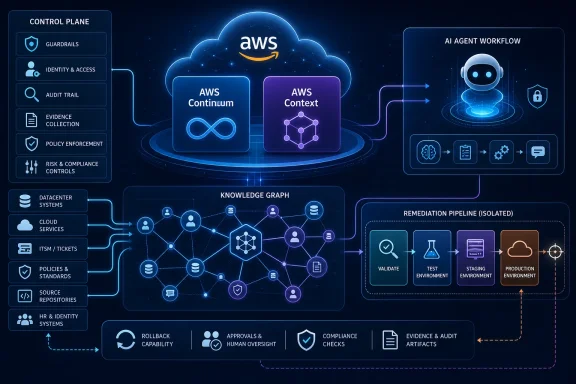 AWS Turns the Agent Pitch From Demos to Control Planes
For the last two years, the industry has treated AI agents as a kind of software theater. A prompt turns into a plan, a plan turns into tool calls, and the demo ends before anyone asks who approved the change, what data was used, or how the agent will be stopped when it misunderstands the task. AWS’s New York announcements are notable because they concede, implicitly, that the demo era is over.Continuum is framed as an AI-native security service for code vulnerabilities. It is meant to continuously discover vulnerabilities, validate which ones are actually exploitable, rank them by business impact, and drive remediation through customer-defined guardrails. That is not a chatbot stapled onto a scanner; it is AWS trying to compress the messy loop between detection, triage, proof, ticketing, patching, and validation.
Context attacks a different but related problem. Enterprise agents fail not only because they hallucinate, but because they operate without the organizational map that human employees slowly acquire: which database matters, what a project name refers to, which policy supersedes another, and how a customer, workload, account, or internal system relates to the rest of the company. AWS Context proposes to organize enterprise data into a governed knowledge graph that agents can query at runtime.
The phrase knowledge graph can sound like old wine in new bottles, and in some ways it is. Enterprises have been trying to model institutional knowledge for decades. What changes with agents is the consequence of not doing it: a search result may be incomplete, but an autonomous agent with incomplete context can take the wrong action faster than a human can notice.
Security at Machine Speed Is Also Risk at Machine Speed
AWS’s Continuum pitch rests on a plausible premise: vulnerability management cannot keep up if humans manually inspect every alert, validate exploitability, prioritize work, and chase remediation across sprawling application stacks. Security teams already drown in scanner output, dependency advisories, container findings, infrastructure misconfigurations, and application-specific risk. AI agents promise to turn that backlog into action.The dangerous part is that action is precisely where security automation becomes operational risk. A scanner that cries wolf is annoying. A remediation agent that patches the wrong branch, modifies a dependency without understanding runtime behavior, or deploys a fix that breaks authentication is a business incident wearing a security badge. AWS’s emphasis on isolated validation environments and guardrails is therefore not decorative; it is the product.
Continuum’s most important claim is not that it can find known vulnerabilities. The market already has many tools that do that. The meaningful claim is that it can prove which vulnerabilities are genuinely exploitable, connect that proof to business context, and then push remediation through a controlled path. If it works, the service shifts security from finding flaws to closing the loop.
That is also where AWS will face the hardest scrutiny. Security leaders do not simply need faster patch suggestions. They need explainable evidence, audit trails, rollback paths, change-control integration, and a clear boundary between recommendation and autonomous modification. The more Continuum promises machine-speed remediation, the more customers will ask what happens when the machine is wrong.
The February Kiro Controversy Became the Unofficial Backdrop
AWS did not announce Continuum and Context in a vacuum. Earlier this year, multiple reports said Amazon’s internal AI coding tools had been involved in service disruptions, including a December 2025 incident tied to Kiro, AWS’s agentic coding system. Amazon pushed back sharply, arguing that the relevant disruption was caused by misconfigured access controls and user error rather than an AI tool defect.That distinction matters legally and reputationally, but it matters less operationally. In production, “the AI made the change” and “a human gave the AI too much authority” collapse into the same postmortem category: an automated workflow was allowed to touch something important without sufficient constraint. The lesson for customers is not that Kiro is uniquely dangerous. The lesson is that agentic coding changes the blast radius of ordinary engineering mistakes.
This is why the new AWS DevOps Agent release-management preview is more consequential than it might appear. AWS says the agent can review code changes for release readiness and generate autonomous release tests tailored to the change rather than merely running a static test suite. In plain English, AWS is trying to put an AI reviewer and an AI test planner between AI-generated code and production.
That is a neat symmetry, but also a governance puzzle. If an agent writes code, another agent reviews it, and a third agent generates tests, the system may become faster without becoming safer unless humans can inspect the reasoning, policies, and evidence behind each stage. Enterprises will like the velocity story. Auditors will ask who had authority at each step.
Context Is AWS’s Bet That Hallucination Is an Architecture Problem
Hallucination has often been treated as a model problem: pick a better model, tune the prompt, reduce randomness, or add retrieval. AWS Context suggests a more enterprise-flavored diagnosis. Agents fabricate or misfire because they lack a governed, current, queryable representation of the business.That is a more useful framing. In a corporate environment, truth is rarely a single document. It is distributed across CRM systems, data lakes, wikis, ticket histories, code repositories, access policies, billing systems, and the undocumented memory of teams. An agent that cannot connect those pieces may produce fluent nonsense even when every individual retrieved snippet is technically accurate.
By turning company data into a shared knowledge graph, AWS wants Context to become a common substrate for agents across an organization. The ambition is not merely better search. It is to give multiple agents a consistent, governed view of entities and relationships: customers, applications, services, owners, controls, incidents, contracts, and dependencies.
The governance word is doing a lot of work here. A context layer that ignores permissions becomes a data-exfiltration machine. A context layer that is too restrictive becomes useless. AWS must thread the needle between helpful cross-enterprise memory and the hard boundaries that keep HR data, security findings, source code, customer records, and regulated information from leaking into the wrong workflow.
Bedrock AgentCore Is Becoming the Runtime AWS Needed All Along
The Continuum and Context announcements also make more sense when placed next to Amazon Bedrock AgentCore. AgentCore, introduced as AWS’s managed platform for deploying and operating agents, has been steadily accumulating the pieces that production customers expect: identity, memory, runtime isolation, tool access, gateway controls, observability, evaluation, and policy enforcement. The latest updates add more third-party data connectors and security filters, pushing it closer to an enterprise agent operating layer.This is the cloud-platform playbook. AWS rarely wins by having the flashiest interface. It wins by turning a messy workload into primitives that enterprises can buy, govern, monitor, and scale. EC2 did that for compute, S3 did it for object storage, IAM did it for access control, and Bedrock AgentCore is an attempt to do it for agent execution.
The challenge is that agents are not just another workload. They decide, plan, call tools, interpret feedback, and sometimes improvise. That makes the platform responsible not only for uptime and access control, but for constraining behavior that is probabilistic by design. Runtime infrastructure for agents has to care about intent, context, memory, and policy in ways that traditional application hosting did not.
AWS appears to understand this. The company’s agent stack is increasingly less about “bring your favorite model” and more about surrounding models with durable enterprise machinery. That machinery is unglamorous, but it is exactly what large customers will demand before allowing agents to operate across real business systems.
Kiro’s iOS App Is Small News With a Bigger Signal
The native iOS app for Kiro is not the biggest announcement, but it is an interesting one. Coding agents started as tools developers used while sitting in front of an IDE. Mobile control implies a different relationship: agents keep working when the developer is away, and the human becomes more of a supervisor, reviewer, and approver.That is powerful and unsettling. A mobile interface can make agent workflows more practical for distributed teams, on-call engineers, and managers overseeing long-running tasks. It can also normalize the idea that software work continues asynchronously under agent control, with humans dipping in to steer or approve rather than writing every line.
This is where consumer convenience collides with enterprise change management. If an agent can continue implementing a feature, updating a branch, or preparing a pull request while the developer is on a train, the organization needs crisp policies about what the agent may do unattended. Convenience is not a substitute for authorization.
The mobile app is therefore best read as part of the same production turn. AWS is not merely giving developers a portable coding companion. It is building a world in which agent work is persistent, cross-device, and operationally continuous. That makes release gates, identity boundaries, and context controls more important, not less.
The Enterprise Buyer Is Not Buying Autonomy; It Is Buying Accountability
The agent market has spent too much time selling autonomy as the feature. For enterprise IT, autonomy is a liability until accountability is solved. A system that can act independently must also be able to explain what it did, why it did it, what data it used, which policy allowed it, and how the organization can reverse or contain the result.That is why AWS’s announcements feel strategically coherent. Continuum addresses the accountability of security action. Context addresses the accountability of knowledge. DevOps Agent release management addresses the accountability of shipping. AgentCore addresses the accountability of runtime behavior.
None of this guarantees success. AWS still has to prove that these services work across heterogeneous enterprise environments, not just clean demos. Customers will want integration with existing scanners, ITSM systems, CI/CD pipelines, identity providers, data catalogs, and compliance workflows. The harder a company has worked to standardize its operations, the less patience it will have for an agent platform that demands a parallel universe.
There is also a trust asymmetry. If Continuum remediates 99 vulnerabilities correctly and breaks one critical service, the broken service will dominate the customer’s memory. If Context answers most agent queries well but leaks one sensitive relationship into the wrong workflow, the governance failure becomes the story. Enterprise AI infrastructure is graded on the incidents it prevents and the incidents it causes.
Microsoft, Google, and AWS Are Converging on the Same Wall
AWS is not alone in discovering that agents need more than models. Microsoft has been folding agents into Copilot, Azure AI Foundry, GitHub, Defender, and Microsoft 365 workflows. Google has pushed Vertex AI Agent Builder and its own agent infrastructure story. The competitive frontier is shifting from who can produce a convincing assistant to who can provide the safest substrate for thousands of assistants operating inside a company.That matters for WindowsForum readers because many organizations will not choose a single agent ecosystem. A Windows-heavy enterprise may use Microsoft 365 Copilot for documents and meetings, GitHub or Azure tooling for development, AWS for cloud workloads, ServiceNow for workflows, and specialized agents for security or finance. The future is not one agent. It is many agents contending for context, permissions, and authority.
In that world, AWS Context could become valuable if it serves as a governed layer for AWS-centric workloads. It could also become another silo if its graph is hard to reconcile with Microsoft Graph, enterprise data catalogs, or internal knowledge systems. The same is true for AgentCore: it may simplify production deployment for AWS customers, but multi-cloud and hybrid shops will ask how portable the patterns really are.
The winning platform may not be the one with the cleverest agent. It may be the one that makes agent behavior boring enough for change advisory boards, security operations centers, and compliance teams to tolerate. That is a less romantic vision of AI, but it is closer to how enterprises actually buy technology.
Windows Shops Should Read This as an Operations Story
For Windows administrators and IT pros, the AWS announcements may seem remote at first glance. Continuum is about code vulnerabilities, Context is about enterprise data graphs, and AgentCore is an AWS service family. But the operational pattern is familiar to anyone who has managed endpoints, identity, patching, or production change.Every automation wave begins with a promise to reduce toil. Then it creates a new control problem. PowerShell remoting, configuration management, endpoint detection and response, cloud orchestration, and CI/CD pipelines all improved speed while forcing administrators to rethink permissions, logging, rollback, and policy. Agents are simply the next automation layer, with a more ambiguous decision engine in the middle.
That ambiguity raises the bar for identity design. Agent identities should not be treated as borrowed human credentials. They need scoped permissions, separate audit trails, short-lived access, environment boundaries, and policies that distinguish between reading, proposing, testing, and changing. If an agent can touch production, it should be visible as an actor in production.
The same applies to data. A company that has not classified sensitive data, mapped system ownership, or cleaned up access sprawl will not become safer by adding a context graph. It may simply make messy permissions easier for agents to traverse. AWS Context could help disciplined organizations; it will not magically impose discipline where none exists.
The New AWS Stack Makes the Agent Pilot Look Naive
The most important message from AWS Summit New York is that small agent pilots are poor predictors of production success. A team can build a useful prototype with a model, a prompt, a vector store, and a few tool integrations. That prototype may still be nowhere near ready for real enterprise work.Production agents need threat modeling, test generation, release controls, context governance, identity boundaries, runtime isolation, memory management, observability, and incident response. They also need owners. An agent without an owner is not automation; it is unattended risk.
AWS is effectively packaging this realization into services. Continuum says vulnerability remediation needs agentic speed but controlled execution. Context says agents need business memory but governed access. DevOps Agent says AI-generated changes need AI-assisted release scrutiny, though not necessarily AI-only approval. AgentCore says agents need a managed runtime rather than a collection of scripts glued to APIs.
The irony is that the more serious the agent story becomes, the less magical it sounds. The real work is not getting a model to write code or answer a question. The real work is building the scaffolding around it so the organization can survive the answer.
The Practical Test Is Whether AWS Can Reduce Human Load Without Removing Human Judgment
AWS’s strongest case is that the current human process is already broken. Security teams cannot manually triage every vulnerability. Developers cannot anticipate every integration regression. Employees cannot locate every relevant policy, dependency, or customer detail buried across corporate systems. In that sense, agents are not replacing a well-functioning machine; they are being inserted into overloaded systems.But reducing human load is not the same as removing human judgment. The best near-term use of these services may be to prepare better decisions rather than make all decisions automatically. Continuum can validate exploitability and propose fixes. DevOps Agent can generate release tests and flag policy drift. Context can ground agents in the company’s actual data. Humans can then approve, reject, or refine actions with better evidence.
The danger is executive impatience. Once a vendor says “machine speed,” someone will ask why the machine still needs a human checkpoint. That is how productivity tools become incident generators. The right question is not how much autonomy the platform allows, but where autonomy is appropriate given the system’s blast radius.
Enterprises should therefore evaluate AWS’s agent stack by workflow class. Low-risk documentation updates, test generation, and advisory triage can tolerate more autonomy. Production configuration changes, access-control modifications, dependency upgrades in critical systems, and customer-data operations need stronger gates. The agent’s confidence score should never outrank the organization’s risk model.
The Real Announcement Is That Guardrails Have Become the Product
AWS used the Summit to announce services, but the broader announcement is cultural: guardrails are no longer an afterthought in agentic AI. They are the product. The cloud provider that can make agents observable, governed, contextual, and reversible will have a better enterprise story than the provider with the splashiest demo.This also exposes a tension in the word “agent.” In consumer AI, an agent is often sold as a helpful entity that does things for you. In enterprise IT, an agent is an actor inside a controlled system. It must have a role, a permission boundary, a log trail, a policy environment, and a failure mode. AWS is leaning into the second definition.
Continuum, Context, DevOps Agent, Kiro, and AgentCore are all different expressions of that same idea. Agents need to know more, do more, and be trusted less by default. The platform’s job is to let them become useful without letting them become sovereign.
That is a sober message for a market still addicted to acceleration. The agent future may be real, but it will arrive through procurement reviews, security exceptions, compliance sign-offs, and uncomfortable postmortems. AWS appears to be betting that whoever owns those frictions owns the production market.
The AWS Agent Push Leaves Buyers With Fewer Excuses and Harder Homework
The concrete lesson from AWS’s New York announcements is not that every enterprise should immediately hand remediation, release testing, and business context to AI agents. It is that the infrastructure for doing so is becoming more explicit, which means buyers can ask sharper questions before they deploy.- AWS Continuum is best understood as an attempt to automate the full vulnerability-management loop, not merely another scanner with an AI interface.
- AWS Context reflects a growing consensus that enterprise agents need governed business knowledge at runtime, not just larger prompts or better retrieval tricks.
- The AWS DevOps Agent release-management preview is a direct response to the risk that AI-generated code can move faster than traditional review and testing processes.
- Kiro’s iOS app signals that agentic development is becoming persistent and cross-device, which increases the need for approval gates and auditability.
- Bedrock AgentCore is becoming the control plane AWS needs if it wants customers to run agents as production infrastructure rather than experiments.
- The unresolved issue is not whether agents can act, but whether enterprises can prove that those actions were authorized, contextual, tested, and reversible.
References
- Primary source: AIBase
Published: 2026-06-22T03:50:08.897982
AWS Launches Two New Services, Continuum and Context, to Fully Strengthen AI Agent Security and Business Background Capabilities
At the New York AWS Summit, Amazon launched Continuum and Context services to address security risks and lack of context in AI agent production deployment. Contnews.aibase.com
- Related coverage: aws.amazon.com
AWS DevOps Agent adds release management capability (preview) - AWS
Discover more about what's new at AWS with AWS DevOps Agent adds release management capability (preview)aws.amazon.com
- Related coverage: ciodive.com
AWS unveils agent security, data access tools | CIO Dive
The updates reflect Anthropic's Mythos model and the speed at which vulnerabilities can be surfaced.www.ciodive.com
- Related coverage: tocconsulting.fr
- Related coverage: auto-post.io
Claude Outage Reveals AI Agent Fragility
Claude’s 2026 outages show how UI/auth, multi-surface coupling, and tooling bugs can break AI agents, and why resilience needs real failovers. auto-post.io
- Related coverage: moneycontrol.com
AWS outage: Amazon says AI agent mistake was caused by human error that led to service disruption
Amazon says a December AWS service disruption linked to an internal AI coding agent stemmed from human permission errors, not automation, after the tool was allowed broader system access.www.moneycontrol.com
- Related coverage: propelcode.ai
AI Coding Agent Guardrails: Sandboxing, Prompt Caching, and Code Review Gates | Propel Code
Learn how to deploy AI coding agents safely with sandboxing, prompt caching, and risk-based code review gates that reduce incidents and keep teams fast. www.propelcode.ai
