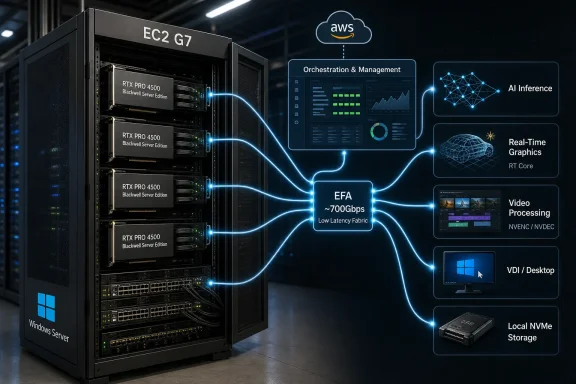
Amazon Web Services made Amazon EC2 G7 instances generally available on June 18, 2026, in the US East (Ohio) and US West (Oregon) regions, pairing NVIDIA RTX PRO 4500 Blackwell Server Edition GPUs with custom sixth-generation Intel Xeon Scalable processors. The launch is not AWS’s biggest Blackwell announcement by raw GPU muscle, but it may be the more revealing one. G7 is aimed at the messy middle of accelerated computing: inference, graphics, video, VDI, rendering, and analytics jobs that need GPU capacity without necessarily requiring top-tier training-class hardware. That makes it a sharper signal of where cloud GPU competition is moving next.
The cloud GPU story is usually told from the top down. Hyperscalers boast about the largest clusters, the fastest interconnects, and the most exotic accelerators because that is where the AI arms race is easiest to dramatize. But most enterprise workloads do not begin life as thousand-GPU training runs; they arrive as inference services, rendering queues, virtual workstation pools, transcoding pipelines, or analytics jobs that need acceleration at a price the finance team will tolerate.
That is the market G7 is built to court. AWS says the new instances deliver up to 4.6 times the AI inference performance and up to 2.1 times the graphics performance of G6, while using NVIDIA’s RTX PRO 4500 Blackwell Server Edition GPUs rather than the larger RTX PRO 6000 Blackwell GPUs used in the already-announced G7e family. In plain terms, AWS is widening Blackwell availability downward, not merely upward.
That matters because cloud GPU scarcity is no longer just about whether a hyperscaler can offer the fastest part NVIDIA ships. It is about whether customers can get the right accelerator in enough regions, at enough sizes, with enough storage and networking attached. The practical bottleneck for many companies is not that they cannot imagine a bigger model or richer simulation; it is that they cannot operationalize a GPU fleet without overspending on hardware designed for someone else’s workload.
G7 gives AWS a new answer for that problem. It says: if you need Blackwell-generation features, better memory bandwidth, modern video engines, and serious networking, you no longer have to jump straight to the heavier G7e class. That is a more subtle product move than a flagship launch, but for IT buyers it may be the more useful one.
This is where the product positioning becomes important. G7 is not pretending to be a universal AI supercomputer. It is a GPU instance family that trades absolute headroom for broader deployability and workload fit. AWS is effectively segmenting Blackwell into a more disciplined set of options: G7 for mainstream accelerated work, G7e for heavier graphics and generative AI jobs with more memory, and the broader EC2 accelerated portfolio for training, HPC, and specialized use cases.
For WindowsForum readers, that distinction should sound familiar. The PC industry has lived for years with GPU tiers that differ less by architecture than by memory, thermals, driver support, and software certification. Cloud instances are now being carved up the same way. The architecture may be Blackwell, but the business decision is about where each slice of Blackwell lands in the stack.
The RTX PRO 4500 Blackwell Server Edition gives AWS a part that can plausibly serve a wide customer base without turning every deployment into a premium procurement exercise. The 32 GB frame buffer is meaningful for inference and professional graphics, especially when compared with older virtual workstation and video pipelines. But it also imposes discipline: customers still need to profile models, quantify batch sizes, and understand when they are memory-bound rather than compute-bound.
That is the right kind of constraint. In the first wave of generative AI adoption, too many teams treated GPU selection as a ladder where the only direction was up. G7 nudges the conversation back toward workload engineering. If an inference endpoint, rendering service, or analytics pipeline runs well on a 32 GB Blackwell GPU, buying a larger slice of hardware is not strategy; it is waste.
That is not a side note. It is an admission that accelerated computing has become a systems problem. GPU performance alone does not rescue a workload if data movement, storage throughput, or inter-node latency becomes the bottleneck. The workloads AWS names — inference, graphics-intensive applications, GPU-accelerated analytics, and multi-node jobs — all punish weak plumbing.
The inclusion of NVIDIA GPUDirect Peer-to-Peer for multi-GPU sizes and GPUDirect RDMA with EFA is part of the same story. AWS is trying to make G7 look less like a simple PCIe card rental and more like a cloud-native GPU platform. That difference matters for teams building distributed inference, analytics on Kubernetes, or rendering and media workflows that spill beyond a single machine.
Local NVMe storage of up to 7.6 TB also belongs in this argument. Keeping models, intermediate datasets, textures, video assets, or analytics working sets close to the GPU can reduce the kind of data shuffling that turns theoretical accelerator performance into disappointing wall-clock results. The storage number is not glamorous, but it is exactly the sort of specification that sysadmins and platform engineers notice after the demo ends.
G7’s value will therefore depend less on a single benchmark than on the balance of GPU memory, CPU allocation, network bandwidth, EBS throughput, and local disk. AWS has published seven sizes, from single-GPU instances up through eight-GPU and bare-metal configurations. That range gives customers room to tune, but it also demands more careful testing than a marketing table can provide.
That is why AWS’s “up to 4.6x” inference claim is doing a lot of work. If customers can serve the same workload with fewer instances, lower latency, or better batching, the economics of AI deployment change. But the phrase “up to” is doing work too. Real-world inference gains depend on model architecture, precision, batching strategy, memory pressure, framework support, and whether the application is actually GPU-bound.
For administrators, the practical lesson is to treat G7 as a candidate platform, not an automatic migration target. Teams running G6 today should benchmark their actual models before assuming the headline uplift applies. A vision workload using modern Tensor Cores may see a very different improvement from a lightly accelerated application where preprocessing, network calls, or storage reads dominate.
The more interesting point is that AWS now has a stronger answer for organizations that want to industrialize inference without necessarily entering the H100-or-bust procurement culture. NVIDIA’s data center flagship parts remain essential for certain jobs, but a great deal of enterprise AI is likely to be served by smaller, denser, more targeted accelerators. G7 is part of that normalization.
This is also where Windows developers and administrators should pay attention. AI inference is no longer confined to Linux-first research environments. It increasingly shows up in business applications, media workflows, virtual desktops, call center tools, and internal automation. G7’s support for Windows Server alongside Amazon Linux, Ubuntu, and RHEL makes the launch relevant beyond the usual Python-and-Kubernetes crowd.
For VDI, the argument is straightforward. Many organizations still need remote desktops that can handle CAD, 3D visualization, geospatial applications, engineering tools, media review, or GPU-accelerated productivity workloads. These are not always enormous jobs, but they are intolerant of stutter, driver weirdness, and unpredictable capacity. A cloud instance family that supports DirectX, Vulkan, and OpenGL with NVIDIA driver integration has obvious appeal.
The graphics claim of up to 2.1 times G6 performance should be read in that context. It is not merely about prettier pixels. It is about whether a remote workstation can feel responsive enough for professionals who are used to local hardware, and whether IT can centralize those workstations without creating a worse experience.
Video is another telling use case. G7 includes ninth-generation NVENC and sixth-generation NVDEC engines, with support for 4:2:2 encode and decode workflows and a claimed 1.5 times improvement in concurrent streams over G6. That speaks directly to broadcasters, post-production teams, streaming platforms, training-video pipelines, and anyone building automated media processing at scale.
These markets are less fashionable than generative AI, but they are real. They also tend to have clearer ROI than speculative AI prototypes. A studio that can finish renders faster, a broadcaster that can process more streams, or an engineering firm that can support more remote GPU desktops has a concrete operational story. AWS knows this, and G7 is positioned accordingly.
For cloud-native teams, this is the natural end state. Inference services, analytics pipelines, and batch jobs all want scheduling, autoscaling, observability, and standardized deployment pipelines. Kubernetes is imperfect, but it has become the default abstraction for many platform teams that need to share expensive compute across internal customers.
The danger is that Kubernetes can also make GPU waste easier to hide. A cluster may look modern while silently stranding accelerator capacity because requests, limits, node groups, device plugins, and workload placement are poorly tuned. With G7, the expensive part of the bill is still the GPU, not the YAML.
That is why the operational maturity around G7 will matter as much as the silicon. Driver baselines, AMI maintenance, container images, CUDA compatibility, monitoring, and workload isolation all become part of the platform contract. AWS can provide the building blocks, but customers still need disciplined fleet management.
The upside is that G7’s multiple sizes should help platform teams avoid a one-size-fits-all GPU pool. A lightweight inference service does not need to wait behind an eight-GPU job if the fleet is designed properly. A GPU-accelerated Spark or EMR workload should not be forced onto a virtual workstation-shaped instance if a better fit exists. The instance family gives architects more choices; it does not remove the need to make them.
For those shops, G7 is potentially a bridge. It can support cloud-hosted GPU desktops, professional visualization, rendering, or Windows-based application stacks that need modern NVIDIA acceleration. Compatibility with DirectX, Vulkan, and OpenGL matters because legacy and commercial software ecosystems do not rewrite themselves around cloud-native assumptions overnight.
There is also a security and management angle. Centralizing GPU workstations in the cloud can reduce data sprawl on high-end local PCs, simplify access controls, and make it easier to scale contractor or project-based environments. But it can also introduce new failure modes: identity misconfiguration, network latency, driver drift, image sprawl, and cost overruns from idle GPU instances.
The Windows opportunity, then, is not simply that G7 supports Windows Server. It is that cloud GPU infrastructure can now be integrated into familiar enterprise management patterns while still offering modern acceleration. That is attractive, but only if administrators resist the temptation to treat cloud GPUs like ordinary VMs.
A GPU-backed Windows instance is not an ordinary VM. It has specialized drivers, licensing considerations, workload-specific performance profiles, and a cost curve that punishes casual provisioning. The organizations that benefit most will be the ones that wrap G7 in policy: scheduled shutdowns, image governance, usage reporting, and clear ownership.
AWS points customers toward regional expansion planning through its capabilities-by-region tooling, which is useful but not the same as broad availability. Until G7 reaches more regions, many customers will have to decide whether the performance gain justifies moving workloads or data closer to the available capacity. That trade-off is especially sensitive for regulated industries and media companies with large assets.
This is where the cloud GPU market differs from ordinary compute. When a conventional instance family launches in a handful of regions, customers may grumble and wait. When a GPU family launches in limited regions, early capacity can become strategically important. Teams that need the hardware may adapt architectures around it rather than waiting for perfect regional coverage.
The regional constraint also complicates comparisons with on-premises hardware. A company evaluating RTX PRO Blackwell servers in its own data center may find the cloud attractive for elasticity, procurement speed, and managed networking. But if the nearest supported AWS region is not suitable, the argument weakens quickly. Latency and data movement costs are not abstractions.
For now, G7’s limited footprint should temper the hype. It is a general availability launch, not universal availability. The distinction matters for anyone planning production services rather than experiments.
That is sensible because GPU monoculture at the instance level is a trap. If every workload is pushed toward the largest available accelerator, customers overspend and capacity gets distorted. If every workload is forced onto cheaper instances with insufficient memory or bandwidth, teams waste engineering time fighting bottlenecks. The correct answer is portfolio depth.
AWS also has its own silicon agenda, including Trainium and Inferentia, but G7 shows that NVIDIA remains central to the broadest swath of accelerated workloads. Professional graphics, CUDA software compatibility, video engines, and enterprise driver support are not easily replaced by a custom AI accelerator. NVIDIA’s moat is not just flops; it is the surrounding software and workflow gravity.
That creates a delicate balance for AWS. The company wants to offer differentiated infrastructure and avoid being merely a reseller of scarce NVIDIA capacity. But customers often want the NVIDIA ecosystem because their tools, models, frameworks, and staff expertise already depend on it. G7 is AWS leaning into that reality while packaging it in EC2’s familiar operational model.
For customers, the best reading is pragmatic. G7 is not proof that every accelerated workload should run on NVIDIA, nor is it evidence that custom cloud silicon is irrelevant. It is evidence that the enterprise GPU market is fragmenting into workload-specific tiers, and cloud buyers need to become more fluent in those distinctions.
That is not a criticism unique to AWS. All infrastructure vendors market best-case or representative comparisons. The job of IT professionals is to translate those claims into internal benchmarks that reflect actual service-level objectives and cost constraints.
For AI inference, the key questions are tokens per second, latency distribution, batch size, memory residency, quantization strategy, and utilization. For graphics, the questions are frame rate, scene complexity, encoding overhead, user density, and application certification. For analytics, the questions become data locality, shuffle behavior, GPU acceleration coverage, and whether the pipeline spends enough time in accelerated code to justify the instance.
The result may be that G7 is excellent for some jobs and merely adequate for others. That is normal. The problem is not variability; the problem is pretending variability does not exist.
This is where WindowsForum’s sysadmin audience should be especially conservative. Do not migrate a VDI pool, rendering farm, or inference endpoint because the instance family is new. Build a representative test, run it under realistic concurrency, measure the bill, and compare against the alternatives. The fastest GPU is not always the cheapest finished job.
AWS says G7 can be purchased as On-Demand Instances, Spot Instances, or through Savings Plans. That purchasing flexibility matters because accelerated workloads have different economic shapes. A persistent VDI deployment may reward commitment discounts, while batch rendering or analytics may be able to exploit Spot capacity if interruption handling is designed well.
But pricing strategy cannot rescue poor architecture. An idle GPU instance remains expensive even with a discount. A poorly batched inference service can burn money while delivering mediocre latency. A virtual workstation pool without automated shutdown policies can become a silent budget leak.
The stronger the hardware gets, the more embarrassing those mistakes become. G7’s improvements in memory bandwidth, networking, storage, and video throughput raise the ceiling, but they also raise the stakes for operational discipline. Cloud GPUs are not magic accelerators; they are premium infrastructure that must be scheduled, monitored, and justified.
 AWS Is Selling the Blackwell Middle Class
The cloud GPU story is usually told from the top down. Hyperscalers boast about the largest clusters, the fastest interconnects, and the most exotic accelerators because that is where the AI arms race is easiest to dramatize. But most enterprise workloads do not begin life as thousand-GPU training runs; they arrive as inference services, rendering queues, virtual workstation pools, transcoding pipelines, or analytics jobs that need acceleration at a price the finance team will tolerate.That is the market G7 is built to court. AWS says the new instances deliver up to 4.6 times the AI inference performance and up to 2.1 times the graphics performance of G6, while using NVIDIA’s RTX PRO 4500 Blackwell Server Edition GPUs rather than the larger RTX PRO 6000 Blackwell GPUs used in the already-announced G7e family. In plain terms, AWS is widening Blackwell availability downward, not merely upward.
That matters because cloud GPU scarcity is no longer just about whether a hyperscaler can offer the fastest part NVIDIA ships. It is about whether customers can get the right accelerator in enough regions, at enough sizes, with enough storage and networking attached. The practical bottleneck for many companies is not that they cannot imagine a bigger model or richer simulation; it is that they cannot operationalize a GPU fleet without overspending on hardware designed for someone else’s workload.
G7 gives AWS a new answer for that problem. It says: if you need Blackwell-generation features, better memory bandwidth, modern video engines, and serious networking, you no longer have to jump straight to the heavier G7e class. That is a more subtle product move than a flagship launch, but for IT buyers it may be the more useful one.
The RTX PRO 4500 Is the Interesting Constraint
The defining number on G7 is not the maximum of eight GPUs. It is 32 GB of GPU memory per GPU. That is enough to cover a large range of inference, visualization, media, and virtual workstation workloads, but it is not a blank check for the largest models or most memory-hungry training jobs.This is where the product positioning becomes important. G7 is not pretending to be a universal AI supercomputer. It is a GPU instance family that trades absolute headroom for broader deployability and workload fit. AWS is effectively segmenting Blackwell into a more disciplined set of options: G7 for mainstream accelerated work, G7e for heavier graphics and generative AI jobs with more memory, and the broader EC2 accelerated portfolio for training, HPC, and specialized use cases.
For WindowsForum readers, that distinction should sound familiar. The PC industry has lived for years with GPU tiers that differ less by architecture than by memory, thermals, driver support, and software certification. Cloud instances are now being carved up the same way. The architecture may be Blackwell, but the business decision is about where each slice of Blackwell lands in the stack.
The RTX PRO 4500 Blackwell Server Edition gives AWS a part that can plausibly serve a wide customer base without turning every deployment into a premium procurement exercise. The 32 GB frame buffer is meaningful for inference and professional graphics, especially when compared with older virtual workstation and video pipelines. But it also imposes discipline: customers still need to profile models, quantify batch sizes, and understand when they are memory-bound rather than compute-bound.
That is the right kind of constraint. In the first wave of generative AI adoption, too many teams treated GPU selection as a ladder where the only direction was up. G7 nudges the conversation back toward workload engineering. If an inference endpoint, rendering service, or analytics pipeline runs well on a 32 GB Blackwell GPU, buying a larger slice of hardware is not strategy; it is waste.
Networking Is the Quiet Admission That GPUs Are Not Enough
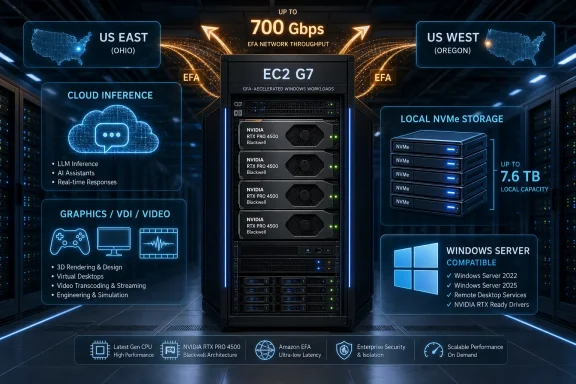
AWS’s most aggressive G7 comparison is not the AI inference uplift. It is the networking jump. The top G7 sizes support up to 700 Gbps of Elastic Fabric Adapter-enabled networking throughput, which AWS frames as seven times the G6 generation.That is not a side note. It is an admission that accelerated computing has become a systems problem. GPU performance alone does not rescue a workload if data movement, storage throughput, or inter-node latency becomes the bottleneck. The workloads AWS names — inference, graphics-intensive applications, GPU-accelerated analytics, and multi-node jobs — all punish weak plumbing.
The inclusion of NVIDIA GPUDirect Peer-to-Peer for multi-GPU sizes and GPUDirect RDMA with EFA is part of the same story. AWS is trying to make G7 look less like a simple PCIe card rental and more like a cloud-native GPU platform. That difference matters for teams building distributed inference, analytics on Kubernetes, or rendering and media workflows that spill beyond a single machine.
Local NVMe storage of up to 7.6 TB also belongs in this argument. Keeping models, intermediate datasets, textures, video assets, or analytics working sets close to the GPU can reduce the kind of data shuffling that turns theoretical accelerator performance into disappointing wall-clock results. The storage number is not glamorous, but it is exactly the sort of specification that sysadmins and platform engineers notice after the demo ends.
G7’s value will therefore depend less on a single benchmark than on the balance of GPU memory, CPU allocation, network bandwidth, EBS throughput, and local disk. AWS has published seven sizes, from single-GPU instances up through eight-GPU and bare-metal configurations. That range gives customers room to tune, but it also demands more careful testing than a marketing table can provide.
Inference Has Become the Default Enterprise AI Workload
The emphasis on AI inference is not accidental. Training may still drive headlines and capital spending, but inference is where many enterprises now feel the recurring operational cost. Every chatbot, document pipeline, vision service, recommender, summarizer, fraud model, and speech workflow eventually becomes an availability and latency problem.That is why AWS’s “up to 4.6x” inference claim is doing a lot of work. If customers can serve the same workload with fewer instances, lower latency, or better batching, the economics of AI deployment change. But the phrase “up to” is doing work too. Real-world inference gains depend on model architecture, precision, batching strategy, memory pressure, framework support, and whether the application is actually GPU-bound.
For administrators, the practical lesson is to treat G7 as a candidate platform, not an automatic migration target. Teams running G6 today should benchmark their actual models before assuming the headline uplift applies. A vision workload using modern Tensor Cores may see a very different improvement from a lightly accelerated application where preprocessing, network calls, or storage reads dominate.
The more interesting point is that AWS now has a stronger answer for organizations that want to industrialize inference without necessarily entering the H100-or-bust procurement culture. NVIDIA’s data center flagship parts remain essential for certain jobs, but a great deal of enterprise AI is likely to be served by smaller, denser, more targeted accelerators. G7 is part of that normalization.
This is also where Windows developers and administrators should pay attention. AI inference is no longer confined to Linux-first research environments. It increasingly shows up in business applications, media workflows, virtual desktops, call center tools, and internal automation. G7’s support for Windows Server alongside Amazon Linux, Ubuntu, and RHEL makes the launch relevant beyond the usual Python-and-Kubernetes crowd.
Graphics and VDI Are No Longer Side Quests
AWS’s inclusion of graphics rendering, game streaming, spatial computing, and virtual desktop infrastructure is not just padding around the AI pitch. NVIDIA’s RTX PRO line carries a professional graphics heritage, and Blackwell’s improvements to ray tracing, Tensor operations, and video engines are not useful only to model-serving teams.For VDI, the argument is straightforward. Many organizations still need remote desktops that can handle CAD, 3D visualization, geospatial applications, engineering tools, media review, or GPU-accelerated productivity workloads. These are not always enormous jobs, but they are intolerant of stutter, driver weirdness, and unpredictable capacity. A cloud instance family that supports DirectX, Vulkan, and OpenGL with NVIDIA driver integration has obvious appeal.
The graphics claim of up to 2.1 times G6 performance should be read in that context. It is not merely about prettier pixels. It is about whether a remote workstation can feel responsive enough for professionals who are used to local hardware, and whether IT can centralize those workstations without creating a worse experience.
Video is another telling use case. G7 includes ninth-generation NVENC and sixth-generation NVDEC engines, with support for 4:2:2 encode and decode workflows and a claimed 1.5 times improvement in concurrent streams over G6. That speaks directly to broadcasters, post-production teams, streaming platforms, training-video pipelines, and anyone building automated media processing at scale.
These markets are less fashionable than generative AI, but they are real. They also tend to have clearer ROI than speculative AI prototypes. A studio that can finish renders faster, a broadcaster that can process more streams, or an engineering firm that can support more remote GPU desktops has a concrete operational story. AWS knows this, and G7 is positioned accordingly.
Kubernetes Is Becoming the GPU Control Plane
AWS calls out Amazon EMR on Amazon EKS and provides guidance for using G7 instances with EKS AMIs built with NVIDIA driver version R595. That detail is easy to skim past, but it points toward a larger platform shift. GPUs are increasingly being managed as pooled infrastructure under Kubernetes rather than as hand-tended pets.For cloud-native teams, this is the natural end state. Inference services, analytics pipelines, and batch jobs all want scheduling, autoscaling, observability, and standardized deployment pipelines. Kubernetes is imperfect, but it has become the default abstraction for many platform teams that need to share expensive compute across internal customers.
The danger is that Kubernetes can also make GPU waste easier to hide. A cluster may look modern while silently stranding accelerator capacity because requests, limits, node groups, device plugins, and workload placement are poorly tuned. With G7, the expensive part of the bill is still the GPU, not the YAML.
That is why the operational maturity around G7 will matter as much as the silicon. Driver baselines, AMI maintenance, container images, CUDA compatibility, monitoring, and workload isolation all become part of the platform contract. AWS can provide the building blocks, but customers still need disciplined fleet management.
The upside is that G7’s multiple sizes should help platform teams avoid a one-size-fits-all GPU pool. A lightweight inference service does not need to wait behind an eight-GPU job if the fleet is designed properly. A GPU-accelerated Spark or EMR workload should not be forced onto a virtual workstation-shaped instance if a better fit exists. The instance family gives architects more choices; it does not remove the need to make them.
Windows Server Support Keeps the Door Open for Hybrid Shops
The AWS announcement explicitly lists Windows Server among supported operating systems. That may sound routine, but it is important for a Windows-heavy readership because accelerated cloud computing is often framed as a Linux-only story. In practice, many enterprises run mixed environments where Windows applications, Active Directory integration, commercial graphics tools, and remote desktop workflows remain central.For those shops, G7 is potentially a bridge. It can support cloud-hosted GPU desktops, professional visualization, rendering, or Windows-based application stacks that need modern NVIDIA acceleration. Compatibility with DirectX, Vulkan, and OpenGL matters because legacy and commercial software ecosystems do not rewrite themselves around cloud-native assumptions overnight.
There is also a security and management angle. Centralizing GPU workstations in the cloud can reduce data sprawl on high-end local PCs, simplify access controls, and make it easier to scale contractor or project-based environments. But it can also introduce new failure modes: identity misconfiguration, network latency, driver drift, image sprawl, and cost overruns from idle GPU instances.
The Windows opportunity, then, is not simply that G7 supports Windows Server. It is that cloud GPU infrastructure can now be integrated into familiar enterprise management patterns while still offering modern acceleration. That is attractive, but only if administrators resist the temptation to treat cloud GPUs like ordinary VMs.
A GPU-backed Windows instance is not an ordinary VM. It has specialized drivers, licensing considerations, workload-specific performance profiles, and a cost curve that punishes casual provisioning. The organizations that benefit most will be the ones that wrap G7 in policy: scheduled shutdowns, image governance, usage reporting, and clear ownership.
Region Availability Is the Reality Check
G7 launches in two regions: US East (Ohio) and US West (Oregon). That is a meaningful start, but it is also a reminder that cloud GPU availability remains geographically constrained. For global enterprises, two regions may not be enough to satisfy latency, data residency, disaster recovery, or internal policy requirements.AWS points customers toward regional expansion planning through its capabilities-by-region tooling, which is useful but not the same as broad availability. Until G7 reaches more regions, many customers will have to decide whether the performance gain justifies moving workloads or data closer to the available capacity. That trade-off is especially sensitive for regulated industries and media companies with large assets.
This is where the cloud GPU market differs from ordinary compute. When a conventional instance family launches in a handful of regions, customers may grumble and wait. When a GPU family launches in limited regions, early capacity can become strategically important. Teams that need the hardware may adapt architectures around it rather than waiting for perfect regional coverage.
The regional constraint also complicates comparisons with on-premises hardware. A company evaluating RTX PRO Blackwell servers in its own data center may find the cloud attractive for elasticity, procurement speed, and managed networking. But if the nearest supported AWS region is not suitable, the argument weakens quickly. Latency and data movement costs are not abstractions.
For now, G7’s limited footprint should temper the hype. It is a general availability launch, not universal availability. The distinction matters for anyone planning production services rather than experiments.
AWS Is Making a Portfolio Argument Against GPU Monoculture
The arrival of G7 just months after G7e helps clarify AWS’s GPU strategy. The company is not betting on a single Blackwell instance family to serve every customer. It is building a ladder of NVIDIA-backed options that cover different memory, performance, and cost profiles.That is sensible because GPU monoculture at the instance level is a trap. If every workload is pushed toward the largest available accelerator, customers overspend and capacity gets distorted. If every workload is forced onto cheaper instances with insufficient memory or bandwidth, teams waste engineering time fighting bottlenecks. The correct answer is portfolio depth.
AWS also has its own silicon agenda, including Trainium and Inferentia, but G7 shows that NVIDIA remains central to the broadest swath of accelerated workloads. Professional graphics, CUDA software compatibility, video engines, and enterprise driver support are not easily replaced by a custom AI accelerator. NVIDIA’s moat is not just flops; it is the surrounding software and workflow gravity.
That creates a delicate balance for AWS. The company wants to offer differentiated infrastructure and avoid being merely a reseller of scarce NVIDIA capacity. But customers often want the NVIDIA ecosystem because their tools, models, frameworks, and staff expertise already depend on it. G7 is AWS leaning into that reality while packaging it in EC2’s familiar operational model.
For customers, the best reading is pragmatic. G7 is not proof that every accelerated workload should run on NVIDIA, nor is it evidence that custom cloud silicon is irrelevant. It is evidence that the enterprise GPU market is fragmenting into workload-specific tiers, and cloud buyers need to become more fluent in those distinctions.
The Benchmark Claims Need Workload-Specific Skepticism
The headline performance claims are useful signposts, but they are not purchasing advice by themselves. “Up to 4.6x” inference performance and “up to 2.1x” graphics performance compared with G6 tell us that AWS has meaningful generational gains to advertise. They do not tell us what a particular customer will see after accounting for model size, driver versions, storage patterns, network paths, application code, and user concurrency.That is not a criticism unique to AWS. All infrastructure vendors market best-case or representative comparisons. The job of IT professionals is to translate those claims into internal benchmarks that reflect actual service-level objectives and cost constraints.
For AI inference, the key questions are tokens per second, latency distribution, batch size, memory residency, quantization strategy, and utilization. For graphics, the questions are frame rate, scene complexity, encoding overhead, user density, and application certification. For analytics, the questions become data locality, shuffle behavior, GPU acceleration coverage, and whether the pipeline spends enough time in accelerated code to justify the instance.
The result may be that G7 is excellent for some jobs and merely adequate for others. That is normal. The problem is not variability; the problem is pretending variability does not exist.
This is where WindowsForum’s sysadmin audience should be especially conservative. Do not migrate a VDI pool, rendering farm, or inference endpoint because the instance family is new. Build a representative test, run it under realistic concurrency, measure the bill, and compare against the alternatives. The fastest GPU is not always the cheapest finished job.
The Cloud GPU Buyer Now Needs a Sharper Checklist
The G7 launch is a useful milestone because it makes the cloud GPU decision more granular. Buyers are no longer choosing simply between “GPU” and “no GPU,” or even between old and new generations. They are choosing among memory tiers, driver stacks, interconnect options, video engines, regional availability, operating systems, and procurement models.AWS says G7 can be purchased as On-Demand Instances, Spot Instances, or through Savings Plans. That purchasing flexibility matters because accelerated workloads have different economic shapes. A persistent VDI deployment may reward commitment discounts, while batch rendering or analytics may be able to exploit Spot capacity if interruption handling is designed well.
But pricing strategy cannot rescue poor architecture. An idle GPU instance remains expensive even with a discount. A poorly batched inference service can burn money while delivering mediocre latency. A virtual workstation pool without automated shutdown policies can become a silent budget leak.
The stronger the hardware gets, the more embarrassing those mistakes become. G7’s improvements in memory bandwidth, networking, storage, and video throughput raise the ceiling, but they also raise the stakes for operational discipline. Cloud GPUs are not magic accelerators; they are premium infrastructure that must be scheduled, monitored, and justified.
The G7 Launch Gives IT a Practical Scorecard
G7 is not the kind of launch that should trigger a reflexive migration, but it is the kind that should trigger a serious evaluation. The best candidates are workloads already constrained by G6-era GPU memory bandwidth, video throughput, graphics performance, or network-limited multi-GPU communication. The weaker candidates are workloads whose bottlenecks sit elsewhere.- AWS has made EC2 G7 instances generally available first in US East (Ohio) and US West (Oregon), so regional fit is the first production constraint.
- Each G7 GPU provides 32 GB of memory, making the family better suited to mainstream inference, graphics, media, VDI, and analytics than to the largest memory-hungry AI workloads.
- The biggest architectural upgrade may be the surrounding system design, including up to 700 Gbps EFA networking and up to 7.6 TB of local NVMe storage.
- Windows Server support and NVIDIA graphics API compatibility make G7 relevant for virtual workstations and professional visualization, not just Linux-based AI services.
- Teams should benchmark real workloads against G6, G7e, and any relevant non-GPU or custom-accelerator alternatives before treating AWS’s headline gains as their own.
References
- Primary source: HPCwire
Published: 2026-06-19T21:40:08.756293
BigDATAwire - Data Science • AI • Advanced Analytics
June 19, 2026 — Amazon Web Services (AWS) has announced the general availability of Amazon Elastic Compute Cloud (Amazon EC2) G7 instances, delivering high performance GPU acceleration for AI inference, graphics, and […]www.hpcwire.com - Related coverage: aws.amazon.com
Amazon EC2 G7 instances are now generally available - AWS
Discover more about what's new at AWS with Amazon EC2 G7 instances are now generally availableaws.amazon.com
- Related coverage: thenasguy.com
Announcing Amazon EC2 G7 instances accelerated by NVIDIA RTX PRO 4500 Blackwell Server Edition GPUs - The NAS Guy
Today, we’re announcing the general availability of Amazon Elastic Compute Cloud (Amazon EC2) G7 instances, delivering high performance GPU acceleration for AI inference, graphics, and data analytics workloads. AWS is the first major cloud provider to support NVIDIA RTX PRO 4500 Blackwell Server...www.thenasguy.com - Related coverage: aws-news.com
Announcing Amazon EC2 G7e instances accelerated by NVIDIA RTX PRO 6000 Blackwell Server Edition GPUs | The AWS News Feed
Amazon EC2 G7e instances powered by NVIDIA RTX PRO 6000 Blackwell GPUs deliver up to 2.3x faster AI inference performance and support models up to 70B…aws-news.com - Related coverage: nvidianews.nvidia.com