

NVIDIA and AWS Move the AI Fight Downstream
The first phase of the generative AI boom was obsessed with training. The public benchmarks, keynote theatrics, and trillion-dollar valuation arguments all orbited the same idea: whoever controlled the biggest GPU clusters controlled the future. That was not wrong, exactly, but it was incomplete.
Enterprises do not live inside model-training demos. They live inside ticket queues, dashboards, compliance reviews, latency budgets, monthly invoices, and awkward meetings where someone asks why the AI pilot worked beautifully in a lab but falls apart when connected to real data. AWS and NVIDIA’s latest collaboration is aimed squarely at that gap.
The new EC2 G7 instances matter because they put Blackwell-class GPU capacity into a more practical tier of the cloud. The cuVS integration in OpenSearch Serverless matters because retrieval — finding the right context for a model before it answers — has become one of the least glamorous but most important parts of production AI. Together, they suggest a maturing market: AI infrastructure is moving from “can we build it?” to “can we operate it cheaply, repeatedly, and without heroic engineering?”
That is a different kind of contest from the one NVIDIA has been winning in the data center for the last several years. It is less about peak spectacle and more about ubiquity. The prize is not merely selling GPUs into the cloud; it is making NVIDIA acceleration the default assumption whenever developers build modern AI systems on AWS.
G7 Is Not the Biggest GPU Story, Which Is Exactly the Point
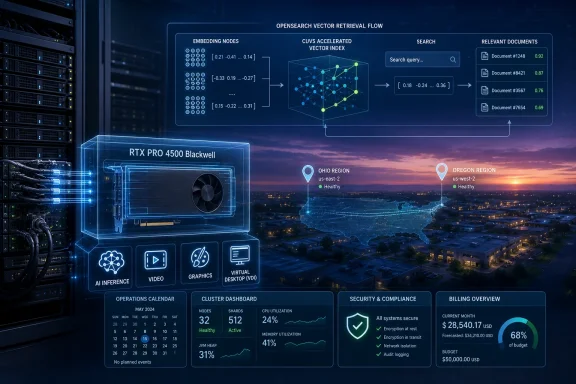
The EC2 G7 family is built around NVIDIA’s RTX PRO 4500 Blackwell Server Edition GPU rather than the largest Blackwell parts that dominate AI-training headlines. AWS pairs those GPUs with custom sixth-generation Intel Xeon Scalable processors, offers configurations from one to eight GPUs, and positions the instances for AI inference, rendering, video workflows, spatial computing, virtual desktops, and GPU-accelerated analytics.
That workload list is revealing. These are not only jobs for frontier-model labs. They are the sort of workloads that sit across media companies, architecture firms, game studios, enterprise analytics teams, support automation platforms, internal copilots, and Windows-heavy virtual desktop deployments.
AWS says G7 delivers up to 4.6 times the AI inference performance and up to 2.1 times the graphics performance of the previous G6 generation. The larger configurations support up to eight GPUs, 256GB of total GPU memory, 700Gbps of Elastic Fabric Adapter networking, and up to 7.6TB of local NVMe SSD storage. Bare-metal options are also planned.
The natural temptation is to compare G7 against the biggest GPU servers available and declare it less exciting. That misses the point. Cloud adoption is not driven only by the fastest possible hardware; it is driven by the availability of the right-sized hardware at a price and operational model that teams can justify.
For many production AI systems, especially inference and retrieval-augmented generation, the question is not whether a customer can rent a monster cluster. The question is whether they can run thousands or millions of model interactions with predictable latency, manageable cost, and enough GPU memory to avoid constant contortions. G7 is AWS and NVIDIA saying that Blackwell is not only for the summit; it is for the fleet.
The Mid-Tier GPU Becomes the Enterprise Workhorse
The distinction between G7 and G7e makes AWS’s positioning clearer. G7e, introduced earlier in 2026, uses the larger RTX PRO 6000 Blackwell GPU and is aimed at heavier generative AI, rendering, and spatial-computing workloads. G7, by contrast, uses the RTX PRO 4500 and looks designed for broader deployment across everyday accelerated tasks.
That matters because enterprises rarely standardize on the most powerful machine available. They standardize on the machine they can afford to deploy widely. The economic center of gravity in AI is shifting from scarce training runs to recurring inference workloads, and recurring workloads are where over-provisioning becomes expensive fast.
A chatbot that costs too much per response is not a product; it is a demo with a finance problem. A document-search assistant that needs a specialist GPU team to keep it online is not an enterprise platform; it is another fragile dependency. The G7 announcement is interesting because it targets that unromantic middle layer where AI either becomes operational software or remains a science project.
For WindowsForum readers, there is a familiar cloud pattern here. The first wave of any new compute class arrives as a premium option for specialized users. The second wave determines whether it becomes infrastructure. If G7-like instances become the default place to run AI inference, GPU rendering, analytics acceleration, and cloud-hosted workstation workloads, then Blackwell moves from halo product to utility layer.
This is also where Windows-adjacent workloads enter the picture. Virtual desktop infrastructure, cloud workstations, rendering farms, video processing, and GPU-backed remote environments are not as fashionable as AI agents, but they are real budgets inside real organizations. A Blackwell GPU tier that handles both AI inference and graphics-heavy remote workloads gives AWS a wider sales motion than a pure AI-training instance would.
OpenSearch Is Where the Announcement Gets More Strategic
The compute launch is only half the story. The deeper strategic move is AWS making NVIDIA’s cuVS library the default for vector indexing in next-generation Amazon OpenSearch Serverless vector collections.
That sentence sounds like infrastructure plumbing because it is. But infrastructure plumbing is often where platform power accumulates. Vector search is now a core part of retrieval-augmented generation, semantic search, recommendation engines, fraud analysis, support automation, and agentic workflows that need to locate relevant information before producing an answer or taking an action.
In older search systems, documents were often retrieved by matching terms. In modern AI systems, text, images, audio, code, or other records can be transformed into numerical embeddings that encode similarity. Searching becomes a problem of finding nearby points in a high-dimensional space. At small scale, that is manageable. At large scale, building and updating the indexes behind those searches becomes computationally demanding.
That is where GPUs fit naturally. NVIDIA says cuVS can make vector indexing up to 10 times faster than CPU-only approaches at a quarter of the cost, and can make billion-scale vector databases practical to build in under an hour. As always, vendor performance claims should be read in context: actual results depend on data shape, index type, workload, configuration, and pricing. But the direction is credible. This is massively parallel math, and GPUs are built for exactly that kind of work.
The important part is not only that GPU acceleration exists. It is that AWS is hiding much of the operational awkwardness behind OpenSearch Serverless. Developers do not necessarily want to become experts in GPU scheduling, index-tuning pipelines, and cluster lifecycle management just to make a search-backed AI application tolerable. If the optimized path becomes the managed default, the barrier to serious AI retrieval drops.
Retrieval Is Becoming the Control Plane for Enterprise AI
The industry spent much of the last three years talking as if the model was the application. Enterprises have learned the hard way that the model is only one component. The quality, freshness, permissions, latency, and observability of the retrieval layer often determine whether the system is useful or dangerous.
Retrieval-augmented generation is popular because it offers a partial answer to a basic problem: large models do not automatically know an organization’s current internal documents, tickets, contracts, runbooks, product catalogs, or policy changes. A RAG system retrieves relevant material and feeds it into the model’s context window before the model responds. When it works, the model is less likely to improvise. When it fails, the answer can be confidently wrong in precisely the way that gives legal, security, and compliance teams heartburn.
This is why GPU-accelerated vector indexing is not merely a performance optimization. Faster indexing changes how often data can be refreshed. Cheaper indexing changes how many teams can afford to build retrieval systems over large corpora. Managed indexing changes who inside an organization can operate the system.
There is also a governance angle. If retrieval becomes easier to deploy through a managed service, more AI applications will be built against centralized search and vector infrastructure rather than one-off databases maintained by individual teams. That may help enterprises impose access controls, logging, retention rules, and cost management. It may also deepen lock-in around AWS’s AI data plane.
That trade-off is familiar to anyone who has watched cloud platforms absorb operational complexity. The managed service removes pain, then becomes the default architecture, then quietly becomes difficult to leave.
AWS Is Selling Less Hardware Drama and More Operational Calm
The shared message from AWS and NVIDIA is not just speed. It is operational reduction. The companies are pitching a future in which AI teams can run inference, build vector indexes, and scale retrieval without assembling a custom GPU platform for every application.
That message will land with IT departments because the first wave of AI adoption created a sprawling mess. Business units experimented with SaaS copilots. Developers built prototypes against hosted models. Data teams tried vector databases. Security teams worried about sensitive documents leaking into prompts. Finance teams discovered that token bills and GPU bills are not rounding errors.
Production AI has exposed an old truth in a new costume: infrastructure that is easy to demo is not necessarily infrastructure that is easy to govern. A working prototype may ignore identity boundaries, backup strategy, monitoring, regional availability, cost allocation, and incident response. A production system cannot.
AWS’s advantage is that it already sells the environment where many enterprises want those concerns handled. NVIDIA’s advantage is that its hardware and software stack are still the default foundation for much of the AI acceleration market. The G7 and OpenSearch moves join those advantages: AWS turns NVIDIA acceleration into managed cloud primitives, and NVIDIA gets embedded deeper into the daily workflows of cloud developers.
That is why this announcement reads as more than a product update. It is a bid to make NVIDIA’s AI infrastructure less visible by making it more pervasive. The more ordinary GPU-backed inference and retrieval become on AWS, the less customers think of them as special procurement decisions.
The GB300 Badge Is About Trust as Much as Benchmarks
HPCwire’s account also highlights AWS achieving NVIDIA Exemplar Cloud status for GB300 training performance. That is a different layer of the stack from G7 and OpenSearch, but it fits the same strategic narrative. NVIDIA’s Exemplar Cloud program is meant to signal that a cloud provider meets performance expectations against NVIDIA reference architectures for large-scale AI workloads.
For customers evaluating training infrastructure, that kind of designation is partly technical and partly psychological. No CIO wants to spend heavily on a cloud AI platform only to discover that the nominal GPU type was available but the real-world cluster performance, networking, storage, or software integration was underwhelming. Certification programs exist because buyers are trying to reduce that uncertainty.
The practical point is that AWS wants to be credible at both ends of the AI lifecycle. GB300 status says AWS can host serious training workloads. G7 says AWS can run the production inference and graphics workloads that follow. OpenSearch Serverless with cuVS says AWS can accelerate the retrieval layer that feeds those applications.
There is a neat platform story there, and platform stories are what cloud providers sell best. Train or tune the model on high-end infrastructure. Serve it on right-sized Blackwell instances. Retrieve context through managed OpenSearch. Monitor, secure, and bill it all inside the AWS universe.
The risk for customers is equally obvious. The more coherent the platform story becomes, the more expensive it may be to unpick later. AI infrastructure decisions made in 2026 could harden into application architecture that lasts for years.
The Competitive Pressure Lands on Azure and Google
AWS is not operating in a vacuum. Microsoft Azure and Google Cloud have their own AI infrastructure strategies, their own custom silicon, and their own NVIDIA partnerships. Microsoft has OpenAI gravity and a massive enterprise software channel. Google has TPUs, Gemini, and deep search and data infrastructure. AWS has breadth, operational maturity, and a long history of turning complex infrastructure into menu items.
The G7 announcement gives AWS a useful talking point: Blackwell-powered mid-tier GPU instances for inference, graphics, analytics, and VDI are available now in initial U.S. regions, with wider expansion expected. If rivals do not offer comparable options at this tier, AWS can frame itself as the place where the latest NVIDIA generation is not reserved only for the highest-end training customers.
That matters because the next phase of AI cloud competition may be less about who can announce the most eye-watering cluster and more about who can make the economics of production AI tolerable. Enterprises are already discovering that inference costs scale with usage, not enthusiasm. A successful AI assistant becomes more expensive precisely because people use it.
The retrieval layer also creates competitive pressure. If AWS can make GPU-accelerated vector indexing a default capability inside OpenSearch Serverless, it reduces the temptation for teams to reach for separate specialist vector database platforms. That does not eliminate the market for dedicated vector databases, but it changes the default buying motion. For many enterprises, “good enough and already managed in our cloud” beats “best of breed but another platform to operate.”
Microsoft and Google will respond in their own ways. Azure can bundle AI infrastructure with Microsoft 365, GitHub, Windows, and security tooling. Google can lean on data, search, and TPU economics. But AWS and NVIDIA are staking out a practical proposition: if you want to move from prototype to production without becoming a GPU infrastructure shop, the pieces are being assembled for you.
The Lock-In Is Not a Bug in the Architecture
There is a less comfortable reading of the same facts. AWS and NVIDIA are not simply making AI easier; they are making a particular AI stack easier. That stack includes NVIDIA GPUs, NVIDIA libraries, AWS compute, AWS managed search, AWS orchestration services, and eventually AWS higher-level AI tools.
This is not sinister. It is how cloud platforms work. The customer gets reduced operational burden in exchange for deeper dependency on provider-specific capabilities. The bargain can be rational, especially when the alternative is building fragile infrastructure with scarce engineering talent.
But IT leaders should be clear-eyed about it. A vector pipeline built around OpenSearch Serverless defaults may not map cleanly to another cloud. An inference deployment tuned for G7 instance shapes, local storage, EFA networking, and AWS images may require rework elsewhere. A cost model that looks attractive during initial deployment may shift as data size, query volume, model complexity, or regional requirements grow.
The real question is not whether lock-in exists. It always does. The real question is whether the productivity gained is worth the future constraint.
For many organizations, the answer will be yes. Running production AI is hard enough that managed acceleration may be worth the architectural gravity. But the decision should be made deliberately, not discovered during a migration project two years later.
Windows Shops Should Read This as a Cloud Workstation Story Too
Although the announcement is framed around AI infrastructure, Windows-heavy organizations should not miss the graphics and virtual desktop angle. G7 instances target graphics rendering, video transcoding, spatial computing, and VDI alongside inference and analytics. That makes them relevant to teams managing designers, engineers, media workflows, and GPU-backed remote desktops.
The old divide between AI infrastructure and graphics infrastructure is narrowing. The same GPU fleet can support inference during one workload window, rendering during another, analytics acceleration elsewhere, and virtual workstations for users who need remote access to high-performance environments. Cloud providers love that kind of versatility because it broadens utilization and makes instance families easier to sell across departments.
For administrators, the promise is attractive but not automatic. GPU-backed cloud desktops still require careful attention to licensing, profile management, storage performance, identity, network latency, image maintenance, and user experience. A faster GPU does not fix a badly designed VDI environment.
Still, G7 gives AWS a fresher option for organizations that need more than CPU-backed desktops but do not need the largest workstation-class GPU available. That could matter for architecture and engineering firms, media production teams, game development groups, simulation users, and enterprises that want burst capacity without buying physical workstations for every peak.
The bigger pattern is that AI demand is subsidizing a broader upgrade cycle for accelerated cloud computing. Even teams that are not building chatbots may benefit from the GPU infrastructure race. The trick is making sure the workload actually fits the instance rather than buying into the halo effect of the latest accelerator.
The Numbers Are Promising, but the Bill Will Decide
Performance claims are useful, but enterprise adoption will hinge on pricing, utilization, and operational fit. A 4.6x inference performance improvement over G6 sounds impressive, but customers need to know what that means per dollar, per watt-equivalent, per response, per rendered frame, or per indexed document. Cloud GPU economics are unforgiving when resources sit idle.
Serverless vector acceleration has a similar caveat. Faster indexing at lower claimed cost is compelling, especially for billion-scale datasets. But real spending depends on collection size, refresh frequency, index configuration, query patterns, idle behavior, regional pricing, and how teams manage data lifecycle. The easiest managed service to deploy can become the easiest bill to ignore until it is large enough to require an executive explanation.
This is where IT pros should bring healthy skepticism. Vendor benchmarks are starting points, not procurement plans. Before standardizing on G7 or GPU-accelerated OpenSearch, teams should test representative workloads: real prompts, real documents, real concurrency, real access controls, and real failure modes.
They should also model what happens when the AI system succeeds. Many pilots are sized for curiosity. Production services must be sized for adoption. If employees actually use the internal assistant, if customers actually search the catalog semantically, if support agents actually lean on retrieval workflows, infrastructure demand can rise quickly.
The encouraging part is that AWS and NVIDIA appear to be targeting exactly this production problem. The caution is that production problems are measured in monthly bills and incident tickets, not launch-day performance charts.
The Practical Reading for the June 2026 AI Stack
The announcement is not a single dramatic rupture. It is a set of platform moves that point in the same direction: accelerated AI infrastructure is being normalized inside managed cloud services. For teams deciding whether this matters now, the concrete implications are straightforward.
- AWS’s EC2 G7 instances put NVIDIA RTX PRO 4500 Blackwell GPUs into a mid-tier cloud instance family aimed at inference, graphics, video, analytics, spatial computing, and virtual desktops.
- The initial general availability footprint is limited to the U.S. East Ohio and U.S. West Oregon regions, so global architecture plans still need to account for regional availability and data residency.
- NVIDIA cuVS becoming the default for vector indexing in next-generation OpenSearch Serverless means GPU acceleration is moving from a custom optimization path into a managed retrieval service.
- The most important production impact may be faster and cheaper index creation for retrieval-augmented generation, semantic search, recommendation systems, and agent-style applications that depend on fresh context.
- AWS’s NVIDIA Exemplar Cloud status for GB300 strengthens its credibility for high-end training, while G7 and OpenSearch target the more common operational problem of serving and feeding AI systems.
- The main trade-off is familiar: customers can reduce infrastructure complexity by adopting the AWS-NVIDIA stack, but they should treat deeper platform dependency as an architectural decision rather than an accident.
The larger lesson is that enterprise AI is becoming less about spectacular demos and more about boring repeatability. That is good news for administrators and developers who have to make these systems work after the keynote ends. It is also a warning: the vendors that make AI infrastructure feel ordinary will be the ones that define its defaults.
NVIDIA and AWS are not merely adding another GPU instance and another acceleration library; they are tightening the path from model to retrieval to production service. If this strategy works, the next generation of enterprise AI applications will not announce themselves with exotic infrastructure diagrams. They will simply appear inside search boxes, support consoles, virtual desktops, analytics jobs, and internal tools — running on accelerated cloud plumbing that most users never see, but every IT department will eventually have to understand.
References
- NVIDIA expands AWS AI infrastructure with new GPU instances - IT Brief Asia IT Brief Asia · Fri, 26 Jun 2026 03:00:00 GMT
- NVIDIA and AWS Collaborate to Bring AI to Production at Scale HPCwire · 2026-06-25T17:20:20.154295