

Amazon Web Services hired former Microsoft corporate vice president Shawn Bice as vice president of AWS AI Services on May 11, 2026, putting the longtime database, cloud, security, and Copilot executive in charge of AWS’s Automated Reasoning Group. The move is not merely another senior AI hire in a market full of them. It is a signal that the next serious contest in enterprise AI will be fought less over chatbots and more over whether autonomous agents can be trusted with real systems. For Windows shops, Microsoft partners, and cloud administrators, Bice’s return to AWS should read as a warning flare: the agent race is moving from demo theater into the control plane.
The most interesting thing about Shawn Bice’s move is not that an executive crossed from Microsoft to Amazon. That happens often enough in cloud computing that it has become part of the industry’s circulatory system. What matters is the particular combination of experience AWS is acquiring at the exact moment every large platform vendor is trying to convince customers that AI agents can safely act on their behalf.
Bice’s résumé is unusually well matched to the problem AWS says it wants to solve. He has spent years around the infrastructure layers that enterprises actually depend on: SQL Server, Azure SQL Database, Azure data services, AWS databases, and more recently Microsoft’s security AI portfolio, including Security Copilot, Sentinel platform work, AI Security Research, and the Microsoft Security Store. That is not the career arc of someone who only knows how to market generative AI. It is the profile of someone who has lived with the consequences of systems that must be durable, observable, recoverable, and supportable when customers are angry at 3 a.m.
That matters because agentic AI is, at its core, an operations problem masquerading as a model problem. A chatbot can be wrong and embarrass a vendor. An agent with permissions can be wrong and delete data, misconfigure infrastructure, leak secrets, approve a bad workflow, or trigger an expensive cascade of automated activity. The enterprise buyer’s question is not whether the model sounds intelligent. It is whether the whole system can be bounded.
AWS’s decision to put Bice over automated reasoning and neurosymbolic AI suggests it understands that distinction. The company is not just hiring someone to add sparkle to Amazon Bedrock. It is hiring someone whose recent work sat at the intersection of security tooling, AI assistants, and enterprise governance — exactly the place where the industry’s current agent enthusiasm is most likely to collide with hard customer requirements.
But the move also reveals how large the AI leadership bench has become across the industry. The same executives now circulate among Microsoft, Amazon, Google, Anthropic, OpenAI, and other players because the market has developed a recognizable class of leaders who have operated production-scale AI services, not just research projects. Bice is part of that class. His movement says as much about the hiring market as it does about either company’s internal health.
For Microsoft, the risk is less that Security Copilot suddenly loses direction and more that AWS now has a leader who knows how Microsoft has been positioning security AI to enterprises. Security Copilot is not just a product; it is a bet that defenders will accept AI assistance inside sensitive workflows if Microsoft can wrap the experience in identity, logging, governance, and familiar administrative surfaces. AWS now has an executive who has helped build inside that world.
That knowledge is valuable because the two companies are chasing many of the same customers with different centers of gravity. Microsoft starts with the user, the tenant, the endpoint, the identity provider, and the productivity estate. AWS starts with the cloud workload, the developer, the platform team, and the infrastructure account. Agentic AI will blur those boundaries. When an agent can reason across tickets, logs, cloud APIs, identity policies, and code repositories, the old distinction between productivity assistant and cloud automation begins to break down.
That last version is the one vendors want customers to imagine. It is also the version that makes security and reliability teams nervous. The more useful an agent becomes, the more authority it needs. The more authority it receives, the more catastrophic its mistakes can be.
The industry’s first wave of generative AI products could hide many defects behind the forgiving language of assistance. A draft email can be edited. A meeting summary can be checked. A code suggestion can be rejected. But an agent that opens a pull request, changes a firewall rule, updates a database, rotates credentials, or books a transaction is operating in a different risk category.
This is where AWS’s emphasis on automated reasoning becomes strategically important. Automated reasoning is not a magic shield against bad AI behavior, and vendors should be punished whenever they imply otherwise. But the discipline does offer something probabilistic language models lack by default: formal methods for proving that certain properties hold, or that certain classes of bad outcome should not occur under specified conditions.
That distinction will matter more as agents graduate from “write me a script” to “go fix the environment.” Enterprises do not merely need models that are more accurate on benchmarks. They need systems that can demonstrate constraints, produce verifiable artifacts, and fail safely when they do not know what to do. That is the ground AWS is trying to claim.
The enterprise agent problem needs both. A model may be good at interpreting a messy support ticket, reading log fragments, or generating a plausible remediation plan. But before that plan is executed, another layer should be able to check whether it violates policy, exceeds scope, conflicts with configuration rules, or relies on a false assumption.
That is the promise AWS is trying to package. If Bedrock, AgentCore, Kiro, or future AWS agent services can pair model-driven flexibility with formal checks, AWS can argue that its agents are not just clever but governable. That is a more enterprise-friendly pitch than simply saying the next model is smarter.
There is a catch. Neurosymbolic AI is only as useful as the quality of the symbolic layer and the boundaries it can express. Many real business environments are messy, inconsistent, and filled with undocumented exceptions. Formal reasoning works best when the rules are known, the state can be modeled, and the desired properties can be expressed precisely. Enterprise IT is often where precise intent goes to die.
Still, even partial progress could be meaningful. If an agent can prove that a proposed IAM change does not grant public access, or that a database migration plan preserves a defined invariant, or that a generated policy conforms to an organization’s written rules, that is not science fiction. It is a concrete improvement over a model that merely sounds confident.
Agents need state. They need memory, task history, permissions, plans, tool results, rollback logic, and audit trails. They need to understand the difference between reading a fact, inferring a fact, and changing a system. They need to know what they have done, what they are allowed to do next, and when they must stop.
This is not the natural terrain of a pure chat interface. It is the terrain of distributed systems. It is also the terrain of databases, transaction logs, access-control systems, and cloud service APIs. Bice has spent much of his career around precisely those layers.
AWS’s database business, which Bice previously helped lead, is one of the company’s most strategically important cloud franchises. Services such as Aurora, RDS, DynamoDB, Neptune, ElastiCache, DocumentDB, and others are not peripheral to AWS; they are where customer applications live and where cloud lock-in becomes durable. An executive who has operated at that level understands that enterprise trust is built through boring guarantees as much as flashy features.
That sensibility is useful for AI agents because the next phase of the market will punish vendors that treat agents as personality layers. The winning platforms will need permissions models, testing harnesses, simulation environments, observability, policy verification, incident response hooks, and billing controls. In other words, agents need the engineering disciplines that cloud infrastructure already learned the hard way.
Agentic AI gives AWS a chance to change the conversation. If the first stage of the AI cloud war was about model access, the second is about useful automation. That plays more naturally to AWS’s strengths. Developers and platform teams already use AWS as a programmable substrate. The question is whether AWS can make agents a safe abstraction over that substrate.
That is why the Automated Reasoning Group is not an academic ornament. It is potentially central to AWS’s differentiation. Microsoft can tie Copilot into Office, Windows, Defender, Entra, GitHub, and Azure. Google can lean on Gemini, Workspace, Kubernetes heritage, and data infrastructure. AWS needs a story that fits its customer base: builders, cloud operators, ISVs, regulated enterprises, and partners that want automation without surrendering control.
Control is the word that matters. AWS has always sold customers a version of control: primitives, services, APIs, accounts, policies, regions, and architectures that can be assembled in many ways. Agentic AI threatens to invert that by asking customers to trust a system that decides its own steps. Automated reasoning is AWS’s attempt to reconcile those two instincts.
If AWS can say, “Our agents act, but their actions are bounded by provable constraints,” it has a powerful enterprise message. If it cannot deliver that in practice, the phrase will become another layer of AI marketing varnish.
Microsoft has the home-field advantage inside Windows and Microsoft 365 environments. Copilot is being woven through the productivity layer, while Security Copilot gives Microsoft a path into SOC workflows and defender tooling. For many organizations, Microsoft’s pitch is simple: your users, identities, documents, mailboxes, endpoints, and security signals are already here, so let Copilot work where the data lives.
AWS’s pitch is different but no less relevant. Many Windows-heavy enterprises also run significant workloads on AWS. They use Active Directory integrations, Windows Server instances, SQL Server on EC2 or RDS, .NET applications, FSx file systems, and hybrid management patterns that span Microsoft and Amazon ecosystems. If AWS agents become the preferred automation layer for cloud operations, Windows admins will encounter them whether or not they think of themselves as AI adopters.
The operational stakes are obvious. An AI agent that can inspect a failed deployment, read CloudWatch logs, modify infrastructure-as-code, open a ticket, and suggest a rollback could be genuinely useful. The same agent, poorly constrained, could normalize a dangerous permission change or misread a transient outage as a configuration problem. In mixed Microsoft-AWS shops, the blast radius may cross identity, endpoint, and cloud boundaries.
That is why security-minded administrators should care about AWS’s automated reasoning bet. The practical question is not whether an agent uses a neural model or a symbolic checker in some abstract sense. It is whether the platform can expose enough of its reasoning, policy boundaries, approval chain, and rollback posture for IT teams to trust it with limited authority.
For AWS partners, Bice’s arrival could make the agentic AI portfolio easier to sell to regulated customers. “Trustworthy agents” is not just a slogan in financial services, healthcare, government, manufacturing, and critical infrastructure. It is a procurement condition. Customers in those sectors need evidence that automation can be governed, audited, and limited.
But the channel also has a credibility problem to manage. The past two years produced a flood of AI proofs of concept that looked impressive in a conference demo and then struggled in production because of data quality, permissions complexity, latency, cost, change management, or plain old user mistrust. Partners that oversell autonomy will inherit the backlash.
Automated reasoning gives partners a more disciplined story if AWS can productize it clearly. Instead of promising that an agent is smart enough to avoid mistakes, a partner can explain which actions are permitted, which policies are checked, which outputs are verified, and where human approval remains mandatory. That is a healthier conversation.
The danger is that “neurosymbolic” becomes the new “zero trust”: a technically meaningful idea flattened into a sticker. If every agent magically becomes “verified” because a marketing deck says so, customers will learn to discount the term. AWS’s challenge is to make the verification tangible enough that partners can demonstrate it under real customer conditions.
That is a more difficult job than it sounds. A lab can publish a model card. A platform company must decide what the model can touch, how customers configure it, how logs are retained, how abuse is prevented, how regressions are handled, how pricing works, how regulators are satisfied, and how support teams explain failures. Agentic AI multiplies each of those questions.
This is why AWS’s hire feels strategically coherent. The company does not need only AI evangelists. It needs service builders. It needs people who understand how to scale cloud products, how to organize engineering teams, how to build partner confidence, and how to turn research into customer-facing controls.
Microsoft has many such people, which is one reason it has moved so aggressively with Copilot across its portfolio. AWS has many as well, particularly in infrastructure and managed services. The competitive frontier is now where those cultures meet: AI systems that must behave like dependable cloud services rather than clever demos.
The hiring market will keep reflecting that shift. Expect more executives with security, databases, developer tools, identity, and operations backgrounds to become AI leaders. The companies that win will not be the ones with the most poetic descriptions of agents. They will be the ones that make agents boring enough to approve.
Microsoft wants Copilot to become the interface layer across work. In that vision, the assistant understands documents, meetings, emails, chats, security alerts, code, and business applications. Its power comes from proximity to the user and the organization’s Microsoft Graph-connected data estate. Governance is anchored in Microsoft’s identity, compliance, and security stack.
AWS wants agents to become builders and operators inside cloud environments. In that vision, the agent understands services, APIs, logs, infrastructure, policies, and application behavior. Its power comes from proximity to workloads and the programmable cloud substrate. Governance is anchored in AWS identity, policy, account boundaries, service controls, and, increasingly, automated reasoning.
Many enterprises will use both. That creates a new class of governance challenge. One AI system may summarize a security incident in Microsoft 365. Another may inspect infrastructure in AWS. A third may modify code in GitHub or another repository. A fourth may interact with a ticketing system. If these systems are not coherently bounded, organizations will end up with fragmented automation authority spread across vendors.
That is why agentic AI is likely to force a rethink of enterprise architecture. Administrators will need inventories of agents, permissions, tools, approval paths, memory stores, data access, and audit logs. They will need to know not just which humans can do what, but which AI-mediated workflows can do what on behalf of which humans.
Bice’s move to AWS lands in the middle of that emerging governance fight. Microsoft is trying to make Copilot the trusted front end of work. AWS is trying to make agents trustworthy enough to operate the cloud. The overlap will be messy, lucrative, and strategically decisive.
Humans struggle with that too, of course. But human administrators exist inside social, legal, and organizational structures that assign responsibility. When an AI agent performs an action, responsibility becomes more diffuse. Was the model wrong? Was the tool interface unsafe? Was the policy too broad? Did the human approver understand the implications? Did the vendor misrepresent the system’s reliability?
Automated reasoning can answer only part of that. It can help prove that certain constraints hold. It can check whether a proposed action violates formalized rules. It can generate artifacts that make some decisions more inspectable. But it cannot eliminate the need for institutional judgment.
That is why the most credible agent deployments will likely be modest at first. They will narrow the action space, require human approval for high-risk steps, operate in sandboxed environments, and use formal checks around specific properties. The industry may talk about autonomous digital workers, but the practical path runs through constrained automation.
AWS’s opportunity is to make those constraints feel like a strength rather than a limitation. In consumer AI, friction is often treated as failure. In enterprise IT, the right friction is governance. If AWS can make agents that are slower to do dangerous things and faster to verify safe ones, it will have a story administrators can take seriously.
That does not guarantee success. AWS still has to turn research and internal capability into products that customers can understand and use. It has to integrate automated reasoning into services without making them unusably complex. It has to explain the limits of verification honestly. It has to avoid the industry’s worst habit: treating a real technical idea as a universal solvent.
But the hire shows that AWS knows where the weak point is. The agent market is not waiting for another assistant that can write a nicer paragraph. It is waiting for systems that can be trusted with narrow slices of real authority. The companies that solve that will define the next cloud platform layer.
For Microsoft, the move is a reminder that Copilot’s success will depend on trust as much as ubiquity. Putting AI into every surface is not the same as convincing administrators to let it act. Security Copilot, Windows Copilot experiences, Microsoft 365 Copilot, and Azure AI agents will all face the same demand: show your work, respect policy, and fail safely.
That structure matters because enterprise AI failures are rarely caused by model behavior alone. They emerge from seams between research, product, engineering, security, support, and customer expectations. Putting automated reasoning closer to product execution is AWS’s way of saying the proof layer must not remain a lab curiosity.
The industry should be judged by that standard. It is easy to announce an agent. It is harder to expose its assumptions. It is easy to show a workflow that succeeds once. It is harder to define what the agent will never do. It is easy to claim reliability. It is harder to build the machinery that makes reliability inspectable.
That is the point Windows and cloud administrators should take from this hire. The next wave of AI tooling will arrive with bigger promises and deeper permissions. The only sane response is to demand evidence of boundaries before granting authority.
Source: crn.com Microsoft VP Of Copilot Security And AI Joins AWS To Lead Agentic AI Charge At ‘Crucial Moment’
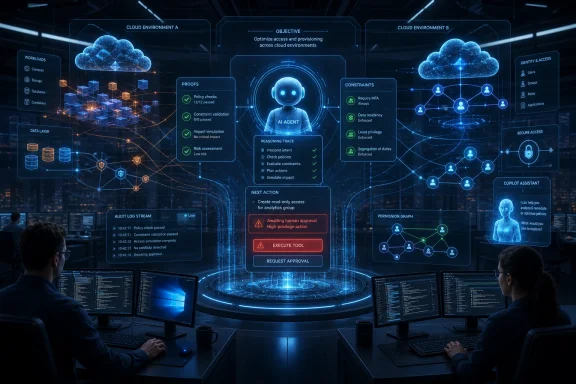 AWS Is Buying Scar Tissue, Not Just AI Prestige
The most interesting thing about Shawn Bice’s move is not that an executive crossed from Microsoft to Amazon. That happens often enough in cloud computing that it has become part of the industry’s circulatory system. What matters is the particular combination of experience AWS is acquiring at the exact moment every large platform vendor is trying to convince customers that AI agents can safely act on their behalf.Bice’s résumé is unusually well matched to the problem AWS says it wants to solve. He has spent years around the infrastructure layers that enterprises actually depend on: SQL Server, Azure SQL Database, Azure data services, AWS databases, and more recently Microsoft’s security AI portfolio, including Security Copilot, Sentinel platform work, AI Security Research, and the Microsoft Security Store. That is not the career arc of someone who only knows how to market generative AI. It is the profile of someone who has lived with the consequences of systems that must be durable, observable, recoverable, and supportable when customers are angry at 3 a.m.
That matters because agentic AI is, at its core, an operations problem masquerading as a model problem. A chatbot can be wrong and embarrass a vendor. An agent with permissions can be wrong and delete data, misconfigure infrastructure, leak secrets, approve a bad workflow, or trigger an expensive cascade of automated activity. The enterprise buyer’s question is not whether the model sounds intelligent. It is whether the whole system can be bounded.
AWS’s decision to put Bice over automated reasoning and neurosymbolic AI suggests it understands that distinction. The company is not just hiring someone to add sparkle to Amazon Bedrock. It is hiring someone whose recent work sat at the intersection of security tooling, AI assistants, and enterprise governance — exactly the place where the industry’s current agent enthusiasm is most likely to collide with hard customer requirements.
Microsoft’s Loss Is Also a Measure of Its AI Maturity
There is an obvious temptation to frame this as a clean win for AWS and a clean loss for Microsoft. That is directionally true, but too simple. Microsoft has spent the past several years turning Copilot from a brand into a sprawling product doctrine that touches Windows, Microsoft 365, GitHub, Azure, security, and the Power Platform. Losing a senior executive who worked on Security Copilot and AI security research is not trivial, especially when Microsoft is trying to persuade customers that Copilot can become the organizing layer for work.But the move also reveals how large the AI leadership bench has become across the industry. The same executives now circulate among Microsoft, Amazon, Google, Anthropic, OpenAI, and other players because the market has developed a recognizable class of leaders who have operated production-scale AI services, not just research projects. Bice is part of that class. His movement says as much about the hiring market as it does about either company’s internal health.
For Microsoft, the risk is less that Security Copilot suddenly loses direction and more that AWS now has a leader who knows how Microsoft has been positioning security AI to enterprises. Security Copilot is not just a product; it is a bet that defenders will accept AI assistance inside sensitive workflows if Microsoft can wrap the experience in identity, logging, governance, and familiar administrative surfaces. AWS now has an executive who has helped build inside that world.
That knowledge is valuable because the two companies are chasing many of the same customers with different centers of gravity. Microsoft starts with the user, the tenant, the endpoint, the identity provider, and the productivity estate. AWS starts with the cloud workload, the developer, the platform team, and the infrastructure account. Agentic AI will blur those boundaries. When an agent can reason across tickets, logs, cloud APIs, identity policies, and code repositories, the old distinction between productivity assistant and cloud automation begins to break down.
The Agent Boom Has a Reliability Problem It Cannot Market Away
The phrase agentic AI has become elastic enough to cover almost anything more ambitious than a prompt-and-response chatbot. In some products, it means a model that can call tools. In others, it means a workflow engine with a conversational interface. In the most ambitious versions, it means software that can observe a goal, plan steps, use APIs, revise its approach, and continue until the task is complete.That last version is the one vendors want customers to imagine. It is also the version that makes security and reliability teams nervous. The more useful an agent becomes, the more authority it needs. The more authority it receives, the more catastrophic its mistakes can be.
The industry’s first wave of generative AI products could hide many defects behind the forgiving language of assistance. A draft email can be edited. A meeting summary can be checked. A code suggestion can be rejected. But an agent that opens a pull request, changes a firewall rule, updates a database, rotates credentials, or books a transaction is operating in a different risk category.
This is where AWS’s emphasis on automated reasoning becomes strategically important. Automated reasoning is not a magic shield against bad AI behavior, and vendors should be punished whenever they imply otherwise. But the discipline does offer something probabilistic language models lack by default: formal methods for proving that certain properties hold, or that certain classes of bad outcome should not occur under specified conditions.
That distinction will matter more as agents graduate from “write me a script” to “go fix the environment.” Enterprises do not merely need models that are more accurate on benchmarks. They need systems that can demonstrate constraints, produce verifiable artifacts, and fail safely when they do not know what to do. That is the ground AWS is trying to claim.
Neurosymbolic AI Is AWS’s Answer to the Hallucination Hangover
AWS’s internal framing around Bice’s hire leans on neurosymbolic AI, the combination of neural network techniques with symbolic logic and rule-based reasoning. The term has been around for years, and it has acquired a new commercial urgency because large language models have made both sides of the bargain obvious. Neural systems are flexible, fluent, and capable of generalization. Symbolic systems are rigid, explicit, and better suited to rules, proofs, constraints, and domain logic.The enterprise agent problem needs both. A model may be good at interpreting a messy support ticket, reading log fragments, or generating a plausible remediation plan. But before that plan is executed, another layer should be able to check whether it violates policy, exceeds scope, conflicts with configuration rules, or relies on a false assumption.
That is the promise AWS is trying to package. If Bedrock, AgentCore, Kiro, or future AWS agent services can pair model-driven flexibility with formal checks, AWS can argue that its agents are not just clever but governable. That is a more enterprise-friendly pitch than simply saying the next model is smarter.
There is a catch. Neurosymbolic AI is only as useful as the quality of the symbolic layer and the boundaries it can express. Many real business environments are messy, inconsistent, and filled with undocumented exceptions. Formal reasoning works best when the rules are known, the state can be modeled, and the desired properties can be expressed precisely. Enterprise IT is often where precise intent goes to die.
Still, even partial progress could be meaningful. If an agent can prove that a proposed IAM change does not grant public access, or that a database migration plan preserves a defined invariant, or that a generated policy conforms to an organization’s written rules, that is not science fiction. It is a concrete improvement over a model that merely sounds confident.
The Database Veteran Matters Because Agents Need State
Bice’s database background is not a biographical footnote. It may be the most practical part of the story. Databases teach engineers humility because they sit at the intersection of correctness, performance, concurrency, durability, governance, and customer fury. If an AI agent is going to operate in enterprise systems, it will need a similarly sober design culture.Agents need state. They need memory, task history, permissions, plans, tool results, rollback logic, and audit trails. They need to understand the difference between reading a fact, inferring a fact, and changing a system. They need to know what they have done, what they are allowed to do next, and when they must stop.
This is not the natural terrain of a pure chat interface. It is the terrain of distributed systems. It is also the terrain of databases, transaction logs, access-control systems, and cloud service APIs. Bice has spent much of his career around precisely those layers.
AWS’s database business, which Bice previously helped lead, is one of the company’s most strategically important cloud franchises. Services such as Aurora, RDS, DynamoDB, Neptune, ElastiCache, DocumentDB, and others are not peripheral to AWS; they are where customer applications live and where cloud lock-in becomes durable. An executive who has operated at that level understands that enterprise trust is built through boring guarantees as much as flashy features.
That sensibility is useful for AI agents because the next phase of the market will punish vendors that treat agents as personality layers. The winning platforms will need permissions models, testing harnesses, simulation environments, observability, policy verification, incident response hooks, and billing controls. In other words, agents need the engineering disciplines that cloud infrastructure already learned the hard way.
AWS Is Rebuilding the AI Story Around Control
AWS spent the early generative AI boom defending itself against the perception that it had been caught flat-footed by Microsoft’s OpenAI alliance and Google’s model portfolio. Amazon Bedrock was the company’s answer: a managed platform for accessing multiple foundation models, building generative AI applications, and keeping customers inside the AWS operating model. It was a familiar AWS move, emphasizing choice, infrastructure, and enterprise integration over a single model identity.Agentic AI gives AWS a chance to change the conversation. If the first stage of the AI cloud war was about model access, the second is about useful automation. That plays more naturally to AWS’s strengths. Developers and platform teams already use AWS as a programmable substrate. The question is whether AWS can make agents a safe abstraction over that substrate.
That is why the Automated Reasoning Group is not an academic ornament. It is potentially central to AWS’s differentiation. Microsoft can tie Copilot into Office, Windows, Defender, Entra, GitHub, and Azure. Google can lean on Gemini, Workspace, Kubernetes heritage, and data infrastructure. AWS needs a story that fits its customer base: builders, cloud operators, ISVs, regulated enterprises, and partners that want automation without surrendering control.
Control is the word that matters. AWS has always sold customers a version of control: primitives, services, APIs, accounts, policies, regions, and architectures that can be assembled in many ways. Agentic AI threatens to invert that by asking customers to trust a system that decides its own steps. Automated reasoning is AWS’s attempt to reconcile those two instincts.
If AWS can say, “Our agents act, but their actions are bounded by provable constraints,” it has a powerful enterprise message. If it cannot deliver that in practice, the phrase will become another layer of AI marketing varnish.
Windows Administrators Should Watch the Cloud Control Plane
For WindowsForum readers, this story may look at first like a cloud executive shuffle. It is more than that. The agentic AI race will eventually reach every place administrators manage Microsoft estates: endpoint security, identity, Microsoft 365 governance, Azure resources, hybrid infrastructure, SaaS integrations, and incident response workflows.Microsoft has the home-field advantage inside Windows and Microsoft 365 environments. Copilot is being woven through the productivity layer, while Security Copilot gives Microsoft a path into SOC workflows and defender tooling. For many organizations, Microsoft’s pitch is simple: your users, identities, documents, mailboxes, endpoints, and security signals are already here, so let Copilot work where the data lives.
AWS’s pitch is different but no less relevant. Many Windows-heavy enterprises also run significant workloads on AWS. They use Active Directory integrations, Windows Server instances, SQL Server on EC2 or RDS, .NET applications, FSx file systems, and hybrid management patterns that span Microsoft and Amazon ecosystems. If AWS agents become the preferred automation layer for cloud operations, Windows admins will encounter them whether or not they think of themselves as AI adopters.
The operational stakes are obvious. An AI agent that can inspect a failed deployment, read CloudWatch logs, modify infrastructure-as-code, open a ticket, and suggest a rollback could be genuinely useful. The same agent, poorly constrained, could normalize a dangerous permission change or misread a transient outage as a configuration problem. In mixed Microsoft-AWS shops, the blast radius may cross identity, endpoint, and cloud boundaries.
That is why security-minded administrators should care about AWS’s automated reasoning bet. The practical question is not whether an agent uses a neural model or a symbolic checker in some abstract sense. It is whether the platform can expose enough of its reasoning, policy boundaries, approval chain, and rollback posture for IT teams to trust it with limited authority.
The Partner Channel Sees the Opportunity and the Liability
CRN’s reporting naturally emphasizes the partner angle, and in this case the channel’s interest is not incidental. Partners will be the ones asked to turn vendor AI claims into customer deployments. They will also be the first line of defense when those deployments behave unpredictably.For AWS partners, Bice’s arrival could make the agentic AI portfolio easier to sell to regulated customers. “Trustworthy agents” is not just a slogan in financial services, healthcare, government, manufacturing, and critical infrastructure. It is a procurement condition. Customers in those sectors need evidence that automation can be governed, audited, and limited.
But the channel also has a credibility problem to manage. The past two years produced a flood of AI proofs of concept that looked impressive in a conference demo and then struggled in production because of data quality, permissions complexity, latency, cost, change management, or plain old user mistrust. Partners that oversell autonomy will inherit the backlash.
Automated reasoning gives partners a more disciplined story if AWS can productize it clearly. Instead of promising that an agent is smart enough to avoid mistakes, a partner can explain which actions are permitted, which policies are checked, which outputs are verified, and where human approval remains mandatory. That is a healthier conversation.
The danger is that “neurosymbolic” becomes the new “zero trust”: a technically meaningful idea flattened into a sticker. If every agent magically becomes “verified” because a marketing deck says so, customers will learn to discount the term. AWS’s challenge is to make the verification tangible enough that partners can demonstrate it under real customer conditions.
The Talent War Has Moved From Models to Mechanisms
The most visible AI recruiting battles have often centered on model researchers, chip architects, and founders of frontier labs. Bice’s move points to a different phase. The scarce talent now includes executives who know how to turn AI into services that enterprises can buy, operate, secure, and blame.That is a more difficult job than it sounds. A lab can publish a model card. A platform company must decide what the model can touch, how customers configure it, how logs are retained, how abuse is prevented, how regressions are handled, how pricing works, how regulators are satisfied, and how support teams explain failures. Agentic AI multiplies each of those questions.
This is why AWS’s hire feels strategically coherent. The company does not need only AI evangelists. It needs service builders. It needs people who understand how to scale cloud products, how to organize engineering teams, how to build partner confidence, and how to turn research into customer-facing controls.
Microsoft has many such people, which is one reason it has moved so aggressively with Copilot across its portfolio. AWS has many as well, particularly in infrastructure and managed services. The competitive frontier is now where those cultures meet: AI systems that must behave like dependable cloud services rather than clever demos.
The hiring market will keep reflecting that shift. Expect more executives with security, databases, developer tools, identity, and operations backgrounds to become AI leaders. The companies that win will not be the ones with the most poetic descriptions of agents. They will be the ones that make agents boring enough to approve.
The Copilot-AWS Divide Is Becoming a Governance Fight
Microsoft’s Copilot strategy and AWS’s agentic AI strategy are not identical, but they are converging on the same customer anxiety. Who gets to mediate between human intent and machine action?Microsoft wants Copilot to become the interface layer across work. In that vision, the assistant understands documents, meetings, emails, chats, security alerts, code, and business applications. Its power comes from proximity to the user and the organization’s Microsoft Graph-connected data estate. Governance is anchored in Microsoft’s identity, compliance, and security stack.
AWS wants agents to become builders and operators inside cloud environments. In that vision, the agent understands services, APIs, logs, infrastructure, policies, and application behavior. Its power comes from proximity to workloads and the programmable cloud substrate. Governance is anchored in AWS identity, policy, account boundaries, service controls, and, increasingly, automated reasoning.
Many enterprises will use both. That creates a new class of governance challenge. One AI system may summarize a security incident in Microsoft 365. Another may inspect infrastructure in AWS. A third may modify code in GitHub or another repository. A fourth may interact with a ticketing system. If these systems are not coherently bounded, organizations will end up with fragmented automation authority spread across vendors.
That is why agentic AI is likely to force a rethink of enterprise architecture. Administrators will need inventories of agents, permissions, tools, approval paths, memory stores, data access, and audit logs. They will need to know not just which humans can do what, but which AI-mediated workflows can do what on behalf of which humans.
Bice’s move to AWS lands in the middle of that emerging governance fight. Microsoft is trying to make Copilot the trusted front end of work. AWS is trying to make agents trustworthy enough to operate the cloud. The overlap will be messy, lucrative, and strategically decisive.
The Hard Part Is Not Letting Agents Act; It Is Knowing When They Should Not
The industry’s enthusiasm for agents often focuses on capability: more tools, longer plans, deeper context windows, better memory, richer integrations. But the harder enterprise problem is restraint. A useful agent must know when to ask, when to refuse, when to escalate, when to simulate, and when to stop.Humans struggle with that too, of course. But human administrators exist inside social, legal, and organizational structures that assign responsibility. When an AI agent performs an action, responsibility becomes more diffuse. Was the model wrong? Was the tool interface unsafe? Was the policy too broad? Did the human approver understand the implications? Did the vendor misrepresent the system’s reliability?
Automated reasoning can answer only part of that. It can help prove that certain constraints hold. It can check whether a proposed action violates formalized rules. It can generate artifacts that make some decisions more inspectable. But it cannot eliminate the need for institutional judgment.
That is why the most credible agent deployments will likely be modest at first. They will narrow the action space, require human approval for high-risk steps, operate in sandboxed environments, and use formal checks around specific properties. The industry may talk about autonomous digital workers, but the practical path runs through constrained automation.
AWS’s opportunity is to make those constraints feel like a strength rather than a limitation. In consumer AI, friction is often treated as failure. In enterprise IT, the right friction is governance. If AWS can make agents that are slower to do dangerous things and faster to verify safe ones, it will have a story administrators can take seriously.
The Real Signal Behind Bice’s Return to AWS
Bice’s return to AWS is a personnel move, a competitive jab at Microsoft, and a product signal all at once. The surface story is that AWS has hired a senior Microsoft AI and security executive. The deeper story is that AWS is organizing its agentic AI ambitions around reliability, reasoning, and formal assurance.That does not guarantee success. AWS still has to turn research and internal capability into products that customers can understand and use. It has to integrate automated reasoning into services without making them unusably complex. It has to explain the limits of verification honestly. It has to avoid the industry’s worst habit: treating a real technical idea as a universal solvent.
But the hire shows that AWS knows where the weak point is. The agent market is not waiting for another assistant that can write a nicer paragraph. It is waiting for systems that can be trusted with narrow slices of real authority. The companies that solve that will define the next cloud platform layer.
For Microsoft, the move is a reminder that Copilot’s success will depend on trust as much as ubiquity. Putting AI into every surface is not the same as convincing administrators to let it act. Security Copilot, Windows Copilot experiences, Microsoft 365 Copilot, and Azure AI agents will all face the same demand: show your work, respect policy, and fail safely.
The Useful Lesson Is Hidden in the Org Chart
The immediate facts are simple enough, but the implications are more durable. Bice will report to AWS agentic AI leader Swami Sivasubramanian and lead the Automated Reasoning Group as AWS doubles down on neurosymbolic AI. The group is being reorganized across science, development, product, and technical leadership, which suggests this is not a vanity appointment.That structure matters because enterprise AI failures are rarely caused by model behavior alone. They emerge from seams between research, product, engineering, security, support, and customer expectations. Putting automated reasoning closer to product execution is AWS’s way of saying the proof layer must not remain a lab curiosity.
The industry should be judged by that standard. It is easy to announce an agent. It is harder to expose its assumptions. It is easy to show a workflow that succeeds once. It is harder to define what the agent will never do. It is easy to claim reliability. It is harder to build the machinery that makes reliability inspectable.
That is the point Windows and cloud administrators should take from this hire. The next wave of AI tooling will arrive with bigger promises and deeper permissions. The only sane response is to demand evidence of boundaries before granting authority.
What WindowsForum Readers Should Carry Into the Next AI Rollout
The practical meaning of this story is not that every administrator needs to become an automated reasoning expert. It is that agentic AI should be evaluated as production automation, not as a smarter chatbot. Once an AI system can call tools, change state, or recommend privileged actions, it belongs in the same risk conversation as scripts, service accounts, CI/CD pipelines, and outsourced operations.- Shawn Bice’s move gives AWS a leader with deep experience in Microsoft security AI, cloud databases, and large-scale service operations.
- AWS is positioning automated reasoning and neurosymbolic AI as trust infrastructure for agents, not merely as research branding.
- Microsoft’s Copilot strategy and AWS’s agent strategy are converging on the same enterprise problem: how to govern AI systems that act across sensitive workflows.
- Windows-heavy organizations should expect agentic AI to appear in hybrid operations, cloud management, security triage, developer workflows, and partner-delivered services.
- The right evaluation question is not whether an agent is impressive in a demo, but whether its permissions, constraints, audit trail, rollback plan, and failure modes are understandable.
- Vendors that can prove limits, not just advertise intelligence, will have the advantage with serious IT buyers.
Source: crn.com Microsoft VP Of Copilot Security And AI Joins AWS To Lead Agentic AI Charge At ‘Crucial Moment’
