

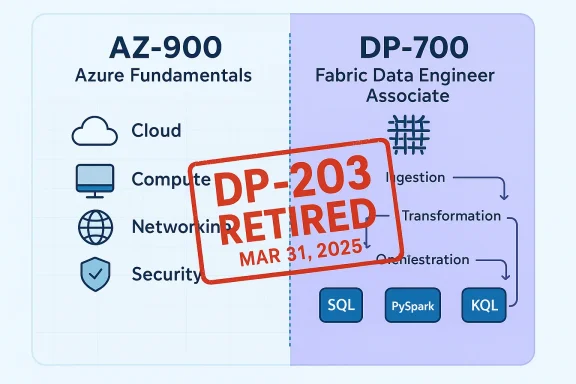
Preparing for Azure certification in 2026 means understanding not just what the exams cover, but how Microsoft’s certification roadmap has shifted beneath them. AZ-900 remains the standard entry point for Azure fundamentals, while the older DP-203 data engineering exam was retired on March 31, 2025, and its role has effectively been succeeded by DP-700: Fabric Data Engineer Associate. That change matters because it alters the best path for learners, employers, and certification planners alike.
Azure certifications have long served as a shorthand for cloud readiness. For newcomers, AZ-900 is still the most approachable way to learn core cloud concepts, Azure architecture, and basic governance ideas, and Microsoft positions it as a common starting point for a career in Azure. For data professionals, the broader market has moved from traditional Azure data-engineering patterns toward Microsoft Fabric-oriented workflows, which explains the retirement of DP-203 and the rise of DP-700.
That shift is not cosmetic. Microsoft’s official study guide for AZ-900, updated as of January 14, 2026, frames the exam around cloud fundamentals, Azure services, and securing, governing, and administering Azure. In contrast, the DP-203 study guide now exists mainly as a historical reference, with Microsoft stating plainly that the exam was retired on March 31, 2025.
The practical implication is that any article, bootcamp, or study plan that still treats DP-203 as a current, schedulable certification is out of date. Learners who are building a career path today should treat DP-203 content as background knowledge and look at DP-700 for the current Microsoft data-engineering credential. That distinction is critical for anyone investing weeks of study time or employer training funds.
At the same time, Microsoft’s practice-assessment ecosystem has expanded as a preparation aid. Practice Assessments are free, can be repeated, and are designed by the same team that develops certification exams, but Microsoft also emphasizes that they are not a replacement for training or real product experience. That makes them useful for readiness checks, not shortcuts.
For readers looking at cloud careers through a hiring lens, the certification story is also a story about role clarity. AZ-900 signals a baseline grasp of cloud concepts, useful for sales engineers, support staff, junior admins, and students. The current data-engineering path, now centered on Fabric Data Engineer Associate, points to hands-on data loading, orchestration, transformation, and analytics-solution management skills that align more closely with modern enterprise analytics stacks.
For beginners, that breadth is a feature, not a flaw. A lot of cloud anxiety comes from not knowing where one service ends and another begins, and AZ-900 helps flatten that learning curve. It gives you a map of Azure rather than expecting you to build the whole city.
A strong AZ-900 candidate should be comfortable with the basic distinctions among public, private, and hybrid cloud, and should understand why organizations choose one model over another. Microsoft’s fundamentals page explicitly frames Azure Fundamentals as a practical, high-level overview that helps users learn cloud computing concepts and the differences among deployment models.
Key areas to study include:
That legacy is still relevant because the underlying job has not disappeared. Organizations still need pipelines, transformations, secure data movement, and analytics enablement. What changed is the platform emphasis: Microsoft now wants that story told through Fabric rather than the older exam framing.
That matters for career planning because it changes the toolchain emphasis. DP-700 is not just “DP-203 with a new badge.” It aligns with Microsoft Fabric’s integrated analytics vision and suggests that future data engineering work on Microsoft’s stack will be judged through that lens.
Important DP-700 takeaways:
Still, there is an important caveat. Microsoft says practice questions are only examples and are not a substitute for training or experience using Microsoft products. That warning is easy to ignore when people are trying to save time, but it is probably the most useful sentence in the whole prep stack.
A practical sequence looks like this:
When people ask whether practice tests are “necessary,” the honest answer is nuanced. They are not strictly required, but they are one of the best low-risk ways to calibrate readiness. For AZ-900, that calibration is especially valuable because the exam often feels easier on paper than it does under timed conditions.
The mistake many candidates make is starting with videos and ending with hope. A better approach starts with the exam outline, then layers in reading, labs, and practice questions. That keeps your study time anchored to the actual certification target.
A sensible study rhythm includes short daily sessions and one longer weekly review. Daily repetition helps with terminology, while the weekly block is where you tie concepts together and test your memory. That split reduces the risk of passive reading, which is one of the most common reasons certification prep stalls out.
Useful planning habits include:
Microsoft’s official materials repeatedly emphasize experience over rote memorization. Even the practice-assessment page warns that practice tests are not a substitute for actual product use. That is not just exam advice; it reflects how cloud roles are evaluated in the real world.
If you are studying DP-700, prioritize data movement and operational logic. Microsoft describes the role around ingesting and transforming data, securing and managing an analytics solution, and monitoring and optimizing an analytics solution. That makes practical exposure to pipelines and orchestration especially valuable.
Try to practice with:
For enterprise teams, the value is broader. A common baseline helps sales, support, IT operations, and junior technical staff speak the same cloud language, which reduces misunderstanding and improves planning. In organizations moving to Azure, that shared vocabulary can be as valuable as a specific technical skill.
This distinction matters in hiring conversations. A candidate with AZ-900 has demonstrated literacy, while a candidate aligned to DP-700 is signaling capability in data engineering workflows. Neither is “better” in the abstract; they simply target different layers of the cloud stack.
Enterprise buyers should also pay attention to the certification lifecycle. Microsoft now refreshes its role-based certifications and practice resources more tightly than it did a few years ago, which means the learning path can shift quickly as the platform evolves. That is good for relevance, but it requires teams to review prep materials more carefully than they used to.
It is tempting to chase the most aggressive promise of instant results. That is usually where questionable “exam dump” sites enter the picture. But if your goal is cloud success rather than a temporary badge, the safer strategy is to build actual competence and use assessments as a validation layer rather than a shortcut.
Look for resources that:
For DP-203 specifically, the most important caveat is historical context. If a course still markets itself around DP-203 as if it were current, it is not aligned with Microsoft’s present certification line. The content may still teach useful data-engineering fundamentals, but the exam target is no longer current.
One immediate watch item is how quickly Microsoft continues to update practice assessments and exam pages. Another is whether more legacy Azure data content gets reframed around Fabric services and workflows. A third is whether learning paths become even more role-specific as enterprise cloud adoption matures.
For learners, the winning formula is simple: follow the current blueprint, practice with the real platform, and use official assessments to measure readiness. For employers, the lesson is equally clear: certifications work best when they are paired with project experience and aligned to present-day tools. In cloud computing, the badge matters, but relevance matters more.
Microsoft certification remains valuable because it tracks the living platform rather than a static curriculum. If you prepare with that reality in mind, you will not just be ready to pass an exam — you will be ready to work in the cloud as it exists now, which is the only version that will matter tomorrow.
Source: nerdbot.com A Complete Guide to Passing Azure DP-203 and AZ-900 Certifications for Cloud Success
 Background
Azure certifications have long served as a shorthand for cloud readiness. For newcomers, AZ-900 is still the most approachable way to learn core cloud concepts, Azure architecture, and basic governance ideas, and Microsoft positions it as a common starting point for a career in Azure. For data professionals, the broader market has moved from traditional Azure data-engineering patterns toward Microsoft Fabric-oriented workflows, which explains the retirement of DP-203 and the rise of DP-700.That shift is not cosmetic. Microsoft’s official study guide for AZ-900, updated as of January 14, 2026, frames the exam around cloud fundamentals, Azure services, and securing, governing, and administering Azure. In contrast, the DP-203 study guide now exists mainly as a historical reference, with Microsoft stating plainly that the exam was retired on March 31, 2025.
The practical implication is that any article, bootcamp, or study plan that still treats DP-203 as a current, schedulable certification is out of date. Learners who are building a career path today should treat DP-203 content as background knowledge and look at DP-700 for the current Microsoft data-engineering credential. That distinction is critical for anyone investing weeks of study time or employer training funds.
At the same time, Microsoft’s practice-assessment ecosystem has expanded as a preparation aid. Practice Assessments are free, can be repeated, and are designed by the same team that develops certification exams, but Microsoft also emphasizes that they are not a replacement for training or real product experience. That makes them useful for readiness checks, not shortcuts.
For readers looking at cloud careers through a hiring lens, the certification story is also a story about role clarity. AZ-900 signals a baseline grasp of cloud concepts, useful for sales engineers, support staff, junior admins, and students. The current data-engineering path, now centered on Fabric Data Engineer Associate, points to hands-on data loading, orchestration, transformation, and analytics-solution management skills that align more closely with modern enterprise analytics stacks.
What AZ-900 Actually Measures
AZ-900 is fundamentally about vocabulary, structure, and confidence. Microsoft says candidates should be able to describe Azure architectural components and services such as compute, networking, and storage, while also understanding tools and features used to secure, govern, and administer Azure. That means the exam rewards breadth more than depth.For beginners, that breadth is a feature, not a flaw. A lot of cloud anxiety comes from not knowing where one service ends and another begins, and AZ-900 helps flatten that learning curve. It gives you a map of Azure rather than expecting you to build the whole city.
Core Topic Areas
The official study guide groups content around cloud concepts, Azure architecture, Azure services, and governance. That structure is useful because it mirrors how professionals actually think about cloud systems: first the model, then the platform, then the controls that keep the platform safe and cost-effective.A strong AZ-900 candidate should be comfortable with the basic distinctions among public, private, and hybrid cloud, and should understand why organizations choose one model over another. Microsoft’s fundamentals page explicitly frames Azure Fundamentals as a practical, high-level overview that helps users learn cloud computing concepts and the differences among deployment models.
Key areas to study include:
- Cloud concepts
- Azure architectural components
- Core Azure services
- Security and governance
- Pricing and support
- Identity basics
- Management tools
What DP-203 Meant, and What Replaced It
DP-203 was once the flagship Azure data-engineering exam, but Microsoft retired it on March 31, 2025. The retired study guide still provides a valuable snapshot of what Microsoft used to expect from Azure data engineers: integrating, transforming, and consolidating structured, unstructured, and streaming data into analytics-ready schemas.That legacy is still relevant because the underlying job has not disappeared. Organizations still need pipelines, transformations, secure data movement, and analytics enablement. What changed is the platform emphasis: Microsoft now wants that story told through Fabric rather than the older exam framing.
The Fabric Transition
The replacement direction is clearly visible in DP-700, which Microsoft labels Fabric Data Engineer Associate. The exam targets data loading patterns, data architectures, orchestration processes, and the ability to ingest, transform, secure, manage, and monitor analytics solutions. It also explicitly calls out SQL, PySpark, and KQL as expected skill areas.That matters for career planning because it changes the toolchain emphasis. DP-700 is not just “DP-203 with a new badge.” It aligns with Microsoft Fabric’s integrated analytics vision and suggests that future data engineering work on Microsoft’s stack will be judged through that lens.
Important DP-700 takeaways:
- DP-203 is retired
- DP-700 is the current Microsoft data-engineering certification
- Fabric skills are now central
- SQL, PySpark, and KQL are specifically relevant
- Analytics orchestration and monitoring are core expectations
How Microsoft’s Practice Assessments Fit In
Microsoft now pushes practice assessments as one of the most accessible preparation tools for certification candidates. The company says these assessments are free, can be attempted as many times as desired, and are updated in step with certifications to stay current. That makes them a useful checkpoint before scheduling an exam, especially for AZ-900.Still, there is an important caveat. Microsoft says practice questions are only examples and are not a substitute for training or experience using Microsoft products. That warning is easy to ignore when people are trying to save time, but it is probably the most useful sentence in the whole prep stack.
A Better Way to Use Practice Tests
The most effective candidates do not use practice exams to memorize answer patterns. They use them to identify weak spots, confirm whether they can explain a concept in plain language, and measure whether they understand why an answer is right. That method works better because modern certification exams increasingly test judgment, not just recall.A practical sequence looks like this:
- Read the official study guide.
- Take notes by topic, not by question.
- Build hands-on familiarity in Azure or Fabric.
- Take a practice assessment.
- Re-study only the weak areas.
- Repeat until your mistakes are conceptual, not careless.
When people ask whether practice tests are “necessary,” the honest answer is nuanced. They are not strictly required, but they are one of the best low-risk ways to calibrate readiness. For AZ-900, that calibration is especially valuable because the exam often feels easier on paper than it does under timed conditions.
Building a Study Plan That Actually Holds Up
A good Azure study plan is not a calendar full of ambitious intentions. It is a sequence of specific, measurable actions that map to the exam blueprint and your current skill gaps. Microsoft’s study guides make that process easier because they define the relevant skills up front.The mistake many candidates make is starting with videos and ending with hope. A better approach starts with the exam outline, then layers in reading, labs, and practice questions. That keeps your study time anchored to the actual certification target.
A 30- to 90-Day Preparation Rhythm
For AZ-900, many learners can be ready in a few weeks if they already work in IT or have studied cloud basics. For DP-700, the timeline is usually longer because the expected background is more advanced and hands-on. Microsoft’s own Fabric data-engineer course describes the audience as professionals with ETL experience and familiarity with SQL, PySpark, or KQL.A sensible study rhythm includes short daily sessions and one longer weekly review. Daily repetition helps with terminology, while the weekly block is where you tie concepts together and test your memory. That split reduces the risk of passive reading, which is one of the most common reasons certification prep stalls out.
Useful planning habits include:
- Studying one exam domain at a time
- Writing a plain-English summary after each module
- Reviewing missed questions the same day
- Reserving one session each week for hands-on practice
- Tracking what you can explain without notes
- Repeating hard topics before moving on
Hands-On Experience: The Difference Between Knowing and Passing
Hands-on work is where certifications become job skills. For AZ-900, this might mean creating a resource group, deploying a storage account, or exploring portal-based governance features. For DP-700, it means working with ingestion, transformation, orchestration, and analytics-solution monitoring in a way that mirrors enterprise practice.Microsoft’s official materials repeatedly emphasize experience over rote memorization. Even the practice-assessment page warns that practice tests are not a substitute for actual product use. That is not just exam advice; it reflects how cloud roles are evaluated in the real world.
What to Practice in Azure and Fabric
If you are studying AZ-900, focus on the service families and the administrative basics behind them. Learn where compute fits, how storage tiers differ at a high level, and how governance and cost controls are presented in the portal. Those are the kinds of concepts the exam expects you to recognize quickly.If you are studying DP-700, prioritize data movement and operational logic. Microsoft describes the role around ingesting and transforming data, securing and managing an analytics solution, and monitoring and optimizing an analytics solution. That makes practical exposure to pipelines and orchestration especially valuable.
Try to practice with:
- Azure portal navigation
- Identity and access basics
- Storage and compute setup
- Simple data ingestion flows
- Querying with SQL or KQL
- Notebook-based transformation work
- Monitoring and troubleshooting workflows
Career Impact: Consumer Learners vs Enterprise Teams
For individual learners, AZ-900 is a confidence builder. It validates that you understand the language of cloud computing and gives you a low-friction credential to place on a résumé, profile, or internal development plan. It also creates a useful bridge to more technical certifications later.For enterprise teams, the value is broader. A common baseline helps sales, support, IT operations, and junior technical staff speak the same cloud language, which reduces misunderstanding and improves planning. In organizations moving to Azure, that shared vocabulary can be as valuable as a specific technical skill.
Data Teams Need a Different Signal
The data-engineering side is different. Employers are not just looking for someone who can define analytics terms; they want someone who can build and operate pipelines, secure the data estate, and support an analytics platform at scale. That is why DP-700’s focus on orchestration and monitoring is more operationally meaningful than a generic fundamentals badge.This distinction matters in hiring conversations. A candidate with AZ-900 has demonstrated literacy, while a candidate aligned to DP-700 is signaling capability in data engineering workflows. Neither is “better” in the abstract; they simply target different layers of the cloud stack.
Enterprise buyers should also pay attention to the certification lifecycle. Microsoft now refreshes its role-based certifications and practice resources more tightly than it did a few years ago, which means the learning path can shift quickly as the platform evolves. That is good for relevance, but it requires teams to review prep materials more carefully than they used to.
Choosing the Right Learning Resources
The best learning resources are the ones that match the exam you are actually taking. For AZ-900, Microsoft Learn’s study guide and practice assessment are the most obvious first stops. For the modern data-engineering path, Microsoft’s DP-700 certification page and course materials are the correct references, not retired DP-203 dumps or outdated blog posts.It is tempting to chase the most aggressive promise of instant results. That is usually where questionable “exam dump” sites enter the picture. But if your goal is cloud success rather than a temporary badge, the safer strategy is to build actual competence and use assessments as a validation layer rather than a shortcut.
What Good Resources Should Do
A quality prep resource should help you understand why a concept matters. It should show you the service, the use case, the tradeoff, and the operational implications. Anything less tends to create shallow knowledge that evaporates after the exam.Look for resources that:
- Align with the current Microsoft exam blueprint
- Include official terminology
- Offer realistic practice questions
- Explain incorrect answers
- Encourage hands-on labs
- Reflect current product names and service models
For DP-203 specifically, the most important caveat is historical context. If a course still markets itself around DP-203 as if it were current, it is not aligned with Microsoft’s present certification line. The content may still teach useful data-engineering fundamentals, but the exam target is no longer current.
Strengths and Opportunities
The strongest certification strategy in 2026 is to use AZ-900 as a true foundation and to use DP-700 as the current data-engineering destination if your career path points that way. That combination reflects both Microsoft’s current roadmap and the realities of how cloud teams are organized. It also keeps your study investment aligned with live credentials rather than retired ones.- AZ-900 is still an accessible, high-signal entry point for cloud literacy.
- Microsoft’s free practice assessments reduce the cost of readiness checks.
- The shift to Fabric gives data engineers a more modern, integrated analytics story.
- Microsoft’s official study guides are current and exam-specific.
- Hands-on practice maps well to real workplace tasks.
- Fundamentals certifications can support broader career mobility.
- The current path is clearer than it was during the Azure-only data-engineering era.
Risks and Concerns
The biggest risk is preparing for a certification that no longer exists in its original form. DP-203 was retired on March 31, 2025, so learners who follow stale advice may waste time, money, and momentum. A related risk is assuming that a practice test or dump site is enough to compensate for the absence of real product experience.- Outdated articles may still present DP-203 as active.
- Some prep content may not reflect Microsoft’s current skill outline.
- Memorization-heavy study can fail on scenario-based questions.
- Overreliance on dumps can create false confidence.
- Candidates may underestimate the hands-on portion of cloud readiness.
- Fabric’s evolution means the target stack can keep changing.
- Beginners can confuse foundational knowledge with job-ready competence.
What to Watch Next
The next phase of Azure certification will likely continue to track Microsoft’s platform shifts, especially around Fabric and integrated analytics. For learners, that means staying close to official study guides and reevaluating older prep material regularly. For employers, it means treating certification trends as a signal of platform direction, not just a badge inventory.One immediate watch item is how quickly Microsoft continues to update practice assessments and exam pages. Another is whether more legacy Azure data content gets reframed around Fabric services and workflows. A third is whether learning paths become even more role-specific as enterprise cloud adoption matures.
- New or updated Microsoft Learn study guides
- Further Fabric-centered certification alignment
- Continued retirement of legacy exam references
- Expanded practice-assessment coverage
- Changes to role-based certification renewal policies
Looking Ahead
The best long-term certification strategy is to treat cloud learning as a moving target. AZ-900 remains the right first step for fundamentals, but the data-engineering path now belongs to Microsoft Fabric and DP-700, not the retired DP-203 exam. That shift is more than administrative housekeeping; it is a sign of where Microsoft wants the market to go.For learners, the winning formula is simple: follow the current blueprint, practice with the real platform, and use official assessments to measure readiness. For employers, the lesson is equally clear: certifications work best when they are paired with project experience and aligned to present-day tools. In cloud computing, the badge matters, but relevance matters more.
Microsoft certification remains valuable because it tracks the living platform rather than a static curriculum. If you prepare with that reality in mind, you will not just be ready to pass an exam — you will be ready to work in the cloud as it exists now, which is the only version that will matter tomorrow.
Source: nerdbot.com A Complete Guide to Passing Azure DP-203 and AZ-900 Certifications for Cloud Success
