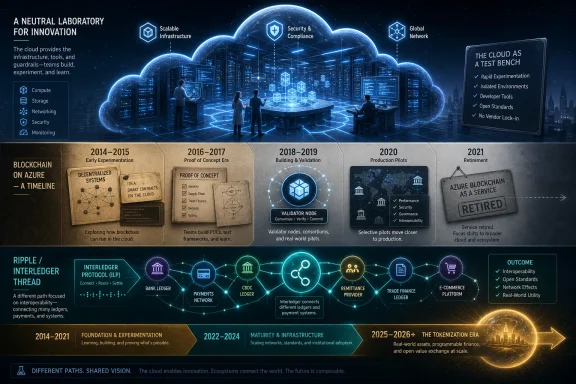
Microsoft’s historical Azure work with Ripple-related technology resurfaced in May 2026 after MEXC amplified reporting that Azure Blockchain as a Service once supported Ripple infrastructure and that Microsoft explored Interledger for payment interoperability. The important word is historical. This is not evidence of a fresh Microsoft-XRP partnership, but it is a useful reminder of what enterprise blockchain looked like before tokenization became Wall Street’s favorite future tense.
The story matters because it sits at the intersection of three things WindowsForum readers know well: Microsoft’s habit of incubating enterprise infrastructure before the market is ready, the cloud’s role as the neutral ground for regulated experimentation, and crypto markets’ tendency to turn an old integration into a new narrative. Azure did give developers access to blockchain tooling, and Ripple’s technology did appear in that enterprise cloud conversation. But the lesson is less “Microsoft is back on XRP” than “the cloud was always the test bench for financial networks that were too risky, too regulated, or too immature to run in production.”
The first mistake in reading the renewed Ripple-Azure chatter is to treat cloud availability as corporate sponsorship. Azure Blockchain as a Service was Microsoft’s attempt to make distributed ledger experiments manageable for enterprises that did not want to assemble nodes, networks, identities, and developer tooling from scratch. In that sense, support for a Ripple validator node was consistent with the broader Azure pitch: bring the unfamiliar into a familiar procurement, monitoring, and deployment model.
That matters because enterprise adoption rarely begins with ideological commitment. Banks, insurers, supply-chain firms, and software vendors do not usually wake up wanting a blockchain; they wake up wanting lower reconciliation costs, faster settlement, richer audit trails, or a more programmable way to move assets and data between institutions. Azure’s role was to reduce the friction of testing those ideas without requiring every pilot team to become infrastructure specialists.
Ripple’s presence in that environment was therefore meaningful, but bounded. It showed that XRP Ledger-related infrastructure had made it into the same enterprise experimentation layer as other blockchain projects. It did not prove that Microsoft was betting its cloud strategy on XRP, nor that Azure customers were preparing a broad commercial rollout around Ripple.
That distinction is important in 2026 because crypto narratives age strangely. An archived enterprise integration can be reframed years later as proof of inevitable institutional adoption. In reality, it is better understood as a snapshot from a period when Microsoft, IBM, Amazon, and others were trying to determine whether blockchains were databases, financial networks, middleware, or all of the above.
That framing was classic Microsoft. The company did not need to own the protocol layer to win; it needed developers and enterprises to use Azure as the operating environment. Whether a customer was testing Ethereum, Quorum, Hyperledger, Corda, or Ripple-adjacent tools, the revenue and strategic value came from Azure becoming the substrate.
The proof-of-concept economy rewarded breadth. Cloud providers wanted to offer enough options that no serious enterprise pilot would leave the platform because a particular ledger was missing. Blockchain startups wanted cloud marketplace exposure because it made them look enterprise-ready. Systems integrators wanted deployable templates because they could turn experiments into billable engagements.
That world produced a lot of pilots and fewer durable platforms. Many blockchain projects were technically interesting but commercially awkward. Enterprises discovered that shared ledgers do not magically create shared governance, that faster settlement requires legal and operational redesign, and that integration with legacy systems is often the most expensive part of any “disruptive” technology.
Microsoft eventually retired Azure Blockchain Service in 2021, a decision that looks less like a repudiation of distributed ledger ideas than a recognition that the first-generation managed blockchain market had not matured as expected. The company moved toward partner-led offerings and other ledger-adjacent services rather than continuing to operate a broad managed blockchain platform under its own banner.
That made Ripple a natural candidate for enterprise cloud experimentation. The company’s pitch was not that every business should become a token issuer or that every user should self-custody assets. It was that value could move across borders more efficiently if financial institutions had better rails, better liquidity options, and a ledger designed for fast finality and low transaction cost.
A validator node in an Azure context fit that story. Validators are part of the consensus machinery that helps determine which transactions become part of the ledger’s accepted history. For enterprises evaluating network behavior, infrastructure reliability, or integration design, the ability to deploy and observe that kind of component in a cloud environment had obvious appeal.
Still, the word “validator” can do too much work in public discussion. Running or supporting a node does not mean adopting a token as a treasury asset, routing production bank flows through it, or endorsing every market claim surrounding it. In enterprise technology, infrastructure support is often exploratory, modular, and reversible.
That is why the revived Azure-Ripple discussion should be read as evidence of early institutional curiosity, not as a fresh market signal. It confirms that Ripple’s technology was visible to major cloud and financial technology conversations years ago. It does not establish that Microsoft has revived a Ripple strategy in 2026.
For Microsoft, the attractive concept was not necessarily XRP itself. It was the possibility that cloud-hosted applications could interact with multiple financial networks through a common interoperability layer. That is the kind of problem Azure was built to monetize.
Enterprise customers rarely live in single-network fantasy worlds. A bank may need to interface with card networks, correspondent banking rails, internal ledgers, customer databases, stablecoin platforms, tokenized asset systems, and regulatory reporting infrastructure. A multinational company may need treasury operations to reconcile across currencies, jurisdictions, and settlement windows.
Interledger’s appeal was that it treated fragmentation as a permanent condition rather than a temporary flaw. Instead of assuming one blockchain would dominate, it imagined a world of many ledgers connected by routing, quoting, and settlement logic. That worldview has aged better than many maximalist claims from the same era.
It also explains why the Azure connection still attracts attention. In 2026, the market conversation has shifted toward tokenized deposits, stablecoins, central bank digital currency experiments, on-chain collateral, and around-the-clock settlement. Those trends all intensify the need for interoperability. The more ledgers institutions create, the more valuable connective tissue becomes.
Microsoft’s retreat from a dedicated Azure Blockchain Service came after several years of enterprise blockchain enthusiasm cooling into selective deployment. The technology did not disappear, but the market became more disciplined. Customers wanted fewer generic blockchain platforms and more specific solutions tied to trade finance, supply chain, identity, auditability, settlement, or compliance.
That pattern is familiar in enterprise IT. A platform category gets overbuilt during the hype phase, then decomposes into narrower services, partner offerings, and embedded capabilities. The same thing happened with big data appliances, IoT platforms, low-code suites, and assorted AI tooling before the generative AI boom reorganized the market.
The retirement also shows why “Microsoft once supported X” is a weak foundation for 2026 claims. Microsoft has supported, previewed, deprecated, renamed, and retired a long list of Azure services. The company experiments aggressively because cloud platforms need to follow developer interest; it also cuts aggressively when demand, economics, or strategic fit fall short.
That does not make the Ripple connection meaningless. It makes it historical. It belongs in the record of how cloud providers explored blockchain infrastructure, not in the bucket of proof that Microsoft has quietly chosen XRP as a future settlement layer.
That shift makes earlier experiments look more prescient. A cloud-hosted validator, an interoperability protocol, or a bank settlement pilot may have seemed speculative at the time. Today, the same architecture can be reinterpreted as groundwork for programmable financial infrastructure.
But reinterpretation is not the same as inevitability. The fact that institutions now care about tokenization does not mean every early blockchain project was right, or that every ledger tested in Azure will become core market plumbing. Many pilots fail because the technical idea works but the governance model does not. Others fail because incumbents prefer controlled networks, regulated intermediaries, or database-like systems with blockchain vocabulary.
Ripple and the XRP Ledger remain part of that debate because they were designed around payment speed, liquidity, and settlement rather than general-purpose computation alone. That gives XRP Ledger a clearer financial-market story than many chains whose enterprise pitch had to be retrofitted after speculative adoption. But clarity of use case is still not the same as institutional dominance.
The cloud angle remains central. If tokenized finance expands, enterprises will need infrastructure for nodes, APIs, compliance monitoring, custody integrations, analytics, key management, identity, and disaster recovery. Whether that infrastructure runs on Azure, AWS, Google Cloud, specialist providers, or private environments, the cloud will remain the place where much of the operational burden gets abstracted.
That neutrality can look like endorsement from the outside. A vendor appears in Azure Marketplace, a developer template supports a network, or a Microsoft blog post discusses a protocol, and suddenly market participants infer strategic alignment. But cloud platforms are marketplaces as much as product portfolios. They are designed to make competing technologies deployable.
This is particularly important for XRP watchers. Microsoft’s willingness to support or explore Ripple-related technology says more about Azure’s enterprise cloud ambitions than about XRP’s market destiny. The cloud business wanted to be relevant wherever customers were experimenting. It did not need to pick a single financial ledger winner.
The same logic applies across Microsoft’s modern stack. The company can support Linux while selling Windows Server, support PostgreSQL while selling SQL Server, support OpenAI models while offering model choice in Azure AI, and support partner security tools while expanding Microsoft Defender. The platform wins by becoming unavoidable, not by making every layer proprietary.
In that sense, Ripple’s Azure history is an example of Microsoft behaving exactly as Microsoft tends to behave. It brought a potentially important enterprise technology into its cloud orbit, watched customer demand evolve, and later adjusted the product portfolio when the managed blockchain market failed to justify its original shape.
That is understandable. Unlike meme-driven assets or purely DeFi-native tokens, XRP’s public case has long depended on the belief that financial institutions will eventually need digital settlement infrastructure with characteristics the XRP Ledger claims to provide. Enterprise references therefore carry symbolic value even when they do not imply current commercial activity.
But symbolic value is not operational evidence. The hard questions are still practical: Who is running production volume? Which institutions are settling real obligations? What regulatory permissions apply? How is liquidity sourced? What happens when a transaction crosses jurisdictions, compliance regimes, and asset types?
Those questions matter more than whether a cloud platform once made a node easier to deploy. Enterprise adoption is not a press-release chain reaction. It is a slow grind through procurement, risk committees, legal review, integration testing, cybersecurity audits, and operational resilience planning.
For IT pros, this is the useful corrective. The presence of a technology in Azure can lower experimentation costs, but it does not remove the institutional work required to make that technology production-critical. Cloud hosting is the beginning of the enterprise journey, not the end.
A ledger with fast settlement and low fees is therefore attractive in theory. But payments are not just packets. They carry sanctions obligations, anti-money-laundering controls, fraud risk, consumer protection rules, capital requirements, liquidity constraints, and national regulatory politics.
This is where many blockchain payment narratives become too neat. They assume that if a ledger can settle quickly, the business system around it will naturally reorganize. In practice, speed can create new risk if compliance, liquidity, reversibility, and dispute processes do not keep pace.
Microsoft’s Interledger interest is relevant here because interoperability acknowledges the mess. It does not assume the world will collapse into a single ledger. It assumes many systems will continue to exist and that value transfer will require coordination across them.
That is closer to how enterprise IT actually changes. Legacy systems do not vanish; they get wrapped, bridged, abstracted, and slowly retired where the economics justify it. Any future for XRP Ledger in institutional finance will likely depend less on a grand replacement story and more on whether it can fit into the hybrid reality banks already inhabit.
That evolution matters for digital assets. If tokenized markets become more important, cloud providers will not need branded blockchain services to participate. They can provide confidential computing, key management, identity, observability, compliance tooling, managed databases, data lakes, AI surveillance, and secure networking around whatever ledger systems customers choose.
This may ultimately be more important than the old Azure Blockchain branding. The future of enterprise blockchain may not look like a tile in the Azure portal labeled “Blockchain.” It may look like a set of regulated financial applications using ledger components underneath, integrated with ordinary cloud services that auditors and administrators already understand.
Microsoft is well positioned for that world because it owns so much of the enterprise control plane. Entra ID, Defender, Purview, Sentinel, Azure networking, confidential computing, and developer tooling are all relevant to financial institutions that need to govern complex systems. A blockchain node is only one small part of that architecture.
That is why the Ripple-Azure link is best seen as an early signal of cloud-finance convergence. It showed that cloud providers could make ledger infrastructure more accessible. The bigger story is that cloud platforms are becoming the default environment where new financial infrastructure is tested, secured, monitored, and connected to legacy systems.
There is a legitimate story here. Microsoft’s Azure work placed Ripple-related technology inside a major enterprise cloud environment, and Microsoft’s exploration of Interledger aligned with a real interoperability problem that still matters. Those facts help explain why XRP Ledger remains part of enterprise blockchain conversations.
There is also a limit. Azure Blockchain as a Service belonged to a previous Microsoft product era. Its retirement means the old service cannot be used as evidence of a current Azure product push. Without new announcements, customer deployments, technical documentation, or Microsoft statements, the story remains retrospective.
That retrospective still has value. Technology markets often move in cycles, and ideas that fail as standalone platforms can reappear later as features, partner integrations, or infrastructure patterns. The original enterprise blockchain wave overpromised, but it also trained banks, cloud providers, and regulators to think more concretely about shared ledgers.
The right conclusion is therefore neither hype nor dismissal. Ripple’s Azure history is not a smoking gun. It is a breadcrumb from an earlier phase of enterprise experimentation that looks more relevant now because tokenization has made the underlying problems fashionable again.
Source: MEXC Ripple and Microsoft Azure Link Highlights Enterprise Role for XRP Ledger | MEXC News
The story matters because it sits at the intersection of three things WindowsForum readers know well: Microsoft’s habit of incubating enterprise infrastructure before the market is ready, the cloud’s role as the neutral ground for regulated experimentation, and crypto markets’ tendency to turn an old integration into a new narrative. Azure did give developers access to blockchain tooling, and Ripple’s technology did appear in that enterprise cloud conversation. But the lesson is less “Microsoft is back on XRP” than “the cloud was always the test bench for financial networks that were too risky, too regulated, or too immature to run in production.”
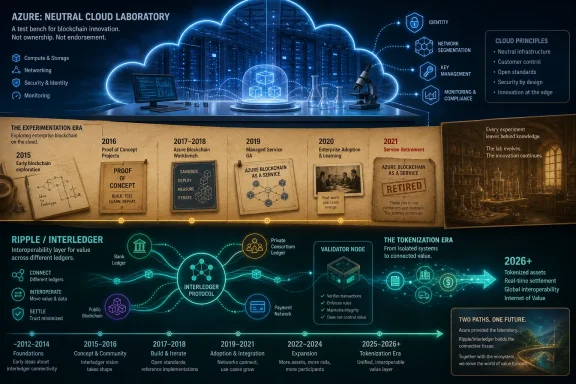 Azure Was the Laboratory, Not the Endorsement
The first mistake in reading the renewed Ripple-Azure chatter is to treat cloud availability as corporate sponsorship. Azure Blockchain as a Service was Microsoft’s attempt to make distributed ledger experiments manageable for enterprises that did not want to assemble nodes, networks, identities, and developer tooling from scratch. In that sense, support for a Ripple validator node was consistent with the broader Azure pitch: bring the unfamiliar into a familiar procurement, monitoring, and deployment model.That matters because enterprise adoption rarely begins with ideological commitment. Banks, insurers, supply-chain firms, and software vendors do not usually wake up wanting a blockchain; they wake up wanting lower reconciliation costs, faster settlement, richer audit trails, or a more programmable way to move assets and data between institutions. Azure’s role was to reduce the friction of testing those ideas without requiring every pilot team to become infrastructure specialists.
Ripple’s presence in that environment was therefore meaningful, but bounded. It showed that XRP Ledger-related infrastructure had made it into the same enterprise experimentation layer as other blockchain projects. It did not prove that Microsoft was betting its cloud strategy on XRP, nor that Azure customers were preparing a broad commercial rollout around Ripple.
That distinction is important in 2026 because crypto narratives age strangely. An archived enterprise integration can be reframed years later as proof of inevitable institutional adoption. In reality, it is better understood as a snapshot from a period when Microsoft, IBM, Amazon, and others were trying to determine whether blockchains were databases, financial networks, middleware, or all of the above.
Microsoft’s Blockchain Era Was Built for the Proof-of-Concept Economy
Azure Blockchain as a Service arrived during the mid-2010s enterprise blockchain boom, when nearly every large vendor had a slide deck about distributed ledgers. Microsoft’s pitch was pragmatic rather than utopian. It wanted Azure to be the place where companies could spin up ledgers, build decentralized applications, test smart contracts, and connect blockchain systems to conventional enterprise identity and application stacks.That framing was classic Microsoft. The company did not need to own the protocol layer to win; it needed developers and enterprises to use Azure as the operating environment. Whether a customer was testing Ethereum, Quorum, Hyperledger, Corda, or Ripple-adjacent tools, the revenue and strategic value came from Azure becoming the substrate.
The proof-of-concept economy rewarded breadth. Cloud providers wanted to offer enough options that no serious enterprise pilot would leave the platform because a particular ledger was missing. Blockchain startups wanted cloud marketplace exposure because it made them look enterprise-ready. Systems integrators wanted deployable templates because they could turn experiments into billable engagements.
That world produced a lot of pilots and fewer durable platforms. Many blockchain projects were technically interesting but commercially awkward. Enterprises discovered that shared ledgers do not magically create shared governance, that faster settlement requires legal and operational redesign, and that integration with legacy systems is often the most expensive part of any “disruptive” technology.
Microsoft eventually retired Azure Blockchain Service in 2021, a decision that looks less like a repudiation of distributed ledger ideas than a recognition that the first-generation managed blockchain market had not matured as expected. The company moved toward partner-led offerings and other ledger-adjacent services rather than continuing to operate a broad managed blockchain platform under its own banner.
Ripple Fit the Enterprise Dream Better Than the Crypto Stereotype
Ripple has always occupied an unusual place in the digital asset conversation. It is grouped with crypto because XRP trades on exchanges and because the XRP Ledger is a public distributed ledger. But Ripple’s commercial story has long been aimed at banks, payment companies, liquidity providers, and cross-border settlement problems rather than at consumer speculation alone.That made Ripple a natural candidate for enterprise cloud experimentation. The company’s pitch was not that every business should become a token issuer or that every user should self-custody assets. It was that value could move across borders more efficiently if financial institutions had better rails, better liquidity options, and a ledger designed for fast finality and low transaction cost.
A validator node in an Azure context fit that story. Validators are part of the consensus machinery that helps determine which transactions become part of the ledger’s accepted history. For enterprises evaluating network behavior, infrastructure reliability, or integration design, the ability to deploy and observe that kind of component in a cloud environment had obvious appeal.
Still, the word “validator” can do too much work in public discussion. Running or supporting a node does not mean adopting a token as a treasury asset, routing production bank flows through it, or endorsing every market claim surrounding it. In enterprise technology, infrastructure support is often exploratory, modular, and reversible.
That is why the revived Azure-Ripple discussion should be read as evidence of early institutional curiosity, not as a fresh market signal. It confirms that Ripple’s technology was visible to major cloud and financial technology conversations years ago. It does not establish that Microsoft has revived a Ripple strategy in 2026.
Interledger Was the More Microsoft-Friendly Idea
The Interledger Protocol may be the more revealing part of the story. Ripple helped originate Interledger as a way to connect different ledgers and payment networks, not simply to promote one chain. That idea maps neatly onto Microsoft’s enterprise instincts: interoperability, abstraction, connectors, standards, and middleware that lets incompatible systems exchange value or data.For Microsoft, the attractive concept was not necessarily XRP itself. It was the possibility that cloud-hosted applications could interact with multiple financial networks through a common interoperability layer. That is the kind of problem Azure was built to monetize.
Enterprise customers rarely live in single-network fantasy worlds. A bank may need to interface with card networks, correspondent banking rails, internal ledgers, customer databases, stablecoin platforms, tokenized asset systems, and regulatory reporting infrastructure. A multinational company may need treasury operations to reconcile across currencies, jurisdictions, and settlement windows.
Interledger’s appeal was that it treated fragmentation as a permanent condition rather than a temporary flaw. Instead of assuming one blockchain would dominate, it imagined a world of many ledgers connected by routing, quoting, and settlement logic. That worldview has aged better than many maximalist claims from the same era.
It also explains why the Azure connection still attracts attention. In 2026, the market conversation has shifted toward tokenized deposits, stablecoins, central bank digital currency experiments, on-chain collateral, and around-the-clock settlement. Those trends all intensify the need for interoperability. The more ledgers institutions create, the more valuable connective tissue becomes.
The 2021 Retirement Is the Fact Crypto Narratives Prefer to Skip
Any serious discussion of Microsoft’s blockchain history has to confront the uncomfortable middle chapter: Azure Blockchain Service was retired in September 2021. That date does not erase Microsoft’s earlier experimentation, but it does limit what can fairly be inferred from it. A discontinued managed service is not the same thing as an active product strategy.Microsoft’s retreat from a dedicated Azure Blockchain Service came after several years of enterprise blockchain enthusiasm cooling into selective deployment. The technology did not disappear, but the market became more disciplined. Customers wanted fewer generic blockchain platforms and more specific solutions tied to trade finance, supply chain, identity, auditability, settlement, or compliance.
That pattern is familiar in enterprise IT. A platform category gets overbuilt during the hype phase, then decomposes into narrower services, partner offerings, and embedded capabilities. The same thing happened with big data appliances, IoT platforms, low-code suites, and assorted AI tooling before the generative AI boom reorganized the market.
The retirement also shows why “Microsoft once supported X” is a weak foundation for 2026 claims. Microsoft has supported, previewed, deprecated, renamed, and retired a long list of Azure services. The company experiments aggressively because cloud platforms need to follow developer interest; it also cuts aggressively when demand, economics, or strategic fit fall short.
That does not make the Ripple connection meaningless. It makes it historical. It belongs in the record of how cloud providers explored blockchain infrastructure, not in the bucket of proof that Microsoft has quietly chosen XRP as a future settlement layer.
Tokenization Makes the Old Experiment Look Less Strange
The reason this old Azure thread is resurfacing now is that tokenization has changed the lens. In the mid-2010s, enterprise blockchain often sounded like a solution searching for a use case. By 2026, financial institutions are more openly discussing tokenized funds, real-world assets, stablecoin settlement, and digital market infrastructure that operates beyond traditional business hours.That shift makes earlier experiments look more prescient. A cloud-hosted validator, an interoperability protocol, or a bank settlement pilot may have seemed speculative at the time. Today, the same architecture can be reinterpreted as groundwork for programmable financial infrastructure.
But reinterpretation is not the same as inevitability. The fact that institutions now care about tokenization does not mean every early blockchain project was right, or that every ledger tested in Azure will become core market plumbing. Many pilots fail because the technical idea works but the governance model does not. Others fail because incumbents prefer controlled networks, regulated intermediaries, or database-like systems with blockchain vocabulary.
Ripple and the XRP Ledger remain part of that debate because they were designed around payment speed, liquidity, and settlement rather than general-purpose computation alone. That gives XRP Ledger a clearer financial-market story than many chains whose enterprise pitch had to be retrofitted after speculative adoption. But clarity of use case is still not the same as institutional dominance.
The cloud angle remains central. If tokenized finance expands, enterprises will need infrastructure for nodes, APIs, compliance monitoring, custody integrations, analytics, key management, identity, and disaster recovery. Whether that infrastructure runs on Azure, AWS, Google Cloud, specialist providers, or private environments, the cloud will remain the place where much of the operational burden gets abstracted.
Microsoft’s Real Strategy Is Infrastructure Neutrality
Microsoft’s most durable advantage in this story is not blockchain conviction. It is infrastructure neutrality. Azure is valuable because it can host competing databases, competing AI models, competing Linux distributions, competing security tools, and competing application frameworks. Blockchain was another candidate for that same treatment.That neutrality can look like endorsement from the outside. A vendor appears in Azure Marketplace, a developer template supports a network, or a Microsoft blog post discusses a protocol, and suddenly market participants infer strategic alignment. But cloud platforms are marketplaces as much as product portfolios. They are designed to make competing technologies deployable.
This is particularly important for XRP watchers. Microsoft’s willingness to support or explore Ripple-related technology says more about Azure’s enterprise cloud ambitions than about XRP’s market destiny. The cloud business wanted to be relevant wherever customers were experimenting. It did not need to pick a single financial ledger winner.
The same logic applies across Microsoft’s modern stack. The company can support Linux while selling Windows Server, support PostgreSQL while selling SQL Server, support OpenAI models while offering model choice in Azure AI, and support partner security tools while expanding Microsoft Defender. The platform wins by becoming unavoidable, not by making every layer proprietary.
In that sense, Ripple’s Azure history is an example of Microsoft behaving exactly as Microsoft tends to behave. It brought a potentially important enterprise technology into its cloud orbit, watched customer demand evolve, and later adjusted the product portfolio when the managed blockchain market failed to justify its original shape.
The XRP Community Sees Signal Because the Market Wants One
The renewed attention around the MEXC item is also a lesson in how crypto markets process enterprise news. XRP has one of the most institution-focused communities in digital assets, and that community is highly sensitive to bank, government, and cloud-provider references. Any connection to Microsoft, however old, becomes part of a larger adoption narrative.That is understandable. Unlike meme-driven assets or purely DeFi-native tokens, XRP’s public case has long depended on the belief that financial institutions will eventually need digital settlement infrastructure with characteristics the XRP Ledger claims to provide. Enterprise references therefore carry symbolic value even when they do not imply current commercial activity.
But symbolic value is not operational evidence. The hard questions are still practical: Who is running production volume? Which institutions are settling real obligations? What regulatory permissions apply? How is liquidity sourced? What happens when a transaction crosses jurisdictions, compliance regimes, and asset types?
Those questions matter more than whether a cloud platform once made a node easier to deploy. Enterprise adoption is not a press-release chain reaction. It is a slow grind through procurement, risk committees, legal review, integration testing, cybersecurity audits, and operational resilience planning.
For IT pros, this is the useful corrective. The presence of a technology in Azure can lower experimentation costs, but it does not remove the institutional work required to make that technology production-critical. Cloud hosting is the beginning of the enterprise journey, not the end.
The Banking Use Case Still Runs Into Non-Technical Walls
Ripple’s strongest claim has always been that cross-border payments are inefficient. That claim is not controversial. Correspondent banking can be slow, expensive, opaque, and operationally messy, especially across currencies and jurisdictions where liquidity is fragmented.A ledger with fast settlement and low fees is therefore attractive in theory. But payments are not just packets. They carry sanctions obligations, anti-money-laundering controls, fraud risk, consumer protection rules, capital requirements, liquidity constraints, and national regulatory politics.
This is where many blockchain payment narratives become too neat. They assume that if a ledger can settle quickly, the business system around it will naturally reorganize. In practice, speed can create new risk if compliance, liquidity, reversibility, and dispute processes do not keep pace.
Microsoft’s Interledger interest is relevant here because interoperability acknowledges the mess. It does not assume the world will collapse into a single ledger. It assumes many systems will continue to exist and that value transfer will require coordination across them.
That is closer to how enterprise IT actually changes. Legacy systems do not vanish; they get wrapped, bridged, abstracted, and slowly retired where the economics justify it. Any future for XRP Ledger in institutional finance will likely depend less on a grand replacement story and more on whether it can fit into the hybrid reality banks already inhabit.
Azure’s Blockchain Past Foreshadowed a Broader Cloud Role in Finance
Even though Azure Blockchain Service is gone, the cloud’s role in financial infrastructure has only grown. Banks that once treated public cloud as too risky now use it for analytics, customer engagement, cybersecurity, development environments, and increasingly regulated workloads. The debate has moved from “whether cloud” to “which workloads, under what controls, and with what exit plan.”That evolution matters for digital assets. If tokenized markets become more important, cloud providers will not need branded blockchain services to participate. They can provide confidential computing, key management, identity, observability, compliance tooling, managed databases, data lakes, AI surveillance, and secure networking around whatever ledger systems customers choose.
This may ultimately be more important than the old Azure Blockchain branding. The future of enterprise blockchain may not look like a tile in the Azure portal labeled “Blockchain.” It may look like a set of regulated financial applications using ledger components underneath, integrated with ordinary cloud services that auditors and administrators already understand.
Microsoft is well positioned for that world because it owns so much of the enterprise control plane. Entra ID, Defender, Purview, Sentinel, Azure networking, confidential computing, and developer tooling are all relevant to financial institutions that need to govern complex systems. A blockchain node is only one small part of that architecture.
That is why the Ripple-Azure link is best seen as an early signal of cloud-finance convergence. It showed that cloud providers could make ledger infrastructure more accessible. The bigger story is that cloud platforms are becoming the default environment where new financial infrastructure is tested, secured, monitored, and connected to legacy systems.
The Article MEXC Amplified Gets the Caveat Right
The MEXC-circulated piece is careful on the most important point: renewed attention does not confirm new Microsoft activity with Ripple in 2026. That caveat should not be treated as boilerplate. It is the difference between a useful historical analysis and a market rumor.There is a legitimate story here. Microsoft’s Azure work placed Ripple-related technology inside a major enterprise cloud environment, and Microsoft’s exploration of Interledger aligned with a real interoperability problem that still matters. Those facts help explain why XRP Ledger remains part of enterprise blockchain conversations.
There is also a limit. Azure Blockchain as a Service belonged to a previous Microsoft product era. Its retirement means the old service cannot be used as evidence of a current Azure product push. Without new announcements, customer deployments, technical documentation, or Microsoft statements, the story remains retrospective.
That retrospective still has value. Technology markets often move in cycles, and ideas that fail as standalone platforms can reappear later as features, partner integrations, or infrastructure patterns. The original enterprise blockchain wave overpromised, but it also trained banks, cloud providers, and regulators to think more concretely about shared ledgers.
The right conclusion is therefore neither hype nor dismissal. Ripple’s Azure history is not a smoking gun. It is a breadcrumb from an earlier phase of enterprise experimentation that looks more relevant now because tokenization has made the underlying problems fashionable again.
The Signal Inside the Old Azure Footnote
The practical reading for WindowsForum’s audience is straightforward: this is a story about infrastructure maturity, not a secret alliance. It helps explain how Microsoft and other cloud providers approached blockchain before the market hardened around today’s tokenization language.- Microsoft’s prior Azure support for Ripple-related infrastructure shows historical enterprise experimentation, not proof of a new 2026 partnership.
- Azure Blockchain Service was retired in 2021, which sharply limits claims based on that old product line.
- Interledger remains the more strategically interesting concept because interoperability is still a central problem for tokenized assets, payments, and multi-ledger finance.
- Ripple’s enterprise positioning fits the payment and settlement debate better than many speculative crypto narratives, but production adoption still depends on regulation, liquidity, governance, and integration.
- Cloud providers are likely to matter in digital finance even without branded blockchain services because they supply identity, security, compliance, analytics, and operational tooling.
- XRP market watchers should separate historical technical access from present commercial deployment before treating old Azure material as an adoption signal.
Source: MEXC Ripple and Microsoft Azure Link Highlights Enterprise Role for XRP Ledger | MEXC News